


Erhalten Sie Zugang zu diesem und mehr als 300000 Büchern ab EUR 5,99 monatlich.
- Herausgeber: Mercier Press
- Kategorie: Geisteswissenschaft
- Sprache: Englisch
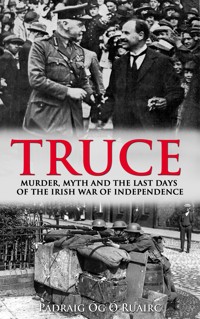
On 8 July 1921 a Truce between the IRA and British forces in Ireland was announced, to begin three days later. However, in those three days at least sixty people from both sides of the conflict were killed. In 'Truce', Pádraig Óg Ó Ruairc goes back to the facts to reveal what actually happened in those three bloody days, and why. •tWhat sparked Belfast's 'Bloody Sunday' in 1921, the worst bout of sectarian violence in Northern Ireland's troubled history? • Why were four unarmed British soldiers kidnapped and killed by the IRA in Cork just hours before the ceasefire began? •tWho murdered Margaret Keogh, a young Dublin rebel, in cold blood on her own doorstep? •tWere the last spies shot by the IRA really working for British intelligence or just the victims of anti-Protestant bigotry? This book answers these questions for the first time and separates fact from fiction to find out what really happened in the final battles between the IRA and the British forces.
Sie lesen das E-Book in den Legimi-Apps auf:
Seitenzahl: 619
Veröffentlichungsjahr: 2016
Das E-Book (TTS) können Sie hören im Abo „Legimi Premium” in Legimi-Apps auf:
Ähnliche



















MERCIER PRESS
3B Oak House, Bessboro Rd
Blackrock, Cork, Ireland.
www.mercierpress.ie
http://twitter.com/IrishPublisher
http://www.facebook.com/mercier.press
© Pádraig Óg Ó Ruairc, 2016
ISBN: 978 1 78117 385 5
Epub ISBN: 978 1 78117
Mobi ISBN: 978 1 78117
This eBook is copyright material and must not be copied, reproduced, transferred, distributed, leased, licensed or publicly performed or used in any way except as specifically permitted in writing by the publishers, as allowed under the terms and conditions under which it was purchased or as strictly permitted by applicable copyright law. Any unauthorised distribution or use of this text may be a direct infringement of the author’s and publisher’s rights and those responsible may be liable in law accordingly.
To my wife Anne Maria, meeting you was the best thing that ever happened to me.
Acknowledgements
First of all I wish to thank my PhD supervisor, Dr Ruán O’Donnell of the University of Limerick, for his confidence in me, support and assistance during the course of my studies. I also owe a great debt of gratitude to Dr John O’Callaghan of St Angela’s College for his invaluable help and advice during my research; Dr John Borgonovo of University College Cork, who has always been very generous in sharing his extensive knowledge and research on the 1916 period; Dr Fearghal McGarry of Queen’s University Belfast, who acted as external examiner for my PhD thesis; Dr Gavin Wilk, who was my PhD’s internal examiner; Dr William Mulligan of University College Dublin, who was very helpful in giving me direction when I called upon him as a former student; Dr Seán Gannon, who gave me a lot of help and sound practical advice; Dr Andy Bielenberg, who was often my first port of call whenever I got ‘stuck’ on a query relating to fatalities in Cork; Dr Philip McConway, who shared his knowledge and research on the conflict in the midlands; Dr Daithí Ó Corráin, who bore my unsolicited requests for information with good grace, even when they must have been an unwelcome imposition; Dr Gerard Noonan, who generously shared information from his then-unpublished thesis about IRA activity in Britain; Dr Brian Hanley, who gave me great assistance; Dr Tim Horgan, undoubtedly one of the finest historians that ‘the Kingdom’ has ever produced and whose wit and humour make every meeting memorable; Dr William Kautt and Commandant Sean A. Murphy (ret.), who gave advice on military matters; Dr Matthew Lewis, who advised me on the history of Armagh and south Down; Fr Brian Murphy, OSB, who was able to give me great insight into the political machinations of the era; John Dorney, a great man to discuss history with; Tommy Graham of History Ireland magazine; Las ‘Guns&Hoses’ and Donal ‘CHTM’ Fallon, the best father-and-son team in Irish history; Barry Keane, who helped me to understand the local geography of the Ellis Quarry killings; Liz Gillis, a hard-working historian who has a real passion for her subject; Liam Ó Duibhir, an expert on the history of Donegal, who was always willing to help; Donal O’Flynn, one of nature’s gentlemen, who has an encyclopedic knowledge of the 3rd West Cork Brigade area; my old pal Cyril Wall, who gave me great advice in my early endeavours; Jim McDermott and Kieran Glennon, two great Belfast historians without whose assistance I would never have been able to write the chapter on Belfast’s Bloody Sunday; Gary O’Brien, who gave vital assistance; Seán Enright, who provided a valuable insight into legal matters related to the Hague Conventions; Gerry White, an officer and a gentleman; Phil Flood, who did not bat an eyelid when I arrived on her doorstep unannounced asking awkward questions about the history of Kilcash; and Kathy Hegarty Thorne, for sharing her research on Roscommon. A special thanks also to the Sheehy family of Clonmeen House.
Thanks also to the staff of the Irish Military Archives, in particular Hugh and Noelle, who do a spectacular job and provide a top-class service; the staff of the British National Archives at Kew in London, whose thorough and efficient service make research there a pleasure; to a number of British military museums that gave me assistance, including The National Army Museum, the Argyll and Southern Highlanders Museum, the Keep Military Museum in Dorset, the Worchestershire Regimental Museum; and of course, to Ian Hook at the Essex Regimental Museum and Stanley C. Jenkins of the Soldiers of Oxfordshire Trust, who both went above and beyond the call of duty in their efforts to help me; also to Mike Maguire of the local studies section in Limerick City Library and his counterpart Peter Byrne in the Local Studies Centre in Ennis; and Sean O’Mahony and the 1916–21 Club in Dublin, who have always given valuable assistance and support to my endeavours; and to the members of the Meelick-Parteen and Cratloe Commemoration Committee (Johnny White, Councillor Cathal Crowe, Tom Gleeson, Éamon O’Halloran, Jody O’Connor, Ger Hickey and Pat McDonough), who have done incredible work in preserving the history of the IRA’s East Clare Brigade. Tom Toomey is an inspiration to me and a generation of younger historians – the people of Limerick are lucky to have such a talented scholar at work preserving and promoting their heritage.
To my work colleagues in the OPW, especially those in the Shannon region and Claremorris; William Butler, who is on the cusp of publishing a brilliant book; Michael Houlihan, a font of wisdom and encouragement; Dara Maken, a great friend and proprietor of Enniskerry Village Stores – the finest retail emporium in Ireland; Chris Coe, a loyal friend and an extraordinarily talented craftsman; Patrick Fleckenstein and Seán Patrick Donald, two Cape Veterans, of whom the Atlantic prevents me seeing more; Liam Hogan, my comrade in sedition; and Joe, Sham, Farrell, Larkin, Spud and O’Connell: I couldn’t have done this without you.
Des and Annette Long do unceasing work to keep the ‘spirit of ’16’ alive in Limerick; Criostoir de Baroid keeps the flag flying in Cork; Cormac Ó Comhraí, I have learned so much from you in the few years of our friendship – I hope some of your regular pupils realise how lucky they are to have such a talented and dedicated teacher; Dr Tomás Mac Conmara has never been given the credit he deserves for the outstanding work he has done to preserve Clare’s heritage; and Dr Billy Mag Fhloinn, I want to thank you for the years of help you have given me with so many different things.
A special thanks to my parents, Pat and Monica, for their financial assistance during my time at university, and to my sister Deirdre and my brother Kevin for their support.
Tomás – mo bhuachaill beag gealgháireach, sonas agus spreagadh nua i mho shaol agus Anne Maria, ar ndóigh.
1 Introduction
For decades, nationalist Ireland has told glorious stories of IRA flying columns beating the dastardly Black and Tans. In fact there were few flying columns and an awful lot of … murders … In [July] 1921, with the Truce just hours away, an RIC man named Alfred Needham, aged 20, clearly thought that finally he could marry his sweetheart. But a clerk in Ennis tipped off the IRA that the groom’s profession was ‘Constable’. So a beaming Alfred and his teenage bride emerged from the registry office and two gunmen shot him dead. Yet … this July our political classes will once again unite around the fiction that ‘the War of Independence’ was honourable and necessary and largely worthwhile.1
This is how newspaper columnist Kevin Myers described one of the last killings of the Irish War of Independence in an article in the Irish Independent marking the ninetieth anniversary of the Anglo-Irish Truce, which ended the war on 11 July 1921. Myers dismissed the IRA military campaign of 1919–21, which eventually led to the creation of an independent state in southern Ireland, as part of a ‘cycle of psychiatric futility’. Furthermore, he claimed that the ‘murder’ of Alfred Needham exposed as a fiction the concept of the War of Independence as a necessary and legitimate war.
Ironically, Myers’ account of Needham’s killing is almost entirely fictional. There was no wedding ceremony, no teenage bride and no clerk who tipped off the IRA. Needham, a Black and Tan from London, was shot standing at the door of a stable with two other armed members of the Royal Irish Constabulary (RIC) – not while leaving a registry office with his new bride. The tale about Needham being killed immediately after getting married appears to have been invented for melodramatic effect in a propaganda story. Yet different versions of this story continue to resurface every few years masquerading as factual history. Author Richard Abbott, an RUC officer who compiled a history of RIC casualties during the War of Independence, claimed that the IRA had attacked both Needham and his new bride after their wedding ceremony – killing him and hospitalising her.2 Eunan O’Halpin, Professor of Contemporary Irish History at Trinity College Dublin, stated in a recent television documentary that Needham had married in a church ceremony and was shot dead in front of his new bride just minutes after they had exchanged wedding vows.3 A common element in most of these accounts is the suggestion that the IRA Volunteers who killed Needham knew a ceasefire had been agreed with the British forces and that this was a motivating factor in the attack.
The stories about Needham’s wedding are part of a wider narrative about the War of Independence, which claims that the announcement of the Truce on 8 July 1921 led to a wave of unjustifiable ‘eleventh-hour’ IRA attacks before the ceasefire began. Supporters of this narrative claim that republicans launched a determined campaign to kill as many people as possible before the war ended and that these final IRA attacks were made mainly against so-called ‘soft targets’, i.e. unarmed members of the British forces and loyalist civilians. Some historians and commentators allege that attacks on ‘soft targets’ accounted for the bulk of IRA activity throughout the War of Independence, which they claim was more akin to terrorism than to a military campaign. It has also been asserted that Protestants were targeted as part of a sectarian campaign conducted by the IRA, and that such attacks intensified after the Truce was announced.
A number of stories similar to the one about Needham’s wedding are reproduced regularly in histories of the War of Independence to support the idea that the IRA exploited the declaration of the Truce as an opportunity for wanton violence. These include claims that:
• After the announcement of the Truce, the IRA killed up to a dozen alleged spies, most of whom were innocent Protestants with no connection to the British forces.
• Four teenage soldiers, mere boys who had left their post to visit a sweet shop, were abducted and murdered by the IRA for no apparent reason.
• Three Protestant boys were abducted, killed and secretly buried by the IRA in Cork city because of republican paranoia about spies.
• A devout Catholic serving in the RIC was shot dead by IRA gunmen while on his way to Mass on the morning of the ceasefire.
• The IRA in Kerry launched its only attack of the war, killing a soldier and an innocent young woman, just minutes before the Truce started.
• A Black and Tan strolling through a picturesque Wicklow village was murdered by republicans less than an hour after the ceasefire began.
Some of these stories have a grain of truth to them. Others are entirely fictional or are genuine killings taken out of context and with new details invented for propaganda value. For years, Irish and British authors writing about the War of Independence have accepted these stories as truthful, repeating and recycling them without question. Meanwhile the activities of the British forces in the same period have been ignored, with many authors unquestioningly accepting assurances that the British Army, RIC and Black and Tans all ceased hostilities the minute the Truce was announced, leaving the IRA as the sole protagonists in the final violent days of the conflict.
The allegation that the IRA callously took the announcement of the Truce as an opportunity to attack ‘soft targets’ was first employed as anti-republican propaganda in early accounts of the war written by British authors. The official history of the British Army’s 6th Division in Ireland, written in 1922, claimed the IRA exploited the declaration of the Truce as:
… an opportunity for attacking and murdering people when vigilance would obviously be relaxed, and if they could only postpone these murders to the last moment, the murderers could not possibly be punished. They carried out their programme to the letter. A private of the Machine Gun Corps was murdered on July 10th … four unarmed soldiers were kidnapped and murdered in Cork, and a patrol in Castleisland was ambushed, with results more disastrous to the rebels than even to the patrol itself; and finally, within fifteen minutes of the Truce, the inhabitants of Killarney, who had never summoned up courage to strike a blow for freedom during the progress of the war, attacked two sergeants of the Royal Fusiliers in the street, one of whom died. Thus was the Truce inaugurated.4
Walter Phillips, an English historian who published one of the first popular histories of the conflict in 1923, said: ‘the weekend before the coming of the Truce was one of the bloodiest on record in Ireland’. Phillips held the IRA solely responsible for this increase in violence and focused on the killings of off-duty soldiers and loyalist civilians.5 In his memoirs, published in 1924, General Nevil Macready, the former commander of the British forces in Ireland, contrasted the morality of the military campaigns waged by the rival forces in the final days and hours before the Truce began. According to Macready, British forces refrained from any hasty and unnecessary last-minute attacks, while the IRA intensified its military campaign through opportunistic killings:
The Truce would begin at 12 noon on 11th July, 1921, until which time the troops, while taking no risks, should abstain as far as possible from unnecessary activity against the rebels, who, far from imitating such chivalrous forbearance, continued their campaign of outrage and assassination until the clocks struck twelve on 11th July.6
Like Phillips, Macready cited attacks on the British forces, the killing of civilians and the destruction of the homes of loyalists as proof of an IRA ‘campaign of outrage’ prompted by the announcement of the Truce.7
Allegations that the IRA engaged in unjustified military operations in the dying hours of the conflict were not confined to British writers. This accusation became a core piece of anti-republican propaganda in the Irish Free State. During the Civil War both sides accused their opponents of cowardice, denouncing them as ‘eleventh-hour warriors’ and ‘Trucileers’, i.e. men who joined the IRA at the time of the Truce but who had played little or no part in the War of Independence. The military record of its various supporters and opponents often dominated the debates surrounding the acceptance of the Anglo-Irish Treaty.8 Free State propaganda defined republican opponents of the Anglo-Irish Treaty as ‘Johnny-come-latelys’ who ‘had never challenged Dublin Castle’ or ‘ever fired a shot against the British forces’. Furthermore they denounced the guerrilla tactics used by IRA ‘Trucileers’ and, with no sense of irony or hypocrisy, encouraged them to ‘fight fair’ even though the exact same guerrilla tactics had been employed during the War of Independence.9
In his 1924 book The Victory of Sinn Féin, the Free State polemicist P. S. O’Hegarty condemned the anti-Treaty IRA as ‘a terrorist army’ of ‘Tinpikemen’ that had shied away from danger during the War of Independence but who had sprung into action at the last moment: ‘all the young men in all the counties who had kept aloof of the fighting when it was dangerous were now eager to become heroes, and to be able to tell stories about this and that ambush’.10 Piaras Béaslaí, the former IRA director of publicity who wrote a biography of Michael Collins shortly after the Civil War, castigated the republican opponents of the Treaty, whom he dismissed as ‘Trucileers’:
A great many eleventh-hour warriors, in comparatively peaceful parts of the country, hastened to make up arrears by firing shots at the last moment, and there were attacks on the English forces up to within a few minutes of the Truce. These belated exhibitions of prowess, with no military objective, when the danger seemed past, reflected no credit on Irishmen.11
Many of the IRA units responsible for these operations later fought against acceptance of the Treaty, and Béaslaí’s comments are likely to have been influenced by his support for the Treaty and his experiences during the Civil War.
Abusive comments about ‘Trucileers’ were directed in particular against republicans in Kerry, where there had been limited IRA activity in the pre-Truce period but an increase in operations in the last days of the war. In October 1933, following a republican attack on a ‘Blueshirt’ rally in Tralee, Eoin O’Duffy, leader of the pro-Treaty Fine Gael party, taunted his political opponents in the county by declaring: ‘Kerry’s entire record in the Black and Tan struggle consisted in shooting an unfortunate soldier the day of the Truce. To hear such people shouting “Up the Republic” would make a dog sick.’12
Years later, a number of historians began repeating allegations that the IRA had exploited the announcement of the Truce to commit unjustified and morally questionable attacks, and over time this allegation became widely accepted as historical fact. In his book The Black and Tans, Richard Bennett claimed that there was ‘a wild flurry of activity’ by ‘Eleventh hour warriors of the IRA [who] hurried to get their last shots in’. Bennett cited the IRA execution of civilians suspected of spying and attacks on off-duty members of the British forces as proof of this. He claimed that these ‘eleventh-hour’ attacks were typical of the IRA’s military campaign, which had ‘relapsed into a moral anarchy unconnected with any political or social or practical end other than the muzzle of a gun’.13
Charles Townshend has claimed that the Truce was ‘preceded by one of the bloodiest weekends in the conflict, with the IRA killing some 20 people in the last 36 hours’.14 Joseph Curran attributed a propaganda and political motivation to the apparent escalation in IRA violence immediately before the ceasefire: ‘On July 8 Macready ordered his troops to abstain from unnecessary activity in view of the Truce agreement. The IRA, on the other hand, kept up its attacks until the last moment to demonstrate its capacity and willingness to carry on the fight.’15 Tim Pat Coogan claimed that the IRA committed ‘cold-blooded’ killings after the Truce’s announcement: ‘the IRA kept up the offensive to within minutes of that noontide. On some it had a galvanic effect. Knowing that retribution could not occur after the 11th, many literally eleventh-hour warriors now took the field’.16 Maryann Valiulis claimed that some bloodlust was to be found on both sides in the last days of the war, but suggested that the republicans were primarily responsible, having provoked British forces through a series of unjustified and gratuitous killings:
Neither side … would let the hostilities cease without one last burst of violence before the Truce came into effect. The IRA received word that the British forces would attempt one final action … The reason for the contemplated action by the British forces was that six soldiers were captured and shot on about 9 July 1921. In addition, records indicate that 11 spies were executed by the IRA just prior to the advent of the Truce.17
Peter Hart stated that local IRA units had advance knowledge of the Truce and this led to an increase in republican violence deliberately calculated to inflict fatalities on British forces and to kill loyalist civilians and other ‘soft targets’:
The first eleven days in July did bring a last-minute upsurge in political activity … this was partly a product of the impending Truce, allowing IRA units outside Dublin to wreak maximum havoc in the knowledge that they would soon be immune from retaliation … Civilian targets, in fact, offered the only remaining untapped market for IRA operations in early 1921, which guerrillas were already beginning to exploit when the Truce mercifully intervened.18
Hart further claimed that anti-Protestant violence perpetrated by the IRA increased continually until the Truce began on 11 July 1921.19 According to him, the IRA engaged in a spate of unwarranted killings after the ceasefire was announced: ‘many guerrilla units had made a point of killing as many enemies as possible up until the last minute (twenty people in the last thirty-six hours)’.20
More recently, Marie Coleman has suggested that IRA Volunteers who knew the Truce was imminent might have had a sectarian motive in launching last-minute attacks. Coleman cites the executions of the Pearson brothers, two Protestant farmers at Coolacrease, Co. Offaly, and suggests that their killers were motivated by ‘the desire of the hitherto inactive Offaly Brigade to record a success before the Truce’.21
Through frequent repetition, the claim that the announcement of the Truce led to a surge in unjustifiable ‘last-minute’ republican killings has effectively become part of the standard narrative of the War of Independence. Over time, this narrative has become more exaggerated and has been incorporated into an increasingly melodramatic, propagandistic and factually inaccurate history. This repetition and promotion has been part of a wider ideological debate about ‘revisionism’ in the academic study of Irish history and an ongoing political debate on the legitimacy of physical-force republicanism. The debate on these issues has been conducted in overtly political and moral terms in newspaper articles, and on radio and television, with politicians and polemicists such as Conor Cruise O’Brien featuring prominently.22
Newspaper columnist and political activist Eoghan Harris, a self-described anti-republican revisionist, has produced a number of television pieces and articles critical of the IRA’s conduct during the War of Independence, which allege that republican violence in that period had a strong sectarian intent. He has insisted that ‘the first duty of academic historians is to protect past victims of the IRA who no longer have a voice’.23 Harris has also made the specific claim that republican ‘bloodlust’ led to an increase in IRA violence after the announcement of the Truce.24
Kevin Myers has made similar claims in his newspaper columns, which regularly feature the War of Independence as a topic. He has frequently repeated the claim that the IRA exploited the announcement of the Truce as an opportunity to indulge in sectarian killings and attacks on ‘soft targets’. In The Irish Times, Myers alleged that: ‘The conference in the Mansion House in Dublin, where the details of the ceasefire were being hammered out, gave three days’ notice of the Truce. Those days were filled with bloodshed as killers embarked upon a once-in-a-lifetime Summer Sale of murder, guaranteed without legal consequence.’25 Claims by Myers and Harris cannot be treated with the same weight as serious historical research by academics, but the media in Ireland plays an important role in shaping perceptions of the conflict and opinion pieces by these commentators have helped to promote and expand the existing narrative of pre-Truce violence.
This book attempts to separate the fiction, myth and propaganda from the facts, and to establish what really happened from 8–11 July 1921 – to find out if there is any truth in the allegations, or if they are just made-up stories that have enjoyed an unnaturally long life. To date, almost all of the books and articles which claim that the announcement of the Truce led to a massive surge in violence have focused entirely on killings carried out by the IRA and ignored the actions of British forces in the last days of the conflict. This has resulted in a biased history of the last days of the conflict, in which those killed by the IRA are remembered as the victims of vengeful and futile militarism while those killed by the British forces are conveniently forgotten. Here, contemporary accounts from newspapers, military and police reports, testimony from Irish loyalists and eyewitness accounts from veterans of both the IRA and the British forces have been used to build up a detailed and accurate picture and to establish for the first time what really happened during the final days and hours of the Irish War of Independence.
2 The Political and Military Origins of the Truce
A huge volume of history has been written about the negotiations that led to the Anglo-Irish Treaty – but, in comparison, very little has been written about the peace talks that brought about the Truce which ended the War of Independence. Even after both sides had come to realise that a military cessation was necessary, there was a long and protracted debate between them about the form the ceasefire should take.
Republicans were keen to exact the maximum propaganda value from any agreement with the British and wanted to secure a formal, bilateral military armistice. Such an agreement would effectively bestow ‘belligerent status’ on the IRA, meaning that the British recognised them as lawful ‘combatants’ in a ‘legitimate’ army.1 It would also involve the British giving tacit political recognition to Dáil Éireann, the Irish republican government. The republicans were determined to ensure that any ceasefire would not involve any major concessions on their part, such as the surrender of IRA arms or the prosecution of wanted IRA leaders.
In contrast, the British aimed to force the IRA to accept an informal truce that imposed harsh military conditions and restrictions on the republicans. This would effectively amount to a military surrender by the IRA, and would deny Dáil Éireann, Sinn Féin and the IRA the propaganda coup and legitimacy they would win as parties to a formal agreement with the British government.
Many of the writers who have claimed that there was an upsurge in IRA violence just before the Truce have mistakenly attributed a degree of foresight to republican combatants that simply did not exist. Supporters of this account wrongly assumed that IRA Volunteers throughout Ireland knew well in advance that the Truce was coming, were motivated to kill as many of their enemies as possible before the war ended and had time to plan new attacks before the ceasefire began. Some of these writers also did not understand the terms and conditions of the Truce or the type of ceasefire it involved. A full understanding of the Truce, its form and political and military origins, is necessary before any attempt can be made to understand the violence that occurred after the ceasefire was announced, or to put those events in context.
The official position of the British government during the conflict was that the IRA was a ‘murder gang’ and that the republican insurrection was an illegal attempt by a criminal conspiracy to overthrow British rule through terrorism. Some members of the British government even believed that the IRA was the puppet of an international conspiracy, led by Bolshevik Russia, which sought to destroy the British Empire.2 Because members of the British government continually repeated this position in public, they could not openly encourage any contact or negotiations with Irish republicans. In 1918 the British cabinet insisted:
as a preliminary to proceeding with the Government policy … of the grant of self-government to Ireland, it was first necessary [to] restore respect for government, enforce the law and, above all, put down with a stern hand the Irish-German conspiracy which appears to be widespread in Ireland.3
In 1920 the British cabinet’s ‘Irish Situation Committee’ recommended:
no person … should in any circumstance be permitted to hold communication with Sinn Féin, except on the basis of the Government’s expressed policy, viz: the repression of crime and the determination to carry through the Government of Ireland Bill on its present main lines.4
Despite this hardline public stance, in private the British authorities maintained contact with members of Sinn Féin throughout the conflict in the hope of opening peace negotiations. In March 1920 Alfred Davies, a Conservative MP, wrote to Art O’Brien, Sinn Féin’s representative in London, stating that the majority of MPs favoured a political settlement for Ireland. Davies offered to arrange a meeting between the Sinn Féin leader, Arthur Griffith, and the British prime minister, David Lloyd George.5 In July of that year, Lord Curzon, the British foreign secretary, advised the British cabinet that ‘you must negotiate with Sinn Féin. We shall be driven to dominion Home Rule [in southern Ireland] sooner or later.’6
In the same month Sir Charles Russell, the English barrister and baronet, was approached by Lloyd George and asked to contact Sinn Féin to begin negotiations. Lloyd George indicated to Russell that a negotiated peace was possible on condition that it excluded Michael Collins and other members of the IRA leadership.7 Two months later a meeting was arranged in Dublin between Griffith and Sir John Anderson, the joint under-secretary for Ireland. The meeting was aborted at the last moment, apparently because Griffith insisted that the British would first have to recognise Dáil Éireann. Though disappointed by this outcome, Mark Sturgis, the most senior British civil servant in Dublin Castle, interpreted the development as evidence of a split among Irish republicans: ‘It looks as if the pressure on the quiet side of Sinn Féin to break away from the gunmen is increasing.’8 The attorney general was less optimistic: ‘the bad element in Sinn Féin would seize on any new statement made by the government [as a weakness] and any Sinn Feiners negotiating would be shot’.9
The first peace initiative to suggest a ceasefire between the opposing military forces came from General George Cockerill, a Conservative MP, who proposed in October 1920 that an immediate ceasefire between the IRA and the British forces should be arranged. Cockerill suggested that once this ceasefire began, Dáil Éireann would meet in public with British approval and political negotiations could begin.10 Responding to this call, Patrick Moylett, an Irish Republican Brotherhood (IRB) member and judge in the Sinn Féin courts, met Cockerill and a number of other influential British politicians, including C. J. Phillips, an official from the British Foreign Office, and Herbert Fisher, the Minister for Education.11 Despite being a member of Sinn Féin and an associate of Griffith, Moylett was acting on his own initiative.
Shortly after Moylett and Cockerill began these discussions, they took on a new sense of urgency when Terence MacSwiney, the republican mayor of Cork, died on hunger strike at Brixton Prison in England. Moylett was summoned immediately to Downing Street for an additional meeting with Phillips. Phillips proposed that the announcement of an immediate IRA ceasefire would lead to an informal truce between them and the British forces, allowing formal political negotiations to begin.12 Moylett forwarded this proposal to Griffith, who responded in writing with the following proposals:
(1) The Dáil Éireann should be allowed to meet on the distinct understanding that –
(a) Attacks on the police and soldiers instantly cease.
(b) At the meeting no reference be made to the existence of any ‘Irish Republic’. From the point of view of the British Government the meeting would merely be that of representatives of Ireland referred to by the Prime Minister in his speech in Parliament …
(2) The only ‘business’ of the meeting would be to receive and answer an invitation from the British Government to nominate representatives to a conference called by the British Government for a settlement of the whole Irish question. Sinn Féin’s idea of a conference is that it would consist of one or two members representing Ulster, one or two representing Sinn Féin and (say) five others representing England, Scotland, Wales and possibly the two Dominions specially interested in the Irish Question, viz., Canada and Australia.13
Whilst secret negotiations with Griffith continued in private, in public the British government engaged in a bout of sabre rattling. Lloyd George made a speech at the Guildhall in London stating: ‘We have murder by the throat, we had to reorganise the police. When the government was ready we struck the terrorists and now the terrorists are complaining of terror.’14 The hardline rhetoric coming from the British government and its public inflexibility frustrated Michael Collins, who asked: ‘I wonder what these people with their hypocritical good intentions and good wishes say to L. George’s speech yesterday? So much for the peace feelers.’15
The willingness of Moylett and Griffith to negotiate a ceasefire gave their British counterparts the impression that the republicans were ready to sue for peace at any cost, which may have influenced the triumphalist tone of the prime minister’s speech. It also convinced Phillips that British measures to crush the insurrection and restore order were bearing fruit. On 19 November he wrote to Lloyd George:
I got a very clear impression … that the Sinn Féin leaders realise quite well the hopelessness of their attempts to carry on the struggle on present lines and are seeking a plan by which they may at the same time end the present crisis, save their own faces as far as possible and checkmate the extremist section among their followers.16
Within days of Phillips’ letter, the IRA scored a series of decisive victories that completely undermined this impression.
In a wave of co-ordinated attacks on Sunday 21 November 1920, the IRA’s Dublin Brigade killed twelve suspected British intelligence agents and two members of the RIC Auxiliary Division.17 A few hours later members of the British forces took their revenge by attacking spectators at a Gaelic football match in Croke Park, killing fourteen civilians. That night, members of the RIC Auxiliary Division at Dublin Castle killed two senior IRA officers and a civilian.18According to Moylett, the day that became known as Bloody Sunday gave a new impetus to the negotiations: ‘The week following the 21st November I had conferences every day with Phillips. That week … I spent every day in Downing St and we discussed the question of a settlement in detail from every angle.’ Phillips assured Moylett that if Dáil Éireann used its influence to get the IRA to suspend their military campaign for a week, it would enable Lloyd George to propose a peace settlement in the House of Commons.19
Moylett assured the British that Dáil Éireann could secure a week-long IRA ceasefire. In return he sought a commitment from the British that the Black and Tans and RIC Auxiliaries would be confined to barracks once the cessation began. The proposed truce was intended as a temporary, informal arrangement to facilitate political negotiations.20 However, efforts to secure a truce were soon frustrated by the arrest of Griffith and another Sinn Féin TD, Eoin MacNeill.21 A further complication emerged when the British insisted that leading members of the IRA would not be immune from prosecution during the ceasefire. ‘They wished to exempt Mick Collins, Dan Breen and one or two others. The truce would not cover these men, meaning that they were reserved for subsequent prosecution.’ Moylett’s talks with the British faltered on this issue, and his peace initiative fell apart soon after.22
On 28 November 1920 the Cork No. 3 Brigade IRA ambushed a patrol of RIC Auxiliaries at Kilmichael, killing sixteen members of the patrol. A seventeenth Auxiliary initially escaped but was captured and killed shortly afterwards.23 The IRA victory at Kilmichael was an unprecedented development that came as a great shock to the British government.24 Apart from the large number of fatalities, the fact that sixteen of the dead were ex-military officers from England and Scotland had an additional impact in Britain, because before Kilmichael the majority of ‘British’ fatalities in Ireland had been Irish RIC constables. Lloyd George observed, ‘The last attack of the rebels seemed … to partake of a different character from the preceding operations. The others were assassinations. This last was a military operation.’25 By coincidence, on the same date as the Kilmichael ambush, the IRA carried out co-ordinated acts of industrial sabotage in several British cities. In Liverpool and Bootle alone, IRA operations caused £250,000 worth of damage.26 The British public and press feared these attacks were the start of an IRA campaign in Britain.
Bloody Sunday, Kilmichael and the campaign of sabotage in England generated significant press coverage in the British media.27 The unprecedented scale of these attacks, coupled with the state funerals at Westminster Abbey of six British officers killed on Bloody Sunday, ensured that the IRA’s military campaign made front-page newspaper headlines all over Britain. Mark Sturgis, who was in London at the time, was struck by the public reaction:
One thing is very sure. We can no longer complain of lack of interest on this side … Liverpool and the murders have made a tremendous difference in the tone. Everyone is talking of Shin [Féin] murder plots and the press is unanimous as far as I have seen it. Even The Times wishes us God speed in smashing the murder gang.28
These dramatic events were followed immediately by a profusion of new attempts to secure a truce.
Some Sinn Féin politicians were disturbed by the violence of the IRA’s military campaign, the most prominent being Roger Sweetman, Sinn Féin TD for North Wexford. In the immediate aftermath of Bloody Sunday and Kilmichael, Sweetman wrote to several newspapers appealing for an IRA ceasefire.29 He expressed serious reservations about the morality of the use of military force by republicans, and his attempts to arrange a ceasefire appear to have been based on a moral objection to the growing intensity of the IRA’s military campaign. Sweetman’s appeal was made without the approval of Dáil Éireann or consultation with the IRA’s leadership, and had no prospect of success. Nonetheless, it was significant because it was the first time a TD had called publicly for an end to hostilities as a precursor to peace negotiations. Shortly afterwards Sweetman resigned as a TD in protest at the nature of the IRA’s continuing military campaign.30 The British government took notice of Sweetman’s appeal and Phillips questioned Moylett about it. Moylett and others in Sinn Féin regarded Sweetman’s appeal as premature, damaging and counter-productive.31
Following quickly after Sweetman’s appeal came the ‘Galway Peace Resolution’, tabled at a special meeting of Galway County Council on 3 December 1920. The meeting had been called to discuss the council’s finances. Because of the number of councillors wanted by the British forces, only six attended. Since a quorum of eight was not present, the meeting did not have the power to conduct any official council business.32 A discussion of the political situation in Ireland ensued among the assembled councillors, during which Councillor James Haverty, an IRA officer, read the following proposal for peace negotiations:33
That we, the members of Galway County Council, assembled on December 3, 1920, view with sorrow and grief the shootings, burnings, reprisals and counter-reprisals now taking place all over England and Ireland by armed forces of the British Empire on one hand and armed forces of the Irish Republic on the other. That we believe this unfortunate state of affairs is detrimental to the interests of both countries in such a crisis in world affairs. We, therefore, as adherents of Dáil Éireann, request that body to appoint three delegates to negotiate a truce.
We further request the British Government to appoint three more delegates who will have power to arrange a truce and preliminary terms of peace so that an end may be brought to the unfortunate strife by a peace honourable to both countries. That we consider the initiative lies with the British Government who should withdraw the ban on the meeting of Dáil Éireann for the purpose of appointing delegates. That we further consider that if either side refuses to accede to proposals such as these, the world will hold it responsible for any further shootings or burnings that may take place.34
Haverty’s proposal was widely reported in the national and international press.35 Reacting to these press reports, the acting chairwoman of the council, Alice Cashel, called a meeting of the full council to repudiate publicly Haverty’s proposal. However, she was arrested along with several other councillors who were on their way to that meeting.36 Regardless of its validity, the ‘Galway Peace Resolution’ resulted in swift condemnation from other republicans. Galway Councillor Pádraig Kilkelly approached the local IRA leadership, asking them to issue a statement denouncing the resolution and highlighting the fact that the majority of councillors were ‘on the run’ and had not supported Haverty’s motion.37 The IRA in Galway despairingly referred to it as ‘The White Feather Resolution’ and was anxious to take action to dispel the rumour that ‘Galway had been tamed’.38 When a copy of the resolution was circulated to Clare County Council, Michael Brennan, the council’s chairman and leader of the IRA’s East Clare Brigade, burned it in protest.39
Nonetheless, the British government was encouraged by events in Galway, interpreting them as further evidence of a growing split between republican ‘moderates’ and ‘gunmen’. A meeting of the British cabinet on 6 December described the ‘Galway Peace Resolution’ as ‘the first occasion on which a Sinn Féin County Council had condemned the Sinn Féin policy of murder and outrage’. Lloyd George sent a receptive, yet firm response to Haverty’s proposal, stating that negotiations could begin as soon as the IRA declared a ceasefire:
The first necessary preliminary to the re-establishment of normal conditions is that murder and crimes of violence shall cease. It is to that end that the efforts of the Irish executive have been constantly directed, and until it has been attained no progress can be made toward a political settlement.40
Those who supported the ‘Peace Resolution’ had no authority from Dáil Éireann to enter negotiations with the British. Nor did they have the necessary influence with the IRA to compel it to accept British demands for a unilateral ceasefire as a precursor to negotiations – so it is not surprising that the political manoeuvres that grew from the ‘Peace Resolution’ came to nothing.
Fr Michael O’Flanagan, who had been appointed ‘acting president’ of Sinn Féin after Griffith’s arrest, launched the next peace initiative. Shortly after the dramatic events in Galway, O’Flanagan sent a telegram to Lloyd George seeking terms: ‘You state you are willing to make peace at once without waiting till Christmas. Ireland is also willing to make peace. What first step do you propose?’41 Like Sweetman, O’Flanagan was acting on his own and held moral reservations about the IRA’s military campaign.42 However, his efforts met with more success, mainly because of his senior position within Sinn Féin and his willingness to compromise on what Phillips called ‘the full republican attitude’.43 O’Flanagan was one of the few republican separatists willing to countenance partition. He believed that Ulster unionists had excluded themselves from the Irish nation, and republicans could not ‘compel Antrim and Down to love us by force’. He believed that it would be hypocritical for Sinn Féin to condemn British coercion of Ireland while attempting to coerce the unionists of Ulster. Furthermore, O’Flanagan was also willing to consider a political settlement based on dominion status.44
While relatively few members of Sinn Féin and the IRA were willing to consider partition, many members of Sinn Féin at the time shared O’Flanagan’s attitude towards dominion status and were willing to compromise on the demand for a republic because many were separatists seeking Irish independence, rather than idealists committed to the philosophy and ideals of Irish republicanism.45
Because of O’Flanagan’s senior position within Sinn Féin, the British initially made the mistake of thinking he spoke with full authority and the power to negotiate as an official representative of the republican leadership. Sturgis noted with misguided optimism that O’Flanagan was ‘an accredited representative ready to speak as “the man on the bridge” from Dáil Éireann’.46 However, as time went on they developed doubts about the priest’s credentials, and in early 1921 Lloyd George told Sir John Anderson that O’Flanagan represented nobody but himself and that he must deal with someone ‘who could deliver the goods’. Consequently Anderson asked O’Flanagan to help him make direct contact with Éamon de Valera, leader of Sinn Féin and president of the Irish Republic, concerning negotiations.47
Michael Collins did not appreciate O’Flanagan’s efforts to secure an IRA ceasefire, considering them to be an unjustified intrusion imposing on the efforts of others who had greater prospects of success. He publicly condemned O’Flanagan’s efforts, saying: ‘We must not allow ourselves to be rushed by these foolish productions or foolish people, who are tumbling over themselves to talk about a truce, when there is no truce.’48 One contemporary recalled that Collins was extremely angry: ‘He was very wroth with Father O’Flanagan … He said, “That ruins things for us”, and he was not surprised when the negotiations broke down.’49Likewise, Collins told Jerry Ryan, an IRA officer from Tipperary, that the priest’s meddling had prevented a political settlement being reached: ‘only for Fr Flanagan [sic] and Galway County Council we would have a good settlement, but not a republic’.50
Despite the rash of peace initiatives that began in November 1920, the only endeavour that had a realistic prospect of success was that headed by Patrick Clune – the Archbishop of Perth.51 Clune had a personal interest in Irish affairs because RIC Auxiliaries had killed his nephew, Conor Clune, on Bloody Sunday.52 On 1 December the archbishop and his secretary, Rev. J. T. McMahon, met the British prime minister at the House of Commons. He recounted his experiences of conditions in Ireland where he had witnessed the aftermath of British reprisals, and Lloyd George asked him if he would go to Dublin and meet the leadership of Sinn Féin to arrange an IRA ceasefire as a precursor to political negotiations.53 The archbishop agreed, and Art O’Brien forwarded a letter written by him to Collins. Collins favoured a truce and wrote to Griffith on 2 December, stating: ‘My view is that a truce on the terms specified cannot possibly do us any harm. It appears to me that it is distinctly an advance.’54 Collins was willing to support a ceasefire provided the terms were favourable to the IRA: ‘It is too much to expect that Irish physical force could combat successfully English physical force for any length of time if the directors of the latter could get a free hand for ruthlessness’.55
Clune returned to Ireland, accompanied by Dr Fogarty, the Bishop of Killaloe, and held several meetings with Collins in Dublin. He made contact in Dublin Castle with Andy Cope, the assistant under-secretary for Ireland. Cope arranged for the clergymen to visit Griffith, MacNeill and Michael Staines, a Sinn Féin TD for Dublin, all of whom were prisoners in Mountjoy Gaol. Staines was the most militant of the republican leaders in Mountjoy. As well as being a TD and a judge in the Dáil Éireann courts, he was an IRA officer and a veteran of the 1916 Rising.56 Collins had told him that the archbishop was conducting truce negotiations with the endorsement of the IRA and would be visiting the prison to meet him. It is likely that Collins wanted Staines involved in the negotiations as a precaution against the possibility that Griffith and MacNeill would agree to conditions that would have been unacceptable to the IRA. Griffith also regarded Staines as the unofficial voice of the IRA rank and file during the negotiations. Staines recalled Griffith asking him, ‘What I want to know is what will the fighting men think about this?’ Staines replied, ‘the fighting men would be quite happy for a truce, provided there was no surrender of arms’.57
Bishop Fogarty recalled that the republican leaders in Mountjoy Gaol were initially receptive to the peace proposal: ‘We discussed the proposed truce, which Arthur Griffith welcomed with enthusiasm … Eoin MacNeill … was not so impressed, but was willing to accept it.’58 Fogarty also claimed that Cope was enthusiastic about the prospects for a ceasefire, describing them as ‘a splendid opportunity … for a final settlement’.59 Both Griffith and Collins were prepared to advise Dáil Éireann to support a truce, provided the terms and conditions attached to it were favourable to the IRA.60 Collins provided Clune with a general outline of the terms that would be acceptable to the republicans. These were based on a bilateral truce and a commitment that the entire republican government would be allowed to meet in public: ‘If it is understood that the acts of violence (attacks, counter-attacks, reprisals, arrests, pursuits) are called off on both sides, we are agreeable to issue the necessary instructions on our side, it being understood that the entire Dáil shall be free to meet and that its peaceful activities not be interfered with.’61
With the initial groundwork for negotiations laid, Clune returned to London with a proposal for both sides to agree to a month-long ceasefire. He had a meeting with Lloyd George on 8 December, but quickly realised that during his absence from London the ‘Galway Peace Resolution’ and O’Flanagan’s letter had changed the whole political situation and the British government’s attitude to negotiations. After meeting Clune, Lloyd George held aloft Fr O’Flanagan’s telegram and a copy of the ‘Galway Peace Resolution’, proclaiming, ‘Dr Clune, this is the white feather and we are going to make these fellows surrender!’62 Convinced that the republicans were desperate for a settlement, the British prime minister began to impose new demands during the peace negotiations. The British rejected the initial republican proposals delivered by Clune and insisted that TDs who were members of the IRA leadership, specifically Collins and Richard Mulcahy, could not attend the proposed public meeting of Dáil Éireann. Furthermore the British now demanded that the hierarchy of the Catholic Church and the Labour Party be involved in the peace talks.63 Next, Lloyd George introduced the demand that the IRA would have to surrender their arms as a condition of the ceasefire. Clune objected to this, knowing it would be unacceptable to the republicans.64 Having reached this impasse, the archbishop returned to Dublin to hold further discussions with the republican leaders in Mountjoy Gaol. Two days later Sir Hamar Greenwood publicly offered the Irish republicans an armistice in the House of Commons, on the condition that the IRA would first have to surrender its arms and turn over members of the republican leadership to the British.65
On 11 December the British cabinet met to discuss Clune’s request for a month-long ceasefire to facilitate negotiations and drafted the following response, which Sir John Anderson was to deliver to the archbishop in Dublin:
Such a request as you make would deserve earnest consideration of H.M. Government if it was made upon the authority of the constitutional representatives of Ireland. We have already stated that we are willing to facilitate a meeting of the Irish Parliamentary representatives for this or any other purpose likely to bring about an end of the present unhappy conditions. The cessation of murderous attacks upon the loyal servants of the Crown would immediately enable constitutional discussions to begin and peace to be restored …
1. All arms, ammunition, uniforms, explosives, in area under martial law to be surrendered to the Government.
2. All arms in the rest of Ireland to be handed over to the safe custody of Government, no distinction to be made between the rest of Ireland and Ulster.
3. Sinn Fein to order the cessation of all violence in return for which the government to stop reprisals and shop looting, raids, burnings, floggings, execution without court martial (not admitted) and people only to be executed after due court martial.
4. Sinn Fein M.P.s (except specific list) to be allowed to assemble.66
Rejecting the British government’s proposals as too punitive, Clune sent another telegram to London, again asking for a month-long truce that did not involve a surrender of IRA arms. During the cabinet discussion that followed, Lloyd George indicated that there had been a shift in public opinion and that the British government’s policies were winning the support of ‘the decent public in Ireland’, citing the Catholic bishop of Cork’s condemnation of IRA ambushes in support of this.67
Clune met Sturgis and Anderson to tell them that the republicans would not agree to a surrender of arms. Anderson encouraged Clune to persevere with his efforts, stating that even if the republicans would not surrender their arms, ‘an unofficial truce, a slacking off on both sides might be arranged’.68 The archbishop responded favourably to Anderson’s suggestion and stated that, if such a situation could be created over the Christmas period, it might induce the necessary conditions for a political settlement. Following his meeting with Anderson, Clune again returned to Mountjoy.69 Griffith rejected the proposals, stating that ‘there would be no surrender, no matter what frightfulness was used’.70
Lloyd George’s hardening attitude and his insistence on IRA disarmament as a precondition of the proposed truce had by this time damaged Collins’ interest in the peace negotiations, since he believed the British were taking advantage of the republicans’ willingness to negotiate. On 14 December Collins wrote to Griffith, emphasising that the British terms were entirely unacceptable and that it was preferable for the IRA to continue its military campaign rather than submit to punitive terms:
I am looking at it from an entirely utilitarian point of view. We have clearly demonstrated our willingness to have peace on honourable terms. Lloyd George insists on capitulation. Between them there is no mean; and it is only a waste of time continuing. It may make it appear that we are more anxious than they … Let Lloyd George make no mistake – the IRA is not broken.71
Cope held another meeting with Clune on 17 December. This meeting coincided with a communiqué from London, which reiterated that ‘no truce is possible without disarmament’. Clune reported this to the republican leaders at Mountjoy, who again rejected this demand. Clune complained that the British government had ‘jumped a step’ and were laying down terms for a formal peace agreement while he was merely trying to arrange an informal military truce. The circular argument about the surrender of arms continued.72
On 21 December Clune had a meeting with Lloyd George and Andrew Bonar Law, the British Conservative leader, in London. The archbishop appealed to them to drop their demand for a surrender of IRA arms. Clune submitted to them the following proposals, drafted by Griffith and endorsed by Collins, which stated that if the British pledged to ensure their forces complied with the terms of the proposed truce, Dáil Éireann would give the same undertaking regarding the IRA:
The British Government undertakes that during the Truce, no raids, arrests, pursuits, burnings, shootings, lootings, demolitions, courts-martial or other acts of violence will be carried out by its forces, and there will be no enforcement of the terms of martial law proclamations. We on our side undertake to use all possible means to ensure that no acts whatever of violence will occur on our side during the period of the Truce.
The British Government, on their part, and we on ours, will use our best efforts to bring about the conditions above mentioned, with the object of creating an atmosphere favourable to the meeting together of the representatives of the Irish People, with a view to the bringing about of a permanent peace.73
On Christmas Eve Lloyd George informed the British cabinet that he had held further discussions with Clune, and the archbishop had informed him that Collins desired peace and was in earnest about a truce, but that the IRA would never surrender its arms. Clune had enquired whether this condition could be rescinded. In considering this proposal the British cabinet enquired about the current military situation in Ireland and were told that IRA arms had already been surrendered in some districts and that the British forces ‘had at last definitely established the upper hand’. Consequently, senior British military officers advised the British cabinet not to do anything that might upset this new favourable military situation. The cabinet decided not to change the demand for a surrender of IRA arms and reflected on whether ‘it would not be wiser to postpone any further approaches towards Sinn Fein until the Government of Ireland Act [scheduled for the summer of 1921] has been brought into operation’.74
Lloyd George’s private discussions with Clune went on, but the issue of IRA arms continued to be the main stumbling block. On 28 December Clune outlined his final proposals for a truce to begin on New Year’s Eve:
(1) Cessation of hostilities – acts of aggression and activities on both sides for the period of one month in order to create a peaceful atmosphere.
(2) The meeting of Dáil Éireann to discuss among themselves or with plenipotentiaries of the Government the final settlement of the Irish Question.75
Meanwhile, members of the British cabinet had further meetings with their military advisers to discuss the possibility of a truce. The British generals insisted they could crush the IRA within six weeks. Greenwood assured the prime minister: ‘The SF cause and organisation is breaking up. Clune and everyone else admits this … there is no need of hurry in settlement. We can in due course and on our own good terms settle this Irish Question for good.’76 Macready emphasised that there was a danger that an armistice would lead to a strengthening and reorganisation of the IRA. Sir Henry Wilson, chief of the Imperial General Staff, stated that a truce with the IRA ‘would be absolutely fatal’. While other members of the cabinet spoke in favour of a compromise, the majority supported a continuation of the war. Accepting these military assurances, the British government rejected the republican proposals for a truce.
On New Year’s Eve Lloyd George’s private secretary, Philip Kerr, citing the precedent of the surrender of arms by the Boers during the Second Boer War, informed Archbishop Clune that the surrender of arms by the IRA remained an essential precondition to any proposed truce.77 This brought an end to these negotiations, and the British cabinet did not seriously consider the prospect again until the cabinet meetings of late April and early May 1921.78
The Government of Ireland Act had been passed through the British parliament in December 1920. This was due to come into effect in May 1921, by which time it was envisaged that the ‘Ulster Question’ would be solved through partition and the creation of the new parliament of Northern Ireland, and that these measures would satisfy the Conservatives and the Ulster Unionist members of the British government. If this political situation was implemented successfully and the extremely optimistic predictions of the British government’s military advisers came to pass, then Lloyd George would have much greater freedom to negotiate with Sinn Féin concerning the future of ‘Southern Ireland’ by May 1921. This optimistic political and military forecast was undoubtedly a factor in the British decision to end negotiations. Lloyd George’s secretary spelled this out to Clune in late December 1920 when terminating the Truce negotiations, stating:
the [British] Government had come to the conclusion that it was better to see the thing through as was done in the American and South African wars unless meanwhile the Sinn Feiners surrender their arms and publicly announce the abandonment of violent measures: that the Government felt sanguine that the new Home Rule Bill when studied and understood would be worked, in fact they felt sanguine that within six months all would be working in harmony for Ireland …79
The negotiations came so close to success that one of the principal negotiators on the republican side, Michael Collins, told his comrade Liam Deasy that they ‘nearly had a truce’ but that General Macready had made this impossible.80 Herbert Asquith later described it as ‘the big missed opportunity’.81




