


2,99 €
Mehr erfahren.
- Herausgeber: Atlantic Books
- Kategorie: Geisteswissenschaft
- Sprache: Englisch
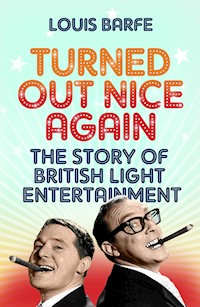
With a cast of thousands, including Peter Cook, Ken Dodd, Dusty Springfield, Spike Milligan, Rolf Harris, Bruce Forsyth and Reeves and Mortimer, Turned Out Nice Again reveals a world of comedians and cavorters, dancing girls and crooners. From the early days of vaudeville, via the golden age of radio, to live television spectaculars, the rise of the chat show and alternative comedy, Louis Barfe pulls back the curtain of variety to reveal the world of light entertainment in all its glory.
Das E-Book können Sie in Legimi-Apps oder einer beliebigen App lesen, die das folgende Format unterstützen:
Veröffentlichungsjahr: 2013
Ähnliche


















Turned Out Nice Again
First published in Great Britain in 2008 by Atlantic Books, an imprint of Grove Atlantic Ltd.
Copyright © Louis Barfe 2008
The moral right of Louis Barfe to be identified as the author of this work has been asserted by him in accordance with the Copyright, Designs and Patents Act of 1988.
All rights reserved. No part of this publication may be reproduced, stored in a retrieval system, or transmitted in any form or by any means, electronic, mechanical, photocopying, recording, or otherwise, without the prior permission of both the copyright owner and the above publisher of this book.
Every effort has been made to trace or contact all copyright holders. The publishers will be pleased to make good any omissions or rectify any mistakes brought to their attention at the earliest opportunity.
1 3 5 7 9 10 8 6 4 2
A CIP catalogue record for this book is available from the British Library.
ISBN 978 1 84354 380 0 eISBN 978 1 84887 757 3
Typeset by Ellipsis Books Limited, Glasgow Printed in Great Britain
Atlantic Books An imprint of Grove Atlantic Ltd Ormond House 26–27 Boswell Street London WC1N 3JZ
For Sir Bill, who was there, and for Susannah, Primrose and Lyttelton, who were here
Contents
List of Illustrations
Introduction
1 Empires, moguls and a man called Reith
2 A wizard time for all
3 Strictly commercial
4 ‘Albanie – douze points’
5 ‘Can you see what it is yet?’
6 Saturday night’s all right for fighting
7 My auntie’s got a Whistler
8 ‘Let’s get the network together’
9 Weekend world
10 Goodbye to all that
Notes
Bibliography
Index
Acknowledgements
List of Illustrations
Canterbury Hall. © Illustrated London News Ltd/Mary Evans Picture Library.
Dan Leno. Author’s collection.
The Co-Optomists. © BBC/Corbis.
Horace Percival and Tommy Handley. © BBC/Corbis.
The Windmill Girls. Mary Evans Picture Library.
Nude revue bill. Author’s collection.
The Goons. © BBC/Corbis.
Take It From Here rehearsal. Popperfoto/Getty Images.
Danny Kaye programme cover. Author’s collection.
Danny Kaye programme. Author’s collection.
Poster for The Crazy Gang’s Young in Heart. Author’s collection.
Poster for Billy Cotton’s band. Author’s collection.
Poster for Mike and Bernie Weinstein’s Showtime! Author’s collection.
Poster for Dickie Henderson’s Light Up the Town. Author’s collection.
The Albanian Eurovision delegation. Courtesy of Terry Henebery.
Ernest Maxin, Kathy Kirby, Bill Cotton Junior and Tom Sloan. BBC Photo Library/Referns.
That Was the Week That Was. Author’s collection.
The George Mitchell Minstrels. Author’s collection.
Dusty Springfield. Dezzo Hoffman/Rex Features.
Duke Ellington. David Redfern/Redferns.
Shirley Bassey and Tommy Trinder. Getty Images.
Bruce Forsyth and Sammy Davis Junior. Getty Images.
Rolf Harris. ITV/Rex Features.
Michael Parkinson and Harry Stoneham. Author’s collection.
Peter Cook and Dudley Moore. Author’s collection.
Eric Morecambe and Ernie Wise. Courtesy of Barry Fantoni.
The Comedians. Courtesy of Granada.
Les Dawson. Getty Images.
Lord Grade, Fozzie Bear and Frank Oz. Getty Images.
Jimmy Savile. Getty Images.
The Price is Right board game. Author’s collection.
Noel Edmonds and Mr Blobby. New Group/Rex Features.
Strictly Come Dancing. © Topfoto/PA.
Introduction
What is light entertainment? Over the years, the term has baffled even its most distinguished practitioners. Scriptwriter Denis Norden once noted the glee with which its detractors asked ‘whether “Light Entertainment” fell into the same insubstantial category as “Light Refreshments” and “Light Housework”’. Norden also recalled Eric Maschwitz – novelist, songwriter and a distinguished head of BBC Television’s LE department – ‘loath[ing] the term and . . . prowl[ing] his office in shirtsleeves and thin red braces enquiring “What is it meant to be the opposite of? Heavy Entertainment? Or Dark Entertainment?”’1
Although inextricably linked with television, the expression predates broadcasting. It first occurs in The Times in September 1796, in a review of a Haymarket Theatre production called A Peep Behind the Curtain. By the early twentieth century, it had come to describe the genteel, frothy productions that dominated the West End stage. In 1945, James Agate published an anthology of his theatre reviews called Immoment Toys: a survey of light entertainment on the London stage, 1920–1943.
In broadcasting terms, however, light entertainment is a development from the earthier productions of the variety theatre and music hall, and as radio and television have expanded and diversified, the concept of ‘variety’ has expanded and diversified too. In the forties and fifties, when television was growing up in public, it meant acts or ‘turns’: magicians; whistlers; light-opera singers; crooners; women who couldn’t sing very well, but had big knockers (one female singer’s bill matter was a coarse, leering ‘All this and four octaves!’); performing animals; animals whose unique selling point was their refusal to perform (dog owners will know that deadpan is not their natural tendency); and comedians who claimed to have a giraffe in a shoebox.
Since then, the broadcast definition of variety has expanded to include quiz shows, ‘people’ shows, chat shows and talent shows. In the sixties and seventies, television became the dominant force in entertaining the nation, and, before the fragmentation of audiences caused by home video and the advent of satellite television, an exceptional programme could capture and captivate half the UK population.
As a child growing up in the late seventies and early eighties, I absorbed it all. One of my earliest memories is of Tom O’Connor presenting Thames Television’s London Night Out, complete with the Name That Tune quiz segment. The Muppet Show, The Good Old Days and The Morecambe and Wise Show and anything featuring Les Dawson were required family viewing. The Royal Variety Performance and the Eurovision Song Contest were (and are) non-negotiable annual appointments to view. When Tommy Cooper took his final, fatal bow on Live From Her Majesty’s, I was watching the show with my great-grandmother, unsure of what had happened until the newsflash immediately after. Family holidays were spent in British seaside resorts where real live variety lived on in pier theatres – on one jaunt, when I was nine, I was taken to see Tommy Trinder doing his stand-up act, as well as Jimmy Edwards and Eric Sykes in the comic play Big Bad Mouse. Trinder addressed his audiences as ‘You lucky people’. It wasn’t until adulthood that I realized how lucky I’d been to see him and Edwards in action while I could.
As I moved from impressionable youngster to objectionable teenager, I turned my back on old-school entertainment in favour of rawer, more alternative fare. It was that period just after The Young Ones when Brucie and Tarby were being painted as, at best, cosy old farts gagging their way round the golf course, and, at worst, close friends of the common enemy, Mrs Thatcher. Bob Monkhouse was just a smarmy game show host, a fake-tanned snake oil salesman. One Christmas, a violent row blew up because I wanted to watch something dangerous and alternative, while the rest of my family wanted to watch Russ Abbot. Majority rule and family gerontocracy had their way, so I sat with them all, declaring Abbot to be about as funny as piles and determined not to laugh. I lasted about three minutes before cracking a smile. Now, on Christmas Day, I rue my posturing, there being vast stretches of tedium in the modern festive schedules during which I’d happily crawl across broken glass for a glimpse of Bella Emberg dressed as Wonder Woman.
By the early nineties, television had turned its back on the old-school entertainers, but in doing so revealed the alternatives to be the new establishment. Ben Elton was on the way to writing musicals with another common enemy, Andrew Lloyd-Webber. Stephen Fry was rapidly becoming the human equivalent of a much-loved listed building. Meanwhile, Bob Monkhouse showed his true colours as a clever, thoughtful man of comedy with an incendiary performance on Have I Got News For You, and a funny, and unexpectedly candid autobiography. At this point, I realized I’d been a fool. It’s perfectly possible to love both Adrian Edmondson and Bruce Forsyth. After all, what was Saturday Live if not Sunday Night at the London Palladium with knob and fart jokes?
Variety has been pronounced dead many times, but the truth is that the genre will never truly die. It just keeps evolving. What follows is the story of that evolution, from Victorian singalongs to the Saturday night spectaculars.
CHAPTER ONE
Empires, moguls and a man called Reith
The acme of light entertainment was reached between 8.55pm and 10pm on Christmas Day 1977, when 28 million viewers tuned into BBC1 to watch the Morecambe and Wise Christmas Show. From the opening spoof of US cop show Starsky and Hutch, to the closing sequence in which Elton John played the piano in an empty studio TC8 at BBC Television Centre, to be precise for Eric and Ernie dressed as the studio cleaners, over half the nation was present. Variety had come a long way in the century and a quarter since its birth.
The birth took place at the Canterbury Arms in Lambeth and, in time, Charles Morton, the Canterburys licensee, became known as the father of the halls. Morton, born in Hackney in 1819, had been in the pub business since his early twenties; he had been landlord of the Canterbury, situated just south of the River Thames between St Thomass Hospital and the railway line into the newly built Waterloo station, since December 1849. At his previous establishment in Pimlico, hed gained a reputation for providing good entertainment, mostly in the form of free and easies, harmonic meetings or sing-songs evenings where the drinkers, almost all of them male, would get up and give a song, accompanied on the pubs piano. He continued these attractions at the Canterbury, adding ladies evenings by popular demand, and their success was such that the taverns parlour soon proved inadequate.
Four skittle alleys at the rear of the public house were swept away to allow a suitable venue to be built, and on 17 May 1852, the Canterbury Hall opened its doors for the first time, allowing larger audiences to be accommodated. The bill was very much as it had been in the pub, with singers called forward by the chairman, accompanied on the grand piano and a harmonium on the stage. As important as the singing was the opportunity to enjoy a pipe, a glass of porter and convivial company. Such was the demand that by 1856, a bigger, better Canterbury Hall had to be built. Ingenious planning and construction allowed entertainment to continue uninterrupted through the building works. The new Canterbury was opened in its entirety on 21 December 1856. This was an age when pub design was ornate to the point of suffocation, and the second Canterbury took its cue from this tradition. It was noted for its architectural merits, and the general propriety and beauty of its decorations . . . the careful blending of colour; and the large amount of glass judiciously distributed about over the building imparts lightness and character to a room of more than ordinary dimensions . . . The customary evening attendance at this popular resort, we understand, extends to 1000 persons.1
In these early days, the bill consisted largely of songs, glees, madrigals, etc.2 with comedy very low on the bill. Influential as Morton was, he was not the first to use the name music hall. In November 1848, publican Richard Preece had renamed the Grand Harmonic Hall of the Grapes in Southwark Bridge Road the Surrey Music Hall. Then, in 1851, Edward Winder changed the name of the Mogul Saloon in Drury Lane to the Middlesex Music Hall. He was also preceded slightly by restaurants that laid on entertainment and invited musical contributions from diners; these were known as song and supper rooms and had sprung up from the 1830s onwards.
The first, and best known, of the song and supper rooms was at 43 King Street, which had once been a private house belonging to Sir Thomas Killigrew, founder of the Theatre Royal, Drury Lane. Since 1774, it had operated as a hotel, known as Joys, until it was taken over by W.C. Evans, comedian at the Covent Garden theatre. Known, rather pedantically, as Evanss (late Joys), it offered bed and breakfast at a guinea a week, and a table dhte at 6pm every day for just two shillings. A fine HAUNCH and NECK of VENISON ready this day said the advertisement in The Times the nosh being top of the bill. Almost as an afterthought, the ad explained that there was The Harmonic Meeting every evening as usual; Mr. Evans in the chair.3
The song and supper rooms were resolutely male, and a flavour of the resentment this must have caused at home can be found in Mr Caudle joins a club The Skylarks, written in 1845 for the then new humorous periodical Punch by Douglas Jerrold, who frequented Evanss:
How any decent man can go and spend his nights in a tavern . . . There was a time when you were as regular at your fireside as the kettle. That was when you were a decent man, and didnt go amongst Heaven knows who, drinking and smoking, and making what you think your jokes. I never heard any good come to a man who cared about jokes . . . The Skylarks, indeed! I suppose youll be buying a Little Warbler and at your time of life, be trying to sing . . . Nice habits men learn at clubs! Theres Joskins: he was a decent creature once, and now Im told he has more than once boxed his wifes ears . . . Going and sitting for four hours at a tavern! What men, unless they had their wives with them, can find to talk about, I cant think. No good, of course.4
The early manifestations of the Canterbury Hall bore no resemblance to a theatre. Their design was somewhere between a banqueting hall and a concert hall with a platform for performers at the end. There was no sign of a proscenium arch, boxes or a raked floor and for good reason. Music halls were not permitted to put on theatrical entertainment, and the Lord Chamberlains men were always on hand to make sure that the drama in the halls and taverns remained strictly off-stage.
A degree of liberalization finally occurred with the passing of the Theatres Regulation Act in 1843, which allowed places of entertainment to apply for theatrical licences, under the jurisdiction of the Lord Chamberlains office. Before 1843, only the theatre at Covent Garden, on the site of the present Royal Opera House, and the original Theatre Royal at Drury Lane were allowed to stage plays. Drury Lane had opened in 1663, just three years after the restoration of the monarchy, and even this limited provision was improvement on the times of Cromwell, when the playhouses were pulled down and actors branded as vagabonds.5 Unlicensed premises were allowed to present monologues, songs or ballets anything musical or involving a single dramatic performer seemed to be permissible but even a brief extract from a play was out of the question. Scripts (such as they were) of these performances evaded the Lord Chamberlains prim pencil, entertainment venues without a theatrical licence being instead controlled by the Disorderly Houses Act of 1751, a law originally intended to regulate brothels. With provision of public entertainment regarded as on a par with whoring, the idea of performers as disreputable individuals was sown early.
Lesen Sie weiter in der vollständigen Ausgabe!
Lesen Sie weiter in der vollständigen Ausgabe!
Lesen Sie weiter in der vollständigen Ausgabe!
Lesen Sie weiter in der vollständigen Ausgabe!
Lesen Sie weiter in der vollständigen Ausgabe!
Lesen Sie weiter in der vollständigen Ausgabe!
Lesen Sie weiter in der vollständigen Ausgabe!
Lesen Sie weiter in der vollständigen Ausgabe!
Lesen Sie weiter in der vollständigen Ausgabe!
Lesen Sie weiter in der vollständigen Ausgabe!
Lesen Sie weiter in der vollständigen Ausgabe!
Lesen Sie weiter in der vollständigen Ausgabe!
Lesen Sie weiter in der vollständigen Ausgabe!
Lesen Sie weiter in der vollständigen Ausgabe!




