


73,99 €
Mehr erfahren.
- Herausgeber: John Wiley & Sons
- Kategorie: Geisteswissenschaft
- Sprache: Englisch
TWO OXEN AHEAD
This revealing study of farming practices in societies around the Mediterranean draws out the valuable contribution that knowledge of recent practices can make to our understanding of husbandry in prehistoric and Greco-Roman times. It reflects increased academic interest in the formative influence of farming regimes on the societies they were designed to feed. The author’s intensive research took him to farming communities around the Mediterranean, where he recorded observational and interview data on differing farming strategies and practices, many of which can be traced back to classical antiquity or earlier.
The book documents these variables, through the annual chaîne opératoire (from ploughing and sowing to harvesting and threshing), interannual schemes of crop rotation and husbandry, and the generational cycle of household development. It traces the interdependence of these successive stages and explores how cultural tradition, ecological conditions, and access to resources shape variability in husbandry practice. Each chapter identifies ways in which heuristic use of data on recent farming can shed light on ancient practices and societies.
Sie lesen das E-Book in den Legimi-Apps auf:
Seitenzahl: 621
Veröffentlichungsjahr: 2014
Ähnliche




















Contents
Preface
Acknowledgments
1 Introduction: Mediterranean Farming between Longue Durée and Contingency
1.1 Fieldwork
1.2 Scales of Analysis
References
2 Working the Earth: Tillage and Sowing
2.1 Two-Oxen Households in Paliambela
2.2 Scratching a Living in the Hills of Messenia
2.3 Tillage Time and Sowing Season from Assiros to Asturias
2.4 Juggling with Seedcorn
2.5 Flexible Farmers
2.6 Ard, Hoe, and Scale of Cultivation
2.7 Tillage and Sowing in the Past
References
3 Harvest Time
3.1 Amorgos: From Field to Threshing Floor
3.2 When to Reap
3.3 What and How to Reap
3.4 After Reaping: Binding, Drying, and Transporting the Harvest
3.5 Who and How Many to Reap
3.6 Harvest Ceremonies
3.7 Reaping in the Past
References
4 Sorting the Wheat from the Chaff
4.1 Amorgos: On and After the Threshing Floor
4.2 Ways of Threshing
4.3 Ways of Winnowing and Coarse Sieving
4.4 Cleaning for Storage and Consumption
4.5 Storage
4.6 Consumption
4.7 Questions of Scale: Labor and Time Stress
4.8 Threshing Floor Customs
4.9 Crop Processing in the Past
References
5 Managing the Land: Coping with Failure and Planning for Success
5.1 Watching the Corn Grow
5.2 Planning for Success: Fallowing and Rotation
5.3 Planning for Success: Manuring
5.4 Planning for Success, Mitigating Failure: Irrigation
5.5 Averting Failure: Weeding
5.6 Crop Husbandry and Crop Yields
5.7 Crop Husbandry and Yields in the Past
References
6 Family Planning: Land, Labor, and Livestock
6.1 Clearance
6.2 Long-Term Improvement: Deep Tillage, Terracing, and Enclosure
6.3 Extending and Improving Cultivable Land: Drainage and Irrigation
6.4 Counting the Cost of Extension and Improvement
6.5 Subsistence and Cash Crops
6.6 Mixed Farming: Livestock
6.7 Labor, Land, and Livestock: The Domestic Cycle
6.8 Household and Community
6.9 Land, Labor, and Livestock in the Past
References
7 Homo agronomicus? Mediterranean Farming, Present and Past
7.1 Analogies for the Past: “Matters of Fact” and “Matters of Interest”
7.2 Cultural Reason
7.3 Environmental and Technological Constraints
7.4 Practical Reason: Costs, Benefits, and Knowledgeable Farmers
7.5 Ancient Farmers: Knowledgeable and Rational?
7.6 Farming in the Mediterranean: Analogy and Change
References
Glossary
Index
This edition first published 2014© 2014 Paul Halstead
Registered OfficeJohn Wiley & Sons, Ltd, The Atrium, Southern Gate, Chichester, West Sussex, PO19 8SQ, UK
Editorial Offices350 Main Street, Malden, MA 02148-5020, USA9600 Garsington Road, Oxford, OX4 2DQ, UKThe Atrium, Southern Gate, Chichester, West Sussex, PO19 8SQ, UK
For details of our global editorial offices, for customer services, and for information about how to apply for permission to reuse the copyright material in this book please see our website at www.wiley.com/wiley-blackwell.
The right of Paul Halstead to be identified as the author of this work has been asserted in accordance with the UK Copyright, Designs and Patents Act 1988.
All rights reserved. No part of this publication may be reproduced, stored in a retrieval system, or transmitted, in any form or by any means, electronic, mechanical, photocopying, recording or otherwise, except as permitted by the UK Copyright, Designs and Patents Act 1988, without the prior permission of the publisher.
Wiley also publishes its books in a variety of electronic formats. Some content that appears in print may not be available in electronic books.
Designations used by companies to distinguish their products are often claimed as trademarks. All brand names and product names used in this book are trade names, service marks, trademarks or registered trademarks of their respective owners. The publisher is not associated with any product or vendor mentioned in this book.
Limit of Liability/Disclaimer of Warranty: While the publisher and author have used their best efforts in preparing this book, they make no representations or warranties with respect to the accuracy or completeness of the contents of this book and specifically disclaim any implied warranties of merchantability or fitness for a particular purpose. It is sold on the understanding that the publisher is not engaged in rendering professional services and neither the publisher nor the author shall be liable for damages arising herefrom. If professional advice or other expert assistance is required, the services of a competent professional should be sought.
Library of Congress Cataloging-in-Publication Data
Halstead, Paul. Two oxen ahead : pre-mechanized farming in the Mediterranean / Paul Halstead. pages cm Includes bibliographical references and index.
ISBN 978-1-4051-9283-5 (hardback)1. Agriculture–Economic aspects–Mediterranean Region. 2. Farm management–Mediterranean Region. 3. Land use, Rural–Mediterranean Region. I. Title. HD2055.7.H35 2014 630.937–dc23
2013036924
A catalogue record for this book is available from the British Library.
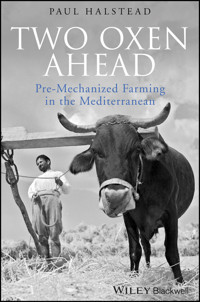
Cover image: Threshing with oxen in Crete, c. 1927–30, photograph by Nelly’s (Elli Souyioultzoglou-Seraidari) © Photographic Archive of the Benaki Museum, Athens.Cover design by Simon Levy
Preface
This is a study of how Mediterranean farmers grew crops and raised families before mechanization and industrialization. With the ultimate aim of enriching ancient historians’ and prehistorians’ understanding of Mediterranean farming societies in the distant past, it explores pattern and diversity in the practices and decision-making of twentieth-century premechanized farmers. Much of this book is based, therefore, on first-hand observation of and interviews with residents of the Mediterranean countryside (Chapter 1).
Anthropologists often disguise the identity of informants and host communities, but real toponyms are used here to place agricultural practices and decisions in their ecological and social context. Informants were not asked deeply personal questions, although some volunteered sensitive information about themselves or neighbors. Many would happily have been named in print, but most have been more or less anonymized, occasionally out of discretion, but mainly because it would be confusing to name them all. Those named are identified by first names, for brevity, and sometimes by pseudonyms to differentiate between homonymous neighbors. A few informants are named frequently, because they were important sources and to place what they said in the context of their particular circumstances or life history. Informants did not sign “informed consent” forms. Some, whom I had known for decades, would have treated any such request with disbelief. Others I met for the first time when I “interviewed” (i.e., talked with) them, and any invitation to sign a printed form would have ended our acquaintance before it began. A few were illiterate, some had failed eyesight, and several died before I thought of writing about what they told me. Informants often provided greatest insight when they strayed from the preplanned questions that a consent form would have covered. None of the information used was intentionally acquired by subterfuge.
Acknowledgments
To my largely elderly sources, named and unnamed, I am deeply indebted for generously sharing their time, knowledge, and, often, food and drink. In northern Greek Assiros, the barber, Fotis Alexiou, introduced customers by occupation (“current goat herder,” “retired pig farmer”), while my regular evening companion in the kafenío, Apostolis Papafotiou, invited to our table experts in whatever aspect of rural economy had caught my interest. Introductions were similarly provided in north Greek Paliambela and Kolindros by Yannis Stangidis; in central Greek Tharounia on Euboea by Giorgos Palogos (“Skantzouris’”); on southern Greek Kithira by Despina Isaakidou; on Crete by Stavros Amianakis, Gerald Cadogan, Angeliki Karagianni, Spiros Liapakis, Yannis Papadatos, Antonis Vasilakis, and Kostas Venianakis; in Tuscan Garfagnana by Mariangela Filippi; around Haute Provençal Sault by Jean-François Devaux; in Asturias by Valentina Palacios; and in Andalucian Zuheros by Leonor Peña-Chocarro. Companions in information gathering included Bill “ethnokafenologist” Alexander, Amy Bogaard, Artemis Brofidou, Mike Charles, Pat Collins, Jack Davis, Michele Forte, Angelos Gkotsinas, Eleni Hatzaki, Valasia Isaakidou, Glynis Jones, Ingrid Mainland, Vaso Tzevelekidi, Tony Wood, and, as infant passports to households closed to unaccompanied adults, Georgina and Huw Halstead. Directly or indirectly, the Arts and Humanities Research Council (and preceding AHRB), British Academy, Institute for Aegean Prehistory, Natural Environment Research Council, King’s College Cambridge, University of Cambridge Faculty of Classics, University of Cincinnati, and University of Sheffield funded fieldwork. The British School at Athens library, Gennadius Library (American School of Classical Studies at Athens), and Spoudastirio Laografias (Aristotle University of Thessaloniki) provided a wealth of Greek literature. Tina Badal, John Bennet, John Bintliff, Amy Bogaard, Cristina Fernandez Bustamante, Kostis Christakis, Michele Forte, Yannis Galanakis, Andy Garrard, Angelos Hadjikoumis, Debi Harlan, Eleni Hatzaki, Valasia Isaakidou, Kostas Kotsakis, Nancy Krahtopoulou, John Moreland, Mark Nesbitt, Gianna Siamidou, Christina Tsoraki, Duska Urem-Kotsou, and Todd Whitelaw shared unpublished information or published sources. Ferran Antolín, John Bennet, Amy Bogaard, and Valasia Isaakidou helpfully commented on draft chapters. Nikos Valasiadis provided the maps and Valasia Isaakidou some of the photographs.
1
Introduction
Mediterranean Farming between Longue Durée and Contingency
For the last 8000–10 000 years, the peoples of the Mediterranean have overwhelmingly subsisted on cultivated plants and domestic animals. Historians and archaeologists have studied ancient farming for insight into changing economy, society, and landscape, but available evidence has significant limitations. Literary sources assume much background knowledge and, to varying degrees, address moralizing or romantic content to elite readers. Iconography is selective and poses problems of distinguishing normal practice from rare innovations or fantasy. More mundane archaeological evidence (tools, seeds, bones) is potentially more representative and socially inclusive but provides ambiguous traces of many practices, a fragmentary picture of farming regimes, and at best circumstantial insight into why people farmed in particular ways. Scholars have drawn extensively on recent “traditional” (nonmechanized, preindustrial) farming, therefore, to infer uses of tools (e.g., Byzantine digging implements – Bryer, 1986), practices (e.g., Roman harvesting methods – Spurr, 1986), land-use regimes (e.g., Bronze Age cereal–olive–vine polyculture – Renfrew, 1972), or production parameters (e.g., area yields for classical Greek grain crops – Gallant, 1991) for which direct evidence is lacking or ambiguous and to identify likely rationales for documented practices (e.g., nonspecialized, classical Greek oil- and wine-processing facilities reflecting limited production for market – Foxhall, 2007).
Many accounts of traditional Mediterranean farming overgeneralize, however, or conversely highlight local customs, and few explore the balance between “practical” and “cultural” influence on methods. Moreover, detailed studies of particular aspects (e.g., tillage, reaping) may obscure the extent to which decisions shape outcomes and choices at subsequent stages of the agricultural cycle. The relevance of traditional farming to the past also requires critical consideration. Emphasis on relatively timeless constraints (e.g., Semple, 1932; Blanchard, 1945; Grigg, 1974; Braudel, 1975) of environment (e.g., low rainfall), technology (e.g., “primitive” wooden plows) and perhaps know-how (e.g., presumed ignorance of crop rotation) has encouraged uncritical extrapolation to antiquity. Traditional practice was highly variable, however, and demonstrably shaped also by medium-term historical contingencies (e.g., land tenure, markets – Silverman, 1968; Halstead, 1987; Forbes, 1993) and cultural preferences and by short-term tactical decision-making. These influences must be disentangled to enable judicious use of recent practices as analogies for the past.
This study attempts an overview of traditional Mediterranean farming practice and a critical evaluation of its potential to illuminate ancient farming. It explores what recent farmers did and how, why, and with what consequences. For reasons of space, it concentrates on staple Old World grain crops, dealing briefly with fruit, fiber, oil and vegetable crops (primarily where relevant to farmers’ overall cropping decisions and rotation practices), and livestock (primarily as aids to or beneficiaries of arable farming). Geographically, it focuses on Greece, with patchier coverage of the northwest and eastern Mediterranean to encompass greater ecological and cultural diversity; inclusion of upland Asturias on the Atlantic façade of northwest Spain, characterized by wet summers, offers a useful contrast with typically Mediterranean regions of mild, rainy winters and hot, dry summers.
Evidence is drawn partly from published agronomic, ethnographic, and folkloric studies but in large measure from firsthand observations and oral-historical accounts, because this makes accessible a substantial body of original information and facilitates contextualized exploration of farmers’ decisions. These observations and oral histories were collected over four decades in Spain, southern France, Italy, Cyprus, and especially Greece (Figure 1.1). Much of this information is a by-product of ethnoarchaeological projects, investigating whether particular farming practices leave distinctive material traces: crop processing in the Greek islands (Jones, 1984); irrigation in northern Spain (Jones et al., 1995); intensive “gardening” of pulses in central Greece (Jones et al., 1999) and cereals in Asturias (Charles et al., 2002); extensive einkorn growing in Provence; and woodland management in northwest Greece (Halstead and Tierney, 1998; Smith, 1998). Much has also been gathered during archaeological fieldwork in Greece, with subject matter depending on local land use, informants’ experiences, and my evolving interests.
1.1 Fieldwork
Many interviewees expressed delight at finding someone interested in their experiences. A farmer on the Greek island of Amorgos solicited questions to prolong breaks in the kafenío, while his son sweated on the threshing floor. One May in Khionades on the mountainous Greek–Albanian border, a blind woman of 85 initiated conversation from behind closed shutters. She had outlived her husband, siblings, and children and, other than periodic shouted exchanges with a housebound neighbor, I was her first social contact since the previous summer. In northern Greek Assiros, the neighborhood grandmothers regularly invited me for morning coffee, entertaining me (and themselves) with half-forgotten dialect words and customs or embarrassing stories about male villagers. Conversely, some individuals were reluctant to recall grinding poverty or civil war. Others were wary of a stranger but perhaps relented on seeing friendly exchanges with neighbors. As an outsider, being foreign was sometimes advantageous in that curiosity was attributed to eccentricity or ignorance rather than official snooping. Once, mention of an émigré mutual acquaintance, who had not written home for months, proved difficult, but normally introductions from an insider greatly eased information gathering. Frustratingly, women carers occasionally limited access to housebound individuals, out of embarrassment for their decrepitude, misplaced concern that they would bore me, or fear of their revealing family secrets – often already heard from neighbors.
Figure 1.1 Map of Mediterranean Europe, showing locations described by informants. Key: 1. Zureda, 2. Tiós, 3. Xomezana, 4. Carraluz, 5. Piñera, 6. Llanos de Somerón, 7. Ambel, 8. Borja, 9. Zuheros, 10. Mollans-sur-Ouvèze, 11. Brantes, 12. Sault, 13. Piazza al Serchio, 14. Castiglione di Garfagnana, 15. Casalattico, 16. Monforte, 17. Gerakies, 18. Kouklia, 19. Neo Sidirokhori, 20. Prasinada, 21. Mouries, 22. Lazarades, 23. Skafi, 24. Assiros, 25. Mavrorakhi, 26. Kastania, 27. Kolindros, 28. Paliambela, 29. Aiginio, 30. Kitros, 31. Nea Trapezounta, 32. Agia Paraskevi, 33. Aetomilitsa, 34. Fourka, 35. Khionades, 36. Likorakhi, 37. Pigi, 38. Plikati, 39. Agios Minas, 40. Aristi, 41. Dikorfo, 42. Mavrovouni, 43. Ligopsa, 44. Zitsa, 45. Metsovo, 46. Kipourio, 47. Kranea, 48. Kanalia, 49. Prodromos, 50. Sesklo, 51. Vizitsa, 52. Zoodokhos Pigi, 53. Manikia, 54. Tharounia, 55. Markopoulo, 56. Arkhaia Nemea, 57. Dervenakia, 58. Methana, 59. Mikines, 60. Karitaina, 61. Asoutaina, 62. Iklaina, 63. Khora, 64. Kinigou, 65. Kontogoni, 66. Korifasio, 67. Makraina, 68. Metaxada, 69. Milioti, 70. Palaio Loutro, 71. Potamia, 72. Tragana, 73. Stoupa, 74. Aroniadika, 75. Frilingianika, 76. Kastrisianika, 77. Mitata, 78. Potamos, 79. Filoti, 80. Kourounokhori, 81. Melanes, 82. Potamia, 83. Kolofana, 84. Agia Semni, 85. Aloides, 86. Ano Asites, 87. Anogia, 88. Arkalokhori, 89. Arkhanes, 90. Kalo Khorio, 91. Knossos, 92. Miliarisi, 93. Skalani, 94. Pinakiano (Lasithi plateau), 95. Anatoli, 96. Mirtos, 97. Pakhia Ammos, 98. Stavrokhori, 99. Vasiliki, 100. Olimbos.
Ethnoarchaeological projects, involving systematic sampling of plant or animal specimens from fields, threshing floors, and barns, required completion of standardized questionnaires, but most “interviews” defied close control. In the mountains of northwest Greece, a Vlach herder and anthropologist’s father had firm ideas on note-taking (“that is important, write it down”). Some informants overestimated my interest in warfare (men) and miraculous icons (women), but often such lack of discipline proved invaluable, because my questions reflected the limits of my understanding and the most revealing “answers” were unsolicited.
The words of Mediterranean farmers, like those of academics, cannot be treated uncritically. Sometimes participant observation provided a check and, wherever possible, multiple oral sources were compared. Once, a recent interviewee reacted angrily to my asking his neighbor the same questions, but most informants seemingly attributed such behavior to slow learning. While conversations with one person at home were easiest to follow, group discussions, as with the old men outside the cobbler’s workshop in Assiros, revealed who embroidered their experiences – for dramatic effect or in a misguided attempt to be helpful. It was often clear from context whether answers were pessimistic (“life was hard in the old days”) or optimistic (“I had the best-fed and most powerful oxen in the village”), and generalizations were easier to evaluate when leavened with specific examples (“in 1934, when it did not rain from October 18 to March 18, we only harvested 20 loads of wheat”), the accuracy of which was often confirmed by other informants. A common response to questions, as Binford found among the Nunamiut, was “it depends” (Binford, 1978; also Forbes, 1992, 92), and the contingent nature of decisions and their outcomes accounts for many apparent discrepancies between informants. Thanks to the close interest that Mediterranean farmers take (for sound reasons – Section 7.4) in neighbors’ activities, informants could often identify differences of needs or means that might account for such discrepancies.
Given the rapid pace of technological, economic, political, and social change in the twentieth-century Mediterranean, it is essential to establish a chronological framework for oral histories – despite the tendency of elderly informants to use “recently,” “the year before last,” or even “the day before yesterday” to refer to events 50 or 60 years ago. A positive consequence of this logarithmic perception of time is that informants’ memories focus on adolescence and early adulthood rather than providing a pastiche of experiences throughout their lifetimes. Informants in their 90s and occasional centenarians thus provided vivid firsthand accounts of life near the beginning of the twentieth century, even if they could not remember breakfast on the day of interview. Indeed, one 90-year-old, close as a teenager to a centenarian grandfather, provided oral history reaching back in two steps to the early nineteenth century. The building of oral histories with time depth from informants of successive generations is invaluable in revealing how “traditional” agricultural practices have altered with changing circumstances. Fortunately, most informants distinguished readily between experiences as members of their parental household and subsequently as independent householders. Women especially linked experiences to the life cycles of close kin (“I was breast-feeding my son when we first harvested that field”) and could recall or calculate dates of births, marriages, and deaths. Men routinely recalled whether experiences pre- or postdated military service or work abroad. For both men and women, war and civil unrest provided indelible temporal signposts. Insofar as interviews could be stage managed, therefore, the first step was to establish a potted biography for the informant, identifying areas of firsthand expertise and events (marriage, military service) that could date experiences.
1.2 Scales of Analysis
Variability in traditional farming is explored in turn through the annual cycle of grain production, from tillage and sowing (Chapter 2) to harvest (Chapter 3) and processing for storage or consumption (Chapter 4); then the interannual cycle of practices such as crop rotation and manuring (Chapter 5); and finally the generational cycle of shifting balance between households’ consumption needs and available labor, land, and livestock (Chapter 6). Attention is drawn to how decisions on a generational and interannual scale inform those taken during the annual crop production cycle and how the latter shape choices at subsequent stages of this cycle. Diversity of practice is explored in terms of cultural “ways of doing” and practical adjustment to circumstances, the latter on timescales ranging from the timeless longue durée through the medium-term conjoncture to the short-term événement of Braudel (1975). Each chapter examines the contexts and consequences of alternative practices (e.g., tillage with hoe or plow, yoking of oxen or cows), offers order-of-magnitude estimates of costs and benefits (e.g., speed of tillage or reaping, fodder requirements of draft animals), and suggests how this information might shed light on ancient Mediterranean farming, drawing examples from the earliest Neolithic to Greco-Roman antiquity. Although largely dealing with very practical matters, much of this book is concerned with human decision-making. Chapter 7, therefore, discusses how traditional Mediterranean farmers acquired information and skills, how they made decisions, and the extent to which they were rational actors making predictable choices, before assessing the potential of traditional farming to provide relevant and illuminating analogies for the distant past. Because traditional farming was not timeless, the temptation will be resisted to write agricultural history just from recent analogy.
References
Binford, L.R. (1978) Nunamiut Ethnoarchaeology, Academic Press, New York.
Blanchard, R. (1945) Les Alpes occidentales 4: les préalpes françaises du sud, Grenoble & Paris, Arthaud.
Braudel, F. (1975) The Mediterranean and the Mediterranean World in the Age of Philip II, volume 1, Fontana, London.
Bryer, A. (1986) Byzantine agricultural implements: the evidence of medieval illustrations of Hesiod’s ‘Works and Days’. Annual of the British School at Athens, 81, 45–80.
Charles, M., Bogaard, A., Jones, G. et al. (2002) Towards the archaeobotanical identification of intensive cereal cultivation: present-day ecological investigation in the mountains of Asturias, northwest Spain. Vegetation History & Archaeobotany, 11, 133–142.
Forbes, H. (1992) The ethnoarchaeological approach to ancient Greek agriculture: olive cultivation as a case study, in Agriculture in Ancient Greece (ed. B. Wells), Swedish Institute at Athens, Stockholm, pp. 87–101.
Forbes, H. (1993) Ethnoarchaeology and the place of the olive in the economy of the southern Argolid, Greece, in La production du vin et de l’huile en Méditerranée (eds M.-C. Amouretti and J.-P. Brun), École française d’Athènes, Athens, pp. 213–226.
Foxhall, L. (2007) Olive Cultivation in Ancient Greece, Oxford University Press, Oxford.
Gallant, T.W. (1991) Risk and Survival in Ancient Greece, Polity Press, Cambridge.
Grigg, D.B. (1974) The Agricultural Systems of the World: An Evolutionary Approach, Cambridge University Press, Cambridge.
Halstead, P. (1987) Traditional and ancient rural economy in Mediterranean Europe: plus ça change? Journal of Hellenic Studies, 107, 77–87.
Halstead, P. and Tierney, J. (1998) Leafy hay: an ethnoarchaeological study in NW Greece. Environmental Archaeology, 1, 71–80.
Jones, G. (1984) Interpretation of archaeological plant remains: ethnographic models from Greece, in Plants and Ancient Man (eds W. van Zeist and W.A. Casparie), Balkema, Rotterdam, pp. 43–61.
Jones, G., Charles, M., Colledge, S., and Halstead, P. (1995) Towards the archaeobotanical recognition of winter-cereal irrigation: an investigation of modern weed ecology in northern Spain, in Res Archaeobotanicae – 9th Symposium IWGP (eds H. Kroll and R. Pasternak), Oetker-Voges, Kiel, pp. 49–68.
Jones, G., Bogaard, A., Halstead, P. et al. (1999) Identifying the intensity of crop husbandry practices on the basis of weed floras. Annual of the British School at Athens, 94, 167–89.
Renfrew, C. (1972) The Emergence of Civilisation: The Cyclades and the Aegean in the Third Millenniumbc, Methuen, London.
Semple, E.C. (1932) The Geography of the Mediterranean Region: Its Relation to Ancient History, Constable, London.
Silverman, S.F. (1968) Agricultural organization, social structure, and values in Italy: amoral familism reconsidered. American Anthropologist, 70, 1–20.
Smith, D. (1998) Beyond the barn beetles: difficulties in using some Coleoptera as indicators of stored fodder. Environmental Archaeology, 1, 63–70.
Spurr, M.S. (1986) Arable Cultivation in Roman Italy c.200B.C.–c.A.D. 100, Society for the Promotion of Roman Studies, London.
2
Working the Earth
Tillage and Sowing
“What does ‘farmer’ mean?” Alexis answered his own question: “two oxen ahead and one ox behind”; in Greek, vódhi (ox) symbolizes stupidity rather than strength. At 81, Alexis was lame and his sight failing. He no longer had draft animals and his tools gathered cobwebs in the barn, but he enjoyed reenacting his craft. He yoked virtual oxen to a wooden ard that “scratched” a furrow, rather than turning the soil like a modern plow, in the dirt road outside the barber’s shop in north Greek Assiros. He paced out a 10 m-wide strip for broadcast sowing, marked the edges by plowing a single furrow, and then walked up one edge and back down the other, pulling imaginary seed from a double bag on his shoulder and casting it 5 m towards the middle of the strip. From time to time, he reversed the bag on his shoulder to keep the weight of unsown grain balanced. Then, he walked up and down the middle of the strip, casting seed towards the edge. He maintained a steady rhythm by synchronizing hand movements with paces. “That’s how we ‘locals’ sowed.” Thracian refugees from European Turkey, who arrived in the 1920s, sowed by casting alternately left and right and, he reckoned, achieved less even coverage; he could identify “locals” and Thracians from afar by their sowing rhythm.
After stopping for a real cigarette, he plowed the strip to cover the seed before birds could rob it; migratory flocks of geese were a particular worry. He placed the iron share tip of the ard at the start of the first furrow. Then, with one hand steering the ard from behind and the other brandishing a goad that doubled as a spatula for scraping mud off the share, he trudged up and down the sown strip. As he walked, he called instructions to the oxen to keep straight and then turn at the end of the field, where he lifted the ard and positioned it to start the next furrow. He reckoned the oxen pulled the ard back and forth 15–25 times to cover over the 10 m-wide “sowing,” with furrows overlapping to avoid leaving untilled strips in which weeds would grow and compete with the crop. If the ground was heavy, he kept stopping to scrape mud off the share. “Next, if possible, you harrowed the field, but the animals were slow and the weather was a problem. We started plowing in October, as soon as the first rains softened the ground, but we could not work when the ground was wet and, by early December, frost often made the ground too hard.”
As dusk fell, Alexis pulled up a chair. “Then, from late January, when the weather allowed, we plowed the fallow fields.” Each year, half of the fields were sown with wheat and half left fallow. “We plowed the fallow in one direction and then a second time, after it had rained, crosswise. Before April or May, we plowed a third time, in the same direction as the first. If you had good animals, you plowed four or five times.” In March to May, some fallow fields were planted in summer crops (e.g., maize, sesame), and once these were harvested, the fields should be plowed again. The number of plowings grew as Alexis warmed to his theme. Other elderly villagers claimed that earlier generations had plowed nine times, citing a false folk etymology for niáma, the word used in many parts of Greece to denote tilled fallow or the first plowing of the fallow period. However exaggerated, these accounts underline the value placed on repeated plowing of fallow – echoed by the Cretan and Cypriot term for tilled fallow (kalourgiá, kalourká), which literally means “good working.”
Alexis’ reenactments were somewhat idealized – he had not been the most thorough farmer. Much of his performance is echoed, however, for sound practical reasons, in descriptions of ard plowing elsewhere in Greece (e.g., Loukopoulos, 1983, 182–183) and the wider Mediterranean (e.g., Palmer, 1998). The characteristic back–forth movement is necessary for effective tillage with an ard (Forbes, 1982, 215). A sowing strip about 10 m wide is widespread, as is the explanation that 5 m is a practicable distance over which to scatter seed and that throwing seed from both edges and perhaps also the middle achieves even broadcasting. The length of sowing strip is more variable but limited by size of field, strength of draft animals, and the need to cover seedcorn promptly; farmers feared not only robbing by birds but also interruption by rain or snow. At Anogia in highland Crete, a man had just sown a terrace far above the village and was plowing in the seed, with his pregnant wife behind breaking clods with a pick when she announced that her waters had broken. He helped her onto the donkey and told her, “hold tight [to the unborn baby!] and hurry”; he followed down the mountain as soon as he had covered the seed. Fear of interruption before the job was complete, coupled with the slowness of plow animals, strongly favored sowing small strips, enabling cropping decisions to be taken on a much smaller scale than with mechanized agriculture (Section 6.5).
Despite many common features in the tillage and sowing of fields for Old World cereals and pulses, there are also important variations in several interrelated aspects: the type of tool used for tillage and what (or who) provides the labor to operate it, how often and when the ground is tilled, and the method and timing of sowing. Some of this variability is found in Alexis’ Assiros and some further afield.
2.1 Two-Oxen Households in Paliambela
The lowland hamlet of Paliambela lies 45 km southwest of Assiros, below the town of Kolindros. The workforce of a Turkish agricultural estate occupied Lotzano, as it was then called, until the early twentieth century, when the area was incorporated within the Greek state and a syndicate from Kolindros bought the land. A few estate workers remained in Paliambela and were joined in 1922 by Thracian refugees from European Turkey. The Thracians had fled their homes temporarily a few years previously, but in 1922, knew they were leaving for good. “My father loaded my mother and us girls on the oxcart with the chickens, hand-mill, loom, cooking utensils, sickles, and two sacks of grain. Then, he emptied the remaining sacks, drained the wine barrels, and turned loose the rest of the animals. As we pulled away, one sack of grain fell off the cart.”
In Thrace, most of the refugees had been farmers with their own plow oxen. For the first few years in Paliambela, they were landless and several families shared the abandoned two-room houses of the estate workers. They survived by plowing and harvesting for “local” landowners and, once they accumulated some cash, by renting a few fields to cultivate on their own account. In the late 1920s, each family was allocated 3–4 ha of land, depending on the number of children. The more industrious households rented, and eventually bought, additional fields so that they cultivated up to 5–6 ha of autumn- or winter-sown cereals and pulses and perhaps 1–1.5 ha of summer crops (e.g., maize). Nikos, born in 1929, orders two glasses of tsípouro (the north Greek equivalent of Italian grappa) before filling in some details. “Our fathers all had a pair of oxen. With one good pair, you could not sow more than 50–60 strémmata (5–6 ha) of winter crops, because every field had to be plowed twice: after the first rains, to break the stubble, and then crosswise after sowing, to cover the seed. After that, to break clods and make the field level, we harrowed with a bundle of wild pear branches – it has very tough wood.” The Paliambela Thracians had too little land to sow only half of their fields every winter (as Alexis had done in Assiros). Fallowing was limited to the small area of summer crops, and most stubble fields were plowed only once, at the end of summer, before being sown again.
The Thracians used oxen for plowing and carting the harvest, whereas “locals” in Paliambela and many in Kolindros, perched on a hill, favored horses and mules for plowing as these served as pack animals on steep paths, carrying produce from distant fields and transporting merchandise over the hills to the town of Veria. Thracians and “locals” agreed that oxen plowed more thoroughly than horses or mules. Some “locals” also used oxen, but the refugees regarded a pair of oxen as a source of pride and, in their first years in Paliambela, these animals must have been the only material sign of their status as farmers. The first generation of Thracians maintained and, when necessary, replaced these costly assets, although initially they cannot have used them fully.
As Nikos’ generation entered their teens, surpluses produced with oxen enabled some purchases of additional fields. By the 1950s, however, those born in Paliambela were marrying and setting up separate households, leading to subdivision of landholdings. Nikos stayed with his father, to accumulate property for his sisters’ dowries, and continued plowing with oxen. Many of his contemporaries, starting independent households with only 1–2 ha of fields and lacking the cash to rent more, could not maintain oxen and started plowing with cows. Like horses and mules in Kolindros, draft cows had uses other than plowing – in this case, producing calves for sale to urban butchers. Mitsos, the oldest man in Paliambela, takes up the story over morning coffee. “My father plowed with oxen, big animals that he brought from Thrace. The older generation was proud of their oxen and they could really work. When I got married, I made up a lame pair of two little cows, thinking I could make money from the calves, but they could not do much work. I had to work them gently at the start of each season, until a callus formed on the neck where the yoke rubbed. It was the same with oxen, but they were stronger. They worked longer hours and plowed a bigger area; and the furrow went deeper and did a better job. The cows could not plow the heaviest soils, and some people only used them instead of oxen after tractors came in and could be hired for the difficult fields. Oxen also lasted longer, working until they were 12 or 15 years old, whereas cows were worn out by 10–12 or even younger.” Some of the oxen that came from Thrace in 1922 must have worked until they were over 20 years old, as Eleni and others of her age recall them around the village in the late 1930s.
Cows were less effective plow animals than oxen because they were smaller, less powerfully built, and sometimes worked while pregnant. Kostas, born in an oxcart en route to Paliambela, joins in: “we also worked them too young. Our fathers trained oxen from three or four years old, starting with pulling a cart – it is lighter work than plowing. They would not work them until they were four or five years old and strong. We sometimes worked the cows at two or three years because we had no other means of plowing.” Diet affected the strength of both oxen and cows. In Kolindros, landownership was far more uneven than among the Paliambela Thracians, and some farmers owned enough fields to leave half fallow each winter. One such was Iraklis, who in his youth plowed with oxen and horses. Once the winter crops were sown, Kolindros farmers with well-fed oxen plowed their fallow fields in late winter, then again in spring, and a third time in autumn to sow the following crop. Pasture is very poor in late winter, however, and poorer farmers, who could not spare much grain for fodder, had to delay plowing fallow fields until May, when the new grass had restored their draught cattle’s strength.
While some Kolindros inhabitants had enough land to practice biennial fallow or even leave large areas uncultivated, others owned a garden or small vineyard and few fields. They gathered every morning in the town square, armed with tools appropriate to the season, and waited to be hired for the day. I am nursing tsípouro to repel the mosquitoes, but Nikos says he is used to giving blood. As manual cultivators interest me, he calls over Vasilis, who married into Paliambela in the 1940s after growing up in Kolindros. “In spring we dug vineyards for other people. In summer we harvested. In winter we cleared new fields, but only when the weather was good. If it was raining or snowing, there was no paid work.” Vasilis’ father owned a 0.3 ha vineyard, from which he produced wine and tsípouro for sale, and 2.5 ha of fields. He had a donkey for transport but too few fields to support oxen or even cows for plowing. “We sowed three quarters of the fields with wheat and the rest with maize. We got someone with oxen or horses to plow the wheat fields, and repaid them in cash or kind – three days of manual labor for one day’s plowing. In spring, sometimes someone else plowed the maize field and we then dug and planted it, but sometimes we did the whole job by hand because we were rested after the winter break when we could not work. One spring, my father and I planted maize in a field here in Paliambela. It was not plowed and we took two weeks to dig it. In autumn, after months of hard labor digging and harvesting, we were too tired to cultivate the wheat fields by hand.” Nikos, who later bought Vasilis’ maize field, added that it measured 0.65 ha.
Nikos and the other Paliambela Thracians also had plentiful experience of digging fields with pick and mattock but supplementing rather than replacing the plow. Hand tools played a minor role in preparing fields for autumn sowing. “The oxen worked the fields well, but as a teenager I had to follow behind with a mattock, digging up the brambles that the plow did not dislodge.” Sometimes, the mattock or pick went ahead so that brambles or saplings would not hold up the plow. Fields sown in spring, however, were worked more thoroughly to destroy weeds, which would compete vigorously as the weather warmed up, and to retard evaporation of scarce moisture from the soil (cf. Forbes, 1976; 1982, 205, 436–438). While the male household head drove the plow team, women and older children followed behind, digging out weeds and breaking clods to create a clean and even seedbed (Figure 2.1). Such scenes can still be seen in upland areas, such as Asturias or the Pindos Mountains, during late spring sowing of maize and potatoes. For farmers of moderate means, like Nikos’ father, the area sown with summer crops depended on the number of household members fit enough for digging and hoeing. “We only sowed a few summer crops because the whole field had to be hoed after plowing and that was very hard work.” In the case of maize, further hoeing was needed once the young plants had become established. Wealthier farmers could plant more maize because they hired poor neighbors, like Vasilis and his father, for the hard labor.
Figure 2.1 Tillage for planting maize and potatoes at Plikati, northwest Greece. (a) Two mules pulling an ard. (b) Manual weeding and clod breaking follow a mule-drawn ard.
In both Kolindros and Paliambela, as throughout the Mediterranean, small gardens in backyards and in more distant locations with light tractable soils or accessible water produced onions, cabbages, salad plants, and so on for domestic consumption. They often contained a few rows of pulses (e.g., broad beans or peas, perhaps also grown as field crops) and in Asturias even small patches of spelt/emmer. Many such gardens were cultivated entirely by hand (hence the selection of light soils) because they are too small to maneuver a plow team (Figure 2.2). In Asturias, two experienced practitioners independently stated that they would yoke draft animals for half a day’s plowing (400 m2 – Section 2.6.1) but dig by hand plots half this size. A recent survey (Charles et al., 2002) found that plots up to 200 m2 were indeed tilled by hand, but some even smaller (conveniently long and thin) strips in open fields were plowed.
Figure 2.2 Manual cultivation of a vegetable garden at Plikati, northwest Greece.
2.2 Scratching a Living in the Hills of Messenia
Within living memory, use of the plow was also restricted in many hilly regions by natural obstacles. Metaxada in Messenia, southwest Greece, is now largely depopulated, and the surrounding slopes are extensively overgrown, but widespread traces of terracing and field boundaries are visible. Ilias, in his early 80s and too lame to negotiate the path down to the kafenío, welcomes visitors to his balcony overlooking the steep-sided valley where he has spent a lifetime herding goats and growing cereals, vines, and olives. Like Nikos in Paliambela, he learned to plow with his father’s oxen. “Those who produced only 500–1000 kg of wheat plowed with little cows. Big farmers, real husbandmen like my father, only plowed with oxen. They were big animals that scattered stones and bushes when we cleared new fields. If you stood next to one of these animals, you could not see someone standing on the other side. But they needed feeding to work at their best. Wealthy farmers fed their oxen all year round with oats, hay and straw, but the poorer ones left them, once the sowing was over, to graze prickly oaks [evergreen bushes] on the mountain. Even some cows were strong if they were well fed.”
Ilias plowed where possible, but digging with hand tools was necessary around rocks and near terrace edges; because of the width of the plow team, he could plow no closer to walls and boulders than perhaps half a meter. Working such slopes by hand was hard because the soil was full of stones. One day in 1950, Ilias and his brother with their young wives (they still maintained a joint household) were working on a stony high terrace. His sister-in-law cut her foot with the pick and started crying, in despair as much as pain. It seemed an opportune moment to suggest pooling their savings to buy land around the nearby town of Khora. “Do you want to dig with a mattock instead of a pick, and in soft earth?” The prospect of using a broad-bladed mattock, though by no means light work, persuaded his hobbling sister-in-law. Some households in Metaxada had too little land to maintain work animals and either hired a pair of oxen for an agreed amount of grain or exchanged two or three days of manual labor per day of plowing. In other hill villages, men and women of Ilias’ generation described cultivating fields with so many boulders that the plow was not used at all.
Compared with the gentle slopes round Paliambela, plowing was inevitably slower on the steep and stony fields of Metaxada because of repeated interruptions to negotiate boulders or move the team between terraces that accommodated only a few short furrows. In such terrain, areal measurement of landholdings is neither easy nor meaningful, and farmers are consistently less willing than their lowland counterparts to offer such figures; they often refer to days of plowing (e.g., Methana, Peloponnese (Forbes, 2000a, 348, n. 8); Kalo Khorio and Skalani, central Crete), days of sowing (e.g., Agia Paraskevi, Pindos Mountains), or quantities of seedcorn (e.g., Anogia, highland central Crete) rather than areas sown (cf. Petropoulos, 1952, 89–92). Nonetheless, it seems that significantly smaller areas of winter cereals and pulses were sown per pair of oxen at Metaxada than at Paliambela. The fields of Metaxada were divided into two alternating bands of winter cereals/pulses and fallow. In the fallow zone, the best fields were plowed twice in March and planted with maize, New World beans, or chickpeas, while the rest were grazed uncultivated. In autumn, the poorer fields were sown with barley or oats “on the face of the earth” and then plowed only once to cover the seed. “If you had strong animals, you plowed the [remaining] good fields once after the first rains and then, two weeks later, sowed wheat and plowed them a second time to cover the seed.” The two-week delay allowed weeds to appear and be destroyed by the second plowing. In fields too narrow for second plowing at right angles to the first, the furrows were aligned at a slight angle to reduce the chances of leaving ground untilled.
2.3 Tillage Time and Sowing Season from Assiros to Asturias
Despite Alexis’ normative performance, methods of tilling and sowing were very variable in Assiros, reflecting farmers’ variable circumstances. Assiros lies just north of the city of Thessaloniki. When Alexis was born in 1908, much of the arable land in the village was owned by a handful of Ottoman beys and cultivated by sharecroppers, often using oxen provided by the beys; these oxen were big and well fed, and the few villagers old enough to have seen them recalled their size and strength with admiration. Most of the remaining men of the village gained their livelihood by digging vegetable gardens on the outskirts of Thessaloniki or driving horse-drawn carts between the city and the towns of Serres and Nigrita. During the first two decades of the twentieth century, as the Ottoman Empire was dismembered, some of the more dynamic sharecropper households acquired substantial blocks of land from the departing beys and, in the late 1920s, land reform allocated smaller holdings of 3–5 ha to the rest of the community (Karakasidou, 1997, 164–169). Many in the latter category initially plowed by yoking a cow to that of a neighbor, later buying a horse to combine part-time farming with carting. Those with larger holdings (and, as in Paliambela, a few Thracian refugees) initially used oxen and later switched to horses. In 1940, when the Greek army mobilized the horses, rich farmers reverted to oxen, while their poorer neighbors used cows or buffalos and a few tried cultivating small areas of cereals by hand. Many Assiros elders thus had firsthand experience of several alternative means of tillage. By almost universal consent, oxen plowed more thoroughly than horses, but the latter were faster and more useful for carting. An enabling factor was the spread of iron plows designed for a single horse, which reduced the costs of equid traction.
Like all his neighbors old enough to have plowed with animals, Alexis emphasized the problems posed by weather during the autumn and spring sowing seasons. Around Assiros, there are both heavy and light soils, the former being more fertile but harder to work – especially when wet. Accordingly, farmers with access to both soil types, and also to strong work animals, prioritized sowing of heavy soils before repeated rainfall made them unworkable. “But, if it rained, we sowed light soils until wind dried out the heavy ones.” Alexis grew oats to feed two horses that carried grain to and from the family’s water mill in another village. As oats are undemanding and the quality of the harvest was not a vital concern, he sowed some oats directly onto the previous year’s wheat stubble, plowing the field only once to cover the seed. As well as increasing the area available for sowing, this relaxation of the “norm” of alternate-year fallowing extended the effective length of the autumn sowing season because stubble could be worked immediately after rain, whereas tilled fallow fields needed first to dry out a little. As soon as the first rains made the ground soft, therefore, Alexis sowed and plowed in oats on stubble until last year’s fallow plots were dry enough to start sowing the main wheat crop. When it rained again, he switched back to sowing oats on stubble until he could return to sowing wheat. Such tactics for making the most of the autumn tillage period were widespread. In Paliambela, Mitsos also sowed oats on stubble while aiming to plow his wheat and barley fields both before and after sowing, and in Haute Provence, einkorn was likewise sown on stubble (Duplessy et al., 1996, 55). In Metaxada, Ilias worked stony terraces on rainy days when his better fields were too sticky for access, and he too aimed to plow wheat fields more thoroughly than those sown with the less demanding and less valuable oats and barley. In Kinigou, another hill village nearby, fodder lupines were sown on unplowed stubble, and in some regions, sowing was begun even before the first rains (e.g., xirovolí (dry broadcasting) in Kouklia, southwest Cyprus).
One year, lack of rain delayed the start of sowing at Paliambela until St Nicholas’ Day, December 6. By this date, local farmers normally aimed to have finished sowing and, in neighboring Kolindros, the feast of Panagía Xespirítsa (Our Lady of the End of Sowing) on November 22 marked this aspiration (just as the feast of St George the Sower on November 3 signaled the start of sowing on Rhodes – Vrontis, 1938–1948, 111). At Assiros, Alexis also reckoned, with good weather, to finish sowing winter cereals before Christmas, again ideally before the end of November. By December, the cumulative effects of rain might make fields unworkable or overnight frosts might delay the start of plowing until late morning (to allow the ground to thaw). When sowing continued into January, there was a significant risk that heavy frosts would kill germinating wheat. “I remember one year, when the rains started late and I was still struggling to plow and sow the fields in March. With the frost, it was terrible, but I had no choice.” Normally, however, he devoted any good weather in January and February to plowing fallow fields and in March started sowing these with pulses, maize, and sesame. Alexis was a moderately large landowner, who at one stage cultivated more than 10 ha of fields, so putting himself under considerable time stress during the autumn–winter sowing season. A few villagers managed substantially larger holdings by employing farmhands and running several plow teams, while neighbors with a single plow team but fewer fields (up to, say, 5–7 ha) normally sowed both cereals and pulses before Christmas.
Uneven landownership and access to work animals thus affected the timing of tillage and sowing. The variable responses from Assiros regarding sowing dates of pulses, in particular, are paralleled widely in Greece. The New World beans (Phaseolus spp.) and Old World black-eyed bean (Vigna unguiculata) seem invariably to have been sown in spring, and chickpea (Cicer arietinum) was normally sown at the same time or slightly earlier. Lentil (Lens culinaris), bitter vetch (Vicia ervilia), broad bean (Vicia faba), pea (Pisum arvense), and several Lathyrus species, however, seem variously to have been sown in autumn–early winter or early spring, as also in ancient Greece (Theophrastus Enquiry into Plants 8.1.4) and twentieth-century AD Jordan (Palmer, 1998, 157). In Paliambela, Koula and Marika insist that peas and broad beans sown in spring had to be picked green – the onset of summer drought prevented them from ripening, but elsewhere both autumn- and spring-sown pulses are harvested dry. Another consideration is that whereas wheat was normally a staple and sometimes an important cash crop, these pulses were – quantitatively speaking – of secondary dietary and economic importance, and their date of sowing seems sometimes to have been adjusted to avoid scheduling conflicts. Similarly, in northeast Turkey, where macaroni wheat recently displaced emmer, small-scale sowing of the latter for locally consumed cracked wheat or bulgur is now delayed until spring (Hillman, 1981, 147–148).
The date of onset of winter conditions of course varies with latitude and altitude. After the end of November, farmers in Assiros could not rely on good plowing and sowing weather, but their counterparts in the low hills just to the north half-expected snow cover. The residents of Plikati, at 1200 m in the Pindos Mountains, faced an even more restricted sowing season. Only the month of October could be depended on for sowing the highest terraces, where the snow settled first, and these were sown before the lower fields around the village to make the most of this narrow window. As elsewhere in the Pindos, villagers sowed wheat, barley, oats, and rye in autumn, before the snow came, and then again in spring (March–April), before planting maize, potato, and Phaseolus bean summer crops. In the case of wheat, barley, and rye, at least, distinct fast-growing varieties (e.g., “two-month” or “three-month” wheat and barley) were sown in spring. The autumn varieties were more productive, and both autumn and spring varieties failed or yielded poorly when sown out of season. Lentil and bitter vetch too were variously sown in autumn or spring, though it is said that those sown in spring “did not grow [in years] when it did not rain.”
In the absence of scheduling conflicts, early sowing is normally favored, not only because wet or cold weather in midwinter may prevent tillage or reduce its thoroughness but also because a long growing season enhances yields. The former consideration exercises farmers especially in the northern Mediterranean and at higher altitudes, while the latter is critical further south, where rainfall during the winter–spring growing season is modest on average and very variable from year to year and rapidly gives way to summer drought. Early-sown crops benefit from relatively dependable winter precipitation, while late-sown crops are dependent on less reliable spring rainfall or, as they say in parts of Greece, “the early[-sown crop] is blessed by God, the late[-sown] by luck.” Italian folk wisdom is even clearer: “early sowing is rarely a mistake” (Spurr, 1986, 42). Probably for this reason, in the early twentieth century, the growing of separate spring varieties of wheat and barley seems to have been significantly less common in lowland Greece than in the Pindos, where the brevity of the autumn sowing season strongly encouraged this practice. “Three-month wheat? Here? This place is dry. Even the winter crops don’t grow if it doesn’t rain,” replied an octogenarian at Markopoulo in lowland Attica, central Greece. The same verdict was delivered at Anatoli in the dry southeast of Crete, but some central Cretan farmers sowed in March a little Martáki, descriptions of which suggest two-row barley (Hordeum vulgare ssp. distichum), because it produced whiter and lighter bread than the staple six-row barley (H. vulgare ssp. hexastichum) sown in autumn–early winter. This spring barley only grew on the better fields, however, in the fallow year when these had been plowed repeatedly “like chickpeas” and even then was more at the mercy of spring rainfall than its less desirable six-row counterpart. Other farmers saw their neighbors’ results with Martáki and did not try it themselves.
A distinctive ecological niche, in which spring-sown grain crops may, unlike Martáki, neither require intensive tillage nor risk water deficit late in the growing season, is the seasonally exposed margins of lakes and large rivers. In early nineteenth-century Thessaly, central Greece, Leake saw cereals sown in spring on the margins of Lake Karla when low water levels had ruined the fishing (Leake, 1967, 424). In 1974, the oldest residents of Kanalia, a village on the shore of Karla, recalled similar opportunism in 1895 when “three-month wheat” was broadcast without tillage on the dried-up bed of the lake; more modest falls in water level exposed reed beds rather than bare ground and could not be exploited. The floodplains of the larger rivers of northern Greece also posed problems. At Aiginio near the mouth of the Aliakmon, before the latter was canalized, New World beans and maize were sometimes sown in the alluvium left by retreating floodwaters. The spring (March–May) floods, fed by snowmelt in the mountains, were dependable, but their number and timing varied and renewed flooding sometimes swept away growing beans and maize. Earlier sowing of Old World cereals and pulses on this part of the floodplain was not worth attempting. Despite abundant moisture and rich soil requiring little or no tillage, therefore, the alluvial margins of Mediterranean lakes and rivers, without extensive drainage works, offer unreliable opportunities for spring sowing of most Old World grain crops (Section 5.1).
Within the main autumn–early winter season, the timing and order of sowing responded to several considerations. Even in semiarid areas, late sowing of the heavier fields entailed some risk that harvests would be poor in rainy winters because wet ground was inadequately tilled. On the dry Cycladic island of Amorgos, farmers tended to sow the productive flat fields, on which they primarily depended, before the lower-yielding and more risk-prone terraces. Conversely, at Kalo Khorio in the hills of central Crete, the poorer terraces were sown before the heavier fields to allow time after the first rains for weeds to appear on the latter and be eradicated by the plow that covered the seedcorn. Moreover, especially in semiarid areas, farmers have to balance the disadvantages of late sowing (a short growing season and low yields) against the risk that the first rains might suffice for seed to germinate but not for seedlings to become established. Accordingly, on Amorgos, inessential broad beans and fodder pulses (common vetch and grass pea) were sown in November, before staple barley and wheat (Halstead and Jones, 1989). Similarly, in Jordan, wheat is sown at the optimum time, with barley and pulses scheduled before and after (Palmer, 1998, 146).
While fodder crops may be sown early on inadequately tilled ground to lengthen the plowing season, cereals may also be sown early on fertile land to encourage vigorous growth for “early-bite” grazing or green fodder. In Assiros, owners of sheep flocks sowed barley (less commonly oats and occasionally wheat) for this purpose (khasíl) on plots that, thanks to heavy manuring, were easily worked as well as fertile. In Asturias, spelt/emmer to be cut as green fodder (alcacer) for cattle was sown as early as August. Conversely, sowing may be delayed by choice rather than scheduling conflicts. In Asturias, the sowing of spelt/emmer or pan (literally “bread”) for grain, now on a trivial scale and largely restricted to heavily manured infield plots, has recently shifted from November–December to December–January or even February, partly because of milder winters and partly to shorten the growing season and so reduce excessive crop growth and the risk of lodging (stem collapse). The same tactic was employed, albeit more selectively, in central Crete on the more fertile fields. In the same region, sowing of both chickpeas and Martáki spring barley was sometimes delayed to reduce the likelihood of heavy rain thereafter compacting the surface of the sown and plowed field and so making it difficult to harvest these short crops by uprooting. In the case of pulses eaten fresh, such as broad beans, sowing may also be staggered to ensure a longer season of green produce.
Finally, crops are sometimes sown late because an earlier sowing has failed (e.g., because severe frost has killed sprouting wheat). Common millet (Panicum miliaceum) can be sown very late in the growth cycle of the staple winter cereals and, being very small seeded, also requires little investment of seedcorn (also Spurr, 1986, 96–97). Alexis used to sow millet in April for fodder grain, broadcasting as little as 20–30 kg/ha – a tenth of the seedcorn normal for wheat or barley in Assiros. Occasionally, a farmer wishing to take advantage of actual or hoped-for early summer rainfall sowed millet here as late as June for cutting as green fodder. Tall Andonis did this in mid-June 1989, and although the field was very wet and so was plowed very poorly, a harvestable crop developed.
2.4 Juggling with Seedcorn
The amount of seedcorn used varies between crops. Alexis recited an old saying that advocated “sow broad bean upon broad bean [densely] and chickpeas with big gaps between [sparsely]” (koukkí apáno sto koukkí kai to revíth’ edó ki ekeí ). In Asturias, traditional advice is: “if you don’t want to leave the shop [if you want to keep buying staple grains], sow spelt thinly and maize thickly [so that both yield poorly].” Around Sault in Haute Provence, southeast France, einkorn is sown far more sparsely than bread wheat because it tillers more strongly – each germinating grain produces more shoots. For broadcast sowing of cereals, a rule of thumb repeated in different parts of Greece (e.g., Loukopoulos, 1983, 182, n. 2), and again attributed to past generations, is that there should be four to five grains in the hoofprint of an ox. Although practical application of this mnemonic is hard to imagine, the implied sowing rate of perhaps 150–250 kg/ha (assuming a 10–12 × 10–12 cm hoofprint and 1000 wheat grains/50 g (cf. Gill and Vear, 1966, 258)) falls within the range for broadcast wheat in northern Greece.




