


13,99 €
Mehr erfahren.
- Herausgeber: John Wiley & Sons
- Kategorie: Fachliteratur
- Sprache: Englisch
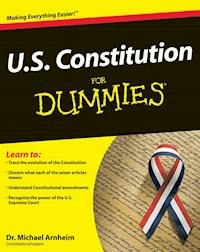
An in-depth look at the defining document of America Want to make sense of the U.S. Constitution? This plain-English guide walks you through this revered document, explaining how the articles and amendments came to be and how they have guided legislators, judges, and presidents and sparked ongoing debates. You'll understand all the big issues -- from separation of church and state to impeachment to civil rights -- that continue to affect Americans' daily lives. * Get started with Constitution basics -- explore the main concepts and their origins, the different approaches to interpretation, and how the document has changed over the past 200+ years * Know who has the power -- see how the public, the President, Congress, and the Supreme Court share in the ruling of America * Balance the branches of government -- discover what it means to be Commander in Chief, the functions of the House and Senate, and how Supreme Court justices are appointed * Break down the Bill of Rights -- from freedom of religion to the prohibition of "cruel and unusual punishments," understand what the first ten amendments mean * Make sense of the modifications -- see how amendments have reformed presidential elections, abolished slavery, given voting rights to women, and more Open the book and find: * The text of the Constitution and its ammendments * Discussion of controversial issues including the death penalty, abortion, and gay marriage * Why the word "democracy" doesn't appear in the Constitution * What the Electoral College is and how it elects a President * Details on recent Supreme Court decisions * The Founding Fathers' intentions for balancing power in Washington
Sie lesen das E-Book in den Legimi-Apps auf:
Seitenzahl: 683
Veröffentlichungsjahr: 2009
Ähnliche

















U.S. Constitution For Dummies®
Table of Contents
Introduction
About This Book
Conventions Used in This Book
What You’re Not To Read
How This Book is Organized
Part I: Exploring Constitutional Basics
Part II: We the People: How the United States Is Governed
Part III: Balancing the Branches of Government: The President, Congress, and the Judiciary
Part IV: The Bill of Rights: Specifying Rights through Amendments
Part V: Addressing Liberties and Modifying the Government: More Amendments
Part VI: The Part of Tens
Icons Used in This Book
Where To Go from Here
Part I: Exploring Constitutional Basics
Chapter 1: Constitutional Law: The Framework for Governance
Defining “Constitution”
Knowing When and Why the Constitution Was Created
ummarizing the Main Principles of the Constitution
dentifying Some Areas of Controversy
Chapter 2: Framing the U.S. Constitution: Big Thinkers, Big Thoughts
Building on Magna Carta
Respecting the Rule of Law (Or the Rule of Lawyers?)
Analyzing the Concepts Underlying the Declaration of Independence
Invoking the law of nature
Securing “unalienable Rights”
“Deriving their just powers from the consent of the governed”
Establishing a Republic
Getting rid of the king
Crafting the Articles of Confederation
Leaving democracy out of the U.S. Constitution
Chapter 3: Debating the Constitution
Listing Some Sources of Confusion
Discarding Out-Of-Date Ideas?
Untangling Ambiguities
Giving Some Important Principles the Silent Treatment
Interpreting the Constitution
Comparing interpretations of “cruel and unusual punishments”
Comparing interpretations of partial-birth abortion
Identifying methods of interpretation
Chapter 4: Introducing . . . the Constitution! The Preamble and the Seven Articles
Presenting the Preamble: “We the People . . .”
Article I: Setting up the Congress
Magnifying the commerce power
(Mis)interpreting the “necessary and proper” clause
Article II: Hailing the Chief
Listing presidential powers and duties
Identifying the real issues
A drafting boo-boo
Succeeding to the presidency
Article III: Understating Judicial Power
Article IV: Getting Along with the Neighbors — and Uncle Sam
Article V: Changing versus Amending the Constitution
Article VI: Fudging Federalism
Article VII: Ratifying the Constitution
Chapter 5: Amending versus Interpreting the Constitution: Taking Time for Change
Noting the Four Paths to an Amendment
Explaining What Happens in Practice
Listing the Amendments
Rating the Ratification of the Fourteenth Amendment
Reviving a Forgotten Amendment
Calling Time on an ERA
Reviewing Other Unratified Proposed Amendments
Debating the Need for Judge-Made Law
Reading a Right to Privacy into the Constitution
Using a sledgehammer to crack a nut: Griswold v. Connecticut
Disliking a law versus declaring it unconstitutional
Embarking on the road to Roe v. Wade
Part II: We the People: How the United States Is Governed
Chapter 6: Scrutinizing Sovereignty: Who Rules America?
Introducing “We the People”
Ordaining and establishing a Constitution
esolving to preserve democracy
Defining democracy
Testing for democracy today
Hailing the Chief
Congress: Flexing Its Lawmaking Muscle
The High Court: Saying What the Law Is
Giving the States Their Due
Uncovering Conspiracies
Chapter 7: Federalism: Forming One out of Many
Tracing the Origins of U.S. Federalism
Analyzing the founding documents
Forming “a more perfect Union”
Banking on McCulloch v. Maryland
Testing the limits of federal power
Realizing the repercussions
Navigating the Commerce Clause with John Marshall
Riding the Federalism Rollercoaster
Ignoring the Elephant in the Room: The Question of State Sovereignty
Defining sovereignty
Testing state sovereignty: Chisholm v. Georgia
Can a state secede from the union?
Dredging up the Articles of Confederation
Chapter 8: Separation of Powers: To Each His Own
No Moonlighting for the President
Keeping the Branches Apart
Membership
Functions
hecking and Balancing
Keeping each branch in line
Considering the judiciary’s special position
Chapter 9: Doing Business: The Commerce Clause
How the Commerce Clause Was Born
Interpreting the Commerce Clause
Hunting Down the Dormant Commerce Clause
Assuming Congress has exclusive power
Giving concurrent powers to the states
Poking holes in the Dormant Commerce Clause
Tracing the Changing Meaning of the Commerce Clause
Protecting freedom of contract
Introducing the Four Horsemen and the Three Musketeers
Signaling the feds’ control of the economy
Controlling the production of wheat that never left its home farm
Using the Commerce Clause to advance civil rights
Turning back the federal tide?
“Appropriating state police powers under the guise of regulating commerce”
Taking a step backward
Part III: Balancing the Branches of Government: The President, Congress, and the Judiciary
Chapter 10: Looking at the Role of Commander in Chief
Being “Eligible to the Office of President”
Picking a President
Paying the price for passing over political parties
Rescuing the situation with the Twelfth Amendment
Examining the modern electoral system
Exploding some myths about the Electoral College
Canning the President
Signing, Vetoing, and Pocketing Legislation
Appointing Key Positions
Hailing the Chief: The President’s Administration
ncovering the secrets of Cabinet secretaries
Unmasking the imperial presidency
Unlocking the Executive Office of the President
Selling the President’s legislative program
Battling Executive Privilege
Claiming executive privilege in the early days
Achieving a total blowout against President Nixon
Balancing recent claims of justice against executive privilege
Making War versus Declaring War
Controlling the President through the War Powers Act of 1973
Preventing presidential precedents?
Chapter 11: Giving Everyone a Voice: The House of Representatives and Senate
Making the Laws That Govern the Land
One function, two houses
Keeping the President in the loop
Visiting the People’s House
Representing the U.S. population
Respecting the power of the Speaker
Controlling the nation’s purse strings
Deciding disputed presidential elections
Impeaching the President and other civil officers
Declaring war
Getting to Know the Senate
Electing a senator
Presiding over the Senate
Advising and consenting
Passing Legislation
Tracking a bill’s progress
Examining congressional committees
Chapter 12: “During Good Behaviour”: The Judicial System
Examining the Courts’ Function
Defining jurisdiction
Applying the law
Appointments and Elections: Becoming a Judge
Judging the election process
Considering whether elections taint the judiciary
Understanding Judicial Independence without Accountability
Bypassing term limits and salary concerns
Grappling with issues the Constitution doesn’t address
Examining the abortion litmus test
Making the Judiciary Paramount: Judicial Review
Understanding the nature of judicial review
Tracing the origins of judicial review
Noting Jefferson’s response to Marbury v. Madison
Considering alternatives for solving Constitutional conflicts
Watching the Supreme Court’s power seep into politics
Casting the Swing Vote
Recalling “the switch in time that saved nine”
Wielding the swing vote under Rehnquist and Roberts
Labeling Supreme Court Justices
Conservative/liberal
Strict constructionism/living Constitution
Stare decisis/free exercise of power
Judicial activism/judicial restraint
Chapter 13: You’re Fired! Investigating the Impeachment Process
There’s Nothing Peachy about Impeachment
“High Crimes and Misdemeanors”: What Impeachment Is and Isn’t
Defining impeachment
Can you be impeached for something that isn’t a crime at all?
Tracking the Impeachment Process
Playing grand jury and prosecutor: The role of the House
Trying the articles of impeachment: The role of the Senate
Understanding the Implications of Impeachment
Impeaching isn’t the same as convicting
Keeping Congress out of the fray
Impeaching for poor private conduct
Pardoning is not an option
Impeachment in Action: Johnson, the Judges, and Clinton
Andrew Johnson: “Let them impeach and be damned”
Judging the judges
Bill Clinton: “I did not have sexual relations . . .”
Removing State Officials from Office
Impeaching governors
Total recall, or terminating a governor
Part IV: The Bill of Rights: Specifying Rights through Amendments
Chapter 14: The First Amendment: Freedom of Religion, Speech, and Assembly
Considering the Amendment’s Wording
Prohibiting Congress from taking away rights
Applying the amendment to the states
Separating Church and State
Guaranteeing the Free Exercise of Religion
Adopting a strict scrutiny test
Witnessing judicial gyrations: Jehovah’s Witnesses and the Supreme Court
Guaranteeing Freedom of Expression
Denying protection to speech creating a “clear and present danger”
Allowing obscenity to be seen?
Using and abusing the right to freedom of the press
Protecting the Right to Assemble and Petition
Chapter 15: The Second Amendment: Bearing Arms
Debating Interpretation: Individual versus State Rights
Breaking Down the Amendment’s Clauses
Understanding the states’ rights interpretation
Interpreting “the right of the people”
Upholding Individual Rights: D.C. v. Heller
Considering an earlier Supreme Court decision
Taking two sides on what Miller meant
Considering the Future of the Debate
Chapter 16: The Third and Fourth Amendments: Protecting Citizens from Government Forces
Keeping the Feds Out of Your House
Keeping the Government Off Your Back
Prohibiting “unreasonable searches and seizures”
Excluding evidence
Avoiding making “a crazy quilt of the Fourth Amendment”
Rewriting the Fourth Amendment
Defining “probable cause”
Prohibiting police fishing expeditions
Searching without a warrant?
Protecting America without a warrant?
Chapter 17: Taking the Fifth — and a Bit of the Fourteenth
Invoking the “Great Right” Against Self-Incrimination
Peeking Behind the Closed Doors of the Grand Jury
Deciding whether to indict
Victimizing suspects or protecting victims?
Avoiding Double Jeopardy
Applying the principle
Allowing for an end to litigation
Jeopardizing “life or limb”
Agonizing over Due Process
Trying to define the term
Triggering due process
Wrestling with substantive due process
Opening Up the Incorporation Debate
Does the Bill of Rights apply to the states?
Watching selective incorporation in action
Taking Private Property
Recognizing eminent domain
Losing protection
Chapter 18: Dealing with Justice and Individual Rights: The Sixth through Eighth Amendments
Outlining Defendants’ Rights in Criminal Prosecutions: The Sixth Amendment
Having the same rights in a state and federal trial
How speedy is a speedy trial?
Appreciating the need for a public trial
Guaranteeing trial by jury
Being “informed of the nature and cause of the accusation”
Confronting adverse witnesses
Compelling witnesses to attend
Demanding the right to counsel
Guaranteeing Jury Trials in Civil Suits: The Seventh Amendment
Prohibiting “Cruel and Unusual Punishments”: The Eighth Amendment
Banning excessive bail
Removing excessive fines
Barring “cruel and unusual punishments”
Debating the death penalty
Chapter 19: The Ninth and Tenth Amendments: Leaving Things Up to the People and States
Reading the Constitution: The Ninth Amendment
Considering the Tenth Amendment
Analyzing the wording
Balancing power between federal and state governments
Determining the limits of federal power
Puzzling over “prohibited” powers
Disentangling states’ rights from individual rights
Giving the Tenth Amendment its due
Part V: Addressing Liberties and Modifying the Government: More Amendments
Chapter 20: States’ Rights, Elections, and Slavery: The Eleventh through Thirteenth Amendments
The Eleventh Amendment: Asserting State Sovereign Immunity?
Overruling the Supreme Court
Interpreting the Eleventh Amendment
Cleaning Up the Framers’ Political Mess: The Twelfth Amendment
Electing the President: The original rules
Understanding politics 1796 style
Tying and vying with your running mate: The 1800 election
Preventing future chaos
Removing the Blot of Slavery: The Thirteenth Amendment
Tracking the debate on slavery
Sliding into secession
Considering the Corwin amendment
Graduating from emancipation to abolition
Introducing an entirely different thirteenth amendment
Chapter 21: The Fourteenth Amendment: Ensuring Equal Protection
Defining Citizenship
Understanding States’ Obligations
Disentangling state citizenship
Analyzing “privileges or immunities”
Achieving “Equal Justice Under Law” — Or Not
Age discrimination
Capital punishment
Racial segregation
School busing
Affirmative action
Gerrymandering
Apportioning Representatives
Recognizing proportionality 80 years too late?
Denying or abridging the right to vote
Disqualifying Confederates from Office
Repudiating Confederate Debts
Empowering Congress
Chapter 22: Starts, Stops, and Clarifications: Amendments since 1870
Removing Race Qualifications for Voting: The Fifteenth Amendment
Letting Uncle Sam Raid Your Piggy Bank: The Sixteenth Amendment
Electing the Senate: The Seventeenth Amendment
Outlawing Liquor: The Eighteenth Amendment
Giving Women the Vote: The Nineteenth Amendment
Moving Out of the Horse and Buggy Age: The Twentieth Amendment
Repealing Prohibition: The Twenty-First Amendment
Taking George Washington’s Lead: The Twenty-Second Amendment
Enfranchising the Nation’s Capital: The Twenty-Third Amendment
Banning Tax Barriers to Voting: The Twenty-Fourth Amendment
Succeeding to the Presidency: The Twenty-Fifth Amendment
Succeeding as President or Acting President?
Replacing the Veep
Acting as President
Lowering the Voting Age: The Twenty-Sixth Amendment
Limiting Congressional Pay Raises: The Twenty-Seventh Amendment
Part VI: The Part of Tens
Chapter 23: Ten Landmark Constitutional Cases
Marbury v. Madison (1803)
Brown v. Board of Education (1954)
Parents Involved in Community Schools v. Seattle School District No. 1 and Meredith v. Jefferson County Board of Education (2007)
West Coast Hotel v. Parrish (1937)
United States v. Lopez (1995)
Kelo v. City of New London (2005)
United States v. Nixon (1974)
Nixon v. Fitzgerald (1982)
Clinton v. Jones (1997)
Boumediene v. Bush (2008)
Chapter 24: Ten Influential Supreme Court Justices
John Marshall
Oliver Wendell Holmes, Jr.
Louis Brandeis
Felix Frankfurter
Earl Warren
Thurgood Marshall
William Rehnquist
Sandra Day O’Connor
Antonin Scalia
John Roberts
Chapter 25: Two Sides of Five Constitutional Conundrums
Is the Constitution Outdated?
Should the Electoral College Be Abolished?
Does the U.S. Supreme Court Have Too Much Power?
Why Is There No Agreed-Upon Interpretation of the Constitution?
Does the President Have Too Much Power?
Appendix: Constitution of the United States of America
ARTICLE I
ARTICLE II
ARTICLE III
ARTICLE IV
ARTICLE V
ARTICLE VI
ARTICLE VII
AMENDMENT I
AMENDMENT II
AMENDMENT III
AMENDMENT IV
AMENDMENT V
AMENDMENT VI
AMENDMENT VII
AMENDMENT VIII
AMENDMENT IX
AMENDMENT X
AMENDMENT XI
AMENDMENT XII
AMENDMENT XIII
AMENDMENT XIV
AMENDMENT XV
AMENDMENT XVI
AMENDMENT XVII
AMENDMENT XVIII
AMENDMENT XIX
AMENDMENT XX
AMENDMENT XXI
AMENDMENT XXII
AMENDMENT XXIII
AMENDMENT XXIV
AMENDMENT XXV
AMENDMENT XXVI
AMENDMENT XXVII
U.S. Constitution For Dummies®
by Dr. Michael Arnheim
Barrister at Law
Sometime Fellow of St. John’s College, Cambridge
Foreword by Ted Cruz
Partner, Morgan, Lewis & Bockius LLP
Former Solicitor General of Texas
U.S. Constitution For Dummies®
Published byWiley Publishing, Inc.111 River St.Hoboken, NJ 07030-5774www.wiley.com
Copyright © 2009 by Wiley Publishing, Inc., Indianapolis, Indiana
Published simultaneously in Canada
No part of this publication may be reproduced, stored in a retrieval system, or transmitted in any form or by any means, electronic, mechanical, photocopying, recording, scanning, or otherwise, except as permitted under Sections 107 or 108 of the 1976 United States Copyright Act, without either the prior written permission of the Publisher, or authorization through payment of the appropriate per-copy fee to the Copyright Clearance Center, 222 Rosewood Drive, Danvers, MA 01923, 978-750-8400, fax 978-646-8600. Requests to the Publisher for permission should be addressed to the Permissions Department, John Wiley & Sons, Inc., 111 River Street, Hoboken, NJ 07030, (201) 748-6011, fax (201) 748-6008, or online at http://www.wiley.com/go/permissions.
Trademarks: Wiley, the Wiley Publishing logo, For Dummies, the Dummies Man logo, A Reference for the Rest of Us!, The Dummies Way, Dummies Daily, The Fun and Easy Way, Dummies.com, Making Everything Easier!, and related trade dress are trademarks or registered trademarks of John Wiley & Sons, Inc. and/or its affiliates in the United States and other countries, and may not be used without written permission. All other trademarks are the property of their respective owners. Wiley Publishing, Inc., is not associated with any product or vendor mentioned in this book.
Limit of Liability/Disclaimer of Warranty: The contents of this work are intended to further general scientific research, understanding, and discussion only and are not intended and should not be relied upon as recommending or promoting a specific method, diagnosis, or treatment by physicians for any particular patient. The publisher and the author make no representations or warranties with respect to the accuracy or completeness of the contents of this work and specifically disclaim all warranties, including without limitation any implied warranties of fitness for a particular purpose. In view of ongoing research, equipment modifications, changes in governmental regulations, and the constant flow of information relating to the use of medicines, equipment, and devices, the reader is urged to review and evaluate the information provided in the package insert or instructions for each medicine, equipment, or device for, among other things, any changes in the instructions or indication of usage and for added warnings and precautions. Readers should consult with a specialist where appropriate. The fact that an organization or Website is referred to in this work as a citation and/or a potential source of further information does not mean that the author or the publisher endorses the information the organization or Website may provide or recommendations it may make. Further, readers should be aware that Internet Websites listed in this work may have changed or disappeared between when this work was written and when it is read. No warranty may be created or extended by any promotional statements for this work. Neither the publisher nor the author shall be liable for any damages arising herefrom.
For general information on our other products and services, please contact our Customer Care Department within the U.S. at 877-762-2974, outside the U.S. at 317-572-3993, or fax 317-572-4002.
For technical support, please visit www.wiley.com/techsupport.
Wiley also publishes its books in a variety of electronic formats. Some content that appears in print may not be available in electronic books.
Library of Congress Control Number: 2009925425
ISBN: 978-0-7645-8780-1
Manufactured in the United States of America
10 9 8 7 6 5 4 3 2 1
About the Author
Dr. Michael Arnheim is an English Barrister who also sits periodically as a court-appointed mediator. In addition, he is a member of the Irish Bar and is of counsel to Brown & Welsh P.C. of Meriden, Connecticut.
Michael Arnheim’s active interest in the U.S. Constitution started with a comparative paper he wrote at the age of 17, for which he was awarded a special prize in the Royal Commonwealth Society Essay competition. As a junior barrister he wrote a fortnightly column in the Solicitors Journal, in which he dealt with U.S. constitutional issues among others. He has also written on U.S. constitutional themes for publications such as the New Law Journal and Counsel magazine. In 1994, he was invited to edit the comparative Common Law volume in the prestigious International Library of Essays in Law and Legal Theory, published by Ashgate Dartmouth. He has also been consulted on matters involving immigration, healthcare, protectionism, states’ rights, and same-sex marriage.
Dr. Arnheim is the author of numerous articles and 15 books to date, including the following titles: Drafting Settlements of Disputes (Tolley, 1994), Civil Courts Practice & Procedure Handbook (Butterworths, 1999), A Handbook of Human Rights Law (Kogan Page, 2004), and Principles of the Common Law (Duckworth, 2004).
Dr. Arnheim has been interviewed on television on a number of occasions, particularly in South Africa and Sweden. In 1985 he spent several enjoyable hours on David Brudnoy’s radio talk show on WRKO in Boston, fielding calls from listeners on topical legal and political issues.
Michael Arnheim started life as a member of the “Quiz Kids” team on South African national radio. He went to university at 16, took his first degree when he was 19, received a First Class Honours degree at 20, and was awarded a master’s degree (with distinction) at age 21. He then won a national scholarship to St. John’s College, Cambridge, where he took his PhD and was elected a Fellow of the College.
After spending several years researching and teaching Classics and Ancient History as a Fellow of St. John’s College, Cambridge, at the age of 31 he was appointed a full Professor and Head of the Department of Classics at his original university in South Africa. Returning to Britain, he was called to the English Bar by Lincoln’s Inn in 1988.
When he is not trying cases or advising clients, Michael Arnheim spends his time teaching, writing, and (less often than he should) swimming.
For updates on the U.S. Constitution, comments, and reviews on the subject, go to www.michaelarnheim.com.
Dedication
To the memory of my beloved parents.
To my students over the years, who kept me on my toes.
And to the spirit of American liberty, in the light of Abraham Lincoln’s challenge:
Must a government, of necessity, be too strong for the liberties of its own people, or too weak to maintain its own existence?
Author’s Acknowledgments
My classical and historical training has stood me in good stead in my practice of law, and, not least, in my study of the U.S. Constitution. Professor Theo Haarhoff taught me how difficult it sometimes is to differentiate between objective views and subjective views that mimic objectivity. Professor Hugo Jones and Professor John Crook of Cambridge University were two of the most tolerant minds that I have ever come across, but they never made the mistake of equating toleration with acceptance of all views as equally valid.
Special thanks to my editors at Wiley: Kathy Cox, Diane Steele, and Joan Friedman. My thanks also to Susan Ellis Wild for her review of the manuscript. I owe a particular debt of gratitude to Kathy Nebenhaus, Vice President and Executive Publisher at Wiley, who, beyond the call of duty, took this book under her wing and saw it through to completion.
As I don’t have a cat, I can’t blame it for clambering over the keyboard. The sole responsibility for any mistakes rests on me. The law as stated in the book is correct as of Washington’s Birthday (Presidents’ Day), February 16, 2009. For updates, go to www.michaelarnheim.com.
Publisher’s Acknowledgments
We’re proud of this book; please send us your comments through our online registration form located at http://dummies.custhelp.com. For other comments, please contact our Customer Care Department within the U.S. at 877-762-2974, outside the U.S. at 317-572-3993, or fax 317-572-4002.
Some of the people who helped bring this book to market include the following:
Acquisitions, Editorial, and Media Development
Project Editor: Joan Friedman
Acquisitions Editor: Lindsay Sandman Lefevere
Assistant Editor: Erin Calligan Mooney
Editorial Program Coordinator: Joe Niesen
Technical Editor: Susan Ellis Wild
Senior Editorial Manager: Jennifer Ehrlich
Editorial Supervisor: Carmen Krikorian
Editorial Assistant: Jennette ElNaggar
Cover Photos: © Comstock Images
Cartoons: Rich Tennant (www.the5thwave.com)
Composition Services
Project Coordinator: Patrick Redmond
Layout and Graphics: Reuben W. Davis, SDJumper, Sarah Phillipart, Christin Swinford
Proofreaders: Laura Albert, Nancy L. Reinhardt
Indexer: Becky Hornyak
Publishing and Editorial for Consumer Dummies
Diane Graves Steele, Vice President and Publisher, Consumer Dummies
Kristin Ferguson-Wagstaffe, Product Development Director, Consumer Dummies
Ensley Eikenburg, Associate Publisher, Travel
Kelly Regan, Editorial Director, Travel
Publishing for Technology Dummies
Andy Cummings, Vice President and Publisher, Dummies Technology/General User
Composition Services
Debbie Stailey, Director of Composition Services
Foreword
“We the people” are the opening words of the U.S. Constitution, and it is fitting that this book is written for “We the people.” Both the Constitution itself, and this book explaining it, were meant for everybody, for all of the American people.
This book can be read on several different levels. If you just want to understand the basics of the Constitution, this book offers you an easy, enjoyable, and at times humorous way to do so. But the book also offers a much deeper insight into the Constitution and all the controversies surrounding it.
Michael Arnheim does not pull his punches. He makes no secret of his own views on the Constitution. However, the book always presents both sides of every argument fairly, so that you, the reader, can decide what take to adopt on any issue.
The U.S. Constitution is the world’s oldest written constitution, and it was a revolutionary document. Written by men who just a few years earlier had won American independence from Britain, it changed the relationship altogether between people and government.
Indeed, that was the genius of the Constitution — limiting government to protect the liberty of the people. Because the Framers recognized that unchecked government can strip the people of their freedoms, they designed a constitution to prevent that from happening.
James Madison, the primary author of the Constitution, explained as follows:
If men were angels, no government would be necessary. If angels were to govern men, neither external nor internal controls on government would be necessary. In framing a government which is to be administered by men over men, the great difficulty lies in this: you must first enable the government to control the governed; and in the next place oblige it to control itself.
Because men are not angels, the Constitution was designed to create an effective national government and, at the same time, prevent the government from overreaching.
At the time of this writing, our Nation is facing some of the greatest challenges in its history. One possible solution to these problems is to allow the government ever-expanding power. But it remains to be seen whether that would really be the best choice either in practical terms or in terms of the Constitution.
For good or for ill, the meaning of the Constitution has often been very much in the hands of the nine justices of the U.S. Supreme Court. This book goes in depth into the different approaches adopted by different justices over the years. Dr. Arnheim explains his own interpretations in simple, direct language, and he also explains why he favors the approach that he adopts — while at the same time setting out the opposing views.
For example, Justices William Brennan and Thurgood Marshall both believed that the death penalty always constituted “cruel and unusual punishment.” Dr. Arnheim explains why he believes they were wrong — based on the text of the Constitution itself. But Dr. Arnheim goes further, arguing that Justices Brennan and Marshall were really confusing what the Constitution actually says with what they as judges thought it ought to have said. There are serious policy arguments both for and against capital punishment — but given that the constitutional text twice explicitly authorizes capital punishment, the only proper way to change that would be a constitutional amendment as laid down in Article V of the Constitution. And an amendment is unlikely to be passed, because large majorities of the American people have consistently supported capital punishment for the very worst criminals. Accordingly, a judge imposing his or her views on the issue is not only unconstitutional, it is also undemocratic.
Chief Justice Rehnquist, for whom I had the honor of clerking, was an original dissenter from the Court’s opinion striking down the death penalty. And, over his three decades on the Court, he helped overturn that decision and return the Court to a more limited view of judicial authority. Indeed, the very last opinion he ever wrote was a case I was privileged to litigate for the State of Texas, Van Orden v. Perry, which upheld the Texas Ten Commandments monument and repudiated many years of judicial hostility to expressions of religious faith (discussed in Chapter 14).
Likewise, in 2008, the Supreme Court decided District of Columbia v. Heller, holding for the first time that the Second Amendment protects an individual right to keep and bear arms (discussed in depth in Chapter 15). Texas led 31 states in defense of the Second Amendment in that case, and our arguments for giving force to the plain text of the Constitution and the original understanding of the Framers prevailed by a vote of 5 to 4.
The Constitution is designed to limit government and to protect all the freedoms that you and I cherish as Americans. And this book is a clear, straightforward roadmap to understanding how it works — and a lot more.
Ted Cruz
Partner, Morgan, Lewis & Bockius LLP
Former Solicitor General of Texas
Introduction
Okay, so you bought this book (or you got it as a present, or you borrowed it, or you’re browsing through it in a bookstore). Obviously, you have some interest in the U.S. Constitution, but maybe you’re afraid the Constitution isn’t really that interesting.
Well, you’re in luck. Even if you don’t find the Constitution itself to be the most riveting read, it’s a never-ending source of debates and arguments. And we all know how interesting debates and arguments can be!
About This Book
This book explains the Constitution simply and thoroughly, including all the juicy controversy it evokes. Whether you’re a student, a lawyer, or just a concerned citizen, I hope you find it to be both a good read and a great resource.
You don’t have to read this book from cover to cover, and you don’t have to read the chapters in order. I’ve written each chapter so it can be understood on its own; if it refers to topics that aren’t covered in that chapter, I tell you where to find information about that topic elsewhere in the book. Using the Table of Contents or the Index, feel free to identify topics of the greatest interest to you, and dive in wherever you want. Even if you dive into the middle or end first, I promise I won’t let you get lost.
I cover the entire Constitution in this book, but I don’t give each article or amendment equal attention. That’s because some parts are more important, more difficult to understand, more controversial, or more relevant to modern society than others. If I believe a particular part of the Constitution requires or deserves more explanation than another, I give it lots of real estate in the pages that follow. Parts that are easier to understand or less important to your 21st-century life get less space in the book.
Throughout the book, I offer not just facts but also a variety of opinions about constitutional issues that have created debate for more than 200 years. In some cases, the opinions belong to Supreme Court justices, advocates for or against specific rights, or any number of other sources. In other cases, the opinions are my own — and I alert you to that fact. I may sometimes try to persuade you of the rightness or wrongness of a certain opinion, but you’re welcome to disagree — that’s the fun and the privilege of becoming a more informed citizen!
Conventions Used in This Book
Whenever I quote or refer to a specific part of the Constitution, I tell you the name of that part. You’ll often see this reference in the form of an article, a section, and maybe a clause — for example, Article I, Section 8, Clause 3. If you turn to the Appendix at the back of the book, where the text of the Constitution is provided, you can see that it’s broken into seven articles, some of which are divided into sections. If a section contains more than one paragraph, I refer to each paragraph as a clause. So if you’re looking for Clause 3 within Section 8 of Article I, just find the third paragraph in that section.
The amendments to the Constitution appear in the Appendix after the main body of the document (and after the list of people who signed it). It’s pretty easy to locate an amendment, as long as you aren’t too rusty on Roman numerals.
When you see the term the Constitution, it always refers to the U.S. Constitution. Each of the 50 states also has its own constitution, but if I’m referring to one of those, I include the state name (such as the Virginia Constitution). Similarly, when I refer to the Supreme Court,the high court, or just the Court, that means the U.S. Supreme Court. If I refer to a state supreme court, I always give the name of the state concerned (such as the Texas Supreme Court).
You can’t learn about the Constitution without being introduced to some legal, political, and other jargon, but I do my best in this book to ease you into the constitutional vocabulary. If I use a term that I suspect may not be familiar to you, I put that term in italic and provide a definition or explanation nearby.
What You’re Not To Read
This may seem like a strange topic to discuss — after all, I’d love for you to read every word that I’ve written! But the beauty of the For Dummies series is that I won’t demand such commitment. If you’re not interested in knowing every nitty-gritty detail about a certain subject, there are two types of text you can skim or skip altogether:
Paragraphs that have a Technical Stuff icon next to them: In just a minute, I explain what the various icons in this book mean. This one means that the information in a given paragraph goes into detail that may be interesting to some readers but isn’t essential to your understanding of the subject at hand.
Sidebars: The text tucked into gray boxes is also optional. Sidebars contain in-depth historical information, somewhat technical explanations of legal or political situations, or just interesting stories that happen to be tangential to the topic at hand. Take them or leave them — it’s your call.
How This Book is Organized
I’ve divided the book into six parts, each of which contains a series of related chapters. Here’s a bird’s-eye view of the way the book is arranged.
Part I: Exploring Constitutional Basics
This part of the book explains the basic concepts underlying the Constitution and the motivating forces behind its creation. I present the basic concepts of the Constitution and where they came from.You may find a few surprises here. For example, the Constitution didn’t originally establish a democracy — the word democracy doesn’t appear even once in the entire document.
I also explain the different approaches to interpreting the Constitution and how those approaches can conflict. And I then show you how the Constitution has changed in the past 200-plus years in both formal ways (through relatively few amendments) and informal ways (as a result of the way the U.S. Supreme Court has interpreted and reinterpreted the Constitution).
Part II: We the People: How the United States Is Governed
In this part, I first study who wields power in the United States, considering how that power is shared among “We the People,” the President, Congress, the Supreme Court, and possibly other entities.
The Framers of the Constitution (the men who wrote and ratified it) were anxious to prevent the concentration of power in the hands of one person or one government institution, so they designed an elaborate structure to make sure that power was shared. They did so first by creating a federal government: one in which power is shared between the national and state governments. In Chapter 7, I explore how that power-sharing arrangement works.
In Chapter 8, I discuss another way in which power is shared: among the three branches of the federal government — the Executive (the President and his Cabinet), the Legislature (Congress), and the Judiciary (the Supreme Court and other federal courts).
Perhaps the biggest tug-of-war between the federal government and the states has centered on the power given to Congress in the Commerce Clause of the Constitution. In Chapter 9, I explain why this power is so important, how judicial interpretation has broadened it (and has recently reined it in slightly), and why the whole issue matters so much.
Part III: Balancing the Branches of Government: The President, Congress, and the Judiciary
This part tackles the three main parts of the U.S. government — the Executive, Legislative, and Judicial branches — as well as how members of those branches can be fired or removed.
I open this part by focusing on the President, covering such topics as how the President is elected, what it means to be commander in chief, how a president makes appointments, and whether (and when) a president is immune from lawsuits. I then turn my attention to Congress, explaining the membership and the important functions of the House of Representatives and Senate. Chapter 12, on the judiciary, explains how the justices of the Supreme Court and other federal judges are appointed, the powers of the Supreme Court, and how the Court operates.
I finish this part with a discussion of impeachment, explaining why it’s possible to be impeached but not convicted (and therefore not removed from office), what the impeachment process is, and who has been impeached since the Constitution was ratified.
Part IV: The Bill of Rights: Specifying Rights through Amendments
Here I discuss the first ten amendments to the Constitution, which were all ratified together in 1791 (only three years after the main body of the Constitution). These amendments are commonly referred to as the Bill of Rights because they confer or guarantee fundamental civil rights, including the right to freedom of speech and assembly; the separation of church and state; the right to bear arms; the guarantee of a fair trial; the protection of private property rights; and the prohibition of “cruel and unusual punishments.”
Part V: Addressing Liberties and Modifying the Government: More Amendments
In this part, I discuss the ragbag of amendments that have been ratified since 1791, including amendments that have reformed presidential elections, abolished slavery, ensured equal protection, prohibited alcohol and then made it legal again, given voting rights to women, and limited presidents to two elected terms.
Part VI: The Part of Tens
This part contains three short chapters: one that outlines ten landmark Supreme Court cases that have tackled constitutional issues; one that discusses the influence of ten Supreme Court Justices who have served at various times in the country’s history; and one that presents two sides of five sticky constitutional issues that are bound to be debated for years to come.
Icons Used in This Book
Throughout this book, you find small pictures in the margins. These icons highlight paragraphs that contain certain types of information. Here’s what each icon means:
The Remember icon sits beside paragraphs that contain information that’s worth committing to memory. Even if you’re not studying for an exam on the Constitution, you may want to read these paragraphs twice.
This icon denotes material that may fall into the “too much information” category for some readers. If you like to know lots of details about a topic, the information in these paragraphs may thrill you. If details aren’t your thing, feel free to skip these paragraphs altogether.
The Constitution is nothing if not controversial, and this icon highlights paragraphs that explain what all the debate is about. If you want to know why people can’t seem to figure out what this document means even after 200-plus years, head toward these icons.
Where there’s debate, there are opinions, and I won’t pretend not to have some of my own. Where you see this icon, you’ll know that I’m offering my perspective on the subject at hand, and I don’t necessarily expect you to agree!
Where To Go from Here
That depends on why you’re reading this book. If you’re a student who needs help understanding how and why the Constitution was created, what it says, and why it’s still so important, I’d suggest that you start at the beginning.
If you picked up this book because you want to understand the debate about a certain issue (such as gun rights), check the Table of Contents or Index and flip to the chapter where that debate is explored. (In the case of gun rights, that’d be Chapter 15.)
If you’re planning to start a campaign to impeach a government official who rubs you entirely the wrong way, perhaps Chapter 13 will be your cup of tea.
If you want to very quickly get a sense of why constitutional issues can cause tempers to flare, flip to Chapter 25 and read about just five of the many debates that keep people talking.
Part I
Exploring Constitutional Basics
In this part . . .
These chapters give you a bird’s-eye view of constitutional thought as a whole, starting with the ideas on which the Constitution was based and ending with a very brief summary of the Constitution as originally ratified in 1788 and of some of its amendments. Chapter 5 also explains how the Constitution has undergone some fundamental changes without formal amendment.
Chapter 1
Constitutional Law: The Framework for Governance
In This Chapter
Understanding what a constitution is
Finding out who created the U.S. Constitution, and why
Gaining a bird’s-eye view of the Constitution
Introducing some constitutional problems
Most of the stuff written about the Constitution is boring and hard to understand. But it doesn’t have to be. And frankly, it shouldn’t be, because the Constitution is pretty important — yes, important to you in your daily life.
In this book, I do my best to explain the Constitution in simple language. And in this chapter, I offer a broad introduction to the Constitution: what it is, who created it, the principles it does and doesn’t discuss, and the areas of controversy that keep it in the headlines even today.
Defining “Constitution”
First, what exactly is a constitution? Okay, here goes. A constitution is a sort of super-law that regulates the way a country or state is run. How helpful is that as a definition? Not very? So let’s be more specific, and this time let’s focus specifically on the Constitution of the United States.
The U.S. Constitution is the supreme law of the nation controlling the following main features (plus a few more):
The functions and powers of the different branches of the government: the President, the Congress, and the courts
The way in which the President and the Congress are elected and how federal judges are appointed
The way government officials — including the President and the judges — can be fired
The relationship between the federal government and the states
Your rights as a citizen or inhabitant of the United States
Knowing When and Why the Constitution Was Created
The Constitution emerged from a meeting called the Philadelphia Convention, which took place in 1787. (That meeting has since come to be known also as the Constitutional Convention.) The Convention was held because the Articles of Confederation — the document that had been serving as the country’s first governing constitution — were considered to be weak and problematic (see Chapter 2). The stated goal of the Convention was to revise the Articles of Confederation, but the outcome was much more than a mere revision: It was a new form of government.
The 55 delegates to the Philadelphia Convention came to be known as the Framers of the Constitution. They represented 12 of the 13 states (Rhode Island didn’t send a delegate), and they included some familiar names, such as George Washington, Alexander Hamilton, and James Madison.
The Convention lasted from May 25 to September 17, 1787. In the end, only 39 of the 55 delegates actually signed the Constitution. Three delegates refused to sign it, and the rest had left the Convention before the signing took place.
In order for the Constitution to take effect, it had to be ratified — or confirmed — by nine states. Special conventions were summoned in each state, and the Delaware, New Jersey, and Georgia conventions ratified the Constitution unanimously. But some of the other states saw a pretty fierce battle for ratification. In New York, for example, the Constitution was ratified only by 30 votes to 27.
Ratification was achieved in 1788, and the Constitution took effect with the swearing in of President George Washington and Vice President John Adams on April 30, 1789.
Distinguishing the Founders from the Framers
The term Founding Fathers was (probably) coined by President Warren G. Harding about 100 years ago. Founding Fathers, or simply Founders, refers to the political leaders of the struggle for American independence against Britain. It includes the American leaders in the Revolutionary War, the signatories of the Declaration of Independence, and also the Framers of the Constitution.
The Founders include George Washington, Benjamin Franklin, Alexander Hamilton, John Jay, John Adams, Thomas Jefferson, James Madison, James Monroe, Patrick Henry, and Tom Paine.
The term Founding Fathers overlaps somewhat with the term Framers of the Constitution, but the two terms are not identical in meaning. The term Founders is much broader than the term Framers because it covers all the leaders in the fight for American independence, including all the delegates to the Philadelphia Convention that drafted the Constitution. So all the Framers were Founders, but not all the Founders were Framers!
Thomas Jefferson, for example, drafted the Declaration of Independence and was one of the leading Founders of the United States. But he was not involved in the drafting of the Constitution because he was on official business in France at the time. So Jefferson was a very prominent Founder, but he was not a Framer.
Summarizing the Main Principles of the Constitution
In broad strokes, here are the principles you find in the Constitution:
Liberty: The Framers of the Constitution aimed to establish a form of government that gave the people as much individual freedom as possible, by guaranteeing them
• Religious freedom
• Freedom of speech
• Freedom to defend themselves with arms
Federalism: The United States started out as 13 separate British colonies, which banded together to throw off the British yoke. At first, in 1777, the colonies formed a loose alliance under the so-called Articles of Confederation (not to be confused with the similarly named Confederacy proclaimed by the seceding southern states in the 1860s). But the need for a stronger central government resulted in the drafting of the U.S. Constitution, which was ratified in its original, unamended form in 1788. The Constitution established a federal system of government, which gave the central or federal government certain clearly defined and limited powers, reserving the remaining powers to the states or to the people.
Separation of powers: The Framers of the Constitution were very anxious to prevent any one person or institution from becoming too powerful. So the Constitution keeps the three branches of government separate. These branches are the Executive (the President), Legislative (Congress), and Judicial (the law courts). But a system of “checks and balances” cuts across this separation. So, for example, Congress passes laws, but the President can veto them. Similarly, the President has the power to appoint Cabinet officers and federal judges, but his appointments are subject to the “advice and consent” of the Senate. And the Supreme Court can check any perceived abuse of the power of Congress by striking down laws that the court rules are unconstitutional.
Due process: “Due process of law” is one of the main buzz-phrases of the Constitution — according to the Supreme Court. You may assume that this phrase would refer simply to procedure, or how things should be done, like whether or not you are allowed a jury trial. But the Supreme Court has widened its interpretation of the phrase greatly to include substantive due process, or what rights the Constitution actually confers or protects. As a result, the court has interpreted the Constitution as guaranteeing a bunch of controversial “fundamental rights,” including
• An expansion of the rights of those suspected or accused of crimes
• An expansion of minority rights
• Privacy
• Abortion
Here are some of the principles you may assume are addressed in the Constitution, but aren’t:
Democracy: The words democracy and democratic don’t figure anywhere in the text of the Constitution. In its original form, the Constitution was not democratic, and the House of Representatives was the only directly elected part of the federal government. The Constitution became democratic as a result of the rise of President Andrew Jackson’s Democratic Party in the 1830s (see Chapter 6).
Equality: Equality was also not one of the principles of the Constitution in its original form.
• Slavery formed an integral part of the Constitution until the Civil War. For example, Article IV, Section 2, Clause 3 provided in its original, unamended form that runaway slaves who escaped from a slave state to a free state had to be “delivered up” to their original owners. The whole structure of the House of Representatives also depended on slavery. In its original form, Article I, Section 2 of the Constitution apportioned the representation of the various states according to the numbers of their free population — plus three-fifths of their slaves. This “three-fifths rule” cynically used the slave population (who of course didn’t have the right to vote) to give the slave states more representation in the House than they would otherwise have had.
• Women didn’t have the right to vote until 1920.
• To this day, the interpretation of the anti-discrimination amendments to the Constitution remains highly controversial. The most controversial amendment is the Fourteenth, which can be invoked either in support of affirmative action or in opposition to it. Those Supreme Court justices who support affirmative action see it as a necessary part of the antidiscriminatory thrust of the Due Process Clause of the Fourteenth Amendment, while those justices who oppose affirmative action see it as itself just another form of discrimination.
The Federalist Papers
When the U.S. Constitution emerged from the Philadelphia Convention after being signed by delegates from each of the 12 participating states, it still had to be ratified, or confirmed, by the states, each of which summoned a special convention for this purpose. Fierce controversy reigned.
In October 1787, Alexander Hamilton, a leading member of the Convention and a dedicated upholder of the Constitution, started publishing a series of articles explaining and justifying the Constitution. Hamilton got James Madison, another leading Convention delegate, to join him. John Jay, another Founding Father (although not a Convention delegate) also contributed some articles.
The series of articles was titled The Federalist and was described as “a Collection of Essays written in favor of the New Constitution.” Hamilton himself wrote 51 of the 85 articles, Madison contributed 27, and Jay wrote five.
Although they were written before the Constitution took effect, these essays show tremendous insight into the problems of government and have been cited ever since as embodying an authoritative interpretation of the Constitution.
Identifying Some Areas of Controversy
The whole text of the Constitution takes up just a few pages of print; see the Appendix if you don’t believe me. So why do you need to read a book this long in order to understand it? The old-fashioned language of the Constitution sometimes needs to be explained. And there are a few — actually surprisingly few — genuine ambiguities in the text. But, for the most part, you can blame it on the lawyers and the judges — particularly the U.S. Supreme Court — who have made a major production out of a pretty simple, straightforward document.
How come there is such major disagreement about what the Constitution means? There are essentially three reasons:
Old-fashioned language: The English language has changed since the horse-and-buggy era when most of the Constitution was written (but perhaps not as much as you may think). Consider the following examples:
• Article III, Section 3 contains the phrase “Aid and Comfort” in connection with committing treason. Does this mean that you’ll go to jail if you give the enemy milk and cookies? Not quite. The phrase was lifted straight out of the old English Treason Act of 1351. The word comfort comes from a Latin root meaning to strengthen. So, giving the enemy “Aid and Comfort” means actively assisting the enemy and strengthening him, whether by means of arms, money, or intelligence.
• The biggest changes have occurred in punctuation. So, for example, the Fifth Amendment ends with this prohibition: nor shall private property be taken for public use, without just compensation. Some commentators have claimed to notice a smudge in the original handwritten version of the Bill of Rights, which they take to be a comma between “taken” and “for,” making “for public use” a bracketed phrase. They conclude from this that the Constitution allows the government to take private property for purposes other than “for public use.”
Even if there’s meant to be an additional comma in there, this interpretation is plainly wrong. First, in the 18th century commas were strewn around much more liberally than today, without affecting the meaning. Second, the idea that the government can just take private property whenever it feels like it goes clean against the whole tone and tenor of the Constitution.
Ambiguity: There area few passages in the Constitution where the meaning is genuinely in doubt. Here are two examples:
• Do individuals have the right “to keep and bear Arms”? The Supreme Court says yes, but the wording of the Second Amendment is not at all clear. I discuss this important question in Chapter 12 and Chapter 15.
• If the President dies, does the Vice President become President or only Acting President? Article II, Section 1 of the Constitution is genuinely ambiguous. The Twenty-Fifth Amendment, which came along only in 1967, says that in these circumstances the Veep does become President. But the problem was actually solved in practice by John Tyler, back in 1841. See Chapters 10 and 22 for all the details.
Interpretation: Many of the disputes about the meaning of the Constitution arise out of different approaches to constitutional interpretations by justices of the Supreme Court. Some of these disagreements boil down to political differences between the members of the court. Here are just a few of the most controversial constitutional issues:
• Can Congress pass any laws it likes? The Supreme Court says no. But some commentators disagree with this interpretation and read Article I, Section 8 of the Constitution very widely. In particular, they interpret the power of Congress to “pay the Debts and provide for the common Defence and general Welfare of the United States” as meaning that Congress can pass any laws it likes. This reading is almost certainly wrong, and James Madison said so himself. I tackle this question particularly in Chapter 9.
• Does the President have the power to lock up “enemy combatants” and deny them access to the U.S. courts? In the 2008 case Boumediene v. Bush, by a majority of 5 to 4, the U.S. Supreme Court said no.
• Is the death penalty kosher? Yes, but it does depend on the method used. Lethal injection is now the favored method — and the Supreme Court says it’s not “cruel and unusual punishment.” But the Supreme Court has also held that it’s unconstitutional to execute minors and the mentally ill.
• Can a school district assign students to public high schools on the basis of race alone? In 2007, by 5 votes to 4, the Supreme Court said no. Writing for the majority, Chief Justice John Roberts held that “The way to stop discrimination on the basis of race is to stop discriminating on the basis of race.”
• Is gay marriage unconstitutional? Marriage doesn’t figure in the U.S. Constitution at all. It’s a matter for the states. Some states now allow same-sex marriages, but these unions are not recognized as marriages under federal law because of the Defense of Marriage Act (DOMA) of 1996. However, Article IV, Section 1 of the U.S. Constitution requires each state to give “Full Faith and Credit” to “the public Acts, Records, and judicial Proceedings of every other State.” So, a gay marriage contracted in one state may have to be recognized by all other states as well. This question has not yet been decided by the U.S. Supreme Court. Watch this space.
• Are states allowed to secede from the Union? The Supreme Court says no. The last time secession was tried, it took a civil war to end it. Since that time a number of groups have advocated the secession of a state, a city, or a tribe, but no serious attempt has been made. (One such group, the Alaskan Independence Party, hit the news during the 2008 election campaign because of alleged links with Sarah Palin, the Republican vice presidential candidate.)
• Is it okay to display the Ten Commandments in a courthouse? In 2005, the U.S. Supreme Court decided in a 5–4 split that displaying the Ten Commandments on a Kentucky courthouse wall violated the First Amendment’s requirement of separation between church and state. But a display of the Ten Commandments in the grounds of the Texas State Capitol in Austin, Texas, was held by the same margin to be permissible.
This is just the tip of the iceberg when it comes to constitutional controversies, and I devote a good deal of space in this book to sifting through them and offering my own humble opinions of the Supreme Court’s interpretations. If the Constitution weren’t a source of so much debate within the halls of government, perhaps it wouldn’t be nearly as interesting to read and learn about. Luckily for you, that isn’t the case!
Chapter 2
Framing the U.S. Constitution: Big Thinkers, Big Thoughts
In This Chapter
Recognizing the influence of Magna Carta
Adhering to the rule of law
Noting influences on the Declaration of Independence
Writing republicanism into the founding documents
The United States started out as 13 British colonies that overthrew the British yoke — which was no joke at all! The American Revolution and the War of Independence led to the birth of a new nation and a new form of government enshrined in a written constitution — which, with a number of changes, has survived for more than 200 years.
Although the Unites States was born out of a bitter struggle with Britain, the leading citizens of the new nation — including the Framers of the Constitution (see Chapter 1) — were of British stock. They were educated men steeped in English law and familiar with British political institutions and philosophy.
No wonder, then, that the U.S. Constitution drew on these British sources — but no wonder either that it departed from British traditions in some major ways too, sometimes deliberately and sometimes accidentally.
In this chapter, I discuss some of the British constitutional documents, political writings, and doctrines that were most venerated by the Founders of the United States, including:
Magna Carta
Habeas corpus
The rule of law
Natural law
The consent of the governed
Republicanism
Building on Magna Carta
Magna Carta (Latin for “Great Charter”) is a document dating back to the year 1215 containing a number of concessions made by King John of England to his rebellious barons.
What relevance could this kind of document possibly have to the United States nearly six centuries later? Magna Carta was used by the Founding Fathers as a justification for the Declaration of Independence and later as a precedent for some features of the U.S. Constitution.
Such is the veneration accorded this document in the United States that in 1957 the American Bar Association erected a memorial to Magna Carta in England. And a 1297 reissue of Magna Carta (recently sold at auction for $21.3 million!) sits in a glass case in the National Archives rotunda in Washington D.C. — right beside the original texts of the Declaration of Independence and the U.S. Constitution.
If you take the trouble to read Magna Carta, you’ll probably find it just about as riveting as a phonebook — even if you speak Latin at home, because that is the language in which Magna Carta is written.
The good bits of Magna Carta are few and far between. Here’s the most quoted provision:
No free man shall be arrested or imprisoned, or deprived of his rights or property, or outlawed or exiled . . . except by the lawful judgment of his equals or by the law of the land.
Here are a few examples of ways Magna Carta may have influenced the Founding Fathers, as evidenced in the Declaration of Independence and the U.S. Constitution:
Taxation without representation: Did Magna Carta prohibit taxation without representation? Clause 12 of the original promised “no scutage or aid shall be imposed on our kingdom, except by the common council of our kingdom.” Scutage and aid were two feudal taxes on knights and barons alone. But did this mean that a tax could be imposed only with the consent of those subject to it? Possibly. The American patriots sure thought so. When in 1765 the British Parliament passed the Stamp Act taxing everything from newspapers to playing cards and dice, the Massachusetts Assembly declared the act “against the Magna Carta and the natural rights of Englishmen, and therefore . . . null and void.” I discuss the concept of “the consent of the governed” in connection with the Declaration of Independence later in the chapter.
Trial by jury:




