


88,99 €
Mehr erfahren.
- Herausgeber: John Wiley & Sons
- Kategorie: Geisteswissenschaft
- Serie: Blackwell Studies in Discourse and Culture
- Sprache: Englisch
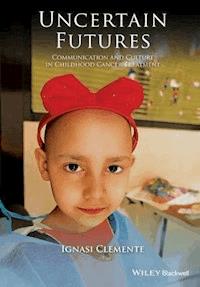
This book examines children and young people's attempts to participate in conversations about their own treatment throughout uncertain cancer trajectories, including the events leading up to diagnosis, treatment, remission, relapse, and cure or death. * Clearly and compellingly written, Clemente relies on a new multi-layered method to identify six cancer communication strategies * Illustrates that communication is central to how children, parents, and healthcare professionals constitute, influence, and make sense of the social worlds they inhabit--or that they want to inhabit * Provides ethnographic case studies of childhood cancer patients in Spain, using children's own words * Examines the challenges of how to talk to and how to encourage patients' involvement in reatment discussions * In his critique of the "telling" versus "not telling" debates, Clemente argues that communication should be adjusted to the children's own needs, and that children's own questions can indicate how much or little they want to be involved Uncertain Futures is the winner of the 15th Annual Modest Reixach Prize.
Sie lesen das E-Book in den Legimi-Apps auf:
Seitenzahl: 523
Veröffentlichungsjahr: 2015
Ähnliche




















CONTENTS
Cover
Title page
Series Preface
Acknowledgments
Preface
1 Children: Contributions to Communication and Illness
Alternatives to Speaking
Problematizing Participation
Uncertainty and the Practice of Optimism
Ethnography and Conversation Analysis
Plan of the Book
2 A Linguistic Anthropologist in a Pediatric Cancer Unit
Culture and Disclosure Practices in Catalonia
Fieldwork with Children
Contexts of Children’s Questions
Investigating Avoidance
Multiple Ways of Talking about Cancer
3 Living and Dealing with Cancer
Focusing on Treatment
Guessing
Being Together
Talking Privately
Uncertainties of Treatment
4 Co-constructing Uncertainty
Questions and Answers
Uncertainty and the Topic of Questions
Contingent Answers
Contingent Questions
Uncertainty and the Action of Questions
Answers that Lead to Subsequent Actions
Avoiding Answers and Avoiding Silence
Stepping into the Uncertain Future One Turn at a Time
5 Engaging in Communication at Catalonia Hospital
Learning the Diagnosis
L’entrevista
(The Treatment Interview)
“And When Will I Be Completely Cured?”
Six Communication Strategies
6 Patient Pressure and Medical Authority
Everyday Life in Treatment
“How Many Chemos Do I Have Left?”
Seeking Answers Without Challenging Medical Authority
7 The Limits of Optimism at the End of Treatment
Remission
Relapse
Negotiating Death
“Is the Day of the Autotransplant Going to Be Delayed
?
”
Optimistic Collusion
8 Conclusion
Appendix A: Profiles of Patients
Children (ages 3–6)
Young people (ages 11–18)
Appendix B: Transcription Conventions
1. Temporal and Sequential Relationships
2. Aspects of Speech Delivery, including aspects of Intonation
3. Other Markings
4. Crying (from Hepburn (2004))
References
Index
End User License Agreement
List of Tables
Chapter 06
Table 6.1 Robert’s questions about the autotransplant
List of Illustrations
Chapter 04
Figure 4.1 Robert and his mother asking questions as doctors and the nurse leave the room.
Chapter 07
Figure 7.1 Toni talking to the doctors during the visit (Scene A) and as the doctors and his mother leave the room (Scene B).
Guide
Cover
Table of Contents
Begin Reading
Pages
ii
iii
iv
v
ii
ix
xii
xiii
xiv
xv
1
2
3
4
5
6
7
8
9
10
11
12
13
14
15
16
17
18
19
20
21
22
23
24
25
26
27
28
29
30
31
32
33
34
35
36
37
38
39
40
41
42
43
44
45
46
47
48
49
50
51
52
53
54
55
56
57
58
59
60
61
62
63
64
65
66
67
68
69
70
71
72
73
74
75
76
77
78
79
80
81
82
83
84
85
86
87
88
89
90
91
92
93
94
95
96
97
98
99
100
101
102
103
104
105
106
107
108
109
110
111
112
113
114
115
116
117
118
119
120
121
122
123
124
125
126
127
128
129
130
131
132
133
134
135
136
137
138
139
140
141
142
143
144
145
146
147
148
149
150
151
152
153
154
155
156
157
158
159
160
161
162
163
164
165
166
167
168
169
170
171
172
173
174
175
176
177
178
179
180
181
182
183
184
185
186
187
188
189
190
191
192
193
194
195
196
197
198
199
200
201
202
203
204
205
206
207
208
209
210
211
212
213
214
215
216
217
218
219
220
221
222
223
224
225
226
227
228
229
Blackwell Studies in Discourse and Culture
Linguistic anthropology evolved in the 20th century in an environment that tended to reify language and culture. A recognition of the dynamics of discourse as a sociocultural process has since emerged as researchers have used new methods and theories to examine the reproduction and transformation of people, institutions, and communities through linguistic practices. This transformation of linguistic anthropology itself heralds a new era for publishing as well. Blackwell Studies in Discourse and Culture aims to represent and foster this new approach to discourse and culture by producing books that focus on the dynamics that can be obscured by such broad and diffuse terms as “language.” This series is committed to the ethnographic approach to language and discourse: ethnographic works deeply informed by theory, as well as more theoretical works that are deeply grounded in ethnography. The books are aimed at scholars in the sociology and anthropology of language, anthropological linguistics, sociolinguistics and socioculturally informed psycholinguistics. It is our hope that all books in the series will be widely adopted for a variety of courses.
Series Editor
James M. Wilce (PhD University of California, Los Angeles) is Professor of Anthropology at Northern Arizona University. He serves on the editorial board of American Anthropologist and the Journal of Linguistic Anthropology. He has published a number of articles and is the author of Eloquence in Trouble: The Poetics and Politics of Complaint in Rural Bangladesh (1998) and Language and Emotion (2009) and the editor of Social and Cultural Lives of Immune Systems (2003).
Editorial Board:
Richard Bauman – Indiana UniversityEve Danziger – University of VirginiaPatrick Eisenlohr – University of ChicagoPer-Anders Forstorp - Royal Institute of Technology, StockholmElizabeth Keating – UT AustinPaul Kroskrity – UCLANorma Mendoza-Denton – University of ArizonaSusan Philips – University of ArizonaBambi Schieffelin – NYU
In the Series:
1. The Hidden Life of Girls by Marjorie Harness Goodwin
2. We Share Walls: Language, Land, and Gender in Berber Morocco by Katherine E. Hoffman
3. The Everyday Language of White Racism by Jane H. Hill
4. Living Memory: The Social Aesthetics of Language by Jillian R. Cavanaugh
5. Lessons from Fort Apache: Beyond Language Endangerment and Maintenance by M. Eleanor Nevins
6. Language and Muslim Immigrant Childhoods: The Politics of Belonging by Inmaculada Mª García-Sánchez
7. Uncertain Futures: Communication and Culture in Childhood Cancer Treatment by Ignasi Clemente
Uncertain Futures
Communication and Culture in Childhood Cancer Treatment
Ignasi Clemente
This edition first published 2015© 2015 John Wiley & Sons, Inc.
Registered OfficeJohn Wiley & Sons, Ltd, The Atrium, Southern Gate, Chichester, West Sussex, PO19 8SQ, UK
Editorial Offices350 Main Street, Malden, MA 02148-5020, USA9600 Garsington Road, Oxford, OX4 2DQ, UKThe Atrium, Southern Gate, Chichester, West Sussex, PO19 8SQ, UK
For details of our global editorial offices, for customer services, and for information about how to apply for permission to reuse the copyright material in this book please see our website at www.wiley.com/wiley-blackwell.
The right of Ignasi Clemente to be identified as the author of this work has been asserted in accordance with the UK Copyright, Designs and Patents Act 1988.
All rights reserved. No part of this publication may be reproduced, stored in a retrieval system, or transmitted, in any form or by any means, electronic, mechanical, photocopying, recording or otherwise, except as permitted by the UK Copyright, Designs and Patents Act 1988, without the prior permission of the publisher.
Wiley also publishes its books in a variety of electronic formats. Some content that appears in print may not be available in electronic books.
Designations used by companies to distinguish their products are often claimed as trademarks. All brand names and product names used in this book are trade names, service marks, trademarks or registered trademarks of their respective owners. The publisher is not associated with any product or vendor mentioned in this book.
Limit of Liability/Disclaimer of Warranty: While the publisher and author have used their best efforts in preparing this book, they make no representations or warranties with respect to the accuracy or completeness of the contents of this book and specifically disclaim any implied warranties of merchantability or fitness for a particular purpose. It is sold on the understanding that the publisher is not engaged in rendering professional services and neither the publisher nor the author shall be liable for damages arising herefrom. If professional advice or other expert assistance is required, the services of a competent professional should be sought.
Library of Congress Cataloging-in-Publication Data
Clemente, Ignasi, author. Uncertain futures : communication and culture in childhood cancer treatment / Ignasi Clemente. pages cm Includes bibliographical references and index.
ISBN 978-1-118-90971-3 (cloth)1. Cancer in children–Spain–Case studies. 2. Communication and culture–Spain. I. Title. RC281.C4C53 2015 618.92′994–dc23
2015004072
A catalogue record for this book is available from the British Library.
Cover image: Child with cancer dressed up as Snow White during carnival, 2010. Photo © Tino Soriano / National Geographic Creative.
“Call it sentimental, call it Victorian and nineteenth century, but I say that anthropology that doesn’t break your heart just isn’t worth doing anymore.”
Ruth Behar (1996)
The Vulnerable Observer. Boston: Beacon Press.
Series Preface
Blackwell Studies in Discourse and Culture was launched in 2005, committed to publishing books whose ethnographic approach to language and discourse contributes to linguistic-anthropological theory. Each of the books that has appeared thus far in the series exemplifies that commitment. Now, we are proud to introduce Ignasi Clemente’s Uncertain Futures: Communication and Culture in Childhood Cancer Treatment as the latest book in the series and an exciting addition to ethnography and theory in linguistic anthropology. It is a book that we hope will leap the fence of academe and find many readers in the world of cancer—particularly the world of pediatric cancer. We foresee Uncertain Futures contributing to discussions of childhood cancer by clinicians, family members, and patients, and more broadly to discussions of cancer treatment and its human side and of the ethics of health communication.
Clemente tells us that his book is an ethnographic treatment of communication. Significantly, it is about “the communicative patterns of commission and omission of a community.” And that is largely what marks Clemente’s book as a departure. As important as previous studies of “communicative omission” and silence have been in the ethnography of communication and conversation analysis, Uncertain Futures differs sharply from its precedents, and in some ways goes far beyond them. Silences in the children’s cancer ward at “Catalonia Hospital” are part of a dance—one that could be construed as deadly. We can also think of Clemente as the John Nash of linguistic anthropology. Like Nash (made famous in the Hollywood film A Beautiful Mind), Clemente offers an important contribution to a kind of game theory as he describes the “cat-and-mouse game” between children who ask questions persistently, and adults who try to protect them from potentially distressing news.
This is a poignant book, but no story of unmitigated suffering or of the young and weak enduring the total domination of older, more powerful people. Perhaps the best illustration of this is in the way Clemente problematizes concepts that have largely been taken for granted, especially “participation.” What does “participation” mean here, in the lives of young patients whose parents and doctors appear to block their participation, even as we come to see that those apparently blocked patients are not victims but find ways to be active? Pediatric cancer patients’ questions, Clemente argues, reveal their communicative competence, their knowledge of the forms of participation that are culturally acceptable and available to them, i.e., what are appropriate ways of talking about cancer in Catalonia (Spain)—without talking about it. Just as Uncertain Futures is no story of total domination and submission or subjugation, neither is it a tale of villains and victims, but of younger and older social actors whose agency is both apparent (though appearing in differing forms for healthcare providers, parents, and pediatric cancer patients) and limited (running up against the limits imposed by different organizations of interaction and social action as much as by cancer itself).
This book is not only the first medically themed book in the series, Blackwell Studies in Discourse and Culture; it may also be the very first book that combines ethnographic depth with conversation-analytic empiricism in a study of cancer. Some readers may find ethnographic methods foreign; other readers will be unfamiliar with conversation analysis (CA). Clemente gently and effectively introduces readers to both. In many ingenious ways over several decades, CA has uncovered the systematicity of talk-in-interaction. Drawing on that tradition, Clemente shows how each move or conversational turn-at-talk influences the next without determining it. Ironically, as Clemente shows, it is the very system, including the sequential organization of talk (page 27) and preference organization (page 28) that contains within itself the seeds of danger, perhaps even the undoing of the social-order-in-miniature that any instance of conversation helps to constitute and/or sustain (Goodwin 2006). Questions and answers, says Clemente, may lead to not just more questions and answers in general, but to questions and answers that are potentially more destabilizing. Such “question–answer sequences” Clemente compares to a Pandora’s box. Just as that mythic box has fascinated hundreds of generations, so will readers be fascinated by the struggles documented here—with children on one side laboring to break open that box and doctors on the other, struggling to put the Q-A sequence to sleep, tucked safely back into the box.
In contrast with some work in the tradition of CA, what is new here are the riches of ethnographic depth and poignancy Clemente mines from his painstakingly recorded and transcribed material but especially from sources beyond the recordings—his knowledge of family life and sometimes family breakdown, of shortages of financial resources and their consequences, of medical teamwork and interfamilial solidarity, of adolescent patients’ flirtatiousness, humor, and assertive seeking of sociality. To add one more phenomenon to this list of others so richly described—a phenomenon that so deserves to be introduced with “Finally…”—Clemente allows us to be drawn in, as he was, to the endings of stories begun on the pediatric cancer ward but finished elsewhere, as some patients graduate from hospitalization to health and others die, surrounded by family.
Clemente’s Uncertain Futures thus takes its place alongside influential contributions from books in this series to our knowledge of the world—be it knowledge of the hidden life of girls (Goodwin 2006); of the sharing of walls, stories, and songs by Berber women (Hoffman 2008); of white racism, its everyday language, and its survival in the face of social pressure (Hill 2008); of Muslim immigrant childhoods in Spain (García-Sánchez 2014); or of languages struggling to remain a viable part of different communities (Cavanaugh 2009; Nevins 2013). To the author: Thank you for challenging our thinking about cancer, children, and talk in this powerful book. To the reader: Welcome to—or, we hope, in many cases, back to—the dynamic world of Discourse and Culture.
James M. Wilce, series editor
Acknowledgments
This book has been a long enterprise of work and dedication. Over the years, I have benefited from the compassion and wisdom of many individuals. In Catalonia, I would like to thank my professors Lluís Payrató and Emili Boix, my colleagues Marta Payà, Óscar Bladas, Eva Codó, Dolça Albert, Xavier Vila, and Marina Solís; and the wonderful people of the AFANOC (Association of Relatives and Friends of Children with Cancer of Catalonia) and of the Foundation of Childhood Oncology Enriqueta Villavecchia.
At UCLA, I would like to thank my professors Alessandro Duranti, John Heritage, Linda Garro, and Paul Kroskrity for guiding my intellectual training, and my friends who have supported me unconditionally, Francisca Angulo Olaiz, Mary Hardy, Wendy E. Prentice, Andrea Maestrejuan, and Mel Herst. I am also indebted to my colleagues at the UCLA Center for the Interdisciplinary Study and Treatment of Pain, particularly Marcia Meldrum, and to Mary Lawlor and Cheryl Mattingly, who welcomed me at the Division of Occupational Science and Occupational Therapy at the University of Southern California.
In the writing of my PhD dissertation, which is the basis for this book, I benefited from the thoughtful advice of Tanya Stivers, Jack Sidnell, Susan DiGiacomo, Marga Marí-Klose, and Carmelo Pinto. In regard to the writing of this book, I want to express my gratitude to my research assistant Eugene Danyo for all the work he has done over the last three years, to Annie Robinson for her patient editing, and to Galina Bolden, Douglas W. Maynard, Charles Goodwin, Paul Zeltzer, Myra Bluebond-Langner, Stephanie Gilardi, and Stephanie Feyne for their comments. At Hunter College, I would like to thank my colleagues in the Department of Anthropology, and also Maryam Bahkt and Angela Reyes. I want to express my deep and heartfelt gratitude to my mentors and enthusiastic supporters of my work, Bambi Schieffelin and Norma Mendoza-Denton. At Wiley-Blackwell, I want to thank Elizabeth Swayze, Ben Thatcher, Mark Graney, and the two anonymous reviewers who provided excellent comments and suggestions. I owe a very special thanks to Jim Wilce, Blackwell Series in Discourse and Culture editor, mentor, and medical linguistic anthropology pioneer. Scattered across the world, my dear friends Rafa Barruè, Alícia Segura, Pippa Jones, Lily Devcic, and Jessica Rothman have always found ways to lift my spirits when studying children living with and dying of cancer was too much.
I could not have done it without the scholarship, love, and mentorship of Melissa Moyer, Marjorie H. Goodwin, and Lonnie K. Zeltzer. Over the last 25 years, they have inspired me to work hard and rigorously, to pursue my interests beyond disciplinary boundaries, and to be generous intellectually and personally. Because I cannot repay what they have done for me, I hope I can do the same for future generations of students.
I am grateful to the institutions and agencies that sponsored my doctoral studies and research: the Spanish Department of Education and Science; the US-Spain Fulbright Bilateral Commission; the Graduate Division and the Department of Anthropology at the University of California, Los Angeles; the National Science Foundation; the Woodrow Wilson National Fellowship Foundation (Johnson & Johnson Dissertation Grant in Children’s Health); and the Alpha Association of Phi Beta Kappa Alumni in Southern California.
Finally, I would like to thank the children, their parents, and the hospital staff at Catalonia Hospital. Because of the focus on children’s questions for their doctors, my book does not do justice to the immense work that nurses do in taking care of children and parents and to the critical importance of their role in everyday communication at the hospital. Although I cannot thank the children by name, I want them to know that whenever I became lost in the data, my memories of the times that we spent together playing, eating, and going around the hospital always reminded of the most meaningful reason to write this book.
I dedicate this book to my family. Because I promised my mother I would write something she would understand, I now take a language license and switch from English to Catalan:
Vull dedicar aquest llibre a la meua família. Des de mon pare, com a Secretari de la Col·lectivitat Agrícola de la CNT-FAI durant la Guerra Civil, i President de la PYMEC anys més tard, fins a ma mare, Presidenta de la Joventut Antoniana i de Càritas de Vila-real, tots els de casa hem participat en molts projectes. Hem compartit il·lusions i fracassos: tots recordem l’Operació Reformista, l’incendi del magatzem, el racisme contra els immigrants marroquins, i els petits favors per a Mossén Guillermo, l’escola i els drogaadictes. Sovint hem perdut la batalla, però el que no hem perdut mai és la determinació de lluitar per una societat més justa i més humana. Per tot això, dedique el meu esforç a tota la meua família, que en la distància continua essent la columna vertebral que em sosté.
Preface
Like many people across the world, I have relatives and friends who have or have had cancer. In my case, as somebody who was born and grew up in Spain, how I talk or do not talk about cancer both reflects the ways in which Spanish and Catalan people speak about cancer, and contributes to sociocultural continuities and changes in cancer communication in these societies.
Lesen Sie weiter in der vollständigen Ausgabe!
Lesen Sie weiter in der vollständigen Ausgabe!
Lesen Sie weiter in der vollständigen Ausgabe!
Lesen Sie weiter in der vollständigen Ausgabe!
Lesen Sie weiter in der vollständigen Ausgabe!
Lesen Sie weiter in der vollständigen Ausgabe!
Lesen Sie weiter in der vollständigen Ausgabe!
Lesen Sie weiter in der vollständigen Ausgabe!
Lesen Sie weiter in der vollständigen Ausgabe!
Lesen Sie weiter in der vollständigen Ausgabe!
Lesen Sie weiter in der vollständigen Ausgabe!
Lesen Sie weiter in der vollständigen Ausgabe!
Lesen Sie weiter in der vollständigen Ausgabe!




