


89,08 €
Mehr erfahren.
- Herausgeber: John Wiley & Sons
- Kategorie: Fachliteratur
- Sprache: Englisch
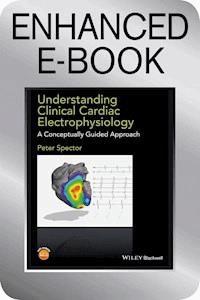
In the fast paced world of clinical training, students are often inundated with the what
of electrophysiology without the why
. This new text is designed to tell the story of electrophysiology so that the seemingly disparate myriad observations of clinical practice come into focus as a cohesive and predictable whole.
- Presents a unique, conceptually-guided approach to understanding the movement of electrical current through the heart, the impact of various disease states and the positive effect of treatment
- Reviews electrophysiologic principles and the analytic tools which, when combined with a firm grasp of EP mechanisms, allow the reader to think through any situation
- Presents the mathematics necessary for the practice of cardiac electrophysiology in an accessible and understandable manner
- Contains accompanying video clips, including computer simulations showing the flow of electrical current through the heart, which help explain and visualise concepts discussed in the text
- Includes helpful chapter summaries and full color illustrations aid comprehension
Sie lesen das E-Book in den Legimi-Apps auf:
Seitenzahl: 331
Veröffentlichungsjahr: 2016
Ähnliche


















Table of Contents
Cover
Title Page
Preface
Why this book?
Cardiac electrophysiology as a “complex non-linear system”
“The heart is a computer”
What this book isn’t
Acknowledgments
About the companion website and enhanced edition
PART I: Third-person omniscient (how we would see EP if we could see EP)
1 Ion channels
How does a cell become electrically active?
Summary
2 Action potentials
Action potential phases
The connection between ion channel physiology and tissue behavior
Clinical correlation
Summary
3 Propagation
Summary
4 Arrhythmia mechanisms
Automaticity
Triggered firing
Reentry
Atrial fibrillation: a case study in reentry
Summary
5 Anatomy for electrophysiologists
A tour of cardiac anatomy
Right atrium
Right ventricle
Left atrium – pulmonary vein
Left atrium
Coronary sinus
Left ventricle
Left meets right
Summary
PART II: Doctor’s-eye view (dealing with incomplete knowledge)
6 Deducing anatomy
Using imaging to navigate the heart
Fluoroscopy
Trans-septal catheterization
Summary
7 Electrical activity, electrodes, and electrograms
Intracardiac recording and spatial resolution
Recording configuration and spatial resolution
Orthogonal close unipolar
Quantifying spatial resolution
Calculating electrical activity from electrograms
Spatial resolution and electrogram fractionation
Tissue activation patterns and electrograms
Summary
8 Electrogram analysis: understanding electrogram morphology
Electrograms vs. EKGs
Electrograms
Unipolar electrograms
Bipolar electrograms
Discerning earliest activation
General considerations
Summary
9 Differential diagnostic pacing maneuvers
Differential diagnosis of narrow complex tachycardia
Mapping accessory pathways
Para-Hisian pacing
Para-Hisian pacing 201
Entrainment
Summary
10 Electro-anatomic mapping
Activation mapping
Substrate mapping
Putting it all together: a case
Summary
Appendix: What we measure when we record an electrogram
Electricity and the electric field
Coulomb’s law
The electric potential field
Ohm’s law
Recording the intracardiac electrogram
Afterword: Your heart is a computer: from army ants to atrial fibrillation
Suggested reading
Index
End User License Agreement
List of Illustrations
Chapter 01
Figure 1.1
Lipid bilayer.
Charged ions cannot cross the cell membrane; they are repelled by the hydrophobic lipid “tails.”
Figure 1.2
Creation of an ion concentration gradient.
(Top) Without the sodium potassium pump (Na
+
K
+
ATPase) there is equal distribution of ions on both sides of the membrane (represented by the horizontal lines). (Middle and bottom) Na
+
K
+
ATPase moves Na
+
ions out of, and K
+
ions into, the cell, establishing concentration gradients for both of these ions.
Figure 1.3
Electrochemical gradient.
(Top) Once I
K1
channels open, allowing K
+
to move across the membrane, the K
+
concentration gradient pulls K
+
out of
the cell. (Bottom) As K
+
leaves the cell (without any anions) a voltage gradient begins to develop; this exerts an
inward
force on K
+
, reducing the net outward force. K
+
will continue to flow down its concentration gradient until the voltage gradient exactly offsets the concentration gradient; this voltage is called the equilibrium potential (there is no longer any
net
flow of K
+
).
Figure 1.4
Sodium channel
gating.
(Top left) In the resting state sodium channels are closed and their inactivation gate is open (“recovered from inactivation”). (Top right) If the membrane is depolarized to threshold the voltage sensor moves, causing a conformational change in the channel which opens the pore (activation). Because activation gating is faster than inactivation, at this point the inactivation gate remains open and sodium can enter the cell. (Bottom left) After a few milliseconds the inactivation gate closes. (Bottom right) As the membrane repolarizes the activation gate closes. With further repolarization the inactivation gate “recovers from inactivation” (opens) and the cell is prepared for the next action potential (top left).
Lesen Sie weiter in der vollständigen Ausgabe!
Lesen Sie weiter in der vollständigen Ausgabe!
Lesen Sie weiter in der vollständigen Ausgabe!
Lesen Sie weiter in der vollständigen Ausgabe!
Lesen Sie weiter in der vollständigen Ausgabe!
Lesen Sie weiter in der vollständigen Ausgabe!
Lesen Sie weiter in der vollständigen Ausgabe!
Lesen Sie weiter in der vollständigen Ausgabe!
Lesen Sie weiter in der vollständigen Ausgabe!
Lesen Sie weiter in der vollständigen Ausgabe!
Lesen Sie weiter in der vollständigen Ausgabe!
Lesen Sie weiter in der vollständigen Ausgabe!
Lesen Sie weiter in der vollständigen Ausgabe!
Lesen Sie weiter in der vollständigen Ausgabe!
Lesen Sie weiter in der vollständigen Ausgabe!
Lesen Sie weiter in der vollständigen Ausgabe!
Lesen Sie weiter in der vollständigen Ausgabe!
Lesen Sie weiter in der vollständigen Ausgabe!
Lesen Sie weiter in der vollständigen Ausgabe!
Lesen Sie weiter in der vollständigen Ausgabe!
Lesen Sie weiter in der vollständigen Ausgabe!
Lesen Sie weiter in der vollständigen Ausgabe!




