


52,99 €
Mehr erfahren.
- Herausgeber: John Wiley & Sons
- Kategorie: Fachliteratur
- Serie: Addiction Press
- Sprache: Englisch
The book presents an integrative theory of hard-to-maintain behaviours, that includes hard-to-reduce or eliminate behaviours like smoking and other drug use, overconsumption of food or unsafe sex, and hard-to-sustain behaviours like exercise and sun-safe behaviours. Most of the examples come from the author's work on tobacco smoking, but it is relevant to anyone who is concerned to understand why some forms of desirable behaviour are so hard to achieve, and to those trying to help people change. It also has important implications for public health campaigns and for the development of policies to nudge behaviour in desirable ways.
The book provides readers with frameworks to:
- Determine whether a "hard to maintain" behaviour is a result of the skills needed to perform it, its reinforcement history, the way the person thinks about it, the context, or some combination of these.
- Better integrate cognitive and behavioural change strategies, including emergent strategies related to mindfulness and acceptance, plus novel ways of retraining operational processes.
- Understand the different nature of challenges for behaviours where multiple attempts are typically required before the desired behaviour pattern is sustained.
- Better understand the role of feelings and emotions as influences on behaviour.
- Understand the limits of environmental factors to determine change.
- Understand the limits of self-control and will-power.
Sie lesen das E-Book in den Legimi-Apps auf:
Seitenzahl: 587
Veröffentlichungsjahr: 2013
Ähnliche



















Table of Contents
Series Page
Title Page
Copyright
Preface
Acknowledgements
Chapter 1: An overview of the theory
Limitations of the existing theories
Core elements of CEOS
Biological constraints
Elaboration of CEOS theory
References
Chapter 2: Characteristics of hard-to-maintain behaviours
Types of behaviour to change
Hard-to-reduce/resist/eliminate behaviours
Hard-to-sustain behaviours
Combinations of both kinds of behaviour change
What is learnt in HTM behaviour change
References
Chapter 3: The roles of the operational and executive systems
The Operational System
The Executive System
What the ES can do
Relationship of CEOS to other dual-process theories
References
Chapter 4: Environmental influences: the context of change
The relatively stable environment
Changing the broader environment
The interactional environment
References
Chapter 5: Conceptual influences on change
Framing the problem
Organisation of concepts about change
The desirability of change
Goal achievability
Beliefs that can interfere with behaviour change
References
Chapter 6: The structure of the change process
Tasks involved in behaviour change
Getting behaviour change on the agenda
Making an attempt to change
Maintaining change: perseverance
Determinants of maintenance/relapse
Repeated attempts are the norm
References
Chapter 7: Interventions for behaviour change
Internal and external perspectives on change
Differences between HTR and HTS behaviours
Enhancing executive function: optimising understanding
Making relevant knowledge salient
Enhancing self-control
Enhancing self-reorientation
Creating more supportive environments
Integrative strategies
References
Chapter 8: Using CEOS to advance knowledge
Key features of CEOS theory
Key questions to answer for behaviour change
Measuring key constructs
Elements of a theory-driven research agenda
Implications for reducing inequities
Concluding comments
References
Index
Addiction Press aims to communicate current ideas and evidence in this expanding field, not only to researchers and practising health professionals, but also to policy makers, students and interested non-specialists. These publications are designed to address the significant challenges that addiction presents to modern society.
Other books in the Addiction Press series
Theory of Addiction
Robert West and Jamie Brown
9780470674215
Clinical Handbook of Adolescent Addiction
Edited by R. Rosner
9780470972342
Harm Reduction in Substance Use and High-Risk Behaviour
Edited by R. Pates & D. Riley
9781405182973
Injecting Illicit Drugs
Edited by R. Pates, A. McBride & K. Arnold
9781405113601
Neuroimaging in Addiction
Edited by B. Adinoff & E. Stein
9780470660140
Treating Drinkers and Drug Users in the Community
T. Waller & D. Rumball
9780632035755
Understanding and Treating Addictions: Psychological Assessment and Intervention
Edited by A. Copello
9781405124171
This edition first published 2014 © 2014 by John Wiley & Sons, Ltd.
Registered office: John Wiley & Sons, Ltd, The Atrium, Southern Gate, Chichester, West Sussex,
PO19 8SQ, UK
Editorial offices: 9600 Garsington Road, Oxford, OX4 2DQ, UK
The Atrium, Southern Gate, Chichester, West Sussex, PO19 8SQ, UK
111 River Street, Hoboken, NJ 07030-5774, USA
For details of our global editorial offices, for customer services and for information about how to apply for permission to reuse the copyright material in this book please see our website at www.wiley.com/wiley-blackwell
The right of the author to be identified as the author of this work has been asserted in accordance with the UK Copyright, Designs and Patents Act 1988.
All rights reserved. No part of this publication may be reproduced, stored in a retrieval system, or transmitted, in any form or by any means, electronic, mechanical, photocopying, recording or otherwise, except as permitted by the UK Copyright, Designs and Patents Act 1988, without the prior permission of the publisher.
Designations used by companies to distinguish their products are often claimed as trademarks. All brand names and product names used in this book are trade names, service marks, trademarks or registered trademarks of their respective owners. The publisher is not associated with any product or vendor mentioned in this book. It is sold on the understanding that the publisher is not engaged in rendering professional services. If professional advice or other expert assistance is required, the services of a competent professional should be sought.
The contents of this work are intended to further general scientific research, understanding, and discussion only and are not intended and should not be relied upon as recommending or promoting a specific method, diagnosis, or treatment by health science practitioners for any particular patient. The publisher and the author make no representations or warranties with respect to the accuracy or completeness of the contents of this work and specifically disclaim all warranties, including without limitation any implied warranties of fitness for a particular purpose. In view of ongoing research, equipment modifications, changes in governmental regulations, and the constant flow of information relating to the use of medicines, equipment, and devices, the reader is urged to review and evaluate the information provided in the package insert or instructions for each medicine, equipment, or device for, among other things, any changes in the instructions or indication of usage and for added warnings and precautions. Readers should consult with a specialist where appropriate. The fact that an organization or Website is referred to in this work as a citation and/or a potential source of further information does not mean that the author or the publisher endorses the information the organization or Website may provide or recommendations it may make. Further, readers should be aware that Internet Websites listed in this work may have changed or disappeared between when this work was written and when it is read. No warranty may be created or extended by any promotional statements for this work. Neither the publisher nor the author shall be liable for any damages arising herefrom.
Library of Congress Cataloging-in-Publication Data
Borland, Ron.
Understanding hard to maintain behaviour change : a dual process approach / Ron Borland.
pages cm
Includes bibliographical references and index.
ISBN 978-1-118-57293-1 (pbk.)
1. Behavior modification. 2. Change (Psychology) 3. Habit breaking. 4. Habit. I. Title.
BF637.B4B67 2014
153.8′5– dc23
2313034134
A catalogue record for this book is available from the British Library.
Wiley also publishes its books in a variety of electronic formats. Some content that appears in print may not be available in electronic books.
Cover image: iStock © Meinzahn
Cover design by www.hisandhersdesign.co.uk
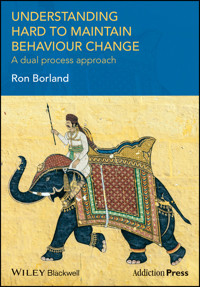
The challenge of the rider controlling the elephant is one of the oldest metaphors for how our sometimes rational minds attempt to control our natural passions: the main theme of this book.
Preface
I have had the great fortune to work for a small organisation that has had a huge impact, not only in tobacco control, but also in skin cancer prevention and other areas of cancer control. Under the inspired leadership of Nigel Gray and David Hill, the Cancer Council Victoria has been a leading light in the development of evidence-driven approaches to health promotion, in particular, the use of mass media and other mass communication tools to drive both environmental and personal changes to reduce behavioural risk factors for cancer. For more than 25 years, I have been contributing to this effort, researching aspects of tobacco control and sun protection, including evaluating the impacts of mass campaigns. For the past 15 years, my work has focussed on smoking. This continues to be satisfying because all the successful efforts to reduce smoking (however small) add healthy years to people's lives. When I started to work in this area, there was implicit confidence that we would quickly get on top of the problem. As smokers came to realise how bad it was and the social desirability of smoking was reduced, most smokers would quit and the problem would largely go away. However, in countries such as Australia, and increasingly elsewhere, the agenda for change that was adopted in the early days of tobacco control efforts has been pretty much completely implemented, but we are still only about half way to our goal.
As I have researched the issue, including being involved in some of the early evaluations of concerted efforts to control tobacco use, I have become increasingly impressed (and concerned) by what a resilient habit smoking is. Not only has it proved difficult to get smokers to quit successfully, it has challenged much of what I had been taught as a psychology student about the nature of learning and unlearning and how they relate to persuasion and choice. I soon realised that this was not a unique challenge. The research I did on sun-protection behaviours highlighted the challenge of maintaining an under-cued set of behaviours, and of the need for constant campaigns, not just to remind people of the need to protect themselves, but also to maintain motivation to do so. Looking over the fence into other efforts to control problematic behaviours, I see similar challenges. Consistently doing enough of certain activities, such as exercising, is beset with similar problems. Many people find it extremely difficult to maintain weight loss, even though many can initially lose some. The difficulties of maintaining seemingly simple behaviour changes all point to this being a set of wicked problems, that is, ones for which the immediately obvious solution turns out to be dangerously over-simplistic.
Most failures to change complex behaviours are not for want of trying. Simple attempts to explain these failures as being due to lack of willpower are not particularly useful. Nor is it productive to disparage those who fail. Drug addicts are notorious for telling therapists that they really want to stop using, only to be found shooting up soon after. Contrary to the views of some, I see this not as lying, but as showing the difficulty of maintaining a consistent position when the environmental cues and the associated cravings for the drug vary so greatly from a doctor's clinic to the streets associated with use. Any useful new theory should be able to shed novel insights into the complexities and seeming inconsistencies of behaviour in these difficult areas.
The work of an applied scientist is of applying theory to solve problems and any theory testing is secondary. Throughout my career I have been frustrated by the limitations of existing theories and the lack of integration of theories used in one aspect of my work to inform other aspects. Working in the real world with complex problems that involve diverse aspects of human thought and behaviour, I have wanted a comprehensive theory that helped integrate understanding: a theory to understand a set of problems, rather than trying to view a problem through the distorting lens of a set of only partly applicable theories.
This book represents an attempt to build up a comprehensive theory of why some forms of behaviour change don't fit the mould of being easy and are difficult to institute and/or maintain, in the hope that it will lead to more effective interventions. It is informed by Alfred North Whitehead's aphorism ‘Seek simplicity and distrust it’. My aim is to keep things as simple as I can while taking into account the complex dynamics of human behaviour. Most of the elements of the theory are borrowed and/or adapted from other theories. What is unique here is the ways in which these components are put together and in the ways some of the elements of existing theories are rejected or modified.
My efforts to develop an alternative conceptualisation to the mass of overlapping and mutually inconsistent theorising around behaviour change have been a far from linear process. Some of my early ideas have been abandoned or modified in the face of evidence. However, the rate of need for change has gradually slowed (but not to zero) and I now have less discomfort in having to ‘fix’ my ideas. I believe the core ideas presented here can be defended and will remain pretty much as postulated, while some of the minor elements are less well grounded and thus may need to change as evidence accumulates. I encourage readers who find the basic ideas useful to let me know about failings and inconsistent evidence. This is not the last word.
Acknowledgements
This book has influences reaching many aspects of my life. The strong underpinnings of the theory in the ideas of Pavlov and Vygotsky owe much to my early mentor MB Macmillan, and the ideas from communication and systems thinking to Robyn Penman. David Hill, my long-term boss and mentor at the Cancer Council Victoria, has been a constant source of inspiration and advice and has shaped my thinking in innumerable ways. I am indebted to my research team from over the years for support, suggestions and helping me show how some of my early ideas were wrong. The emergence of the ideas in this book has benefitted from discussions over the years with many people, but particularly with Arie Dijkstra, Robert West, Geoff Fong and Mike Cummings.
Related directly to the present volume, particular thanks are due to James Balmford and David Young for incisive comments on drafts and to other members of my team for chasing references and other bits and pieces. I am also grateful for comments on a preliminary draft from Susan Michie, Steve Sutton and Jill Francis, in particular. I am indebted to those who pointed out the burgeoning thinking about dual-process theories within psychology of which I was unaware, which has allowed me to align my thinking with elements of that work. Finally thanks to my family, my wife Virginia Lewis, who not only put up with me but read and commented positively on key elements, and to Ross and Harry who at least humoured me.
Chapter 1
An overview of the theory
Most behaviour change is unproblematic. People's behaviour changes all the time, both in response to an ever-changing environment and their increasingly refined responses to it as they learn and adapt. This book is about trying to understand those aspects of human behaviour that aren't readily brought into concordance with environmental conditions and individual desires. It develops and elaborates a theoretical framework, called CEOS theory (I will explain the acronym later), which is designed to be a new and comprehensive way of thinking about how people change habitual behaviours. This involves understanding the constraints on and the potential of volitional attempts to change behaviour patterns that are under the moment-to-moment control of non-volitional processes.
The theory also focusses on the different processes involved in the initiation and maintenance of behaviour change. It is primarily designed to understand behaviours that are hard-to-maintain (HTM behaviours); that is, ones that while seen as desirable by the individual are not spontaneously adopted or are hard to sustain and/or are seen as undesirable and hard to reduce or eliminate in the long term. These behaviours include stopping smoking, eating healthy foods to maintain a desirable weight, exercising regularly and controlling alcohol consumption. CEOS theory also encompasses easy-to-change behaviour, where it is similar to many existing theories because there is less need to consider the conflict between volitional and non-volitional forces within the individual.
The focus of this book is on health-related behaviours. The big question it attempts to answer is: Is it possible to help people to enjoy and value healthy lifestyles, to the point where there is no longer any real effort involved in avoiding unhealthy and embracing healthy behavioural alternatives? Where this is not possible, can we develop strategies to help people maintain healthy options, at least most of the time, and to minimise unhealthy choices and to break unhealthy habits, even if it requires ongoing vigilance?
Key ideas and observations that have informed the need for a new theory include the following:
People sometimes don't act in ways that are objectively in their best interests even when they want to change; for example, they continue to smoke or continue a high-fat low-exercise lifestyle even though they want to be fit and healthy.
Even when people try to adopt healthy behaviours, these new forms of behaviour are difficult to maintain and are thus characterised by high rates of failure. The causes of these failures are not well understood, and attempts to reduce relapse rates have a bleak record.
Recent research has established that the determinants of deciding and trying to change are different from those of maintaining behaviour change, at least for smoking [1, 2]. (See Chapter 2 for more details.) Some of the things that motivate smokers to try to quit, and which quitting improves, are associated perversely with reduced chances of success. It is not yet known whether similar perverse relationships are present for other HTM behaviours.
CEOS is a biopsychosocial theory, in that it postulates that behaviour is co-determined by the interaction between biological factors, modifiable aspects within the individual (psychological factors) and aspects of the environment, especially social factors. Which of these influences is most important for any particular kind of behaviour, or as is the case here, which make it difficult to maintain desirable behaviours, is an empirical question.
Lesen Sie weiter in der vollständigen Ausgabe!
Lesen Sie weiter in der vollständigen Ausgabe!
Lesen Sie weiter in der vollständigen Ausgabe!
Lesen Sie weiter in der vollständigen Ausgabe!
Lesen Sie weiter in der vollständigen Ausgabe!
Lesen Sie weiter in der vollständigen Ausgabe!
Lesen Sie weiter in der vollständigen Ausgabe!
Lesen Sie weiter in der vollständigen Ausgabe!




