


14,99 €
Mehr erfahren.
- Herausgeber: John Wiley & Sons
- Kategorie: Fachliteratur
- Sprache: Englisch
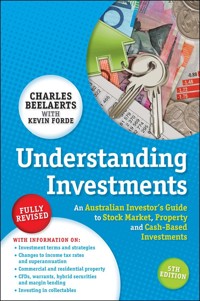
Understanding Investments is the ultimate guide for Australians looking to take control of their finances.
This new edition has been thoroughly updated for the modern investor, and includes essential information that will help you:
- Decipher the jargon
- Choose an investment strategy
- Work with a financial adviser
- Structure and diversify your portfolio
- Avoid costly tax pitfalls
Covering investments ranging from shares, CFDs and managed funds through to options, property, collectables and much more, Understanding Investments provides you with the tools you need to make a profit in all types of markets. Whether you're just starting your investment journey or you're a seasoned investor wanting to learn more, this user-friendly guide contains the most up-to-date information to help you make the most from your money.
Sie lesen das E-Book in den Legimi-Apps auf:
Seitenzahl: 606
Veröffentlichungsjahr: 2010
Ähnliche



















Understanding Investments
Table of Contents
PART I:
What you need to know
Chapter 1: Investing today
Why learn about investing?
Financial information
Ground rules for successful investing
The global financial crisis
Chapter 2: Investment terms
What is a financial institution?
Basic investment terms
Real rate of return
Risk and return
Tax
Liquidity
Credits and debits
Secured and unsecured
Dividend imputation
Negative gearing
Derivatives
Chapter 3: Structuring your investment portfolio
Asset allocation and your circumstances
What type of investor are you?
How to get started
Risk and diversification
Risk versus reward
Achieving good diversification
Changing your asset allocation
What sort of returns can you expect?
Chapter 4: Keeping track of your investments
Legal requirements
Investment registers
Expenses versus capital expenditure
Share watchlists
Measuring investment performance
Inflation
Property
Portfolio balance
Chapter 5: Finding an adviser
Where do you start?
The Australian Securities & Investments Commission
A licence is required
The costs
What you should tell your adviser
What your adviser should tell you
Examine the recommendations
Is the adviser independent?
Do not make cheques out to the adviser
Qualifications
Ongoing service
Matters of opinion
Questions to ask an adviser
Parliamentary Joint Committee on Corporations and Financial Services
Discount funds brokers
Chapter 6: Trading and researching over the internet
How to research a company
Trading over the internet
Other services
Low-cost access to managed funds
Discount brokers
Chapter 7: Tax considerations
Taxation is a burden
Negative gearing
Property trusts
Foreign income
Investing overseas
Ownership of investments
Income splitting
Never invest solely to reduce your tax
Investing in Australian films
Investment advice
Australia’s Future Tax System Review
PART II:
Investment options
Chapter 8: Investing in the sharemarket
Company floats
Dividends
Bonus issues, rights issues, share placements and purchase plans
Types of shares
Understanding sharemarket tables
Share categories
The All Ordinaries index
How to invest
The dangers of sharemarket investing
How to pick shares
Building your own share portfolio
Chapter 9: More sophisticated sharemarket strategies
Warrants
Contracts for difference
Chapter 10: Hybrid securities and margin lending
How a typical hybrid works
Margin lending
Chapter 11: Listed investment companies
Why invest in an LIC?
Investing in listed investment companies
Listed investment company floats
Taxation and LICs
Chapter 12: New floats
The float process
Winners and losers
Evaluating a float
How to read a prospectus
Investment versus speculation
Floats and sharemarket cycles
Sources of information
Floats and taxation
Chapter 13: Investing in managed funds
Measuring risk
The size of the fund
Performance tables
Star ratings
Past performance is no guarantee of future performance
How to use performance figures
The costs of investing in a managed fund
Selecting funds
Alternatives to managed funds
Exchange-traded funds
Tax and managed funds
Chapter 14: Hedge funds
A brief history of hedge funds
How hedge funds work
Other hedge fund features
Types of hedge funds
Hedge funds and risk
Hedge fund managers can shift ground
Hedge funds and investment time frames
Fees
Transparency
Are hedge funds a good investment?
Hedge funds as a separate asset class
Taxation and hedge funds
Chapter 15: Investing in bonds
Bond terminology
Investing in government bonds
Types of bonds
Monitoring your bonds
Volatility and bonds
Bonds compared with shares
How risky are corporate bonds?
Tax and bonds
Chapter 16: Interest-bearing investments
Bank bills
Cash management trusts
Debentures
Unsecured notes
Income securities
Disadvantages of interest-bearing investments
How to invest in CMTs and debentures
Selling debentures
Taxation and interest-bearing investments
Chapter 17: Options and futures
Exchange-traded options
Why use the futures market?
Tax and options and futures
Chapter 18: Property investing basics
Different ways to invest in property
Factors affecting property prices
Direct investment
Sources of information
Types of property
Some disadvantages of property investment
Sensible rules of property investing
Be on your guard at property seminars
Chapter 19: How to evaluate a property investment
Discounted cash flow
Getting the best price when selling at auction
Buying at auction
Chapter 20: Tax and property investments
Negative gearing
Positive gearing
Income tax deductions
Common tax mistakes
What records do you need to keep?
Chapter 21: Listed and unlisted property trusts
Property investment structures
Property cycles
Mortgage trusts
Syndicates and property trusts
Split trusts
Product disclosure statements
Chapter 22: Investing in collectables
Types of collectors
Areas of collectables
How to assess the markets for your investments
Buying collectables
Selling collectables
Investing in art
Investing in wine
Investing in coins
Collectables and taxation
Chapter 23: Superannuation
What is superannuation?
Types of super funds
How super is taxed
How much super do you need?
Choice of fund
Setting up your own super fund
Appendix: Detailed DCF analysis
Understanding Investments
An Australian Investor’s Guide to Stock Market, Property and Cash-Based Investments
5th Edition
CHARLES BEELAERTS
WITH KEVIN FORDE
First published 2010 by Wrightbooks
an imprint of John Wiley & Sons Australia, Ltd 42 McDougall Street, Milton Qld 4064
Office also in Melbourne
Typeset in 11.5/13.8 pt Garamond
© Charles Beelaerts and Kevin Forde 2010
The moral rights of the authors have been asserted
National Library of Australia Cataloguing-in-Publication data:
Author: Beelaerts, Charles.
Title: Understanding investments: an Australian investor’s guide to stock market, property and cash-based investments / Charles Beelaerts; Kevin Forde.
Edition: 5th ed.
ISBN: 9781742469508 (pbk.)
Notes: Includes index.
Subjects: Stocks — Australia.
Investments — Australia.
Other Authors/Contributors: Forde, Kevin, 1949–
Dewey Number: 332.678
All rights reserved. Except as permitted under the Australian Copyright Act 1968 (for example, a fair dealing for the purposes of study, research, criticism or review), no part of this book may be reproduced, stored in a retrieval system, communicated or transmitted in any form or by any means without prior written permission. All inquiries should be made to the publisher at the address above.
Tax rate table (used in chapters 2 and 7): From ATO web page ‘Individual income tax rates’ 2009, copyright Commonwealth of Australia, reproduced by permission.
Cover images: © iStockphoto/pamspix; © iStockphoto/DSGpro; © wrangler, 2010, used under license from Shutterstock.com; © max blain, 2010, used under license from Shutterstock.com; © Beluza Ludmila, 2010, used under license from Shutterstock.com.
Extracts from The Weekend Australian (chapter 8): AAP content is owned by or licensed to Australian Associated Press Pty Limited and is copyright protected. AAP content is published on an ‘as is’ basis for personal use only and must not be copied, republished, rewritten, resold or redistributed, whether by caching, framing or similar means, without AAP’s prior written permission. AAP and its licensors are not liable for any loss, through negligence or otherwise, resulting from errors or omissions in or reliance on AAP content. The globe symbol and ‘AAP’ are registered trademarks.
Extracts from the Parliamentary Joint Committee on Corporations and Financial Services — Terms of Reference and Conclusion (chapter 5): from Inquiry into financial products and services in Australia, Parliamentary Joint Committee on Corporations and Financial Services, November 2009, copyright Commonwealth of Australia, reproduced by permission.
Printed in Australia by McPherson’s Printing Group
10 9 8 7 6 5 4 3 2 1
Disclaimer
The material in this publication is of the nature of general comment only, and does not represent professional advice. It is not intended to provide specific guidance for particular circumstances and it should not be relied on as the basis for any decision to take action or not take action on any matter which it covers. Readers should obtain professional advice where appropriate, before making any such decision. To the maximum extent permitted by law, the authors and publisher disclaim all responsibility and liability to any person, arising directly or indirectly from any person taking or not taking action based upon the information in this publication.
Dedication
We would like to dedicate this book to our mothers for the encouragement and support they gave us.
About the authors
Charles Beelaerts is an economics graduate of the University of Sydney and a graduate of Harvard Business School. He is a financial consultant and author who has previously worked as an analyst for banks and finance companies.
Kevin Forde holds a Master of Economics degree from the University of NSW, where he has lectured for 10 years. He has worked as an industrial analyst and as a funds manager.
PART I:
What you need to know
Part I outlines the knowledge you need to have to make sound investment decisions. It begins by looking at investing today, including a discussion of the global financial crisis. Chapter 2 then introduces fundamental investment terms such as simple and compound interest and how, by saving a small amount regularly, you can accumulate a large sum over a long period. More complex investment terms such as negative gearing, derivatives, diversification and dividend imputation are also explained. The factors you need to consider when structuring an investment portfolio are examined, as are the records you need to maintain to track your investments for tax purposes and to measure the return from your investment portfolio.
The important issue of obtaining sound financial advice is considered with a review of the questions you need answered to ensure you get appropriate guidance. The potential disadvantages of paying financial advisers via commission are considered and the findings of a government inquiry on this issue are summarised. Most investors will want to know how to make best use of the internet in trading and researching investments. This is outlined in chapter 6. The final chapter in part I summarises the main sections of the Australian tax system that apply to investors and provides you with an understanding of what you need to know to legally minimise your income tax liability.
Chapter 1: Investing today
Why learn about investing?
In the 1960s and 1970s only about 10 per cent of Australians owned shares directly. In the 1980s and 1990s this changed dramatically following major privatisations, including Qantas, Telstra, the Commonwealth Bank and AMP. Currently around 50 per cent of Australians own shares directly or through managed funds. This puts Australia in equal first place with the US in share ownership per head of population. Unfortunately, most of the privatisations took place in a bull market. As a result, many investors did not really understand the risks they were taking by investing in shares. When world sharemarkets turned down in 2000, these new sharemarket investors were taken by surprise by the severity and suddenness of the decline. Since then worse has happened with the global financial crisis (GFC), when share prices declined by much more. These events highlight that there are numerous traps for the unwary in financial markets.
As there are now more investment products from which to choose, investing wisely has become more important than ever. The government has made it clear that everyone should be more financially responsible for their retirement. So if you do not save and invest successfully during your working life you may suffer a major decline in your standard of living when you retire.
Remember that the average life expectancy in Australia is around 80 years. So if you retire when you are 60 the savings you accumulated during the approximately 40 years of your working life will have to last you around 20 years.
Interest rates and the Australian dollar are now determined more by market forces than government decree. Again this can provide profitable opportunities for anyone who understands the implications of this. Or it can simply be another trap for the unwary investor.
It is essential to educate yourself about investing, as there are many people who make a living by selling investment products. There are over 16000 licensed investment advisers in Australia and not all of them are competent. If you decide to seek guidance from an investment adviser, it is still a good idea for you to have some basic understanding of how financial markets work so you do not put your hard-earned money into the hands of a less-than-professional financial adviser.
Most daily papers contain numerous advertisements extolling the virtues of one investment product or another. How can you tell whether a particular investment product is right for you? The only sure way is to become familiar with the language used in the financial industry.
The long-term benefits of becoming more financially wise are enormous — as are the costs of allowing yourself to remain financially illiterate. These days we are all bombarded by people trying to sell financial products such as life insurance, managed funds, superannuation, home loans, margin lending schemes, exchange-traded funds, contracts for difference, hedge funds, warrants and personal loans. Unless you know how these products work you could end up paying too much, losing your money or buying something you don’t really need.
The chance of losing money through unwise investments seems to have increased. In recent years in Australia there have been several spectacular corporate crashes, such as Timbercorp, Opes Prime and Storm Financial. These resulted in investors losing thousands and sometimes tens of thousands of dollars. In addition, the Australian Securities & Investments Commission estimates that more than 100000 Australians have lost money in fraudulent or illegal investment schemes in the last 15 years, and many of these were intelligent people. In the US, Bernie Madoff ‘lost’ US$50 billion of investors’ money.
Does this mean you should play it safe by keeping your money in the bank or under your bed? Generally the answer is no — but there certainly is a need to understand the types of risks you are taking when you invest.
With this changed investment environment has come a need for investors to know more than they have ever known before.
Financial information
These days everyone is an investor. Investing is not difficult, but to be a competent investor you need to understand what you are doing. There are many traps for the unwary. Knowing how to use financial information is crucial for making sound investment decisions. Establishing what information you need and where to obtain it is another essential part of this book. Clearly, not all areas regarding the provision and use of financial information can be covered at the same time. The foundations for effectively using financial information are twofold. Part I of the book deals with what you need to know. Part II looks at investment options.
Financial information is published constantly in numerous forms that are often not comprehensible to the layperson. Many investors, financial advisers and stockbroker analysts are expert in using financial information and already know where to obtain it. This book is written for non-experts who are interested in deriving a working knowledge of financial information and its sources.
Ground rules for successful investing
Before examining different financial investments in detail there are some ground rules for successful investing that have stood the test of time. With time, patience and effort you can be a successful investor in all of the arenas that are open to you. This will not come overnight and you will have to confront the risk of losing some of your money. But, if you persevere, you will be a successful investor. The road is not always easy, but nothing worthwhile is.
My ground rules for successful investing have not changed from previous editions of this book, and they are:
1 Be your own investment manager. No ‘adviser’ or stockbroker should do it for you. Only you know what your real needs and temperament are and only you are motivated by your own best interests — not by the chance of earning a sales commission. It is also more fun to do it yourself.
2 Confront risk and then reduce it through spreading your investments. This is referred to as ‘diversification’, ‘asset allocation’ or ‘portfolio balance’.
3 Take a ‘contrarian’ stance in investment markets. That is, look for opportunities to watch what the ‘herd’ is doing and then do the opposite.
4 Do not be put off by investment jargon. After reading this book you will be on top of it.
5 It’s always a good time to start. Do not wait for markets, such as the sharemarket or the property market, to get better. If the sharemarket is filled with gloom, it may be the time to buy bargains.
6 Make good-quality shares the core of your investment strategy. Then you can rest easy when you invest in more speculative areas.
7 Always consider the tax implications of making investments, but never let tax minimisation be your main objective. The fundamental rule is to think in terms of after-tax returns.
8 Keep up to date through reading the financial pages of a major daily newspaper. Later you can extend this to include more specialised publications such as AFR Smart Investor, BRW magazine and others.
9 Discussing investment is stimulating. Condition your mind to talking to others about it, especially those more knowledgeable than you are.
10 Do not be greedy. Discipline yourself to cut your losses with a bad investment and to cash-in when you have made a reasonable profit.
11 Be patient. You probably will not become a millionaire overnight through investing, but you can expect to make money over time.
12 Never invest in anything you do not understand. If a particular investment sounds too good to be true it probably is.
13 Pay yourself first. Many people put off learning about investing because they claim they do not have any money to invest. The solution is to set aside a portion of your income each month — say 5 or 10 per cent — to build up your initial investing capital. By doing this you will force yourself to become an investor and the longer term benefits will be enormous.
If you can master these 13 ground rules you will be a successful investor. You will rival so-called professionals and you will sleep easily at night knowing that money is the least of your worries.
The aim of this book is to inform you so that you can make better investment decisions. Alternatively, if you wish to entrust your money to a professional investment adviser, you will be better able to assess how well he or she is doing with your money. This book focuses on the relevance, use and acquisition of information relating to investment. It explicitly recognises that many investors are new and unfamiliar with the sources of financial information that are available, and their use.
This book gives you an introduction to the main types of investments available to individual investors in Australia. Before focusing on specific investment choices there is some discussion of basic investment terms as well as the very important matter of risk and return. This will show that risk and return go hand in hand and that the best way to hedge against risk is to spread your investments across different areas. The tax implications of various investments are discussed, as is the importance of keeping track of your investments.
Reading this book will empower you with financial knowledge. Hopefully you will never be ‘sold’ a financial product ever again.
The global financial crisis
The global financial crisis threatened to undermine the very foundations of the world financial system and provided a much needed reality check for individual investors. There are many lessons to be learned from this experience — primarily that investing involves both risk and return. Leading up to the GFC, most investors became too focused on returns, ignoring the risks they were taking to achieve these returns.
The 1980s saw the deregulation of both local and overseas financial markets, bringing an array of new financial products. With the arrival of the GFC, the situation has changed and there are calls for more government regulation of financial markets. Thirty years ago investing was relatively easy, mainly because there were only a few places you could put your money. Today investing is more complex than it has ever been. Not only have many new investment products been launched, but there have also been changes to income tax rates, numerous alterations to the superannuation system, the introduction of capital gains tax, and on top of this it has to be accepted that there will be more government regulation of financial markets.
Causes of the GFC
The causes of the GFC had been building up for years, but the trigger was the collapse of the sub-prime market in the US. Banks in the US had embarked on a course of action whereby they made increasing numbers of risky loans available to home buyers, many of whom had little prospect of repaying them. These loans were then packaged into securities (a process called ‘securitisation’) which could be bought and sold like any other securities. Financial institutions in the US — for example, investment banks— pushed turnover of these packaged securities to enormous levels, which boosted the demand for more securitisation. Short-term profit was being placed ahead of risk management. Then home loan borrowers began to default as the US economy became overheated. The trend worsened and the sub-prime market eventually collapsed completely. Holders of the packaged securities were left with worthless paper, and financial institutions faced bankruptcy across the board, as did home loan borrowers.
The US Government bailed out many of the banks and financial institutions, but this merely enabled those institutions to stay afloat and lose more money. One investment bank that the US Government did not save was Lehman Brothers, one of Wall Street’s most prominent. Meanwhile the tidal wave of financial disaster had spread to world sharemarkets, which declined by 30 to 40 per cent in 2008 and early 2009, wiping off over US$14 trillion in the value of companies. Governments around the world introduced measures to stimulate economic activity involving a combination of increased government spending and tax cuts. In addition, central banks around the world reduced interest rates to historically low levels.
The main losers from the GFC
Individual investors were losers from the GFC because world sharemarkets dropped quickly and significantly and a great deal of wealth was wiped out. The average Australian superannuation or pension fund lost 30 to 40 per cent over 18 months from 2008 to early 2009. As a result many retirees saw their living standard eroded, and some were even forced to apply for the aged pension. People who did not understand risk and return before the GFC are certainly more familiar with these terms today. Many investors took out loans to invest and saw the value of their investments collapse, but the value of their loans remained. In many cases they lost their jobs as well so they had no means of servicing their debt. Between March and December 2009 the sharemarket rose by around 50 per cent in Australia, but many investors no longer had money to invest or feared the repercussions of re-entering the sharemarket. They are the main losers from the GFC. The other losers were investors who panicked and sold their shares at relatively low prices, and therefore missed the significant rebound in share prices.
At least in the short term, people are wary of high-risk products or any products that they do not really understand. This includes hedge funds and sub-prime mortgages. In such circumstances, investors resort to traditional products, which are basically property, shares, fixed interest and cash. Unfortunately, history shows that investors have short memories. After the sharemarket crash in 1987 and the ‘dotcom’ bust in early 2000, investors also shunned high-risk investment products. But in the subsequent sharemarket booms the lessons of the previous crashes were soon erased from their memories.
The main winners from the GFC
Not everyone was a loser from the GFC. Winners include companies that engage in the infrastructure projects financed by the bailout packages of major countries. The G8 group of countries — which is made up of Canada, France, Germany, Italy, Japan, Russia, the UK and US — individually introduced bailout packages running into the billions of dollars.
The history of sharemarket collapses shows that share prices eventually begin to rise, and the most significant gains are usually in the first 12 months of the recovery phase. However, some companies will rebound faster than others. For example, any companies in industries that were going to benefit from the stimulus packages are likely to recover more quickly. In Australia, the four major banks were also significant beneficiaries of government bailout policies as well as receiving a government guarantee on their deposits of up to $1 million per depositor. Unless you think that the world economy is going to collapse and never recover, you need to continue to look for profitable investment opportunities.
Lessons learned from the GFC
The saying, ‘History repeats itself and those who forget it are condemned to repeat it’ applies to investors as much as anyone else. In the last 25 years, the GFC was not the first time that the sharemarket had crashed. In October 1987 the Australian sharemarket fell about 25 per cent in a matter of hours, and it crashed again in the dotcom bust in 2000. Circumstances were repeated during the GFC.
There are several notable lessons to be learned.
The GFC highlighted the dangers of negatively gearing share portfolios. (Negative gearing is a concept explained in chapters 7 and 20.) In the period leading up to the GFC, many investors borrowed money against the value of their share portfolios to such an extent that the interest payments on the loans exceeded the dividend income from their portfolios. While the losses they were making as a result could be offset against other income and were therefore tax deductions, they found that the value of their portfolios dropped 30 to 40 per cent. This is the opposite of what you would hope would happen with the value of a negatively geared share portfolio. Consequently, many investors were faced with both losses from having to pay interest and a capital loss.
Many investors mortgaged their homes to either buy shares or invest in superannuation. In the latter case, the Australian Government was encouraging the public to invest in superannuation through the tax system. However, when sharemarkets fell dramatically, those who had done what the government had been encouraging found that the value of their superannuation had dropped alarmingly, and they were left with hefty mortgages as well. In the case of investors who mortgaged their homes to buy shares, many lost their homes. The lesson to be learned is: never invest more than you can afford to lose.
At the peak of a bull (rising) market investors tend to ignore risk and chase high returns instead. The lead up to the crash that accompanied the GFC was no different, with investors taking unprecedented risks with their money. This meant that investors bought financial products they did not understand, such as hedge funds (see chapter 14), in the hope of making quick profits. The lesson to be learned is: if a return seems too good to be true, it probably is.
The ultimate responsibility for your investments lies with you. With one or two isolated exceptions, no one saw the GFC coming. So-called ‘experts’ were caught up in the mania as much as lay investors. The lesson to be learned is: do not rely on your investment adviser to monitor your investments.
As people retire or approach retirement, they should rebalance their superannuation and other investments so as to have more interest-bearing and less risky investments in their portfolios. In the lead up to the GFC such people were active participants in the sharemarket and paid a huge price for shunning less risky investments which promised lower returns. Some investors, who relied heavily on dividend income for their retirement income, were badly affected by the GFC when companies cut dividends or did not pay them at all. The lesson to be learned is: if you are in or near retirement, have a spread of fixed-interest, rental property and dividend-paying investments, so if one source dries up you still have others.
The GFC demonstrated the dangers of buying at the top of the sharemarket and selling out at the bottom. Many investors were affected because they thought that worse was to come. The lesson to be learned is: do not panic — for longer term investors the rebound in the sharemarket was almost as quick as the fall.
The GFC also demonstrated the dangers of being fully invested in the sharemarket. If you do that you risk not having sufficient funds for when other profitable opportunities arise. Always have some money available to take advantage of cheap shares such as Australia’s major banks in late 2008 and early 2009.
Another lesson to be learned from the GFC is that you should separate your share buying and selling decisions (see Charles Beelaerts and Kevin Forde, You Only Make a Profit When You Sell, Wrightbooks 2001, chapter 16). If you were fortunate or astute enough to sell shares in 2007, it would have been wise not to have used this money to buy other shares. As a general rule, if you sell shares because they are overpriced, it is highly likely that at the same time the share prices of most other companies are also relatively expensive.
The GFC highlighted the importance of diversifying outside of the sharemarket. As you will see in later chapters, most investment risks can be mitigated through having a diversified portfolio of investments. Although market risk, which is the risk that the whole sharemarket declines, cannot be reduced through diversification, other risks can be. It is a case of not ‘having all your eggs in one basket’.
Share prices sometimes go up 1 or 2 per cent in a day and down by the same amount the next. Something that differentiated the GFC from many previous sharemarket crashes is that it brought with it extremely volatile share price movements. The lesson to be learned is: do not try to pick the sharemarket, but rather, take a long-term view and invest in shares you think are undervalued and sell expensive ones.
As stated above, these phenomena are generally not new. Think about what you will do the next time there is a bull market followed by a bear market (falling prices) or indeed another crash, because it will happen again. Hopefully you will be well prepared to negotiate the difficult investment landscape.
Key points
• The global financial crisis is over but its impact will continue to be felt for many years.
• Through good fortune and good management, Australia fared well during the global financial crisis and the prospect of strong economic growth is good.
• Note the lessons to be learned from the crisis and consider how well placed you are for next time.
• Investing is more complex than it has ever been, and you need to be aware of the vast number of investment opportunities as well as the pitfalls and traps.
• The sooner you get your finances into order the better. Remember it’s never too early to start.
• Financial deregulation since 1980 has meant a huge increase in the number of financial products in the marketplace. To keep pace with this increase, investors need to know more than they have ever known before.
• Because of the global financial crisis it is likely that there will be greater government regulation of financial markets in the future.
• Read the 13 ground rules in this chapter. How do you see yourself in terms of each of them?
• Resolve to begin your savings and investing plans today by setting aside some income each month.
• It’s your responsibility to take control of your finances — do not rely on others to do it for you.
Chapter 2: Investment terms
Many novice investors are discouraged from attempting to devise their own financial plan because they are overwhelmed by the number of financial products on the market and they are bamboozled by the jargon used in the finance industry. As a result they often hand over responsibility for their investment strategy to a financial adviser. Unfortunately this frequently means that investors are ‘sold’ financial products which make a lot of money in commissions for the adviser but cause financial misery for the investor. This has been highlighted by events stemming from the fallout from the GFC, where many investors were sent bankrupt even though they followed the advice of licensed financial advisers.
For individual investors the lessons from the GFC are clear: you need to educate yourself about the workings of financial markets, and it is essential that you take responsibility for devising your own investment plans rather than delegating this to a financial adviser. This does not mean that you should never seek advice from a financial adviser. Certainly with superannuation, where the rules are complex and government policy is constantly changing, it is wise to get opinions from experts in this field. But unless you have some basic understanding of fundamental investment terms and concepts you will not be able to evaluate whether the advice you are given is competent and right for your situation. For example, similar-sounding investment products can involve substantially different risks and returns. If you do not understand the potential risks you are taking you could end up losing a lot of your hard-earned money.
Lesen Sie weiter in der vollständigen Ausgabe!
Lesen Sie weiter in der vollständigen Ausgabe!
Lesen Sie weiter in der vollständigen Ausgabe!
Lesen Sie weiter in der vollständigen Ausgabe!
Lesen Sie weiter in der vollständigen Ausgabe!
Lesen Sie weiter in der vollständigen Ausgabe!
Lesen Sie weiter in der vollständigen Ausgabe!
Lesen Sie weiter in der vollständigen Ausgabe!
Lesen Sie weiter in der vollständigen Ausgabe!
Lesen Sie weiter in der vollständigen Ausgabe!
Lesen Sie weiter in der vollständigen Ausgabe!
Lesen Sie weiter in der vollständigen Ausgabe!
Lesen Sie weiter in der vollständigen Ausgabe!
Lesen Sie weiter in der vollständigen Ausgabe!
Lesen Sie weiter in der vollständigen Ausgabe!
Lesen Sie weiter in der vollständigen Ausgabe!
Lesen Sie weiter in der vollständigen Ausgabe!
Lesen Sie weiter in der vollständigen Ausgabe!
Lesen Sie weiter in der vollständigen Ausgabe!
Lesen Sie weiter in der vollständigen Ausgabe!
Lesen Sie weiter in der vollständigen Ausgabe!
Lesen Sie weiter in der vollständigen Ausgabe!




