


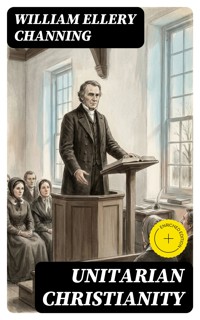
1,99 €
Niedrigster Preis in 30 Tagen: 1,99 €
Niedrigster Preis in 30 Tagen: 1,99 €
Mehr erfahren.
- Herausgeber: DigiCat
- Kategorie: Religion und Spiritualität
- Sprache: Englisch
In "Unitarian Christianity," William Ellery Channing articulates a compelling vision of faith grounded in reason and moral integrity. Channing's eloquent prose combines philosophical depth with accessible clarity, addressing contemporary religious debates of the early 19th century. The book stands as a pivotal manifesto for Unitarianism, emphasizing a rational approach to spirituality, the importance of individual conscience, and the inherent goodness of humanity, challenging orthodox views of the time. Channing's literary style is marked by persuasive rhetoric and theological insight, encouraging a departure from dogmatic beliefs towards a more personal understanding of the divine. William Ellery Channing, a prominent Unitarian minister and theologian, played an instrumental role in shaping American religious thought. His upbringing in the early American religious landscape, coupled with his profound engagement with Enlightenment principles, informed his belief in an ethical and impassioned faith. Channing's commitment to social justice and reform—evinced through his abolitionist stance—further illustrates his dedication to aligning faith with reason and moral action. "Unitarian Christianity" is an essential read for anyone interested in the evolution of religious thought, offering a fresh perspective that continues to resonate today. Channing invites readers to embrace reason, understand the moral imperatives of faith, and engage critically with their beliefs, making this work both relevant and transformative. In this enriched edition, we have carefully created added value for your reading experience: - A succinct Introduction situates the work's timeless appeal and themes. - The Synopsis outlines the central plot, highlighting key developments without spoiling critical twists. - A detailed Historical Context immerses you in the era's events and influences that shaped the writing. - A thorough Analysis dissects symbols, motifs, and character arcs to unearth underlying meanings. - Reflection questions prompt you to engage personally with the work's messages, connecting them to modern life. - Hand‐picked Memorable Quotes shine a spotlight on moments of literary brilliance. - Interactive footnotes clarify unusual references, historical allusions, and archaic phrases for an effortless, more informed read.
Das E-Book können Sie in Legimi-Apps oder einer beliebigen App lesen, die das folgende Format unterstützen:
Veröffentlichungsjahr: 2022
Ähnliche












Unitarian Christianity
Table of Contents
Introduction
In Unitarian Christianity, William Ellery Channing advances the claim that Christian faith shines brightest when the light of reason, the authority of Scripture, and the voice of conscience illuminate one another, resisting both creedal coercion and skeptical dismissal. Set amid early nineteenth-century debates over the Trinity and the shape of Christian morality, his appeal insists that intellectual honesty and devout piety are companions, inviting readers into a broad, charitable, and practical religion. By affirming the unity of God and the reality of moral responsibility, he challenges inherited formulas while seeking common ground, urging a Christianity tested by reason and proved in conduct.
First delivered in Baltimore in 1819 at the ordination of Jared Sparks, Unitarian Christianity is a sermon that swiftly entered print and circulated well beyond its local occasion, becoming a focal point in early American theological controversy. As a work of public religious argument situated in the pulpit yet aimed at the wider republic of letters, it stands at the crossroads of sermon and essay, addressing questions of doctrine, interpretation, and piety. Its setting is the early national period, when Protestant denominations in the United States were clarifying identities and practices amid rapid social change and expanding democratic sensibilities.
Readers encounter a voice that is calm, exacting, and pastoral rather than polemical, moving by careful definition and cumulative reasoning rather than flourish. Channing lays out principles in orderly sequence, returning repeatedly to the authority of the Bible interpreted with disciplined common sense and to the moral character of God as a touchstone. The prose favors clarity over ornament, with examples drawn from everyday judgment to make theological claims intelligible. The tone is confident yet conciliatory, offering firm disagreement without caricature, and encouraging patience, inquiry, and mutual respect as the means by which religious truth is best discerned.
At its center lies a simple confession that God is one, accompanied by an insistence that doctrines must answer to the plain tenor of Scripture and to the moral sense. The sermon argues for the use of reason as a God-given faculty for interpretation, resists speculative formulas that obscure devotion, and emphasizes the ethical fruits of faith. It treats the person and work of Jesus with reverence while distinguishing his mission from claims that collapse him into the Deity, and it stresses accountability, growth in virtue, and hope grounded in the goodness of God. Charity toward opponents is integral, not optional.
It soon came to symbolize the emerging identity of American Unitarianism, clarifying for supporters and critics alike the grounds on which a liberal Christian could stand. By articulating a method that combined scriptural study with disciplined reasoning and moral testing, the sermon offered a template for religious disputation in a democratic culture. Its influence reached beyond denominational lines, informing broader conversations about education, conscience, and the rights of private judgment. The text also models a way of dissenting without rancor, demonstrating how public theology can be rigorous, accessible, and civic-minded at once.
For contemporary readers, the questions that animate Unitarian Christianity remain urgent: how to hold faith and intellect together, how to weigh tradition against conscientious interpretation, how to measure doctrine by its ethical consequences. In an age of polarized discourse, Channing’s insistence on fairness, proportion, and candor offers a corrective to caricature and suspicion. His emphasis on the moral character of religion invites attention to how belief translates into conduct and communal responsibility. The sermon also provides tools for interfaith and intrafaith dialogue, framing disagreement as a shared search for truth under the claims of integrity and humility.
Approached today, the sermon rewards slow reading, with its arguments building step by step toward a vision of Christianity that is both spiritually earnest and intellectually transparent. One can trace how a pastoral concern for conscience organizes the whole, making even technical questions feel connected to everyday moral life. For students, clergy, and lay readers, it offers a primer in how to reason from texts to life without sacrificing reverence. Above all, it reminds us that the pursuit of religious understanding can be charitable as well as exacting, and that clarity is a form of devotion.
Synopsis
Unitarian Christianity, William Ellery Channing’s 1819 ordination sermon in Baltimore, sets out to define the principles of a liberal Christian faith amid controversy. Addressing both sympathizers and critics, Channing clarifies what Unitarians affirm, not only what they refuse. He frames the discourse as a call to conscientious inquiry, insisting that Christianity engages the understanding as well as the heart. The sermon seeks to distinguish essential truths of religion from human additions, resisting coercive creeds and inherited suspicions. With a measured tone, it proposes that genuine piety is strengthened, not threatened, when doctrines are examined openly, and when reverence cooperates with disciplined interpretation.
Channing begins with method, arguing that Scripture must be read with the same rational care applied to other texts, attentive to language, context, and the character of its authors. He asserts the right and duty of private judgment, contending that no church authority may bind conscience beyond the evident teachings of the New Testament. Where interpretations conflict, the controlling standard is the moral perfection of God and the coherent sense of the whole. He cautions against forcing obscure passages to overrule clear ones and maintains that genuine mystery should not be confused with contradiction, error, or claims that affront reason and conscience.
From this foundation he advances the doctrine most associated with the sermon: the unity of God. Channing holds that the Bible presents one Supreme Being, whose wisdom, goodness, and justice order creation and moral government. He regards complex theories that blur this unity as unsupported by the clearest scriptural witness and as tending to obscure devotion. While acknowledging that revelation contains depths, he argues that religious language should not assert what the mind cannot reconcile with divine moral perfections. Worship, therefore, is directed to the one God, with adoration heightened rather than diminished when believers approach through intelligible, consistent truth.
On the person and office of Christ, Channing portrays Jesus as the divinely commissioned revealer of God’s character and the guide to human perfection, yet distinct from the Supreme Being. He treats the New Testament as presenting a subordinate Son who depends on the Father, while still serving as the central medium of Christian faith. Miracles attest the authority of the message, but the inward excellence of Christ’s spirit and teaching supplies a confirming evidence accessible to conscience. This view preserves the uniqueness of Christ’s mission without requiring assertions that confound reason, and it directs imitation and worship in their proper relation.
Extending these principles, the sermon presents a hopeful view of human nature. Channing emphasizes the capacity for moral growth under God’s parental government, rejecting notions that depict humanity as incapable of goodness without annihilating freedom. Repentance, discipline, and trust in divine aid foster character, and the ends of religion are seen in purity of heart and beneficent action rather than subscription to complex dogmas. He argues that sanctions of reward and punishment are intelligible only in a system that honors responsibility. Salvation thus involves transformation of life and mind, with the promises of Christianity binding believers to practical righteousness and charity.
Measured critiques follow from these claims. Channing questions interpretations that portray human guilt as total, divine decrees as unconditional, or atonement as the transfer of penalties in ways that appear inconsistent with equity. He urges that disputed systems yield to the combined testimony of Scripture, conscience, and the moral attributes of God. Yet he counsels candor and forbearance, declining to make speculative points the test of Christian standing. Unitarians, he insists, should be judged by the fruits of their faith, as should their opponents. The sermon therefore balances controversy with a plea for mutual respect, public honesty, and spiritual seriousness.
In closing, Channing links doctrine to devotion and character, contending that a reasonable, scripturally grounded faith deepens reverence and strengthens civic and domestic virtue. The vision he outlines shaped subsequent American religious liberalism, encouraging open inquiry, ethical reform, and cooperation across denominational lines. The sermon’s enduring resonance lies less in institutional prescriptions than in its confident appeal to conscience and its assurance that piety need not fear understanding. Without depending on technical disputes, it leaves readers with a framework for testing teachings by their fidelity to God’s goodness and to Christ’s spirit, a framework that invites continuing, charitable examination.
Historical Context
William Ellery Channing delivered his sermon commonly known as Unitarian Christianity on May 5, 1819, at the ordination of Jared Sparks in the First Independent Church of Baltimore. Channing had served since 1803 as minister of Boston’s Federal Street Church, a prominent liberal Congregational pulpit. The Baltimore occasion placed a New England controversy before a broader public. The sermon, quickly issued in pamphlet form, circulated widely in the United States and Britain. The setting—an ordination in a newly organized independent congregation—gave Channing a platform to define a movement that had grown within New England parishes yet often avoided formal creedal declaration.
Early nineteenth-century Massachusetts still maintained the Congregational standing order, with towns supporting parishes and ministers through taxation. Within this system, a theological divide widened between liberal ministers in Boston and orthodox Calvinists elsewhere. A pivotal institutional marker was Harvard College’s 1805 election of Henry Ware Sr., a liberal, to the Hollis Professorship of Divinity, signaling control of ministerial training by Unitarians. Orthodox leaders responded by founding Andover Theological Seminary in 1807 to defend Trinitarian Calvinism. These competing institutions shaped pulpits, periodicals, and networks that formed the immediate backdrop for Channing’s Baltimore address.
Channing’s approach drew on currents of Enlightenment moral philosophy and biblical criticism compatible with Protestant piety. New England clergy absorbed Scottish Common Sense realism and English liberal theology that prized reason and conscience in interpreting Scripture. British Unitarians like Joseph Priestley and Theophilus Lindsey had earlier articulated anti-Trinitarian readings and modeled congregational reform, and their writings were known in Boston circles. American liberals rejected charges of irreligion by emphasizing the character of God as benevolent and the example of Jesus as ethically authoritative. These ideas furnished the intellectual vocabulary that Channing systematized before a national audience.




