


Erhalten Sie Zugang zu diesem und mehr als 300000 Büchern ab EUR 5,99 monatlich.
- Herausgeber: Books on Demand
- Kategorie: Geisteswissenschaft
- Sprache: Englisch
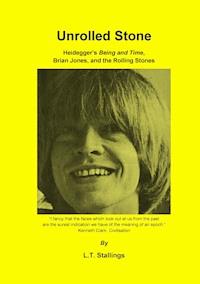
*A Fusion of Horizons* Unrolled Stone proposes to do nothing less than treat the Rolling Stones for the first time ever as a genuine cultural phenomenon worthy of what might be called ‘philosophical’ attention. The fundamental significance of this analysis acquires its incisive shape on the scaffolding of Heidegger’s Being and Time. Even though the focal point of the existential analytic employed focuses around the late Brian Jones, still the book is designed to situate the truth-claim of the Rolling Stones within the broader horizon of a universal radical uprootedness which constitutes the necessary point of departure for any serious reflection concerning the very meaning of existence in today’s belongingless historical epoch.
Sie lesen das E-Book in den Legimi-Apps auf:
Seitenzahl: 178
Veröffentlichungsjahr: 2016
Das E-Book (TTS) können Sie hören im Abo „Legimi Premium” in Legimi-Apps auf:
Ähnliche




















CONTENTS
Frontispiece
Dedication
Acknowledgements
My Personal Journey to the East – The Life and Death of a Burning Idea
Preface (a portion)
Preface: The Dis-ease of the Times
Note
The Précis, How to Read It, or Not Read It: An Excursus
Original Cover
Précis
“Adonais” by P.B. Shelley
Scapegoat
The Soundtrack of Modern Times
Ripping the Core From the Big Apple
The Scream
In Track of a Shadow
Tightrope Ride
Is Nothing Sacred?
Annex
Recommended Reading
The Spirit of ‘76 – A Biographical Sketch
An American Dream?
Personal / General
“What I Have Lived For” by B. Russell
FRONTISPIECE
To Paul Demeny
Charleville 15 May 1871
“…The Poet makes himself a SEER through a long, tremendous, planned DERANGEMENT of ALL THE SENSES. All the forms of love, of suffering, of madness: he himself seeks and in himself exhausts all poisons, so as to keep only the quintessences. Ineffable torture that takes all his faith, all his superhuman strength, that makes him, among his fellow-men, the great Sick Man, the great Criminal, the great Accursed – and the supreme Sage! – For he reaches the UNKNOWN. Because he has cultivated his soul, rich already, more than anyone else! He reaches the unknown, and if, maddened in his pursuit, he should in the end lose all understanding of his visions, still he has seen them! Let him perish in his fling through things unheard-of and unnameable; other terrible toilers will come; they will start out from the horizons where he succumbed! … ”
Arthur Rimbaud (1854-1891)
(see E. Kahler, The Tower and the Abyss, pp. 137-138)
DEDICATION
In a spirit of respectful admiration, this book is dedicated to the memory of MARTIN HEIDEGGER, who has so radically illuminated the shimmering horizon of the historical present, and to the ROLLING STONES themselves, who have dared to grope so courageously toward its ever-evasive irresistibility.
“Our destiny exercises its influence over us even when, as yet, we have not learned its nature: it is our future that lays down the law of our today.” – Friedrich Nietzsche
ACKNOWLEDGEMENTS
I am humbly indebted to and gratefully salute three illustrious teachers whose Socratic midwifery has been especially crucial in the critical steps of my own thinking development:
Professor Charles Drekmeier of Stanford University
Professor Albert Borgmann of the University of Montana (formerly of the University of Hawaii)
Professor J. L. Mehta of both the University of Hawaii and Harvard University
Sine quibus non
“Came Neptunus
his mind leaping
like dolphins…” – Ezra Pound
A FINAL ACKNOWLEDGEMENT
I would like to take this last opportunity to profusely thank Lucas Kent Ogden for his incredible exertions and labors on my behalf in the preparation and publication of this new version of Unrolled Stone.
A gentleman, scholar, and dear friend, without his undying help, support, and advice, this book would never have seen the light of day.
He understood perfectly that the Sixties were a spiritual stampede of power, depth, and creativity on all fronts, especially in the field of music. More than a historical event, they represent a permanent possibility of the human spirit, and an expansion of consciousness. They can be reactivated and embodied any where, any time, by any and every body. In short, a cultural and spiritual heritage that can never die.
Thanking you once again for everything you have done for me… My life has been enriched by your presence…
Sine quo non
*P.S. – I would also like to thank Daniel Schottmüller for a last-minute proof-reading of the entire book. He not only went over the text with a fine-tooth comb, but as a stickler for detail he has a truly microscopic eye. Superb job, thank you so much!
“There’s no success like failure, and failure’s no success at all.”
– Bob Dylan
*My Personal Journey to the East –
The Life and Death of a Burning Idea*
To the Reader,
I hereby put into your hands a work that has been the labor of a lifetime. If you derive as much pleasure in reading it as I did in writing it, my gargantuan efforts on your behalf will have been more than rewarded.
Let me explain…
The theme of Unrolled Stone as a book is TECHNOLOGY and NIHILISM, the deepening existential crisis, relativity, and collapse of the highest values in our time – an AXIOLOGICAL meditation (moral, aesthetic, religious, and metaphysical – the “polytheism” of values).
The dramatis personae are: Martin Heidegger, Brian Jones, and the Rolling Stones.
Unrolled Stone as it now stands, after a hiatus of more than 40 years, I will try to publish once again. The structure is basically a triptych consisting of:
A
Précis
(written in 1971 – 50 pages).
In Track of a Shadow
(written in 1972 – 50 pages).
An
Annex
(compiled in 2015 – 100 pages).
My own interest in the Rolling Stones goes back to early 1964 when they first cut “Not Fade Away,” and I have taken great pains to minutely follow their step by step total development with passionate precision ever since (even to the extent of walking across campus in Hawaii to my graduate philosophy seminars in the mid-1960’s with a copy of 16, Fave, or Rave magazine under my arm if a peripheral article or newsy item had turned up on the Stones in a particular issue).
So it need hardly be said that Unrolled Stone is not merely a flash-in-the-pan or fly-by-night affair. My own remarks from a July 29th, 1966, newspaper review of the first Rolling Stones’ concert in Honolulu (cited on p. → of the Précis) should be sufficient enough objective evidence to belie such an assertion. Throughout the five year course of Ph.D. studies in Comparative Philosophy at the East-West Center, U. of Hawaii, where I specialized in Contemporary European and Indian Philosophy, the germ of Unrolled Stone slowly unfolded with a quasi-conscious surety – until near the end of 1971.
I decided then and there to postpone the imminent completion of a doctorate in Germany, because I strongly felt that such a novel book on the Rolling Stones had to be written before all else, had to be done NOW at the most relevant historical moment possible. Why? Because I saw with a blinding clarity that what the Rolling Stones were SINGING about (with its Blues foundation) was IDENTICAL with what HEIDEGGER was WRITING about in Being and Time (a FUSION of HORIZONS).
I was so convinced by the truth and rightness of my insights, that in September 1971 I flew from Hawaii back to the mainland, and then hitchhiked non-stop across America on the Interstate 80 highway from Sather Gate on the U.C. Berkeley campus to the George Washington Bridge (San Francisco → New York City – a 3000 mile journey to the East in 7 days). Why I did this was simple and clear – I wanted to get in touch and stay in touch with leading New York publishers in person.
Therefore, after some trials and tribulations, I managed to get settled down, and compose a detailed Précis (basically a fairly rigorous outline, a philosophically-inspired overview of Unrolled Stone), which I nevertheless believed was watered down enough to be sufficiently intelligible to any moderately attuned senior editor. I submitted the said Précis to Harper & Row, and five other big-name publishing houses in New York in 1972. Only Harper expressed a really genuine interest in financially supporting such a unique book, and they asked me at the end of the Stones’ Exile on Mainstreet tour that summer (1972) to write up an actual sample chapter from the book – which I duly submitted that November (1972) entitled In Track of a Shadow (essentially an intricate elucidation of the song “Paint It Black” that stresses Brian Jones’ crucial role in the song’s eery genesis). In this respect In Track of a Shadow is a concrete extension of the Précis to Unrolled Stone.
The sample chapter, the centerpiece, the jewel in the crown of the triptych that is Unrolled Stone, also represents a stylistic experiment in language whose incipient radicality I hope can be appreciated. Indeed, I can honestly say that every word has been thought out in terms of its subtlety and potential richness. In other words, I don’t think there is a wasted word in the whole chapter. In this age of the obvious decline of language, language itself must be re-juvenated, be re-imbued with the artistic power to really speak, to literally generate ‘reality.’ This means that any writer has an awesome professional responsibility that cannot be shirked, for as Nietzsche has said, “every word is a prejudice.”
Leaving aside all feigned sense of modesty, I firmly believed that Unrolled Stone would be quite simply the definitive work on the Rolling Stones. The Rolling Stones would HAPPEN in the book that comes THROUGH me. The TEXT would be the thing that has happened.
But I was faced with a pressing, yet fundamental problem, which was simply this: MONEY (and hence by implication TIME). The big-name publishers with enough money to advance for the completion of Unrolled Stone were too narrow mindedly conservative and short sighted to see the patently obvious existential import of this book, while the smaller publishing companies, although far more flexible and open-minded, simply did not have the necessary available funds to adequately back such a venture.
In short, I was left hanging, my burning idea, my dream, died, not even stillborn (à la David Hume’s Treatise On Human Nature), but not born at all. I was forced by circumstance to give up my project at the end of 1973, and resume my graduate studies in philosophy in Germany at the beginning of 1974. The cost in TIME and ENERGY had been immense, over two years (1971, 1972, and 1973).
*Concluding Remarks*
However, all is not lost. I still have the manuscript in two parts, a Précis, and a sample chapter, In Track of a Shadow – a total of around 100 pages. Although not a book, but an amputated TORSO, or a book PROJECT, I still believe its basic insights are valid and true as far as they go even today, perhaps even more so than ever today.
So what I have done this year is to compile an Annex in six parts (p. →), a total of more than 100 pages. Its purpose is twofold: to flesh out the Zeitgeist (“spirit of the times”), the framework, the backdrop, the Weltanschauung (“worldview”) existing back then, and to show how a book project like Unrolled Stone came into being, its GENESIS as it were.
The documentation thus presented, exhibited, is rigorous, massive, comprehensive, and varied. It consists overwhelmingly and almost entirely of my own writings and publications of the time 1971-1973 in various fields of endeavor (poems, articles, letters, etc.).
And so dear reader I take leave of you now, hoping that Unrolled Stone will resonate, echo within you as it has for me all these years… Fare Thee Well…
L.T.S.
Tübingen, Germany
June 16, 2015
PREFACE (a portion)
In terms of the current temporal interplay of a receding horizon of over-arching meaning and its shuddering result – namely an underlying, concrete historicity – one dominant question continues to hauntingly animate the interpretive thrust of this book: what are the fateful conditions for the possibility of someone like a ROLLING STONE? Even though it is stated in a provisionally Kantian manner, clearly this is no ordinary question, however much it might seem so to the thoughtless and the un-receptive who typify much of the insensitive “dead weight” of the present. For in its very asking is embedded much of the RADICAL UPROOTEDNESS of our own age, the age of the planetary collision between modern man and global technology in the retrogressive context of a darkening world relentlessly metamorphosing itself into a flattened-out, valueless, pure mathematical present (this exhaustive and exhausting process of “de-spiritualization” obscenely parades itself naïvely under the euphemism of “progress”). It is precisely in its UNROLLING through the life-stretch of a single yet significant human being that this unordinary QUESTION acquires the status of a productive MARK which can only be glimpsed in the form of an incisive PORTRAIT.
If the reader will but dis-cover some jagged fragments of his own life-history in the gathering sweep of this study, then the author feels that the book will have more than accomplished its exploratory task: to wit, an ILLUMINATION of the commonality of individual fates that dovetail inexorably into a generational rubric that can be called a “DESTINY.” We shall be ‘on the way to wisdom’ when we thinkingly accept the loosened shackles of our own fatefully binding destiny, for it is assuredly only the felt resistance of these never-to-be-fuIly-broken chains that will allow us to dance with the tranquil yet joyous fervor of a Zarathustra, a Zorba, or a Jumpin’ Jack Flash. This is the passionate freedom which does not so much break with and thus shatter tradition altogether, as it does re-appropriate the waiting claim of that same heritage in ever novel yet authentic ways. It is only in such a manner that we can even begin to step beyond the shrill, paralyzing nihilism of our essentially “belongingless age,” the age of the Rolling Stones… “Into each new home we must take the old gods with us” (Wilhelm Dilthey’s essay “The Dream” – cf. H. Meyerhoff’s The Philosophy of History In Our Time).
“What does nihilism mean?
THAT THE HIGHEST VALUES
DEVALUATE THEMSELVES,
The aim is lacking: ‘WHY?’
finds no answer.” – Friedrich Nietzsche
“I wish I never left home.” – Brian Jones
PREFACE: The Dis-ease of the Times
For an increasing many of us today the most thought-provoking thing about this essentially thoughtless age is that we are in danger of suffocating within the iron grip of invisible powers and opaque forces utterly beyond the control, ken, and call of anyone. Indeed, the uncanny ‘logic’ of contemporary events simply reinforces a pervasive feeling already tinged with deep disquiet, angry outrage, and paralyzing despair: namely, that a full-blown nihilism as the ‘normal’ condition of man is being blindly forged out of the sagging crucible of our precarious era.
In barely disguised, lonely desperation we linger in the heartland of a technocratic void which rides roughshod over the fragile aspirations of an emerging humanity, and which with equal mindlessness mutilates the vulnerable ecological body of Nature on the grim rack of economic ‘necessity.’ Our institutions – whether we speak about the family, the school, the church, the university, the labor union, the business corporation, the governmental agency, or the State – have degenerated into little more than reciprocal and overlapping networks of internalized violence; while directionless ‘leaders’ either urge us to glut ourselves aimlessly at the expense of others, or mouth jellied clichés squeezed from the exhausted residue of an ossified past. Our jobs have become psychic prisons chaining us to the treadmill of a meandering oblivion, and we are in effect bludgeoned in order to march in thudding step to a straightjacket conformity which is ‘killing’ time while time kills us. Mindsuicide would seem to be the indispensable precondition for the perpetuation of a much emulated, swinish contentedness and its necessary correlate – a dubious sanity.
If we step back, however momentarily, from the subliminal din of advertising, with its busyness-as-usual ‘ethic’ doggedly bombarding the innermost recesses of our fleeting, personal lives, at some point we are forced by our own integrity to raise certain fundamental questions concerning the undeniable bankruptcy and shipwreck of our own age: Who are we? Where are we going? What is the point of it all? If we go further and attempt to shake the bars of the elaborate cages that have been so carefully constructed for us by the mysterious machinations of self-deceptive, calculating others, we are told that it is rude and even ‘unreasonable’ to be so shrill. Moreover, to persist in such behavior and refuse to be co-opted is tantamount to being relegated to the supine position of a random psychiatric couch, or guilty genuflection before the forgiving intolerance of an all-embracing, glassy theological gaze.
At least this much is certain: we have understood better than our elders in the very guts of our daily lives the ‘death of God,’ and have experienced the numbing tug of the absurd as it draws us into the gaping jaws of a crystalline nothingness. The Bomb and boredom – these are the existential absolutes between which we are challenged to chart the hazardous course of a potentially authentic, common ‘destiny’ on a choppy sea rife with uncertainty.
Although it would be sheer mystification to expect a beplumed phoenix of hope to emerge magically and unscathed from the scattered ashes of our historical epoch, nevertheless certain striking traces or iridescent striations are becoming more and more clearly distinguishable on the groundless bedrock of the immediate present. For example, viewed from the intimate standpoint of an atrophied and dying dominant culture which is fed by the yawning hiatus between private isolation and public chaos, perhaps the most singularly significant phenomenon of recent years worthy of genuine futural promise has been the sudden emergence and rapid growth of the Counterculture. In spite of the loose heterogeneity of its budding elements, the poignant thrust of its diffuse reverberations coalesces around the unshakeable core of a tirelessly repeated and consistently vociferous message: the dominant culture’s total counter-productivity vis-à-vis the needful implementation of genuine human aspirations and values into society-at-large. The universal language of this Counterculture has been and will continue to be the infectious, driving dynamism of rock and roll music, and to be sure the shock-waves emanating from its vibrant center have quite literally rocked the world. If it is legitimate to speak of an ongoing cultural revolution in the West which is shaking the brittle foundations of our senescent civilization, then it hardly can be doubted that rock and roll music is not an authentic voice of this widespread and general upheaval.
Certainly everyone caught up in it has his or her favorites in the shifting solar system of rock music, but a steady, reflective glance backwards to the tumultuous history of the 1960s and then forward to our own present brings to light an observation fraught with the utmost interpretive significance: to wit, that together with Bob Dylan and the Beatles, the exciting lyrical, percussive energy and the radical life-style of a leering, shaggy quintet called the Rolling Stones has had and continues to have the most formative, dramatic effect on the life-orientation and world-view of dissatisfied, discontented millions who would immediately define themselves in terms of an unflinching allegiance to the developing Counterculture. It is precisely the Age of Rock which has given birth to the Rolling Stones, but what is so remarkable in all of this is a notorious dearth of intelligent commentary and written material on them, as compared to the bevy of published opinion readily available concerning Bob Dylan or the Beatles – especially when the Rolling Stones have stood out like such stellar objects of the first magnitude in the dawn of our own day. Could it well be that there is an underlying residual fear, a sneaking suspicion that the Rolling Stones embody too much what might be loosely designated ‘the spirit of the times’ as it were, that the black beam they cast back upon their own present is too blinding to be ever acknowledged, let alone taken with a seriousness even remotely bordering on the philosophic? We believe this to be so much the case that this book itself constitutes a dedicated, quasi-systematic attempt to rectify the currently deficient state of affairs, and thus endeavors to do at least some necessary historical justice to the existential import of the Rolling Stones, not only as a decisive rock and roll music group or as highly influential flesh-and-blood individuals, but as consequential concrete symbols, radiating prisms illuminating and typifying the ‘essence’ of our own times …and its involuntary dis-ease. It is precisely in this latter sense that to ask about the Rolling Stones is to raise with equal significance the fundamental issue concerning the meaning of ourselves …our very lives in the course of this convulsive epoch.
Therefore, in terms of what has been briefly sketched out in the preceding paragraphs, one dominant question continues to hauntingly animate the interpretive thrust of this book: what is the MEANING of the Rolling Stones in both an overall and underlying sense, or more pointedly, what does it MEAN TO BE a Rolling Stone? Even though it is stated in a provisionally philosophical manner, clearly this is no merely abstract, harmless question, however much it might seem so to the thoughtless and the unreceptive who characterize much of the insensitive “dead weight” of the present. For, as has already been alluded to, in its very asking is embedded much of the RADICAL UPROOTEDNESS of our own age, an age which is witnessing a planetary collision between modern man and global technology within the retrogressive context of a darkening world that is relentlessly transforming itself into a flattened-out, valueless, pure mathematical present (this exhaustive and exhausting process of ‘de-spiritualization’




