


19,99 €
Mehr erfahren.
- Herausgeber: John Wiley & Sons
- Kategorie: Geisteswissenschaft
- Sprache: Englisch
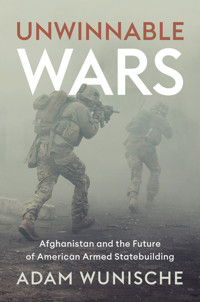
In nine short days, Taliban forces destroyed two decades of American armed statebuilding in Afghanistan. This was no isolated failure. Over the last century, almost every attempt to intervene militarily to prop up or reconstruct an allied state has seen similar dismal outcomes. Why? This book answers that fundamental question.
By exploring the factors that hindered success in Afghanistan, Adam Wunische identifies forces common to other unsuccessful U.S. armed statebuilding missions, from Vietnam to Syria, Haiti to Iraq. These forces, he argues, inherently favor insurgencies, forfeit sustainability for quick results, and create dependencies and corruption – all of which undermine the goal of building a state that can stand on its own. Not only that, but most of these forces are inescapable and uncontrollable. This means any future attempts at armed statebuilding will likely also be unwinnable, with costs and consequences far outpacing America’s interests and benefits.
Faced with a future likely dominated by proxy wars, Wunische offers a novel way forward to prevent the U.S. from chasing new wars that it is destined to lose.
Sie lesen das E-Book in den Legimi-Apps auf:
Seitenzahl: 386
Veröffentlichungsjahr: 2023
Ähnliche




















CONTENTS
Cover
Notification
Title Page
Copyright
Abbreviations
Preface
Introduction: The Fall of Kabul
Why Did the U.S.-Backed Government Collapse in Just Nine Days?
Structure of the Book
Conclusion: The Long Road to Collapse
Notes
1 Preexisting Conditions
Introduction: The Graveyard of Empires
Inaccessible Geography
Resentment Against Foreign Forces
Ethnic Fragmentation
Potential Mitigating Conditions
Post-WWII Anomalies
Conclusion: Preexisting Conditions Dictate
Notes
2 Ticking Clocks
Introduction: You Have the Watches, We Have the Time
Military Timelines of the Intervenors
Political Timelines of the Intervenors
Timelines of the Locals
Conclusion: Culminating Point of Victory
Notes
3 Dilemmas
Introduction: Between a Rock and A Hard Place
Structural Forces
The Institutions We Keep
Dilemmas in Action
Conclusion: Misplaced Preferences
Notes
4 Paradoxes
Introduction: Do No Harm
Dependence
Disruptions
Conclusion: Moral Hazards
Notes
5 Avoiding Unwinnable Wars
Introduction: Pursuing What Objectives?
In the Beginning, Plan for the End
Alternative Futures in Afghanistan
Tasks in Isolation
Mission Creep
Conclusion: Selective Engagements
Notes
6 Wars Worth Fighting
Introduction: U.S. Foreign Policy Debate over Afghanistan
From Here, Where?
A New Framework: Assessing If and How to Intervene
The Future is (Probably) Grey
Tradeoffs in Pursuing Different Options
Hypothetical Cases
The Strategic Patience Option
Conclusion: Chasing Unwinnable Wars
Notes
Index
End User License Agreement
Guide
Cover
Table of Contents
Notification
Title Page
Copyright
Abbreviations
Preface
Introduction: The Fall of Kabul
Begin Reading
Index
End User License Agreement
List of Figures
Chapter 1
Figure 1.1
Guard Tower at U.S. Airbase Showing the Geographic Inaccessibility of Afghanista…
Figure 1.2
U.S. Armed Statebuilding Cases
Chapter 2
Figure 2.1
Terrorism Events in Afghanistan, 2001–2019
Figure 2.2
Taliban Tightening Control Around Cities by 2019
Figure 2.3
Growth of Commandos Relative to Total ANA
Figure 2.4
Comparative U.S. Public Approval for Iraq and Afghanistan Wars
Chapter 3
Figure 3.1
Timeline of Statebuilding Institutions, WWII-Vietnam
Figure 3.2
Timeline of Statebuilding Institutions, Iraq and Afghanistan
Figure 3.3
PRTs and Command Country by Province and Year
Figure 3.4
Economic Aid and Military Assistance in Vietnam
Chapter 5
Figure 5.1
Types and Level of Violence in Colombia, 1988–2012
Chapter 6
Figure 6.1
Notional Graph Imagining Increase in Resistance as Objectives Increase in Afghan…
Figure 6.2
Intervention/Conditions Matrix Cases
List of Tables
Introduction
Table 0.1
U.S. Armed Statebuilding Cases and Outcomes
Chapter 6
Table 6.1
Relationship between Type of Intervention and Limiting Forces
Table 6.2
Determination of Favorable Conditions
Table 6.3
Framework Applied to Afghanistan, 2001
Table 6.4
Framework for the United States Applied to Ukraine and Syria
Table 6.5
Framework for the United States Applied to Taiwan Post-Invasion
Table 6.6
Framework for the United States Applied to Taiwan Without Invasion
Table 6.7
Framework for the United States Applied to Myanmar
Table 6.8
Framework for the United States Applied to Haiti
Pages
ii
iii
iv
viii
ix
x
1
2
3
4
5
6
7
8
9
10
11
12
13
14
15
16
17
18
19
20
21
22
23
24
25
26
27
28
29
30
31
32
33
34
35
36
37
38
39
40
41
42
43
44
45
46
47
48
49
50
51
52
53
54
55
56
57
58
59
60
61
62
63
64
65
66
67
68
69
70
71
72
73
74
75
76
77
78
79
80
81
82
83
84
85
86
87
88
89
90
91
92
93
94
95
96
97
98
99
100
101
102
103
104
105
106
107
108
109
110
111
112
113
114
115
116
117
118
119
120
121
122
123
124
125
126
127
128
129
130
131
132
133
134
135
136
137
138
139
140
141
142
143
144
145
146
147
148
149
150
151
152
153
154
155
156
157
158
159
160
161
162
163
164
165
166
167
168
169
170
171
172
173
174
175
176
177
178
179
180
181
182
183
184
185
186
187
206
207
208
209
210
211
212
213
All statements of fact, opinion, or analysis expressed are those of the author and do not reflect the official positions or views of the U.S. Government. Nothing in the contents should be construed as asserting or implying U.S. Government authentication of information or endorsement of the author’s views.
UNWINNABLE WARS
Afghanistan and the Future of American Armed Statebuilding
Adam Wunische
polity
Copyright © Adam Wunische 2024
The right of Adam Wunische to be identified as Author of this Work has been asserted in accordance with the UK Copyright, Designs and Patents Act 1988.
First published in 2024 by Polity Press
Polity Press65 Bridge StreetCambridge CB2 1UR, UK
Polity Press111 River StreetHoboken, NJ 07030, USA
All rights reserved. Except for the quotation of short passages for the purpose of criticism and review, no part of this publication may be reproduced, stored in a retrieval system or transmitted, in any form or by any means, electronic, mechanical, photocopying, recording or otherwise, without the prior permission of the publisher.
ISBN-13: 978-1-5095-5486-7
A catalogue record for this book is available from the British Library.Library of Congress Control Number: 2023938221
The publisher has used its best endeavors to ensure that the URLs for external websites referred to in this book are correct and active at the time of going to press. However, the publisher has no responsibility for the websites and can make no guarantee that a site will remain live or that the content is or will remain appropriate.
Every effort has been made to trace all copyright holders, but if any have been overlooked the publisher will be pleased to include any necessary credits in any subsequent reprint or edition.
For further information on Polity, visit our website:politybooks.com
Abbreviations
AAF
Afghan Air Force
ANA
Afghan National Army
ANSF
Afghan National Security Forces
ARVN
Army of the Republic of Vietnam
BRI
Belt and Road Initiative
CAP
Combined Action Program
CERP
Commander’s Emergency Response Program
CIA
Central Intelligence Agency
CIDG
Civilian Irregular Defense Group
CORDS
Civilian Operations and Revolutionary Development Support
DoD
U.S. Department of Defense
DoS
U.S. Department of State
FARC
Revolutionary Armed Forces of Colombia
HKIA
Hamid Karzai International Airport
ISAF
International Security Assistance Force
MACV
Military Assistance Command, Vietnam
NGO
non-governmental organization
PRC
People’s Republic of China
PRT
Provincial Reconstruction Team
RED HORSE
Rapid Deployable, Heavy Operational Repair Squadron, Engineer
SFA
Security Force Assistance
SFAB
Security Force Assistance Brigade
SIGAR
Special Inspector General for Afghanistan Reconstruction
USACE
U.S. Army Corps of Engineers
USAID
United States Agency for International Development
Preface
This book started for me on September 11, 2001. Unsurprisingly, this era-defining event shifted the focus and directions of many lives, including mine. I was directionless before and singularly focused after. Afghanistan would quickly come to define nearly the entirety of my adult life. I deployed to Afghanistan for the U.S. Army in 2008 and 2009. I studied Afghanistan throughout my academic career, eventually giving lectures on Afghan history and military developments in the region. My first job after university was as a research fellow covering Afghanistan, and now I focus on Afghan security issues as an analyst for the U.S. Government. The U.S. war in Afghanistan has meant different things to me at different times. While in the Army, it was about a patriotic duty to serve my country. At university, it represented America’s place in a long history of failed interventions. And now, as an analyst, professor, and someone who witnessed the fall in 2021, I’m not quite sure what Afghanistan means to me anymore. Throughout each of these periods, one thing remains clear, someone can spend a lifetime studying a country, talking to its people, and dissecting its history and military affairs and still not know enough. My hope is that this book can contribute something, even if only a small amount, to advancing our limited understanding.
Much of this book identifies the structural and preexisting conditions that led to failure in Afghanistan. There are many books, papers, and articles that identify poor individual decisions and corrupt behavior as the cause of failure. My intent is not to excuse these decisions or minimize the impact of corrupt behavior, but simply to show that these decisions and behaviors are not distinct to Afghanistan. They consistently occur in every armed statebuilding operation and will occur again no matter how much we think we can get it right this time. After 13 attempts at U.S. armed statebuilding over 125 years and the only successes coming in the rare ideal conditions that existed in a historically unprecedented 10-year period following WWII, we need to ask not only what went wrong in Afghanistan but why do operations like Afghanistan never go right?
Much of the commentary on Afghanistan and the wars and operations that followed 9/11 falls short of anything that could be considered consistent with analytic rigor or tradecraft. These commentaries and think pieces, sometimes written by those prominent individuals who have a personal or reputational stake in extricating their own culpability for what happened, will simply state their opinions, and call it analysis. But to call that analysis is disingenuous at best. This book seeks to be a work of honest analytic tradecraft and to do justice to the lived experiences of all those involved in the Afghan war.
Analysis should not torture the data and methodologies, or selectively pick convenient data to acknowledge or ignore, to produce a desired outcome. Analysis should be designed logically and scientifically, be grounded in sound methodologies, gather all available data, and accept the outcome – good or bad. Unfortunately, this rarely happens, especially when considerations of pride, ego, ignorance, or personal careers seep into the analytic process. Nowhere does this happen more than in the analysis of terrorism or counterterrorism operations. Terrorism is a tactic designed to induce fear, which runs counter to the objectivity necessary for good analysis. Fear induced by 9/11 was detrimental to the objective analysis of the international events that followed. This book is a collection of the most important dynamics and forces impacting outcomes of armed statebuilding. It does not seek to tell the convenient story, but a truthful story no matter how difficult or painful that may be.
I have many people to thank for supporting me and without whom I would not be in a position to produce this book. I’m forever indebted to the soldiers, civilians, diplomats, and Afghans who shared their stories. While studying in Thailand, I frequently heard a saying: “When the elephants fight, it’s the grass that gets trampled.” Those that shared their stories were not the elephants, but the grass that had to live with the consequences of poor decisions. I hope I do their stories justice.
I’m grateful to my university advisors, Gerald Easter, Lindsay O’Rourke, and Peter Krause, who instilled in me the skills, knowledge, and insights to be able to produce anything even approaching a legitimate intellectual product. My ideas, and the skills required to formulate and test them, are ultimately the product of a long line of teachers and mentors stretching as far back as my childhood – far too many to mention here, but all appreciated. I am thankful to my parents, Paul and Barb. No matter how absurd or outlandish my childhood ambitions, they were and are always supportive. Finally, I am forever grateful to Whitney Pfeifer. She inspires and challenges me, and I would have accomplished very little in life without her love and support.
Introduction: The Fall of Kabul
It was a few months from my 16th birthday on September 11, 2001. On the west coast of the United States, east coast occurrences are delayed by a three-hour time difference. So, while east coasters knew of some event occurring but did not learn the true nature of the event until after their day had begun, our day on the west coast began with the knowledge of it being a terrorist attack. I was barely aware of world events before that day. I was technically alive and aware for the fall of the Soviet Union, the Oklahoma City bombing, the first Gulf War, and the Bosnian Genocide; I have no recollection of what I was doing at the time or how I personally experienced those events. 9/11 was different. Some experienced the event firsthand and lost loved ones, but the collective American consciousness experienced the event almost entirely as one.
My parents were saving what little extra they had in a college saving account for me. The account would never be used. After that day, nothing could shake me off the path to the U.S. Army. I enlisted in 2004, shortly after I turned 18, into a delayed entry program that enlisted soldiers before their entry date and before they actually left for basic training. I signed up exactly 1 year before my basic training date because it was the absolute earliest I could do so. I could barely wait. So much so that I took summer classes so I could graduate high school early and leave sooner.
I enlisted the first opportunity I could get. I briefly considered other options for entry into the U.S. Army, going to college first and then commissioning as an officer, or becoming a warrant officer and flying helicopters. The problem was those paths took too long. It was 2004, involvement in Iraq had started a mere 12 months prior and I thought if I delayed my entry by even a few months that I would miss the war and it would have all just passed me by. I didn’t miss the war. I would be in training for nearly a year and a half. I came into my unit while they were already deployed, so I had to wait until the next rotation. I deployed twice between 2007 and 2008. I would leave the army in 2010 and go to school for the next decade, giving lectures about Afghan political dynamics and history near the end of that time. I would start teaching at university, courses on terrorism, political violence, and military strategy. I would start a new job in 2020 analyzing the Afghan National Security Forces for the U.S. government. And in 2021, 17 years after I thought I would miss the war, I watched the armed statebuilding operation come to an end and the government it attempted to build collapse in nine days.
In the waning years of the U.S. attempt at armed statebuilding in Afghanistan, and likely in the decades to follow the ultimate collapse of that effort, books, policy papers, reports, and news articles tried to identify “lessons learned,” searching for mistakes so that they might not be repeated the next time. The Special Inspector General for Afghanistan Reconstruction (SIGAR) published a grand culminating report after 14 years of reports submitted to the U.S. Congress saying, “Unless the U.S. government understands and accounts for what went wrong, why it went wrong, and how it went wrong in Afghanistan, it will likely repeat the same mistakes in the next conflict.”1 Many of these efforts that have already been published typically identify one strategy or policy they take particular issue with and argue that, if we are able to change how this was done for the next armed statebuilding war, we might just win it.
But what if changing one or two strategies does nothing to affect the outcome, or what if it is not even possible to change some of these strategies or limitations? If that’s the case, initiating these armed statebuilding operations is starting wars that cannot be won.
Why Did the U.S.-Backed Government Collapse in Just Nine Days?
Afghanistan was the most substantial and expensive armed statebuilding attempt ever, but the groundwork for the swift collapse was laid years in advance, if not decades. The withdrawal of U.S. forces was not a primary (not even a secondary) cause of the collapse of the Afghan government. It was a catalyst that accelerated many of the preexisting and uncontrollable forces that were inherent to the type of operation. Following the withdrawal of U.S. troops, President Biden said at the time, “I refuse to continue a war that was no longer in the service of the vital national interest of our people.”2 Chairman of Joint Chiefs of Staff, General Mark Milley, said during testimony before the U.S. Senate following the collapse that, “I think the end state would have been the same no matter when you [withdrew U.S. forces].”3
Nine Days to Kabul
By September 2021, Lashkar Gah, the capital city of Helmand province in the south of Afghanistan, had been under siege for days. Helmand, along with Kandahar province to the east, together constituted the traditional heartland of the Taliban; it’s where they started their march across Afghanistan in the 1990s and is the home to the ethnic Pashtuns that comprise the vast majority of the organization. The Afghan National Security Forces (ANSF) were stretched thin from years of high attrition. This was not the first time the Taliban had attempted to overrun a major provincial capital, but this time U.S. military power would not push it back.
The decision was made by then Afghan President, Ashraf Ghani, to save Lashkar Gah at all costs. It was probably thought that the loss of a major city in the Taliban’s traditional heartland was too great a propaganda victory for the group to allow it to fall before the Americans had even completed their withdrawal. When the Soviets withdrew from Afghanistan in 1989, the Soviet-supported regime survived for nearly three years after. Units and equipment from the Afghan special forces Commandos and the Afghan Air Force (AAF) were redirected from their postings throughout Afghanistan to Lashkar Gah. Commandos were airlifted into the sports stadium on the outskirts of the city, one of the few areas of the city still in government hands.
Several weeks prior, Herat City in the western province of the same name came under intense pressure from Taliban assaults. A video was posted on social media of Afghan civilians in that city chanting, “Allahu Akbar,” meaning God is greatest, in support of the ANSF defending the city. The chant became a rallying cry of support for the Afghan government and had the potential to be the first narrative shift of the war. For decades the Taliban owned the narrative of being a movement of the Afghan people to expel foreign invaders in the name of God. By chanting “Allahu Akbar,” the Afghan people were disrupting this Taliban narrative, even if by a small margin. The chants went viral on social media and videos emerged from across the country of Afghan civilians chanting in support of the Afghan government. When the commandos landed at the stadium in Lashkar Gah, the ANSF posted a video of them in full gear marching into battle chanting the same phrase. It felt as if the momentum of the last 20 years could shift, but the feeling would not last.
Both sides took heavy casualties in Lashkar Gah. After a brief pause by the Taliban as they cycled in fresh fighters, they launched new assaults in the heart of the city. After taking heavy casualties in the face of the highly competent commandos and AAF air strikes, the Taliban eventually pulled back from the city center. The city was saved for the time being, but there was a cost. The commandos were one of the few competent units in the whole of the ANSF, one of the only ones that could operate independent of significant U.S. support and planning. They comprised about 10 percent of the ANSF but accounted for more than 90 percent of the fighting.4 They had been stretched thin for years and the defense of Lashkar Gah weakened them further. The AAF was a potentially game changing capability for the ANSF, but a very nascent one and years of a high operational tempo and mismanagement was grinding them down. Lashkar Gah increased pressure on aircraft that were already being pushed far beyond their normal operating capacity. Assessments from early 2021 showed 15 of 34 provincial capitals were surrounded by the Taliban and easily cut off from ground resupply.5 The Taliban by this point had the luxury of choosing when and where to launch their assaults and as the ANSF shifted to shore up one city, the Taliban had 14 others to choose from to assault while the ANSF were distracted with, and concentrated in, the first.
With all eyes on Lashkar Gah, the Taliban pulled back from the city center, and with the government in Kabul feeling better about their prospects without U.S. support, a chain of events was initiated that would have the Taliban strolling through the streets of Kabul within nine days, Ghani fleeing the country in secret, and the United States discussing joint security responsibilities with the Taliban at Kabul’s main airport, Hamid Karzai International Airport (HKIA). Lashkar Gah was saved, but it pulled the ANSF’s best and most capable assets away from cities that were also cut off and under threat of a Taliban assault. On August 6, reports emerged that the Taliban had taken Zaranj, the capital city of Nimruz province 150 miles to the southwest of Lashkar Gah on the Iranian border, before any clear indication that fighting was even occurring there. Many were not even aware of where Zaranj was; Nimruz was a backwater province for the international mission in Afghanistan.
The next day, Taliban forces took Jowzjan province. The provincial capital had been in a precarious position for some time, but the capture of a northern province, the heartland of the anti-Taliban resistance (the Northern Alliance) in the 1990s, was strategically significant and effectively killed any prospects of a modern anti-Taliban resistance. The next day, on August 8, three more northern provinces fell to the Taliban. Four provinces fell over the next three days. On August 12, all hope of stopping the bleeding vanished with the capture of Afghanistan’s second and third most populous cities of Kandahar and Herat, along with the capture of the strategic Ghanzi City on highway 1, only 80 miles south of Kabul city. The next day, five more provinces fell, including the beacon of hope early in the initial push, Lashkar Gah. By August 14, some provincial capitals were being taken with little to no fighting, simply being handed over after local forces likely cut deals with the Taliban in exchange for their safety. The capital of the central Daykundi province, Nili, was reported to have been taken with only two gunshots heard in the city.6
After little more than a week of fighting, the Taliban controlled half of the Afghan population and had consolidated control of every power center from their traditional base of power in the south up through Highway 1 leading into Kabul. Little stood in their way of sending everything they had against Kabul. On August 15, Ashraf Ghani, who only a few weeks earlier said he would never abandon his country and author of a book entitled Fixing Failed States, boarded a plane bound for Tajikistan without the knowledge of most of his own security detail and senior cabinet members. He left so abruptly he reportedly did not have time to take his passport or even his own sandals.7 Later that day, residents spotted small groups of Taliban fighters roaming the city as they faced no real organized resistance, and 20 years of U.S. armed statebuilding in Afghanistan was over.
Costs
Could this outcome have been avoided if more money, troops, or time had been committed? In military strategy, the merit of any action is, or should be, determined by the potential benefit to be gained relative to the expected costs, as well as the probability of success and that those benefits will actually be realized. The costs in Afghanistan were substantial. A complete account of the costs of armed statebuilding in Afghanistan may not truly be known for some time (if ever), but an honest attempt must still be made. The operation was historically unprecedented, as was the speed of collapse in its final stage. Many costs are obvious, and their calculation is straightforward. Some of the costs are less clear. Other costs were obscured by standard practices, like the practice of enumerating uniformed U.S. military casualties while omitting those of civilian contractors serving beside them, often exposed to the same harsh conditions and experiencing the same combat, but their experience and contribution were often unrecognized and certainly not honored like those in uniform.
The United States lost over 6,000 uniformed and civilian personnel to combat deaths during armed statebuilding in Afghanistan.8 Killed in the war were also 67 journalists, 424 humanitarian and NGO workers, over 64,000 Afghan national police and army personnel, and over 43,000 Afghan civilians. When accounting for the amount appropriated, interests on loans, and total long-term care for veterans, the war in Afghanistan cost over $2.3 trillion. Billions more were spent on non-military projects, like aid and development efforts. The reconstruction costs in Afghanistan exceeded the Marshall Plan reconstruction of Europe post-WWII.
I was asked by a colleague shortly after the fall of Kabul, what it would have cost to win. The lack of a clear goal or objective that could be achieved aside, there was no amount of money that could have been spent to achieve a more favorable outcome. The large flow of money was itself one of the causes of failure. Large flows of money distort the local economy, engender corruption, and breed dependence, all of which cause major disruptions when that money is eventually withdrawn. A non-monetary option was to increase troop levels at various points in the operation, but foreign military presences cause resentment among the local population. There are similar effects from extending foreign troop presences. The longer they stay, the more the local population will resist it. So, increasing troop numbers, or extending the length of the operation, would have increased pressure on the Taliban but also increased resistance from civilians. In military strategy, they say quantity has a quality all its own. Nowhere is that more false than in armed statebuilding.
Armed Statebuilding is Overdetermined for Failure
In this book, I argue that armed statebuilding in Afghanistan was overdetermined for failure, that the sheer weight of countervailing forces – most of them uncontrollable by the intervening power – negated any policy option or military strategy that could have secured a better outcome. Furthermore, I argue that these forces are present in nearly every armed statebuilding attempt, historical or future, and that initiating them is simply starting a war that cannot be won. They are, unwinnable. This book gathers the research of those that have studied these failed operations and the personal experiences of those involved and shows why armed statebuilding in Afghanistan failed, why nearly every other armed statebuilding attempt has failed, and why any future attempt will also fail.
Preexisting conditions and uncontrollable forces were so great in the U.S.’s armed statebuilding in Afghanistan that the ultimate outcome was essentially guaranteed the moment the operation began, and initiating it was starting a conflict that could not be won. These same forces were present in nearly every other attempt at armed statebuilding that ultimately led to similar outcomes and imposed similar constraints such that no viable alternatives existed. Finally, because these constraints and limitations are preexisting and uncontrollable by the intervening power, any future attempt would likely fail all the same. This is not to say that policy choices and strategies have no effect. They do. But in armed statebuilding, these choices are unlikely to overcome the overwhelming limitations imposed by preexisting and uncontrollable forces. In many cases, policy choices and strategies exacerbated the overwhelming limitations of these forces that, as Daniel L. Byman said about the Iraq war, “even within those narrow limits, the United States made many bad choices that further diminished the chances of success.”9
Alternative explanations for the outcome in Afghanistan consistently disappoint. While countless analysts, policymakers, and armchair strategists have offered their opinions, the counterarguments can be grouped into two unsatisfying arguments: poor choices and lack of commitment.
Analysts like Paul Miller argued that success in armed statebuilding simply needs to match policy and strategy to the conditions present in each case, and failure is the result of poor choices.
10
Former U.S. commander in Afghanistan David Petraeus, argued in an op-ed one year after the collapse that the result was merely due to a lack of commitment by the United States.
11
If it was simply about choices, why has nearly every case failed outside of the pristine conditions in the post-WWII cases? If poor choices are being made that consistently, the choices are probably constrained in some significant way. It cannot simply be about commitment; Afghanistan was America’s longest war ever and cost more than the U.S.funded reconstruction of Europe after WWII. These explanations fail to explain the outcome in Afghanistan, as well as other armed statebuilding attempts.
In social sciences, the term “overdetermined” is used to describe a situation in which so many forces are present that cause a particular outcome, that the fact that that outcome occurred is unsurprising, uninteresting, and of little scientific value. For example, if we know that fragile democracies, racially motivated economic inequality, previous occurrences of terrorism, and bordering a country with an ongoing civil war are each strong predictors of increased levels of terrorism within a country, studying a country in which all these conditions exist simultaneously is of little value. It is so painfully obvious that terrorism would be elevated in such a country that studying it would tell us nothing about the strength or accuracy of each of the variables independently. Armed statebuilding is similar. These operations contain so many causal forces pushing against success that the fact that success does not occur is unsurprising.
Imagine going for a swim in a lake. The water is calm. Every action you take to get from the beach to a buoy near the beach has the intended effect: you move your arm through the water and are propelled forward. Now imagine swimming on an ocean beach and there is a slight current. Your actions still have the intended effect, but the effort needs to be increased in the current to have the same level of effect.
But if there is a rip tide, swimming against the rip tide is hopeless and swimmers are advised to swim parallel to the beach to exit the rip tide first before swimming back toward the shore. Strong currents in rivers overflowing with spring runoffs are some of the most powerful forces of nature and can submerge massive trees for miles before they are able to resurface. Swimming in these conditions will have almost no effect at all. You will go wherever the current pushes you.
Armed statebuilding is like trying to swim against a rapid current, at night, and trying to find your way back to a beach you cannot see 20 miles away.
Afghanistan was not lost because of poor decision making or strategic choices, but rather by unchangeable, overwhelming forces that were always going to be present and will always be present in similar types of operations. Any civilian or military leaders placed in the same position would have faced the same constraints, the same incentives, and the same dilemmas and paradoxes. Poor decisions made by those placed in charge, as documented by many,12 were also either motivated or constrained by these forces and conditions that are present in every armed statebuilding operation. Preexisting conditions in Afghanistan, timeline constraints, dilemmas of asking the military to perform non-military tasks, and the unintended consequences and tradeoffs of aid and development programs all served to make armed statebuilding in Afghanistan functionally impossible.
And Afghanistan is far from an aberration. In Paul Miller’s book on the topic, he identified 13 cases of U.S. armed statebuilding. Armed statebuilding is a type of intervention by one country into another target country “to compel failed or collapsed states to govern more effectively.”13 These operations are comprehensive undertakings that require substantial personnel and financial resources. Miller identified four successes and one shallow success, with the rest rated as failure or mitigated failure. In all these cases, only Haiti in the early 1900s and the post-WWII cases were marked as non-failures. Haiti has been plagued with state failure, corrupt and abusive governance, and human rights violations both before and after the U.S. intervention. The post-WWII cases occurred in a historically unprecedented and unique set of global conditions that enable success in those rare circumstances, which are unlikely to ever occur again. Table 0.1 shows these cases and their outcomes according to Paul Miller, with the post-WWII cases highlighted. For Miller, failures did not achieve any of the goals of statebuilding. Success achieved all goals for more than 10 years after the end of the intervention. Shallow successes achieved stable liberal governance and no atrocities for more than 10 years but no political economic progress. Mitigated failure did not sustain liberal governance or avoid atrocities for at least 10 years but showed some economic and political progress. The inclusion of Haiti as a shallow success by this standard is questionable considering the U.S. marines were accused of human rights violations during the operation itself.14
Table 0.1 U.S. Armed Statebuilding Cases and Outcomes
Source: Data from Miller, P.D. 2013. Armed state building: confronting state failure, 1898–2012. Cornell University Press.
Country
Start Year
Outcome
Cuba
1898
Failure
Cuba
1906
Failure
Haiti
1915
Shallow Success
Dominican Republic
1916
Failure
Nicaragua
1927
Mitigated Failure
Italy
1943
Success
Austria
1945
Success
West Germany
1945
Success
Japan
1945
Success
South Korea
1945
Mitigated Failure
South Vietnam
1962
Failure
Afghanistan
2001
Failure
Iraq
2003
Mitigated Failure
Each of the limiting factors identified in this book are problems on their own, capable of causing armed statebuilding failure independently. They impose incremental costs at the local and tactical level, but across the entirety of the operating area and taken together at scale, they add up to exorbitant and unacceptable costs. They undermine the operation, impose costs on the occupiers, and induce friction at every turn. Taken together simultaneously, at the strategic level, they become an overwhelming and insurmountable obstacle to successful armed statebuilding.
The State and Armed Statebuilding
Although the terms country, nation, regime, and state are casually used interchangeably, there are vital differences between them. It is important to understand these differences in order to realize why the operations fail. Many refer to operations like Afghanistan as nation-building. This is objectively incorrect. A nation is an imagined community of people that construct a common origin story, usually tied to a common geographic location or language. The state is as an organization that successfully claims a monopoly over the legitimate use of violence or coercion within a given territory, meaning the state is an organization that is the only actor within a given territory that can legitimately make and enforce rules and engage in coercion, like arresting people that violate rules, collect taxes, and in some cases kill people. The difference between the state and a criminal gang is that the state is viewed as mostly legitimate, and the gang is not. Members of criminal gangs are arrested for engaging in coercion or violence, members of the state are not, and this is (for the most part) accepted as legitimate by most within that territory. U.S. operations were not trying to build nations, they were trying to build states.
Foreign-imposed statebuilding has increased significantly since the end of the Cold War. The primary intervenor has been the United States, but the Soviet Union and United Nations have also launched such operations. The reasons for the rise of statebuilding operations are primarily great power competition and the increasingly strong international norm of not changing borders through military force. States now, instead of being annexed into the conquering country, must be rebuilt, and returned to indigenous sovereignty.
Statebuilding can also occur internally without foreign intervention. The internal statebuilding process in Europe, where the state as an organization first appeared, was a very long and violent process.15
Armed statebuilding, then, is a military intervention in a foreign country that seeks to build a functioning state or the components of a state as part of a broader military/civilian effort during a time of war or immediately following hostilities. The U.S. military refers to the types of tasks involved in armed statebuilding operations as “stability operations” in official doctrine.16 According to this doctrine, the U.S. military should be able to perform five tasks as part of stability operations: the delivery of humanitarian aid, the provision of security, the building of infrastructure, the building of local security forces, and the building of local governance organizations. Infrastructure, security forces, and governance are vital components of the state and thus are the statebuilding tasks the military recognizes it needs to be able to perform.
Structure of the Book
This book traces the most important forces that impose costs and prevent success in armed statebuilding and shows how these forces manifested in Afghanistan. I also draw parallels to previous armed statebuilding failures to show how Afghanistan was not an anomaly. Chapters 1–4 identify the overwhelming universe of constraints that impede and frustrate armed statebuilding options grouped by chapter into the preexisting conditions that exist in target countries; the ticking clocks that impose time pressures on everyone involved; the dilemmas faced by the military trying to do widely divergent tasks simultaneously; and, finally, the paradoxical actions that are intended to achieve aid and development objectives that unintentionally actively undermine those very objectives.
Preexisting Conditions
Regardless of strategy and choices, preexisting conditions encountered in countries selected for armed statebuilding severely limit the potential of the operation. Chapter 1 explores preexisting conditions, like rough terrain, economic deprivation, and ethnic division, and how these enabled Taliban safe havens, how they induced resentment against a foreign military presence, and how local leaders pursued their own selfish interests against the objectives of the United States and against the goals of the new system. The chapter also explores the post-WWII cases and what abnormal conditions were present that enabled successful outcomes. It also identifies why these cases were so unique and why those unique conditions are unlikely to ever occur again.
Ticking Clocks
On top of poor preexisting conditions, temporal myopia incentivizes poorly conceived short-term strategies at the expense of long-term success. Chapter 2 shows how intervening powers are pressured to exit quickly and local leaders are incentivized to undermine the operation (or at least undermine the successfulness of it) to keep the intervenor invested long term to help them stay in power. It also creates perverse incentives for civilian and military officials to alter assessments and measurements of the state of the conflict to show progress, even if conditions are deteriorating.
Dilemmas
On top of preexisting conditions and timeline pressures, the military is placed in an impossible position to conduct missions it does not train for, while continuing to train for the preferred mission of conventional combat against other states. Chapter 3 shows how the military prioritizes conventional missions over statebuilding tasks, even when pressured to prioritize statebuilding by policymakers. Those tasks that can be repurposed for conventional missions will receive sufficient funding and staffing, while those that cannot are chronically underfunded and quickly dismantled once the armed statebuilding mission ends. Similar patterns can be observed as far back as the ancient Roman Army.
Paradoxes
On top of preexisting conditions, timeline pressures, and the military’s dilemma, the aid and development programs designed to rebuild the state have unintended consequences that actively undermine the objective of exiting from a country with a functioning state that can stand on its own. Chapter 4 shows how massive flows of aid and development money created dependencies among local partners and disrupted the local economy, undermining the end goal of creating a sustainable Afghan government able to stand on its own. All these limiting factors laid out in chapters 1–4 do not operate in isolation, they operate simultaneously, each exacerbating the effects of the others and exponentially increasing costs over time relative to benefits.
Avoiding Unwinnable Wars
Despite these prohibitive limitations, non-vital interests are still present in the outcomes of wars and conflicts around the world, even if they cannot be solved through armed statebuilding. Chapter 5 explores how similar problems and crises were addressed using measures short of comprehensive armed statebuilding. These options identify reasonable political objectives while minimizing costs and efforts relative to the expected benefits and the probability of success. The chapter also explores the advantages of pursuing smaller and less comprehensive armed statebuilding efforts, like in Iceland during WWII.
Wars Worth Fighting
The next few decades will probably be dominated by grey zone competition between great powers in which states compete indirectly and through proxy forces by intervening in smaller countries. This will be a tempting environment in which to initiate armed statebuilding in response to every crisis that emerges. Chapter 6 uses imaginative analytic methods to explore probable future scenarios and the potential options that could secure objectives, minimizing costs and maximizing probabilities of success. It also presents a framework for assessing the feasibility of any potential attempt at armed statebuilding.
Conclusion: The Long Road to Collapse
Scenes from the final moments of the U.S. presence in Afghanistan were traumatic and surreal. The state and security forces that the West spent 20 years building were scattered to the wind, cutting deals with the Taliban to save their lives in the face of inevitable defeat. Helicopters were ferrying the remaining U.S. personnel to evacuation flights. Tens of thousands of desperate Afghans flooded the gates of HKIA in the hopes of not being left behind. Some attempted to rush a U.S. military transport aircraft that tried to take off quickly but with people still trapped on the outside of the aircraft and being dropped to their deaths. The final U.S. casualties of armed statebuilding in Afghanistan were 13 military personnel killed when a suicide bomber detonated outside Abby Gate at HKIA in a packed crowd trying to enter the airport.
Observers were shocked that such a total collapse of the Afghan government could occur within nine days. No insurgency has ever executed such a rapid final push to end a war. The nine-day march to Kabul was the culmination of over 15 years of Taliban advances and Afghan government setbacks. Most of these Taliban advances and the conditions that enabled them were caused by preexisting and structural constraints that made the outcome little more than a foregone conclusion many years before the final campaign. Commanders in Afghanistan had been giving statements of progress and “turning the corner” for 20 years.17 General Milley’s statement above said the outcome would have been the same regardless of when U.S. forces withdrew.18 If the end state would have been the same regardless of the withdrawal date, why continue? Why start the war at all?
Notes
1.
SIGAR. 2022.
Collapse of the Afghan national defense and security forces: An assessment of the factors that led to its demise.
2.
Montanaro, D. 2021. “5 questions now after President Biden’s Afghanistan withdrawal.”
NPR
, September 1.
3.
Statement of General Mark A. Milley. 2021. “Department of Defense Afghanistan Hearing.” Senate Armed Services Committee, September 28.
4.
Cooper, H. 2017. “Afghan forces are praised, despite still relying heavily on U.S. help.”
The New York Times
, August 20.
5.
Schroden, J. 2021. “Lessons from the collapse of Afghanistan’s security forces.”
CTC Sentinel
, 14(8).
6.
The Associated Press. 2021. “Afghan lawmakers says central province of Daykundi surrendered to Taliban, with only two gunshots heard in capital, Nili.” August 14.
7.
SIGAR. 2022.
Theft of funds from Afghanistan: An assessment of allegations concerning President Ghani and former senior Afghan officials
.
8.
Crawford, N. and Lutz, C. 2019. “Human costs of Post-9/11 wars: Direct war deaths in major war zones.” Costs of War Project.
9.
Byman, D. 2008. “An autopsy of the Iraq debacle: Policy failure or bridge too far?”
Security Studies
, 17(4), 599–643.
10.
Miller, P.D. 2013.
Armed state building: Confronting state failure, 1898–2012
. Cornell University Press.
11.
Petraeus, D. 2022. “Afghanistan did not have to turn out this way.”
The Atlantic
, August 8.
12.
Whitlock, C. 2021.
The Afghanistan papers: A secret history of the war
. Simon and Schuster.
13.
Miller,
Armed state building
.
14.
Suggs, D. 2021. “The long legacy of the U.S. occupation of Haiti.”
The Washington Post
, August 6.
15.
Tilly, C. 1992.
Coercion, capital, and European states, AD 990–1992
. Blackwell.
16.
See U.S. Department of the Army. 2014.
Field Manual 3-07: Stability Operations
.
17.
Szoldra, P. 2018. “Here’s how top military leaders have described US ‘progress’ in Afghanistan over the last decade.”
Task & Purpose
, August 23.
18.
Statement of General Mark A. Milley, “Department of Defense Afghanistan Hearing.”




