Table of Contents
Title Page
Copyright Page
Dedication
Acknowledgments
Introduction
The crisis as a catalyst
BRICs in the wall of the future
Chapter One - Back to the Future?
Once upon a time
A change of heart
People power
The lie of the land
Standing on the shoulders of giants
Innovation, imagination and institutions
That was then
It’s a good cat so long as it catches mice
Chapter Two - Who Are Those Guys?
From Third World to emerging markets
The globalisation of emerging markets
PPP beauty contest
Playing catch-up
Chapter Three - To Armageddon and Back
How the subprime minnow became a monster
A ‘Minsky Moment’
The search for villains
A short history of busts
The global savings glut
Back from Armageddon
Chapter Four - Atomic Clouds of Footloose Funds
The $11 trillion elephant in the room
Twentieth-century imbalances
The new imbalances
The end of the renminbi regime
So what is to be done?
Chapter Five - After the Crisis: Catharsis or Chaos?
Euphoria in context
Will the Sun also set on China?
Catch-up constraints
India’s opportunity
The rebalancing of China
Taming the investment boom
The consumer and the countryside
Planning for the next five years
Chapter Six - Older and Wiser: Demographic and Technological Challenges
Why demographics matter
Malthusian flashpoints
Getting old before getting rich
Ageing in China
Ageing in India
Top dogs in technology
Technical progress versus technical prowess
The race for technological leadership
Will China eat our technological lunch?
Chapter Seven - The Climate Change Catch-22
Damned if you grow, damned if you don’t
Climate debate
Essence of climate change science
Bare necessities for emerging markets
Water
Breaking the link between growth and emissions
Dash for growth and be damned
Chapter Eight - Who Will Inherit the Earth?
Contours of power
Rule of law and enduring economic power
America RIP?
Current bones of contention
Leading to a new world order?
Conclusions
Notes
Index
This edition first published 2010
© 2010 George Magnus
Registered office
John Wiley & Sons Ltd, The Atrium, Southern Gate, Chichester, West Sussex, PO19 8SQ, United Kingdom
For details of our global editorial offices, for customer services and for information about how to apply for permission to reuse the copyright material in this book please see our website at www.wiley.com.
The right of the author to be identified as the author of this work has been asserted in accordance with the Copyright, Designs and Patents Act 1988.
The opinions and statements expressed in this book are those of the author and are not necessarily the opinions of any other person, including UBS. UBS accepts no liability whatsoever for any statements or opinions contained in this book, or for the consequences which may result from any person relying on any such opinions or statements.
All rights reserved. No part of this publication may be reproduced, stored in a retrieval system, or transmitted, in any form or by any means, electronic, mechanical, photocopying, recording or otherwise, except as permitted by the UK Copyright, Designs and Patents Act 1988, without the prior permission of the publisher.
Wiley also publishes its books in a variety of electronic formats. Some content that appears in print may not be available in electronic books.
Designations used by companies to distinguish their products are often claimed as trademarks. All brand names and product names used in this book are trade names, service marks, trademarks or registered trademarks of their respective owners. The publisher is not associated with any product or vendor mentioned in this book. This publication is designed to provide accurate and authoritative information in regard to the subject matter covered. It is sold on the understanding that the publisher is not engaged in rendering professional services. If professional advice or other expert assistance is required, the services of a competent professional should be sought.
Library of Congress Cataloging-in-Publication Data
Magnus, George.
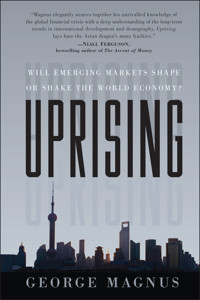
Uprising : will emerging markets shape or shake the world economy / George Magnus.
p. cm.
ISBN 978-0-470-66082-9 (hardback)
1. Economic development-Developing countries. 2. Investments, Foreign- Developing countries. 3. Developing countries-Economic policy. 4. Developing countries-Foreign economic relations. I. Title.
HC59.7.M244 2011
337.09172’4-dc22
2010034792
A catalogue record for this book is available from the British Library.
Set in 10.5 on 15 pt Monotype Janson by Toppan Best-set Premedia Limited
To My Mother
Acknowledgments
The financial crisis that began in 2007 has been shocking in every sense of the word, and the consequences will be felt for many years to come. The enormity of this phenomenon dawned on me in March 2007, and I have explored and examined its dynamics at length for UBS clients and in the media ever since. The book about it I intended to write, however, barely got off the ground when I was persuaded to think about a different kind of crisis book, one that looked at the implications of the crisis for emerging markets.
For this, I have to thank Ellen Hallsworth, Commissioning Editor with John Wiley & Sons in the UK, who planted the idea and then offered me a continuous and regular menu of suggestions and corrections that were invaluable in helping me to develop the structure and the narrative.
My purpose is to re-examine the claims made and prospects for major emerging markets in the wake of the crisis. There is, inevitably, a substantial focus on China. But because the global economic system we have grown up with these last 25 years is in flux, we have to put to one side the linear, spreadsheet-type projections which still abound, and consider the strengths and weaknesses of emerging markets anew, seen through a global, as well as a local, lens. I have had the fortune to be able to look to and consult with several people whose expertise and knowledge have filled many gaps.
I’d like to thank several colleagues at UBS Investment Bank: Terry Keeley, formerly Global Head of Sovereign Relations, whose sharp mind is now considering a new challenge outside UBS; Jonathan Anderson, Head of Emerging Markets Economics, whose prolific work and ideas are an inspiration; Paul Donovan, Senior Global Economist, whose irreverent view about economic research and conventional economic thinking is always refreshing; and Geoffrey Yu, foreign exchange strategist, whose youthful perspective and knowledge are a match for any more seasoned analyst.
Julie Hudson, Head of Socially Responsible Investment Research at UBS, gets very special thanks for contributing almost everything I now know about the challenge that climate change poses to emerging markets and their policies. She went to considerable lengths while pursuing a literary venture of her own.
I’d also like to thank Mark Steinert, Global Head of Research, and Larry Hatheway, Chief Economist, who supported my previous book on demographics, for their encore with this book. UBS takes its research product very seriously, and they have again allowed me to combine my research and client work with this project.
Two emerging market gurus took the time to digest and comment upon my work, offering me their particular insights into China, Asia and emerging markets in general. Guy de Jonquieres, formerly Asia editor of the Financial Times, and now Senior Fellow at the European Centre for International Political Economy, and Simon Ogus, a former colleague at UBS in Hong Kong, now running his own consulting firm, DSG Asia, gave me a lot of food for thought, and the benefits of their rich experience.
And since one of my recurring ideas through the book is that, over time, the quality of institutions matters more than, say, Gross Domestic Product or any cyclical phenomenon, I am grateful to Ed Gottesmann of Gottesmann Jones and Partners LLP, and David Ereira, Partner at Linklaters. These wise lawyers not only tried to straighten out my thinking about the role played by political and legal institutions in economic development, but also inadvertently stimulated me to ponder generally on the respective roles of lawyers and economists in trying to fix the world.
To all of these people I owe a debt of gratitude in helping me reflect on and refine the content of this book, and it remains only to say that I take full responsibility for errors and omissions.
They all made up different parts of an informal team, but as authors are apt to insist invariably and correctly, that team is never complete without spouses and partners. In my case, then, Lesley, my wife, had to put up with my disappearances for extended periods chained to the laptop in my office at home, my impromptu outbursts on often esoteric economic issues at moments that could have been better-timed, and with my sometimes single-minded focus on the book that caused me to hear, but not listen to what was being planned at home. But she also read my drafts, asked me poignant questions, and was, as ever, my rock, love and close companion.
Introduction
Not everything that counts can be counted, and not everything that can be counted, counts.
(attributed to Albert Einstein)
Tens of thousands of people poured spontaneously into Tiananmen Square on a July night in 2001 to celebrate the decision by the International Olympic Committee to award China the Olympic games in 2008. Former Chinese premier Li Peng watched with pride as workers and students danced the conga and sang patriotic songs. Ironically, those same songs had filled the square eleven years earlier when the same Li Peng declared martial law and sent the tanks in to crush the pro-democracy protests. This was 2001, however, and although China had already been making enormous economic progress for a decade or so, it was in the process of moving into top gear.
In 2008, then, the Olympic games provided the backdrop for the much-heralded demonstration of China’s modern image and self-confidence, which took place with great fanfare and to wide acclaim. The games symbolised China’s economic success, coincided with the fifth consecutive year of double-digit economic growth and were the perfect hors d’oeuvre for the 60th anniversary of the founding of the Peoples’ Republic in 2009.
Unfortunately, the games were sandwiched between two earthquakes, both of which served as a reminder that awesome economic achievement and serious political shortcomings were on two sides of the same coin. A geological earthquake that killed about 70,000 people struck in May in the province of Sichuan in central China. In the aftermath, there were allegations about the lax enforcement of building codes and political corruption. The decision to build a reservoir behind a major dam, which burst just a mile from the earthquake’s fault line, exemplified a system in which government takes place without challenge or openness to debate and dissent. These issues are hardly unique to China, but they form part of the mosaic of political and institutional weaknesses that I will argue compromise the country’s capacity to achieve sustained, linear and rapid economic growth as widely anticipated.
In October, a financial earthquake struck, following the collapse of the US investment bank, Lehman Brothers. This brought the world economy to the brink of an economic Armageddon, unrivalled since the Great Depression of the 1930s. Although this was first and foremost a Western crisis, it had a significant impact on China and, indeed, on all emerging markets. The idea that emerging markets would ‘decouple’, or remain aloof from the economic contraction in richer economies, proved wide of the mark.
In China, the authorities misread the signals in the form of the rising number of bankruptcies of small and medium-size enterprises, a fall in exports for the first time in seven years, and sharp declines in the output of electricity, automobiles and steel.
Yet China’s subsequent response was impressive. In November, it announced an economic stimulus programme of 4 trillion yuan ($590 billion), equivalent to 13% of GDP. With a strong emphasis on infrastructure and property projects, it was intended to turn around the slowdown in economic growth, which slipped below 5% in the year to the final quarter of 2008. It also encouraged state banks to make loans on a scale that had barely been rivalled before. China set an example to many other emerging economies and, by the spring of 2009, most emerging countries in Asia and Latin America had started to respond in a strong, positive way. A potential economic crisis had been averted successfully, but perhaps only by a whisker.
Lesen Sie weiter in der vollständigen Ausgabe!
Lesen Sie weiter in der vollständigen Ausgabe!
Lesen Sie weiter in der vollständigen Ausgabe!
Lesen Sie weiter in der vollständigen Ausgabe!
Lesen Sie weiter in der vollständigen Ausgabe!
Lesen Sie weiter in der vollständigen Ausgabe!
Lesen Sie weiter in der vollständigen Ausgabe!
Lesen Sie weiter in der vollständigen Ausgabe!
Lesen Sie weiter in der vollständigen Ausgabe!
Lesen Sie weiter in der vollständigen Ausgabe!