


98,99 €
Mehr erfahren.
- Herausgeber: John Wiley & Sons
- Kategorie: Fachliteratur
- Serie: Real Estate Issues
- Sprache: Englisch
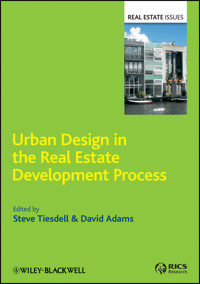
Urban design enables better places to be created for people and is thus seen in Urban Design in the Real Estate Development Process as a place-making activity, rather than the application of architectural aesthetics. Urban design policy can change the 'decision environment' of developers, financiers, designers and other actors in the real estate development process to make them take place-making more seriously. This book reports diverse international experience from Europe and North America on the role and significance of urban design in the real estate development process and explores how higher quality development and better places can be achieved through public policy. The book is focused on four types of policy tool or instrument that have been deployed to promote better urban design: those that seek to shape, regulate or provide stimulus to real estate markets along with those aim to build capacity to achieve these. Urban design is therefore seen as a form of public policy that seeks to steer real estate development towards policy-shaped rather than market-led outcomes. The editors set the examples, case studies and evidence from international contributors within a substantive discussion of the impact of urban design policy tools and actions in specific development contexts. Contributions from leading urban design theorists and practitioners explore how: * Masterplanning and infrastructure provision encourage high quality design * Design codes reconcile developers' needs for certainty and flexibility * Clear policy combined with firm regulation can transform developer behaviour * Intelligent parcelisation can craft the character of successful new urban districts * Powerful real estates interests can capture regulatory initiatives * Stimulus instruments can encourage good design * Development competitions need careful management * Design review can foster developer commitment to design excellence * Speculative housebuilders respond in varied ways to the brownfield design challenge * Physical-financial models could help in assessing the benefits of design investment * Urban design can add value to the benefit of developers and cities as a whole.
Sie lesen das E-Book in den Legimi-Apps auf:
Seitenzahl: 622
Veröffentlichungsjahr: 2011
Ähnliche



















Contents
Preface
Acknowledgements
Contributors
1 Real Estate Development, Urban Design and the Tools Approach to Public Policy
Introduction
Real estate development
Opportunity space theory
The tools approach to public policy
Shaping instruments
Regulatory instruments
Stimulus instruments
Capacity-building instruments
Developers’ decision environments
2 Masterplanning and Infrastructure in New Communities in Europe
Introduction
Differences between the UK and Europe
Challenges for sustainable development
European success stories
Joined-up planning in the Randstad
Conclusion: lessons for the UK
3 Design Coding: Mediating the Tyrannies of Practice
Introduction
The three tyrannies
From development standards to design codes
The research findings
Conclusion
4 Proactive Engagement in Urban Design – The Case of Chelmsford
Introduction
Making the turnaround
The need for negotiation
Two examples
Reflections on the developers’ response
Conclusion
5 Plot Logic: Character-Building Through Creative Parcelisation
Introduction
Setting the rules
Parcelling and subdivision strategies
The primacy of the urban realm
The pitfalls of flexibility
Economic viability of low-scale, densely distributed buildings
Alternative models
Conclusion
6 The Business of Codes: Urban Design Regulation in an Entrepreneurial Society
Introduction
Zoning America
Developing America
Designing the American future
Conclusion
7 Good Design in the Redevelopment of Brownfield Sites
Introduction
Redeveloping and reusing brownfield sites: the policy and regulatory context
Stimulus instruments in practice
Conclusion
8 Competitions as a Component of Design-Led Development (Place) Procurement
Introduction
The place promoter
The deliverer and competition participant
The (end) place matters most
The competition
Conclusion
9 Design Review – An Effective Means of Raising Design Quality?
Introduction
Origins, emergence and critiques of design review internationally
The typology of design review in England, Scotland and Wales
National design review: the genesis of CABE’s procedures and processes
How design review can increase the opportunity space for design
The effectiveness of design review
Conclusions: design review and the quality of development control
10 ‘Business as Usual?’ – Exploring the Design Response of UK Speculative Housebuilders to the Brownfield Development Challenge
Introduction
The design debate around speculative housing development
The conventional approach to design and construction in speculative housebuilding
Responding to the challenge of brownfield development
Conclusion
11 Physical-Financial Modelling as an Aid to Developers’ Decision-Making
Introduction
Design quality and development viability
Visualisation and financial appraisal
Conclusion
12 Design Champions – Fostering a Place-Making Culture and Capacity
Introduction
The UK local government context
The design champion as change agent
Edinburgh’s design champion initiative
Conclusion
13 Value Creation Through Urban Design
Introduction
Design and development projects
Strategies for enhancing value
Coupling urban design and development
14 Connecting Urban Design to Real Estate Development
Introduction
Urban design and development economics
Opportunity space and developer–designer relations
Policy choices and policy design
Towards a research agenda
References
Index
To Joe and Pat Tiesdell (Steve’s parents); to Sylvia Adams,and in memory of Richard Adams (David’s parents)
This edition first published 2011 © 2011 Blackwell Publishing Ltd.
Blackwell Publishing was acquired by John Wiley & Sons in February 2007. Blackwell’s publishing program has been merged with Wiley’s global Scientific, Technical and Medical business to form Wiley-Blackwell.
Registered officeJohn Wiley & Sons, Ltd, The Atrium, Southern Gate, Chichester, West Sussex, PO19 8SQ, UK
Editorial offices9600 Garsington Road, Oxford, OX4 2DQ, UKThe Atrium, Southern Gate, Chichester, West Sussex, PO19 8SQ, UK2121 State Avenue, Ames, Iowa 50014-8300, USA
For details of our global editorial offices, for customer services and for information about how to apply for permission to reuse the copyright material in this book please see our website at www.wiley.com/wiley-blackwell.
The right of the author to be identified as the author of this work has been asserted in accordance with the UK Copyright, Designs and Patents Act 1988.
All rights reserved. No part of this publication may be reproduced, stored in a retrieval system, or transmitted, in any form or by any means, electronic, mechanical, photocopying, recording or otherwise, except as permitted by the UK Copyright, Designs and Patents Act 1988, without the prior permission of the publisher.
Designations used by companies to distinguish their products are often claimed as trademarks. All brand names and product names used in this book are trade names, service marks, trademarks or registered trademarks of their respective owners. The publisher is not associated with any product or vendor mentioned in this book. This publication is designed to provide accurate and authoritative information in regard to the subject matter covered. It is sold on the understanding that the publisher is not engaged in rendering professional services. If professional advice or other expert assistance is required, the services of a competent professional should be sought.
Library of Congress Cataloging-in-Publication Data
Urban design in the real estate development process / edited by Steve Tiesdell, David Adams.p. cm.Includes bibliographical references and index.ISBN 978-1-4051-9219-4 (hardcover : alk. paper)1. City planning. 2. Real estate development. I. Tiesdell, Steven. II. Adams, David, 1954–HT165.5.U723 2011307.1′16–dc222010047411
A catalogue record for this book is available from the British Library.
This book is published in the following electronic formats: ePDF [9781444341157];Wiley Online Library [9781444341188]; ePub [9781444341164]; Mobi [9781444341171]
All reasonable attempts have been made to contact the owners of copyrighted material used in this book. However, if you are the copyright owner of any source used in this book which is not credited, please notify the Publisher and this will be corrected in any subsequent reprints or new editions.
The Royal Institution of Chartered Surveyors is the mark of property professionalism worldwide, promoting best practice, regulation and consumer protection for business and the community. It is the home of property related knowledge and is an impartial advisor to governments and global organisations. It is committed to the promotion of research in support of the efficient and effective operation of land and property markets worldwide.
Real Estate Issues
Series Managing Editors
Stephen Brown
Head of Research, Royal Institution of Chartered Surveyors
John Henneberry
Department of Town & Regional Planning, University of Sheffield
K.W. Chau
Chair Professor, Department of Real Estate and Construction, The University of Hong Kong
Elaine Worzala
Professor, Director of the Accelerated MSRE, Edward St. John Department of Real Estate, Johns Hopkins University
Real Estate Issues is an international book series presenting the latest thinking into how real estate markets operate. The books have a strong theoretical basis – providing the underpinning for the development of new ideas.
The books are inclusive in nature, drawing both upon established techniques for real estate market analysis and on those from other academic disciplines as appropriate. The series embraces a comparative approach, allowing theory and practice to be put forward and tested for their applicability and relevance to the understanding of new situations. It does not seek to impose solutions, but rather provides a more effective means by which solutions can be found. It will not make any presumptions as to the importance of real estate markets but will uncover and present, through the clarity of the thinking, the real significance of the operation of real estate markets.
Books in the series
Greenfields, Brownfields & Housing DevelopmentAdams & Watkins9780632063871
Planning, Public Policy & Property MarketsAdams, Watkins & White9781405124300
Housing & Welfare in Southern EuropeAllen, Barlow, Léal, Maloutas & Padovani9781405103077
Markets & Institutions in Real Estate & ConstructionBall9781405110990
Building Cycles: Growth & InstabilityBarras9781405130011
Neighbourhood Renewal & Housing Markets: Community Engagement in the US and UKBeider9781405134101
Mortgage Markets WorldwideBen-Shahar, Leung & Ong9781405132107
The Cost of Land Use Decisions: Applying Transaction Cost Economics to Planning & DevelopmentBuitelaar9781405151238
Urban Regeneration & Social Sustainability: Best Practice from European CitiesColantonio & Dixon9781405194198
Urban Regeneration in EuropeCouch, Fraser & Percy9780632058419
Urban Sprawl in Europe: Landscapes, Land-Use Change & PolicyCouch, Leontidou & Petschel-Held9781405139175
Real Estate & the New Economy: The Impact of Information and Communications TechnologyDixon, McAllister, Marston & Snow9781405117784
Economics & Land Use PlanningEvans9781405118613
Economics, Real Estate & the Supply of LandEvans9781405118620
Management of Privatised Housing: International Policies & PracticeGruis, Tsenkova & Nieboer9781405181884
Development & Developers: Perspectives on PropertyGuy & Henneberry9780632058426
The Right to Buy: Analysis & Evaluation of a Housing PolicyJones & Murie9781405131971
Housing Markets & Planning PolicyJones & Watkins9781405175203
Mass Appraisal Methods: An International Perspective for Property ValuersKauko & d’Amato9781405180979
Economics of the Mortgage Market: Perspectives on Household Decision MakingLeece9781405114615
Towers of Capital: Office Markets & International Financial ServicesLizieri9781405156721
Making Housing More Affordable: The Role of Intermediate TenuresMonk & Whitehead9781405147149
Global Trends in Real Estate FinanceNewell & Sieracki9781405151283
Housing Economics & Public PolicyO’Sullivan & Gibb9780632064618
International Real Estate: An Institutional ApproachSeabrooke, Kent & How9781405103084
British Housebuilders: History & AnalysisWellings9781405149181
Transforming Private LandlordsCrook & Kemp9781405184151
Urban Design in the Real Estate Development ProcessTiesdell & Adams9781405192194
Real Estate Finance in the New Economic World: Development of Deregulation and InternationalisationTiwari & White9781405158718
Office Markets & Public PolicyDunse, Jones & White9781405199766
Preface
We are not creatures of circumstance, we are the creators of circumstance.
Benjamin Disraeli (1827)
(Vivian Grey – volume II, book VI, chapter 7)
Given the development of urban design over the past 50 years and especially the past two decades, there is, at least to some degree, significant consensus about the qualities of ‘good’ urban design and of ‘better’ places. Good places are, for example, those where people want to live, work, rest, play and invest. A number of urban design policy documents also set out general qualities of good urban design – though what these mean for any specific time and place needs to be negotiated and agreed at the local level by key stakeholders and key interest groups. The contemporary challenge for policy and practice, however, is to ensure the delivery of better places. Thus, while the Urban Design Compendium (Llewelyn-Davies 2000) concentrated on what was considered good urban design in a UK context, some seven years later a second volume (Roger Evans Associates 2007) focused on delivering quality places.
Bringing together urban design, real estate development and the tools approach in public policy, this book explores the relationship between state and market with respect to design and development processes and outcomes. The overarching research question is:
How successful are particular public policy instruments in framing (and reframing) the relationship between designers and developers to the advantage of urban design (place) quality?Subsidiary questions are:
What public policy instruments are available to facilitate better quality urban development and better places?How do particular policy instruments impact on the decision environments or opportunity space of developers and designers?In what other ways do particular policy instruments impact on design quality?Are some types of policy instruments more effective than others in facilitating higher quality development and better places?The central research inquiry thus concerns the impact of urban design policy instruments on developers’, and thence on designers’, decision-making and, in particular, their impact on those factors – reward, risk, uncertainty, time, etc – that would make them more likely, or less likely, to provide higher quality development and to contribute to producing better places. The underlying proposition is that better quality urban design comes about when private developers decide, or are either motivated or compelled, to produce it as an integral part of their business strategies. This raises the important issue of how public policy instruments can be deployed to encourage/compel this shift.
The research questions posed in this book do not have simple and straightforward answers, and up to now relevant research has neither been consolidated nor discussed in terms of a policy instruments framework. In that context, this book seeks to advance the policy agenda in the hope that a clear focus on connecting high quality urban design to the practicalities of the real estate development process will reinforce momentum towards the creation of better places.
Steve Tiesdell and David AdamsUniversity of Glasgow
Acknowledgements
As editors, we would like to thank all our fellow contributors to the book for their wholehearted participation in this venture, and for their patience, good humour and constructive responses to our numerous requests and editorial recommendations.
We would particularly wish to acknowledge the encouragement given to us by Madeleine Metcalfe and Cat Oakley at Wiley-Blackwell both in developing the concept for the book and in helping us with all the practicalities of seeing it through to completion. We would also grateful to Maggie Reid at the University of Glasgow for her thorough and conscientious work in compiling the index.
We wish to thank Building Design for permission to reproduce textual material in Chapter 9 and the Carnyx Group for permission to do likewise in Chapter 12. Throughout the book, UK Parliamentary material is reproduced with the permission of the Controller of HMSO on behalf of Parliament. All other permissions to reproduce photographs, diagrams and other illustrative material are acknowledged where the relevant illustrations appear in the text.
Steve Tiesdell and David Adams
Contributors
David Adams holds the Ian Mactaggart Chair of Property and Urban Studies at the University of Glasgow. His main research interests are in state–market relations in land and property, with a particular interest in land, planning and regeneration policy. He has researched and published widely in these fields, most notably as author of Urban Planning and the Development Process (1994), co-author of Land for Industrial Development (1994) and Greenfields, Brownfields and Housing Development (2002) and as co-editor of Planning, Public Policy and Property Markets (2005).
Eran Ben-Joseph is the chair of the PhD programme in urban planning at the Massachusetts Institute of Technology. His research and teaching areas include urban and physical design, design standards and regulations, sustainable site planning technologies and urban retrofitting. He has published numerous articles, monographs and book chapters and authored or co-authored Streets and the Shaping of Towns and Cities (2003), Regulating Place (2004), The Code of the City (2005) and re:New Town (2010)
Matthew Carmona is Professor of Planning & Urban Design and Head of the Bartlett School of Planning, UCL. His research has focused on the policy context for delivering better quality built environments. His background is as an architect and a planner, and he has published widely in the areas of urban design, design policy and guidance, housing design and development, measuring quality and performance in planning, and on the management of public space.
Andrew Clarke is an associate director with Taylor Young Ltd. He is an urban designer and town planner and has been with the practice for ten years. In this time he has worked on, and led, projects producing many design guides for sites and areas, design frameworks and strategies and masterplanning projects. Andrew has experience in urban design training and research and is at the forefront of the urban design agenda. He is committed to delivering practical and deliverable design solutions which are contextually based and provide creative responses to client briefs and aspirations.
Christina Crawford is an architect and urban designer currently pursuing a PhD in architectural history and theory at Harvard University. She worked for several years at Utile, Inc., a planning and architecture firm based in Boston, and teaches architectural history and theory at Northeastern University. Her professional work includes designs for discrete architectural projects, masterplans for local municipalities and open space design for a waterfront city in Dubai, UAE. Christina received her undergraduate degree in Architecture and East European Studies from Yale University and a Masters in Architecture from the Harvard Graduate School of Design.
Nicholas Falk, the founder director of URBED (Urban and Economic Development), is an economist, urbanist and strategic planner, with over 30 years’ experience of helping towns and cities plan and deliver urban regeneration and sustainable growth. Co-author of a range of publications, including Sustainable Urban Neighbourhood: Building the 21st century home with David Rudlin, he has undertaken pioneering research into lessons to be drawn from European experience in planning new communities. He is a Visiting Professor at the University of the West of England.
Gary Hack is professor of urban design and dean emeritus in the School of Design, University of Pennsylvania. He practices urban design and is author (with others) of Local Planning (2009), Urban Design in the Global Perspective (2006), Global City Regions (2000) and Site Planning (1984), as well as many chapters and articles.
Tony Hall is a Professor within the Urban Research Program at Griffith University, Brisbane, Australia, where he is carrying out research on sustainable urban form. Until 2004, he was Professor of Town Planning at Anglia Ruskin University, Chelmsford, and had notable publications in the field of design guidance. He was also an elected member of Chelmsford Borough Council and successfully led its planning policy at the political level for seven years leading to the award to the Council by the UK Government of Beacon Status for the Quality of the Built Environment in 2003.
John Henneberry is Professor of Property Development Studies in the University of Sheffield, Department of Town and Regional Planning. His interests focus on the structure and behaviour of the property market and its relation to the wider economy and polity. He has researched and published widely in this field. John is a member of the editorial boards of the Journal of Property Research, the Journal of European Real Estate Research and Town Planning Review. He is an Editor of Regional Studies with responsibility for land, property, planning and regional development. John was recently appointed an Academician of the Social Sciences.
Eckart Lange is Professor and Head of the Department of Landscape at the University of Sheffield. His research focuses on how landscape and environmental planning can influence anthropogenic landscape change, and how landscape visualisation and modelling can be used to explore human reaction to these changes. He holds a PhD and Habilitation from ETH Zurich, a Master in Design Studies from Harvard University and a Dipl.-Ing. in Landscape Planning from TU Berlin. He is a member of the scientific committee of the European Environment Agency, as the scientific advisor in the area of Spatial Planning and Management of Natural Resources.
Tim Love is the founding principal of Utile, an architecture and urban design firm located in Boston. He is also a tenured associate professor at the Northeastern University School of Architecture where he teaches housing, urban design and architectural theory. In the spring of 2009, Tim coordinated and taught the required urban design studio at Yale University; and from 1997 until 2003, he gave weekly lectures on design tactics to first-year students at the Harvard Graduate School of Design. Tim is also a frequent contributor to the Harvard Design Magazine and a Contributing Editor of Places/Design Observer. He writes about urban design and market-driven building types, among other issues, for both publications.
Nicholas J. Marantz is a PhD student in MIT’s Department of Urban Studies & Planning. He holds a JD from Harvard Law School and a Master in Urban Planning from the Harvard Graduate School of Design. He is an MIT Presidential Fellow and a National Science Foundation Graduate Research Fellow. His research analyses the regulation of the built environment and, more generally, the political economy of local decision-making.
Sarah Moore is a researcher on the Urban River Corridors and Sustainable Living Agendas (URSULA) project at the University of Sheffield. Funded by EPSRC, URSULA is a four-year, interdisciplinary project with the working hypothesis that there are significant social, economic and environmental gains to be made with innovative, integrated interventions within river corridors. Originally a biologist, Sarah now undertakes research in two main areas of urban regeneration: the impact of design – in terms of building function and development layout – on the financial viability of development schemes, and storm water disconnection to improve water quality, quantity and amenity values of urban areas.
Ed Morgan is a computer scientist with special interest in landscape visualisation. He is a part-time researcher on the EPSRC-funded Urban River Corridors and Sustainable Living Agendas (URSULA) project at the University of Sheffield, exploring the use of real-time 3D visualisation software to produce virtual models of future design scenarios in various riverside areas of Sheffield. This involves utilisation of various software (including Simmetry 3d), which he has developed and continues to develop commercially.
Sarah Payne is a Research Associate in the Centre for Urban Policy Studies at the University of Manchester. Her PhD, undertaken at the University of Glasgow, assessed the impact of the brownfield development policy agenda on the structure and workings of the UK speculative housebuilding industry. After her doctoral studies, Sarah completed two years’ work in the private sector as a land buyer for a major housing developer. Her current research interests include brownfield development, the residential development process and the UK speculative housebuilding industry.
John Punter is Professor of Urban Design in the School of City and Regional Planning at Cardiff University, and previously taught at Strathclyde, Reading and York (Toronto) universities. He is a chartered town planner and a member of the Urban Design Group. His books include Design Control in Bristol (1990), The Design Dimension of Planning (1997), Design Guidelines in American Cities (1999), The Vancouver Achievement (2003) Capital Cardiff 1975–2020 (2006) and Urban Design and the British Urban Renaissance (2009). He is a Director of the Design Commission for Wales and was Founder-Chair, now Co-Chair, of its Design Review Panel.
Lynne B. Sagalyn is Earle W. Kazis and Benjamin Schore Professor of Real Estate and Director of the Paul Milstein Center for Real Estate in the Columbia Business School. She is the author of Times Square Roulette (2001), Cases in Real Estate Finance and Investment Strategy (1999), and co-author of Downtown Inc. (1989) as well as several other books and many chapters and articles.
Paul Syms is a chartered planning and development surveyor, who has spent most of the last 35 years working as a consultant, advising on the redevelopment and reuse of brownfield land. Between 2004 and 2008 he was a director at English Partnerships, responsible for the National Brownfield Strategy for England. He is now an Honorary Professor at the University of Manchester and Chair of the RICS Education Trust, the surveying profession’s leading research grant awarding body. His publications include Contaminated Land: The practice and economics of redevelopment (1997), Previously Developed Land: Industrial activities and contamination (2004) and Land, Development & Design (2010, second edition).
Steve Tiesdell is Senior Lecturer in Public Policy at the Department of Urban Studies, University of Glasgow. He is an architect and town planner, with research interests in urban design, urban regeneration, public policy and state–market relations in land and property development. He is author (with others) of Public Places – Urban Spaces: The Dimensions of Urban Design (2010) and editor (with Matthew Carmona) of the Urban Design Reader (2006), as well as many chapters and articles.
Steven Tolson is a chartered surveyor specialising in property valuation and development work for the public and private sectors. His postgraduate urban design studies developed a niche interest in the value and facilitation of good place-making. His work on masterplans includes such projects as Crown Street, PARC URC, Glasgow’s Homes for the Future and The Drum, Bo’ness. He is currently a Director of Ogilvie Group Developments, engaged in property regeneration. Steven lectures in urban design and development at a number of Scottish Universities and is a member of RICS Scotland Planning and Development Board, and chairs the RICS Scotland Regeneration Forum.
Ning Zhao obtained her first degree in Urban Planning in Zhejiang University in 2006. As one of the top two undergraduate students in the department, she was recommended directly as a PhD student of architecture at the university without further examination. In 2008, she was awarded a state scholarship to study in the University of Sheffield as a visiting researcher on the URSULA project, where she has worked with John Henneberry on physical-financial modelling. Ning’s research focuses on urban redevelopment and financial analysis of physical development. Four of her papers have been published in Chinese core periodicals.
1
Real Estate Development, Urban Design and the Tools Approach to Public Policy
Steve Tiesdell and David Adams
Introduction
Urban design and place-making involves two key challenges – the first involves recognising what makes ‘good’ urban design and what constitutes ‘better’ places. The second involves delivering good urban design and creating better places on the ground. The first challenge involves, inter alia, developing and reflecting on normative theory about what constitutes a ‘good’ place. The second challenge typically requires close engagement with the real estate development process. This book deliberately focuses on the role and significance of design in the real estate development process, on the decision-making of key development actors and on the relationship between developers and designers. Its overarching object is to explore how higher quality development and better places can be achieved in practice through public policy (i.e. by state actions). It does not, however, interrogate the meaning of higher quality development, or of better places, which have both been addressed at length elsewhere. Instead, for the purpose of analysis, we intend to set aside these issues and focus clearly on delivery. We therefore make the assumption that, in any particular circumstance, ‘higher quality’ and ‘better’ can be defined and agreed and, in turn, made the object of public policy and design processes.1 If we know – or think we know – what better places are, it then becomes essential to understand how best to achieve them.
Urban design can be considered a process of enabling better places for people than would otherwise be created – this is becoming more commonly referred to as ‘place-making’. In this study, the primary concern is with urban design as public policy (Barnett 1974; 1982), reflecting its increasing prominence as a policy area in the UK and in many other countries. Although, in the narrowest sense, public policy on urban design might be equated to a planning or zoning system, we see it as a much wider activity, encompassing a fuller spectrum of state activities.
Urban design can be understood as a direct design and as an indirect design activity. George (1997) termed these design activities first-order and second-order design. In first-order design, the urban designer is a direct designer or ‘author’ of the built environment or a component of it – that is, the designer of a building, a public space, a floorscape, street furniture, an urban event or festival etc – in other words, a relatively discrete ‘project’ of some sort. In second-order design, urban designers design the decision environments within which other development actors – developers, funders, sundry designers, surveyors etc – necessarily operate. Decision environments are typically designed by means of plans, strategies, frameworks etc, but also by deployment and modulation of incentives and disincentives, such as financial subsidies, discounted land or infrastructure provision. Generally (though not exclusively) undertaken by the public sector, second-order design is similar to planning and to governance.
Lesen Sie weiter in der vollständigen Ausgabe!
Lesen Sie weiter in der vollständigen Ausgabe!
Lesen Sie weiter in der vollständigen Ausgabe!
Lesen Sie weiter in der vollständigen Ausgabe!
Lesen Sie weiter in der vollständigen Ausgabe!
Lesen Sie weiter in der vollständigen Ausgabe!
Lesen Sie weiter in der vollständigen Ausgabe!
Lesen Sie weiter in der vollständigen Ausgabe!
Lesen Sie weiter in der vollständigen Ausgabe!
Lesen Sie weiter in der vollständigen Ausgabe!
Lesen Sie weiter in der vollständigen Ausgabe!
Lesen Sie weiter in der vollständigen Ausgabe!
Lesen Sie weiter in der vollständigen Ausgabe!
Lesen Sie weiter in der vollständigen Ausgabe!
Lesen Sie weiter in der vollständigen Ausgabe!




