


16,99 €
Mehr erfahren.
- Herausgeber: John Wiley & Sons
- Kategorie: Geisteswissenschaft
- Sprache: Englisch
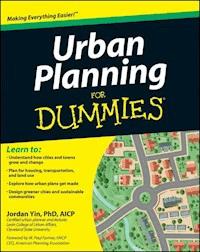
How to create the world's new urban future With the majority of the world's population shifting to urban centres, urban planning--the practice of land-use and transportation planning to help shape cities structurally, economically, and socially--has become an increasingly vital profession. In Urban Planning For Dummies, readers will get a practical overview of this fascinating field, including studying community demographics, determining the best uses for land, planning economic and transportation development, and implementing plans. Following an introductory course on urban planning, this book is key reading for any urban planning student or anyone involved in urban development. With new studies conclusively demonstrating the dramatic impact of urban design on public psychological and physical health, the impact of the urban planner on a community is immense. And with a wide range of positions for urban planners in the public, nonprofit, and private sectors--including law firms, utility companies, and real estate development firms--having a fundamental understanding of urban planning is key to anyone even considering entry into this field. This book provides a useful introduction and lays the groundwork for serious study. * Helps readers understand the essentials of this complex profession * Written by a certified practicing urban planner, with extensive practical and community-outreach experience For anyone interested in being in the vanguard of building, designing, and shaping tomorrow's sustainable city, Urban Planning For Dummies offers an informative, entirely accessible introduction on learning how.
Sie lesen das E-Book in den Legimi-Apps auf:
Seitenzahl: 527
Veröffentlichungsjahr: 2012
Ähnliche




















Urban Planning For Dummies®
Visit www.dummies.com/cheatsheet/urbanplanning to view this books’ cheat sheet.
Table of Contents
Urban Planning For Dummies®
by Jordan Yin, PhD, AICP
Urban Planning For Dummies®
Published by John Wiley & Sons Canada, Ltd. 6045 Freemont Blvd. Mississauga, ON L5R 4J3 www.wiley.com
Copyright © 2012 by John Wiley & Sons Canada, Ltd.
Published by John Wiley & Sons Canada, Ltd.
All rights reserved. No part of this book, including interior design, cover design, and icons, may be reproduced or transmitted in any form, by any means (electronic, photocopying, recording, or otherwise) without the prior written permission of the Publisher. Requests to the Publisher for permission should be addressed to the Permissions Department, John Wiley & Sons Canada, Ltd., 6045 Freemont Blvd., Mississauga, ON L5R 4J3, or online at http://www.wiley.com/go/permissions. For authorization to photocopy items for corporate, personal, or educational use, please contact in writing The Canadian Copyright Licensing Agency (Access Copyright). For more information, visit www.accesscopyright.ca or call toll free, 1-800-893-5777.
Trademarks: Wiley, the Wiley logo, For Dummies, the Dummies Man logo, A Reference for the Rest of Us!, The Dummies Way, Dummies Daily, The Fun and Easy Way, Dummies.com, Making Everything Easier, and related trade dress are trademarks or registered trademarks of John Wiley & Sons, Inc., and/or its affiliates in the United States and other countries, and may not be used without written permission. All other trademarks are the property of their respective owners. John Wiley & Sons, Inc., is not associated with any product or vendor mentioned in this book.
Limit of Liability/Disclaimer of Warranty: The publisher and the author make no representations or warranties with respect to the accuracy or completeness of the contents of this work and specifically disclaim all warranties, including without limitation warranties of fitness for a particular purpose. No warranty may be created or extended by sales or promotional materials. The advice and strategies contained herein may not be suitable for every situation. This work is sold with the understanding that the publisher is not engaged in rendering legal, accounting, or other professional services. If professional assistance is required, the services of a competent professional person should be sought. Neither the publisher nor the author shall be liable for damages arising herefrom. The fact that an organization or Website is referred to in this work as a citation and/or a potential source of further information does not mean that the author or the publisher endorses the information the organization or Website may provide or recommendations it may make. Further, readers should be aware that Internet Websites listed in this work may have changed or disappeared between when this work was written and when it is read.
For general information on John Wiley & Sons Canada, Ltd., including all books published by John Wiley & Sons, Inc., please call our warehouse, Tel 1-800-567-4797. For reseller information, including discounts and premium sales, please call our sales department, Tel 416-646-7992. For press review copies, author interviews, or other publicity information, please contact our marketing department, Tel 416-646-4584, Fax 416-236-4448.
For technical support, please visit www.wiley.com/techsupport.
Wiley publishes in a variety of print and electronic formats and by print-on-demand. Some material included with standard print versions of this book may not be included in e-books or in print-on-demand. If this book refers to media such as a CD or DVD that is not included in the version you purchased, you may download this material at http://booksupport.wiley.com. For more information about Wiley products, visit www.wiley.com.
Library and Archives Canada Cataloguing in Publication
Yin, Jordan, 1970–
Urban planning for dummies / Jordan Yin.
Includes index.
Issued also in electronic formats.
ISBN 978-1-118-10023-3
1. City planning. 2. Land use—Planning. I. Title.
HT166.Y56 2012 307.1’216 C2011-908072-9
ISBN 978-1-118-10168-1 (ebk); 978-1-118-10166-7 (ebk); 978-1-118-10167-4 (ebk)
Printed in the United States
1 2 3 4 5 RRD 15 14 13 12 11
About the Author
Jordan Yin, PhD, AICP, is a native of Cleveland, Ohio, and his experience growing up in this great American city inspired him to pursue a career as an urban planner. He has also lived in Pittsburgh, Pennsylvania; Buffalo, New York; and Kalamazoo, Michigan. Jordan has been involved in urban planning for more than 20 years. He has worked extensively with universities, government agencies, and community organizations on a wide range of issues, including neighborhood planning, affordable housing, environmental conservation, economic development, comprehensive planning, downtown redevelopment, and poverty reduction initiatives.
Jordan is a faculty member of the Maxine Goodman Levin College of Urban Affairs at Cleveland State University, where he teaches graduate and undergraduate classes in urban and regional planning, including workshop classes that engage students in real-world community service projects related to urban planning. He received master’s and doctoral degrees in City and Regional Planning from Cornell University and has been a member of the American Institute of Certified Planners since 1996. Jordan writes a blog about urban planning on his website, www.ask-a-planner.com.
Dedication
To my daughter, Evan. We’ll go out for ice cream more often, I promise.
Author’s Acknowledgments
The opportunity to write a For Dummies book about urban planning has been one of the great experiences of my career. It is also a shining example of the old adage “Be careful what you wish for, because you might just get it.” Without the assistance and support of many people, this already daunting task might have become simply impossible. I thank Robert Hickey and Elizabeth Kuball of the For Dummies series for their invaluable assistance and encouragement on a day-to-day basis. Suggestions and comments from my technical editor, Jennifer Cowley of The Ohio State University, have been especially valuable and appreciated. I owe much of my expertise in urban planning to mentors and colleagues who have shown me the way over many years, especially Norman Krumholz and Pierre Clavel. I am also greatly appreciative of my colleagues at Cleveland State University and have particularly benefited from the support of Edward (Ned) Hill, Wendy Kellogg, W. Dennis Keating, and Sung-Gheel Jang. Joseph Grengs of the University of Michigan and Susan Hoffmann of Western Michigan University also provided valuable support. The professional assistance of Scott Shapiro and Gordon Hare is greatly appreciated. Lastly, the comfort and support of friends and family have been of tremendous importance in seeing this project to completion, including the Yin, Burness, Huston, Dowd, Kasper, Jacobs, Northeim, Henderson-Terwilliger, Holverstott-Cockrell, Wood-Provence, Wassom, May, Antisdale, Posner, Zulewski, Enos, Cross-Coleman, and Moncrief families. Thanks to all.
Publisher’s Acknowledgments
We’re proud of this book; please send us your comments at http://dummies.custhelp.com. For other comments, please contact our Customer Care Department within the U.S. at 877-762-2974, outside the U.S. at 317-572-3993, or fax 317-572-4002.
Some of the people who helped bring this book to market include the following:
Acquisitions and Editorial
Project Editor: Elizabeth Kuball
Acquiring Editor: Robert Hickey
Copy Editor: Elizabeth Kuball
Technical Editor: Jennifer Cowley, PhD
Project Coordinator, Canada: Elizabeth McCurdy
Editorial Assistant: Kathy Deady
Cover Photos: © iStock / John_ Woodcock
Cartoons: Rich Tennant (www.the5thwave.com)
Composition Services
Senior Project Coordinator, U.S.: Kristie Rees
Layout and Graphics: Corrie Niehausr
Proofreaders: Laura Albert, Debbye Butler, John Greenough
Indexer: Christine Karpeles
John Wiley & Sons Canada, Ltd.
Deborah Barton, Vice President and Director of Operations
Jennifer Smith, Publisher, Professional and Trade Division
Alison Maclean, Managing Editor, Professional & Trade Division
Publishing and Editorial for Consumer Dummies
Kathleen Nebenhaus, Vice President and Executive Publisher
Kristin Ferguson-Wagstaffe, Product Development Director
Ensley Eikenburg, Associate Publisher, Travel
Kelly Regan, Editorial Director, Travel
Publishing for Technology Dummies
Andy Cummings, Vice President and Publisher
Composition Services
Debbie Stailey, Director of Composition Services
Foreword
I have occasionally heard someone say that “urban planning isn’t rocket science.” My reply? “You’re right — it’s a lot more complex.” In fact, it’s also not for dummies and you’re reading this book because you’re not a dummy. In all likelihood, you’re already involved in making your community a better place and you may even be involved in planning. If this is your first time reading about urban planning, you’re taking a step in a great direction.
Urban planning, in fact, goes by many names, including city planning, community planning, town planning, and regional planning. These terms reflect the diversity of the places that we call home, and I’m proud to serve as the CEO of the American Planning Association, an educational organization whose members are making great communities happen. Urban planning works to improve the welfare of people and their communities by creating places that are more convenient, equitable, healthful, efficient, and attractive for both present and future generations. Planning creates places of lasting value where generations can prosper. Good urban planning provides civic leaders, businesses, and citizens with an opportunity to play a meaningful role in improving and enhancing their communities by envisioning the future and making choices about development, essential services, environmental protection, and innovative changes. Good planning and good governance go hand in hand — you can’t have one without the other.
Urban Planning For Dummies reflects the spirit of hopefulness and commitment to progress that has driven the profession of urban planning for more than a century. Jordan Yin has been a practicing member of the American Institute of Certified Planners for more than 15 years and teaches urban planning at Cleveland State University’s College of Urban Affairs, a leading program in the United States that offers accredited professional training in urban planning. Throughout this book, Jordan talks in a plainspoken manner about the challenges and opportunities facing today’s communities, discusses cutting-edge techniques that are being used in urban planning, and provides numerous and valuable real-world examples of how thoughtful urban planning approaches are making a difference in communities small and large throughout the United States and around the world. This book is an excellent window into the world of urban planning, and I invite you to join myself, Jordan, thousands of professional planners, and many, many more residents and community leaders in planning a bright future for our communities.
W. Paul Farmer, FAICP
W. Paul Farmer, FAICP, is CEO of the American Planning Association (APA) and its professional institute, the American Institute of Certified Planners (AICP). He managed several departments as executive director of the Department of Planning and Development for the city of Eugene (Oregon) and served as director of the Department of City Planning for the city of Minneapolis, and deputy planning director for the city of Pittsburgh. He has taught in the graduate urban planning programs at the University of Oregon, Carnegie Mellon University, the University of Pittsburgh, the Georgia Institute of Technology, and the University of Wisconsin–Milwaukee.
Introduction
“Make no little plans.” So said the great urban planner Daniel Burnham, the force behind Chicago’s revolutionary 1893 World’s Fair and the epic 1909 Plan of Chicago. These plans helped transform Chicago from a gritty industrial town into an architectural palace and vibrant modern metropolis. Chicago’s success also influenced the planning of other cities all over the world. Burnham believed that making great places required imaginative plans that inspired people to take bold actions.
And because you’re reading this book, you probably share Burnham’s enthusiasm for the future of cities and their regions — places where people can live, work, and play while treating the planet in a responsible manner and leaving a legacy for future generations. Urban planning helps make great places possible by combining an understanding of how places grow and change with a wide range of specific techniques that help communities solve problems and prepare for the future.
Whether you’re looking for some background information on a specific aspect of urban planning, have ambitions to become a professional urban planner, or are looking for ways to become more involved in your community, this book can help you better understand urban planning and how to create successful communities.
Lesen Sie weiter in der vollständigen Ausgabe!
Lesen Sie weiter in der vollständigen Ausgabe!
Lesen Sie weiter in der vollständigen Ausgabe!
Lesen Sie weiter in der vollständigen Ausgabe!
Lesen Sie weiter in der vollständigen Ausgabe!
Lesen Sie weiter in der vollständigen Ausgabe!
Lesen Sie weiter in der vollständigen Ausgabe!
Lesen Sie weiter in der vollständigen Ausgabe!
Lesen Sie weiter in der vollständigen Ausgabe!
Lesen Sie weiter in der vollständigen Ausgabe!
Lesen Sie weiter in der vollständigen Ausgabe!
Lesen Sie weiter in der vollständigen Ausgabe!
Lesen Sie weiter in der vollständigen Ausgabe!
Lesen Sie weiter in der vollständigen Ausgabe!
Lesen Sie weiter in der vollständigen Ausgabe!
Lesen Sie weiter in der vollständigen Ausgabe!
Lesen Sie weiter in der vollständigen Ausgabe!
Lesen Sie weiter in der vollständigen Ausgabe!
Lesen Sie weiter in der vollständigen Ausgabe!
Lesen Sie weiter in der vollständigen Ausgabe!
Lesen Sie weiter in der vollständigen Ausgabe!
Lesen Sie weiter in der vollständigen Ausgabe!
Lesen Sie weiter in der vollständigen Ausgabe!
Lesen Sie weiter in der vollständigen Ausgabe!
Lesen Sie weiter in der vollständigen Ausgabe!
Lesen Sie weiter in der vollständigen Ausgabe!
Lesen Sie weiter in der vollständigen Ausgabe!
Lesen Sie weiter in der vollständigen Ausgabe!




