


35,99 €
Mehr erfahren.
- Herausgeber: John Wiley & Sons
- Kategorie: Fachliteratur
- Serie: Lecture Notes
- Sprache: Englisch
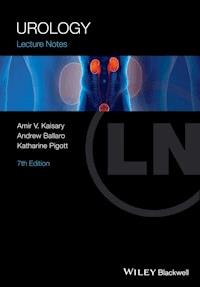
Urology Lecture Notes contains all the essential knowledge for medical students, junior doctors and early-stage trainees involved in urology placements or urological surgery. With a strong emphasis on clinical presentation, procedures and surgery, it provides an accessible, conversational guide to all the situations likely to be encountered on the wards.
Key features include:
- Extensive illustration to clearly demonstrate relevant procedures, conditions, and physiology
- Important information flagged up in key points
- Self-assessment MCQs to test and help consolidate knowledge
Whether you are preparing for your first urology rotation or looking for a quick reference to all aspects of the system, Urology Lecture Notes provides key support to all students, junior doctors and trainees involved in this specialty.
Sie lesen das E-Book in den Legimi-Apps auf:
Seitenzahl: 501
Veröffentlichungsjahr: 2016
Ähnliche



















Table of Contents
Cover
Title Page
Preface
Acknowledgements
Part 1: Meet the patient
1 Assessment of the urological patient
History
Overactive bladder syndrome
Examination
2 Assessment of the urological patient
Urinalysis
Imaging the urinary tract
Part 2: The kidneys and adrenal gland
3 The kidney
Embryology
Congenital errors
4 Kidney trauma
Penetrating injuries
Closed injuries
5 Kidney infections and inflammation
Uncomplicated infections
Complicated infections
Ascending infection
Blood-borne infection
End result of urinary infection
Complicated renal infections
Clinical sequelae of renal infections
Chronic upper urinary tract infections and inflammation
Granulomatous disease
6 Urinary tract calculi
Epidemiology
Pathophysiology
Crystal aggregation and stone growth
Stone-specific factors
Evaluation of the stone former
Treatment of urinary tract calculi
Prevention of recurrent urinary stones
7 Kidney neoplasms
Surgical anatomy and renal surgery
Surgical approaches to the kidney
Complications after renal surgery
Wilms’ tumour (nephroblastoma)
Renal cell cancer (hypernephroma)
Management of metastatic disease: Systemic therapy
Other renal tumours
8 The renal pelvis and ureter
Anatomy
Peristalsis
Inflammation of the ureter
Vesicoureteric reflux
Ureteric obstruction
Ureteric injury
Carcinoma of the ureter
9 The adrenal gland
Surgical anatomy and physiology
Physiology and disorders of the adrenal cortex
Adrenal tumours
Part 3: The bladder and urethra
10 The bladder
Structure
Bladder function
Bladder investigations
Urethral pressure profile
11 Bladder infections and inflammation
Lower urinary tract infection
Simple cystitis
Chronic cystitis
Interstitial cystitis
Schistosomiasis (bilharziasis)
Radiation cystitis
12 Disorders of bladder function
Overactive bladder syndrome
Detrusor overactivity
Incontinence
13 Bladder cancer
Clinical features
Pathology
Staging of bladder cancer
Treatment of bladder cancer
Carcinoma of the urachus
Combination chemotherapy
Palliation
Part 4: The prostate gland
14 Benign disorders of the prostate gland
Surgical anatomy
Prostatitis
Benign prostatic enlargement
Treatment
15 Prostate cancer
Pathology
Tumour markers
Presentation
Investigations
Staging of prostate cancer
Treatment
Advanced/metastatic disease
Castrate-resistant prostate cancer (CRPC)
Part 5: Male genitalia
16 The urethra
Anatomy
Congenital disorders of the urethra
Inflammation of the urethra
Urethral trauma
Complications of urethral injuries
Urethral stricture
Urethral carcinoma
17 The penis
Surgical anatomy
Blood supply
Nerves
Physiology of erection
Ejaculation
Circumcision
Acute balanoposthitis
Peyronie’s disease
Ejaculatory failure
Erectile dysfunction
Priapism
Cancer of the penis
Chemotherapy
18 The testicle
Embryology
Surgical anatomy
Blood supply
Structure
Congenital anomalies
Torsion
Varicocele
Hydrocele
Cysts of the epididymis
Trauma to the testicle
Inflammation of the testicle
Cancer of the testis
19 Male infertility
History and general examination
Investigations
Infertility
Vasectomy
Part 6: Additional therapeutic modalities
20 Radiotherapy
Delivery
Side effects of radiotherapy
Pelvic radiotherapy
Pre-existing morbidities
Steps in delivering radiotherapy
External beam radiotherapy
Proton beam therapy
21 Minimally invasive urology
Laparoscopy
Trans-peritoneal compared to extra-peritoneal approaches for laparoscopy
Robotics
Single-port laparoscopy versus multi-port laparoscopy
Complications of robotic surgery
Training in laparoscopy and robotics
Appendix A: ECOG performance status
Appendix B: TNM classification of malignant tumours
Sentinel lymph node
Histopathological grading: G
Stage grouping
Appendix C: Response evaluation criteria in solid tumours
Eligibility
Methods of measurement
Baseline documentation of ‘target’ and ‘non-target’ lesions
Response criteria
Confirmation
Duration of overall response
Appendix D: The Clavien–Dindo classification of surgical complications
Appendix E: Adverse effects of cancer treatment
Appendix F: Urinary catheters
Condom catheters
Indwelling catheters
Intermittent (short-term) catheter
Appendix G: Evidence-based medicine
Levels of evidence
Grades of recommendation
Multiple choice questions
Answers
Index
End User License Agreement
List of Tables
Chapter 06
Table 6.1 Stone composition and approximate occurrence rates
Chapter 07
Table 7.1 Staging system of the Children’s Oncology Group Stage
Table 7.2 Neoplastic hormone syndromes in renal cell cancer
Table 7.3 Bosniak renal cyst classification system
Table 7.4 International TNM system of staging for renal cell carcinoma
Table 7.5 Major histological subtypes
Table 7.6 Fuhrman grading system
Table 7.7 Leibovich score
Table 7.8 Estimated metastasis-free survival
Chapter 13
Table 13.1 EORTC risk tables for stage Ta T1 bladder cancer
Table 13.2 Risk group stratification in superficial bladder cancer
Chapter 14
Table 14.1 Classification of the prostatitis syndromes
Table 14.2 International Prostate Symptom Score (IPSS)
Chapter 15
Table 15.1 Risk of prostate cancer in relation to low PSA values
Table 15.2 Total PSA age reference ranges
Table 15.3 Prostate nomogram
Table 15.4 Predictive risk groups’ criteria in prostate cancer
Table 15.5 Prostate cancer protocol for active surveillance guide
Chapter 16
Table 16.1 TNM classification
Chapter 17
Table 17.1 Erectile dysfunction pathophysiology
Table 17.2 Cardiac risk group stratification in erectile dysfunction
Table 17.3 Treatment strategies in penile cancer
Chapter 18
Table 18.1 Risk factors for testicular cancer
Chapter 19
Table 19.1 Normal semen parameters
Table 19.2 Klinefelter’s syndrome
Appendix F
Table F.1 Charrière catheter sizes and diameters
List of Illustrations
Chapter 01
Figure 1.1 Physical signs of an enlarged kidney.
Figure 1.2 There is often a band of resonance in front of the kidney from gas in the colon.
Figure 1.3 The bladder is dull to percussion.
Figure 1.4 An enlarged bladder may go to one or other side.
Figure 1.5 Landmarks for groin hernias.
Figure 1.6 Pantaloon hernia.
Figure 1.7 Varicocele: enlarged testicular veins. There is a cough impulse and the swelling disappears when the patient lies down.
Figure 1.8 Lump in the scrotum: can you get above it?
Figure 1.9 Lump in the scrotum: check whether it is solid or fluctuant. Determine fluctuation in two planes.
Figure 1.10 To see if light shines through a swelling, it helps to use a cylinder, for example, one made from rolled-up paper.
Figure 1.11 Hydroceles lie in front of the testis and tend to surround it.
Figure 1.12 Cystic swellings behind the testis are cysts of the epididymis.
Figure 1.13 Solid swellings in the epididymis are usually inflammatory.
Figure 1.14 A solid swelling in the testis is a cancer until proven otherwise.
Figure 1.15 Multiple knotty swellings in the epididymis and a ‘beaded’ are highly suggestive of tuberculosis.
Figure 1.16 Anatomical landmarks that may be felt per rectum.
Chapter 02
Figure 2.1 Casts in the urine.
Figure 2.2 Check the plain abdominal X-ray for the four Ss: side, skeleton, soft tissues and stones.
Lesen Sie weiter in der vollständigen Ausgabe!
Lesen Sie weiter in der vollständigen Ausgabe!
Lesen Sie weiter in der vollständigen Ausgabe!
Lesen Sie weiter in der vollständigen Ausgabe!
Lesen Sie weiter in der vollständigen Ausgabe!
Lesen Sie weiter in der vollständigen Ausgabe!
Lesen Sie weiter in der vollständigen Ausgabe!
Lesen Sie weiter in der vollständigen Ausgabe!
Lesen Sie weiter in der vollständigen Ausgabe!
Lesen Sie weiter in der vollständigen Ausgabe!
Lesen Sie weiter in der vollständigen Ausgabe!
Lesen Sie weiter in der vollständigen Ausgabe!
Lesen Sie weiter in der vollständigen Ausgabe!
Lesen Sie weiter in der vollständigen Ausgabe!
Lesen Sie weiter in der vollständigen Ausgabe!
Lesen Sie weiter in der vollständigen Ausgabe!
Lesen Sie weiter in der vollständigen Ausgabe!
Lesen Sie weiter in der vollständigen Ausgabe!
Lesen Sie weiter in der vollständigen Ausgabe!
Lesen Sie weiter in der vollständigen Ausgabe!
Lesen Sie weiter in der vollständigen Ausgabe!
Lesen Sie weiter in der vollständigen Ausgabe!
Lesen Sie weiter in der vollständigen Ausgabe!
Lesen Sie weiter in der vollständigen Ausgabe!
Lesen Sie weiter in der vollständigen Ausgabe!
Lesen Sie weiter in der vollständigen Ausgabe!
Lesen Sie weiter in der vollständigen Ausgabe!
Lesen Sie weiter in der vollständigen Ausgabe!
Lesen Sie weiter in der vollständigen Ausgabe!
Lesen Sie weiter in der vollständigen Ausgabe!
Lesen Sie weiter in der vollständigen Ausgabe!
Lesen Sie weiter in der vollständigen Ausgabe!
Lesen Sie weiter in der vollständigen Ausgabe!
Lesen Sie weiter in der vollständigen Ausgabe!
Lesen Sie weiter in der vollständigen Ausgabe!
Lesen Sie weiter in der vollständigen Ausgabe!
Lesen Sie weiter in der vollständigen Ausgabe!
Lesen Sie weiter in der vollständigen Ausgabe!
Lesen Sie weiter in der vollständigen Ausgabe!
Lesen Sie weiter in der vollständigen Ausgabe!
Lesen Sie weiter in der vollständigen Ausgabe!
Lesen Sie weiter in der vollständigen Ausgabe!
Lesen Sie weiter in der vollständigen Ausgabe!




