


1,99 €
Mehr erfahren.
- Herausgeber: Publisher s22302
- Kategorie: Geisteswissenschaft
- Sprache: Englisch
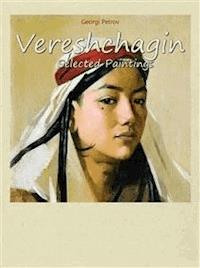
Vasily Vasilyevich Vereshchagin (1842 -1904) was one of the most famous Russian war artists and one of the first Russian artists to be widely recognized abroad. The graphic nature of his realist scenes led many of them to never be printed or exhibited.
Das E-Book können Sie in Legimi-Apps oder einer beliebigen App lesen, die das folgende Format unterstützen:
Veröffentlichungsjahr: 2017
Ähnliche




















Vereshchagin
Selected Paintings
By Georgi Petrov
––––––––
First Edition
*****
Copyright © 2017 by Georgi Petrov
Table of Contents
Title Page
Copyright Page
Foreword
Contents
Foreword
Vasily Vasilyevich Vereshchagin (1842 -1904) was one of the most famous Russian war artists and one of the first Russian artists to be widely recognized abroad. The graphic nature of his realist scenes led many of them to never be printed or exhibited.
Vereshchagin was born at Cherepovets, Novgorod Governorate, Russia in 1842 as the middle of three brothers. His father was a landowner of noble birth. When he was eight years old he was sent to Tsarskoe Selo to enter the Alexander Cadet Corps, and three years later he entered the Sea Cadet Corps at St Petersburg, making his first voyage in 1858. He served on the frigate Kamchatka, which sailed to Denmark, France and Egypt. Vereshchagin graduated first in the list at the naval school, but left the service immediately to begin the study of drawing in earnest. He won a medal two years later, in 1863, from the St Petersburg Academy for his Ulysses Slaying the Suitors. In 1864 he proceeded to Paris, where he studied under Jean-Leon Gerome, though he dissented widely from his master's methods.
In the Paris Salon of 1866 he exhibited a drawing of Dukhobors chanting their Psalms. In the next year he was invited to accompany General Konstantin Kaufman's expedition to Turkestan. He was granted the rank of ensign. His heroism at the siege of Samarkand from June 2-8 1868 result an award of the Cross of St George. He was an indefatigable traveler, returning to St. Petersburg in late 1868, to Paris in 1869, back to St. Petersburg later in the year, and then back to Turkestan at the end 1869 via Siberia. In 1871, he established an atelier in Munich, and made a solo exhibition of his works at the Crystal Palace in London in 1873. He made another exhibition of his works in St. Petersburg in 1874. In late 1874, he departed for an extensive tour of the Himalayas, India and Tibet, spending over two years in travel. He returned to Paris in late 1876. With the start of the Russo-Turkish War (1877-1878), Vereshchagin left Paris and returned to active service with the Imperial Russian Army. He was present at the crossing of the Shipka Pass and at the Siege of Pleven, where his brother was killed; and he was dangerously wounded during the preparations for the crossing of the Danube near Rustchuk. At the conclusion of the war, he acted as secretary to General Skobelev at San Stefano.
After the war, Vereshchagin settled at Munich, where he produced his war pictures so rapidly that he was freely accused of employing assistants. The sensational subjects of his pictures, and their didactic aim, the promotion of peace by a representation of the horrors of war, attracted a large section of the public not usually interested in art to the series of exhibitions of his pictures in Paris in 1881 and subsequently in London, Berlin, Dresden, Vienna and other cities. Vereshchagin painted several scenes of imperial rule in British India. His epic portrayal of The State Procession of the Prince of Wales into Jaipur in 1876 is claimed to be the third largest painting in the world. In 1882-1883, he again traveled to India. By the late 19th century Vereshchagin had gained popularity not only in Russia, but also abroad and his name never left the pages of the European and American press. From his earliest works, unlike most contemporary battle pieces depicting war as a kind of parade, Vereshchagin graphically depicted the horrors of war. In Russia a ban on exhibitions of Vereshchagin's work was enforced, as well as a ban on reproductions of them in books and periodicals amidst accusations of slandering the Russian army.
A journey in Syria and Palestine in 1884 furnished him with an equally discussed set of subjects from the New Testament. Vereshchagin's paintings caused controversy over portraying the figure of Christ with what was thought at the time to be an unseemly realism.
The "1812" series on Napoleon's Russian campaign, on which Vereshchagin also wrote a book, seem to have been inspired by Tolstoi's War and Peace, and were painted in 1893 at Moscow, where the artist eventually settled.
Vereshchagin was in the Far East during the First Sino-Japanese War of 1894-1895, and was with the Russian troops in Manchuria during the Boxer Rebellion of 1900. In 1901, he visited the Philippines, in 1902 the United States and Cuba, and in 1903, Japan. During the Russo-Japanese War, he was invited by Admiral Stepan Makarov to join him aboard Makarov's flagship, Petropavlovsk. On April13, 1904, Petropavlovsk struck two mines while returning to Port Arthur and sank, taking down with it most of the crew, including both Admiral Makarov and Vereshchagin. Vereshchagin's last work, a picture of a council of war presided over by Admiral Makarov, was recovered almost undamaged.
Paintings
Burlak, Holding Hands for the Strap
, 1866, Study for the Unrealized Picture "Burlaki",
Oil on canvas, 34 x 22 cm
2. Burlak with a Hat in His Hand, 1866, Etude to the Unrealized Picture "Burlaki",
Oil on canvas, 31 x 22 cm




