


15,99 €
Mehr erfahren.
- Herausgeber: Parkstone International
- Kategorie: Geisteswissenschaft
- Sprache: Englisch
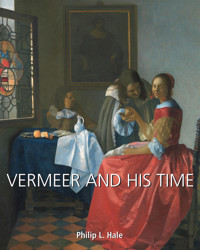
Johannes Vemeer, a 17th century artist, is recognised primarily for his genre scenes. Through meticulous precision in his paintings and drawings he achieves perfection and maximum impact. Unlike his predecessors, Vermeer used a camera obscura to bring even more perspective to his art in the most delicate of manners. He revolutionised the way in which we use and make paint and his colour application techniques predate some of those used by the impressionists nearly two centuries later. Girl with a Pearl Earring remains to this day his greatest masterpiece.
Das E-Book können Sie in Legimi-Apps oder einer beliebigen App lesen, die das folgende Format unterstützen:
Seitenzahl: 141
Veröffentlichungsjahr: 2019
Ähnliche




















Author: Philip L. Hale
© Confidential Concepts, worldwide, USA
© Parkstone Press International, New York, USA
Image-Barwww.image-bar.com
All rights reserved.
No part of this publication may be reproduced or adapted without the permission of the copyright holder, throughout the world. Unless otherwise specified, copyright on the works reproduced lies with the respective photographers, artists, heirs or estates. Despite intensive research, it has not always been possible to establish copyright ownership. Where this is the case, we would appreciate notification.
ISBN: 978-1-64461-827-1
Philip L. Hale
Contents
Preface
I. Vermeer the Supreme Painter
II. Delft and the background of Vermeer’s Art
III. What is known about Jan Vermeer of Delft
IV. Vermeer, Forgotten and Rediscovered
V. His Genius and His Methods
VI. Characteristics of Vermeer’s Technique
VII. Vermeer and Modern Painting
Biography
Index
Preface
This book is written to make the name and the work of Jan Vermeer of Delft better known.
Although he is now well known to artists and connoisseurs, he still remains quite unheeded by very many intelligent and cultivated people. It is to overcome, if possible, this neglect, to bring the man and his work home to people, and to tell so far as may be the curious story of this artist’s disappearance and of his later reappearance that the following pages have been written.
Since there is but little to tell of Vermeer’s life a good deal of this book is given to a study of his artistic qualities and so far as may be of his technical processes.
His particular qualities — his design, his study of edges, his intuition for colour values, his peculiar and very personal system of colour arrangement — are very characteristic and have not perhaps been overmuch dwelt on by previous writers.
One of the things which particularly interest us in Vermeer is his modernity. Certain pictures of his, notably the Painter in his Studio, look, as the saying is, as if they had been painted yesterday. And it is not only that the colour looks freshly laid on, but that it has been seen and understood as we moderns see and understand colour.
Certainly, various qualities in Vermeer’s work are singularly modern; his point of view, his design, his colour values, his edges, his way of using the square touch, his occasional pointillé touch — all these are peculiarly modern qualities which one seldom notices in other old masters. Perhaps then, we particularly admire Vermeer because he has attacked what seem to us distinctly modern problems or motifs and solved them, on the whole, in a modern way. And with this, he has been able to retain something of the serenity, poise and finish that we regard as peculiarly the property of the old masters. Our modern work is petulant, that of the masters was serene.
The Procuress (detail), 1656. Oil on canvas, 143 x 130 cm. Gemäldegalerie Alte Meister, Dresden.
The Milkmaid, c. 1658. Oil on canvas, 45.5 x 41 cm. Rijksmuseum, Amsterdam.
I. Vermeer the Supreme Painter
The best men in art are found by a process of elimination. It may be a challenging statement to call Jan Vermeer of Delft the greatest painter who has ever lived. Yet in sheer downright painting, he was in most respects the leader of all. There were giants, of course, such as Velazquez, Rubens and Rembrandt, who did very wonderful things, but none of these ever conceived of arriving at tone by an exquisitely just relation of colour values — the essence of contemporary painting that is really good.
Various qualities in Vermeer’s work are those for which the best painters of our day strive: his design, his colour values, his edges, his way of using the square touch, his occasionally pointillé touch, all of which are qualities that one seldom observes in other old masters. We of today particularly admire Vermeer because he has attacked what seems to us significant problems or motives, and has solved them, on the whole, as we like to see them solved. The yellowish jacket. And with this he has been able to retain something of the serenity, poise and finish that we regard as peculiarly the property of the old masters. Our present-day work is often petulant that of the old masters was generally serene.
True it is, as will appear in the discussion to follow that Vermeer was not always wholly successful. Nobody ever has been, and doubtless no one ever will be. It is silly to ascribe to one’s hero all the virtues, it is enough to point out the qualities which he possesses.
By and large, Vermeer has more great painting qualities and fewer defects than any other painter of any time or place. He was born in 1632 and died at the age of forty-three in 1675 and it is when one compares him with other great artists of his own day and land that his superiority is most manifest. Terborch, by comparison with Vermeer, appears sleazy and mannered, de Hooch looks hot and stodgy. Even Metsu, perhaps the most accomplished technician of them all, seems rather artificial and by no means alert to colour values. Each of these men, of course, had extraordinary qualities. But Vermeer combined within himself most of their good qualities and avoided many of their defects.
His manner of seeing is the basic excellence of Vermeer’s art — the thing that sets it apart from the work of other men. Where others had a genius for drawing or for colouration, he had a genius for vision. One arrives, while studying his work carefully, at a feeling that he looked at things harder than others have looked at them. Many painters acquire a manner of making things, a parti pris, which impels them to distort nature to suit their book. Vermeer, too, had his manner of workmanship, but after he had laid his picture in, and indeed carried it quite far, he seems to have sat back and looked at what was before him again and again to see if there was anything he could do to his picture to make it portray more closely the real aspect of nature — la vraie verité, as Gustave Courbet liked to call it. His almost perfect rendering was the outcome of perfect understanding.
There is a tendency in appraising the work of artists to adore warm, picturesque personalities. To some writers Rembrandt is a delight not so much on account of the qualities of his painting as because of his remarkable way of living. Goya is admired not merely because of his good painting but also because he was a bull fighter. Many feel that they must have the work of a man rich, warm, passionate. They are not interested that it shall be right. Many of us, indeed, have forgotten that there is a beauty in rightness that there really is no beauty without it.
Vermeer’s art has this quality of cool, well-planned rightness to the full. He holds, as it were, a silver mirror up to nature, but he tells no merely pleasant tale as he holds it. His work is as intensely personal as any that was ever done, but it offers a personality disengaged from self-consciousness during the making process.
His name is not surrounded by the kind of fame for which a more accurate word is notoriety. He was no playboy of the boulevards, he did not run away with some rival painter’s wife, he did not do eccentric things of the kind for which, again, the better term is egocentric. On the contrary, so little was known of him for about two hundred and fifty years that the impression became fixed that almost nothing at all was known about him. Following the lead of his “rediscoverer,” M. Théophile Thore, who called him “the Sphinx of Delft,” those members of the general public who knew anything about him at all — even so much as his name — thought of him as a man of mystery. They came almost to doubt his very existence and to wonder how pictures painted so entrancingly could be the work of a man so little known and so completely without any background of alluring anecdote. Indeed, as we shall see, many of his pictures themselves were for years attributed to other painters, some through ignorance, some through deliberate fraud, because they would sell better if they bore some other name than his — some name that was at the moment better known.
Hendrick ter Brugghen,Saint Sebastian Tended by Irene, 1625. Oil on canvas, 150.2 x 120 cm. Allen Memorial Art Museum, Oberlin College, Ohio.
Hendrick ter Brugghen, The Concert, c. 1626. Oil on canvas, 99.1 x 116.8 cm. The National Gallery, Londres.
Carel Fabritius, The Beheading of John the Baptist, c 1640-1645. Oil on canvas, 149 x 121 cm, Rijksmuseum Amsterdam.
Rembrandt, Portrait of Two Figures from the Old Testament known as The Jewish Bride, 1665. Oil on canvas, 121.5 x 166.5 cm. Rijksmuseum, Amsterdam.
Carel Fabritius, Mercury and Aglauros, c. 1645-1647. Oil on canvas, 72.4 x 91 cm. Museum of Fine Arts, Boston, Martha Ann Edwards Fund.
It may truly be said that the real romance of Vermeer is the extraordinary story of how he sank into oblivion, slumbered for centuries and then came again out of his deep obscurity into the light of fame. For, as we shall see, he was by no means an unimportant figure in his own day. Modern research, the results of which are presented in later pages, has established the fact that he attained the status of a master painter in the Guild of St. Luke at Delft when he was barely twenty-one, the son of parents who came from families on the whole of fairly substantial means that he was mentioned in a poem written when he was scarcely twenty-two in a way which indicates how highly he was considered as a young man of promise that he had already married at twenty the daughter of a woman who clearly regarded him as a good and dependable son-in-law throughout his comparatively short life that he was, during at least four different years, one of the six Syndics of the Guild and for two of those years their chairman or president that he was especially visited by a French connoisseur in his studio that he was particularly mentioned in the voluminous work of the local historian during his own lifetime that throughout his career as a painter in Delft he associated on equal terms in responsible positions with men much older than himself that there is reason to believe that his pictures brought excellent prices during his own day because sales records show that in the years immediately following his death they sold for sums which compared favorably with those paid for the work of other men.
For reasons which will be set forth later, however, Vermeer’s reputation presently languished and the fame which seemed likely to be his passed him by. We see, perhaps, an early indication of this in the record of a sale of pictures less than half a century after his death when the dealer, in listing a picture by Vermeer of Delft, set forth as a selling argument that it was as good as an Eglon van der Neer.
One of the reasons why his reputation became obscured may have been because so few of his pictures came into public view. If it be true, as some scholars surmise, that his productive years, which in the nature of things could not have been much more than twenty, were really no more than ten, the number of paintings which he left behind him must still be regarded as small, even when one realizes how much time it must have taken to paint as he painted. There are not fifty well-authenticated pictures by Vermeer known to be in the world today, and the number of “lost” Vermeers, even if one includes some dubiously recorded attributions, is small. A painter whose name seldom turned up in the sales catalogues could not become widely known by that easiest of all methods of publicity — getting frequently mentioned and with so limited a number of pictures to change hands the occasions when a Vermeer would be offered would naturally be few. And so it was perhaps not surprising, when John Smith wrote his nine-volume work on the most eminent Dutch, Flemish and French painters, in 1833, that he remarked, with curious logic, in the tiny paragraph which he devoted to Vermeer, “this painter is so little known, by reason of the scarcity of his works, that it is quite inexplicable how he attained the excellence many of them exhibit”
Inexplicable or not, “the excellence many of them exhibit” was the thing which finally brought Vermeer the fame so long denied him, for when in the middle fifties of the nineteenth century M. Thoré saw the View of Delft at The Hague, he was so impressed by its excellence that he set out forthwith on his quest for more pictures by its little-known painter.
Diana and her Nymphs, 1653-1654. Oil on canvas, 97.8 x 104.6 cm. Mauritshuis, The Hague.
Rembrandt, Diana Bathing, c. 1634-1635. Oil on canvas, 73.5 x 93.5 cm. Museum Wasserburg Anholt, Anholt.
Rembrandt, The Toilet of Bathsheba, 1643. Oil on wood, 57.2 x 76.2 cm. The Metropolitan Museum of Art, New York.
That was the beginning. The growth of Vermeer’s fame was slow, but it was steady, and it was safe and sure. Now and then an article appeared, and now and then a book. Errors of fact and errors of surmise were repeated, after the manner of writers, from one writer to another. Slowly the obscurity was lifted, however, and the facts emerged.
Perhaps the most obvious evidence of a painter’s fame is where his pictures are to be found and how much they bring in the marketplace. In Vermeer’s case, of the forty-odd pictures satisfactorily ascribed to him, more than four fifths have arrived at final and permanent homes in public museums and of the few others several are in collections which are on their way to becoming public property. The time is not far distant, therefore, when the opportunity to apply the criterion of price to a picture by Vermeer will have gone and when it will not be a matter of sensational news that an American collector has bought a Vermeer for $290,000 or that another American collector has offered his for a quarter of a million dollars. When twenty-one of Vermeer’s paintings were sold in Amsterdam in 1696 they brought all told only 1404 florins, a small sum judged by modern standards, even though, as has already been said, their prices were not small by comparison with others. With scarcely more than twice as many accounted for today, Mr. James Henry Duveen has estimated the total value of the entire small number at about twenty-five million dollars (five million pounds). When the Music Lesson was bought as a van Mieris for King George III, it cost less than $500 (£100). Now it is said to be worth from $400,000 to $500,000 (£80,000 to £ 100,000). The Milkwoman sold for about $70 in 1696, some two centuries later it was bought for the Rijksmuseum at Amsterdam for about $ 120,000 (£24,000). Instances might be multiplied, but the fuller story will be found in Part II of the present volume where we shall see the records of sale of this, that or the other picture, and shall be able to apply the yardstick of market value to the fluctuations of Vermeer’s fame during the years in which his paintings have lifted his name to the heights because of “the excellence many of them exhibit.”
The personality who through the years has eluded those whose attention can be caught only by the beating of the drum is revealed in the device of the subject, in the arrangement of colours, in the registration of colour values and of edges, it does not appear in little graces of indication and handling. The man simply painted on, striving for and attaining the rightness of things, not cunning little affectations, taking mannerisms or engaging graces. He conceived and sought the best arrangement of line and colour that he could achieve. He must have had the thought, uttered or unexpressed, that if only he could make his painting just like what was before him it would comprise all the valid technical merits.
And it is this thought of the supreme value of rightness of artistic perception that is the underlying idea of the chapters to follow on Vermeer, the man and the artist.




