


51,99 €
Mehr erfahren.
- Herausgeber: John Wiley & Sons
- Kategorie: Fachliteratur
- Sprache: Englisch
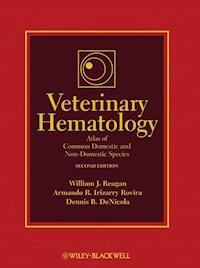
The long-awaited Second Edition of Veterinary Hematology: Atlas of Common Domestic and Non-Domestic Species serves as a major update to this essential introductory hematology atlas. In addition to a thorough update of all chapters, the new edition now includes coverage of laboratory animals and pocket pets, two new chapters devoted entirely to avian and exotic animals, and a PC compatible CD providing a wealth of additional hematological images. Now fully updated and revised, the Second Edition is the must-have veterinary hematology atlas for veterinarians, veterinary students, and veterinary technicians alike.
Sie lesen das E-Book in den Legimi-Apps auf:
Seitenzahl: 178
Veröffentlichungsjahr: 2013
Ähnliche



















CONTENTS
Preface
About the Authors
Chapter 1. Hematopoiesis
GENERAL FEATURES
ERYTHROPOIESIS
GRANULOPOIESIS
MONOCYTOPOIESIS
MEGAKARYOCYTOPOIESIS AND PLATELET PRODUCTION
LYMPHOPOIESIS
OTHER CELLS OF THE BONE MARROW
Chapter 2. Normal Red Blood Cell Morphology
Chapter 3. Variations in Red Blood Cell Morphology
REGENERATIVE RESPONSE
IMMUNE-MEDIATED DAMAGE
OXIDATIVE INJURY
METABOLIC/MEMBRANE DISORDERS
MECHANICAL FRAGMENTATION
Chapter 4. Red Blood Cell Inclusions and Parasites
Chapter 5. Normal White Blood Cell Morphology
SEGMENTED NEUTROPHIL
BAND NEUTROPHIL
LYMPHOCYTE
MONOCYTE
EOSINOPHIL
BASOPHIL
Chapter 6. Variations in White Blood Cell Morphology
Chapter 7. White Blood Cell Inclusions and Parasites
Chapter 8. Platelets
Chapter 9. Lymphoproliferative and Myeloproliferative Disorders
GENERAL FEATURES
LYMPHOPROLIFERATIVE DISORDERS
MYELOPROLIFERATIVE DISORDERS
Chapter 10. Miscellaneous Findings
Chapter 11. Avian Hematology
Chapter 12. Reptilian Hematology
Appendixes
1. Semiquantitative Grading Scheme for Evaluation of Red Blood Cell Morphology
2. Semiquantitative Grading Scheme for Evaluation of Neutrophil Toxicity
Glossary
Selected References
Index
First edition first published 1998
© 1998 Iowa State University Press
Second edition first published 2008
© 2008 Wiley-Blackwell
Blackwell Publishing was acquired by John Wiley & Sons in February 2007.
Blackwell’s publishing program has been merged with Wiley’s global Scientific, Technical, and Medical business to form Wiley-Blackwell.
Editorial Office
2121 State Avenue, Ames, Iowa 50014-8300, USA
For details of our global editorial offices, for customer services, and for information about how to apply for permission to reuse the copyright material in this book, please see our website at www.wiley.com/wiley-blackwell.
Authorization to photocopy items for internal or personal use, or the internal or personal use of specific clients, is granted by Blackwell Publishing, provided that the base fee is paid directly to the Copyright Clearance Center, 222 Rosewood Drive, Danvers, MA 01923. For those organizations that have been granted a photocopy license by CCC, a separate system of payments has been arranged. The fee codes for users of the Transactional Reporting Service are ISBN-13: 978-0-8138-2809-1/2008.
Designations used by companies to distinguish their products are often claimed as trademarks. All brand names and product names used in this book are trade names, service marks, trademarks or registered trademarks of their respective owners. The publisher is not associated with any product or vendor mentioned in this book. This publication is designed to provide accurate and authoritative information in regard to the subject matter covered. It is sold on the understanding that the publisher is not engaged in rendering professional services. If professional advice or other expert assistance is required, the services of a competent professional should be sought.
Library of Congress Cataloging-in-Publication Data
Reagan, William J.
Veterinary hematology: atlas of common domestic and non-domestic species / William J. Reagan, Armando R. Irizarry Rovira, Dennis B. DeNicola. – 2nd ed.
p. ; cm.
Includes bibliographical references and index.
ISBN 978-0-8138-2809-1 (alk. paper)
1. Veterinary hematology–Atlases. I. Irizarry Rovira, Armando R.
II. DeNicola, D. B. III. Title.
[DNLM: 1. Hematologic Diseases–veterinary–Atlases. 2. Animals, Domestic–Atlases. SF 769.5 R287v 2008]
SF769.5.R43 2008
636.089′615–dc22
2008011368
A catalogue record for this book is available from the U.S. Library of Congress.
1 2008
PREFACE
The purpose of this book is to provide the fundamentals for recognizing the normal and abnormal morphological features of blood cells of the common domestic and non-domestic species. The first edition was limited to the morphology of the common domestic species, including dogs, cats, horses, ruminants, and llamas. This second edition has been greatly expanded to include the commonly used laboratory animal species, including rats (Sprague-Dawley), mice (CD1), nonhuman primates (cynomolgus monkey; Macaca fascicularis), ferrets, rabbits (New Zealand White), and guinea pigs. In addition, chapters on avian and reptilian hematology are also included. These chapters demonstrate the normal and abnormal morphology in many of the common pet avian and reptilian species. To accomplish this hematology review of the common domestic and non-domestic species, photomicrographs that show many of the common, as well as some of the less frequent, blood morphologic abnormalities are presented. A high number of the photomicrographs are of canine blood smears, but many of the abnormalities shown occur in other species as well. Those that are unique to one species are mentioned. Attempts were made to be as complete as possible, but clearly, not all abnormalities that can be found in the blood are shown. There is also a list of selected references provided that may be helpful in evaluating a morphological feature that is not described in this book. Throughout the book, in addition to the morphological features of the blood cells, some of the more common diseases or pathophysiological states in which these abnormalities may occur are mentioned. These lists of disease states are not always totally inclusive of all possible states in which these abnormalities may occur, and the readers are again referred to more complete treatises of hematology in the references.
Wright or Wright-Giemsa stains were used on the majority of blood smears that were photographed. If another stain was used, it is stated in the figure legend. If no stain is mentioned in the figure legend, the stain used was Wright or Wright-Giemsa. Other stains including Diff-Quik and other similar rapid stains are identified specifically as Diff-Quik stain or simply as “quick stain.” The color reproductions of the cells were kept as consistent and as accurate as possible. The descriptions in the text and figure legends highlight these characteristics. However, depending on the exact type of stain used by the reader, the color of the blood cells may be slightly different from those described in the text. Some of the major differences in staining are described in Chapter 10.
The microscope objective that was used to take the photomicrographs is also listed in the figure legend. The objective is listed instead of the total original magnification in an attempt to make it easier to understand how a cell, inclusion, and so on would appear on the reader’s microscope. The final magnification of most of the figures is similar, so that the figures with the same objective listed can be compared directly. Insets have been added to several figures, which may give a greater magnification of the cell or object of interest; these are marked appropriately.
This textbook should be useful to the novice and experienced hematologist alike. The glossary, which defines many of the terms used in the text, may be more useful to the novice. Two appendixes, which present methods used in the Purdue University Veterinary Teaching Hospital Clinical Pathology Laboratory for semiquantitation of some of the morphological abnormalities, may be useful to the novice as well as the experienced hematologist. These appendixes should be helpful guidelines for reproducibly recording morphological abnormalities that may be present in a blood smear.
Finally, we have many people to thank for their assistance in developing the second edition of the atlas. First and most important are our families, who provided us with the time and support to pursue this project. Special thanks go to our wives, Julie Clements-Reagan, Heather Irizarry, and Jan DeNicola. We also thank Julie Clements-Reagan again for her contribution to the graphic design of first edition, which is also retained in this edition. We thank Teresa Sanders and the technicians and clinical pathology residents of the Purdue University Veterinary Teaching Hospital Clinical Pathology Laboratory for suggestions on content, as well as help in acquiring the case material used in the first edition and again used in the second edition. We are thankful for the many avian and reptilian samples that non-domestic animal practitioners, such as Dr. Angela Lennox (Avian and Exotic Animal Clinic of Indianapolis, Indiana) and Dr. Alexander Wolf (Avian and Exotic Animal Clinic of Lafayette, Indiana), contributed over the past many years. Some additional material was obtained from glass slides that were submitted to the American Society for Veterinary Clinical Pathology annual slide review; those slides are identified as such in the legends. We thank the society and contributors for this material. Finally, we appreciate the support and opportunity that Wiley-Blackwell has given us to develop this resource.
ABOUT THE AUTHORS
WILLIAM J. REAGAN received his DVM degree from the College of Veterinary Medicine, Ohio State University, Columbus, and his PhD degree from the College of Veterinary Medicine and Biomedical Sciences, Colorado State University, Fort Collins. He is a Diplomate of the American College of Veterinary Pathologists. Dr. Reagan was formerly an associate professor of veterinary clinical pathology, Purdue University School of Veterinary Medicine, West Lafayette, Indiana, and is currently an associate research fellow at Pfizer, Inc., Groton, Connecticut.
ARMANDO R. IRIZARRY ROVIRA received his DVM and PhD degrees from the School of Veterinary Medicine, Purdue University. He is a Diplomate of the American College of Veterinary Pathologists and is currently a research advisor-pathologist at Eli Lilly and Company, Greenfield, Indiana, as well as an adjunct associate professor of veterinary anatomic and clinical pathology at Purdue University School of Veterinary Medicine, West Lafayette, Indiana.
DENNIS B. DENICOLA received his DVM degree from the School of Veterinary Medicine, Purdue University, and his PhD from Purdue University. He is a Diplomate of the American College of Veterinary Pathologists and was formerly a professor of veterinary clinical pathology, Purdue University. Dr. DeNicola currently is the chief veterinary educator at IDEXX Laboratories, Inc., Westbrook, Maine, and adjunct professor of veterinary clinical pathology at Purdue University.
CHAPTER ONE
HEMATOPOIESIS
GENERAL FEATURES
All blood cells have a finite life span, but in normal animals, the number of cells in circulation is maintained at a fairly constant level. To accomplish this, cells in circulation need to be constantly replenished, which occurs via the production and release of cells from the bone marrow. Production sites in the bone marrow are commonly referred to as medullary sites. In times of increased demand, production can also occur outside the bone marrow in sites such as spleen, liver, and lymph nodes. These sites are called extramedullary sites. In rodents, in the normal steady state, extramedullary production of blood cells occurs in the spleen.
Lesen Sie weiter in der vollständigen Ausgabe!
Lesen Sie weiter in der vollständigen Ausgabe!
Lesen Sie weiter in der vollständigen Ausgabe!
Lesen Sie weiter in der vollständigen Ausgabe!
Lesen Sie weiter in der vollständigen Ausgabe!
Lesen Sie weiter in der vollständigen Ausgabe!
Lesen Sie weiter in der vollständigen Ausgabe!
Lesen Sie weiter in der vollständigen Ausgabe!
Lesen Sie weiter in der vollständigen Ausgabe!
Lesen Sie weiter in der vollständigen Ausgabe!
Lesen Sie weiter in der vollständigen Ausgabe!
Lesen Sie weiter in der vollständigen Ausgabe!
Lesen Sie weiter in der vollständigen Ausgabe!
Lesen Sie weiter in der vollständigen Ausgabe!
Lesen Sie weiter in der vollständigen Ausgabe!




