


58,99 €
Mehr erfahren.
- Herausgeber: John Wiley & Sons
- Kategorie: Fachliteratur
- Sprache: Englisch
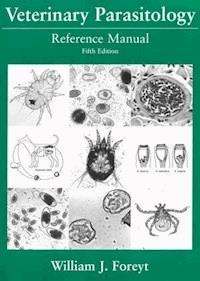
Veterinary Parasitology Reference Manual, Fifth Edition is a practical, thorough, bench top reference for basic diagnostic veterinary parasitology. The manual provides pertinent information on parasite life cyles, importance, location in the host, zoonotic potential, current literature, diagnosis, and treatment. It also includes step-by-step instructions for the most common diagnostic procedures used in routine veterinary practice. Sections are organized by animal host species, including dogs; cats; cattle, sheep and goats; llamas; horses; pigs; birds; ratites (ostriches, emus, and cassowaries); and laboratory animals, as well as wildlife, reptiles, marine mammals, and humans. There is a section in which common artifacts found in fecal samples are presented, and the last section includes conversion tables and a list of abbreviations. Features of the Fifth edition include: * updated and enhanced references * information on new drugs * improved section on parasites of marine mammals * sections on parasites of laboratory animals and humans * over 500 photographs and figures Readers will find this to be an easily accessible and accurate resource for information about parasites in a variety of animals - wild, domestic, common and exotic.
Sie lesen das E-Book in den Legimi-Apps auf:
Seitenzahl: 239
Veröffentlichungsjahr: 2013
Ähnliche



















Contents
PREFACE
INTRODUCTION
Section 1: DIAGNOSTIC PARASITOLOGY
Collection and Submission of Samples
Diagnostic Techniques
Microscopy
Bibliography
Section 2: GENERAL PARASITOLOGY
Classification Simplified
Bibliography
Section 3: PARASITES OF DOGS
Fecal Eggs and Oocysts
Location of Major Parasites
Drugs
Internal Parasites
External Parasites (See also page 48)
Protozoan Parasite
Bibliography (see pages 63–68)
Section 4: PARASITES OF CATS
Miscellaneous Parasites
Miscellaneous External Parasites of Cats and Dogs
Fecal Eggs and Oocysts
Location of Major Parasites
Zoonotic Diseases
Drugs
Internal Parasites
External Parasites
Bibliography
Section 5: PARASITES OF CATTLE, SHEEP, AND GOATS
Fecal Eggs and Oocysts in Cattle
Coccidia in Cattle
Location of Major Parasites in Cattle
Zoonotic Diseases in Cattle
Fecal Eggs and Oocysts in Sheep and Goats
Coccidia in Sheep and Goats
Location of Major Parasites in Sheep and Goats
Zoonotic Diseases in Sheep and Goats
Drugs Used in Ruminants
Internal Parasites
External Parasites
Bibliography
Section 6: PARASITES OF LLAMAS
Fecal Eggs and Oocysts
Coccidia in Llamas
Location of Major Parasites
Drugs
Internal Parasites
External Parasites
Bibliography
Section 7: PARASITES OF HORSES
Fecal Eggs and Oocysts
Location of Major Parasites
Zoonotic Diseases
Drugs
Internal Parasites
External Parasites
Bibliography
Section 8: PARASITES OF PIGS
Fecal Eggs and Oocysts
Location of Major Parasites
Zoonotic Diseases
Drugs
Internal Parasites
External Parasites
Bibliography
Section 9: PARASITES OF BIRDS
Fecal Eggs and Oocysts
Location of Major Parasites
Zoonotic Diseases
Coccidia in Birds
Drugs
Internal Parasites
External Parasites
Bibliography
Section 10: PARASITES OF RATITES (OSTRICHES, EMUS, AND CASSOWARIES)
Location of Major Parasites
Drugs
Common Parasites
Bibliography
Section 11: PARASITES OF LABORATORY ANIMALS
Drugs
Common Parasites
Bibliography
Section 12: PARASITES OF WILDLIFE
Important Parasites of Wildlife
Parasites
Bibliography
Section 13: PARASITES OF MARINE MAMMALS
Marine Mammals
Major Parasites
Drugs
Internal Parasites
Bibliography
Section 14: PARASITES OF REPTILES
Common Reptiles
Major Parasites
Fecal Eggs and Oocysts
Drugs
Internal Parasites
Bibliography
Section 15: PARASITES OF HUMANS
Location of Major Parasites
Common Parasites
Internal Parasites
External Parasites
Bibliography
Section 16: COMMON ARTIFACTS IN FECES
Artifacts
Spurious Parasites
Section 17: TABLES
INDEX
William J. Foreyt, Ph.D., is a professor in the College of Veterinary Medicine at Washington State University and teaches veterinary parasitology, diseases of wildlife, and diagnostic parasitology. His major research interests are parasitic and infectious diseases of wild and domestic animals, with an emphasis on disease interaction between wild and domestic animals.
© 1997, 1994, 1990, 1989 William J. Foreyt © 2001 Iowa State University Press All rights reserved
Blackwell Publishing Professional 2121 State Avenue, Ames, Iowa 50014
Orders: 1-800-862-6657 Office:1-515-292-0140 Fax: 1-515-292-3348 Web site:www.blackwellprofessional.com
Authorization to photocopy items for internal or personal use, or the internal or personal use of specific clients, is granted by Blackwell Publishing, provided that the base fee of $.10 per copy is paid directly to the Copyright Clearance Center, 222 Rosewood Drive, Danvers, MA 01923. For those organizations that have been granted a photocopy license by CCC, a separate system of payments has been arranged. The fee code for users of the Transactional Reporting Service is 0-8138-2419-2/2001 $.10.
First edition, 1989 © William J. Foreyt Second edition, 1990 © William J. Foreyt Third edition, 1994 © William J. Foreyt Fourth edition, 1997 © William J. Foreyt Fifth edition, 2001 © Iowa State University Press
Library of Congress Cataloging-in-Publication Data
Foreyt, William J. Veterinary parasitology reference manual / William J. Foreyt. — 5th ed. p. cm. Includes bibliographical references and index. ISBN 0-8138-2419-2 (alk. paper) 1. Veterinary parasitology—Handbooks, manuals, etc. [DNLM: 1. Parasitic Diseases, Animal—Handbooks. 2. Parasites—Handbooks.] I. Title. SF810.A3 F67 2001 636.089′696—dc21
2001004464
Disclaimer
The nature of drug information is constantly evolving because of ongoing research and clinical experience. While care has been taken to ensure the accuracy of the information presented, errors may have been missed. Readers are advised that decisions regarding drug use must be based on the independent judgment of the clinician, new information about the drug, and changing medical practices. Package inserts and labels for each drug product should be read carefully for dosage, route of administration, and withdrawal period. The author and publisher cannot be held responsible for any damage resulting from reliance on any information contained herein, whether with respect to drug identification, uses, procedures, dosages, or equivalencies, or by reason of any misstatement or error, negligent or otherwise, contained in this work.
9 2011
PREFACE
In this revised fifth edition, many references and figures have been updated and improved, newer drugs have been included, the section on parasites of marine mammals has been improved, and sections on laboratory animal parasites and human parasites have been added.
This book evolved as a response to the needs of veterinarians, veterinary students, and technicians and provides access to pragmatic reference information in veterinary parasitology. I arranged the book by host species, dogs, cats, ruminants, horses, pigs, avian, reptiles, wildlife, marine mammals, laboratory animals, and humans to allow easy access to information on parasite life cycles, importance, location in host, zoonotic potential, pertinent literature, diagnosis, and treatment. I have simplified the taxonomy of parasites for veterinary use by modifying the most easily understood taxonomic systems. Photographs of the important diagnostic stages are included to assist in the diagnosis of parasitic disease. While this book is not a complete parasitology reference encyclopedia, it meets the challenge of providing a composite reference in everyday, routine veterinary parasitology.
Many people have assisted with this publication and my thanks are extended to them. I especially thank the late Dr. Richard Wescott, Dr. Charles Leathers, Richard Dixon, Kris Foreyt, Dr. Lora Rickard, Dr. Ann Lichtenwalner, Dr. Bill Pedersen, Dr. Allan Pessier, Dan Rice, John Lagerquist, Dr. Mark Winning, Ann Foreyt, the Biomedical Communications Unit at Washington State University, Amy Wood, Dr. Murray Dailey, and Susan Barnard, who contributed to several important aspects of the book.
The Washington Department of Fish and Wildlife, Oregon Department of Fish and Wildlife, and the Idaho Department of Game have cooperated with me in my research projects and supplied me with thousands of wildlife samples over the years. I thank them for their enthusiastic support. Richard Dixon and Kristine Foreyt drew a majority of the illustrations, which significantly enhance the usefulness of this publication. Their artwork is greatly appreciated. Dr. Lora Rickard contributed significantly to the section on parasites of llamas. Dr. Murray Dailey contributed significantly to the section on marine mammals. Susan Barnard of the Atlanta Zoo contributed significantly to the section on reptiles. Financial support for the first edition of this publication in 1984 from The Merck Company Foundation is gratefully acknowledged.
This book is dedicated to my five exciting kids, Ann, Russell, Jane, Emily, and Kara, who are allowing me to live my second childhood through their interest in small wiggling creatures. It is equally dedicated to veterinary students to develop their biological interests and skills in the fascinating arenas of veterinary parasitology and field biology. I hope this book is useful to you.
Bill Foreyt
INTRODUCTION
Parasites are a fascinating group of invertebrates that are found in and on all groups of animals of interest in veterinary medicine. They have evolved and developed with many of their hosts and may or may not produce clinical disease, depending on a variety of environmental, ecological, immunological, physiological, and managerial factors that influence the host parasite relationship. This relationship is constantly changing, and as producers change management systems through animal breeding, animal manipulation, exotic introductions, environmental control, and use of drugs, different manifestations of disease are observed. As an example, Fascioloides magna is a liver fluke of white-tailed deer and elk and usually does not harm these hosts. However, when domestic sheep or goats are grazed in areas where F. magna is present, death of sheep and goats occurs within a relatively short time. Some hosts cannot tolerate the effects of specific parasites and die, whereas other hosts are well adapted to the parasite and no clinical signs of disease are present.
Examples of some of the ways parasites affect hosts are:
1. The worry and scare factor. Adult bot flies do not harm directly, but terrify animals.
2. Irritation. Lice cause intense irritation and self-mutilation.
3. Transmission of diseases. Biting flies and ticks transmit a variety of diseases.
4. Ingestion of blood and lymph. An abomasal nematode, Haemonchus contortus, causes severe anemia.
5. Secretion of toxins. Bot fly larvae secrete toxins and may cause death.
6. Mechanical blockage. Massive ascarid infections may occlude the intestine.
7. Tissue damage. Kidney worms in dogs destroy entire kidneys.
8. Production of traumatic lesions. Larvae of Habronema sp. produce “summer sores” in horses.
9. Psychosomatic disease. Animals are restless when external parasites are prevalent.
10. Disruption of metabolic function. Type II Ostertagia ostertagia increases abomasal pH.
11. Competition for nutrients. Many parasites cause reduced weight gains and feed utilization.
12. Zoonotic infections. Certain parasites transfer from animals to humans.
Since many parasites can be pathogenic, the goal of the clinician and producer is prevention of clinical parasitism through management, nutrition, epizootiology, and effective drugs. Knowledge of life cycles and epizootiology must be used in the formulation of effective parasite control programs. Indiscriminate use of drugs is a poor substitute for suboptimal management.
A final word is that new parasites and ecological relationships are being discovered, so do not be surprised when you make a discovery contrary to published reports.
Section 1
DIAGNOSTIC PARASITOLOGY
Collection and Submission of Samples
Diagnosis of parasitic infections depends on several factors, such as collection of the sample, transport of the sample to the laboratory, and method of laboratory evaluation. Diagnostic stages of most parasites can be detected in feces, blood, sputum, or skin scrapings. However, infections of immature parasites and latent and occult infections present a diagnostic challenge. Important factors to be considered in the diagnosis of parasitism and the interpretation of results are:
Proper collection and submission of samples to the laboratory increase the accurate diagnosis of parasitic infection.
Fecal Samples
Feces must be fresh for accurate results. As feces age, a diagnosis is complicated because many parasite eggs develop and hatch into larvae. Contaminants such as free-living soil nematodes, fly larvae, mites, and other arthropods often invade feces and complicate a diagnosis.
At least 10 g of fresh feces should be collected. If samples are more than two hours old, samples should be stored at 4°C until examined. Many parasite stages can be stored at 4°C for at least two months with minimal development. For routine shipment to the laboratory, samples can be cooled to 4°C and then packed with ice or other coolant (blue ice) for shipment via any of the 24- to 48-hour transport services. Fecal samples are best stored and sent in whirl-pak bags, small plastic sandwich bags, plastic containers, disposable laboratory gloves turned inside out, or rectal palpation gloves turned inside out. All samples should be clearly labeled with a black indelible marker with the number of the animal, date, and the person responsible for the sample.
Lesen Sie weiter in der vollständigen Ausgabe!
Lesen Sie weiter in der vollständigen Ausgabe!
Lesen Sie weiter in der vollständigen Ausgabe!
Lesen Sie weiter in der vollständigen Ausgabe!
Lesen Sie weiter in der vollständigen Ausgabe!
Lesen Sie weiter in der vollständigen Ausgabe!
Lesen Sie weiter in der vollständigen Ausgabe!
Lesen Sie weiter in der vollständigen Ausgabe!
Lesen Sie weiter in der vollständigen Ausgabe!
Lesen Sie weiter in der vollständigen Ausgabe!
Lesen Sie weiter in der vollständigen Ausgabe!
Lesen Sie weiter in der vollständigen Ausgabe!
Lesen Sie weiter in der vollständigen Ausgabe!
Lesen Sie weiter in der vollständigen Ausgabe!
Lesen Sie weiter in der vollständigen Ausgabe!
Lesen Sie weiter in der vollständigen Ausgabe!
Lesen Sie weiter in der vollständigen Ausgabe!




