


31,99 €
Mehr erfahren.
- Herausgeber: John Wiley & Sons
- Kategorie: Fachliteratur
- Sprache: Englisch
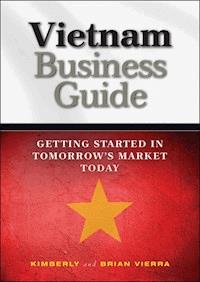
Vietnam Business Guide GETTING STARTED IN TOMORROW'S MARKET TODAY Kimberly and Brian Vierra have written the most useful guide I have seen for foreigners who want to do business in Vietnam. I've spent years in the country, but I learned a lot from this book. It's full of practical information about unique aspects of Vietnam's business culture; registration, legal and tax issues; working with local business partners; living conditions in Vietnam and industry-specific opportunities. Interviews with experienced expatriates bring the issues to life. The Vierras are very frank about tough problems such as corruption, but they also convey a real affection for and understanding of this wonderful country. Raymond Burghardt Former US Ambassador to Vietnam; Director, Indochina Capital Corporation Vietnam Business Guide is the book that every seasoned Southeast Asia hand, bellied up to a Saigon bar, says he ought to write. Be thankful the Vierras made good on this common boast. Unstinting, pragmatic, penetrating and incredibly accessible, this highly readable volume may not keep you from the suffering the pain of starting up, but--if read closely, with a yellow highlighter--may very well spare you the agony of undue blood-letting. There will be blood, but Vietnam Business Guide will mitigate the flow. James Sullivan Managing Director, Mandarin Media; Author, National Geographic Vietnam and Over the Moat Vietnam Business Guide provides practical and balanced information about Vietnam for foreigners to plan their first steps to enter the market. What separate this book from others are its reality and practicality, brought about by both the authors who themselves are entrepreneurs having walked the same journey and the experts who contributed their experiences on different topics throughout the book. The business landscape in Vietnam is speedily changing. Some facts, by the time you read the book, may need updating but still it serves best in providing newcomers essential starting points--a should-read book for those who consider doing business in Vietnam! Vu Minh Tri General Director, Yahoo! Vietnam Co. Ltd. I believe that Vietnam Business Guide has been very objective and true to its purpose. It covers almost all relevant business and personal challenges that one would face in Vietnam, with the authors' firsthand experience shining through in their handling of culture issues and the Vietnamese mindset. Despite the constraints on size, it has sufficient details and a wealth of references to guide entrepreneurs and business executives in the right direction. Crisply written with interviews and real-life anecdotes, it makes for a very interesting read. A must-read book and an invaluable tool kit for anyone looking to Vietnam for business. Manish Dhawan Vice President -- Coffee Division, Olam International Limited
Sie lesen das E-Book in den Legimi-Apps auf:
Seitenzahl: 285
Veröffentlichungsjahr: 2011
Ähnliche



















Contents
Cover
Half Title page
Title page
Copyright page
Preface
Introduction
Structure of the Book
Part 1: Considering Vietnam—Get Ready!
Chapter 1: Why Vietnam?
A Snapshot of Vietnam’s Economy
Economic Overview
Summary
Web Resources
Endnotes
Chapter 2: Living in Vietnam—It isn’t for Everyone
Part 2: Starting up in Vietnam—Get Set!
Roadmap to Starting Your Business in Vietnam
Chapter 3: Establishing Your Presence
Getting Started: A Vietnamese Perspective
Legal Structure
Work Permits
Renting Office Space
Exit Strategy
Summary
Endnotes
Chapter 4: Navigating the Business Landscape
Business Protocol
Corruption
Negotiating with the Vietnamese
Dealing with the Different Government Departments
Import and Export Considerations
Banking and Money Matters
Summary
Endnotes
Chapter 5: The Labor of Labor
Overview of the Labor Landscape
What to Expect: Local Candidates
Summary
Skill Set Gaps
What to Expect: The Viet Kieu Candidate
What to Expect: Working Regulations
Wages
Working Hours
Overtime
Annual Leave
Other Leave
Working Age
Recruiting Procedure
Labor Contracts
Compulsory Insurances
Employment of Expatriates
Summary
Endnotes
Chapter 6: Working with Local Business Partners
Why Do You Need A Partner?
Finding A Partner
Protecting Yourself
How to Approach and Structure A Partnership
Managing Your Business from Abroad
Summary
Endnotes
Chapter 7: Legal and Other Administrative Hurdles
Permitting
Regulation and Overall Ease of Doing Business
The Post Office Metaphor
Endnotes
Part 3: The Daily Challenges—Go!
Chapter 8: Manufacturing, Outsourcing, and Agricultural Production
Manufacturing in Vietnam
Quality Concerns
Strikes
Tax Incentives
Outsourcing to Vietnam
Agricultural Production
Summary
Endnotes
Chapter 9: Selling into the Vietnamese Market
What the Vietnamese Want
Branding and Name Recognition
Local Competition
Distribution
Managing A Local Sales Force
Advertising
Pirated Products and Copies: How They Are Viewed
Summary
Endnotes
Chapter 10: Intellectual Property Rights
IPR Challenges and Realities in Vietnam
The Path to Protection
Endnotes
Chapter 11: Tax
Taxation Overview
Business Taxation
Personal Taxation
Tax-Related Resources
Endnotes
Appendix A: Industrial and Economic Sector Overview
Export Production
Agricultural Sector
Power Generation and Related Services/Products
Construction
Telecommunications Equipment and Services
Oil and Gas Services/Machinery
Airport Support Services and Equipment
Environmental Services
Health Care
Education and Training
Franchising
Information Technology
Endnotes
Appendix B :Vietnam Living Conditions
Severe Climate
Pollution, Sanitation Issues and Disease
Vaccination Schedule for Shorter Stays (Less than Four Weeks)
Vaccination Schedule for Longer Stays (More than Four Weeks)
Inadequate Medical Facilities/Questionable Pharmaceutical Products
Crime
Traffic and Transportation Concerns
Social, Cultural and Recreation Outlets
Schooling
Infrastructure Concerns
Religious Matters
Housing
Goods and Services
Air Travel from Vietnam
Endnotes
Epilogue—Can You Handle the Truth?
Index
VIETNAM BUSINESSGUIDE
Getting Started inTomorrow’s Market Today
Copyright © 2010 John Wiley & Sons (Asia) Pte. Ltd.Published in 2010 by John Wiley & Sons (Asia) Pte. Ltd.2 Clementi Loop, #02-01, Singapore 129809
All rights reserved.
No part of this publication may be reproduced, stored in a retrieval system, or transmitted in any form or by any means, electronic, mechanical, photocopying, recording, scanning, or otherwise, except as expressly permitted by law, without either the prior written permission of the Publisher, or authorization through payment of the appropriate photocopy fee to the Copyright Clearance Center. Requests for permission should be addressed to the Publisher, John Wiley & Sons (Asia) Pte. Ltd., 2 Clementi Loop, #02-01, Singapore 129809, tel: 65-6463-2400, fax: 65-6463-4605, e-mail: [email protected].
This publication is designed to provide accurate and authoritative information in regard to the subject matter covered. It is sold with the understanding that the publisher is not engaged in rendering professional services. If professional advice or other expert assistance is required, the services of a competent professional person should be sought.
Neither the authors nor the publisher are liable for any actions prompted or caused by the information presented in this book. Any views expressed herein are those of the authors and do not represent the views of the organizations they work for.
Other Wiley Editorial Offices
John Wiley & Sons, 111 River Street, Hoboken, NJ07030, USA John Wiley & Sons, The Atrium, Southern Gate, Chichester, West Sussex, P019 8SQ, United Kingdom John Wiley & Sons (Canada) Ltd., 5353 Dundas Street West, Suite 400, Toronto, Ontario, M9B 6HB, Canada John Wiley & Sons Australia Ltd, 42 McDougall Street, Milton, Queensland 4064, Australia Wiley-VCH, Boschstrasse 12, D-69469 Weinheim, Germany
Library of Congress Cataloging-in-Publication Data
ISBN 978-0-470-82452-8
Preface
On a warm evening in November of 2000, we were walking along a beach in the Dominican Republic, reflecting on the great day we had just had. We had spent most of the morning mountain biking through the hills with an adventure sports operator that ran a variety of trips in the country. In a contemplative moment I thought out loud, “I bet we could run a trip like what we did today. I’ve traveled to lots of great places where this would work. I bet we could even do it better.” And thus our first business was born.
At that time Kim was working in New York City as a human resources consultant and I was an import manager for a global logistics company. We had met in an international business master’s program in Portland, Oregon, two years previous to this, and were dutifully applying what we had learned and walking the path that many business managers before us had trodden; climbing the corporate ladder and angling for the next promotion.
It wasn’t that we were unhappy in our jobs. Kim loved the kind of work she was doing in New York and today works for the same employer in Singapore. I had just been promoted and was working on a number of interesting projects. But we wanted to create something that was our own; take what we loved to do, find a way to turn it into a business, and make a living out of it. We are avid outdoors people, so we wanted to turn what we were doing on the weekend into a job that we could do every day.
Once we had committed to the idea of pursuing a business of our own, we needed to find a suitable location. Our master’s degrees were in international business with a focus on Asia, but neither of us had any experience in trying to run an adventure business. So we decided to narrow our search in Asia to those countries where we would encounter very little competition; we wanted time to learn how to make our business work without getting into an immediate slugfest with established operators. The more we researched, the more we realized that we were going to have to forge into one of the lesser-developed Southeast Asian countries where our business model would be unique and the competition limited, or at best non-existent. We also wanted to base ourselves where the weather is conducive to year-round activities. Deciding to set up our company in Vietnam, therefore, was the logical conclusion, and, in November 2001, after a year of working on a business plan and feasibility study, we set off on our Vietnam adventure.
It was probably better that we had no idea of what we were getting into. Vietnam had very recently opened its doors to foreign investment and was beginning to recover from the Asian Financial Crisis of 1997. There were few books about doing business in Vietnam. There were very few people who could advise us on how to set up a private business. In fact, Vietnam had just made it legal for private Vietnamese businesses to exist in 2000—the year before we arrived.
Undaunted, we spent a couple of months traveling throughout the country searching for a suitable location. After dismissing several of our previous location ideas, we stumbled upon a beautiful, old hill town in the central highlands, a colonial retreat where the French escaped the heat of Saigon back when Vietnam was a part of French Indochina. The climate was temperate, and traveling out into the hills on our mountain bikes we found an abundance of natural places to explore and a small town, alive with adventure possibilities. We fell in love with the place. But this is where the easy part of our plan ended.
Although we initially spoke with lawyers in Ho Chi Minh City about setting up a business in Vietnam, we decided to pursue the task on our own. We thought that our independent natures and intense curiosity would help us navigate the path we had chosen. In reality the experience was exhausting, frustrating and bewildering. The only thing that kept us going was having no idea how much more we would have to go through. From the massive amount of documentation required for licensing to the ambiguity of what our responsibilities would be, the process of making our business legal nearly got the better of us. Still, we refused to give up simply because we had already come so far. Eventually, in November 2001 our company was established. We could finally experience the joy of working in a business that was our very own.
In 2003, we created our second business; a corporate training company addressing the training needs of multinational firms operating in Vietnam. This time we used a lawyer. The process was still frustrating, but with the compass of our previous experience, and with the help of a good lawyer things were more expeditious and less confusing.
Fast forward to 2009. We had gained valuable knowledge with our hands-on approach—from the licensing of our business to the intricacies of the tax regime and labor contracts—but we had also learned that it’s better to get help. After such a long and interesting journey, we decided our experiences and insights should be passed on to others, which is why we’ve written this book.
Vietnam is a beautiful country that is developing quickly and offers a plethora of opportunities to the bold and adventurous business person. An adventure is guaranteed to all who seek business opportunities here, but going in with a good understanding of what to expect will increase the chance for success. We hope our book serves as a guide to avoiding pitfalls and surmounting obstacles. Most importantly we hope to help entrepreneurs enter into the modern and rapidly-evolving Vietnamese business world.
Special thanks are due to all those who helped make this book possible. To our publisher John Wiley and Sons and especially CJ Hwu. To our editor and friend, Mary Murakami. To all of those who took the time to speak to us about their experiences in Vietnam and act as the experts on different topics including Vu Minh Tri, Aidan Lynam, Chad Ovel, Luzius Wipf, Seth Restaino, and Amanda Tucker. To ORC Worldwide, for generous contributions to the Living in Vietnam section. To our parents, who said “You’re quitting your jobs, moving to Vietnam and doing what?” and then fully supported us anyway. And finally to the many others who took the time to speak with us and chose to remain anonymous. We thank you all.
Introduction
“When the prison doors are opened, the dragon will fly out.”
Ho Chi Minh
The battle still rages on in Vietnam, although the theatre of operations is different. It’s a true fight to succeed in the Vietnamese business environment. The opportunities of a populous and quickly developing country lure many a naïve investor into what inevitably proves too grueling an experience to overcome. The big multinationals have the resources, lawyers and accountants to capitalize on the opportunities, but even they suffer casualties. While a particular project may not fail, many expatriates, brought in as country managers and paid top dollar, do.
Simply applying the strategies that have worked for a company elsewhere in Asia could prove fatal in Vietnam. The culture and history of the country have sculpted a workforce and workplace unlike anything else seen in Asia. Most readers are familiar with a brief history of the country through the Vietnam War (called the American War in Vietnam), and have seen Hollywood’s interpretations. It’s critical to know that the conflict ended fairly recently (1975), and the Vietnamese people that you want to work with are very much a product of their country’s history. Vietnam is still a communist country, and one that is just emerging from a long period of isolation and an even longer period of war. Capitalism is in its infant stages.
Lesen Sie weiter in der vollständigen Ausgabe!
Lesen Sie weiter in der vollständigen Ausgabe!
Lesen Sie weiter in der vollständigen Ausgabe!
Lesen Sie weiter in der vollständigen Ausgabe!
Lesen Sie weiter in der vollständigen Ausgabe!
Lesen Sie weiter in der vollständigen Ausgabe!
Lesen Sie weiter in der vollständigen Ausgabe!
Lesen Sie weiter in der vollständigen Ausgabe!
Lesen Sie weiter in der vollständigen Ausgabe!
Lesen Sie weiter in der vollständigen Ausgabe!
Lesen Sie weiter in der vollständigen Ausgabe!
Lesen Sie weiter in der vollständigen Ausgabe!
Lesen Sie weiter in der vollständigen Ausgabe!
Lesen Sie weiter in der vollständigen Ausgabe!
Lesen Sie weiter in der vollständigen Ausgabe!
Lesen Sie weiter in der vollständigen Ausgabe!
Lesen Sie weiter in der vollständigen Ausgabe!
Lesen Sie weiter in der vollständigen Ausgabe!




