


18,99 €
Mehr erfahren.
- Herausgeber: John Wiley & Sons
- Kategorie: Fachliteratur
- Sprache: Englisch
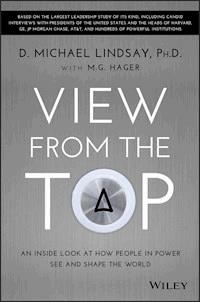
Learn leadership from the best—proven insights from the power elite in business, government, and beyond
View from the Top brings readers inside the corridors of power and relates the personal stories and powerful findings from the Platinum Study, a groundbreaking study of 550 elite American CEOs, senior government leaders, and nonprofit executives based on ten years of research. The largest study of its kind, the Platinum Study delves into the domains of the elite with stories that illustrate both the use and misuse of power across the landscape of prominent American institutions such as AT&T, Harvard University, UnderArmour, JP Morgan Chase, Bain & Company, and the White House. The book explores not only how leaders wield power, but it also provides readers with insight into applying the strategies of the successful in their own lives.
In the United States, only a few thousand individuals make the decisions that influence the lives of over 300 million people. Whether in the government, business, higher education, or the arts, these individuals direct policy and set the terms of national debates, yet remain virtually unknown. View from the Top explores the real lives of the elite and the social worlds they inhabit, revealing lessons about influence at the top, and the seven principles that shape those in power. The results of the Platinum Study include unexpected truths such as:
- Being born into wealth is a poor predictor of leadership success
- One program can set you on the path to leadership
- It doesn't matter what college you attend
- A leader's best work never sees the light of day
- Time-crushed executives are better situated than most to manage their family lives
- Crisis is the quickest way for a leader to shape an institution
- Working longer does not mean working better
The book examines the different paths to power and describes the essence of leadership and the fundamental traits that distinguish a leader from the pack. For anyone seeking sharpen their leadership skills and impact the world around them, View from the Top: An Inside Look at How People in Power See and Shape the World provides the roadmap to taking charge and inspiring change.
Das E-Book können Sie in Legimi-Apps oder einer beliebigen App lesen, die das folgende Format unterstützen:
Seitenzahl: 391
Veröffentlichungsjahr: 2014
Ähnliche



















Table of Contents
Praise for
View From the Top
Title Page
Copyright
Introduction
Platinum Leaders
Learning from Stories as Well as Statistics
On Top of the World
Why Study Power from within the Halls of Faith?
Notes
Chapter 1: Act Personally, But Think Institutionally: Develop Your Network Beyond Your Organization
Mentor Relationships
Institutions
Connections
Cohesion and Tension
Act Personally, But Think Institutionally
Notes
Chapter 2: Leadership Begins at 20: Beyond Bootstraps and Boarding School
The Path to the Top
Overcoming Disadvantage
Early Influences
College and Beyond: Continuing the Liberal Arts Life
Notes
Chapter 3: More Breadth, Less Depth: Catalyzing Your Leadership
Leadership Catalysts
The White House Fellowship
Notes
Chapter 4: The Essence of Leadership: Driving Productivity, People, and Culture
Leadership and Power
Productivity
Managing and Motivating
Building a Thriving Culture
Notes
Chapter 5: Strength in the Crucible of Crisis
Surviving Frustrations and Futility
The Crucible Refines
Making Decisions in the Crucible
Notes
Chapter 6: Lead with Your Life: Because It's Much More than a Job
The Toll It Takes
Taxing the Personal Life
The Privileged Lifestyle: “There's Something Wrong Here”
They Love to Work
Notes
Chapter 7: Lead for Good: Motivations and Outcomes
Motivations
Mechanisms of Influence
View From the Top
Notes
Conclusion
Incarnational Leadership
Appendix
Notes
Acknowledgments
Index
End User License Agreement
Pages
ix
x
xi
xii
xiii
xiv
xv
xvi
xvii
xviii
xix
xx
xxi
1
2
3
4
5
6
7
8
9
10
11
12
13
14
15
16
17
19
20
21
22
23
24
25
26
27
28
29
30
31
32
33
34
35
36
37
38
39
40
41
42
43
44
45
46
47
48
49
50
51
52
53
55
56
57
58
59
60
61
62
63
64
65
66
67
68
69
70
71
72
73
74
75
77
78
79
80
81
82
83
84
85
86
87
88
89
90
91
92
93
94
95
97
98
99
100
101
102
103
104
105
106
107
108
109
110
111
112
113
114
115
116
117
118
119
120
121
122
123
124
125
126
127
128
129
130
131
132
133
134
135
136
137
138
139
140
141
142
143
163
164
165
166
167
168
169
170
171
172
173
174
175
176
177
178
179
180
181
182
183
184
185
186
187
188
189
190
191
192
193
194
195
196
197
198
199
200
201
202
203
205
206
207
209
210
211
212
213
214
215
216
217
218
Guide
Cover
Table of Contents
Introduction
Begin Reading
Praise for View From the Top
“This is a seminal and compelling work. Dr. Michael Lindsay, university president and sociologist, gained unprecedented access to hundreds of leaders of America's elite institutions, and reached many unexpected conclusions. For example, it's not a privileged upbringing, but the influence of a caring mentor early in a developing career (as well as grit and opportunity) that launches careers of highly influential leaders. Dr. Lindsay found that the best leaders are not primarily ego-driven, but are able to influence a shared organizational vision and submerge their egos so as to be credible stewards of a greater cause.
View From the Top
reveals the hidden attributes of those blessed with the platform of leadership—and explores what defines a leader's identity beyond the title on their business card.”
—Rich McClure President, UniGroup (United Van Lines and Mayflower Transit)
“Michael Lindsay's
View From the Top
recounts the experiences of a wide variety of leaders—in both success and failure—to reveal a deeper understanding of leadership: cause-oriented, people-driven, sacrificial, and reflective. Drawing from a variety of fields, Dr. Lindsay draws out some of the common elements of excellence. Anyone interested in the subject of leadership—or interested in exercising it—would benefit from reading
View from the Top
.”
—Michael Gerson Columnist, the Washington Post
“This is an informative and inspiring book for any leader, drawing on unprecedented personal access and a keen sense of the dynamics of leaders' institutions and personal lives. It contains both celebrations of the ways power can be used for good, and warnings of how slippery its effects can be on both leader and led. It is an indispensable catalog of stories and insights for those of us who want our use of power to be both effective and redemptive.”
—Andy Crouch Executive editor, Christianity Today, and author, Playing God: Redeeming the Gift of Power
View From the Top
D. Michael Lindsay, PH. D. with M. G. Hager
Cover image: Elevator Up-and-Down Button © Image Source/Corbis
Cover design: Chris Wallace
Copyright © 2014 by D. Michael Lindsay, Ph.D. All rights reserved.
Published by John Wiley & Sons, Inc., Hoboken, New Jersey.
Published simultaneously in Canada.
No part of this publication may be reproduced, stored in a retrieval system, or transmitted in any form or by any means, electronic, mechanical, photocopying, recording, scanning, or otherwise, except as permitted under Section 107 or 108 of the 1976 United States Copyright Act, without either the prior written permission of the Publisher, or authorization through payment of the appropriate per-copy fee to the Copyright Clearance Center, 222 Rosewood Drive, Danvers, MA 01923, (978) 750-8400, fax (978) 646-8600, or on the web at www.copyright.com. Requests to the Publisher for permission should be addressed to the Permissions Department, John Wiley & Sons, Inc., 111 River Street, Hoboken, NJ 07030, (201) 748-6011, fax (201) 748-6008, or online at www.wiley.com/go/permissions.
Limit of Liability/Disclaimer of Warranty: While the publisher and author have used their best efforts in preparing this book, they make no representations or warranties with respect to the accuracy or completeness of the contents of this book and specifically disclaim any implied warranties of merchantability or fitness for a particular purpose. No warranty may be created or extended by sales representatives or written sales materials. The advice and strategies contained herein may not be suitable for your situation. You should consult with a professional where appropriate. Neither the publisher nor the author shall be liable for damages arising herefrom.
For general information about our other products and services, please contact our Customer Care Department within the United States at (800) 762-2974, outside the United States at (317) 572-3993 or fax (317) 572-4002.
Wiley publishes in a variety of print and electronic formats and by print-on-demand. Some material included with standard print versions of this book may not be included in e-books or in print-on-demand. If this book refers to media such as a CD or DVD that is not included in the version you purchased, you may download this material at http://booksupport.wiley.com. For more information about Wiley products, visit www.wiley.com.
ISBN 978-1-118-90110-6 (cloth); ISBN 978-1-118-90139-7 (ebk); ISBN 978-1-118-901151 (ebk)
Introduction
“What? What does that mean, ‘I'm not the job?’” I could hardly hear Price, the search consultant, on my cell phone over the screeching of the subway car pulling in next to me. I was changing trains at the Park Street T station in downtown Boston, on my way to interview Diana Chapman Walsh, the highly successful president of Wellesley College. I had traveled to Boston from Houston—where I worked as a professor at Rice University—for a dual purpose. Not only was I completing additional interviews for my research project, but I had come to be interviewed myself. I was a candidate for the presidency of a Christian liberal arts college north of Boston, Gordon College.
“You got the job!” he repeated. This time I understood. In that moment, surrounded by strangers in that subway station, my life changed forever. I agreed to meet the board chair and the head of the search committee back at the hotel after the Walsh interview, and I hung up in a euphoric daze. I don't know how I managed to find my way to the Cleveland Circle T stop where I met up with Walsh, but I sobered up as soon as we greeted. I had been conducting interviews with leaders like Walsh for years, but now I had an even keener interest in learning from her. What went well for her early on, and what missteps does she wish she could do over? How does she handle her critics, including her inner critic? The lessons about leadership and power that I had been picking up for years were no longer strictly academic but were suddenly, startlingly relevant.
In other words, my social-scientific study had begun to morph into something more. The insights I had been gathering, sorting, and coding from interviews I conducted became a second doctoral education of sorts for me—one where the professors shared not only their achievements but also their failings, where their personal and institutional lives were the curriculum, and where the student's task was to synthesize these insights and then draw his own conclusions. What follows is, in essence, my “dissertation” from this priceless education.
Lesen Sie weiter in der vollständigen Ausgabe!
Lesen Sie weiter in der vollständigen Ausgabe!
Lesen Sie weiter in der vollständigen Ausgabe!
Lesen Sie weiter in der vollständigen Ausgabe!
Lesen Sie weiter in der vollständigen Ausgabe!
Lesen Sie weiter in der vollständigen Ausgabe!
Lesen Sie weiter in der vollständigen Ausgabe!
Lesen Sie weiter in der vollständigen Ausgabe!
Lesen Sie weiter in der vollständigen Ausgabe!
Lesen Sie weiter in der vollständigen Ausgabe!
Lesen Sie weiter in der vollständigen Ausgabe!
Lesen Sie weiter in der vollständigen Ausgabe!




