


9,99 €
Mehr erfahren.
- Herausgeber: 50Minutes.com
- Kategorie: Geisteswissenschaft
- Serie: Art & Literature
- Sprache: Englisch
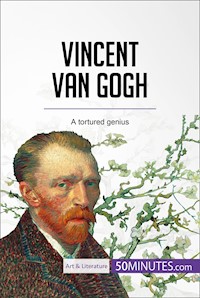
Keen to learn but short on time? Find out everything you need to know about the life and work of Vincent van Gogh in just 50 minutes with this straightforward and engaging guide!
Vincent van Gogh was a Dutch artist who was active during the late 19th century. The primary subjects of his work were landscapes and the realities of rural life, and his paintings often reflected his own state of mind through the use of vibrant colours and curved lines. Van Gogh was an extremely prolific painter and produced around 900 paintings in his lifetime, most of which were completed in his final two years of life. However, it is believed that he only sold one painting during his lifetime, as his unconventional style did not become popular until after his death. Today, his most famous works include
The Starry Night and
The Sunflowers, and his work is credited with inspiring several later artistic movements, including Fauvism and Expressionism.
In this book, you will learn about:
• The artistic and cultural trends that influenced Van Gogh’s work, including Impressionism, Naturalism and Japonism
• Van Gogh’s most famous works, including masterpieces such as
The Starry Night and
The Potato Eaters
• The later artistic movements inspired by Van Gogh’s work, such as Fauvism and Expressionism
ABOUT 50MINUTES.COM | Art & Literature
The Art & Literature series from the 50Minutes collection aims to introduce readers to the figures and movements that have shaped our culture over the centuries. Our guides are written by experts in their field and each feature a full biography, an introduction to the relevant social, political and historical context, and a thorough discussion and analysis of the key works of each artist, writer or movement, making them the ideal starting point for busy readers looking for a quick way to broaden their cultural horizons.
Das E-Book können Sie in Legimi-Apps oder einer beliebigen App lesen, die das folgende Format unterstützen:
Seitenzahl: 39
Veröffentlichungsjahr: 2018
Ähnliche











VINCENT VAN GOGH
Born: 30 March 1853 in Zundert (Netherlands).Died: 29 July 1890 in Auvers-sur-Oise (France).Context: Postimpressionism.Notable works:The Potato Eaters (1885), paintingA Pair of Shoes (1886), paintingThe Sunflowers (1888), paintingThe Sower (1888), paintingThe Starry Night (1889), paintingBedroom in Arles (1889), paintingSelf-Portrait with Bandaged Ear (1889), paintingVincent van Gogh was a Dutch painter who was greatly influenced by the social upheaval that characterised the 19th century. He was a religious individual who struggled with depression and the challenges of pursuing an unconventional career, and drew inspiration from the work of French realist authors, Dutch painters and the pastoral works of French artist Jean-François Millet (1814-1875) for inspiration. Today, he is remembered both for the genius of his work and for his struggles with his mental health.
Van Gogh found inspiration in both the Impressionist movement and Japonism, but went on to develop a distinctive artistic style that set him apart from other artists who were active at that time. Painting also provided him with an outlet as his mental health deteriorated. In Van Gogh’s work, the subject of the painting is rarely just a simple object: in most cases, it also acts as a reflection of the artist’s subconscious mind. Furthermore, the vibrant colours, frenetic execution and curved lines of Van Gogh’s work paved the way for the rise of two other significant art movements: Fauvism and Expressionism. Although Van Gogh was deeply misunderstood during his lifetime and died in obscurity, his work was nothing less than revolutionary, and truly shaped 20th-century art.
CONTEXT
THE CALM AFTER THE STORM
After a number of uprisings and revolutions earlier in the 19th century, France entered a period of relative economic stability under the Second Empire (1852-1870). Industry was booming and new methods of communication were appearing, along with modern innovations such as railways, banks and department stores. This coincided with the rise of the middle class, and the job market was revitalised by strong economic growth. Furthermore, the 1860s were a period of political liberalisation, as Emperor Napoleon III (1808-1873) granted the right to strike in 1864 as a means of boosting his popularity, and granted parliament the right to interpellation four years later.
However, this era of peace and prosperity descended into turmoil when Napoleon III followed in the footsteps of his uncle Napoleon I (French Emperor, 1769-1821) by declaring war on Prussia on 19 July 1870. He was quickly defeated at the Battle of Sedan less than two months later, leading to the establishment of the Third French Republic (1870-1940), but Paris was nevertheless besieged by Prussian forces for several months. This led to the Paris Commune, an unprecedented political uprising in March 1871 which saw the proletariat challenge the authority of the Third Republic. The Commune was founded on the tenets of socialism, which had emerged in 1820, and demanded a better quality of life for France’s working-class citizens, as a lack of meaningful social progress meant that the country’s newfound economic prosperity in the previous decades had not brought the same benefits for them as it had for the upper classes. However, the Third Republic soon regained control, and the establishment of the French Constitutional Laws of 1875 finally restored political stability. Van Gogh travelled to France for the first time that year.
MODERN LIFE VS. RURAL LIFE
Advances in metallurgy led to the invention of lighter, more malleable construction materials. This in turn led to a large-scale renovation of Paris (1853-1870) led by Baron Haussmann (French architect, 1809-1891), in accordance with Napoleon III’s goal of transforming Paris into “the capital of capitals”.




