


15,99 €
Mehr erfahren.
- Herausgeber: John Wiley & Sons
- Kategorie: Geisteswissenschaft
- Sprache: Englisch
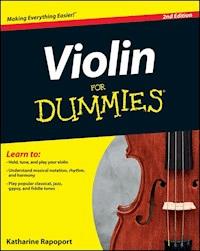
The bestselling guide to teaching yourself the violin just got better Despite being one of the most popular musical instruments for budding musicians, the violin has a reputation as being amongst the most difficult to learn. But no longer. Violin for Dummies is packed with the information you need to learn the art of this beautiful instrument, whether you're looking to get a head start before taking up lessons or are already studying with a tutor but want a little boost. With this book you have everything you need to get started. Even if you've never read a note of music, this book will have you playing in no time, introducing you to the fundamentals of the violin, from selecting and tuning to understanding rhythm, musical notation, and harmony. * Walks you through everything from how to hold your violin to playing popular classical, jazz, gypsy, and fiddle tunes * Filled with all-new content, including new music and updated resources * Designed for aspiring musicians going it alone, the book can also serve as an invaluable aid for instructors Fully revised and updated, Violin For Dummies builds on the winning formula that made the original a bestseller, establishing it as the only book the aspiring violinist needs to get started. CD-ROM/DVD and other supplementary materials are not included as part of the e-book file, but are available for download after purchase
Sie lesen das E-Book in den Legimi-Apps auf:
Seitenzahl: 591
Veröffentlichungsjahr: 2012
Ähnliche




















Violin For Dummies®, 2nd Edition
Visit www.dummies.com/cheatsheet/violin to view this book's cheat sheet.
Table of Contents
Violin For Dummies®, 2nd Edition
by Katharine Rapoport
Violin For Dummies®, 2nd Edition
Published by John Wiley & Sons Canada, Ltd. 6045 Freemont Blvd. Mississauga, ON L5R 4J3 www.wiley.com
Copyright © 2012 by John Wiley & Sons Canada, Ltd.
All rights reserved. No part of this book, including interior design, cover design, and icons, may be reproduced or transmitted in any form, by any means (electronic, photocopying, recording, or otherwise) without the prior written permission of the Publisher. Requests to the Publisher for permission should be addressed to the Permissions Department, John Wiley & Sons Canada, Ltd., 6045 Freemont Blvd., Mississauga, ON L5R 4J3, or online at http://www.wiley.com/go/permissions. For authorization to photocopy items for corporate, personal, or educational use, please contact in writing The Canadian Copyright Licensing Agency (Access Copyright). For more information, visit www.accesscopyright.ca or call toll free, 1-800-893-5777.
Trademarks: Wiley, the Wiley logo, For Dummies, the Dummies Man logo, A Reference for the Rest of Us!, The Dummies Way, Dummies Daily, The Fun and Easy Way, Dummies.com, Making Everything Easier, and related trade dress are trademarks or registered trademarks of John Wiley & Sons, Inc., and/or its affiliates in the United States and other countries, and may not be used without written permission. All other trademarks are the property of their respective owners. John Wiley & Sons, Inc., is not associated with any product or vendor mentioned in this book.
Limit of Liability/Disclaimer of Warranty: The publisher and the author make no representations or warranties with respect to the accuracy or completeness of the contents of this work and specifically disclaim all warranties, including without limitation warranties of fitness for a particular purpose. No warranty may be created or extended by sales or promotional materials. The advice and strategies contained herein may not be suitable for every situation. This work is sold with the understanding that the publisher is not engaged in rendering legal, accounting, or other professional services. If professional assistance is required, the services of a competent professional person should be sought. Neither the publisher nor the author shall be liable for damages arising herefrom. The fact that an organization or Website is referred to in this work as a citation and/or a potential source of further information does not mean that the author or the publisher endorses the information the organization or Website may provide or recommendations it may make. Further, readers should be aware that Internet Websites listed in this work may have changed or disappeared between when this work was written and when it is read.
For general information on John Wiley & Sons Canada, Ltd., including all books published by Wiley Publishing, Inc., please call our distribution centre at 1-800-567-4797. For reseller information, including discounts and premium sales, please call our sales department at 416-646-7992. For press review copies, author interviews, or other publicity information, please contact our publicity department, Tel. 416-646-4582, Fax 416-236-4448.
For technical support, please visit www.wiley.com/techsupport.
Wiley publishes in a variety of print and electronic formats and by print-on-demand. Some material included with standard print versions of this book may not be included in e-books or in print-on-demand. If this book refers to media such as a CD or DVD that is not included in the version you purchased, you may download this material at http://booksupport.wiley.com. For more information about Wiley products, visit www.wiley.com.
Library and Archives Canada Cataloguing in Publication Data
Rapoport, Katharine Violin for dummies / Katharine Rapoport. — 2nd. ed
(—For dummies) Includes index. Includes CD-ROM with audio and video samples.
1. Violin—Methods—Self-instruction. 2. Violin—Instruction and study. 3. Violin—Studies and exercises. 4. Music theory— Elementary works. I. Title. II. Series: —For dummies
MT278.R219 2012 787.2’193 C2011-907379-X
ISBN 978-1-118-27359-3 (pbk); ISBN 978-1-118-27958-8 (ebk); ISBN 978-1-118-27959-5 (ebk); ISBN 978-1-118-27960-1 (ebk)
Printed in the United States
1 2 3 4 5 RRD 16 15 14 13 12
About the Author
Katharine Rapoport enjoys an eclectic career as a freelance violinist and violist in Toronto. After graduating from Cambridge University and the Guildhall School of Music, London, she spread her musical wings and spent seven more years performing and studying in Italy, Germany, Switzerland, Poland, and Austria before moving across the pond.
She has performed in just about every situation, from elegant Baroque opera on original instruments to cutting edge new music, from La Bohème to Les Miz, from educational recordings to Viagra jingles. Her solo work includes concerto appearances with orchestras and sonata partnerships with pianists, and she also performs and records in collaboration with a variety of chamber ensembles.
Her teaching work has ranged from showing a two-year-old how to unpack his violin case for the very first time to preparing outstanding young professionals for recitals, auditions, and competitions. She is currently an adjunct professor at the University of Toronto, working with students who plan to make music their career, teaching violin and viola performance, leading doctoral seminars in string pedagogy and literature, and working with Education students who are preparing to teach strings in the school system. Many of her former students are now enjoying full-time careers in music, playing with major orchestras and chamber ensembles in Canada, the United States, and England, teaching at schools, colleges and universities, and involving themselves in all aspects of music.
In her “spare” time, she takes on an assortment of projects for the Royal Conservatory of Music in Toronto: teaching in the Young Artists’ Performance Academy for gifted youth, compiling and editing violin and viola publications for the Conservatory’s examination system, devising their string syllabi, and going across Canada to examine and adjudicate young string players. She is frequently on faculty at summer chamber music and orchestral programs and has given Master Classes throughout Canada, in the United States, and in England.
Dedication
Dedicated to my family, to my mentors, and to my students, who taught me how to teach.
Author’s Acknowledgments
Special thanks to:
Robert Hickey, the patient and perspicacious editor of the first edition, who envisioned and carried through this huge project; to Anam Ahmed, who took on the second edition with great aplomb and calm, encouraging efficiency; to Heather Ball of the eagle editing eyes; and to the rest of the wonderful team at Wiley.
Dan and Carol Kushner, without whom Violin For Dummies wouldn’t have arrived at my door in the first place.
Professor Patricia (Pat) Shand, technical editor, dear colleague, and admired mentor, for logical suggestions, ideas, and feedback on pedagogical practicalities.
Rebecca Van der Post, a most wonderful and versatile violinist, and Garnet Willis, audio engineer extraordinaire, of Noisetree, for their fine collaborations on the sound tracks.
Carolyn Jones, for her magnificent piano accompaniments.
Nathan Saliwonchyk, for his excellent photography and videography, and to the most co-operative and photogenic violinist Teddy Wiggins for his fine work at the photo shoot.
My teachers Yfrah Neaman, Bruno Giuranna, Hatto Beyerle, Arrigo Pelliccia, Franco Rossi, Alain Meunier, Burton Kaplan, Jennifer Glass and Nicola LeFanu, from whom I learned so much, and to the late greats whose legacy gives us all a precious violin inheritance, including Leopold Mozart, Leopold Auer, and some people not called Leopold, such as Carl Flesch, Joseph Szigeti, Ivan Galamian, Paul Rolland, and Shinichi Suzuki, whose ideas continue to inspire new generations of players.
My friends, colleagues, and students Daniel Borrillo, Maxine Byam, Ron Hay, Anne Lindsay, George Meanwell, Mary McGeer, Barbara Morris, Elizabeth Morris, Michal and Pasia Schonberg, and James Tinsley, who read, advised, brainstormed.
Alistair Grieve and David Tamblyn at the Soundpost, Toronto; Jaak Liivoja-Lorius; Darragh McGee at Long and McQuade, Toronto; Quentin Playfair; Michael and Rosa Remenyi and Derrick Rathwell at Remenyi House of Music for their valuable expertise on violin and bow-making, repairing and accessories. Remenyi House of Music kindly provided the items for the photoshoot.
The helpful staff at Atelier Grigorian in Toronto and at HMV shops in Vancouver and London, whose knowledge and willingness to help me find some great recordings made my task much easier and more fun.
And finally, to Leo Rapoport, my son, for the idea of providing readers with video clips of the main actions.
Publisher’s Acknowledgments
We’re proud of this book; please send us your comments at http://dummies.custhelp.com. For other comments, please contact our Customer Care Department within the U.S. at 877-762-2974, outside the U.S. at 317-572-3993, or fax 317-572-4002.
Some of the people who helped bring this book to market include the following:
Acquisitions, Editorial, and Media
Editors: Robert Hickey, Anam Ahmed
Production Editor: Lindsay Humphreys
Developmental Editor: Heather Ball
Copy Editor: Heather Ball
Editorial Assistant: Kathy Deady
Technical Editor: Patricia Shand
Media Development Project Manager: John Moss
Cover photo: Nathan Saliwonchyk
Cartoons: Rich Tennant (www.the5thwave.com)
Composition Services
Project Coordinator: Kristie Rees
Layout and Graphics: Carl Byers, Lavonne Roberts, Christin Swinford, Julie Trippetti, Laura Westhuis
Proofreaders: Jessica Kramer, Lisa Young Stiers
Indexer: Christine Karpeles
Photographer: Nathan Saliwonchyk
Special Help
Optical Disc Solutions
John Wiley & Sons Canada, Ltd.
Deborah Barton, Vice President and Director of Operations
Jennifer Smith, Publisher, Professional & Trade Division
Alison Maclean, Managing Editor, Professional & Trade Division
Publishing and Editorial for Consumer Dummies
Kathleen Nebenhaus, Vice President and Executive Publisher
Kristin Ferguson-Wagstaffe, Product Development Director
Ensley Eikenburg, Associate Publisher, Travel
Kelly Regan, Editorial Director, Travel
Publishing for Technology Dummies
Andy Cummings, Vice President and Publisher
Composition Services
Debbie Stailey, Director of Composition Services
Introduction
Violins have fascinated humans ever since they began their existence in primitive forms. The violin’s shape is so stunningly beautiful, and its tone so evocative — like a human voice, but with a magical take on the sound. Watching violinists play allows us a peek into a secret world where physical ability and artistic expression meet to make beautiful music.
I first fell in love with the violin when I was in grade school in London, England. One day, my music teacher, Miss Simpson, brought to class a fascinating-looking case. She opened it up to show us the most exquisite item I had ever seen — a violin. She played a few notes on this beautiful instrument, and I was hooked for life. After listening to my persistent requests for a violin of my own, my parents figured it was more than a passing fancy, so they set me up for some violin lessons with my neighbors’ daughter. I even used her old 3/4-size violin, which cost the shocking sum of £10! The musical bug kept me busy through high school and university, and it has never worn off, even after many years of pursuing a full-time career in music.
Why This Book Is for You
I talk to so many people — audience members after I play a concert, friends, colleagues, people who see me carrying my violin case on the subway — who all tell me the same thing: “I wish I knew how to play the violin.” Violin For Dummies is for all of you (and for all the people I don’t know personally, but who I know are out there) who have the same desire.
Even if you’ve never picked up a violin, let alone tried to play one, this book tells you what you need to know to make some music. I take you from the first moment you look at your instrument right on through the stages of an exciting journey to playing the violin. And the journey is fun — I guarantee it.
No matter how skilled you are with the violin (or even if you have no skills yet), this book has something for you. If you’re new to the instrument and want to play, you can follow the chapters in order. If you have some violin background and are looking for some tips on sharpening your skills, you can zone in on areas where you want some advice and skip over the places where you know how to manage.
If you’re a more advanced musician, or even a music teacher, you may want to use Violin For Dummies for reference. I give you extra teaching ideas, and you can find some new tricks and approaches to playing that really work.
Foolish Assumptions
Because you’re reading this book, I can make quite a few assumptions about you already:
You have a violin.
If you don’t have a violin, you’re preparing to buy, rent, or borrow one, along with a few necessary bits of equipment. I tell you about all the equipment you need, plus some violin accessories that are just really cool.
You love all kinds of music, and you want to play music yourself.
You want to study the violin seriously and quite thoroughly, but you don’t want to be bored out of your mind in the process — that’s why I sprinkle so many fun songs throughout the book for you to play.
You’re not necessarily familiar with reading music, but you want to give it a try. That curiosity is just what you need, because I ease you into reading musical notation until you can read it as well as you’re reading this right now.
You’re eager to add words like pizzicato and purfling to your vocabulary. I give you all the basic violin and music terminology you need to sound very knowledgeable.
You have access to current technology and the Internet, so that you can listen to musical audio tracks and watch video clips of the violin in action.
How This Book Is Organized
No matter how you choose to read Violin For Dummies (jumping between chapters or reading systematically from cover to cover), the book is organized into handy sections so that you always know where you are on your musical journey. This book takes you through the first steps all the way to more-advanced playing techniques, and it even covers some essentials of music theory. Or, if you’re looking for a particular topic, the book’s organization helps you find it faster than you can say “Paganini.”
Part I: So You Want to Play the Violin
Part I introduces you to the world of the violin by telling you the names of the parts of the violin and bow. (Say “Pleased to meet you!”) After you’ve said hello, I show you how to tune your violin and hold it comfortably (and properly) so that you can begin to play.
Part II: Getting Started: The Basics
In this part, I tell you how to hold and manage the bow with your right hand to draw a sound out of the violin. After the bowing’s going (and flowing!), you put both hands to work together by using the left-hand fingers to make many different notes.
Part III: Reading Music for the Violin
You can manage quite a bit of playing by ear and with the handy charts I show you in Part II, but eventually you’ll want to read music on your own, which is exactly what this part is about. After you’re able to read music, you can figure out any new pieces you meet. I show you the main aspects of musical notation: notes, rhythms, meters (not the parking kind!), and other musical signs.
Part IV: Musicianship and Harmony
All kinds of elements go into even the simplest-sounding piece of music. Read this part to understand how music works when all the parts sound together. I talk about scales, key signatures, and harmony so that you know what’s going on around you as you play.
Part V: Taking It Up a Notch: Techniques and Styles
The violin is hardly a one-note wonder. This instrument has lots of character, and I want to show it off. The music that you play becomes quite a lot fancier in Part V, where you find out about some slick moves with the bowing and the fingering. You also enjoy a brief visit to the worlds of fiddling, jazz music, and gypsy violin, and I give you a few tips about how to sound authentic when you play in these characteristic styles.
Part VI: Getting into Gear, Staying in Gear
Read this part to find out about renting or buying a good violin, and taking proper care of your instrument and bow. I also talk about neat accessories, some of which may look rather strange to you at first. I explain what the accessories do and let you know which ones are must-haves and which are ones to lust after unrequitedly at the music store.
Part VII: The Part of Tens
Your family probably tells you that you’re the world’s greatest violinist. But you know you can always find ways to discover more about the violin. This part lists famous violinists of yesterday and today, and mentions some of their recordings for you to enjoy. For even more fun with your violin, I tell you ways to join in on musical activities with other players and how to find a good teacher to take you on the next step of your violin journey.
The Audio and Video Tracks
The tracks that come with Violin For Dummies are recordings of every song and exercise in the book in MP3 format, so you can play along. You also get short video clips of many of the key movements you need to know to play the violin, enabling you to see just what I’m writing about. I fill you in on how to use the audio and video tracks at the back of the book, in the appendix.
Icons Used in This Book
Flipping through the book, you’ll no doubt notice some little pictures in the margins. I hope they grab your attention, because that’s their job. Whenever you see one of these icons, look for the following kinds of information:
A Tip icon tells you stuff that makes life a whole lot easier, and that may even make playing the violin a whole lot easier. So my tip to you is to watch for the Tip icon.
A Remember icon tells you to keep in mind something you probably already know.
When you see the Warning icon, take special notice of the information. This icon tells you that you need to watch out for a possible problem or difficulty.
Technical Stuff icons give you useful information and even some impressive jargon about the theory behind a particular section. But this information isn’t crucial, and it doesn’t affect what you’re actually doing. So if you’re not in a technical frame of mind, you can come back to this icon later, or skip hastily to the next bit.
This icon reminds you that Violin For Dummies is more than just a book: It’s also an audio-visual experience. The book’s companion tracks allow you to listen to the songs and watch video clips of the moves I describe, so you can know if you’re doing them right. Whenever you see this icon, check out the tracks to hear and see things in action.
Where to Go from Here
In most books, page 1 is a good place to start. But this book is different. You don’t have to read Violin For Dummies in strict order, from the first page to the last page. You won’t miss the punch line if you turn to check out some question about violin playing that’s been bugging you for 37 years and then flip back to the previous section afterwards.
Of course, you’re also welcome to start with the basics in Chapter 1 and then move gradually through the book to the more advanced material, because the book does build up systematically, skill by skill, chapter by chapter.
Whatever your musical background, you can use this book as your guide to the world of violins. So sit back (or rather, sit up straight, in case you want to pick up your violin) and get ready to make some music.
Part I
So You Want to Play the Violin
In this part . . .
You don’t have to be a professional violinist to play well and enjoy the violin. You don’t have to be a child prodigy, and you don’t have to buy a million-dollar violin to sound good. But you do have to take it step by step. In Chapter 1, I give you an overview of just about everything you can expect to discover as a violinist. Then it’s time to pick up your instrument. Check out Chapter 2 to become familiar with the names and functions of all the parts of the violin. That chapter also shows you how to tune your instrument so it sounds like it should. Chapter 3 is all about how to hold the violin comfortably.
Chapter 1
Introducing the Violin
In This Chapter
Getting to know the instrument
Making sounds with the violin
Reading and playing music
Putting music theory into practice
Trying different playing styles
Choosing and caring for your instrument
You don’t have to be a professional musician to enjoy playing the violin. Learning to play for your own enjoyment — for the joy of making music —can be really satisfying. If you’ve always wanted to play but have never had the chance, or if you’ve taken some lessons or played a bit at school, this book is for you: It starts right from the first time you open your case and takes you step-by-step to playing real music on your violin.
Lesen Sie weiter in der vollständigen Ausgabe!
Lesen Sie weiter in der vollständigen Ausgabe!
Lesen Sie weiter in der vollständigen Ausgabe!
Lesen Sie weiter in der vollständigen Ausgabe!
Lesen Sie weiter in der vollständigen Ausgabe!
Lesen Sie weiter in der vollständigen Ausgabe!
Lesen Sie weiter in der vollständigen Ausgabe!
Lesen Sie weiter in der vollständigen Ausgabe!
Lesen Sie weiter in der vollständigen Ausgabe!
Lesen Sie weiter in der vollständigen Ausgabe!
Lesen Sie weiter in der vollständigen Ausgabe!
Lesen Sie weiter in der vollständigen Ausgabe!
Lesen Sie weiter in der vollständigen Ausgabe!
Lesen Sie weiter in der vollständigen Ausgabe!
Lesen Sie weiter in der vollständigen Ausgabe!
Lesen Sie weiter in der vollständigen Ausgabe!
Lesen Sie weiter in der vollständigen Ausgabe!
Lesen Sie weiter in der vollständigen Ausgabe!
Lesen Sie weiter in der vollständigen Ausgabe!
Lesen Sie weiter in der vollständigen Ausgabe!
Lesen Sie weiter in der vollständigen Ausgabe!
Lesen Sie weiter in der vollständigen Ausgabe!
Lesen Sie weiter in der vollständigen Ausgabe!
Lesen Sie weiter in der vollständigen Ausgabe!
Lesen Sie weiter in der vollständigen Ausgabe!
Lesen Sie weiter in der vollständigen Ausgabe!
Lesen Sie weiter in der vollständigen Ausgabe!
Lesen Sie weiter in der vollständigen Ausgabe!




