


64,99 €
Mehr erfahren.
- Herausgeber: John Wiley & Sons
- Kategorie: Geisteswissenschaft
- Sprache: Englisch
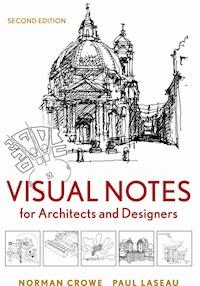
The completely updated step-by-step guide to¿capturing experiences in sketch format--regardless of artistic ability Recording your ideas and observations primarily in pictures instead of words can help you become more creative and constructive on the job, no matter what your level of artistic ability. Featuring completely new coverage of visual note-taking in a digital world, Visual Notes for Architects and Designers, Second Edition demonstrates how to make rapid, notational sketches that serve as visual records for future reference, as well as improve understanding and facilitate the development of ideas. It shows you how to expand your knowledge of a subject beyond what is gained through observation or verbal representation alone. You gain access to simple techniques for collecting, analyzing, and applying information. Crowe and Laseau examine the relationship between note-taking, visualization, and creativity. They give practical guidance on how to develop: * Visual acuity--the ability to see more in what you experience * Visual literacy--expressing yourself clearly and accurately with sketches * Graphic analysis--using sketches to analyze observations Numerous examples demonstrate some of the many uses of visual notes. They help you develop a keener awareness of environments, solve design problems, and even get more out of lectures and presentations. The authors also discuss types of notebooks suitable for taking visual notes. If you want to develop your perceptual and creative skills to their utmost, you will want to follow the strategies outlined in Visual Notes for Architects and Designers, Second Edition. It is a valuable guide for architects, landscape architects, designers, and anyone interested in recording experience in sketch form.
Sie lesen das E-Book in den Legimi-Apps auf:
Seitenzahl: 188
Veröffentlichungsjahr: 2011
Ähnliche




















Table of Contents
Title Page
Copyright
Preface to the Second Edition
Acknowledgments
Chapter 1: Introduction
The Uses of Visual Notes
Visual Literacy
The Notebook
Using this Book
Getting Started
Chapter 2: A Guide to Note-Taking
Recording
Analysis
Design
Chapter 3: A Journal
Exploring a Place
Understanding Order and Disorder
Solutions to Common Problems
Focusing on Details
Design Study: International Center
Chapter 4: A Collection of Visual Notes
Thinking and Creativity
Visual Note-Taking
Examples
Chapter 5: Transitions to Design
Visual Notation and Design Process
The Impact of Digital Technology
Digital Design Media
Examples
Conclusion
Appendix
Equipment
Basic Drawings
Drawing Conventions
Symbolic Drawings
Endnotes
Illustration and Photo Credits
Bibliography
Index
This book is printed on acid-free paper.
Copyright © 2012 by John Wiley & Sons, Inc. All rights reserved.
Published by John Wiley & Sons, Inc., Hoboken, New Jersey.
Published simultaneously in Canada.
No part of this publication may be reproduced, stored in a retrieval system, or transmitted in any form or by any means, electronic, mechanical, photocopying, recording, scanning, or otherwise, except as permitted under Section 107 or 108 of the 1976 United States Copyright Act, without either the prior written permission of the Publisher, or authorization through payment of the appropriate per-copy fee to the Copyright Clearance Center, Inc., 222 Rosewood Drive, Danvers, MA 01923, 978-750-8400, fax 978-646-8600, or on the web at www.copyright.com. Requests to the Publisher for permission should be addressed to the Permissions Department, John Wiley & Sons, Inc., 111 River Street, Hoboken, NJ 07030, 201-748-6011, fax 201-748-6008, or online at www.wiley.com/go/permissions.
Limit of Liability/Disclaimer of Warranty: While the publisher and author have used their best efforts in preparing this book, they make no representations or warranties with respect to the accuracy or completeness of the contents of this book and specifically disclaim any implied warranties of merchantability or fitness for a particular purpose. No warranty may be created or extended by sales representatives or written sales materials. The advice and strategies contained herein may not be suitable for your situation. You should consult with a professional where appropriate. Neither the publisher nor author shall be liable for any loss of profit or any other commercial damages, including but not limited to special, incidental, consequential, or other damages.
For general information on our other products and services, or technical support, please contact our Customer Care Department within the United States at 800-762-2974, outside the United States at 317-572-3993 or fax 317-572-4002.
Wiley publishes in a variety of print and electronic formats and by print-on-demand. Some material included with standard print versions of this book may not be included in e-books or in print-on-demand. If this book refers to media such as a CD or DVD that is not included in the version you purchased, you may download this material at http://booksupport.wiley.com. For more information about Wiley products, visit www.wiley.com.
Library of Congress Cataloging-in-Publication Data:
Crowe, Norman.
Visual notes for architects and designers / Norman Crowe, Paul Laseau.-- 2nd ed.
p. cm.
Includes bibliographical references and index.
ISBN 978-0-470-90853-2 (pbk.); 978-1-118-12295-2 (ebk); 978-1-118-12297-6 (ebk); 978-1-118-12932-6 (ebk); 978-1-118-12933-3 (ebk); 978-1-118-12934-0 (ebk)
1. Communication in architectural design. 2. Visual perception. I. Laseau, Paul, 1937- II. Title.
NA2750.C76 2012
720.28--dc22
2011016228
Preface to the Second Edition
When we completed Visual Notes for publication in 1984, hand drawing with drafting instruments was still the customary practice at the drawing board for most designers. Cameras, however, had virtually replaced field sketches for gathering information in the field. We recognized that something was missing and so we wrote Visual Notes for designers—especially architects, landscape architects, planners, and engineers—to reassert the value of visual notation. The book proved to be remarkably successful, indicating that many agreed with our assessment. Since that time, digital cameras, computer aided design software (CAD), hand-held digital sketchpads, the Internet, smart phones, fax machines, and scanners have become just about ubiquitous. While the aim of this edition is to continue to demonstrate the effectiveness of gathering visual information by means of freehand notational sketches, ways of incorporating today’s available technologies, we believe, have become too important and effective to exclude. Thus, the objective of the current edition is two-fold: to provide further instruction on visual notation, and demonstrate how new graphic-oriented technologies may expand the efficacy of gathering visual information.
We noted in the first edition that sketching and keeping notes was once the mainstay of a traveler’s skills. Recording visual information alongside verbal notes—in forms that are diagrammatic, abstract, pictorial, and realistic—was simply a part of how one “took in” the important qualities of a place, as well as to reinforce the memory of that place for a later time. But there is more to sketching in the field than meets the eye, so to speak. While we engage in sketching for purposes of capturing information, we tend to forget that an important effect has to do with truly seeing things in their deeper complexity, thereby heightening a fuller and at the same time more subtle understanding of our environment. And this effect increases, becoming more efficient and useful as one’s habit of sketching stretches over time.
We are told that sketching engages a different part of the brain than, for instance, taking photographs. Comparable research in 2003 by neuroscientist Eleanor Maguire of University College London, though not focused directly on sketching, seems to emphasize the point. She discovered that spatial understanding is enhanced by direct and intense experience with something in its true three-dimensionality, versus viewing it in two dimensions as a photograph or other abstract representation. In particular, her research involved London cabdrivers, who it turns out have a larger posterior hippocampus—the region of the brain that files spatial memories—than the average Londoner. Of course today, one could negotiate London’s complex street network with a GPS navigational aid, but because it does not engage spatial organization in the same way as a series of related, consecutive active spatial experiences, the brain is deprived of developing more subtle and refined spatial understanding. It would follow that operating computer graphics, for instance, like negotiating the streets with a GPS device, short circuits the fuller neuronal involvement of drawing by hand.
Since the first publication of Visual Notes, an inadvertent discovery involving the application of computer graphics versus hand drawing emerged in response to a decision made by the professional degree architectural program at the University of Notre Dame. After considerable evaluation, it was decided that students would be prohibited from using computer graphics in the design process until they had reached their fourth year of architectural studies. The reason had to do with the observation that hand drawing required a much greater conscious understanding of how things go together—in constructional, architectural, and general spatial terms—than simply selecting a detail or element from a digitized plan file in a CAD program, then modifying it to suit a particular application. What happened, in addition to ensuring a greater understanding of architectural form, was that when architecture students who began with hand drawing finally transitioned to the use of computer graphics, their computer drawings were noticeably superior to others who began with computer graphics in the first place. That was a surprise. It turns out that the use of line weight, perspective devises, color, and the like to clarify formal-spatial understanding were more fully and effectively employed by those who began with the development of hand drawing skills before they learned to use computer graphics. It would seem that the abstract understanding of spatial form gained from computer graphics, as in the situation of photography versus sketching or negotiating London streets with a GPS device, something is gained while something else is lost. But if both are brought to the fore, each in its appropriate place in the larger scope of effective communication, the result is greater breadth of useful understanding.
We believe that encouragement to use hand drawing in its many forms is more important now than ever. The temptation to bypass engaging our environment in all its richness and complexity has become greater than ever.To truly see, as opposed to merely record, enriches our understanding and enhances our ability to remember and to use our knowledge to better facilitate the act of designing.
The act of drawing, like writing, is an integral part of developing thought. William Morrish, whose drawings appear in this addition, demonstrate that point. As he sketches unseen relationships—for instance a landscape of distant features that cannot all be seen at the same time from a given place—he discovers meaningful associations between things that become integral to a broader understanding that cannot be revealed by the eye on its own. Or the drawings by Leon Krier in this edition, which develop a link between the memory of an object or place and its role as an idea that can inform design. These tangible connections between thought, memory, experience, and design, further develop the original theme of Visual Notes.
We believe that engaging hand drawing in its many forms is more important today than it ever was. The temptation to bypass engaging our environment in all its richness, meaning, and complexity has become greater than ever.To actively see, as opposed to merely record inert data, enriches our understanding and enhances our ability to remember and to use our knowledge to more effectively and responsively facilitate the act of designing. NC/PL
Acknowledgments
We would like to thank those who so generously contributed their sketches to this edition. We believed from the onset that expanding those sections of the book that feature a broad array of drawings by people from different fields was of particular importance. New contributors to this edition are Mohammed Bilbesi, Lauren Deeg, Wayne Estopinal, Susan Fox, Harry Eggink, Andrew Hesterman, Susan Fox, John Hoover, Cathi and Steven House, Nancy Kreger, Leon Krier, Jim Leggitt, Scott Lockard, Efthimios Maniatis, William Morrish, Michel Mounayar, Bruce Race, and Kevin Sloan. We wish we could have included all the sketches they sent us, but editing from such a wonderful preponderance of drawings, we believe, provided us with the best combination overall.
We would also like to thank Holly M. Johnson for her generous time and expertise in gathering photographs for us in Philadelphia, Kenneth Johnson for technical consultation, and Michele Laseau for her design advice. Special thanks go to our editors, Margaret Cummins and Lauren Poplawski, for their encouragement and helping us through the process of putting the book together. Finally, we would like to thank all those who expressed their enthusiasm for Visual Notes over the years and whose interest in visual notation encouraged us to expand and revise the original edition.
Introduction
Visual notes are simply the graphic equivalent of written notes. “Taking visual notes” refers to recording information which is primarily visual and, therefore, could not be recorded as effectively with words.
1-1 Charles Darwin’s tree diagrams, representing traceable evolution in biological species.
Keeping notes has always been an effective hedge against an imperfect memory. Moreover, the act of taking notes, selecting and sifting through them, is an important tool for creativity. Keeping a notebook of observations and experiences is a very old custom. Once visual notes were seen by architects to be nearly as important as verbal ones. Sketching was a common part of travel and education for the young architect.
Lesen Sie weiter in der vollständigen Ausgabe!
Lesen Sie weiter in der vollständigen Ausgabe!
Lesen Sie weiter in der vollständigen Ausgabe!
Lesen Sie weiter in der vollständigen Ausgabe!
Lesen Sie weiter in der vollständigen Ausgabe!
Lesen Sie weiter in der vollständigen Ausgabe!
Lesen Sie weiter in der vollständigen Ausgabe!
Lesen Sie weiter in der vollständigen Ausgabe!
Lesen Sie weiter in der vollständigen Ausgabe!
Lesen Sie weiter in der vollständigen Ausgabe!




