


6,49 €
Mehr erfahren.
- Herausgeber: Tracey McDonald Publishers
- Kategorie: Fachliteratur
- Sprache: Englisch
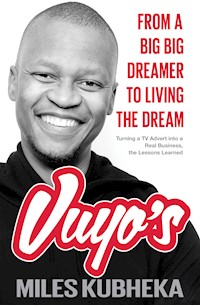
Many people became familiar with the phrase, 'Ooh Vuyo – he's such a big big dreamer' from the TV beer commercial that told a rags-to-riches story about an entrepreneur who starts a business selling boerewors rolls and grows it into a successful multinational business. Wondering whether it was a true tale, Miles Kubheka did some research. When he discovered that Vuyo was a fictitious character, he saw a gap in the market for developing an exciting business model. Moving from his solid IT background into the food business was a major change for Miles, but he took the plunge into an industry he knew nothing about. One step at a time, building on experience often learned from past failures, and with more than a little flair, he created a successful food business. He told his story to anyone who would listen and in time found himself being asked to give motivational talks, initially to groups of students. But the word spread, people were inspired by his story. Before he knew it, Miles was sharing his insights at global platforms such as TEDx and to large audiences at corporate conferences. This book is not a 'recipe for success'. It is rather many recipes which Miles shares with an enthusiasm that will encourage and inspire budding young entrepreneurs to achieve their own dreams of business success.
Das E-Book können Sie in Legimi-Apps oder einer beliebigen App lesen, die das folgende Format unterstützen:
Veröffentlichungsjahr: 2016
Ähnliche



















from a big big dreamer to living the dream
Turning a TV advert into a real business, the lessons learned
MILES KUBHEKA
First published by Tracey McDonald Publishers, 2016
Office: 5 Quelea Street, Fourways, Johannesburg, South Africa, 2191
www.traceymcdonaldpublishers.com
Copyright text © Miles Kubheka, 2016
All rights reserved.
No part of this book may be reproduced, stored in a retrieval system, or transmitted in any form or by any means, electronic, mechanical, photocopying, recording, or otherwise, without the prior written permission from the publisher.
ISBN 978-0-620-71093-0
eISBN 978-0-620-71094-7 ePUB
eISBN 978-0-620-71095-4 PDF
Text design and typesetting by Reneé Naudé
Cover design by Apple Pie Graphics
CONTENTS
ACKNOWLEDGEMENTS
A RECIPE FOR SUCCESS?
Recipe 1 THE JUMP
Recipe 2 HOW TO ACTUALLY START
Recipe 3 LOCATION, LOCATION, LOCATION
Recipe 4 HOW TO DESIGN A PRODUCT
Recipe 5 LIVING THE BRAND
Recipe 6 THE POWER OF PR
Recipe 7 PAID MARKETING
Recipe 8 HOW TO TELL A GREAT STORY
Recipe 9 EXPONENTIAL SCALE: FEEDING PEOPLE AND TRANSFORMING LIVES
Recipe 10 BE PREPARED
Recipe 11 FUNDING AND PARTNERSHIPS
SO WHAT? WHAT NOW?
ACKNOWLEDGEMENTS
To my mother for always giving me many pearls of wisdom, but mostly for her unwavering support and love. Mom I can never thank you enough for all you have sacrificed and done for me. Much love.
To my brother – Believe it or not you have taught me so much about resilience, the one thing every entrepreneur needs. I love you like a brother
To my son – From the age of five you always asked the most inquisitive questions. It is because of you that I still ask: why is it this way and not that way, and what can I do about it? Thank you for your love. My wish for you is to stay inquisitive, because it is the crazy ones who think they can change the world, that often do.
To all the people who have been at my side during this journey, I wish I could list all of you and thank you individually. All I can do is thank you collectively – family, friends, business partners, staff, funders, supporters and customers. I thank you all, and as I connect the dots I realise how each of you have played a pivotal role in my life.
Starting and running a business is a lot like following a recipe. You need to know what you want to cook. When starting a business you first need to have an idea as to what you want your business to be about. Then you need to take action and mix up your idea with passion and belief. Then add a dose of persistence whilst cooking. Keep tasting and stirring until the idea is cooked into a product. When you serve a desired product to desired customers and they pay for it, you have a business.
This is a world-first business recipe book.
A RECIPE FOR SUCCESS?
THERE ARE MANY articles and ‘Top 10’ lists out there that claim to know the recipe for business success. I don’t like lists. Most of these Top 10s are usually the same generic stuff that seems to be more common sense than some elusive secret recipe. They are usually titled ‘a recipe for success’, which I think is misleading. If there was a recipe out there that guaranteed true success we would all be devouring it. Just because certain successful people have similar traits does not necessarily mean that if you adopt those traits you will automatically be successful. Another reason I don’t like Top 10 lists is because they are often written by journalists who are simply trying to create content. To me lists somehow lack credibility. If Bill Gates wrote his own Top 10 list I would definitely read it; however, I am certain that just because those processes worked for him does not guarantee that they will make me as successful as he is.
I have started a number of businesses with varying degrees of success. Am I as successful as Bill Gates? Hell, no! Well, not yet anyway, but I have certainly learned a few things about starting a business over the last ten years. While I have not yet reached stratospheric success, I do know what it requires to start, and run, a business.
My Vuyo’s journey also taught me many lessons that I wish I could have read in a book, for they would have saved me a lot of pain. While there is no substitute for your own experience, I do believe you can learn from other people’s experiences. Most books out there are written by very successful entrepreneurs, and that makes sense. This is possibly why Top 10 lists are popular, because people want short cuts.
I believe that there are many lessons to be learned from people who may not be successful, and in fact you may learn even more lessons from failure. Stories of failure, however, never make it into paperback. This intrigued me. I looked for books written by entrepreneurs while still on their journey to success and I couldn’t find many. Most entrepreneurial books are written when their authors are already successful. While there were many lessons to be learned from such books, I always got the sense that the many hard yard lessons were forgotten by then. I got the sense that most of those books were written by ghost writers and had a veneer of success already ascribed to them. They lacked the authenticity of the day-to-day struggle and hassle that I experienced in my journey of starting a business. This is why I wrote this book. I am not a success yet although, ironically, Vuyo, the TV character I based my whole business on is a success, so this gave me a unique perspective.
I believe that there is no one recipe for starting a business. That would be the same as saying that there is only one recipe for all the meals in the world. I think that as in a cookbook you will find many recipes. Choose the dish you like and make it. In fact you may cook many dishes for a meal and serve them together. But sadly this does not mean that if you follow all the steps in a recipe accurately the resultant meal will be a success.
A recipe is a guide; it tells you what you need to make a dish, and it tells you the steps you need to follow. People have different tastes and even if you follow the same recipe every day the result will always be slightly different. Why? It could be due to a number of factors. For example, the tomatoes you chose today may be sweeter than the ones you used yesterday and therefore you may have to adjust the seasoning to balance the flavours; or maybe today you cooked with a heavy hand and yesterday you didn’t. It’s the same when you are creating a business – the environment in which you start a business changes daily.
Based on this principle, this book is not meant to be a pretentious ‘recipe for success’; it’s more of a reference book comprising a number of recipes which I have broken down into bite-sized chunks to help you actually set your idea in motion. Like any good recipe, this book encourages you to add your own creative flair. It is crucial to make the recipe work for you – not the other way around.
So I believe that there is no one recipe for success; there are in fact a number of recipes that when cooked together may greatly improve chances of success. In much in the same way, you can cook a meal without following a recipe, but if you have never cooked before and you would like to create a fine dining experience, a recipe book would go a long way to your success. I am certainly up for the challenge of sharing some of my recipes; however, the proof will be in the proverbial pudding.
This book is intended to be a one-on-one sharing of some of my learning as I cooked up my business recipes. As mentioned earlier, the best way to learn anything is from experience, whether it is your own or that of other people. Like everything else in life, before you start anything you need to learn. While most people can follow a recipe, even those who have never cooked before, I do believe you will be better off if you learn the basics before you start cooking up anything, including a business idea.
When preparing food it definitely helps to know at least the basic cooking terms and measurements. That’s why I always suggest that entrepreneurs develop basic business knowledge, or gain some experience, before starting a business. In culinary school you spend half of your time in class learning the theory of cooking and the other half in practical work and in the field working in restaurant kitchens. The same will apply in starting a business. There are traditional ways of doing this. One is going to a university or college and getting a qualification in commerce. This will help, largely because a qualification helps build confidence and self-belief. After studying, you will feel as though you know quite a lot about business when in truth, of course, you know nothing. All you know about business at this point is theory and while theory is good it’s not enough. What studying does is gives you a sense of accomplishment. Once you have graduated, you will know that you are capable of starting and completing a challenge. When I hire staff, a qualification is a ticket to the game, but the only thing it tells me is that you can finish what you start. It certainly does not tell me that you are proficient in any skill.
This leads nicely to the second way of starting a business – experience. There is no substitute for experience; skill comes from experience. We learn best by doing. Working in a business in an industry similar to the one you would like to succeed in is a very good idea. It’s not always a must, but it can only benefit you. It may in fact save you time, and some pain. If you can learn at someone else’s expense then do it. I learned everything I know about business at Microsoft. Ironically, there is a book with a very similar title!
Both my undergraduate degree and all my early working experience was in IT, and I then made a drastic career change to an industry I knew nothing about. Well, to say ‘nothing’ would be a little untrue because while my knowledge and experience was in a different field, I had learned and practised the basic principles of business in my previous career.
One of the first things you need to learn when you start a business is how to read. This may seem obvious, but we live in an age of information overload. The same applies to cooking; the first thing you need to learn before you can even start thinking about cooking, is how to read a recipe. Secondly, you need to understand the recipe; the rest simply needs practise. The more you practise, the more habitual things become; the more things become a habit, the more you develop basic instincts, such as knowing how much sugar or butter to add to a recipe. Instinct is what helps you know what little extra something a recipe needs to give it that je ne sais quoi (that extra something special that you can’t explain). A lot about business, and about cooking, involves following processes and systems, but once you master these, what will elevate your business from good to great is trusting your gut instinct.
In business, the ability to read a basic profit and loss (P&L) statement is important, even though most entrepreneurs, myself included, would rather focus on the parts of the business they enjoy than the ones that seem administrative and boring. Nevertheless, if you can’t read and understand a P&L statement then you are condemning yourself to failure.
One of the most expensive lessons I’ve ever learned was in this specific area. I was asked to enter a reality-style TV show in which the winner would receive R1 million growth capital. One of the key requirements for the show was that you needed to have up-to-date financials. This was no surprise, as that is generally a requirement for any business funding. My business financial year-end was a month away from when the TV show was scheduled to start production. I told the production team that the financials would be sent in as soon as they had been audited by my bookkeeper. It was agreed to. The process took longer than I had imagined, as audits sometimes do. The longer it took, the more the TV show judges grilled me as to why it was taking so long. I started to feel that perhaps they thought I had something to hide; I couldn’t blame them.
The financials were finally wrapped up by the time we shot the third episode and I hastily submitted them. During filming of the third or fourth episode, the executive producer of the show casually asked me how much rent I was paying for my restaurant. I told her it was too much and gave her the figure. She said she found that interesting, considering my financials showed the amount as a fraction of the amount I had just given her. I wasn’t sure what she was talking about and it became obvious that I had not looked at my financials. Yes, I had committed a cardinal sin! I had not read them, nor did I understand that a simple understatement had, in fact, overstated my business’s financial position. At first I blamed my bookkeeper and fired her, but the truth is I was to blame. That mistake possibly cost me a million rand. I believe if it was not for that mess-up, my business was the front runner to win that TV show. Of course I can never be certain that we would have won, but I am certain about what made us lose.
The ability to read should not just be limited to your business’s financials; it extends to contracts too. In fact reading extends to reading business books and journals. The best thing you can ever do for yourself when you run a business is to read everything you can.
Once you can read and understand a recipe book, the next important step is to get the right tools. One of the first things I learned when I started cooking was that a sharp knife makes the world of difference. Before I learned how to cook I thought a knife was just a knife but trust me when I tell you that is not the case. A sharp Victorinox chef’s knife, or paring knife, is a tool that every cook should have. Until I was shown the difference between a good knife and a bad one I would never have known what kind of an impact a good knife could have. A chef will tell you that a dull knife will cut you far more badly than a sharp knife. This is because you use more force to cut with a dull knife. Of course, I cut my finger with my first Victorinox knife. It sliced through my nail and finger like a hot knife through butter. The cut was so sharp that I didn’t even feel any pain until I saw the blood dripping onto my chopping board. They say that a knife is not truly yours until you have cut yourself with it.
I refer to the incident as my knife-bonding exercise and I still respect that knife. The moral of this story is that you need to be sharp in business if you are to succeed. The way to sharpen your mind is by reading and learning. A chef always sharpens his knife before using it.
You always need the right tools for the job and that, of course, applies to business too. If you want to be the best in your trade or craft, then buy the best equipment you can afford. The end result will be superior and it will take you remarkably less time to achieve the task in question. This applies particularly to the people you hire. If you hire sharp and smart staff, your workload will be reduced; intelligent people who know what they are doing are worth their weight in gold.




