


7,19 €
Mehr erfahren.
- Herausgeber: Luath Press
- Kategorie: Lebensstil
- Serie: Ribbon of Wildness
- Sprache: Englisch
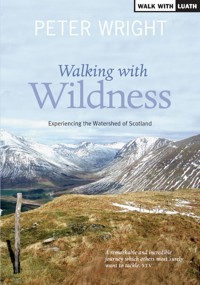
In this new work, the final walk, takes the watershed northwards and is set on Orkney. The wilderness of Scotland offers something special to walkers, nature-lovers and indeed, to any thoughtful, reflective human-beings. LOTHIAN LIFE. The Watershed of Scotland is a line that separates East from West and divides those river basin areas which drain towards the North Sea on the one hand, and those which flow west into the Atlantic Ocean on the other. It meanders from Peel Fell on the English border all the way to the top at Duncansby Head: over 754 miles (1,200km) through almost every kind of terrain. The Watershed follows the high ground, and offers wide vistas down almost every major river valley, towards towns and communities, into the heartlands of Scotland. Walking with Wildness leads the reader through breathtaking, hitherto mostly unknown landscapes, providing valuable advice for walkers on the way.
Das E-Book können Sie in Legimi-Apps oder einer beliebigen App lesen, die das folgende Format unterstützen:
Seitenzahl: 177
Veröffentlichungsjahr: 2013
Ähnliche
















PETER WRIGHT walked the Watershed of Scotland in 2005. It took him 64 days to cover the whole 1,200km, 745 miles, and he was struck by how much of the route went through wild land. He has long been interested in Scotland’s natural environment and history, having volunteered with both the John Muir Trust, and the National Trust for Scotland. He has worked for some 20 years developing the Duke of Edinburgh Award in the Edinburgh area, for which he received the MBE. The National Trust for Scotland presented him with the George Waterston Memorial Award for outstanding voluntary commitment. Peter was instrumental in establishing The Green Team, and is now its honorary Patron.
No other journey through Scotlandcan give so sublime a sense of unity – a feelingof how the Nation’s various different landscapes link together to form a coherent whole.
Ribbon of Wildness
Peter Wright
ISBN 978-1-906817-45-9 PBK £14.99
Also available as an eBook, ISBN 978-1-909912-22-9
The next big wild walk…
If you’ve bagged the Munros, done the Caledonian Challenge and walked the West Highland Way, this is your next conquest.
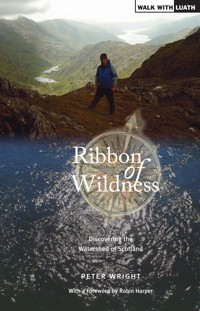
Ribbon of Wildness provides a vivid introduction to the Watershed of Scotland, which has hitherto been largely unknown. The rock, bog, forest, moor and mountain are all testament o the Watershed’s richly varied natural state. The evolving kaleidoscope of changing vistas, wide panoramas, ever-present wildlife, and the vagaries of the weather, are delightfully described on this great journey of discovery.
Peter Wright has done lovers of wild places a great service and providing the first comprehensive description of the Watershed. – THE GREAT OUTDOORS
No other journey can give so sublime a sense of unity – a feeling of how the nation’s various different landscapes link together to form a coherent whole – THE SCOTSMAN
Walking with Wildness
Experiencing the Watershed of Scotland
The Guide to 26 Selected Day or Weekend Walks Upon Scotland’s Watershed
PETER WRIGHT
LuathPress Limited
EDINBURGH
www.luath.co.uk
With fond appreciation of the many influences of KAR, and in particular:
‘…The hills have, quite simply, given me a lot of good fun.’
First published 2012
eBook 2013
ISBN (print): 978-1-908373-44-1
ISBN (eBook): 978-1-909912-39-7
Maps by Jim Lewis
The author’s right to be identified as author of this book under the Copyright, Designs and Patents Act 1988 has been asserted.
© Peter Wright 2012
Contents
Preface
Introduction
Using this book and walking with safety
In the Spirit of it All
ON REIVER MARCH
WALK 1 In the Rolling Border Hills 26km 10 hours
WALK 2 The Ettrick Horseshoe 26km 11 hours
WALK 3 Round the Upper Moffat Water 27km 12 hours
WALK 4 The Devil’s Beef Tub 16km 7 hours
WALK 5 Culter Fell and Gawky Hill 21km 9 hours
ON LAICH MARCH
WALK 6 Across the South Pentlands 20km 7 hours
WALK 7 The Watershed View of Cumbernauld 14km 6 hours
WALK 8 Round Carron in theCampsies 21km 7.5 hours
WALK 9 The Gargunnock and Fintry Hills 21.5km 6.5 hours
ON HEARTLAND MARCH
WALK 10 The Hills Above Glen Arklet 22km 9 hours
WALK 11 Ben Lui and Her Neighbours 27km 13 hours
WALK 12 Corrour to Dalwhinnie 51km 2 days +
WALK 13 Ossian and Alder 34km 2 days
WALK 14 Round the Headwaters of the Spey 36km 2 days
WALK 15 Above the Parallel Roads of Roy 27km 11 hours
ON MOINE MARCH
WALK 16 The Fairy Hill 23km 11 hours
WALK 17 The Upper Glen Quoich Round 27km 12 hours
WALK 18 A High Point and the Mountain with Two Names 37km 2 days
WALK 19 The Glen Carron Experience 45km 2 days
WALK 20 The Splendour of Beinn Dearg and Seana Bhraigh 39km 2 days
WALK 21 Across the Moine Thrust 24.5km 12 hours
WALK 22 Rocky Loop in the North West 23km 10 hours
ON NORTHLAND MARCH (WITH AN ADDITION)
WALK 23 The Crask 30km 12 hours
WALK 24 Forsinard and The Flows 34km 2 days
WALK 25 Guard of Honour at Duncansby 23km 9 hours
WALK 26 On the Mainland of Orkney 31.5km 13 hours
TIME FOR REFLECTION
Preface
‘CLEARLY YOU ARE having a love affair’, was one of the early comments that I received in relation toRibbon of Wildness,but this was then quickly qualified by adding: ‘with the landscapes of Scotland’. I was of course delighted to receive such as observation about the book, or rather, about what the book seemed to represent; about all that had led up to its creation. For it wasn’t written on a whim, even after that epic journey from one end of Scotland to the other, but rather it had grown out of a deep and enduring passion for our natural environment, evidence of our interaction with it over the centuries, and our true enjoyment of it now. And as with any love affair, there would be the hope that from that present enjoyment would emerge a deeper affection and care for it in the future.
Walking with Wildnesshas been written quite simply to provide some of the information necessary, and the further inspiration, to enable more people to get out there and enjoy all that the landscapes of the Watershed of Scotland have to offer, for it is our ever bounteous artery of Nature. There is plenty of space up there, it is unlikely that it will ever get to be crowded, so either solitude, or fellowship within the natural environment, is assured.
But like all good things, it does need to be cared for, so there is a job to be done in calling up thecommunity of interestwe can all share in the conservation of the Watershed. Whether this is fanciful thinking, or genuinely worth doing, well, there’s a choice to be made. But as you read through these pages it is to be hoped that you will then feel motivated to experience some, or all of the walks outlined, do have a great time; do enjoy it, and then perhaps share the pleasure you have obtained with others.
A word or two of thanks are most certainly due here. Firstly to Gary Robbins for his invaluable help in finding a way of producing the 26 route maps. And to my wife Janet for her immense patience.
Introduction
ONE OF THE FINEST and wholly uncompromising delights that the Watershed of Scotland brings is that it is where it is, quite simply because nature alone put it there. Formed out of all the immense forces bound up in geo-glacial time, its place and scale in our landform has been consistent since at least the end of the last ice age. Its identity as a singlegeographic featuremay be very recent, and owe just a little to my first book,Ribbon of Wildness – Discovering the Watershed of Scotland,but that merely represents a bit of catching up with other islands and continents, and their appreciation of their respective watersheds. Now that ours has been plotted, described and mapped in full, the evidence gathered, and a conclusive argument developed for its key place and continuity, there is much to celebrate about it. Chief amongst this is nature’s singular role.
As a route for walking, in whole or in part, the point about the origins of the Watershed, and the lack of human influence in either its making or design, is distinctive, and gives it special appeal. There is something immensely liberating in following a route created entirely by nature; in being guided by the hand of nature, as it were.
That was certainly my own experience when I walked the whole 1,200km of it in 2005, for I had worked out the geographic credentials of the route, and felt that this would stand scrutiny, in every respect. I had looked objectively at the destiny of rainwater falling on Scotland, and then the imperative of its journey by bog, burn and river, to either the Atlantic Ocean or the North Sea. I had considered some key geological factors, and I had taken into account the relatively recent evolution of Scotland’s landform, especially as it affected Orkney’s transition from peninsula to archipelago. And I was able to say with confidence that although geography may be a discipline created by the human need for order, it helps us in no small measure to make sense of what nature has given us. So the very concept of a Watershed is something that many people have enthusiastically warmed to; it does provide a unique route worth exploring further on foot.
As we explore and experience the Watershed of Scotland, we find that it has a number of particular characteristics that set it apart, in addition to its singular creation, that is. Its average elevation of some 450m above sea level puts it generally on the higher ground throughout, and getting near to the conventional upper limit for commercial tree production; a crude measure, I do acknowledge. That almost 88 per cent of it is Class 6 and 7 in terms of potential land-use, and therefore having very limited, or no use agriculturally, is indeed noteworthy. The proportion of the Watershed that is already protected as Sites of Special Scientific Interest (SSSI) or other designation stands at a remarkable 27 per cent, through almost 90 sites. Every single national environmental agency and organisation has an active presence on it, in one or more locations, or by working in partnership. These factors in particular mark out the Watershed as something special, in more than just quasi-environmental terms. Add to this the very little habitation on and about the route – very few people live thereabouts, with the exception of the one and only settlement, Cumbernauld, and it is evident that it is largely a big long almost uninhabited emptiness. But therein lies so much of its appeal.
Now there are of course a great many physical and geographic features that bear the hallmark of nature; every hill, river, loch, and bit of coastline show the same stamp. Each and every one in its place or part can be enjoyed for that. Where the Watershed stands out from this though is the scale of it, and its largely wilder character throughout its very long meander through Scotland, end to end. One critic had this to say of it:‘no other journey can give so sublime a sense of unity – a feeling of how the Nation’s various different landscapes link together to form a coherent whole.’
The appeal of the Watershed as a route to be walked builds.
Having extolled its many virtues, it does have to be acknowledged that very little of it is in a truly natural state, but that is of course true of almost the entire Scottish landscape. The human legacy in terms of settlement, farming, felling, hunting, forestry, communication, enclosure, and so much more is widely evident. So the use of the wordwildernessis most certainly avoided. But it would be true to say that the Watershed does represent a swathe of Scotland’s landscape that is in a state that has had relatively less human influence and impact than much that is on either side of it; it is continuously the least affected, the most naturally evolved perhaps.
The author has been busily engaged in an extensive talks and events programme throughout Scotland. These started prior to the publication of the first book in this quartet, and have continued without a break to the present, and indeed well ahead into 2013. Almost 100 very diverse and appreciative organisations have taken up this opportunity, and the feedback is that it has added something of value to their respective programmes. These events have of course contributed to the growing book sales, but they have increased popular awareness and appreciation of the Watershed and of its distinctive character too.
As a route to be walked, this unique geographic feature has immense promise, but it also presents a major challenge or two. For not only are parts of it extremely remote, and call for a fair degree of skill in self-reliant walking and climbing, but its sheer scale would daunt all but the most intrepid. Few could find the time to cover the huge distance involved in doing it end to end, and the logistics involved in walking it in smaller sections may be complex. As a linear route, much of it does not lend itself to day or weekend ventures, for at the end of each outing, the walker will find themselves a long way from their car or transport home, and re-tracing your steps never has much appeal.
With all this, and much more in mind,Walking with Wildnesshas been written to provide a short guide to some 26 day or weekend walks upon the Watershed, which are eminently possible, and are presented in such a way that the transport issues are satisfactorily dealt with. So the reader can now be armed with the information necessary to plan and carry out a significant number of do-able walks, and to get all of the pleasure and fulfilment which this will undoubtedly bring.
Some areas on the Watershed do lend themselves to fairly straightforward days out – where there is a natural loop in the route, as it swings round the headwaters of a single river. There are a number of such features at various locations along the way, so the potential walker will find within in these pages, advice on where to park, and from that, how to get ready access to and from the Watershed – the aim in this being, wherever possible to maximise theWatershed experience, and minimise non-Watershed time. But there are not really enough of these ‘loops’ to provide anything like a comprehensive guide, so a bit of inventiveness has been called for, sometimes presenting a figure-of-eight route. These have been carefully planned to include particular features or points of interest, whilst maximising to the full, the Watershed experience. Some of the chosen routes will either make for a long and quite demanding single day, or could easily be tackled as two slightly shorter consecutive days, with an overnight camp or where possible, a bothy night. At least two of the walks could only be tackled as weekenders, and quite demanding ones at that. There are some in which the use of public transport will be a ready benefit. Finally, some of the walks present an unconventional route round all or part, of otherwise quite familiar mountain features.
The author acknowledges the positive part that a small number of very resourceful people have already played in walking, and indeed running,theirWatershed, and promoting it in their respective ways. In particular Colin Meek, with his most appealing blog: www.watershedrunning.tumblr.com of 2012, which provides a special insight to the experience and demands of running the whole route in a single four week epic. Dave Hewit’sWalking the Watershedof 1994, which is now out of print but is available on-line, is a very worthy precursor, and can be seen as sowing the seeds of this walking or environmental genre.
There are others who are now taking up the challenge and experiencing it in their own particular way.
Using this Book and Walking with Safety
The Five ‘Marches’ of the Watershed
In my earlier publication, I identified five distinct sections for describing the Watershed, and chose to call them ‘Marches’ – the word march being synonymous with aboundary,for that is what much of it is. The Marches are bounded by key geological features, whether fault line, or landscape transition. So the first and most southerly of these is the Reiver March, from the border with England on Peel Fell, to the Southern Uplands Fault just south of Biggar Common. The second is that which crosses the rift-valley of the central belt, the Laich March – laich meaninglow. This extends to the Highland Boundary Fault near Balfron. The third March takes the Watershed close to the centre of Scotland and is thus the Heartland March, running to the Great Glen Fault. The word moine has two meanings, firstly it refers to abogormorass, and it is of course the name of a major geological feature, the Moine Thrust which runs close to the north-west coast. The Moine March is therefore the fourth in this succession. And finally, the Northlands March is self-evident, as it spans the flow country of Sutherland and Caithness, ending at Duncansby Head – the name being inspired by the passion and writings of Neil Gunn. In time a sixth will be added – the Viking March across Orkney and Shetland.
The notes on equipment, personal outdoor skills and general organisation may offend those who already have the necessary experience, and are equipped in every respect for all thatWalking with Wildnesshas to offer. Bear with me please, for I am certain you would think it remiss of me not to remind everyone of what they will need for where they may be going, and just some of the obstacles they may encounter; this all calls for a bit more than just enthusiasm.
Maps and Planning
The maps that I suggest walkers use, and I give the relevant sheet numbers for each walk, are the Ordnance Survey (OS) Landranger 1:50,000 series. These provide the minimum information needed for safely tackling and navigating any of the walks, and putting the route into its wider landscape context. There are a number of other options including digital downloads and printouts, GPS based and mobile phone uploads. And of course the 1:25,000 series has much more useful and interesting detail to be pored over. Conversely however, it must be stressed that the sketch maps in this book are in no way intended as adequate for navigation purposes; they are but a series of useful cartoons. Of necessity, these route maps are not drawn to a consistent scale.
So the point is clearly made that whatever the walkers’ preference, with technology or otherwise, there is a minimum standard required for both safety, enjoyment and appreciating the wider surrounding landscapes.
The distances for each walk are given in kilometres, with the approach first, then distance on the Watershed in bold, and exit last, all in brackets, thus: (4 :14: 8). The timings are approximate, take some account of varying terrain, and the likely walker’s rate of travel. They do not include meal breaks or camping time, but are purely for walking time. Each walker is advised to adjust these prior to departure, by way of intended route plan.
Equipment
When it comes to equipment, there are as many possibilities and personal preferences as there are puddocks in a pond; every walker will have their own favourites, theories, and prejudices. No harm in that of course, but it has to be stressed nonetheless that Scottish hill and mountain conditions can be both demanding and unpredictable, and walkers, whether solo or in a group, must be fully equipped for all eventualities. To be otherwise is simply irresponsible, and may well endanger others. There are plenty of good sources of information and advice; the outdoors shops, websites and magazines are all avidly competing for everyone’s attention – and money. It is down to each walker or group to formulate their own kit-list, and be aware of why they have selected each item, or rejected others. It is also down to each walker to know how to make safe and best use of every item of equipment.
So that is by way of a necessary word of caution, but from personal experience, it is one of the enduring truths of the hill and mountain experience that having the right gear will contribute much to the enjoyment of the outing. There is something very re-assuring about knowing that you are as well-equipped as you need to be, and can then get on with the business of enjoying the venture, appreciating the surrounding landscapes, and interacting with nature. Every walker will have a tale or two to tell about great days out, and more.
Skills and Competence
Now it wouldn’t do for this author to preach about the necessary levels of competence in outdoor skills for anyone who is intending to tackle any of these day and weekend walks. Suffice it to say however, that the walks vary in length, terrain and potential exposure. None should be underestimated, but each and every one can give a truly fulfilling experience. All of the couth sayings about ‘proper planning’ hold true, and will favour a successful and safe outcome. Do be aware of your physical fitness, and from that, your likely rate of travel. From experience, there is nothing dignified in having to be Mountain Rescued, no matter how uncritical your rescuers may appear to be! Assuming that you are fully prepared and well equipped, I would say that the two key skills that youmusthave are good navigation in all conditions, and a fair competence in route finding; in short, sound mountain-craft.




