


20,99 €
Mehr erfahren.
- Herausgeber: John Wiley & Sons
- Kategorie: Geisteswissenschaft
- Serie: Key Contemporary Thinkers
- Sprache: Englisch
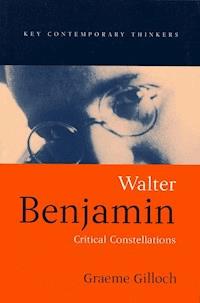
The works of Walter Benjamin (1892-1940) are widely acclaimed as being among the most original and provocative writings of twentieth-century critical thought, and have become required reading for scholars and students in a range of academic disciplines.
This book provides a lucid introduction to Benjamin's oeuvre through a close and sensitive reading not only of his major studies, but also of some of his less familiar essays and fragments. Gilloch offers an original interpretation of, and fresh insights into, the continuities between Benjamin's always demanding and seemingly disparate texts.
Gilloch's book will be of particular interest to students and scholars in social theory, literary theory, cultural and media studies and urban studies who are seeking a sophisticated yet readable overview of Benjamin's work. It will also prove rewarding reading for those already well-versed in Benjaminian thought.
Sie lesen das E-Book in den Legimi-Apps auf:
Seitenzahl: 605
Veröffentlichungsjahr: 2013
Ähnliche


















Table of Contents
Cover
Dedication
Title page
Copyright page
Key Contemporary Thinkers
Acknowledgements
Abbreviations
Introduction: Benjamin as a Key Contemporary Thinker
Origins
Main themes
Biographical sketch
Overview
1 Immanent Criticism and Exemplary Critique
Introduction
Reflection in Fichte and early Romanticism
Immanent criticism
Benjamin and Romanticism
From Angelus Novus to Elective Affinities
Exemplary criticism
Fate and character: novel and novella
Reconciliation, hope and the death of beauty
Conclusion
2 Allegory and Melancholy
Introduction
Background
‘Unmitigated chutzpah’
Trauerspiel and tragedy
Allegory redeemed
Ruin and resurrection
Conclusion
3 From Cityscape to Dreamworld
Introduction
Urban ‘thought-images’
The ‘charmed circle’
The urban ‘engineer’
Surrealism and profane illumination
Conclusion
4 Paris and the Arcades
Introduction
Construction and ruination
The dreamworld of modernity
The dialectics of dreaming
Conclusion
5 Culture and Critique in Crisis
Introduction
The literary engineer
Brecht and ‘crude thinking’
The origins of German epic theatre
Conclusion
6 Benjamin On-Air, Benjamin on Aura
Introduction
Enlightenment for children
Allegories for adults
Photography, art and aura
Pumping aura out
Reproduction and the afterlife of aura
Film and the politics of distraction
Conclusion
7 Love at Last Sight
Introduction
The Image of Baudelaire
Allegory, melancholy and the commodity
Modernité, flânerie and the crowd
Proust and the remembrance of places past
The angel of history and the image of the past
Conclusion
Conclusion: Towards a Contemporary Constellation
Afterlife
Ragpicking
Bibliography
Index
For Thomas and Roisín
Copyright © Graeme Gilloch 2002
The right of Graeme Gilloch to be identified as author of this work has been asserted in accordance with the Copyright, Designs and Patents Act 1988.
First published in 2002 by Polity Press in association with Blackwell Publishers Ltd
Editorial office:
Polity Press
65 Bridge Street
Cambridge CB2 1UR, UK
Marketing and production:
Blackwell Publishers Ltd
108 Cowley Road
Oxford OX4 1JF, UK
Published in the USA by
Blackwell Publishers Inc.
350 Main Street
Malden, MA 02148, USA
All rights reserved. Except for the quotation of short passages for the purposes of criticism and review, no part of this publication may be reproduced, stored in a retrieval system, or transmitted, in any form or by any means, electronic, mechanical, photocopying, recording or otherwise, without the prior permission of the publisher.
Except in the United States of America, this book is sold subject to the condition that it shall not, by way of trade or otherwise, be lent, re-sold, hired out, or otherwise circulated without the publisher’s prior consent in any form of binding or cover other than that in which it is published and without a similar condition including this condition being imposed on the subsequent purchaser.
Library of Congress Cataloging-in-Publication Data
Gilloch, Graeme.
Walter Benjamin—critical constellations / Graeme Gilloch.
p. cm. — (Key contemporary thinkers)
Includes bibliographical references and index.
ISBN 0-7456-1007-2 (HB)—ISBN 0-7456-1008-0
ISBN 978-0-7456-6665-5 (epub)
1. Benjamin, Walter, 1892–1940—Philosophy. I. Title. II. Key
contemporary thinkers (Cambridge, England)
PT2603.E455 Z6743 2001
838′.91209—dc21
2001002110
Key Contemporary Thinkers
Published
Jeremy Ahearne, Michel de Certeau: Interpretation and its Other
Peter Burke, The French Historical Revolution: The Annales School 1929–1989
M. J. Cain, Fodor: Language, Mind and Philosophy
Michael Caesar, Umberto Eco: Philosophy, Semiotics and the Work of Fiction
Colin Davis, Levinas: An Introduction
Simon Evnine, Donald Davidson
Edward Fullbrook and Kate Fullbrook, Simone de Beauvoir: A Critical Introduction
Andrew Gamble, Hayek: The Iron Cage of Liberty
Graeme Gilloch, Walter Benjamin: Critical Constellations
Karen Green, Dummett: Philosophy of Language
Espen Hammer, Stanley Cavell: Skepticism, Subjectivity, and the Ordinary
Phillip Hansen, Hannah Arendt: Politics, History and Citizenship
Sean Homer, Fredric Jameson: Marxism, Hermeneutics, Postmodernism
Christopher Hookway, Quine: Language, Experience and Reality
Christina Howells, Derrida: Deconstruction from Phenomenology to Ethics
Fred Inglis, Clifford Geertz: Culture, Custom and Ethics
Simon Jarvis, Adorno: A Critical Introduction
Douglas Kellner, Jean Baudrillard: From Marxism to Post-Modernism and Beyond
Valerie Kennedy, Edward Said: A Critical Introduction
Chandran Kukathas and Philip Pettit, Rawls: A Theory of Justice and its Critics
James McGilvray, Chomsky: Language, Mind, and Politics
Lois McNay, Foucault: A Critical Introduction
Philip Manning, Erving Goffman and Modern Sociology
Michael Moriarty, Roland Barthes
Harold W. Noonan, Frege: A Critical Introduction
William Outhwaite, Habermas: A Critical Introduction
John Preston, Feyerabend: Philosophy, Science and Society
Susan Sellers, Hélène Cixous: Authorship, Autobiography and Love
David Silverman, Harvey Sacks: Social Science and Conversation Analysis
Dennis Smith, Zygmunt Bauman: Prophet of Postmodernity
Nicholas H. Smith, Charles Taylor: Meaning, Morals and Modernity
Geoffrey Stokes, Popper: Philosophy, Politics and Scientific Method
Georgia Warnke, Gadamer: Hermeneutics, Tradition and Reason
James Williams, Lyotard: Towards a Postmodern Philosophy
Jonathan Wolff, Robert Nozick: Property, Justice and the Minimal State
Forthcoming
Maria Baghramian, Hilary Putnam
Sara Beardsworth, Kristeva
James Carey, Innis and McLuhan
Rosemary Cowan, Cornell West: The Politics of Redemption
George Crowder, Isaiah Berlin: Liberty, Pluralism and Liberalism
Thomas D’Andrea, Alasdair MacIntyre
Eric Dunning, Norbert Elias
Jocelyn Dunphy, Paul Ricoeur
Matthew Elton, Daniel Dennett
Nigel Gibson, Frantz Fanon
Keith Hart, C.L.R. James
Sarah Kay, Žižek: A Critical Introduction
Paul Kelly, Ronald Dworkin
Carl Levy, Antonio Gramsci
Moya Lloyd, Judith Butler
Dermot Moran, Edmund Husserl
Kari Palonen, Quentin Skinner
Steve Redhead, Paul Virilio: Theorist for an Accelerated Culture
Chris Rojek, Stuart Hall and Cultural Studies
Wes Sharrock and Rupert Read, Kuhn
Nicholas Walker, Heidegger
Acknowledgements
I am grateful to many people for their help, guidance and support during the writing of this book. I would especially like to thank John Thompson, who suggested the project initially, and Tim Dant, David Frisby and Neil Leach for their support throughout. My work has benefited greatly from conversations with many people, to whom I would like to extend my thanks: Paul Aylward, Jon Fletcher, Hans-Joachim Hahn, Jaeho Kang, Esther Leslie, Brian Longhurst, Scott McCracken, Tim May, Ulrich Oevermann, Deborah Parsons, Thomas Reghely, Barry Sandiwell, Greg Smith, Gordon Tait, Paul Taylor, Charles Turner, and Cas Wouters. I would also like to thank Troels Degn Johanssen, Claus Krogholm Kristiansen, Erik Steinskøg and the Aesthetic Theory seminar of the Nordic Summer University for their ideas and encouragement.
The section on photography in chapter 6 draws upon a paper jointly written with Tim Dant and presented at the International Walter Benjamin Association conference in Amsterdam in July 1997. I am grateful to Tim for permission to develop these ideas here.
Parts of the present Introduction and Conclusion appear in an earlier version in Profiles in Contemporary Social Theory, edited by Bryan Turner and Anthony Elliott (Sage Publications, London, 2001).
I am very grateful to the Leverhulme Trust, whose generous funding supported the initial work on this book.
I would also like to thank the sociology secretarial staff at the University of Salford (Linda Jones and Beryl Pluples) and the staff at Polity for their practical help and support. Special thanks are due to Jean van Altena for her superb editorial work and to Gill Motley for her patience and help throughout.
Most of all, I wish to thank Bernadette Boyle for all her patience, understanding and encouragement, and Thomas and Roisín, who provided the most delightful distractions possible and to whom this book is dedicated.
The author and publishers would like to thank the following for permission to use copyrighted material:
Harvard University Press and Suhrkamp Verlag for permission to quote from Walter Benjamin: Selected Writings, Volume I 1913–1926, edited by Marcus Bullock and Michael W. Jennings, copyright 1996 by the President and Fellows of Harvard College; and Volume II 1927–1934, translated by Rodney Livingstone, edited by Michael W. Jennings, Howard Eiland and Gary Smith, copyright 1999 by the President and Fellows of Harvard College; and The Arcades Project translated by Howard Eiland and Kevin McLaughlin, copyright 1999 by the President and Fellows of Harvard College, Cambridge Mass.: The Belknap Press of Harvard University Press.
Harvard University Press and Suhrkamp Verlag for permission to quote from Gesammelte Schriften, edited by Rolf Tiedemann and Hermann Schweppenhäuser, Frankfurt am Main, 1974/1991.
HarperCollins Publishers for permission to quote from Illuminations by Walter Benjamin.
The University of Chicago Press for permission to quote from The Correspondence of Walter Benjamin, edited Gershom Scholem and Theodor W. Adorno, translated by Manfred Jacobson and Evelyn Jacobson, Chicago and London, 1994.
Verso for permission to quote from One Way Streets and Other Writings translated by Edmund Jephcott and Kingsley Shorter, London 1985; The Origin of German Drama translated by John Osbourne, London 1985; Understanding Brecht translated by Anna Bostock, London 1983; and Charles Baudelaire: A Lyric Poet in the Era of High Capitalism, translated by Harry Zohn, London 1983.
Every effort has been made to trace the copyright holders, but if any have been inadvertently overlooked, the publishers will be pleased to make the necessary arrangements at the first opportunity.
Abbreviations
Where possible, existing English translations have been used. Otherwise, translations are my own. References to the ‘Arcades Project’ are given by Convolute number and page.
GSGesammelte Schriften, vols I–VII, eds. Rolf Tiedemann and Hermann Schweppenhäuser, with the collabora-tion of Theodor Adorno and Gershom Scholem. Frankfurt am Main: Suhrkamp Verlag, 1974. Taschenbuch Ausgabe, 1991.SW1/SW2 Selected Writings, vols 1 and 2, ed. Marcus Bullock, Michael Jennings et al. Cambridge, MA: Harvard University Press, 1996, 1999.ABCTheodor W. Adorno – Walter Benjamin: The Complete Correspondence 1928–1940. Cambridge: Polity, 1999.APAesthetics and Politics: Debates between Bloch, Lukács, Brecht, Benjamin, Adorno, trans. and ed. Ronald Taylor, ‘Afterword’ by Fredric Jameson. London: Verso, 1980.ARCThe Arcades Project, trans. Howard Eiland and Kevin McLaughlin. Cambridge, MA: Belknap Press of Harvard University Press, 1999.CBCharles Baudelaire: A Lyric Poet in the Era of High Capitalism, trans. Harry Zohn. London: Verso, 1983.CORThe Correspondence of Walter Benjamin, ed. and an-notated by Gershom Scholem and Theodor Adorno, trans. Manfred Jacobson and Evelyn Jacobson, ‘Foreword’ by Gershom Scholem. Chicago and London: University of Chicago Press, 1994.CP‘Central Park’, trans. Lloyd Spencer, New German Critique, 34 (Winter 1985), pp. 28–58.GERThe Correspondence of Walter Benjamin and Gershom Scholem 1932–1940, ed. Gershom Scholem, trans. Gary Smith and Andre Lefevre, ‘Introduction’ by Anson Rabinbach. Cambridge, MA: Harvard University Press, 1992.ILLIlluminations, ed. and with an ‘Introduction’ by Hannah Arendt, trans. Harry Zohn. London: Fontana, 1973.MDMoscow Diary, ed. Gary Smith, trans. Richard Sieburth, Preface by Gershom Scholem. Cambridge, MA: Harvard University Press, 1986.OGTDThe Origin of German Tragic Drama, trans. John Osbourne, ‘Introduction’ by George Steiner. London: Verso, 1985.OWSOne-Way Street and Other Writings, trans. Edmund Jephcott and Kingsley Shorter, ‘Introduction’ by Susan Sontag. London: Verso, 1985.UBUnderstanding Brecht, trans. Anna Bostock, ‘Introduction’ by Stanley Mitchell. London: Verso, 1983.Introduction: Benjamin as a Key Contemporary Thinker
Origins
Writing from Paris to his closest friend, the Judaic scholar Gershom Scholem, on 20 January 1930, the German-Jewish philosopher, literary and cultural theorist Walter Benjamin (1892–1940) makes his intellectual ambition plain:
The goal I had set for myself has not yet been totally realized, but I am finally getting close. The goal is that I be considered the foremost critic of German literature. The problem is that literary criticism is no longer considered a serious genre in Germany and has not been for more than fifty years. If you want to carve out a reputation in the area of criticism, this ultimately means that you must recreate criticism as a genre. (COR, p. 359)
This is a particularly ironic and peculiarly appropriate statement. It is ironic because of Benjamin’s own precarious, marginal situation at the time of writing: the enforced withdrawal of his Habilitations-schrift1 a few years earlier had ended any hope of an academic career, and he was now limited to eking out an indigent living as a freelance writer, reviewer and translator, and even as the author and narrator of radio broadcasts for children. Indeed, Benjamin was to return to Paris only a couple of years later in the even more impoverished guise of a refugee fleeing Nazi tyranny. If Benjamin was to become the ‘foremost critic of German literature’, it was to be an expertise in exile.
It is an ironic statement, moreover, because Benjamin’s attempt to ‘recreate criticism as a genre’ led him not only far beyond the confines of literary criticism as such, but also to its dissolution as a distinct sphere of endeavour. For Benjamin, traditional bourgeois aesthetic categories and practices were to be imploded, and new modes of representation pioneered, modes inspired by and appropriate to the possibilities created by new forms of media amid the transformed social, political and cultural patterns of the inter-war period. Film, photography, magazines, newspapers, advertising, radio – the importance of these for literature and drama was to be captured not by the conventional literary critic, but by another figure: the experimental, polytechnical aesthetic ‘engineer’. It is in this role that Benjamin undertakes a fragmentary but politically charged critique of modern culture, metropolitan experience, technological innovation and historical change. To ‘recreate criticism as a genre’ means to transform it into a panoramic critique of modernity itself.
It is ironic first and foremost, however, because, after a sub-stantial period of neglect, Benjamin is now widely recognized as the most important German literary theorist of his generation and, indeed, as one of the most original and insightful thinkers of the twentieth century. Benjamin has achieved his lofty ambition and more, but only fifty years after his death.
The statement is appropriate because, in Benjamin’s view, it was only the critical outcast who could, freed from the moribund mediocrity of bourgeois (pseudo-)scholarship, develop innovative forms of literary, cultural and social critique. His own radically politicized understanding of art and aesthetics emerges not from the confines of the academy, but in the form of practices and strategies necessitated by the economic exigencies which beset the intellectual as outsider and ‘trailblazer’.
It is appropriate, above all, because central to Benjamin’s work is the insight that texts, objects and images have a particular existence, or ‘life’, of their own which goes beyond, and cannot be reduced to, the intentions and purposes of those who created them. This is not an act of fetishization, the ascription of human capacities and qualities to inanimate things. Rather, it is the contention that the meaning and significance of a text are not determined by the author at the moment of writing, but are contested and conceptualized anew as it enters subsequent contexts, as it is subject to reading and criticism through time. This continuing existence of the text as an object open to reconfiguration and re-evaluation is termed its ‘after-history’ (Nachgeschichte) or ‘afterlife’ (Nachleben). This notion of the afterlife of an object as a period of critical appreciation and political appropriation aptly anticipates the posthumous fate of Benjamin’s own texts, for, as recent commentators have noted,2 these formerly overlooked, now revered writings are the clearest examples imaginable of the critical contingencies and fluctuating fortunes experienced by a corpus of texts.
In the immediate post-war period, Walter Benjamin was in danger of becoming a forgotten figure. In the 1950s, the publication of a two-volume edition of a selection of his writings under the joint auspices of Theodor Adorno and Gershom Scholem brought a modicum of recognition. By the late 1960s, Benjamin’s more expli-citly Marxist cultural writings from the 1930s had begun to attract attention in both West and East Germany: in the West, Benjamin the hashish-experimenter, the brilliant maverick, the melancholy outcast, could not fail to appeal to the rebellious sentiments of the student movement; in the East, he was but one among many heroes of the anti-Fascist struggle, a revolutionary thinker who bridged the gap between German and Soviet cultures. In both cases, though, he was overshadowed by the accomplishments of friends and colleagues: in the West, by Herbert Marcuse, whose writings proved inspirational for the counterculture, and in the East, by revered figures like Bertolt Brecht and Ernst Bloch, who had chosen to settle in the newly established DDR in preference to the Bundesrepublik. That Benjamin should be envisioned, given his view of the ‘author as producer’, as a melancholy genius, or, given his mystical and Messianic motifs, as some kind of orthodox Marxist, is a double irony.
The gradual publication of the Gesammelte Schriften since 1974 under the editorship of Rolf Tiedemann and Hermann Schweppenhäuser, the more recent appearance of Benjamin’s Gesammelte Briefe, and the proliferation of translations of his texts, have been instrumental in the recovery and reception of Benjamin’s work over the last twenty years. Although traces of the earlier sentimentalism3 and political ‘crude thinking’ remain, Benjamin’s work is now subject to rather more sophisticated readings and sensitive appraisals. His Habilitationsschrift, The Origin of German Tragic Drama (Ursprung des deutschen Trauerspiels),4 a text dismissed as utterly arcane and incomprehensible by its examiners, is now esteemed and honoured as his critical masterpiece. Some studies never intended for publication, such as the 1916 fragment on language and the 1940 ‘Theses on the Concept of History’, are now considered among his most brilliant and suggestive works. Benjamin’s radio scripts for chil-dren, which he himself belittled as a mere journalistic sideline, have become the focus of sustained and psychoanalytic study. And his unfinished, and perhaps unfinishable, magnum opus the ‘Arcades Project’ with its attendant, equally incomplete study of Charles Baudelaire, writings hidden away in the Bibliothèque nationale in Paris during the Nazi occupation, are now celebrated as being among the most intriguing and dazzling of modern cultural analyses.
Main themes
Two concepts, the notion of the afterlife of the object, and in particular of the work of art, and the figure of the ‘polytechnical engineer’, are the leitmotifs of this book. They capture two moments of Benjamin’s dialectical thinking: destruction and (re)construction. Afterlife refers to the patient process of disintegration and ruination in which the object emerges from earlier contexts, shorn of some of its original features but with new accretions upon it.5 Afterlife is the period in which the pure but deceptive surfaces of the object are eroded, in which hidden meanings are unfolded and truth is ultimately disclosed. It is the time in which the object is subject to transformations and interventions which re-cognize its significance and ‘actualize’ its potential: translation, transcrip-tion, imitation, criticism, appropriation, (re)construction, reproduc-tion, remembrance, redemption. These are precisely the tasks of Benjamin’s ‘aesthetic engineer’. Objects, edifices, texts and images are fragmented, broken and blasted from their usual contexts so that they may be painstakingly recomposed in critical contempor-ary constellations. The eclectic engineer juxtaposes disparate and despised artefacts, forms and media, so as to generate an electrifying tension, an explosive illumination of elements in the present.
Further, engineer and afterlife are concepts which help us see why Benjamin should be viewed as, and what it means to be, a ‘key contemporary thinker’. First, Benjamin was preoccupied with the contemporary. Although much of his work explored obscure, forgotten historical forms and fragments, his purpose was always a present (and political) one. Dismal dramas, no longer read or performed; obsolete objects and absurdly outmoded fashions; unfrequented places and buildings; and the faces of now-forgotten, long-dead people captured in photographs – Benjamin’s abiding concern with all such dusty, derelict things arose not from an antiquarian interest in the esoteric and arcane. Rather, it derived from the critical imperative to perceive the secret significance of such untimely things in the present, to ‘actualize’ them by identifying and igniting their explosive, incandescent potential. In addition, Benjamin focused the same scrupulously attentive, sublimely appreciative gaze on the marginalia and minutiae of his own time and place: the modern metropolis. In the inconspicuous, incidental details of everyday life lay the most profound insights into, and profane illuminations of, the contemporary condition. Children’s books and toys, postage stamps, automata in Berlin shop windows and Italian fairgrounds, unfashionable yet seemingly indestructible domestic furnishings – through such curios and collectibles, Benjamin sought to reveal and redeem the innermost tendencies and possibilities of contemporary cultural forms and practices.
Benjamin recognized and addressed, albeit in a distinctly unsystematic, often ambiguous, and sometimes thoroughly contradictory manner, a number of social, political and cultural transformations and tendencies which preoccupied his own generation of critical thinkers, avant-garde artists and radical intellectuals. They form a set of key themes in his writings.
Cultural fragmentation
Benjamin’s writings are marked, like those of so many of his contemporaries in Germany, not least the first generation of Frankfurt School Critical Theorists, by the catastrophic historical events and experiences of the early twentieth century: the First World War, economic chaos and inflation in the Weimar years, the Russian Revolution and its descent into Stalinist totalitarianism, the rise of Fascism and National Socialism, enforced emigration and exile. In a cultural environment characterized by disintegration and disorientation as a result of these upheavals, by rapid and unprecedented technological change and by the collapse of traditional values, hierarchies and boundaries, Benjamin recognized the urgent imperative to rethink the tasks and tactics of the writer as author, critic, historian and refugee. How to interpret, and then give critical form to, the modern? This question, which lies at the heart of Charles Baudelaire’s critical prose, also occupied Benjamin. It led to an unequivocal scepticism and scorn for totalizing, systematizing ‘scholarly’ approaches, and a privileging instead of more immediate, more ephemeral, more explosive textual practices. Attentive and attuned to the contemporary technical innovations and transformations within the sphere of cultural production, Benjamin pioneered modes of critical reading and textual representation which were in keeping with the fragmentation, eclecticism and dynamism of modernity – the monad, the treatise, the constellation, the aphorism, the ephemeral ‘thought’, ‘dream’ and ‘dialectical’ image, the textual ‘snapshot’, cinematic montage.6 For Benjamin, the era of long-winded ‘weighty tomes’ was long past, and a new, urgent language was essential. To this end, he was inspired by the artistic avant-garde of his time (the writings of the Surrealists and the theatre of Bertolt Brecht, in particular), by the contemporary techniques of journalism and advertising, radio, photography and film, and especially by the fragmentary writings of the early German Romantics, radical critical and textual pioneers in their own turbulent times.
Consumption and commodification
The historical development and contemporary pre-eminence of consumer capitalism with its emphasis on and manifestation in the acquisition, conspicuous display and advertising of fashionable commodities; the very proliferation and fate of the commodity form itself; and the accompanying commodification of time, space, human experience and sexuality – these became central themes in Benjamin’s work and, in particular, in his ever-expanding study of the Parisian shopping arcades begun in the mid-1920s. In seeking to develop a sophisticated and subtle historical materialist critique of the mystifications attending consumption practices, Benjamin drew upon a number of key notions: Georg Lukács’s key insight in History and Class Consciousness (1974 [1924]) that the commodity and, above all, commodity fetishism must be recognized as the fundamental category of historical materialist critique; the Freudian and psychoanalytic understanding of the fetishized object as the result of a misdirected genuine sexual impulse; Georg Simmel’s insights into the cyclical character of fashion as a form of social differentiation and integration; and the Surrealist preoccupation with the critical energies and, in particular, the comical condition of the now obsolete artefact in the derelict display window. He pioneered dialectical techniques with which to implode the dazzling, dizzying ‘dreamworld’ of consumerist fantasies formed by spectacular shopping complexes, exclusive department stores, extravagant World Exhibitions and saturation advertising, and thereby to bring the intoxicated consuming masses to their sober senses.
Metropolitanism
Benjamin recognized the rapidly expanding and ever-changing metropolitan environment as the principal site of capitalist domination, and saw the interrogation of the city’s architectural forms, spatial configurations and experiential modes as the key to un-ravelling the fantastical, ‘mythological’ features of modernity. The construction, development and eventual decline of the nineteenth-century Parisian arcades, with their magical inversion of street and interior and use of mirrors to achieve perspectival illusions, formed the specific foci of his reading of the urban phantasmagoria of the recent past. Moreover, as I have argued elsewhere,7 Benjamin’s lifelong fascination with the big city leads to a plethora of writings which articulate the distinctive experiences and central tendencies of modern urban life: ‘shock’, acceleration and overstimulation, a sense of fragmentation, disorientation and amnesia, anonymity and depersonalization, and spatial rationalization, interiorization and privatization.
Benjamin here drew explicitly on Simmel’s famous vision of the indifferent, neurasthenic urbanite in the 1903 essay ‘The Metropolis and Mental Life’ (in Simmel, 1971). But, for Benjamin, the big city is not only a site of alienation and the diminution of experience. In envisioning the metropolis as a setting of cultural innovation and intellectual excitement, of electrifying encounters and erotic adventures, of intoxication and sophistication, Benjamin offers a differentiated perspective on the city that is sensitive to its delights and distractions. He was well aware that urban life, however traumatic, was also absolutely indispensable for the modern critic as internationalist and cosmopolitan. Benjamin’s writings on the metropolis thus clearly reject the simple-minded, reactionary anti-urbanism espoused by critics like Ferdinand Tönnies in Community and Association (Gemeinschaft und Gesellschaft) (1988 [1888]) and Oswald Spengler in The Decline of the West (Der Untergang des Abendlandes) (1991 [1918]), authors whose sentimental privileging of small-scale communities and peasant life is imbued with parochialism, anti-intellectualism and latent anti-Semitism.
Benjamin not only offers a series of provocative insights into metropolitan culture and experience, but also discerns and argues for a number of important affinities between the urban and particular forms of representation, most notably between the city and the cine-matic. Film becomes the privileged medium for the exploration and depiction of the metropolitan environment – a key consideration for the urban ‘engineer’ who wishes not merely to decipher but also to ‘cut’ his or her way through the urban labyrinth.
Mass mediation and reproduction
Benjamin’s critique of the modern metropolis goes hand in hand with his analysis (and utilization) of new mass media: radio, photography, film, sound recordings and newspapers. He was not the first, of course, to write on the experiential and perceptual consequences and possibilities of these technologies, but his understanding of the inherent reproducibility of photographs, films and sound recordings is distinctive and important. For Benjamin, the key question raised by film, photography and radio is not whether they are worthy of being classed as art forms but, rather, how these media transform the entire realm and role of art, the categories of aesthetics, and the fundamental relationships between artist/performer and audience. The artist as producer, as engineer – such a materialist view ‘disenchants’ art, and leads the discussion of the new media away from the ethereal domain of aesthetic concerns and into that of everyday political practice. During the mid-1930s, in particular, he developed a highly suggestive conceptual vocabulary so as to reconfigure our understanding of ‘the work of art in the age of its technological reproducibility’ – the ‘optical unconscious’, the ‘spark of contingency’, ‘schooling’, ‘habit’, ‘aura’ and ‘distraction’. In so doing, Benjamin offered an equivocal, differen-tiated analysis of contemporary popular media and cultural forms, which, in endorsing their radical political potential at least, served as a significant counterpoint and corrective to the all too one-dimensional denunciation of the ‘culture industry’ which emerged in the writings of Horkheimer and Adorno, a critique which, in the lamentable absence of contemporary discussions of other Critical Theorists concerned with popular culture like Siegfried Kracauer and Leo Löwenthal, is, alas, only too often misunderstood as the Frankfurt School view of mass/popular culture.
Technological change and historical ‘progress’
The promise of the new media is the production and proliferation of cultural forms not just accessible to the masses, but in which the masses recognize their own (class) situation and interests and are prompted thereby to interrogate and transform their circumstances. This revolutionary pedagogic aspiration is thwarted, however, by the incorporation of the new media into the ideological services of capitalism as illusory spectacle, sentimental compensation and ‘harmless entertainment’. This misdirection of a potentially critical, liberating technology into one driven by the interests of profit and domination is but one instance of the fate of modern technological innovation in general. In his programmatic writings on history and elsewhere, Benjamin outlines an uncompromising, albeit fragmentary, critique of the notions of scientific and technological ‘pro-gress’ as the ever more sophisticated exploitation of nature by humankind. ‘Progress’ is the great myth of modernity. The Enlightenment has betrayed itself. Under capitalism, the Enlightenment has sacrificed its original emancipatory promise of a just, humane society freed from superstition and fear, and has instead aligned itself with vested interests to become the enemy of critique and truth. It is not reason that has flourished in modernity, but a cold, calculating instrumentalism geared to the maximization of profit. As the hireling of capitalist industry, science contents itself with the technical question of ‘how?’, and all too rarely addresses the real moral-practical and political question of ‘why?’ (and ‘for whom?’). Benjamin was neither the first of the Frankfurt School Critical Theorists to develop such a critique (Kracauer had pioneered these themes in his notion of the ‘Ratio’ in his 1927 essay ‘The Mass Ornament’8), nor, of course, the last (the ‘dialectic of enlightenment’ thesis became axiomatic for Theodor Adorno, Max Horkheimer and Herbert Marcuse). Nevertheless, Benjamin’s critique of pro-gress and his related vision of history as perpetual catastrophe lead to a distinctive critique of orthodox Marxism and to a provocative call to redeem the hopes and struggles of those who have been oppressed and silenced in the past, to remember the forgotten dead. Roused from our complacent slumbers, reminded of the sufferings of the past and the present, deprived of the illusion of Communist revolution as historical telos, our task becomes clear: to halt the triumphal procession of technological barbarism, to interrupt the course of history.
‘Alienation’ and the intellectual
In a world shattered by catastrophic events, marked by the depersonalization of everyday life in metropolitan environments and under bureaucratic apparatuses, and shorn of any higher meaning or sense of spiritual/religious consolation, Benjamin, like many other writers of his time, was acutely aware of the impoverished, isolated existence of the modern individual and, above all, of that most marginal and maligned of figures, the contemporary ‘intellectual’. The pessimistic vision of an acute inner loneliness and longing and of a profound spiritual ‘homelessness’ pervading modern culture find frequent expression. In Lukács’s Theory of the Novel (1971 [1920]), the contemporary world is marked by a condition of ‘transcendental homelessness’, one which lies at the heart of the bourgeois novel. Simmel (1903, in Simmel, 1971) argued that the metropolitan individual shuns the overstimulation of the external world (‘objective culture’) and retreats into indifference, neurasthenia and eccentricity. For Kracauer, the new white-collar workers, who increasingly come to predominate in the contemporary metropolitan centres, are characterized by a condition of ‘spiritual homelessness’ (Kracauer, 1998, p. 88) and lack both the class consciousness of the traditional working class and the economic rewards and cultural consolations of the middle classes, the Bildungsbürgertum, to which they aspire. Moreover, the intellectual is the ultimate metropolitan figure condemned to ‘isolation from the absolute … isolation and individuation’ (Kracauer, 1995, p. 131); unconvinced by pseudo-theological speculation and unmoved by naive revolutionary zeal, he or she must join the ranks of ‘those who wait’ (‘Die Wartenden’, 1922, in Kracauer, 1995) in existential uncertainty. And, as for so many German intellectuals, such disquiet, such ‘spiritual homelessness’, was for Kracauer and Benjamin exacerbated by the ‘real’ homelessness of enforced emigration and exile.
In Benjamin’s work the crisis of the modern thinker is characteristically understood in both theological and materialist terms. On the one hand, it is but an element of the sorrowful world-historical condition attendant upon fallen humanity, an all-pervasive melancholy which finds its most precise expression in the allegorical poetics of the baroque and, much later and in profane form, of Baudelaire. On the other hand, the precarious position of the critic results from a failure to perceive his or her true socio-economic and class position as ‘producer’, an intellectual labourer with a clear task: to foster the revolutionary consciousness of the class of which he or she is unambiguously a member. Melancholy and mobilization, acedia and aesthetic ‘engineering’ – these are the two poles of Benjamin’s attempt to articulate the distinctive character of, and the practices incumbent upon, the radical writer under the calamitous, chaotic conditions of his time. The brooding polytechnician – this figure is the very model of the key contemporary thinker for Benjamin then, and even (perhaps, especially) for us now.
Benjamin was a thinker of the contemporary, and is a key contemporary thinker. The evidence for this is overwhelming. There is now a vast literature on Benjamin, encompassing collected editions, translations, scholarly monographs and articles, special issues of journals, student-friendly and cartoon-strip-style introductions, and at least one novel.9 It is a literary mountain, a baroque pile of fragments upon fragments, which has accumulated at an ever more rapid rate over the last twenty years and to which this book inevitably adds yet another piece.10 There are, in addition, web pages, videos, conferences and an international organization dedicated to Benjamin,11 and, most recently, a literary prize for translation has been named after him by the city of Frankfurt am Main. He is required reading for students in a plethora of academic disciplines and interdisciplines – German, French, English, and comparative literature, philosophy, sociology, history, cultural studies, film studies, urban studies and architecture. He is a star in the current academic firmament.
This acclaim is not simply a matter of intellectual whim or fashion. Rather, it reflects the complex and manifold ways in which his ideas, themes and insights are increasingly recognized as having special significance for, and resonance with, current (post-)modern social and cultural analysis. Rapacious consumption and all-pervasive commodification, the tumult of urban experience, the proliferation of new media technologies and our supersaturation by images, the destructive capacities and dominating consequences of ‘progress’ and scientific knowledge, the preservation of the precious counter-histories of oppressed groups and the importance of collective memory and individual testimony – such concerns have not diminished in importance, but are, on the contrary, even more acute today than when Benjamin was writing. His work lays bare with incomparable clarity and critical power his modernity as the ‘prehistory’ of our own ‘post’ or ‘late’ or ‘(dis)organized’ or ‘second’ modernity. In a Europe wherein war, economic ruin, totalitarianism, genocide and concentration camps are far from distant memories, Benjamin’s work has a vital presence in our present.
Biographical sketch
In contrast to the impecunious and imperilled condition of his later life, Benjamin’s childhood was a time of material comfort and tedious tranquillity. Born on 15 July 1892, the son of an auctioneer and eldest of three children, Walter Benedix Schönflies Benjamin grew up in the desirable West End of Berlin in an affluent, assimilated German-Jewish family. As has been commonly observed, his semi-autobiographical reflections on his formative years, ‘A Berlin Childhood around 1900’ and ‘Berlin Chronicle’ (both written in 1932), are more treatises on the promises and prohibitions attending a middle-class, urban childhood in general than an intimate account of Benjamin’s boyhood. He recalls a solitary, sickly childhood cloistered in the insufferably ‘cosy’, cluttered bourgeois interior of the time, the dull and dutiful round of visits to ageing, gossiping relations, and the petty strictures of school life. His reminiscences speak eloquently and poetically of a child whose main consolations for this dry existence consisted in the daydreams stimulated by reading, in the visits to the enchanting Tiergarten and Berlin zoo, in the annual hunt for Easter eggs, the occasional illicit nocturnal pilferings of confectionery, and, on one memorable occasion, an unintended, unsanctioned foray into a seductive, seedy district of the city.
In the belief that he would benefit from the country air, Benjamin was sent away from Berlin to spend two years (1905–6) at a relatively progressive boarding school at Haubinda in Thuringia. There he met and studied under Gustav Wyneken (1875–1964), a key advocate of educational reform and a luminary of the radical wing of the Youth Movement (Jugendbewegung). Originally formed in 1901 as a boys’ hiking organization, the Youth Movement in Imperial Germany expanded and diversified to cover a wide political and social spectrum, from proto-Fascist, anti-Semitic elements such as the Wandervogel with their Volkish ideologies, eulogizing of German nature, sense of martial brotherhood, and privileging of leadership, to the Jewish section of the movement, the Blau-Weiss.12 The radical wing of the Youth Movement to which Benjamin was attracted advocated a complete break with the traditional school system to ensure the free development of youth unencumbered by the dogmas and disciplines of conventional pedagogy. The renewal of German culture and intellectual life could be achieved only through the liberation of youthful creativity and energy. Under the influence of Wyneken, Benjamin became intensely preoccupied with the cultural and educational condition of youth, though not in any practical or instrumental sense. Benjamin’s vision of the mission of students, unsullied by material or political considerations, was couched in the rarefied and abstract terms of the ideal-istic renaissance of Geist (spirit), the solitary, individual life of the mind.13
Although Benjamin returned to complete his school studies in Berlin and then enrolled to study philosophy at Freiburg University in 1912, he remained in regular contact with Wyneken. The year 1913 saw the publication of a number of poetic and idealistic polemics in Wyneken’s journal Der Anfang (The Beginning) as Benjamin returned to Berlin once more to pursue his university studies. Back in his native city, Benjamin was elected to the committee and then to the chair of the ‘Free Students’ (Freie Studentenschaft), an association instigated to oppose the various conservative and martial university fraternities and clubs. This official position notwithstanding, Benjamin’s days of involvement with the idealism of the Youth Movement and the naive student politics of the ‘spirit’ were numbered. August 1914 was to transform everything.
The outbreak of the Great War split the Youth Movement into its numerous factions. Some militants relished the outpourings of patriotic sentiment and the opportunity for imperial adventure and military glory. Some viewed the conflict as the necessary defence and revitalization of German Kultur, in opposition to the decadent foreign (especially French) values of Zivilisation.14 Some saw the war from the very outset as an appalling, futile sacrifice of a betrayed generation, and there were others who changed their minds. In 1913 Wyneken had criticized the warmongering and national fervour of the time – youth must resist the simplistic appeal of sabre-rattling sloganeering.15 In November 1914, however, his speech on ‘War and Youth’ in Munich was a rallying call to youth to defend the besieged and beleaguered ‘fatherland’. Expecting to be called up anyway, Benjamin initially, and without any enthusiasm, volunteered to join the cavalry, but, fortunately for him, was deemed unfit for military service.16 Then, on 8 August 1914, two of Benjamin’s closest friends, Fritz Heinle and Rika Seligson, committed suicide as a despairing protest against the hostilities. Deeply moved by these deaths and feeling utterly betrayed by his mentor, Benjamin broke completely with Wyneken in March 1915.17
Three months later Benjamin met an 18-year-old student of mathematics, Gershom Scholem, an acquaintance who would prove a lifelong friend and profoundly influence Benjamin’s work in the direction of Judaic thought, mysticism and the Kabbalah. Benjamin’s concern with the critical, spiritually redemptive task of youth gave way to a preoccupation with redirecting philosophical enquiry away from the impoverished Enlightenment conception of experience, cognition and knowledge, towards an understanding of the linguistic grounding of truth in Revelation. In his enigmatic fragments from 1916–17, Benjamin identifies the task of philosophy, to call things by their proper names, as the recovery of the perfect language with which Adam named Creation at God’s behest. Benjamin thus sought a new avenue for his concern with the purity of a language and an intellectual realm uncontaminated by im-mediate interests and instrumentalism. Both those who advocated Jewish assimilation within the German state, like Hermann Cohen, and those who later came to advocate Jewish political mobilization and emigration, like Martin Buber, were tainted by their initial enthusiasm for the war.18 Indeed, the politics of Jewish militancy and Zionism were far too pragmatic and partisan to appeal to Benjamin at this time, and his political thinking eventually took a rather different direction. He never learned Hebrew, though he promised Scholem on numerous occasions that he would do so; and he never even visited Palestine when Scholem emigrated there in 1923, let alone emigrate himself.19
Benjamin had been profoundly disappointed by his studies at the University of Freiburg, especially the lectures of the pre-eminent neo-Kantian philosopher Heinrich Rickert, which he found particu-larly boring. Subsequently, he showed considerably more enthu-siasm for the classes and ideas of the sociologist Georg Simmel at the Royal Friedrich Wilhelm University in Berlin. But in the aftermath of the break with Wyneken, Benjamin was keen to leave the Imperial capital. In the autumn of 1915 he moved to Munich, ironically the city where Wyneken had recently delivered his fateful ‘War and Youth’ address. Benjamin managed to avoid subsequent call-ups by feigning sciatica, and in 1917 relocated to neutral Switzerland and Berne University with Dora Kellner, whom he had married in April 1917. Benjamin spent the remaining war years in self-imposed Swiss exile, and completed his doctorate on ‘The Concept of Art Criticism in German Romanticism’ in 1919, a study in which he sought to develop a notion of immanent criticism as the unfolding of the inherent tendencies of a work of art, its ‘truth content’, through critical reflection. Back in Germany, he subsequently provided an exemplary instance of such an approach in an extended essay on Goethe’s peculiar novel Elective Affinities. Eschewing conventional readings of the story as a cautionary moral tale of tragic, illicit love, Benjamin foregrounded the opposition between human subjection to fate and characterful, decisive ac-tion, a contrast which serves as an instructive lesson in the need to contest mythic forces. In particular, Benjamin contended, the protracted death of one of the miscreant lovers, Ottilie, presents the demise of beauty for a higher purpose, truth, and thus serves as an allegory of the task of criticism itself.
In the early 1920s Benjamin hoped to make his mark in literary criticism by editing his own journal, Angelus Novus, the New Angel. Suspecting, however, that the erudite and arcane material would prove commercially unviable, the prospective publisher pulled out before the first issue was finalized. This bitter disappointment prompted Benjamin’s return to the academic sphere. He embarked upon his Habilitationsschrift at the University of Frankfurt, taking as his theme the seventeenth-century German play of mourning, the Trauerspiel. Dismissed as bastardized tragedies, these baroque dramas with their preposterous plots and bombastic language had long been consigned to the dusty attic of literary failures. Benjamin’s immanent critique of these scorned and neglected works distinguished them from the classical tragic form, and reinterpreted and redeemed them as the quintessential expression of the frailties and vanities of God-forsaken human existence and the ‘natural history’ of the human physis as decay. In so doing, Benjamin argued for the importance of allegory as a trope which renders and represents the world precisely as fragmentation, ruination and mortification. Benjamin’s Ursprung des deutschen Trauerspiels, with its obscure subject matter and impenetrable methodological preamble, baffled and bemused its inept examiners, and he was advised to withdraw it, rather than face the ultimate humiliation of outright rejection. By late summer 1925, his ambitions for an academic career lay in ruins.
Benjamin was to remain an intellectual outsider for the rest of his life, free to lambaste and lampoon scholarly conventions, but at the same time utterly dependent on the good offices of publishers, the press, commissioning editors and others who, like Ernst Schoen at Südwestdeutscher Rundfunk and Siegfried Kracauer at the Frankfurter Zeitung, offered what work they could. Benjamin’s growing friendship with Theodor Adorno, whom he met in 1923, led to an associate membership of the Frankfurt Institute for Social Research and a small stipend; yet, his life was dogged by financial anxieties. The fragmentation and astonishing diversity of Benjamin’s oeuvre is a clear consequence of economic exigencies. Benjamin translated and wrote on Marcel Proust; he produced eloquent essays on such key literary figures as Franz Kafka, Bertolt Brecht, Karl Kraus, the Surrealists and Charles Baudelaire; he also penned a radio piece entitled ‘True Stories of Dogs’, a set of reflections on Russian peasant toys, and a review of Charlie Chaplin. Only this can be said of such enforced eclecticism: the least likely and most maligned of things always attracted his attention, and always provided his most telling insights.
Benjamin was never to write another book in the, for him, compromised, ‘scholarly’ style of his Trauerspiel study, which was eventually published in 1928. Instead, the aphorism, the illuminating aside, the quotation, the imagistic fragment, became his preferred – indeed, essential – mode of expression. In presenting and representing the everyday in a new light, observing it from an unexpected angle, such miniatures were intended to catch the reader off guard (like a series of blows decisively dealt, Benjamin once observed, left-handed20). Starting with pen portraits of cities he visited (‘Naples’, ‘Marseilles’, ‘Moscow’) and his 1926 montage of urban images, One-Way Street, Benjamin’s writings began to take on a more pronounced contemporary inflection and radical political colouring. While working on the Trauerspiel study on Capri in the summer of 1924, Benjamin had read Georg Lukács’s History and Class Consciousness, and had been introduced to a Latvian theatre director, Asja Lacis. His enthusiasm for the former and troubled love affair with the latter drew Benjamin to Marxist ideas. In the winter of 1926–7 he visited Moscow to see the new Soviet system for himself. His initial enthusiasm waned in response to the indifference of the Soviet authorities, the impossibility of the language and, especially, the artistic impoverishment and intellectual compromises already discernible. Benjamin returned to Berlin, where, through Lacis, he met and became friends with the playwright Bertolt Brecht. To the dismay of Adorno and Scholem, who saw Benjamin’s always unorthodox, unconvincing espousal of Marxist ideas as a foolhardy flirtation, he became an advocate of Brecht’s ‘epic theatre’ with its blunt political didacticism. While Benjamin himself refrained from ‘crude thinking’, its traces and imperatives are evident in many of his writings during the 1930s on the situation and task of the contemporary artist (‘The Author as Producer’, 1934) and the character and consequences of new media forms for the work of art and aesthetics (‘The Work of Art in the Age of Mechanical Reproduction’, 1935).
Benjamin’s concern with the fate of art within capitalist modernity, with the Marxist critique of commodity culture, and with the character and experience of the urban environment were to combine in a project which was to occupy him from 1927 until his untimely death in 1940. Inspired by the Parisian perambulations of the Surrealist writer Louis Aragon (1987 [1926]), Benjamin embarked upon a study of the then derelict Parisian shopping arcades built in the first half of the nineteenth century. Initially modest in scope, Benjamin’s Passagenarbeit, or Passagen-Werk (‘Arcades Project’) was eventually to comprise more than 1,000 pages of notes, quotations, sketches and drafts, and today remains as an unfinished – indeed, never written – ‘prehistory’ of nineteenth-century Paris as the original site of modern consumer capitalism, a plethora of fragments providing a panoramic and kaleidoscopic exploration of the city’s fashions and phantasmagoria, architecture and boulevards, literature and politics.
Significantly, it was to Paris, rather than to Moscow or Palestine, that Benjamin fled in 1933 to escape the Nazi terror. There he pursued his researches for the ‘Arcades Project’ in the Bibliothèque nationale, work which led to a proposed book on Baudelaire and a series of historiographical principles intended as a methodological introduction. Like the wider Passagenarbeit, these too were never completed. Despite the advice and efforts of Adorno and Horkheimer, then in exile in New York, Benjamin lingered too long in Paris, and was trapped in 1940 by the German invasion. He fled to the south of the country, was temporarily interned, and, once released, desperately sought an escape route. It was not to be. Benjamin attempted to cross into the relative safety of Spain, but was turned back at the border. Wearied by his exertions, facing certain arrest on his return to France, Benjamin committed suicide on 26 September 1940. He is buried at Port Bou.
Overview
Benjamin’s fragmentary oeuvre presents a highly eclectic and pro-vocative combination of concepts, themes and motifs drawn from a distinctive and diverse set of sources: Judaic mysticism and Messianism; early German Romanticism; modernism and, in particular, Surrealism; and an extremely unorthodox Marxism. His writings form a complex constellation with those of a number of friends and associates whose competing influences contribute to the highly paradoxical, ambiguous and elusive character of Benjamin’s principal concepts and arguments. His early ideas on language, translation and mourning were deeply indebted to his close and long-standing friendship with Scholem, who continually urged him to learn Hebrew and to devote himself to his ‘true’ calling: the esoteric domain of Jewish theology. Surprisingly, given the convolutions and intricacies of his own writing, Benjamin was drawn less to the enigmas and subtleties of the Kabbalah, and more to its very antithesis: the Marxist ‘crude thinking’ of Brecht, a writer to whom every hint of mysticism was an anathema. The gravitation of Benjamin’s thinking towards Brechtian didacticism in the 1930s was lamented not only by Scholem, but also by Horkheimer and Adorno, as the most needless self-betrayal. Horkheimer and Adorno wished to claim Benjamin for their own camp – a Critical Theorist and dialectician of the highest order – and tried to persuade him to eliminate from his work not only Brechtian elements, but also concepts drawn from other writers who did not meet with their approval: the supposedly ‘behaviourist’ aspects of Simmel’s urban social psychology, for example. As a result, their treatment of Benjamin’s writings was not always benign, as exemplified by their editorial intransigence and interference vis-à-vis the Baudelaire studies of the late 1930s.21
Benjamin’s work exists in a complex interplay with the Critical Theory of the Frankfurt School. Of all the writers associated with the Institute, it is Kracauer who in many ways demonstrates the closest thematic and conceptual connections: a fascination with the city, urban architecture and flânerie; an appreciation of film and popular culture; a privileging of fragments and surfaces; and a preoccupation with Parisian culture during the Second Empire – to say nothing of Kracauer’s later historiographical interests. Benjamin and Kracauer saw much of each other – they were in the same places at the same time (Frankfurt in the mid-1920s, Berlin in the early 1930s, Paris from 1933) – and they reviewed each other’s work with some enthusiasm.22 Their association was a tense, difficult one, however. Kracauer was sceptical of Benjamin’s theological vocabulary,23 and regarded the notion of immanent criticism as an open invitation to highly subjective (mis)readings.24 For his part, Benjamin, doubtless mortified by the appearance in print of so many of his ‘Arcades’ themes (arcades as phantasmagoria, Paris as dreamworld, flânerie and boredom) albeit in watered-down form, dismissed Kracauer’s 1937 study of the composer Jacques Offenbach: ‘the book itself only makes one angry’ (ABC, p. 238).
Benjamin’s evaluation of cultural phenomena was highly distinctive. Kracauer’s 1926 notion of the ‘cult of distraction’ as involving a breakdown in class distinctions among the audience, but one which offers only stupefaction as compensation for the emptiness of daily life,25 is radically recast in Benjamin’s later privileging of ‘distraction’ as a form of reception which crystallizes class consciousness and promotes proletarian critical expertise. Similarly, Benjamin’s critique of the cultic origins of the ‘authentic’ work of art and his advocacy instead of film and photography as critical and popular media ran directly counter to Adorno’s insistence upon the critical role of ‘autonomous art’ and the ‘infantilization’ of mass media audiences. Given such tensions and fundamental disagreements, it is a pity that Adorno’s plan to publish in one volume Benjamin’s ‘Work of Art’ essay, his own 1938 polemic against jazz (‘On the Fetish Character in Music and the Regression of Listening’) and a specially commissioned piece by Kracauer on the detective story (on which he had already written a philosophical treatise in the early 1920s) did not come to fruition – for the tension between these pieces would have been electrifying.26 Nevertheless, it is perhaps instructive that, given the range of possible collaborators among the writers of the Frankfurt School, Benjamin chose to work with none of them, and indeed, only ever collaborated with one person – the writer and journalist Franz Hessel – and then only on translations of Proust and a one-page fragment of the ‘Arcades Project’. For all his concern with the ‘author as producer’ and class comrade, the role of the polytechnical aesthetic engineer and the task of recreating criticism as a genre proved to be solitary ones for Benjamin.
How can one do justice to such an intriguing figure and such a rich body of work within the necessary limits of a book like this? Benjamin’s own playful attempts to map out his life and work on paper produced only that ultimate figure of complexity and confusion: the labyrinth.27 Attempts to categorize Benjamin’s work by distinguishing between his early and late writings, dividing his texts into an initial messianic phase influenced by Judaic motifs and themes and a subsequent materialist period characterized by Brechtian elements and Marxist orientations, have been rightly criticized for their failure to perceive the complex continuity of his thought. From mysticism to Marxism – such a simplification obscures more than it illuminates, and suggests a linearity of development which is thoroughly alien to Benjamin. I wish to suggest another way of mapping Benjamin’s work, one which draws on another of his key metaphors: not the labyrinth, but the constellation – a figure constituted by a plethora of points which together compose an intelligible, legible, though contingent and transient, pattern. Benjamin’s work might usefully be viewed in terms of two textual constellations: first, that of the Trauerspiel study, comprising his early reflections on language and translation (1916 and 1921), his doctoral dissertation (1919) and the essay on Goethe’s Wahlverwandschaften (1921–2), his plans for Angelus Novus, and various fragments on fate, history, tragedy, Trauerspiel and allegory; and, second, that of the ‘Arcades Project’, including his urban Denkbilder, One-Way Street, the essays on Proust (1929), Surrealism (1929) and Baudelaire (1937–8 and 1939), the texts on Brecht (1930 and 1931), photography (1931) and film (1935), his childhood reminiscences (1932) and his historiographical theses (1940). Inevitably, and regrettably, this book is a highly selective study. It necessarily focuses – in an un-Benjaminian way, alas – on his major texts, and even then there are significant omissions: ‘On the Programme of the Coming Philosophy’ (1917–18), ‘Critique of Violence’ (1921), the essays on Karl Kraus (1931) and Franz Kafka (1934), and ‘The Storyteller’ (1936). Hence, it does not pretend to provide an all-encompassing, exhaustive introduction to Benjamin’s work, but offers instead what I hope will be an engaging, illuminating examination of a selection of his major writings, themes and concepts. It is an investigation which serves, above all, as an invitation to read and explore both the texts discussed here and Benjamin’s wider oeuvre.
Chapter 1 begins with a discussion of Benjamin’s first major attempt to ‘recreate criticism’: his 1919 doctoral dissertation on early Romantic thought. In it Benjamin draws upon the writings of Friedrich Schlegel and Novalis to articulate a notion of ‘immanent critique’, a method which, with its emphasis upon unfolding truth from within the work of art itself, becomes a fundamental critical imperative for Benjamin. In the Romantics’ conception of ‘immanent critique’, Fichte’s idea of the human individual coming to self-consciousness and self-understanding through a never-ending process of self-reflection is transposed to the work of art. For the Romantics, criticism provides the successive mirrors in which the artwork comes to reflect upon itself and thereby disclose its meaning and truth. Truth does not reside in the intentions of the author, but is continually constituted anew through the work of critique until, recognizing its relationship with other works of art, the artwork takes its rightful place within the pantheon of art, dissolving itself into the Idea of Art. The self-disclosure of the truth of the work of art occurs during its ‘afterlife’, conceived as ongoing criticism and final dissolution.
Like the essay on Elective Affinities, Benjamin’s Trauerspiel study (discussed in chapter 2) sought to provide an exemplary instance of immanent critique, in which the work of art was subjected to a process not so much of reflection, as of ruination or mortification for the sake of its truth content. Benjamin’s intention was to correct two fundamental misunderstandings of the Trauerspiel form: that the Trauerspiel was merely a feeble imitation of tragedy, and that its key literary device, allegory, is inferior to the symbol. For Benjamin, the baroque play of mourning was to be distinguished from clas-sical tragedy because of its completely different grounding and purpose: rather than being concerned with myth and the fate of the tragic hero, the Trauerspiel presented the dismal events of history as they conspired to ruin the sovereign. It is not ennobling heroic action, but human indecision, which leads to catastrophe and melancholy. The Trauerspiel articulates a mournful, utterly profane realm of creaturely compulsion and human misery in a God-forsaken world. Benjamin’s notion of melancholy here draws not on Lutheran theology, but on the Judaic mystical tradition, with which he had toyed in a series of earlier fragments: ‘On Language as Such and on Human Language’ (1916), ‘The Task of the Translator’ (1921) and the ‘Theologico-Political Fragment on Human’ (1920–1). According to Hebrew scripture, language in the form of the divine word of God is the origin of things. Adam is called by God to name Creation, to give things their proper names – that is, to translate the divine, creative word of God into human language. The blissful, paradisiacal language of Adamic naming comes to an end with the Fall, and shatters into the multiplicity of historical human languages. Unlike Adam’s perfect language, these languages are arbitrary in terms of the relation between word and thing, and, in their plethora of terms for the same phenomenon, overname nature. Human history is this continuing life amidst a Babel of languages which reduce nature to a state of mournful silence.
Benjamin contends that it is precisely this overnaming of nature by fallen humanity which finds expression in baroque allegory. Arguing against both the neoclassical tradition and the Romantic aesthetic legacy, Benjamin rejects what he sees as the convention-al privileging of the symbol as the aesthetic figure par excellence, arguing instead for the importance of the much-derided allegori-cal form. Drawing on medieval emblematics, the dramatists of the baroque employed allegory to imbue objects with multiple significance. In this overdetermination of meaning, objects and words lose any precise sense. Allegory hollows out meaning, and reduces language to verbose prattle. Allegory, like criticism, thus becomes a form of mortification which discloses a truth: the post-lapsarian condition of language as arbitrary overnaming.
Chapter 3 explores Benjamin’s growing interest in the character and critical representation of the urban environment during the mid- to late 1920s. First, it examines some of the main features of Benjamin’s Denkbilder, his plethora of urban pen portraits. Then it discusses the fragments composing One-Way Street, and introduces the notion of the politically engaged writer as an exponent of, and expert in, polytechnical, urban engineering. As elaborated in chapters 5 and 6, this figure is not just a literary critic, but rather a writer/artist who engages with the manifold cultural forms and media of modernity to illuminate and explode the present. The notion of ‘profane illumination’ pioneered by Surrealism seemed to promise a model of this, but Benjamin’s response to the writings of Louis Aragon and André Breton was guarded: on the one hand, these authors enthused and inspired his work on the Parisian shopping arcades; on the other, he saw their preoccupation with intoxication and the occult as negating the radical potential of Surrealism.
Although the change in thematic focus and textual style between the Passagenarbeit and the Trauerspiel study seems immense, the continuities in Benjamin’s writings must be stressed. Accordingly, chapter 4 initially highlights some of the parallels between these undertakings. The arcade and the play of mourning were both monadological, ruinous entities from which to unfold fragmentary insights into the past and its relationship with the present: of the nineteenth century as the prehistory of modernity, and the seventeenth century as the origin of the baroque imagination. If the Trauerspiel study brought together immanent critique, ruinous history and mournful, mute nature, the ‘Arcades Project’ and its constellation of texts combined ‘strategic critique’ (Caygill, 1998, p. 61), redemptive history and the melancholy, mnemonic cityscape. The chapter then analyses some of the key themes and concepts of the Passagenarbeit




