


18,49 €
Mehr erfahren.
- Herausgeber: The History Press
- Kategorie: Geisteswissenschaft
- Sprache: Englisch
After listening to his mother-in-law talking about her experiences in the Second World War, David Bolton set out to record the wartime memories of British women before it was too late. Many of those he interviewed were child evacuees, some were single mothers, two were ambulance drivers and another was the girlfriend of an American GI killed on D-Day. Other women remembered their experiences working as a young doctor in a POW camp, in a munitions factory filling shells or as a codebreaker at Bletchley Park. War Stories archives the memories of over fifty women in their own words, supplemented by memoirs and diary entries. All tell their very personal war stories with honesty, humour, an amazing memory for detail and a boldness sometimes bordering on the confessional – perhaps because this was their last chance to describe what it was really like to be female in those extraordinary times.
Das E-Book können Sie in Legimi-Apps oder einer beliebigen App lesen, die das folgende Format unterstützen:
Veröffentlichungsjahr: 2022
Ähnliche




















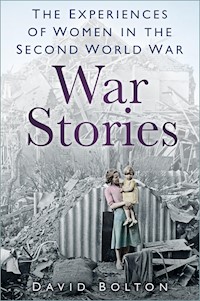
Front cover image: Mrs Clark and her child emerge from their Anderson shelter unhurt after the destruction of their house during the bombing raid on Filton, north Bristol, on 25 September 1940. (© David Facey. Facey Collection. Bristol Archives: 41969/1/80)
First published 2022
The History Press
97 St George’s Place, Cheltenham,
Gloucestershire, GL50 3QB
www.thehistorypress.co.uk
© David Bolton, 2022
The right of David Bolton to be identified as the Author of this work has been asserted in accordance with the Copyright, Designs and Patents Act 1988.
All rights reserved. No part of this book may be reprinted or reproduced or utilised in any form or by any electronic, mechanical or other means, now known or hereafter invented, including photocopying and recording, or in any information storage or retrieval system, without the permission in writing from the Publishers.
British Library Cataloguing in Publication Data.
A catalogue record for this book is available from the British Library.
ISBN 978 1 8039 9228 0
Typesetting and origination by The History Press
Printed and bound in Great Britain by TJ Books Limited, Padstow, Cornwall.
eBook converted by Geethik Technologies
Contents
Introduction
Acknowledgements
1 In the Beginning
2 Preparing for the Worst: Gas Masks, Shelters and the Blackout
3 For Safety’s Sake: Evacuees’ Stories
4 Blitzed
5 Death and Destruction
6 Called Up!
7 War Work
8 Hard Times
9 Not All Doom and Gloom
10 Love and Marriage
11 ‘Overpaid, Oversexed and Over Here’
12 Waiting and Hoping, and then the Day it all Ended
Bibliography
Introduction
This book all started with a conversation I had with my mother-in-law, Mary Fox. She told me how she married in haste – in her lunch hour, in fact – very soon after war was declared. Mary’s newly acquired husband, George, a young army officer, was subsequently sent off to fight the Japanese in Burma. When he left, neither of them knew that she was pregnant. Mary, now effectively a single mother, had to find somewhere, anywhere, to live.
Her pillar-to-post life in temporary accommodation continued for the next four years. She also had to earn a living of sorts.
Finally, sometime after VJ Day, Major George Fox met his daughter for the very first time. Husband and wife were almost strangers; father and daughter were complete strangers. The army then decided that it was perfectly reasonable to send a man who’d been away fighting for years to work at the Nuremberg trials in Germany. The war, for my mother-in-law, was not an easy time.
Those were the bare bones of her story. Sadly, she died two weeks after our conversation so the full story of her experiences as an ordinary woman living through extraordinary times will never be told. But her death made me think that there must be thousands of women with similar stories and unless somebody recorded them quickly, they would be lost forever. I set about contacting as many women as possible of a certain age and, before long, one contact led to another and then another.
The women I spoke to came from a variety of social backgrounds. One was used to having servants do more or less everything for her and the declaration of war unfortunately put paid to her plans to go ‘orff’ to a finishing school in Paris; another was the daughter of a docker, who had to make do with candles rather than electric lights, an outside toilet and one bath a week in a tin tub in the kitchen.
The result is, I believe, an honest and accurate retelling of their stories – the war stories of over sixty women. The pity of it is that most of them have since died.
Along with these interviews I have also included numerous entries from the wartime diaries of three women and excerpts from the unpublished memoirs of two others. All contain an endlessly fascinating mixture of the momentous and the entirely domestic and trivial.
This book is not intended to be a formal history of the roles that women played in the Second World War. It is, instead, a collection of unique first-hand stories and accounts, some of them quirky and bordering on the confessional, but all of them honest and revealing. Together, they amount to a fascinating history of what a varied cross-section of women experienced, felt and achieved during those historic years.
George Fox who was sent off to fight in Burma for over three years.
Mary Fox, the author’s mother-in-law, who was the original inspiration for this book.
Acknowledgements
I’d like to thank all those who helped me in the writing of this book:
Chris Bray, who first put me in touch with his mother, Hazel Bray, and has helped enormously with the photographs in this book.
Gilly Bray who also helped with the photographs and allowed me to use the diaries of her mother, Joan Hancox (née Williams).
Cameron Kennedy, for putting me in touch with many of the women I interviewed.
Audrey Swindells, whose memoirs appear in the book.
Steve Stunt, for helping me with the photographs and telling me about the experiences of his mother, Irene Stunt.
Rob Swindells, for reading and commenting positively on the manuscript.
Sue Brierly-Fellows, for allowing me to use the memoirs of her mother, Lorna Green.
Bruce Fellows, for reading the manuscript and commenting on it constructively.
Sue Stopps, for being so encouraging about the whole project.
Christopher Martin, for reading the original manuscript and coming up with stern but wise criticisms which helped me to improve it considerably.
Many other people, who shall remain nameless, who helped by lending me photographs of their mothers to accompany several of the stories in this book.
Hilary Bolton, my wife, for checking the manuscript for glaring errors and making suggestions on what could be omitted.
My children, for tolerating my retelling of the stories in this book – many times.
The Monday Club, for listening to my frequent and tedious references to its progress, or lack of progress.
Jonathon Hyams, for helping me with all things technological.
Amy Rigg at The History Press, for first accepting the book for publication and then giving invaluable advice about its extent and content.
Alex Boulton, for being such a tolerant and helpful editor.
And finally, to the many women I interviewed, and their families, who were prepared to answer my interminable questions, donate photographs and tell me about their experiences in the war. Without them, the book would not have been possible.
Every effort has been made to contact all copyright holders, and in the event of any errors or omissions these will be rectified in future editions. Names have occasionally been changed to protect anonymity.
The Prime Minister, Neville Chamberlain, declaring war on Germany on 3 September 1939. (Pictorial Press Ltd/Alamy Stock Photo)
1
In the Beginning
At 10 a.m. on Sunday, 3 September 1939, the BBC told its listeners to stand by for an announcement of ‘national importance’. Every fifteen minutes thereafter, listeners were told that the Prime Minister would make an announcement at 11.15 a.m. Music and a talk on ‘How to make the most of tinned foods’ were broadcast in between.
Finally, an announcer declared, ‘This is London. You will now hear a statement from the Prime Minister.’ After a pause, Neville Chamberlain intoned in a flat, doom-laden voice:
I am speaking to you from the Cabinet Room of 10 Downing Street. This morning, the British ambassador in Berlin handed the German Government a final note stating that unless we heard from them by 11 o’clock that they were prepared at once to withdraw their troops from Poland, a state of war would exist between us. I have to tell you now that no such undertaking has been received and that consequently, this country is at war with Germany.
His speech concluded:
Now, may God bless you all and may he defend the right. For it is evil things that we shall be fighting against, brute force, bad faith, injustice, oppression and persecution. And against them I am certain that right will prevail.
Winston Churchill, who was appointed First Lord of the Admiralty that same day, pronounced with a typically orotund flourish in the Commons the next day:
This is not a question of fighting for Danzig or fighting for Poland. We are fighting to save the whole world from the pestilence of Nazi tyranny and in defence of all that is most sacred to man.
Now, for both men, the gloves were off. No need for the diplomatic niceties like ‘Herr Hitler’, which they had used before – they were now free to unequivocally condemn a malevolent dictator.
After this broadcast, a series of short, official announcements were made. These included a prohibition on the blowing of whistles and the blaring of horns as they might be confused with air-raid warnings.
Minutes after the declaration of war, huge numbers of people stood outside their front doors looking up at the cloudless blue sky, expecting German bombers to appear overhead at any moment. Others stayed inside and filled baths and basins with water to tackle the expected incendiary bombs, while some hastily nailed blankets over their windows in preparation for the expected gas attack.
Then, at 11.50 a.m., an air-raid warning sounded in London, followed soon after by the ‘All Clear’. It was later disclosed that an over-eager spotter had seen a plane in the sky just off the south coast at 11.30 a.m. and assumed, wrongly, that it was an incoming German bomber. In fact, it was a French transport plane en route to London. One unnamed person died of heart failure as a result of this false alarm, the very first person to die in the war.
It was also on the very first day of the war that the RAF ‘bombed’ Germany, although there was no TNT involved, only paper. A total of 6 million propaganda leaflets were dropped, weighing a total of 13 tons. Among many claims made in the leaflet was the ‘fact’ that ‘The German people do not have the means to sustain protracted warfare. You are on the verge of bankruptcy!’ The leaflets reportedly kept the German civilian population well stocked in toilet paper for many months.
It would be totally wrong, however, to think that the declaration of war came out of the blue. In fact, the lead-up to hostilities was protracted, uncertain and stressful. It was a period when, either through blind optimism or self-delusion, many people refused to believe that Britain could be going to war again, less than twenty-one years after the conclusion of the First World War. And most galling of all, the next war was going to be fought against the same enemy.
COUNTDOWN TO WAR
As early as 1932, the Deputy Prime Minister, Stanley Baldwin, pessimistically pronounced, ‘I think it is well for the man in the street to realise that there is no power on earth that can protect him from being bombed, whatever people may tell him. The bomber will always get through.’ Baldwin, by this time, knew that the so-called German Air Sports Association (Deutscher Luftsportverband) had morphed into the Luftwaffe (literally ‘air weapon’) and was training pilots in Russia of all places.
Eleanor Frost kept a diary for most of the war. Research shows that she was a very wealthy widow living with her daughter and elderly mother in Leigh Woods, a leafy suburb of Bristol. Eleanor Frost’s wealth came from the family business, Frost & Reed: ‘Art dealers since 1808 with offices and galleries in London’s Mayfair and New York’. To confirm the source of her considerable wealth, Eleanor wrote in her diary on 8 September 1939, ‘The Annual General Meeting of Frost & Reed today – a dividend of 5% on ordinary shares. Not bad considering the alarms and excursions of the last year.’
Bridge House in Leigh Woods, Bristol, where Eleanor Frost, her mother and daughter and many servants, lived for most of the war.
On 17 January 1938, Eleanor wrote:
Today I went to the first class of the Anti-Air Raid Course given for Clifton women. Miss Hall-Houghton is the moving spirit. She painted a grim picture of the possible suddenness and awfulness of war from the air. Well, if we all know all we can, it will make us an instructed public, less liable to panic and possibly useful.
Significantly, this was written more than a year and a half before the declaration of war.
On 10 February, she wrote, ‘Saw A Star is Born. Went as a relief from these Gas Air Raid Precaution lectures and gas mask drill which seem a bit of a strain whilst I am also having my teeth out – two together.’
On 28 March she was much more optimistic about the political developments that day: ‘The international situation seems immensely improved. In Mr Chamberlain’s speech he shows great statesmanship, courage with caution, tenacity of purpose with a sense of appropriate firmness.’
Chamberlain, at this time, dominated the political stage in Britain. With his grizzled moustache, prominent teeth and quaintly reassuring starched wing collar, he was determined to pursue a policy of appeasement with Germany. But he was probably not just an out-of-touch old gentleman with a furled umbrella who, in Harold Nicolson’s words, ‘flew off to see Hitler with the bright faithfulness of a curate entering a pub for the first time’. He made the judgement that Britain had to buy time, however humiliating this policy might be.
From here on, preparations for war gathered pace. The people of Bristol, the author’s home city, were advised to identify cellars, basements, church crypts, tunnels and caves suitable for use as air-raid shelters. In addition, public shelters were also built in many cities. Many people, however, distrusted these and chose to use them as rubbish dumps or public toilets. They very soon smelt strongly of urine.
* * *
Of all the women I interviewed who were old enough to remember this period, most spoke of dreading another war and their desperation to keep the peace. Hazel Bray, from Ashburton in south Devon, who was born in 1920, was warned by her father about the threat of war very early on:
He’d been a sailor in the Royal Navy in the First World War. But he died young, in 1932, when I was only 12. But I’ll always remember what he said to me just before he died, ‘I’m afraid you’re going to have to live through another war. I won’t, but you will’. And that was nearly nine years before war was declared!
Hazel Bray.
The pseudonymous diaries of another Bristol woman, who I will call ‘HJF’ to preserve her anonymity, give telling insights into what women were thinking, doing and feeling at this time. She wrote in the introduction to her diary, ‘To the generation of women yet to come, I offer this my diary, which gives some slight insight of how a very ordinary Bristol housewife lived in the years 1938 to 1945.’
On 26 August 1938, she wrote, ‘The news this evening seems brighter. I think we shall all be so thankful to get something definite. The uncertainty is killing.’
Then on 14 September:
War seems inevitable. Prime Minister Neville Chamberlain is flying to see Hitler. Has the great British nation to wait upon an upstart like him? Where are our great men of the Victorian era? Made some more jelly. In case of war I must stock my larder with all the preserves I can make.
Almost two weeks later, on 27 September:
N. came. He was in very low spirits as he fears war is coming. He certainly knows its horrors as he was gassed in the last one. We listened to Mr Chamberlain on the wireless making every effort for peace.
This was the so-called Munich Agreement, when Chamberlain flew to Germany three times in two weeks for talks with Adolf Hitler. Hitler, in contrast, never once visited Britain. Chamberlain finally returned from Munich with a piece of white paper, which he waved theatrically, and pronounced that it meant ‘Peace for our time’. He was then driven straight from Heston Airport to Buckingham Palace and five minutes later, he and his wife were standing on the balcony, waving, with the king and queen by their side – an unprecedented honour for two ‘commoners’.
But Chamberlain’s return wasn’t universally well received. Some 15,000 people protested against the agreement in Trafalgar Square on 1 October, and one Labour politician, Hugh Dalton, suggested that the piece of paper that Chamberlain was waving was ‘torn from the pages of Mein Kampf’.
While this was happening in London, Hazel Bray was at a teacher-training college in Salisbury:
I remember the principal of the college interrupted Vespers to announce to all of us that, as a result of Chamberlain’s agreement with Hitler, there wasn’t going to be a war after all. But I didn’t believe her. I knew we were just buying time, a year perhaps, before war was declared. It was inevitable.
Several other women referred to the Munich Agreement. Diana England, for example, said:
My mother was so delighted when Chamberlain came back from Munich and proclaimed ‘Peace in our time!’ that she gave each of her three children a book – the Oxford Book of English Poetry. But she also said that, as much as she disliked Hitler, she detested ‘those frightful Bolsheviks even more’.
Diana’s mother had good reason to be worried about the possibility of a second war against Germany. Her husband had been wounded twice in the First World War, had a disfiguring facial wound and a piece of shrapnel buried in his stomach.
Joan Poole had this to say:
I didn’t really believe that it would come to war. We believed that Chamberlain would find a way of averting it. And we were right, for a time at least. And anyway, I don’t think I worried too much about things like war. Like most girls of my age, I was far more interested in make-up and having a good time.
Dr Mary Jones was a medical student at the time:
During the 1930s I was fully aware that a war was probably imminent – that there was trouble ahead. But when Mr Chamberlain came home from Munich, I thought, like a lot of other foolish people, that that would be the end of it. But, of course, it wasn’t.
On 30 September, HJF wrote:
Daddy arrived home at 4 a.m. from Fry’s factory. He says he was on a machine that fixes bands on the gas masks … Is this war, and will our lives be constantly upset like this? [‘Daddy’ was the name HJF always used to refer to her husband.]
Another piece of forward planning was the possible evacuation of children. On 1 October HJF wrote:
Replied to Jean’s [her daughter] Headmistress’s leaflet re. sending children away from Bristol should war break out. We decided as Jean was nearly 14 years of age and she does not want to leave, to let this question rest for the time being.
As it turned out, Jean never was evacuated and, as a much-loved only child, she is often referred to in HJF’s diaries.
Diana England was sent away to boarding school at a young age and there, she admitted:
I was very cocooned, with very little contact with the outside world. We weren’t even allowed to walk into the local village or listen to the wireless so I really knew very little about the impending war. But I do remember that my headmistress mentioned to us girls that she’d visited Germany during the school holidays and had been alarmed at the number of German military planes she saw.
Ruby Spragg was a working-class girl from central Bristol:
My father, Harry Davis, had been in the regular army for twenty-five years. He was always a military man who marched rather than walked. Anyway, after the First World War, he served in the British Army of Occupation and this convinced him that they would ‘rise again’. And he was right, of course. But he also used to say to me, ‘No one will ever beat us at war and they’ll pay for it if they try.’ In fact, he used to regularly go on and on about it to my mother in the kitchen. I don’t think she listened half the time. She just used to get on with her cooking or the washing up.
Another thing I remember – when Hitler came to power, my father always referred to him as ‘that bloody little corporal’. He himself had been a regimental sergeant major so he knew all about ranks in the army.
As a young girl, I suppose I listened to my father and believed what he said, especially when he said, ‘The Germans will never invade this country. And they’d never defeat us. Never!’
Joan Fell, from Exmouth in Devon, said:
In 1938 I was at school and I remember at the time there were quite a few German boys in Exmouth, supposedly on holiday. I met some of them and they were friendly and polite, but I wonder now whether they’d been sent to snoop around the place – there was, after all, an important Marines base just up the road at Lympstone.
This anxiety was echoed by Hazel Bray:
We had two Geography teachers, a husband and wife, Mr and Mrs Peddoe. They weren’t English, they came from somewhere in Eastern Europe. Anyway, we didn’t like them, and one day, in the middle of a Geography lesson, a Military Police officer came into our class and spoke to the Peddoes and then ordered two military policemen to put handcuffs on them and arrest them. It was the last we saw of them. We assumed they must have been spies and as a result they were probably shot. I can’t say we were sorry.
Like Joan Fell, Diana England also came into contact with young Germans of her own age:
We had some German girls at our school for a term. They spoke extremely good English I remember, and one of them, her name was Griselda, said to me when we were talking about the possibility of war, ‘I don’t want to fight you, Diana.’ She then offered to shake my hand and I let her.
Rose Jennings was born in 1920 and had this to say:
Towards the end of the 1930s, the talk was almost always of the imminent war, of how it was bound to come in the end. My father was a Rotarian and some German Rotarians came to stay with us and they told us about what it was like living under Hitler. When Chamberlain came back from Munich, I was convinced that it hadn’t settled matters, that Hitler wasn’t likely to abide by the terms of their agreement. I think, though, that other members of my family tried to push it to the back of their minds. But I couldn’t and I was the one who measured up our windows for blackout curtains. The rest of my family used to laugh at me, I remember.
Iris Gillard had her own thoughts about the political situation at that time:
I didn’t think war was inevitable. I thought George VI was a wise and interesting man and he might somehow help to prevent it. But then Chamberlain came back from Munich and said, ‘Peace in our time!’ I just thought he was a gullible fool … By that time, I was certain war was coming. As for Hitler, I thought he was a dreadful little man, and in some ways I couldn’t wait for the war to start. The sooner we got rid of him the better!
During this period, HJF wrote frequently in her diary about the imminent war:
3 February 1939: An Air Raid Warden called at 9.30 tonight to try the size of the gas masks we shall require. All of us take a medium size. Please God we shall never use them.
19 March: There was a meeting of the English cabinet last night to consider Romania’s SOS to us. Picked primroses and violets in ‘our lane’ in Banwell.
A week later she first mentioned her interest in getting some sort of job in preparation for the war that now seemed almost inevitable:
27 March: ARP [Air Raid Precautions] asks all women drivers to send in their names for ambulance-driving, if necessary, so sent in mine.
In April, war preparations were becoming more pressing:
14 April: Went to the Whiteladies Picture House to see the ARP film ‘The Warning’, showing what things would be like in the event of war and air raids. Makes me very sad and depressed.
20 April: To an ARP lecture for ambulance drivers. I was given a First Aid Handbook. I do hope they will not expect me to bandage the injured as well as drive the ambulance.
27 April: The ARP lecture on the Circulation of the Blood, First Aid Treatment and wounds by pressure and tourniquet (the latter not to be applied round the neck!) and also on the treatment of fractures. I am getting bewildered!
4 May: Attended a third ARP lecture. Feel that the lifting of the stretcher with another member of the class on it is too heavy for me.
2 July: Had a picnic tea of raspberries and cream at Charterhouse. Listened to Mr Chamberlain on Air Raid Precautions.
A month later, HJF and her family had their last holiday together, on the Scilly Isles:
7 August: We went together to a lecture on Birds and Flower Life in the Islands. Talking to a woman inhabitant there she seemed to dislike England and the English for when the question came up as to whether there was going to be another war she said to me, ‘England makes the war and expects us to send our men to fight for her.’ I was shocked at her attitude.
25 August: I have been notified that I have been listed to serve as an Ambulance Driver at the Bedminster Division depot and that I am to report for duty when a message arrives, should war break out. These are anxious days.
But back to the war preparations of Eleanor Frost:
5 July: We are busy completing our preparations for the ‘civil defence’. The dugout is finished and now it only has to be fitted with the necessary stores and equipment. I am doing this and supervising the month’s supply of food in the house which we are all asked to have. Mother is supervising the effective dark screening of all windows.
On 4 August she wrote succinctly, ‘A quarter of a century since the start of the Great War.’ Later that week, Eleanor went on holiday to Cornwall with her daughter Edith and her elderly mother, staying in a smart hotel overlooking the sea in Polzeath. There was only one problem with the hotel: ‘They are feeding us too much meat and far too little fruit. My inside is barely functioning even with air evacuant.’
She was now closely monitoring the worsening international situation and so, apparently, were some of her fellow guests:
7 August: The crisis has become more and more acute and today about half a dozen people left on that account. I still do not believe it will develop into war.
On 26 August, HJF wrote, ‘The war news is very grave. Hitler’s letter to us is not yet published. Out in car and saw sandbags and sentries outside the Filton aeroplane works.’
It was on this day that many kerbs in central London were being painted white, the twelfth-century stained glass was being removed from Canterbury Cathedral and the National Gallery was closed while its pictures were being taken down, for ‘safe-keeping’ in a quarry in Wales.
27 August: Received another letter saying that I must be prepared for duty, day or night. I bought several tins for storing in the event of war. The news this evening seems brighter. I think we shall all be so thankful to get something definite; the uncertainty is killing.
At the end of August, things were going from bad to worse. On 31 August, Eleanor Frost wrote:
Things look black internationally. Walked to Port Quin and while there the wireless was switched on in a cafe and Edith heard, ‘Consider that the war is inevitable.’ She came back and told me – we both felt firm and calm but awful inside. Determined not to tell Mother until after lunch.
Later, Eleanor added, ‘To our unbounded relief the whole sentence had been “We do not consider” etc.’
On 1 September, she wrote, ‘A gorgeous hot day. But at 1 p.m. came the news that Germany has invaded Poland. People began to leave our hotel in the afternoon and several very late and again early on Saturday morning.’
In fact, German tanks and motorised troops numbering 1.5 million men crashed through the frontier between Germany and Poland at 4.58 that morning.
Eleanor’s diary entry for 2 September reads, ‘It is very empty and quiet in the hotel and on the beach.’ And on 3 September:
We planned to leave at 10.30 but discovered we had a puncture at the last moment. We left ultimately at 11 and reached home at about 6. We arrived to an empty house and had to get food and extemporise ‘dark’ lights, make beds and so on. At 10 p.m. we were all completely tired out.
It’s perhaps curious that this was the day war was finally declared and yet Eleanor makes no mention of the fact.
Meanwhile, HJF was at home in Bristol:
2 September: Ambulance duty. Dreadfully bad weather and came home in complete blackout. Spent some time while on duty making black paper masks with cut slits for head and side lights of cars, according to the new regulation.
She then added ominously, ‘We are still awaiting Hitler’s reply.’ She didn’t have to wait for long.
THE DAY WAR WAS DECLARED
The historical background to the final declaration of war is as follows. On Friday, 1 September, the day Germany invaded Poland, Adolf Hitler broadcast his declaration of war with these words:
The Polish state has refused the peaceful settlement of relations which I desired … In order to put an end to this lunacy I have no other choice than to meet force with force … The German Army will fight the battle for the honour and the vital rights of a newborn Germany with hard determination.
To all intents and purposes, the Second World War had begun.
At 9 a.m. on Sunday, 3 September, the British ambassador to Germany, Sir Nevile Meyrick Henderson, went to the German Foreign Ministry. Henderson was a friend and admirer of Hitler’s second in command, Hermann Goering. They shared a love of shooting. Henderson handed in an ultimatum which stated that unless the British Government received ‘satisfactory assurances that Germany was prepared to withdraw from Polish territory, His Majesty’s Government will without hesitation fulfil their obligation to Poland’. And this is what finally triggered Chamberlain’s declaration of war at 11.15 a.m.
* * *
What did the women I interviewed remember of this historic announcement?
Ivy Rogers was 13 at the time:
Some of my family were at church but I was at home with my father. When I heard the news, I felt sick! I didn’t want a war. Nobody wanted another war. It was terrible news. Of course, some people said it would be over by Christmas. How wrong they were.
Iris Gillard said, ‘I think we felt a kind of relief when war was finally declared. Now we really knew what was happening. But I certainly didn’t expect it to last for so long!’
Betty Gough was only 9. Her parents owned a sweet shop in Coventry. ‘I remember a lady came into our shop looking very disturbed. She announced that war had been declared between Britain and Germany. I could tell by my mother’s solemn expression that this was serious.’
Audrey Swindells was 11. She wrote in her memoirs:
Sunday the 3rd of September was a gloriously warm day and while my mother was making dinner I was in the garden when my father called out, ‘Come in at once! The Prime Minister is to speak on the radio.’
My parents and my auntie looked very serious as we sat down. As Mr Chamberlain announced that we were at war, I couldn’t really comprehend what being at war meant. But when the Prime Minister finished speaking I looked at my father. All the colour had drained from his face. ‘It’s only 21 years,’ he said solemnly, ‘and they told us that the last one was the war to end all wars.’
Audrey Swindells with her parents.
In contrast, Enid King said:
I was 15 and I was playing with some friends in the local park when my mother came out to tell us the news. It didn’t mean much to me at the time. I was only a child really, despite the fact that I’d left school and started work.
Doris Marriot was also unfazed, ‘I just thought it was all rather exciting.’ Hazel Bray, who was 19 and a trainee teacher, was far more concerned:
When Chamberlain made his announcement, we all knew that this war wasn’t going to be like the First World War because the civilian population was going to be involved, not just men in the services. And for this reason, we knew it was going to be a long and terrible war. I felt awful.
Dorothy Sanders was also a teacher:
We could all see it coming – or perhaps it’s easy to say that with hindsight. Anyway, listening to Chamberlain and his speeches, he had really put us in a position where we didn’t have any choice. We had to keep our promises to Poland, in particular. That’s what treaties are all about.
Lorna Green was living in the small village of Carhampton, near Minehead in Somerset. She had just started work as a nurse. She wrote in her memoirs:
I was told that when war was declared – it was no longer ‘if’ – I should report to Minehead Hospital. So on September 3rd I was ready. I dug up potatoes to relieve the tension of waiting for Chamberlain on the wireless. The announcement was made. I changed into my uniform and felt quite important cycling through the village to Minehead. Not all the villagers had heard Chamberlain but they knew war had been declared as they saw me cycle past.
Eleanor Frost didn’t write anything on the day itself, but curiously waited until two days later:
5 September: Time at last to write in my diary. Our holiday in Polzeath actually ended only 3 days ago. It seems like a hundred years! We saw on a placard between Polzeath and Launceston ‘War declared’ and everywhere as we passed through the little towns we saw Territorials and Militia, some of them looking so young, far too young for war.
Many women associated the declaration of war with going to church. Pam Allcock remembered:




