


Erhalten Sie Zugang zu diesem und mehr als 300000 Büchern ab EUR 5,99 monatlich.
- Herausgeber: THP Ireland
- Kategorie: Geisteswissenschaft
- Sprache: Englisch
Waterford harbour has centuries of tradition based on its extensive fishery and maritime trade. Steeped in history, customs and an enviable spirit, it was there that Andrew Doherty was born and raised amongst a treasure chest of stories spun by the fishermen, sailors and their families. As an adult he began to research these accounts and, to his surprise, found many were based on fact. In this book, Doherty will take you on a fascinating journey along the harbour, introduce you to some of its most important sites and people, the area's history, and some of its most fantastic tales. Dreaded press gangs who raided whole communities for crew, the search for buried gold and a ship seized by pirates, the horror of a German bombing of the rural idyll during the Second World War – on every page of this incredible account you will learn something of the maritime community of Waterford Harbour.
Sie lesen das E-Book in den Legimi-Apps auf:
Seitenzahl: 198
Veröffentlichungsjahr: 2020
Das E-Book (TTS) können Sie hören im Abo „Legimi Premium” in Legimi-Apps auf:
Ähnliche




















This book is dedicated to my mother Mary Doherty, née Moran, for her unconditional love and ever-present smile and optimism.
And to the memory of my younger sister Eileen, who died in January of this year. Wife, Mother and a wonderful friend who shared my passion for the sea.
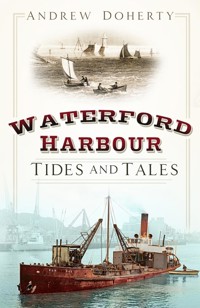
Front cover images:
Top: The construction of Dunmore East pier (National Library of Ireland).
Bottom: The dredger Portlairge (Courtesy of Jonathan Allen).
Back cover: PS Ida at Cheekpoint quay (National Library of Ireland).
First published 2020
The History Press
97 St George’s Place, Cheltenham,
Gloucestershire, GL50 3QB
www.thehistorypress.co.uk
© Andrew Doherty, 2020
The right of Andrew Doherty to be identified as the Author of this work has been asserted in accordance with the Copyright, Designs and Patents Act 1988.
All rights reserved. No part of this book may be reprinted or reproduced or utilised in any form or by any electronic, mechanical or other means, now known or hereafter invented, including photocopying and recording, or in any information storage or retrieval system, without the permission in writing from the Publishers.
British Library Cataloguing in Publication Data.
A catalogue record for this book is available from the British Library.
ISBN 978 0 7509 9594 8
Typesetting and origination by The History Press
Printed in Great Britain
eBook converted by Geethik Technologies
CONTENTS
About the Author
Acknowledgements
Introduction
1 The Press Gang Menace
2 Mysterious Buttermilk Castle
3 Cheekpoint Mail Packet Station
4 River Paddle Steamer Service
5 Dollar Bay Pirates
6 Weir Wars
7 Loss of the Alfred D Snow
8 Quarantine Station
9 Sails Ahoy Hobblers
10 Ever Watchful Coast Guard
11 Long-Legged Spider Light
12 Captain Burns and the Schooner BI
13 Coolbunnia Banshee Attack
14 Incredible Salvage of UC-44
15 Remembering the Formby and Coningbeg
16 The Night the Devil came for the Captain’s Corpse
17 Escaping the ‘Hell Ship’
18 Barrow Railway Viaduct: A Century of Mishaps and Incidents
19 Campile Bombing
20 The Great Western
21Ocean Coast Rescue
22 Remembering the ‘Mud Boat’ SS Portlairge
23 Rambling Over the Minaun
Notes
Bibliography
ABOUT THE AUTHOR
Andrew Doherty was born in 1965 in the village of Cheekpoint, Co. Waterford. He followed his family into the tough traditional commercial fishing way of life for fifteen years of his adult life. On the birth of his first child and the decline of fishing opportunities he worked in local industry before taking up his present career as a community worker. He is involved as a volunteer in village affairs and is passionate about local history and preserving, if not reviving, the traditions of his fishing community.
He has written since his teens and in 2014 commenced a regular blog on the maritime and fishing traditions of the three sister rivers of the Barrow, Nore and Suir, and the harbour of Waterford. His first book, Before the Tide Went Out, was published in 2017. A memoir, it examined the culture, identity and practices within the fishing community of his home village and the wider harbour. He has contributed to numerous newspaper articles, heritage publications, radio and TV programmes.
He posts regularly on Facebook and Twitter and blogs at www.tidesandtales.ie
ACKNOWLEDGEMENTS
I have many people to thank for the contents of this book. The majority are named in the pages and I’ll let that be a testament to them and my debt to them for their kindness.
A book such as this is not much without pictures. So, I would like to thank Andy Kelly and Brendan Grogan helped me in several ways, particularly with images and technical advice, and I also want to acknowledge the assistance of John Flynn. Thanks to Jonathan Allen for allowing use of his image of the Portlairge, and John O’Connor for the image of the Spit Light.
My good friend Damien McLellan has been a sounding board for many of my ventures and helped in the drafting of this book. I need to thank Carmel Golding and my wife Deena for suggesting edits and giving so freely of their time.
I want to thank Mark Minihan, who was supportive when it was required, and Frank Ronan of Port of Waterford.
I’m indebted to Michael Coady of Carrick on Suir for his advice on the title and the blurb for this book.
Charley McCarthy helped me with specific details on the construction of the Spit/Spider Light, and Myles Courtney gave me some vital information on my quarantine story. I’m indebted to them both.
Hours of research have gone into these stories, much of it on the road. I have a lot to be thankful to Sean Heffernan for, who has kept my car up to the task.
Thanks to Richard Daly, a primary teacher with a love of history and culture who helped enormously with my introduction, and to Jacqui De Suin, who advised on my Irish.
Tides and Tales blog is produced with the support of so many it is hard to list them, but for continuous support I need to acknowledge James Doherty, Frank Murphy, Tomás Sullivan, William Doherty, Maurice Power, Michael Farrell, John O’Sullivan, David Carroll, Paul O’Farrell, Eddie Fardy, Pat O’Gorman and Brian Forristal.
INTRODUCTION
This book originated on the river, as I drifted for salmon with the men of my village, and in the homes of so many seafarers, fishermen and their families.
I was born in Cheekpoint, 7 miles downriver from Waterford City at a point where the Rivers Suir, Barrow and Nore meet. The three rivers then flow as one to create Waterford harbour, entering the Atlantic at Hook Head in Wexford and Dunmore East in Waterford.
My childhood in the 1970s was spent in the company of seafarers and fishermen, listening to their stories, spending time in boats and dreaming of one day following in their wake. When I finally left school in 1983, seafaring was a dying trade, at least to a young apprentice looking to start on the bottom rung of the sailor’s career ladder, the ordinary seaman. So I opted instead to go to fish.
I fished full-time from 1983 to 1996 and thereafter part-time to 2006, when the commercial fishery for salmon was closed. In 2014 I set to writing a weekly blog about the heritage of my community and over the years several themes have emerged. My recollections of the commercial fishery were published in a self-published first book Before the Tide Went Out. In this book, however, I am reflecting another major theme: old-time stories and yarns that I either thought to be true or wished to be. In the intervening years I have proven many to be based on fact.
The Irish have an old phrase for the passing along of local culture and lore. Ó Ghlúin go Glúin, or from knee to knee. In essence it reflects the reality of the past when stories told to one generation whilst sitting on the knee of the forbearer were passed along to succeeding generations. Callers to a home were welcomed, stories and songs were swapped and youngsters were both educated and entertained. So strong was this connection that the Gaelic word for generation is the same as knee.
But the old ways were breaking down when I was a child, the television was sitting in the corner of most homes and, although visitors were welcome, the stories were often those passed on by a presenter from the national broadcaster. But other ways were found, and many was the tale or yarn I heard while drifting for salmon, where the only distractions were the splash of a fish or an obstacle in the boat’s path.
The greatest source of my stories has been my father, Bob Doherty: sailor, fisherman, factory worker, gardener and raconteur extraordinaire. But my father’s ability to tell a story has sometimes led to questions about their credibility. For example, his tall tales were legion. Pat Murphy, a friend of his who worked with him at the Paper Mills factory in Waterford in the 1970s, recently recalled one such account.
Although we never had a car, Pat did, and as they shared the same shift, he brought my father to work. One very frosty morning Pat drove up out of the village and stopped at the collection point for my father near our home in the Mount Avenue. There was no sign of my father, so Pat continued on to work on his own. A few weeks later Pat was in the canteen in work and thought he’d blackguard (tease) my father and so he mentioned to some of his colleagues about Bob sleeping in some weeks previous and turning up late for work.
My father came straight over to the group sitting around the table and made answer:‘Well now mates, Pat Murphy don’t believe it, but I have since rectified the problem. I was out on the road one day not long after the incident and I met a man and we fell to talking. I mentioned how on frosty nights the clock doesn’t work so well. Well the man was an engineer and he was very interested and insisted on seeing it, and after carefully examining it, told me it was a tropical clock. Christ I said, I bought it when sailing overseas in Egypt, but the chap never mentioned that. A few days later a lagging jacket arrived by post from the engineer, and do ye know what? – it hasn’t lost a second since.’
According to Pat, each of the men looked from one to the other and then to him. But my father wasn’t done yet. ‘And I’ll tell ye now mates, I haven’t been late for Pat Murphy since.’
And all Pat could do was agree, he hadn’t. Years after being made redundant following a lock-out at their factory, Pat would still meet his ex-work colleagues and they all wanted to know if Bob Doherty’s tropical clock was still keeping time.
So my father had a bit of a reputation when it came to stories, but over the years I have found more than a grain of truth in many of them, as indeed I have found similar in much that I was told as a child. There are no stories of oriental clocks here, but who knows, maybe there will be in the future!
What you can expect are accounts of a life left behind, when the local rivers were chock-a-block full of sailing ships and steam boats, carrying freight to and from the country, crewed by men who knew the hardships of life, and supported or policed by a myriad of other work roles.
1
THE PRESS GANG MENACE
We were drift netting for salmon in a small open punt in the River Suir when I first heard about the press gang menace that troubled the homes and the ships at anchor in the waters around Cheekpoint and Waterford harbour. The story was introduced, like so many others by my father, in a natural yet dramatic way. We were drifting on the ebb tide at night, off Ryan’s shore, between Cheekpoint and Passage East on the Waterford side of the river, when we heard a boat rowing towards us. ‘If this was the Napoleonic wars I’d have had to throw you over the side for your safety,’ he stated flatly. I didn’t get a chance to find out why, as Maurice Doherty and Jimmy O’Dea came alongside for a chat before rowing off again to set nets in on the Point Light (a local place name for a river navigation light that marked a stone outcropping). After they left I was keen to clarify how throwing me overboard was good for my health, something I had dwelt on while the three men chatted about matters fish.
The press gangs were Royal Navy sailors who impressed men into the Navy. To impress was basically a form of kidnapping; men were attacked and forcefully taken to make up the numbers in Royal Navy ships. Impressment had operated from the thirteenth century and was most common in times of war. It operated with official sanction up to the early nineteenth century. The press gangs’ preference was for young fit men with knowledge of the sea, and as a consequence they became a scourge of Waterford city and the villages throughout the harbour. Merchant ships at anchor were a favoured target. Coming ashore had complications for the press gang, as locals were quick to react and riots were not uncommon in response. But all that information was to come at a later date. On the night my father simply shared a yarn.
‘Did I ever tell ya about the man that used to sit in McAlpins Suir Inn and mutter to himself about going with the press gang?’ I immediately perked up in anticipation and, not waiting for an answer, he continued with the story:
There was a group of sailors, fishermen and other locals drinking in the bar many years back. Suddenly a cry went up in the village and while many turned to look, there was a man named Walsh with quick wits that turned on his heels and ran to the back door of the pub. As Walsh went through it, he heard the crashing and banging behind him as the press gang rushed the pub’s front door. He skipped over a ditch and ran.
Approaching a house, he spotted an open window and dived through it, only to land into the lap of a sleeping lady. On awaking, her first impulse was to scream. At this stage the village was in uproar, some of the press gang crew were going door to door seeking recruits and the women of the village were out shouting abuse and flinging stones in their direction. At that stage all the men were either captured, in hiding or running towards the top of the local hill, the Minaun. While Walsh pleaded with the lady to be quiet, her father heard her screams and burst in. Now he had been trying to marry his daughter off for some time, and he measured the situation in a heartbeat. Walsh received a chilling ultimatum: the press gang or his daughter’s hand. Thereafter Walsh, having had one too many in the pub, could be heard to groan from the bar counter, ‘should’ve went with the press gang’.
The practice of impressment is old, being mentioned in the Magna Carta. It was more common in times of war as competing interests vied for crew. During the Napoleonic wars it became widespread when the navy was stretched and simply didn’t have enough men to operate their ships. Apparently the practice had initially started in London but over time and as the needs for crew grew, so did its scope. Waterford was only one of many areas favoured by them, given the quantity of trade, and particularly, it seems, the Newfoundland cod fishery. Crews for the fishery were drawn from farms, villages and towns across the South-East and they flocked to the harbour area to join ships for the cod fishing season on the Grand Banks. These were young, healthy and energetic, and in many ways perfect for the crew-hungry press gangers.
The press gangs had a number of strategies for engaging sailors. These included going ashore to take men from quays, pubs or homes, raiding ships at anchor in harbours or attacking ships on the high seas.
This extract from Waterford of 1777 gives a good example of the practice of going ashore:
The press for seamen still continues here, to the great injury of the trade of this city and the fishery of Newfoundland; several have been picked up lately. Last Wednesday evening the press gang was very roughly treated on the quay, in consequence of their endeavouring to press a man who frequents the fishery of Newfoundland: he (assisted by some female auxiliaries) defended himself with a stick against the attack of the gang, armed with swords, and not withstanding their utmost efforts he got off. By this time a party of resolute fellows assembled, and by pelting of stones soon made the gang disappear. But their resentment did not stop here, for they done considerable damage to the house of Mr Shanahan, publican, on the Quay, where the press gang rendezvous; and had not a party of the army been ordered out to disperse them and prevent further mischief it is probable some fatal consequences would have happened.1
This account also highlights a major disadvantage of a shore-side press – the reaction of the local citizenry.
So if a shore-side press was injurious to the press gang’s health, a relatively safer approach was to board vessels at anchor, under cover of darkness. At Cheekpoint, on what was described as a ‘dark and tempestuous’ night in October 1779, HMS Licorne was at anchor and in need of extra men to supplement her crew. Conditions were considered favourable to a stealth attack and so under the command of Lieutenant Rudsdale a party set off in the ship’s pinnace (a small tender/rowing boat). They immediately drew alongside a local fishing punt and, in case the men aboard reported the navy’s activities, they ‘pressed the lot’. Rudsdale returned to his vessel to drop off his captives and set off again towards Passage and Ballyhack. There they boarded the anchored brig Triton and, finding the crew asleep, pressed as many crew as he could fit in the pinnace. Dropping them back to the Licorne, he again returned to the Triton, but this time the press gangers were confronted by a barrage of spikes, hatchets and crowbars. He withdrew, and the piece goes on to say that, the racket having raised the harbour villages, he was forced to return to his ship. Rudsdale was apparently satisfied with his night’s work; he had secured a score of men (twenty) to add to his vessel’s crew.2
The other approach was to attack ships at sea, and in many cases merchant men were stripped of their capable crew and very often such men were swapped with either injured or incapable sailors, deemed unfit for the navy. Even in circumstances where armed naval vessels were employed, however, successful outcomes were not guaranteed. For example, an unnamed Newfoundland vessel sailing to Waterford on 5 November 1770 was challenged by a ‘press boat’ off Cork harbour. The crew and passengers were up for a fight, however, and following an exchange of gunfire the press boat thought it best to sheer off. Five aboard the Newfoundlander were wounded and it put in to Youghal, where one of the injured died. Meanwhile, the press boat put in to Dungarvan, where her wounded crew received treatment.3
Several other accounts of the press gangs have come to my attention, including a shore-based captain who organised the impressment of sailors from an office at Passage East, a press gang that went ashore in Waterford city – resulting in 140 men pressed on the quay – and the landing of another press gang on the Hook peninsula and their working along the coast to Duncannon.
The press gang diminished after the Napoleonic wars. A peacetime navy required fewer sailors, but naval reforms and improved pay helped encourage voluntary recruitment. Social reformers also helped in fighting the hated practice by pamphleteering, newspaper articles and rallies. The next great naval dispute against Russia in the Crimea in 1853 is said to be the first in which impressed sailors did not serve.
All those insights had yet to come, however. Sitting on the thwart of the punt that night, drifting away on the tide, I was for a few short moments transported away from under the cold star-flecked sky. Tiredness was momentarily forgotten and I laughed into the night, careful however not to be too loud. Noise spooked the salmon we sought and I knew from childhood not to disturb the fish. More importantly, however, I also felt a little closer to my father.
For all I’ve learned since though, I’m still unsure if Walsh and the wife that was ‘pressed’ on him is true or not!
2
MYSTERIOUS BUTTERMILK CASTLE
In the wide-ranging mud flats, inlets, headlands and bays that make up the harbour it would come as no surprise to know that we have a multitude of place names and marks that signify where you are at any particular time. Such names were vitally important in the past to fishermen, denoting as they did as precise a position as any modern satellite aid. Some of these were functional, some literal and others were very confusing, particularly to a child. One that springs to mind in this latter category was Buttermilk Castle, more commonly called by the fishermen ‘the Castle’.
The castle was a formidable lump of rock with a crown of pine trees on the river above Ballyhack in Co. Wexford. An associated fishing weir for catching salmon shared the same name. The rock jutted resolutely into the river, like a brooding citadel, but when I sought further information my youthful questions were usually brushed aside. We drifted close by when fishing, but that didn’t answer any questions either – the building that gave the place its name had crumbled into the cliff, and was swallowed up by an undergrowth of briar, fern and gorse.
My father did share one story that appealed to my youthful imagination and it went something like this. The Old IRA4 had an active unit operating in South West Wexford and the unit leader was from the Duncannon area. They were constantly on the move, seeking safe houses. One evening they found themselves camped at Buttermilk. Informers were often a problem and intelligence was leaked as to their whereabouts. A Royal Navy gunboat was summoned and was a regular visitor in the harbour. The captain had fallen fond of a local girl on many of his trips ashore, but awkwardly enough the object of his desire was a sister of the leader of the IRA active service unit.
When the location of the hideout of the unit was received, the gunboat was dispatched with orders to launch an attack. According to my father, in an attempt to keep the girl sweet, rather than attack the castle directly the captain decided to steam up past the spot, and made a great show of turning and readying his guns. By the time they commenced firing the unit was already safely over the hill and heading towards Ballyhack. The only damage they did was to weaken the structure of the castle itself.
My first proper view of what the castle looked like came when visiting a wonderful maritime museum, which was located at Duncannon Fort, back in the 1990s. Alas no more now, the museum had a photograph of the Castle, taken by the noted Waterford photographer A.H. Poole in the late nineteenth century. It depicted the familiar square-shaped Norman tower house overlooking the river.
But where one question is answered, others very often arise. And so it was with Buttermilk. Why a castle in such an out of the way spot? And what was its purpose? Locally the accepted wisdom stated it was part of the elaborate farm and business of the Cistercian Abbey at Dunbrody, Campile, Co. Wexford. The monks constructed it as a protection and comfort for their fishing monks, who were working the associated weir, and at least two others in the harbour. Recently I’ve heard it described as a strategic location with which to exploit the economic opportunities presented by Waterford harbour.




