


4,99 €
Mehr erfahren.
- Herausgeber: Youcanprint Self-Publishing
- Kategorie: Fachliteratur
- Sprache: Englisch
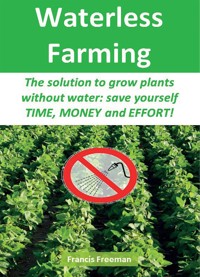
Would you like to grow plants without water? Would you like to save time,money and effort? Would you like to obtain more tasty and nutritive vegetables, farming in an organic way? Well, "Waterless Farming" is just the right book for you! In this book Francis Freeman explains exactly how to grow plants COMPLETELY avoiding any sort of irrigation. The new techniques described by the author are easy to implement for every kind offarmer and every type of soil, ensuring – at the same time - an outstanding effectiveness. The language adopted is easily comprehensible and devoid of technical terms, preferring a concreteand pragmatic approach, able to make us get excellent results right from the start. But not only that. In fact the techniques illustrated by Freeman also allow – as stated in the subtitle – to save time, money and effort, because they revolutionize soil too, allowing to reduce the usual working. Thus the techniques exposed should be definitely discovered and exploited by the largest number of people, since the benefits deriving from their application are many!
Das E-Book können Sie in Legimi-Apps oder einer beliebigen App lesen, die das folgende Format unterstützen:
Veröffentlichungsjahr: 2016
Ähnliche



















Table of Contents
AUTHOR’S PREFACE
INTRODUCTION
Chapter I: DRIP IRRIGATION
Chapter II: ADVANCED MULCHING TECHNIQUES
Chapter III: THE RCW TECHNIQUE
CONCLUSIONS
AUTHOR’S PREFACE
The “Waterless Farming ” project treated in this book is the result of many years of study in which I have devoted myself to the comprehension of the most effective methods, techniques and systems able to answer a simple but highly important question: can we farm without water? The answer is YES! After reading this book, the ways in which this revolution in the agricultural sector can be carried out will be crystal clear.
In the subtitle, it is written that Waterless Farming allows farmers to save time, money and effort. The saving comes from the possibility to avoid all the various and burdensome irrigation operations, but also from using some innovative agricultural techniques–widely tested by me over the years–which allow avoiding the usual workings of the soils, performed by hand or using some agricultural machinery.
The methods described in this book are all based upon experimentation and practical applications performed on my soil, besides personal experiences of more and more farmers, owners of large and small plots of lands, all over the world.
It is necessary to bear in mind that–today more than ever–in many world regions the need to farm saving water is very felt. This for many reasons.
First of all, we must mention the striking increase of world population, passed from 4 billion in 1976 to over 7.3 billions of people in 2016, barely 40 years later. Obviously, these numbers lead to a food need almost doubled within only 40 years. And to produce food, as we all know, huge amounts of water are used.
Here are some other data:
– about 35% of all the landmass is devoted to arable and livestock farming, i.e. about 35% of landmass is used to produce food. However, we must notice the fact that this percentage has remained practically unchanged between 1976 and today, although the above mentioned population growth; in fact, in spite of tillage and crop of large areas–previously wooded–in Brazil, Africa and Indonesia (between 12 and 13 million hectares–30/32 acres–per year), this percentage remains constant because of losses caused by salinization of irrigated fields, soil impoverishment, loss of arable land and advance of urbanization and industrialization.
– about 70% of potable water–that is water mainly destined for human consumption – is used in farming.
– about 10000 human beings die every day from causes directly traceable to poor quality and quantity of water they drink.
Where is the logic in this? Wouldn’t it be better to find methods able to produce the same food quantity, but at the same time saving potable water, in order to primarily destine it to human consumption?
So this book and all the Waterless Farming project mainly derive from indignation and regret to read the above mentioned data, as well as from the knowledge of other critical situations such as the use of fossil water for agricultural purposes, or living conditions of poor Malian peasants, grappling with extended periods of drought which bring about famines and therefore early deaths.
Every one of us had his own reason to begin trying Waterless Farming techniques (ethical, economical, ecological reasons, etc.), but all of us are evidently united by the fact to consider useful a kind of farming which doesn’t need irrigation.
If you too are convinced of this (and if you are reading these pages surely you are!), I warmly wish you a good continuation of reading.
FRANCIS FREEMAN
INTRODUCTION
My experience with Waterless Farming
So do methods to farm without water exist?
My studies upon this subject matter began from this simple question I thought to myself a day, some years ago, while I was in my vegetable garden. Since then the search for methods and techniques to grow plants without irrigation–the have become my absolute priority in life, before any other work or study project. So I began to minutely examine all the websites which talked about this subject, to often go to the library in search of books which described the best techniques and to spend a sizable amount of money to buy books to study at home, in a more comfortable way. Little by little that my search went on, I learned about a lot of methods–already used by many farmers and for a long time–functional to farm saving pretty good percentages of water, or, in several cases, to farm without irrigating at all!
Lesen Sie weiter in der vollständigen Ausgabe!
Lesen Sie weiter in der vollständigen Ausgabe!
Lesen Sie weiter in der vollständigen Ausgabe!
Lesen Sie weiter in der vollständigen Ausgabe!




