


207,99 €
Mehr erfahren.
- Herausgeber: John Wiley & Sons
- Kategorie: Fachliteratur
- Sprache: Englisch
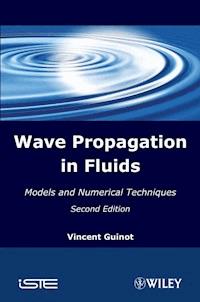
This second edition with four additional chapters presents the physical principles and solution techniques for transient propagation in fluid mechanics and hydraulics. The application domains vary including contaminant transport with or without sorption, the motion of immiscible hydrocarbons in aquifers, pipe transients, open channel and shallow water flow, and compressible gas dynamics.
The mathematical formulation is covered from the angle of conservation laws, with an emphasis on multidimensional problems and discontinuous flows, such as steep fronts and shock waves.
Finite difference-, finite volume- and finite element-based numerical methods (including discontinuous Galerkin techniques) are covered and applied to various physical fields. Additional chapters include the treatment of geometric source terms, as well as direct and adjoint sensitivity modeling for hyperbolic conservation laws. A concluding chapter is devoted to practical recommendations to the modeler.
Application exercises with on-line solutions are proposed at the end of the chapters.
Sie lesen das E-Book in den Legimi-Apps auf:
Seitenzahl: 591
Veröffentlichungsjahr: 2012
Ähnliche


















Table of Contents
Introduction
Chapter 1. Scalar Hyperbolic Conservation Laws in One Dimension of Space
1.1. Definitions
1.2. Determination of the solution
1.3. A linear law: the advection equation
1.4. A convex law: the inviscid Burgers equation
1.5. Another convex law: the kinematic wave for free-surface hydraulics
1.6. A non-convex conservation law: the Buckley-Leverett equation
1.7. Advection with adsorption/desorption
1.8. Summary of Chapter 1
Chapter 2. Hyperbolic Systems of Conservation Laws in One Dimension of Space
2.1. Definitions
2.2. Determination of the solution
2.3. A particular case: compressible flows
2.4. A linear 2×2 system: the water hammer equations
2.5. A nonlinear 2×2 system: the Saint Venant equations
2.6. A nonlinear 3×3 system: the Euler equations
2.7. Summary of Chapter 2
Chapter 3. Weak Solutions and their Properties
3.1. Appearance of discontinuous solutions
3.2. Classification of waves
3.3. Simple waves
3.4. Weak solutions and their properties
3.5. Summary
Chapter 4. The Riemann Problem
4.1. Definitions – solution properties
4.2. Solution for scalar conservation laws
4.3. Solution for hyperbolic systems of conservation laws
4.4. Summary
Chapter 5. Multidimensional Hyperbolic Systems
5.1. Definitions
5.2. Derivation from conservation principles
5.3. Solution properties
5.4. Application: the two-dimensional shallow water equations
5.5. Summary
Chapter 6. Finite Difference Methods for Hyperbolic Systems
6.1. Discretization of time and space
6.2. The method of characteristics (MOC)
6.3. Upwind schemes for scalar laws
6.4. The Preissmann scheme
6.5. Centered schemes
6.6. TVD schemes
6.7. The flux splitting technique
6.8. Conservative discretizations: Roe’s matrix
6.9. Multidimensional problems
6.10. Summary
6.10.1. What you should remember
6.10.2. Application exercises
Chapter 7. Finite Volume Methods for Hyperbolic Systems
7.1. Principle
7.2. Godunov’s scheme
7.3. Higher-order Godunov-type schemes
7.4. EVR approach
7.5. Summary
Chapter 8. Finite Element Methods for Hyperbolic Systems
8.1. Principle for one-dimensional scalar laws
8.2. One-dimensional hyperbolic systems
8.3. Extension to multidimensional problems
8.4. Discontinuous Galerkin techniques
8.5. Application examples
8.6. Summary
Chapter 9. Treatment of Source Terms
9.1. Introduction
9.2. Problem position
9.3. Source term upwinding techniques
9.4. The quasi-steady wave algorithm
9.5. Balancing techniques
9.6. Computational example
9.7. Summary
Chapter 10. Sensitivity Equations for Hyperbolic Systems
10.1. Introduction
10.2. Forward sensitivity equations for scalar laws
10.3. Forward sensitivity equations for hyperbolic systems
10.4. Adjoint sensitivity equations
10.5. Finite volume solution of the forward sensitivity equations
10.6. Summary
Chapter 11. Modeling in Practice
11.1. Modeling software
11.2. Mesh quality
11.3. Boundary conditions
11.4. Numerical parameters
11.5. Simplifications in the governing equations
11.6. Numerical solution assessment
11.7. Getting started with a simulation package
Appendix A. Linear Algebra
A.1. Definitions
A.2. Operations on matrices and vectors
A.3. Differential operations using matrices and vectors
A.4. Eigenvalues, eigenvectors
Appendix B. Numerical Analysis
B.1. Consistency
B.2. Stability
B.3. Convergence
Appendix C. Approximate Riemann Solvers
C.1. The HLL and HLLC solvers
C.2. Roe’s solver
C.3. The Lax-Friedrichs solver
C.4. Approximate-state solvers
Appendix D. Summary of the Formulae
Bibliography
Index
First edition published 2008 by ISTE Ltd and John Wiley & Sons, Inc.Second updated and revised edition published 2010 in Great Britain and the United States by ISTE Ltd and John Wiley & Sons, Inc.
Apart from any fair dealing for the purposes of research or private study, or criticism or review, as permitted under the Copyright, Designs and Patents Act 1988, this publication may only be reproduced, stored or transmitted, in any form or by any means, with the prior permission in writing of the publishers, or in the case of reprographic reproduction in accordance with the terms and licenses issued by the CLA. Enquiries concerning reproduction outside these terms should be sent to the publishers at the undermentioned address:
ISTE Ltd27-37 St George’s RoadLondon SW19 4EUUK
John Wiley & Sons, Inc.111 River StreetHoboken, NJ 07030USA
www.iste.co.uk
www.wiley.com
© ISTE Ltd 2008, 2010
The rights of Vincent Guinot to be identified as the author of this work have been asserted by him in accordance with the Copyright, Designs and Patents Act 1988.
Library of Congress Cataloging-in-Publication Data
Guinot, Vincent.
Wave propagation in fluids : models and numerical techniques / Vincent Guinot. -- 2nd ed., updated and rev.
p. cm.
Includes bibliographical references and index.
ISBN 978-1-84821-213-8
1. Fluids-Mathematics. 2. Wave-motion, Theory of. I. Title.
QA927.G85 2010
532’.05930151-dc22
2010027124
British Library Cataloguing-in-Publication DataA CIP record for this book is available from the British LibraryISBN 978-1-84821-213-8
Introduction
What is wave propagation?
In a kitchen or in a bathroom, the number of times we turn a tap every day is countless. So is the number of times we watch the liquid stream impacting the sink. The circular flow pattern where the fast and shallow water film diverging from the impact point changes into a deeper, bubbling flow is too familiar to deserve attention. Very few people looking at the circular, bubbling pattern – referred to as a hydraulic jump by hydraulics specialists – are aware that they are contemplating a shock wave.
Closing the tap too quickly may result in a thud sound. This is the audible manifestation of the well-known water hammer phenomenon, a train of pressure waves propagating in the metal pipes as fast as hundreds or thousands of meters per second. The water hammer phenomenon is known to cause considerable damage to hydropower duct systems or water supply networks under the sudden operation of valves, pumps or turbines. The sound is heard because the vibrations of the duct system communicate with the ambient atmosphere, and from there with the operator’s ears.
Everyone has once thrown stones into a pond, watching the concentric ripples propagate on the surface. Less visible and much slower than the ripples is the moving groundwater that displaces a pollutant front in a journey that may last for years.
As ubiquitous and familiar as wave propagation may be, the phenomenon is often poorly understood. The reason why intuition so often fails to grasp the mechanisms of wave propagation may lie in the commonly shared, instinctive perception that waves are made of matter. This, however, is not true. In the example of the hydraulic jump in the sink, the water molecules move across an immobile wave. In the example of the ripples propagating on the free surface of a pond, the waves travel while the water remains immobile.
Waves appear when an object or a system (e.g. the molecules in a fluid, a rigid metallic structure) reacts to a perturbation and transmits it to its neighbors. In many cases, as in the example of the water ripples, the initially perturbed system returns to its initial equilibrium state, while the waves keep propagating. In this respect, waves may be seen as information. The ripples propagating in a pond are a sign that the water molecules “inform” their neighbors that the equilibrium state has been perturbed. A sound is nothing other than information about a perturbation occurring in the atmosphere.
Numerical techniques for wave propagation simulation have been the subject of intensive research over the last 50 years. The advent of fast computers has led to the development of efficient numerical techniques. Engineers and consultants now use simulation software packages for wave propagation on a daily basis. Whether for the purpose of acoustics, aerodynamics, flood wave propagation or contaminant transport studies, computer-based simulation tools have become indispensable to almost all domains of engineering. Such tools, however, remain instruments operated by human beings to execute tedious, repetitive operations previously carried out by hand. They cannot, and hopefully never will, replace the expert’s judgment and experience. Human presence remains necessary for the sound assessment of the relevance and accuracy of modeling results. Such an assessment, however, is possible only provided that the very specific type of reasoning required for the correct understanding of wave propagation phenomena has been acquired.
The main purpose of this book is to contribute to a better understanding of wave propagation phenomena and the most commonly used numerical techniques for its simulation. The first three chapters deal with the physics and mathematics of wave propagation. Chapters 4, 5 and 10 provide insight into more theoretical notions, used in specific numerical techniques. Chapters 6 to 9 are devoted to finite difference, finite volume and finite element techniques. Chapter 11 is devoted to practical advice for the modeler. Basic notions of linear algebra and numerical methods are presented in Appendices A to C. The various formulae used in the present book are summarized in Appendix D.
What is the intended readership of this book?
This book is intended for students of professional and research master’s programs and those engaged in doctoral studies, the curriculum of which contains hydraulics and/or fluid mechanics-related subjects. Engineers and developers in the field of fluid mechanics and hydraulics are also a potential target group. This book was written with the following objectives:
(i) To introduce the physics of wave propagation, the governing assumptions and the derivation of the governing equations (in other words, the modeling process) in various domains of fluid mechanics. The application fields are as diverse as contaminant transport, open channel and free surface hydraulics, or aerodynamics.
(ii) To explain how the behavior of the physical systems can be analyzed using very simple mathematical techniques, thus allowing practical problems to be solved.
(iii) To introduce the main families of numerical techniques used in most simulation software packages. As today’s practicing engineers cannot afford not to master modeling packages, a basic knowledge of the existing numerical techniques appears as an indispensable engineering skill.
How should this book be read?
Most of the chapters are made up of three parts:
– the first part of the chapter is devoted to the theoretical notions applied in the remainder of the chapter;
– the second part deals with the application of these theoretical notions to various hydraulics and fluid mechanics equations;
– the third part provides a summary of the key points developed in the chapter, as well as suggestions of application exercises.
The main purpose of the application exercises is to test the reader’s ability to reuse the notions developed in the chapter and apply them to practical problems. The solutions to the exercises may be accessed at the following URL: http://vincentguinot.free.fr/waves/exercises.htm.
Try to resist the temptation to read the solution immediately. Solving the exercise by yourself should be the primary objective. The solution text is provided only as an aid, in case you cannot find a way to start and for you to check the validity of your reasoning after completing the exercise.
Chapter 1
Scalar Hyperbolic Conservation Laws in One Dimension of Space
1.1. Definitions
1.1.1. Hyperbolic scalar conservation laws
A one-dimensional hyperbolic scalar conservation law is a Partial Differential Equation (PDE) that can be written in the form:
[1.1]
where t and x are respectively the time- and space-coordinates, U is the so-called conserved variable, F is the flux and S is the source term. Equation [1.1] is said to be the conservation, or divergent, form of the conservation law. The following definitions are used:
the flux F is the amount of U that passes at the abscissa x per unit time due to the fact that U (also called the transported variable) is being displaced;
the source term S is the amount of U that appears per unit time and per unit volume, irrespective of the amount transported via the flux F. If U represents the concentration in a given chemical substance, the source term may express degradation phenomena, or radioactive decay. S is positive when the conserved variable appears in the domain, negative if U disappears from the domain;
the conservation law is said to be scalar because it deals with only one dependent variable. When several equations in form [1.1] are satisfied simultaneously, the term system of conservation laws is used. Systems of conservation laws are dealt with in Chapter 2.
Only hyperbolic conservation laws are dealt with in what follows. The conservation law is said to be hyperbolic if the flux F is a function of U (and none of its derivatives) and, possibly, of x and t. Such a dependence is expressed in the form:
[1.2]
The function F(U, x, t) is called the flux function.
NOTE. The expression F(U, x, t) in equation [1.2] indicates that F depends on U at the abscissa x at the time t and does not depend on such quantities as derivatives of U with respect to time or space. For instance, the following expression:
[1.3]
is a permissible expression [1.2] for F, while the following, diffusion flux:
[1.4]
where D is the diffusion coefficient, does not yield a hyperbolic conservation law because the flux F is a function of the first-order derivative of U with respect to space.
In the case of a zero source term, equation [1.1] becomes
[1.5]
In such a case (see section 1.1.2), U is neither created nor destroyed over the domain. The total amount of U over the domain varies only due to the difference between the incoming and outgoing fluxes at the boundaries of the domain.
Depending on the expression of the flux function, the conservation law is said to be convex, concave or non-convex (Figure 1.1):
the law is convex when the second-order derivative 2F / U2 of the flux function with respect to U is positive for all U;
the law is concave when the second-order derivative 2F/U2 of the flux function with respect to U is negative for all U;
the law is said to be non-convex when the sign of the second-order derivative 2F/U2 of the flux function with respect to U changes with U.
Figure 1.1.Typical examples of flux functions: convex (a), concave (b), non-convex (c)
1.1.2. Derivation from general conservation principles
The conservation form [1.1] is derived from a balance over a control volume of unit section defined between x0 and x0 + x (Figure 1.2). The balance is carried out over the control volume between two times t0 and t0 + t. The variation in the total amount of U contained in the control volume is then related to the derivatives U / t and F / x in the limit of vanishing t and x.
Figure 1.2.Definition sketch for the balance over a control volume
[1.6]
[1.7]
The variation S in the amount of U induced by the source term S over the domain between t0 and t0 + t is given by:
[1.8]
The amount F(x0) of U brought by the flux F across the left-hand side boundary of the control volume between t0 and t0 + t is given by:
[1.9]
A quantity F(x0 + x) leaves the domain across the right-hand side boundary:
[1.10]
Stating the conservation of U over the control volume [x0, x0 + x] between t0 and t0 + t, the following equality is obtained:
[1.11]
Substituting equations [1.6][1.10] into equation [1.11] leads to:
[1.12]
A first-order Taylor series expansion around (x0, t0) gives:
[1.13]
where the quantities O(t2) and O(x2) are second or higher-order polynomials with respect to t and x respectively. These polynomials contain the second- and higherorder derivatives of U and F with respect to t and x. When t and x tend to zero, the polynomial O(t2) becomes negligible compared to the quantity tU /t because t2 decreases faster than t. The polynomial O(x2) becomes negligible compared to xF / x for the same reason. Relationships [1.13] thus become:
[1.14]
A similar reasoning leads to the following equivalence:
[1.15]
Substituting equations [1.14] and [1.15] into equation [1.12] leads to
[1.16]
Dividing equation [1.16] by tx yields the conservation form [1.1], recalled here:
The following remarks can be made:
the Partial Differential Equation (PDE) [1.1] is a particular case of the more general, integral equation [1.12]. Equation [1.1] is obtained from equation [1.12] using the assumption that t and x tend to zero. Equation [1.12] is the so-called weak form of equation [1.1] (see Chapter 3 for more details);
the conservation form [1.1] is based on the implicit assumption that F is differentiable with respect to x and U is differentiable with respect to t. Consequently, [1.1] is meaningful only when U is continuous in space and time. In contrast, equation [1.12] is meaningful even when U is discontinuous in space and/or time. This has consequences on the calculation of discontinuous solutions, as shown in Chapter 3.
1.1.3. Non-conservation form
Equation [1.1] can be rewritten in the so-called non-conservation form that involves only derivatives of U. The non-conservation form of equation [1.1] is:
Lesen Sie weiter in der vollständigen Ausgabe!
Lesen Sie weiter in der vollständigen Ausgabe!
Lesen Sie weiter in der vollständigen Ausgabe!
Lesen Sie weiter in der vollständigen Ausgabe!
Lesen Sie weiter in der vollständigen Ausgabe!
Lesen Sie weiter in der vollständigen Ausgabe!
Lesen Sie weiter in der vollständigen Ausgabe!
Lesen Sie weiter in der vollständigen Ausgabe!
Lesen Sie weiter in der vollständigen Ausgabe!
Lesen Sie weiter in der vollständigen Ausgabe!
Lesen Sie weiter in der vollständigen Ausgabe!
Lesen Sie weiter in der vollständigen Ausgabe!
Lesen Sie weiter in der vollständigen Ausgabe!
Lesen Sie weiter in der vollständigen Ausgabe!
Lesen Sie weiter in der vollständigen Ausgabe!
Lesen Sie weiter in der vollständigen Ausgabe!




