


0,00 €
Mehr erfahren.
- Herausgeber: transcript Verlag
- Kategorie: Geisteswissenschaft
- Serie: Soziale Bewegung und Protest
- Sprache: Englisch
Who is meant when people talk about the citizens or the activists? Often, they are implied to mean the most privileged positionalities. Simultaneously, refugees and migrants tend to be seen through their (supposed) legal status. Thus, they are neither practically nor conceptually regarded as activists. The variety of intersecting positionings in migrant rights activism results in complex inequalities and power dynamics within activist groups. Solidarities are continually challenged, negotiated, and built. Lea Rzadtki develops a conceptual view on claims, challenges, and processes that activists experience and deal with. She moves beyond dichotomies and engages in transversal dialogue.
Das E-Book können Sie in Legimi-Apps oder einer beliebigen App lesen, die das folgende Format unterstützen:
Seitenzahl: 423
Veröffentlichungsjahr: 2022
Ähnliche




















This open access publication was enabled by the support of POLLUX – Informationsdienst Politikwissenschaft
and a network of academic libraries for the promotion of the open-access-transformation in the Social Sciences and Humanities (transcript Open Library Community Politik 2022).
Vollsponsoren: Freie Universität Berlin – Universitätsbibliothek | Staatsbibliothek zu Berlin | Universitätsbibliothek der Humboldt-Universität zu Berlin | Universitätsbibliothek Bielefeld | Universitätsbibliothek der Ruhr-Universität Bochum | Universitäts- und Landesbibliothek Bonn | Staats- und Universitätsbibliothek Bremen | Universitäts- und Landesbibliothek Darmstadt | Sächsische Landesbibliothek Staats- und Universitätsbibliothek Dresden (SLUB) | Universitäts- und Landesbibliothek Düsseldorf | Universitätsbibliothek Frankfurt am Main | Justus-Liebig-Universität Gießen | Niedersächsische Staats- und Universitätsbibliothek Göttingen | Universitätsbibliothek der FernUniversität in Hagen | Staats- und Universitätsbibliothek Carl von Ossietzky, Hamburg | Gottfried Wilhelm Leibniz Bibliothek - Niedersächsische Landesbibliothek | Technische Informationsbibliothek (TIB Hannover) | Universitätsbibliothek Kassel | Universitätsbibliothek Kiel (CAU) | Universitätsbibliothek Koblenz · Landau | Universitäts- und Stadtbibliothek Köln | Universitätsbibliothek Leipzig | Universitätsbibliothek Marburg | Universitätsbibliothek der Ludwig-Maximilians-Universität München | Max Planck Digital Library (MPDL) | Universität der Bundeswehr München | Universitäts- und Landesbibliothek Münster | Universitätsbibliothek Erlangen-Nürnberg | Bibliotheks- und Informationssystem der Carl von Ossietzky Universität Oldenburg | Universitätsbibliothek Osnabrück | Universitätsbibliothek Passau | Universitätsbibliothek Vechta | Universitätsbibliothek Wuppertal | Vorarlberger Landesbibliothek | Universität Wien Bibliotheks- und Archivwesen | Zentral- und Hochschulbibliothek Luzern | Universitätsbibliothek St. Gallen | Zentralbibliothek ZürichSponsoring Light: Bundesministerium der Verteidigung | ifa (Institut für Auslandsbeziehungen), Bibliothek | Landesbibliothek Oldenburg | Ostbayerische Technische Hochschule Regensburg, Hochschulbibliothek | ZHAW Zürcher Hochschule für Angewandte Wissenschaften, HochschulbibliothekMikrosponsoring: Stiftung Wissenschaft und Politik (SWP) - Deutsches Institut für Internationale Politik und Sicherheit | Leibniz-Institut für Europäische Geschichte
Lea Rzadtki worked on her PhD at Leuphana Universität in Lüneburg until 2021. Her research focus is on social movements and political activism. She is particularly interested in the intersections between academia, activism and professional contexts – all in their way spaces with the potential to question and transform power structures.
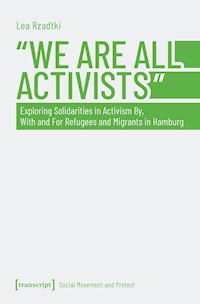
Lea Rzadtki
»We Are All Activists«
Exploring Solidarities in Activism By, With and For Refugees and Migrants in Hamburg
Zgl.: Leuphana, Universität Lüneburg, Dissertation, 2021
Bibliografische Information der Deutschen Nationalbibliothek
The Deutsche Nationalbibliothek lists this publication in the Deutsche Nationalbibliografie; detailed bibliographic data are available in the Internet at http://dnb.d-nb.de
This work is licensed under the Creative Commons Attribution 4.0 (BY) license, which means that the text may be remixed, transformed and built upon and be copied and redistributed in any medium or format even commercially, provided credit is given to the author. For details go to http://creativecommons.org/licenses/by/4.0/
Creative Commons license terms for re-use do not apply to any content (such as graphs, figures, photos, excerpts, etc.) not original to the Open Access publication and further permission may be required from the rights holder. The obligation to research and clear permission lies solely with the party re-using the material.
First published in 2022 by transcript Verlag, Bielefeld © Lea Rzadtki
Cover layout: Maria Arndt, Bielefeld
Printed by Majuskel Medienproduktion GmbH, Wetzlar
Print-ISBN 978-3-8376-6349-5
PDF-ISBN 978-3-8394-6349-9
EPUB-ISBN 978-3-7328-6349-5
https://doi.org/10.14361/9783839463499
ISSN of series: 2701-0473
eISSN of series: 2703-1667
Contents
Acknowledgements
1.Introduction
2.Activism by, with and for migrants in Hamburg
2.1We’ll Come United—Anti-racist parade in Hamburg (September 29, 2018)
2.2Positionality
3.Methodology
3.1Philosophical background and relevant methodologies
3.1.1 Activist and participatory methods
3.1.2 Ethnomethodologies or ethnographic research
3.2Constructivist grounded theory
3.2.1 Data generation
3.2.2 Data analysis
3.3Practical implementation
3.3.1 Field and case selection
3.3.2 Constructivist GTM
3.4Ethics
4.Migrant rights activism as a research subject: Conceptual approaches and relevant literature
4.1State-of-the-art: How migrant rights movements are being studied
4.1.1 Migration studies
4.1.2 Critical Citizenship studies
4.1.3 Social movement studies
4.2Identifying gaps and consolidating my own approach
4.2.1 Four sensitizing concepts sorting the field
4.2.2 Identified gaps in the literature
4.2.3 Setting the stage: Conceptualizing solidarities
5.Negotiating Solidarities: Empirical findings
5.1Feeling the Need to Be Political
5.2Experiencing the Self Through Collectivity
5.3“We Are All Activists”
5.4Making the Social Political
5.5Solid Fluidity of Alliances
5.6“We Have Not Finished”
5.7Summary of the storyline
6.Discussion: Exploring Transversal Solidarities in migrant rights activism
6.1Intersection of differences: how inequalities challenge solidarities
6.2Variety in activities: how everyday politics build solidarities
6.3Ambivalence of success: how relationalities negotiate solidarities
6.4Summary: Exploring Transversal Solidarities
7.Some practical thoughts
8.Conclusion
List of literature
List of figures
Figure 1: Research process illustration, based on Bryant (2017, p. 89), adapted by the author.
Figure 2: Visualization Storyline, by the author.
Figure 3: Visualization practical thoughts, by the author.
Acknowledgements
I want to express my deepest thanks to everyone—individuals and groups—who trusted me to accompany them in their struggles. Many incredible people let me hear their stories and explore lived realities throughout and beyond this academic and personal endeavor. I give them credit for what I present with this book because it emerges from their knowledges!
I want to thank my supervisor Prof. Dr. Sybille Münch who gave me great guidance and space whenever needed and my reviewers Prof. Dr. Thomas Saretzki and Prof. Dr. Elisabeth Tuider for their valuable comments throughout the process. Thanks also to Prof. Hendrik Wagenaar for his support in developing analytical narratives.
Finally, great thanks of course go to my family, friends and colleagues, who were there through the ups and downs of this journey—to all those who supported me and those who read and gave feedback on bits and pieces of what was to become this book! Thanks to Hannes and Christa, Joshi, Simon, Ati, Andrea, Didi, Zora, Sascia, Lena, Lívia, Carolina, Sunjin, Dona and many more!
1.Introduction
“We have made ourselves visible to say that we are here, to say that we are not in hiding but we’re just human beings. We are here and we have been here a long time. We have been living and working in this country for many years and we pay our taxes.” (Cissé, 1996)
Who is taken into consideration when we talk about the citizens, about the people or the activists? Often it is a rather unquestioned privileged positionality, which is taken to be the standard that most of the time it is actually not. In this quote, the activist Madjiguène Cissé, from the transnational Sans-Papiers movement, raises that just because someone or something is not visible—to the broader public or a particular public—it does not mean that they have not been there for a long time. Migrant rights activism is not a new phenomenon but has intensified and become more networked and visible over the past years (Eggert & Giugni, 2015). This study explores group contexts of activism by, with and for refugees and migrants in Hamburg, the claims, interactions, challenges and processes that activists experience, discuss and deal with. I have approached activists experiencing political organizing in this context from a constructivist grounded theory perspective. This allowed me to develop conceptual perspectives grounded in activist groups’ realities and was advanced through existing literature on this social movement but also theories from other research fields. Solidarities emerged throughout the research process as a more concrete focus. This research sets out to answer the questions: What does solidarity mean in social movements, and how do migrant rights activist practices result in negotiating, enacting and challenging it?
This publication is a revised version of my dissertation thesis. Although I only began my PhD research in 2016, the relevant time frame, shaping my research, starts at least in 2015. Similarly, while particularly my data generation only took place until 2019, the writing process still included all of 2020—which certainly shaped it. Finally, the publication is happening in 2022, adding a yet altered context. This overall period covers many societal events and tensions that centrally concern and impact migrant rights activism today but that are not all explicitly part of my data generation and analysis. Since 2015, the so-called “refugee crisis” has been yet another way of framing migration as a threat, especially to Northern, in this case, European countries. However, this does not mean that migration or the often racist and xenophobic motives for problematizing it are new phenomena. To acknowledge this means accepting that the circumstances that make people leave their homes, that solidify borders, that turn landscapes into graveyards and that categorize people into more or less deserving, more or less citizenship-worthy, more or less fitting, are not a temporary crisis, which politicians try to handle. Instead, they are a historically built condition. This condition has been shaped by European imperialism and colonialism, intensified by capitalism and globalization and decided upon by politicians and societies over many years. Just as long as these dynamics exist, there have certainly also been people organizing and struggling against them. This book wants to explore a glimpse of such activities and how activists experience them.
All of this general societal atmosphere has intensified since 2015. The year 2020 is not formally included in my data generation anymore but has undoubtedly brought up further significant circumstances that I want to mention as they have importantly shaped my writing process. Among the globally most significant ones is that we have been facing a global pandemic, which shook up everyone’s lived realities and is on-going. I will not address it further, but it is essential to point out that it has certainly intensified all existing structural inequalities people experience (Hermisson, 2020; Kohlrausch et al., 2020; UNHCR, 2021). In 2020, we also witnessed another chapter in the long line of racist and xenophobic violence in Germany through the murder of nine people in Hanau on February 19: Ferhat Unvar, Gökhan Gültekin, Hamza Kurtović, Said Nesar Hashemi, Mercedes Kierpacz, Sedat Gürbüz, Kaloyan Velkov, Vili-Viorel Păun, Fatih Saraçoğlu are remembered, and a growing movement is calling for justice. We also witnessed fierce Black Lives Matter movements that powerfully spread from the United States all over the world by calling out one more time, ever-so-loudly, the historical deathly racism and inequalities that Black people and People of Color (BPoC) are facing on a daily basis. In the first few weeks that the war in Ukraine is lasting while I am preparing this manuscript for publication in March and April 2022, this clearly constitutes a further relevant circumstance. The war has already forced above 4.5 million people to flee their homes and the country (thus not considering internally displaced people) (UNHCR, 2022). The geographic proximity, a supposed cultural similarity and, quite bluntly, the fact that most of these refugees are white seem to already result in a different involvement for them on the part of European politicians, border regimes and societies than before. Infrastructures are quickly built, legal regulations enable easier procedures, while BPoC refugees, even from Ukraine, are kept from passing the EU’s borders.1
Both in 2015, throughout 2020 and in 2022, there seemed to be a resurgence of the concept of solidarity. However, it also applies to all of these periods that, especially in government-proclaimed crises, the understanding of solidarity is a limited and contradictory one. The Long Summer of Migration in 2015 re-intensified and broadened the fight for the equal rights of migrants, which is facing the societal and political dynamics mentioned above. 2020 also exemplifies how, while calling for solidarity, it was just after exhausting mobilizations of many societal actors that the implicit “Who is involved in it?” was sometimes being questioned. Similarly, 2022 raises critical questions about the importance of solidarity at the face of its clearly selective practices along racist structures. This research explores migrant rights activism in Hamburg in a more limited temporal window. Nevertheless, all these circumstances underscore the ongoing relevance of conceptualizing solidarities. This study aims to offer a reflective, challenging insight into a lived movement reality that is bound up with the historical and contemporary dynamics we continue to face.
The focus is explicitly on mixed group contexts where activists with various legal statuses organize together.2 Therefore, it is also referred to as activism by, with and for migrants and refugees. I do not claim to have researched the migrant rights movements, especially not self-organized and exclusive group structures that undoubtedly are their heart. Of course, my own positionality—including my white, German, cis-gendered, able-bodied, academic and other privileges—shapes all my exploration and analysis. Many knowledge forms that this thesis is centrally based on, to a large extent, come from activists and scholars with lived experiences that I do not share. That can create a gap or tension between recognizing and amplifying while not appropriating or using such knowledge forms and fights. It is an act of balancing that I have experienced and been learning from throughout this research project. I try to address this by including self-reflection, giving credit and focalizing how I have conducted and am presenting my research. Surely, this cannot solve such tensions altogether, and all this is far from flawless, but it represents an immense learning process, which I hope can offer valuable insights.
In this introduction, I briefly delineate the context of this research and the general approach I have been taking to it. I also shortly make two terminological remarks and introduce the structure of the thesis.
Situating this doctoral thesis
“With collective public actions that take on a variety of forms (including marches, hunger strikes, occupations of public sites, and protest camps), refugees, migrants, and those working in solidarity with them, demand advocacy for human rights, freedom of movement, a fair asylum process, and access to labor markets.” (Ataç et al., 2016, p. 527)
Migration certainly represents an increasingly crucial topic in many societies worldwide (Eggert & Giugni, 2015; Rother, 2016). The intensification of globalization and growing numbers of people migrating is often discussed as a challenge both for the countries receiving migrants and those losing more or less significant numbers of their population (Cole, 2016; Mikuszies et al., 2010; Solimano, 2010). Over the last years, European and Northern countries have increased their practices of deterrence and tightening border and migration policies, which also applies to people fleeing war zones and people who risk their lives when moving (Friedrich, 2008; Johnson, 2014; Oberndörfer, 2016). The initial quote by Ataç and colleagues shows that borders are present everywhere and shape people’s lives. Migrants and refugees, being the most affected by these border practices, stand up for their rights, often together with their allies (Fadaee, 2015; Grove-White, 2012; Nicholls, 2013a). And they do not only meet civic response, for example in terms of so-called “welcoming culture”, but also face increasing Right-wing and racist rhetoric, politics and violence referring to migration as a threat (Daphi, 2016; Hann, 2015; Häusler & Schedler, 2016).
Migrant rights activism has existed for a long time. Still, scholars observe that over the past couple of years it has solidified in terms of active groups all over the world becoming more visible, coordinating themselves and organizing on a new scale (Ataç, 2013; McGuaran & Hudig, 2014; Tyler & Marciniak, 2013). While political rights are still dominantly framed as intrinsically linked to citizenship, thus, membership in a nation-state, the institution of the nation-state is increasingly being challenged (Schütze, 2016; Young, 2010). Nevertheless, political scientists have mainly paid attention to migrants’ institutional integration (see e.g. Bertelsmann-Stiftung, 2009; Mikuszies et al., 2010; Schulte, 2015), and especially Northern social movement scholars still seem to predominantly take the supposedly homogeneous citizen for granted as the activist (Stierl, 2016; Zajak & Steinhilper, 2019).
Refugee and migrant activists challenge this. In the dominant view of more traditional perspectives, this results in a conceptual puzzle: People who are not conferred any political rights by the state and are therefore institutionally unexpected as political actors still start constituting themselves as such, enacting political agency (Isin & Nielsen, 2008; Nicholls & Uitermark, 2017). Critical border, migration and citizenship studies have, over the last years, built an academic perspective on migrant rights activism that, conceptually and normatively, underlines this agency of migrants: their active positioning and interacting, as opposed to an often-depicted passive being affected by actions of others (see e.g. Borri & Fontanari, 2015; Hess et al., 2017; Isin, 2012; McNevin, 2006; Nyers, 2015). These research fields constitute the main approaches to academic studies of migrant rights activism so far.
This study builds on this emerging body of literature but aims at developing a conceptual take explicitly focused on social movement studies as a field and at contributing to address some identified gaps. Although there is some engagement with migrant rights activism from this field, it lacks consolidated perspectives (Bloemraad et al., 2016, p. 1648; Eggert & Giugni, 2015, p. 167; Steinhilper, 2017, p. 76f.). Eggert and Giugni observe that while academia is starting to bridge migration and social movement research, “much more work is required in order to better understand under which conditions social movements by, for, and against migrants mobilize and through which processes and mechanisms.” (2015, p. 168) Furthermore, Southern, post-colonial or indigenous theories, as well as those coming from disciplines that emerged from movements themselves, seem little regarded in mainstream social movement studies. Feminist and BPoC perspectives, post- and de-colonial theories are generally too little considered (Bayat, 2010; Fadaee, 2015; Nicholls & Uitermark, 2017). Finally, this research contributes to perspectives on local, contextualized, internal dynamics and dimensions of movements that, according to some scholars, need further development (Armstrong & Bernstein, 2008; Farro, 2014; McDonald, 2002). While scholars have distinguished studies on “pro-migrant solidarity groups” and “the subject of migrant and refugee struggles” (Ataç et al., 2016, p. 530), these groups often still seem to be implicitly assumed as relatively homogeneous. Rather few studies engage with the internal dynamics and categorizations more in detail (Ataç et al., 2015; Fadaee, 2015; Ünsal, 2015).
Focusing this research project
“The solidarity called for is a solidarity that recognizes and respects their action as political participation, and as a radical demand for change. It enables a relationship of mutual support and protection that uses the security of the citizen, but does not reduce or subordinate the power of the migrant. Such solidarity is not easy; it requires a rethinking of protection, equality, and of protest itself.” (Johnson, 2015, p. 16f.)
My research aims to offer new perspectives by exploring migrant rights activism in Hamburg, focusing on developing a conceptual take from a social movement perspective. It was shaped and guided by constructivist grounded theory approaches. This philosophical and methodological perspective allowed me to move into the research process with an open view on what might emerge and to do this while also acknowledging the expectations, perspectives and experiences I brought with me. Interpretive philosophical groundings and practical methodological approaches to self-reflective, iterative, activist scholarship have guided me through this enormous learning process and thereby focused my research. That also means that the concrete focus on filling the concept of solidarities with meaning based on activists’ lived experiences only emerged throughout the research process itself.
This book explores migrant rights activism in Hamburg as experienced by diversely positioned activists. In this endeavor, I accompanied several activist groups and conducted twelve in-depth interviews throughout a time frame of roughly two years. The research develops a conceptual take on this activism through the generated data presented in six analytical categories. These and the codes composing them do not always explicitly raise solidarity. However, Negotiating Solidarities is developed as the overarching storyline, capturing what emerged from them. The activist groups fighting for migrant rights in Hamburg engage in continuous processes, discussions and interactions around what solidarities might be, how they are being challenged and aimed for. This empirical-analytical storyline is informed by existing approaches to this movement, mostly from critical research fields, and developed through the scholarship of intersectional feminists, BPoC and power-sensitive activists themselves.
While I do not pretend to produce any generalizable explanations, I believe that many of the contextualized insights have relevance for a broader range of social movements. I claim that solidarities are constantly being negotiated, challenged and enacted in implicit and explicit, individual and collective processes. Many of the dynamics that become visible through this exploration of local activist groups might thus have value for broader social movement studies. They might potentially be more visible in this particularly diverse context, but they most probably emerge in other social movements as well. Finally, I want to acknowledge that what informed and shaped this research goes way beyond the formal data generation and therefore makes this described setting and time frame confined and endless simultaneously. All of my own experiences—beyond the time frame and local field of my data generation—find their way into this research. I try to make it explicit and give credit while also acknowledging that it is impossible to keep track of all the interactions, experiences and learnings that shape my analysis.
Terminology
“[T]erms such as activism, creative space, cultural activism, critical consciousness and others are not subject to one objective standard. Readers are advised not to see the use of these terms in a strict context, rather they are more flexibly put forth as commonly used within the local communities explored.” (Graham, 2019, p. 285)
This quote aptly points out a challenge of research that is not just claiming to be about social movements or activism but that also engages with these movements. Even though Graham’s examples might not completely apply to my research context, I want to similarly emphasize that, due to my methodological approach and my research setting, my goal is not to develop clear-cut, mutually exclusive and objective terminology. Parts of this are explored more in-depth in Chapters 3 and 4. Nevertheless, throughout this publication, I try to indicate and substantiate my terminological choices, some of which I want to raise here already.
As mentioned, I explicitly focus my research on activist groups with people of various legal statuses. This potentially distinguishes it from research focused on different constellations, such as self-organization, refugee movements or non-citizen struggles (see e.g. Bhimji, 2016; Johnson, 2014; Klotz, 2016; Moulin & Nyers, 2007; Odugbesan & Schwiertz, 2018) but also pro-migrant mobilizations, solidarity movements or “refugees welcome” initiatives (see e.g. Ataç et al., 2016; Every & Augoustinos, 2013; Hamann & Karakayali, 2016; Koca, 2016; Kwesi Aikins & Bendix, 2015; Siapera, 2019).3 Some groups are mainly and sometimes exclusively organized and led by refugees and asylum seekers themselves. Simultaneously, many (activist) groups, especially in the most immediate context of the Long Summer of Migration, are often dominantly constituted by Germans trying to support newly arriving people. Yet, often they are also merely framed as such while actually collecting a variety of people. Of course, these kinds of groups regularly overlap and cannot always be distinguished. However, I think this makes it even more important to explicitly delineate my research focus.
My focus on migrant rights activism is also grounded in that such a broader term as migrant is more embracing. It does not imply the absence of asylum seekers and refugees or a normative judgment of who is or should be a refugee or a migrant.4 Increasing attention is being paid to the pitfalls of using terms, such as “economic” vs. “political migrants”, “refugees”, “asylum-seekers”, “illegals”, “undocumented”, “regular” vs. “irregular migrants”, “aliens” or “non-citizens” (James, 2014; Menjívar & Kanstroom, 2014; Schulze Wessel, 2016). Most of these designations share that—intently or not—they involve a negative connotation or devaluation of the persons they are ascribed to and often reduce people to this one identity (Fleischmann, 2015; Kewes, 2016b; Schwenken, 2006). Based on such reflections, I early-on decided to approach my participants as activists to do justice to their mixed constellations and each person’s complex personal history and identities. However, because dominant societal structures categorize people in the ways mentioned above, these are obviously shaping people’s realities. How these societal inequalities operate within activist groups is an essential part of what I explore. Using such broader terminologies in general does not mean that, where necessary, insightful or meaningful, I do not distinguish between migrant or refugee or German activists, among others. Nonetheless, staying vigilant concerning these categories and ascriptions is a task that has been running through my whole research process (Bakewell, 2008, p. 445; Brubaker, 2013, p. 11; Spivak et al., 2011, p. 11).
Moreover, I mostly refer to activism when discussing the local forms of political organizing that I researched. However, as further discussed in Chapter 4, I consider the overall activities, including all the above, as part of a social movement. Another terminological remark concerns gender. I use the female form as the generic one when there is not a specified gender. That means that, for example, I refer to the researcher justifying her methodological choices. For my research participants and activists referred to in field notes or by interviewees, I use “s*he” and “her*him/ her*his” to further anonymize their identities. As apparent, “I” explicitly appears as a situated researcher throughout the whole thesis. This mirrors my philosophical belief that, even when made invisible in the written presentation, a researcher is never neutral or objective and can, therefore, appear explicitly in the text.
Furthermore, I try to avoid using the denomination “Western,” for example concerning research fields. What is usually referred to as “Western” results from a historical polarization that is not necessary here and gives the illusion of a geographic clarity. Nevertheless, it is generally, at least roughly, understood which countries tend to be referred to as “Western”—most often these are European (at least EU) countries, the United States, Canada and Australia. Especially when criticizing the dominance of these perspectives in academia, it can be important to be able to label them explicitly. The most apt description of such dominance might be to state that they are strongly shaped and thus dominated by the white supremacist structures in society and academia.5 While I will name this where fitting, I finally chose to use the terms “Northern”/“Southern,” in reference to Global South and North. While it continues to be an inappropriate seemingly geographic description, it enables a finer differentiation. A research field can be dominated by Northern perspectives and it does not have to mean that Southern perspectives in the Global North are not still marginalized (Openjuru et al., 2015).
Structure
“Required formats often presuppose a traditional logico-deductive organization. Thus, we need to rethink the format and adapt it to our needs and goals rather than pour our work into standard categories. Rethink and adapt a prescribed format in ways that work for your ideas rather than compromise your analysis.” (Charmaz, 2014, p. 290)
As may have become apparent through this introduction and is nicely captured by this quote, I approached my research context through some not so traditional ways. That also shapes its form and presentation and is very centrally so because of its constructivist grounded theory perspective and its aspiration of exploring meeting grounds of activism and scholarship. After this introducing chapter, the thesis therefore partly continues rather unusually.
Chapter 2 further accompanies the reader into the research setting. Firstly, this consists of a thick description of an activist scene. Secondly, it contains a self-reflection and positioning of myself as a researcher. Chapter 3 follows up on this by explaining the methodological background of this study more in-depth. This is because the philosophical and methodological choices shape all other parts of the research design so explicitly that it is reasonable to introduce this to the reader early on. In turn, this means that the literature review only follows in Chapter 4. Constructivist grounded theory’s take on the engagement with existing literature brings some specificities that result in a lack of what is usually referred to as a conceptual framework. Thus, the chapter, firstly, contains a literature review organized by relevant research fields concerning the study of migrant rights activism. Secondly, it identifies gaps in the existing literature, introduces the sensitizing concepts (developed at the beginning to orient the further research process) and focuses my own conceptual approach by introducing solidarity.
It might also seem untypical for a qualitative research presentation that I present my empirical findings in Chapter 5 without explicitly relating it to extant theory and literature yet. The chapter is structured based on the six analytical categories. This does neither mean that I only descriptively present my empirical data nor that I pretend to introduce entirely new insights never reflected in any publication. Due to constructivist grounded theory’s iterative logic, the form in which I present my empirical findings was developed through multiple stages of data analysis and confrontation with existing theory and literature. Therefore, the categories are already a central part of the analysis. Yet, to give the empirical data and the emergent nature of the analysis the space they deserve, I decided to follow Birks and Mills’ recommendation to first isolate and only later link my findings to the literature (2011, p. 134). The latter then takes place in Chapter 6 in the form of three contributions my research makes. This chapter develops the main insights from my empirical findings together with existing literature to more explicitly engage with and answer the research questions. In Chapter 7, I attempt to summarize the results of my research in a more practical way, acknowledging they should not be limited to academic audiences. The conclusion summarizes my findings, addresses limitations and points to recommendations for further research.
1Various news articles discuss such dynamics (see e.g. Ferris-Rotman, 2022; Howard et al., 2022; ProAsyl, 2022; Schleiermacher, 2022).
2Yet, it will become clear throughout this book that the complexity of identities in these groups certainly goes well beyond that of legal status.
3Some of these publications do not specify the constellations in the context they study.
4This is not to say that a distinction between various forms of migration cannot be significant on a human rights basis. But it raises that the distinction is often arbitrary. Some activists deliberately use the term refugee to emphasize their disagreement with existing asylum laws, thereby re-appropriating the term. Some reject such terms of assigned legal categorizations because they are too often used to essentializing or creating differences among them. Importantly, legal status is not a never-changing characteristic and it is not neutrally assigned. It is not on me to judge so I use the broader term, include controversies on various terms and try to be open to debate.
5Openjuru et al. detect “an international academic publishing universe dominated by scholars from the global North.” (2015, p. 226) Similarly, Linda Tuhiwai Smith explains how already the term research is bound up with European imperialism and colonialism and states: “It appalls us that the West can desire, extract and claim ownership of our ways of knowing […], and then simultaneously reject the people who created and developed those ideas and seek to deny them further opportunities to be creators of their own culture and own nations.” (L. T. Smith, 2012, p. 1)
2.Activism by, with and for migrants in Hamburg
Firstly, this chapter entails a depiction of an exemplary scene: The We’ll Come United Parade that took place in Hamburg on September 29, 2018. It offers the reader a glimpse to better understand my research setting. It is a personal account of the day and I should add that I have myself been involved in the organization. I hope to transmit some of the difficulties, hopes and strengths of this political fight. The parade was organized by a nation-wide network of self-organized, anti-racist and antifascist initiatives, which brought 35,000 people to the streets, making it one of the biggest demonstrations by, with and for migrants in Germany until then. This description is not meant to be representative or exhaustive neither of the activist groups I researched nor of this particular day.
Secondly, this chapter contains a reflection of my own positionality, which deals with my position as a researcher and a person in and beyond this research project. I agree with Bryant’s conviction that at the beginning of a research project researchers should “try to articulate their motivations and relationships to the research and its key issues” because “[c]laiming that one has no preconceptions is not convincing, nor is it defensible.” (2017, p. 152) Given my multiple roles of involvement in the research setting and my privileged positionings, I consider positionality even more relevant than it is anyways.
2.1We’ll Come United—Anti-racist parade in Hamburg (September 29, 2018)
“We turn on the light and turn up the sound. The mics are there for those who need them, to tell it like it is: The history of our society is the history of migration. It is just as unstoppable as the solidarity of the many. So, call us storytellers. We are here. We are coming. We are staying. On Sept 29, 2018 the streets will be ours.” (We’ll Come United, 2018)
It is a crisp Saturday morning in late September in Hamburg. The sky is of a bright blue, the air is still cool from the night, and the big square in front of the city hall is almost empty. It’s is too early for the tourists. The offices are empty because of the weekend. The shops have not opened yet. Only a few police vans are parked at the side of the square. Looking more carefully, I see that there are two bigger groups of people standing on the other end of the square. Otherwise, everything is silent. Suddenly, a truck enters the street beside the square, a few seconds later another one follows, and yet another one, and so on. All at once, something is getting started here. The trucks line up along the sides of the square and in the streets right next to it, as if pulled by invisible but clearly organized threads. People immediately start to prepare with those who are already here. Groups of people start to assemble next to each truck, forming a busy buzzing all around. People climb up on trucks’ sides, rolling up the tarps, others unpack banners, build sculptures, draw posters or make other decorations. The trucks are starting to transform—from gray uniform transport vehicles they turn into something more lively: colorful monuments, airplanes, dream statues, safe spaces, playgrounds, clubs, rooms of education, boats, memorials.
Walking from one to the other, it is almost impossible to take in all the messages that are only starting to be put up: knowledge is not white; women breaking borders; decolonize!; we’ll dance UNITED; Freedom of Movement; Migration ist die Mutter aller Gesellschaften; Familienleben für alle; Smash Racism and Borders; Our Love is louder than Fear; Kein Mensch ist Illegal; Laut gegen Nazis. The square is filling up with colors, noise and people. Some women are sitting on the ground painting more slogans on balloons and cloth. Nearby two people are holding a third one installing a sign on top of a truck. Kids are jumping on and off the loading ramps. And then, the square is full of people. It is hard to pass through the crowd and reach the stage where just the brief presentation of all the trucks takes more than an hour. Women, Black people, children, queer people, refugees, men, white people, People of Color, migrants, Germans, Sans-Papiers and many more—they all hand each other the microphone on this stage, claiming the day, the city, society. It’s easy to tell that it’s not a normal day, not the usual German demonstration, by the diversity of people present on and around the stage. People speaking up, standing hand in hand, showing a society of the many that already exists.
I stand next to the group of people who jointly make the closing statement of this opening by the We’ll Come United network. Despite all joint conviction, there are also tensions. A young woman who is part of the group makes a very short statement and is not allowed to add something later on when she recalls better what she wanted to say. The whole process is sharply planned. The speeches had to be in German and English because it would have taken too long to interpret. Someone being overwhelmed by this situation of speaking in front of thousands of people is not planned. No time to give time.
When the program on stage is finished, the procession of trucks is already moving. Getting through the crowd of smiling, busy, chanting people around each of them means moving slowly. Moving from one truck to the other is a passage from dancing on the street to careful listening to experiences of flight or political demands to clouds of whistles or words of remembrance, grief, rage but always also of hope. It’s impossible to grasp the whole of emotions, activities and faces that move through the city in this never-ending call for visibility, solidarity and future. No one can understand all the languages spoken on the trucks, in the audience and on stage. But everyone gets the message that one activist puts into words: “Love is the only solution.” But anger and determination are part of this too: “The fight has to continue, if we want to continue dreaming and hoping,” says someone, and: “You cannot fight for us without us.” A reminder of the importance of standing together, claiming the fight and acting in solidarity. Speaking up are those who too often are not heard nor seen, those who are creating their own future, even though others keep destroying it.
When we reach the water by the harbor, the sun is setting. People sit down on the street, by the trucks, on the harbor walls. They talk, eat, nap. Ironically, all this takes place in the area of the city where racism is especially present and oppressive on a daily basis. The special task force of the police has made the St. Pauli Hafenstraße its main site for showing active about drug criminality. Black people and People of Color are controlled and harassed here every day. Some do not come here anymore because they cannot move freely. For others, it’s the area they know, where they meet people and where there is also a lot of solidarity and support. Because this is also one of the areas that historically and symbolically most clearly stand for Left organizing, resistance and struggle in Hamburg. Today, maybe the crowd allows to move more unnoticed and might offer recognition. The realities overlap and dreams and claims are weaved into them. The clouds that had accompanied the parade during the day have disappeared, leaving an almost cheesy evening sky on the silhouette of the harbor. Despite the pugnacious demands and the serious experiences, the atmosphere is exuberant. On the top floor of a building near-by the press group offers an impressive panorama perspective to media representatives, trying to help transmit the feelings and claims of the day to those not present. In another organized space close-by some groups already do a direct evaluation round. In a stuffed room without much air, we discuss what went wrong, what to improve, what to do next, when to meet again. Outside the crowd disperses into their multiple realities.
2.2Positionality
What follows is a personal account of how I see what brought me to where I am now: topic-wise, methodologically, normatively, ethically, politically and socially. As such, it is not typically included in most academic publications at all. Still, as part of my epistemological and methodological decisions, I see it as a sign of respect and transparency to share these reflections with my readers.
In a way, I have always had an intense fascination with civil society activities from my early studies onwards. Certainly, my own political views have always been close to many of the movements I read about. I think that I always felt respect for those who dedicate so much of their time to a specific cause. Seeing people give their lives—sometimes literally—to improve the world, not just for themselves but for everyone, has surely inspired me to aim at using the resources I have to also work on this. This account shares my personal development throughout the last years from mainly looking at social movements from an outside perspective toward being involved in them. The feelings while working on this research have often been inspiration—by all the people I was allowed to meet and learn from—, anger—given the unbearable and unjustifiable situations people have to deal with—, indignation—because I am part of the small portion of people that has privileges to (not) do whatever they want—, powerlessness—when seeing how little things change and how small I am—, but also hope and joy—when being so warmly welcomed in groups and being able to live moments of empowerment and solidarity.
The Long Summer of Migration is often depicted as a turning point in the perception and presence of flight and migration in the European and German public discourse. I must admit that I was also not particularly engaged with questions of migration before. For a long time, the right to move was a taken-for-granted privilege for me, which I had and used since birth, but which I only later started to reflect on critically and question more. I witnessed the opening of the inner-European borders, heard about the tightening of the outer ones. Of course, while living in Sicily I came across the situation in the Mediterranean, also given that migration has always been an obvious and visible part of everyday life on this Southern island between Europe and Africa. However, I was not too much involved in doing something about it.
The part of the summer in 2015 that nobody in Europe could have missed I was in the US. The following half-year, I followed what was happening from afar. As for many, this led to a strong urge to finally do something. When I came back to Germany, I got involved in an alliance in Hamburg organizing the International Conference of Refugees and Migrants1. I joined the assemblies and was actively involved in a working group. Strictly speaking and apart from demonstrations, this was probably my first real activist experience altogether. And it certainly was very significant for me. I learned so many things I wasn’t aware of before: topics, backgrounds, experiences, framings, assumptions taken for granted. Given my social movement background as a student, it was invaluable to confront my theoretical knowledge and my own white German perspective with these groups’ realities. The focus of my PhD research clearly originates here.
One strong notion that I took from the conference and that, I think, is very embedded in my research, methodologically and in terms of prior knowledge about the field, is finding a more equal footing: trying to work and talk with instead of about people. I started to reflect more explicitly on how I was positioned as a white German cis-female academic within these activist groups engaging for migrant, precarious, BPoC life realities. That involved evident notions, as well as, for me, at that point, not so obvious ones. Being advantaged and privileged in so many ways I did not know about before—being used to speaking in public or in English, having experience with group discussions, but also having a warm home to go back to, a financially stable situation, being at home, etc. Especially addressing my own internalized racist socializing, learning about anti-racism and exploring what my role as a white person can be in these struggles have been significant developments throughout these past couple of years.
Positionality involves the process of reflecting one’s perspective and position within the research setting—how it impacts what and how I perceive and interact with it (Wilkinson, 2014, p. 403). For me, continuously reflecting on my position as a researcher, and thus as a person, in the research setting and in relation to the research participants has been incredibly valuable. On the one hand, it is essential to reflect on these things for myself. For example, because my assumptions have implications on my methodological and theoretical choices. Additionally, I could not put on paper how much I have personally learnt in the last six years in this process. On the other hand, it is crucial to make these choices and assumptions visible to others, to enter into dialogue and to make my positions and perspectives transparent. I would say that reflecting on and addressing racism, learning about post-colonial perspectives, feminist notions, socio-economic inequalities but also plain and simple human and relational issues have found their way into my methodological choices and the analytical focus of my research in general. However, it is never finished, and this publication probably includes and reflects different stages of this very process.
Constructivist grounded theory is a research approach that allows the researcher to integrate these reflections into the process explicitly. As an approach, it is open enough to let me as a researcher give up some control and take the time to explore while also following certain methods to give direction and guidance to the whole. Both the underlying philosophical ideas and my methodological choices imply that this can never be a closed chapter. Rather, it must be an ongoing process and task for me to keep reflecting on the issues, questions and positions I encounter. It includes challenging myself, “solving” some or revisiting them later-on, re-engaging with them when they emerge at other points in time or being able to let them go for a while when they prove less relevant in certain situations.
As is evident by now, when it comes to my research context, activism by, with and for refugees and migrants in Hamburg, I entirely share the general claims that this movement is making: for the rights of migrants and refugees, against borders, deportation and racism. With my research, I got back in touch with some people and groups in Hamburg that I still knew from organizing the conference. I generally approached them as a researcher and an activist from the very start. I reflected this double role from the beginning, as the following memo excerpt shows, which also raises the uncertainties that come with this:
“Of course, this is an extremely important issue that will not stop coming up. I do have a double role and I still have to figure out, or better I have to continuously and with every single group, figure out what my roles exactly are. There is no either-or but very blurry lines that I have to be as open as possible about.” (Memo Joining meetings in a double-role from 17/01/18)
For me, participant observation does not mean that I am only silently observing. I got actively involved, in some groups more and in others less. Generally, these years have been a process of personal development in terms of political engagement—though as always certainly not a linear one. Within and beyond these groups and even this movement, I became increasingly active and involved but through the writing stage and paid labor also disengaged again. This also means that, to some extent, I was becoming part of my own research subject. Yanow and Schwartz-Shea interestingly refer to this as “enhanced reflexivity,” describing the double role of the researcher as “sense maker” in the more classical sense and, at the same time, as “primary data source” in terms of her own experience (2014, p. 391). In fact, writing field notes for example certainly takes the perspective of who writes them. Sometimes, especially with memos, my feeling was that I was interviewing myself just as I was interviewing others, only more frequently and analytically.
This also comprises that I got to know people on a more personal level, had drinks with them, was invited to birthday parties, made friends. I am aware that all of this can lead to me having too much of an insider view, for instance, meaning that I could romanticize things or have a one-sided view of them. At the same time, I will always be an outsider in certain ways: I am not the one most strongly suffering the consequences of colonialism and racism, I hold a passport that lets me travel wherever I want, I went to school and university and can find work—or even allow myself not to for keeping to learn—, I am white, and I am at home here (and this could go on). Throughout the years, all this has made me continuously reflect on if and how I am entitled to research a fight where I am not part of the groups of people with lived experiences. I think that this reflection is critical—not just but, of course, centrally because it is at the core of my research. I have to ask myself why I, as a white, German academic, should be the one to document, interpret and analyze migrant rights activism (L. T. Smith, 2012, p. 17f.). That is one reason why I focus on mixed group contexts that I was myself involved in. Aiming at taking the claim “Nothing for us without us” serious is not just essential within activist struggles and daily life, but it is also, maybe especially, necessary in academia. Thus, I am an outsider and an insider to my research context in various ways.
Engaging with complex constellations of positionalities is part of this process. I tried to do this through methodological tools, such as memo-writing and the field diary, which means that I was constantly engaging in a dialogue with myself, trying to take steps back, asking myself critical questions and not shying away from these topics. It also meant engaging with ethical concerns regarding my interaction and relationship with groups and people, being as honest and transparent with them as I am trying to be with myself without giving up my research position. Sometimes the groups themselves addressed these topics and reflections. I explicitly talked to activists about my role and position as a researcher or about being white and German in the groups. As will become clear in the empirical and analytical parts of this book, questions of privilege, inequality and perspectives centrally also come up within the groups themselves. These have therefore been very fundamental questions for my research in multiple ways. All these thoughts and discussions have been defining in shaping my research and they re-emerge throughout this dissertation.
1http://refugeeconference.blogsport.eu/.
3.Methodology
This chapter contains a detailed account of my methodological approach, constructivist grounded theory1, its background and the related choices of this research. Rather than merely displaying a technical toolkit, I see the methodology as the basis of my research, shaping its whole process. For this reason, this is a central chapter, which addresses philosophical, practical and ethical questions. Constructivist grounded theory is an approach that enables me to use and include elements of different relevant philosophies and methodologies in my research design. Salazar Pérez and Canella underline that GTM is especially useful in critical qualitative research projects concerned with marginalized positions:




