


12,99 €
Mehr erfahren.
- Herausgeber: tredition
- Kategorie: Geisteswissenschaft
- Sprache: Englisch
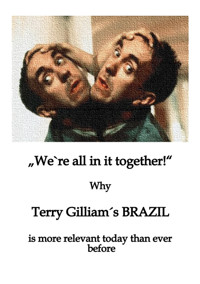
" We're all in it together" deals with Terry Gilliam's groundbreaking 1985 film BRAZIL, which addressed the most important socially relevant issues of its time in an entertaining mix of different genres. Since these issues have only worsened to this day, BRAZIL is more relevant than almost any contemporary film, even forty years after its premiere.
Das E-Book können Sie in Legimi-Apps oder einer beliebigen App lesen, die das folgende Format unterstützen:
Seitenzahl: 221
Veröffentlichungsjahr: 2025
Ähnliche



















© 2025 Jochen Thielmann
Druck und Distribution im Auftrag des Autors:
tredition GmbH, Heinz-Beusen-Stieg 5, 22926 Ahrensburg, Deutschland
Das Werk, einschließlich seiner Teile, ist urheberrechtlich geschützt. Für die Inhalte ist der Autor verantwortlich. Jede Verwertung ist ohne seine Zustimmung unzulässig. Die Publikation und Verbreitung erfolgen im Auftrag des Autors, zu erreichen unter: Jochen Thielmann, Stütingsberg 7, 42281 Wuppertal, Germany .
Kontaktadresse nach EU-Produktsicherheitsverordnung: [email protected]
Table of Contents
Cover
Copyright
"What is this all about?"
"Somewhere in the 20th Century"
1. The state
"Actual terrorists?"
"A ruthless minority of people seem to have forgotten certain good old-fashioned virtues. They just can`t stand seeing the other fellow win."
"It`s absolutely right and fair that those found guilty pay for their periods of detention and the Information Retrieval procedures used in their interrogation."
"… put half as terrorists, the rest as victims…"
"You have to go through the proper channels." - "And you can`t tell me what the proper channels are, because that`s classified information?"
"Half the time I can never see where I`m going."
"We`ve got a crack team of decision makers."
"We don`t make mistakes"
"Wasting Ministry time and paper."
2. The characters
Sam Lowry "You must have hopes, wishes, dreams." - "No, nothing! Not even dreams!"
Jill Layton "Are you all right?"
Archibald "Harry" Tuttle "There`s your problem." - "Can you fix it?" - "No, I can`t."
Jack Lint "This whole Tuttle-Buttle confusion was obviously planned from the inside."
Ida Lowry "Oh, to hell with the diet, a number eight, please."
Eugene Helpmann "The rules of the game are laid down. We all have to play by them … even me."
3. The Society
"We do the work – you do the pleasure."
"I suppose we`re all human."
"I`m waiting for my daddy."
"My mother`s away for Christmas."
"Oh God, she`s got what`s-her-name with her."
"Keep your city tidy."
"A steak, please. Rare."
"The machine keeps picking up old films."
"Here`s looking at you."
“As you don`t live here anymore”
"Do you believe that the government is winning the battle against terrorists?"
"You must be joking."
"There`s one thing I`m certain of, return I will to old Brazil."
We`re all in it together
Cover
Copyright
"What is this all about?"
"There`s one thing I`m certain of, return I will to old Brazil."
We`re all in it together
Cover
1
2
3
4
5
6
7
8
9
10
11
12
13
14
15
16
17
18
19
20
21
22
23
24
25
26
27
28
29
30
31
32
33
34
35
36
37
38
39
40
41
42
43
44
45
46
47
48
49
50
51
52
53
54
55
56
57
58
59
60
61
62
63
64
65
66
67
68
69
70
71
72
73
74
75
76
77
78
79
80
81
82
83
84
85
86
87
88
89
90
91
92
93
94
95
96
97
98
99
100
101
102
103
104
105
106
107
108
109
110
111
112
113
114
115
116
117
118
119
120
121
122
123
124
125
126
127
128
129
130
131
132
133
134
135
136
137
138
139
140
141
142
143
144
145
146
147
148
149
150
151
152
153
154
155
156
157
158
159
160
161
162
163
164
165
166
167
"What is this all about?"
In his dreams, Sam Lowry (Jonathan Pryce) is a shining hero who fights for his dream woman against giants.
Director Terry Gilliam's film BRAZIL, which premiered in 1985 from a screenplay he co-wrote with Tom Stoppard, Charles McKeown and Charles Alverson (uncredited), is one of those rare films that leave the viewer baffled the first time they watch it and then, over the years, make new discoveries every time they rewatch it. It is therefore a film whose greatest weakness – too much – is also its greatest strength.
The fact that BRAZIL initially overwhelmed even experienced viewers is proven by the YouTube video ‘At the Movies with Gene Siskel and Roger Ebert’, probably the two most influential film critics of the eighties. It's not so much that neither of them liked the movie very much, Siskel goes so far as to say: ‘It really has one idea and one idea only which is we`ve been overwhelmed by technology. Hardly a fresh idea. It beats it to death, beautifully beats it to death.’ Siskel initially praises the film's amazing special effects, only to later claim that the film would probably have been better if the dream sequences had simply been left out - the part in which the majority of the special effects occur. Ebert sees ‘a confused and unsatisfying film’ and confirms Siskel's ‘one-idea-picture’: ‘An idea that was totally overwhelmed by its production so it was just technological overkill.’ It is truly ironic that a film as full of ideas as BRAZIL is not accused by two leading film critics in the USA of having too many ideas in it, which could certainly be argued about, but instead that there is only one idea in the film, which is then overshadowed by the technology.
The fact that even the distributor's understanding of the film has not necessarily improved in the meantime is shown by the synopsis on the current German Blu-ray from 2013:
"Sam Lowry is a minor civil servant in a totalitarian state. Instead of tracking down an opponent of the regime (wrong), however, he prefers to indulge in his fantastical daydreams (wrong), in which he fights monsters as a lone hero. One day, a squashed bug on the wanted list causes an innocent man to be liquidated by the security forces (wrong). When Sam discovers the mistake (wrong), he begins to live out his dreams (wrong) and also ends up on the hit list (wrong)…"
This summary does not do justice to what happens on the big screen. Even in the current, 14th edition of the work "1001 films you should see before life is over" (ed. Steven Jay Schneider), the renowned film critic Kim Newman writes of the "terrorist Tuttle", claims that Jill "wants to avenge the injustice done to Buttle and his family" and that the final dream sequence represents the "fantasy of a dead man".
The main reason for this - probably not necessarily intended by Gilliam, but foreseeable - overtaxing of the viewer on first viewing is mainly the wild mixture of reality and dream sequences, whereby the reality level of the film already comes across as nightmarish at times. The added dream sequences are only easily recognisable as such at first because of their fantastic elements, but become more and more realistic as the film progresses. In addition, characters from the main character's dreams now appear in spontaneous visions on the reality level, or something first appears in the dream and only later in reality, which is why there are initially many indications that we are back in a dream sequence. It is therefore almost impossible to draw an exact line at the beginning.1
In reality, Sam is fighting a hopeless battle to save his dream woman.
For the most part, this book deals with the film's level of reality and relates it to the "real world", which has not changed too much in the years since the film was made and therefore still - and even more and more - reflects the world of BRAZIL. Even after forty years, Terry Gilliam's masterpiece is the definitive film of our time because it captures the zeitgeist before and after the turn of the millennium better than any other film. Future generations will be able to find most of the social and political grievances that they will have to deal with in an entertainment film. Yet Gilliam avoids appearing to be a cry in the wilderness amidst all the social criticism by disguising his work as a surreal and humorous satire of the future and filling it with ideas that make it impossible for the viewer to perceive all aspects of the film on first viewing.
It therefore almost goes without saying that it is advisable to have seen the film once or several times before reading this book. The following is an attempt to summarise the plot of BRAZIL in a few sentences:
"At a time when the state is waging a brutal war against the enemy within, a technical error occurs in the gigantic Ministry of Information, resulting in the arrest and later death of a family man in state custody. When the dreamy civil servant Sam Lowry wants to present the widow with a compensation cheque, he recognises the woman of his dreams in her neighbour, who subsequently makes herself suspicious through her brash manner when trying to clear up the mistake. Sam therefore mistakenly believes her to be a terrorist and does everything he can to save her. In the process, he becomes increasingly entangled in the state security net, from which there is ultimately no escape for either of them."
1 The difficult access to the film resulted in Universal refusing to release the film in Gilliam's edited version in American cinemas. Film journalist Jack Mathews has written a detailed and highly readable account of "The Battle of BRAZIL" in his book of the same name.
"Somewhere in the 20th Century"
It is important for the ruling class to persuade the people how beautiful everything is - and it is important for the people to make the rulers realise that they know the truth.
The large poster suggests to the population that all is really well in this world: "Happiness - We`re all in it together!" is the slogan and the family of four with their dog in the car seems to live up to this claim. However, it's all just a painting and the only family of four in Terry Gilliam's BRAZIL that could potentially go on a weekend trip in the car is cruelly torn apart after just a few minutes and destroyed forever. It's no wonder that the word "Happiness" has been crossed out on one of the billboards and replaced with the word "Shit".
The theme of BRAZIL is the world and we humans, because "We`re all in it together". BRAZIL shows a world from which most viewers in the mid-1980s imagined themselves to be far removed. "Dystopian Science-fiction" was the term often used to describe this dark vision, without realising that the filmmakers were dealing with the present, which they had alienated beyond recognition. After all, the themes were all familiar: terrorism; human rights violations and the dismantling of basic rights in favour of state control for reasons of internal security; the unconditional faith in the always growing economy; the resulting environmental pollution and species extinction; the ever-increasing bureaucracy; the tensions between rich and poor; urbanisation and the simultaneous isolation of the individual; the focus on outward appearances, egoism and consumerism. 2
Forty years later, the film is as relevant as it was when it was made. And today we are all still living together in the world of BRAZIL. Back then, the ground had long been prepared for the seeds of the state to sprout, which is in full bloom in the film. And the present is drawing ever closer. Twenty-four years after the attacks of September 11th 2001, this is clearer than ever before: states declaring war on terror and rediscovering torture in the process, versus terrorists who, for their part, do not stop at civilians or schoolchildren with bombing terror; plus the monopolisation of the economy, the gradual extermination of the animal world, the destruction of nature, the climate catastrophe. And the latest development - and very much a theme in BRAZIL - is the fight against political opponents within the country. Humanity is still at war with itself.
Deputy Minister Eugene Helpmann (Peter Vaughn) answers the TV journalist's critical questions and describes the thirteen-year bomb terror as “beginner's luck”.
BRAZIL thus clearly has its thematic starting point in the time of its creation. This should come as no surprise, as the words "Somewhere in the 20th Century" at the beginning of the film show both the era Gilliam is aiming for and that he does not favour any particular country as the setting.3 However, as he exaggerates the problems of the present in a way that could only be possible decades later, he ends up in the future. In order to achieve a U-turn to the present, the director then allows his film to slip into the past in many ways. This approach is particularly striking in the design of the technical facilities: the computers resemble old typewriters with screens that are far too small and whose images have to be enlarged using huge magnifying glasses; the telephone emits low-pitched noises and, with its various plugs, is reminiscent of the days when an operator had to be switched on to make a connection; the mobile surveillance cameras resemble human eyes, but seem to be short-sighted, so that they have to drive very close to their object; in general, the technical equipment seems to be getting on in years and often no longer works, even in the building of the most important department of the state, the "Information Retrieval ", the lift suffers from malfunctions. Through this dual strategy - partly towards the future, partly towards the past - Gilliam ends up in the present without this becoming too obvious.
Terry Gilliam makes it clear with a brilliant introduction that we find ourselves in a world in a state of emergency. BRAZIL begins with a bomb explosion in a shopping arcade, while a customer with a shopping trolley is walking past an electronics shop with a number of TV sets in the window, all showing the same programme. This is followed by a Christmas interview with Deputy Minister Helpmann about the bomb terror that is ravaging the country on the only still-functioning television in the completely devastated shop. This interview is interwoven with an incident in the Ministry of Information, where a civil servant chases and finally kills a beetle, whose remains then fall into a printer and turn a T (for Tuttle) into a B (for Buttle), and the pre-Christmas idyll in the home of Mr and Mrs Buttle and their two children. The television with the Helpmann interview is also on in both rooms, so that the conversation can be followed in the background in excerpts. Immediately after the end of the interview with the Deputy Minister's wishes for a blessed Christmas, the brutal arrest of the father of the family, Archibald Buttle, by heavily armed security troops follows. After just a few minutes, the director has already staked out the ground on which his main characters will have to move in the following two hours.
2 It is very interesting that the film does not deal with the most pressing problem at the time it was made, namely the East-West conflict between Nato and the Warsaw Pact and the resulting arms race. In the world of BRAZIL, there are no states that are hostile to each other, but only one state that stands for the entire world and harbours people who are waging war against themselves on various levels.
3 On very close inspection, it can be seen that on the arrest warrant of the father of the family, Archibald Buttle, the religion is "C of E" (pronounced Church of England), the date/place of birth is "2/6/32 United Kingdom" and the date is "31/6/84", so that we find ourselves in an alternative version of the United Kingdom of the 1980s.
1. The state
The central government is waging a bitter war against terrorism and this conflict has now escalated on both sides. The civilian population has been caught between the fronts.
"Actual terrorists?"
The remains of the crushed beetle can still be seen on the printout of the document, which shortly afterwards leads first to the arrest and then to the death of a man.
From the point of view of the powerful in the world of BRAZIL, this development began when terrorists started fighting the brave new world. We learn that the country has already been shaken by bomb terror for thirteen years; these attacks are repeated throughout the film, which shows just a few days in the life of its main character Sam Lowry: more bombs explode in the shopping centre and in the restaurant, new attacks are reported on the radio ("Terrorist Bombing at the Blue Lagoon."4 ). Sam is present at two of these attacks himself and his reaction in each case shows that this is not a particularly outstanding event.
Terrorism sets the plot in motion but is not made the subject of the film. Not a single character appears in the entire film who could be assigned to a terrorist movement. There is also no explanation of the terrorists' motivation or goals anywhere in the film. The explanation given by Deputy Minister Helpmann in the television interview ("A ruthless minority of people seem to have forgotten certain good old-fashioned virtues. They just can`t stand seeing the other fellow win.") is infantile and thus says much more about him than about the terrorists. The violent enemies of the state remain invisible, as if they were anchored in the system with no prospect of change. When Sam is asked at one point by his dream girl Jill how many real terrorists he has already seen, he replies as a newly appointed employee of the Information Retrieval Department at the Ministry of Information: "Actual terrorists? It`s only my first day". Sam doesn't know any terrorists personally. Probably Eugene Helpmann or the civil servant Jack Lint feel the same way, but they will at least know terror suspects, because the supply of suspects at the Ministry never stops. In the end, even the main character Sam Lowry is one of them, even if he has nothing to do with these explosions in public places. However, the only actions that could possibly be described as terrorist are characteristically carried out by Gilliam's hero.
A security guard bursts into flames while chasing Sam and Jill.
It is he who breaks through a roadblock with the lorry, causes a roadblock himself during the subsequent chase and later sabotages the ministry's internal communication system. If you think about the events against this backdrop, it is possible that the real terrorists are civil servants who have gone berserk, because Sam Lowry, as the prototype of the faceless civil servant, a typical representative of his profession, is specifically responsible for the deaths of security officers and is therefore ultimately regarded as an enemy of the state, and not without good reason. From the regime's point of view, the question even arises as to whether it can really just be coincidence that Sam is in the immediate vicinity of two explosions at different locations within a very short space of time. This fact alone could further substantiate the suspicions against him, because from the point of view of investigators like Jack Lint, there are no coincidences, everything is connected.5 At the same time, from the point of view of the state apparatus, Sam's actions make no sense at all, because it is inexplicable why an inconspicuous civil servant, who has just turned down a promotion to the most important public department and then accepted it, suddenly flips out at the ministry and causes the lorry to break through a roadblock and kill security guards. Even a truthful statement by Sam in an interrogation - "I met my dream woman and wanted to save her because I assumed she was a terrorist" - would not convince his accusers and therefore not help him, especially as motivation is not decisive in the question of criminal liability. Instead, it would probably be - in a variation of what Jack Lint says about Jill Layton: "She`s working for someone and I don`t think it`s us."
Terry Gilliam has stated in various interviews that he doesn't know whether there are any terrorists in the world of BRAZIL at all, whether things might just blow up or whether the state itself is behind the attacks to secure its claim to power.6 The film allows for this interpretation, precisely because real terrorists do not appear and therefore the motivation of a violent opposition is not introduced. However, the fact that the explosions occur by chance due to outdated technology would at least be difficult to comprehend, as these explosions apparently began at a very specific point in time and have been increasing more and more recently. And the fact that the government itself is behind the terrorist attacks does not really fit in with the state structure depicted, as a "liberal-democratic" self-image still prevails there. Another alternative would be that the government did not initiate the explosions but willingly misused them to eliminate any kind of opposition. As there is now no opposition, but the state apparatus needs to be fed and the explosions continue to happen, the search for the unknown terrorists continues. In any case, all citizens are always suspects as soon as they attract attention, regardless of whether the person in question plays by the rules (as Jill does when asked about Buttle's arrest) or not (as Tuttle does in his illegal work). However, all these mind games ignore the fact that in the state structure of BRAZIL, no one is in charge anymore and everything happens automatically. There is no recognisable mastermind, neither on the side of the regime nor on the side of the opposition - whether they are fighting back with terrorist means, whether they exist at all or not.
4 Most of the quotes from the film come from the screenplay that Jack Mathews published in his book "The Battle of BRAZIL"; there are only occasional deviations in the finished film.
5 However, Sam's acquaintance Mrs Terrain and her daughter Shirley are also present at both explosions, so maybe…?
6 However, Gilliam has also stated in interviews that one inspiration for the film was the terrorist groups of the 1970s in Great Britain (IRA), Italy (Red Brigades) and Germany (Red Army Faction).
"A ruthless minority of people seem to have forgotten certain good old-fashioned virtues. They just can`t stand seeing the other fellow win."
Documents fall like snow after an act of sabotage at the Ministry of Information.
The terrorists' bombing campaign with the explosions in public spaces have had no effect whatsoever, apart from the fact that they have prompted the state to take harsh countermeasures, which have presumably increased over the thirteen years that the terror has been going on before reaching its current level. The state's response to the elusive enemy is characterised by armament on the one hand and the curtailment of civil rights on the other. The government's reaction is regardless of losses within its own population; it has obviously done exactly what it accuses the enemy of doing, namely forgetting the good old virtues. In this way, a democratic constitutional state has developed into a totalitarian monster in which every citizen can fall into the clutches of the state apparatus at any time through no fault of their own.
The discussion about the relationship between internal security and personal freedom has been conducted in every constitutional state since the premiere of BRAZIL, especially since the events of September 11th 2001. It cannot be ruled out that there was a comparably drastic event that contributed to the development that led the state into its "total war" against terrorism. It is remarkable that in BRAZIL, Gilliam anticipates images of the attack on the World Trade Centre in the final fantasy of the tortured Sam Lowry, when part of the Ministry of Information is blown up.7 Sixteen years later, life imitated art in this respect. After the two planes hit the towers of the World Trade Centre, it began to rain papers and documents on the streets of New York City, just as it did in Sam's dream vision after the Ministry was blown up, or earlier in the world of BRAZIL after his sabotage of the communications system. When a state is violated, it doesn't rain blood or tears, but paper, without which the apparatus would be no more viable than the human body without red blood cells.




