


8,49 €
Niedrigster Preis in 30 Tagen: 8,49 €
Niedrigster Preis in 30 Tagen: 8,49 €
Mehr erfahren.
- Herausgeber: Alberto Moretti
- Kategorie: Geisteswissenschaft
- Sprache: Englisch
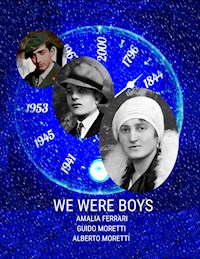
Amalia and Guido are a young couple whose dream of a happy life together is broken by the outbreak of the Second World War. Amalia stays in Milan, juggling the bombings and the no less pressing problems of daily survival. Guido, instead, as commander in the Italian Army, leads an epic crossing in the Sahara desert and manages to bring his soldiers to safety, facing a thousand adversities. The solid mutual love, strengthened also by the birth of a little girl, will accompany them on the arduous journey towards the painful reunification. A path paved with obstacles, revealing encounters, very hard trials, but also unexpected strokes of luck. Based on real events, this novel offers us a vivid glimpse of crucial episodes of our history, between the late 1700s and the late 1900s, narrated from an unprecedented perspective. In addition to the voices of the two courageous and tenacious protagonists, there is also the no less intense voice of their son Alberto, who vigorously depicts the distant years of childhood and youth, the loves and pains until the first professional successes. Many varied adventures that have a common denominator: the strength to get involved to the end, without fears, and living the unknown as a continuous challenge. It is the ability to adapt to the changing and evolving times, almost anticipating them and always staying one step ahead, the key that opens the doors of a future full of promise to Alberto. But the new contains in itself traces of our roots, and today always has a father: the past.
Das E-Book können Sie in Legimi-Apps oder einer beliebigen App lesen, die das folgende Format unterstützen:
Veröffentlichungsjahr: 2021
Ähnliche




















Table of contents
WE WERE BOYS
TAKEN FROM STORIES THAT REALLY HAPPENED
PREFACE
PROLOGUE
FIRST CHAPTER
SECOND CHAPTER
THIRD CHAPTER
FOURTH CHAPTER
FIFTH CHAPTER
SIXTH CHAPTER
SEVENTH CHAPTER
EIGHTH CHAPTER
WE WERE BOYS
WRITER
AMALIA FERRARI
GUIDO MORETTI
ALBERTO MORETTI
TAKEN FROM STORIES THAT REALLY HAPPENED
PREFACE
Our history
Amalia and Guido are a young couple whose dream of a happy life together is broken by the outbreak of the Second World War. Amalia stays in Milan, juggling the bombings and the no less pressing problems of daily survival. Guido, instead, as commander in the Italian Army, leads an epic crossing in the Sahara desert and manages to bring his soldiers to safety, facing a thousand adversities. The solid mutual love, strengthened also by the birth of a little girl, will accompany them on the arduous journey towards the painful reunification. A path paved with obstacles, revealing encounters, very hard trials, but also unexpected strokes of luck. Based on real events, this novel offers us a vivid glimpse of crucial episodes of our history, between the late 1700s and the late 1900s, narrated from an unprecedented perspective. In addition to the voices of the two courageous and tenacious protagonists, there is also the no less intense voice of their son Alberto, who vigorously depicts the distant years of childhood and youth, the loves and pains until the first professional successes. Many varied adventures that have a common denominator: the strength to get involved to the end, without fears, and living the unknown as a continuous challenge. It is the ability to adapt to the changing and evolving times, almost anticipating them and always staying one step ahead, the key that opens the doors of a future full of promise to Alberto. But the new contains in itself traces of our roots, and today always has a father: the past.
PROLOGUE
August 1943 Milan
The lamps began to sway, the ceiling with deaf creaks to tremble, the rubble to fall, while the explosions of the bombs became more and more intense and close, the weeping of children and the moans of fear pervaded our bodies. The light he fizzled out and the terror that a bomb hit the shelter froze the blood of the veins as the heart rose to the throat and the dust of the debris entered our sighs. Endless minutes, eternal, with the heart that seemed to stop at every roar and the air with a slow and imperceptible hiss coming out of the lungs.
I closed my eyes, the noises died away.
I begin to wander through the folds of time.
FIRST CHAPTER
The origin
Dad Angelo's great-grandfather, Alvise, had built the house in Borgo San Marco in 1844 with his own hands, helped by his brothers. I was small but the memory of his stories around the fireplace in the evening is always alive, and I listened enchanted by his adventures and the events of our family. From a farmer, who was emigrating to America with his whole family, he had bought the land for a few ducats, and within a year with many sacrifices he managed to finish the house. He remembered the fear that it would be destroyed during the war against the Piedmont in 1848 and that from the western part of Borgo San Marco, at the crossroads between the roads to Legnago, Mantua and Verona, the Austro-Hungarian soldiers passed by to go and fight the Piedmont. Often, he used to say, at our farm we used to stop troops of lancers on horseback to water the horses and rest in the shade of the oaks in the grove in front of us. He said that one evening they had entered the farm and requisitioned all the chickens in the hen house and ate them. They gave him a piece of paper as compensation that no one was going to honor. For a few months, there was nothing to eat but polenta and milk. Alvise often remembered his father Saverio’s escape from Urbana, from the old house made of wood and stone, to Este for the approach of Napoleon's French troops.
It was June 15, 1796.
The French had recently occupied Verona and were preparing to besiege Mantova while an imposing passage of Austrian troops crossed Montagnana and Legnago. Retreating cavalrymen urged the population to flee towards Este where they were preparing the defenses and gave news of destruction of houses and churches at the passage of the French. Legnago had been bombed by artillery. From the bedroom window on the mezzanine floor you could see the flashes to the west and hear a few seconds after the deaf roar of the explosions. The Legnago bridge had been blown up to stop its advance, but the French troops were quickly building a new bridge of boats and in little time would have arrived in Montagnana. After a few days Montagnana and Este fell and fortunately the refugees were not touched. The French troops wanted to reach Venice as soon as possible. During the night the people of our villages were awakened by the arrival of about 9,000 German soldiers, they were headed towards Legnago. They stopped in front of my drinking trough to quench their thirst. Two months later, there was another transit of the German army with more than 25,000 soldiers. It was September 9, 1796 and already from the morning all the villages saw endless lines of men passing through Cologna to continue towards Minerbe and San Zenone directed to Legnago. The long "procession" in front of our house began in the morning and ended in the evening after 10 p.m. At the beginning of 1797, 400 soldiers of the French general Augerau were stationed inside the castle of Bevilacqua. A German division decided to attack them to conquer the castle. The soldiers passed in front of my house following the moat for Borgo San Marco and Bevilaqua. Arrived in the village of Bevilacqua, the Germanic troops ordered the surrender, the French did not want to lay down their weapons and the battle began. Cannon shots could be heard miles away, their roar made the wooden walls of my house creak and the window panes tremble.
At nightfall, the castle was conquered and the last surviving Frenchmen were taken prisoner. On March 25th four Austrian infantry regiments arrived between Bevilacqua, Minerbe and San Zenone. The whole area was at risk and, the next day, the sound of the cannon was heard from Legnago, two separate battles had begun, both resolved in favor of the Germans. Pressana, Albaredo, Cologna and Minerbe continued to be conquered and then lost by the two armies in the war. My camp had been devastated by the continuous passage of cavalry squadrons. On May 3, 1797, the French soldiers entered in Cologna. As a first consequence of the new state, all the inscriptions and coats of arms that recalled the Venetian Republic were cancelled. Everywhere the Lions of San Marco, symbols of the Serenissima's dominion, were demolished. Napoleon's soldiers plundered and took away everything: animals, hay, wheat, clothes, shoes. In that period the Mattiazzo and Casale families, who had fled from Pressana, arrived terrified with their few things to my house. Their little girl had been raped, and her grandfather killed for trying to defend her. In their eyes I saw the tragedy and the fear of those hellish months. The house had been occupied by the French and before fleeing they had set it on fire, taking away all the cattle and grain supplies. They had lost everything. Between August and September it was a succession of passages of troops and carriage, and by then it became clear to everyone that the Adige had become the natural border between the two enemy sides. Uncle Gustavo died of hardship and malnutrition, and two children fell ill with pellagra. For four times the Austrians tried unsuccessfully to free Mantova, and it was on one of these occasions that the battle of Bevilacqua took place that also interested Montagnana, Merlara, San Salvaro. A cavalry camp was set up in front of our house. That day we were ordered to evacuate to Badia Polesine and my house was used as accommodation for the officers. In the parish archives of Montagnana there are precise references to the fact of arms and many wounded Austrian soldiers were brought to Montagnana. After our grove, about ten soldiers were buried in a ditch.
Our house was in no man's land, and we did not know which authority to turn to for grain and milk subsidies while hunger and misery reigned. We were reduced to eating grass. The French had taken away the seeds and farm animals and there were months of famine and hunger, pellagra and cholera raged for some years, corn made dry cobs with few seeds and many villagers died of hardship. Two brothers and three uncles died from malnutrition as between the families of Mattiazzo and Casale, died a brother-in-law, a daughter-in-law and two children. The church of Borgo San Marco had been set on fire and the archives of births and deaths had been destroyed. The memories of our origins had partly disappeared. With the families of Mattiazzo, Casale and Adrian the friendship would be cemented with the marriages of Paola, Rosa and Domenica with Giovan Battista, Angelo and Alvise. Saverio died of measles together with little Lucia and Roberto, 11 years old. Everyone mourned him for a year and his grave in the small cemetery of Borgo San Marco is always surrounded by flowers in memory of his tenacity and courage for having saved his family in so many years of adversity. I shared the room in the Borgo San Marco farm with Giulia and Giulio and that winter of 1917 we were warmed by the heat of the cows coming up from the stable below us, with the smell of hay and wet straw. Early in the morning we could hear dad Angelo taking care of the cows to clean them and fill the manger and their mooing during milking. As the sun rose we would take turns going to the white vat to wash our faces and hands and running down the stairs to the kitchen while mummy helped daddy with milking. I would light the fire in the fireplace to boil the milk and prepare the table for breakfast with slices of polenta, remained from the evening, toasted on the coals. What a perfume that emanated, unforgettable, and was delicious soaked in warm milk with the thick white foam that looked like butter. After breakfast, we helped Dad to put the yoke on the cows and attach them to the cart loaded with hoes, forks, shovels, and rakes.
The breath of the great war in that month of November 1917 we saw it with the flow of the cavalry in front of our house and the arrival of the English soldiers and their incomprehensible idiom. From the east there were legions of Italian soldiers retreating from the front and from the west the English columns directed to the front. They were the remains of the Second Italian Army retreating from Caporetto. It was a sad spectacle to see men who had been shot down and half starved to death for miles and miles. There was no one who had a rifle, and very few were carrying any other equipment. Here and there, mixed in with them, were herds of quadrupeds. Towards evening a part of the English troops, welcomed by a festive crowd and the band, crossed the drawbridge of Montagnana. Other units of the English divisions settled, for a few days, in Cologna, Legnago, Bevilacqua, Lonigo and other centers of Padua. Legnago. In the autumn of 1918, I had just turned 8 years old, dad had finished the harvest, the first mist covered the fields and the oak grove was losing its leaves. Those were the first days of school and that day the teacher had explained to us that our soldiers had broken through the Austrian enemy lines and were going up the front towards Trieste and the war would be over in a short time and that there would be a big party in the village for the victory in honor of our fallen soldiers. In the kitchen, I was all busy telling my mother the teacher's words when all of a sudden we heard a rumble of wagons approaching and a roar of horses' hooves. We went out into the street while columns and columns of wagons were running in front of us with a very long line of Austrian soldiers prisoners flanked by our cavalrymen. For more than half an hour they passed in front of our farm on their way to Legnago while mum took a ladle and a can of water and handed it to the prisoners to quench their thirst. Their gaze, almost absent, hinted at a smile of thanks as they drank and passed the ladle. As they disappeared at the crossroads, I told my mother that the war was really over, as the teacher was saying, and I saw her nodding with a smile. In front of our farm there is a long dirt road, straight, with a ditch at the side and almost at the end where the oak forest begins there are our fields sown with wheat, corn and sugar beets. The biggest effort for me was harvesting the beets because they had to be pulled with a two-bladed gallows out of the ground and the biggest ones were sometimes so clinging to the ground that I had to call Marino to help me. At noon dad Angelo arrived and all together we went to the shade of the big oak tree, which marked the border of our lands, to eat bread and wine and lay us under its branches, with the straw hats to shelter from the light and rest. Dad's voice woke us up and put a big hurry on everything when there were beets to pick because, if they got wet, with the rain they became less valuable and at the sugar mill they paid a lower price. When the sun started to go down behind the woods, with a full wagon, we returned home tired and hungry. Dad Angelo would leave us on the farmyard and go on with the load to the sugar mill and come back late at night with us kids already in the dream world. Mum was waiting for him in front of the fireplace, mending and knitting to prepare the winter sweaters. Sometimes I felt, when Dad came back from the sugar mill, the discouragement for the hours lost waiting to unload the beets. Then there were the problems of the price of wheat that could not cover the expenses for the new sowing and that the mill would give us less flour at a higher price and that we would have less bread. We had a difficult year ahead of us. Luckily mum had had a couple of rabbits from her grandmother, all white, and she had taken care of them and in two years they had multiplied. Grandma told us that it was thanks to them that during the Spanish epidemic of 1919-1920 the family had managed to come out almost unscathed from that pandemic, and around the fireplace in the evening she would tell us about those tragic events.
We read in the newspapers:
"The disease that was beginning to terrorize the world was suddenly arising with a high fever, 39°\40°, throat discomfort, headaches, widespread pain in the limbs, sometimes nosebleeds and nausea.
A strange and terrible disease that presented itself in the most diverse forms, including that of pneumonic fulminant infection".
They began to prohibit visits to the sick, advised against travel by train, suspended the fairs and markets. In the evening, after the early closure of restaurants and theatres, the streets and squares of the city fell into darkness. Communications from mayors and prefects testified to the fact that we were faced with something frightening and upsetting, something worse than the war. Forbidden the funeral processions, in the cities the coffins were transported on trucks, but in the small towns there were not even coffins, given the shortage of timber. There was a lack of doctors and nurses, medicines and food, and personnel for the burials. The almost ten million casualties of the First World War were not enough, the tremendous epidemic that originated among the trenches without exception to uniforms meant that the number of dead, this time mainly without uniforms and not because of weapons, to rose almost fifty million.
The first cases that could be denounced freely and without censorship were ascertained in Spain and brought to the knowledge of the world through the Spanish News Agency Fabra from March 8, 1918. In reality, the terrible flu virus was brought to Europe by U.S. soldiers who came to Europe in 1917 to give the French a strong hand on the Lorraine front. The contagion spread to almost a billion people on the entire planet and in six months it killed fifty million of them, including over six hundred thousand Italians. The official medicine showed itself incapable in front of what is called the most serious pandemic in history. In one year, the flu killed more people than they died in a century in the Middle Ages for the Black Plague. The First World War had just ended and the winter of 1919 was particularly severe with snowfalls and night frosts. It all started with Toni's family, who lived at the intersection of the bell tower and the level crossing.
Everyone had fallen ill with a sudden fever. My dear friend and schoolmate died, followed a few days later by her grandmother, brother and mother.
As the days went by other families got sick and more and more people died of these unexplained fevers. I continued to go to school in that month of February, but at morning roll call in class there were more and more absent. After a few days they closed the school, even the teachers were sick. Even the mill was closed, the miller and a daughter were dead and nobody was grinding the grain. Dad was more and more worried after learning from the doctor that it was better not to have contact with families with fevers and advised to stay at home and wait for the situation to evolve. Fortunately, dad always kept a supply of flour above the barn and this helped us a lot of keeping us away from possible contagion. One morning Mum also fell ill, and we were all anxious for her but Dad, remembering the words of the doctor, isolated her in a room, and only he could enter to take care of her and bring her food. After a few days we saw Mum coming out of the room and smiling at us, she told us that the fever had passed, she just had a big pain in her bones and she felt tired. Behind us was dad, smiling, and with his confident voice he asked us to go to the kitchen and prepare a hot cup of milk with polenta. We all embraced her, happy to know that she was cured. With the school closed we worked with dad helping him to look after the cows and chickens and even if it was cold we ran behind the garden to play hide-and-seek among the white trees for frost. In the afternoon we would open the stable and with a stick we would send the cows to the watering trough and I would fill it with water with the well hand pump. At the end of March people had started to leave the house. For almost 15 days there were no deaths in the village and many villagers gathered in the church with the parish priest to pray the rosary in memory of the dead. Many families were affected by the pandemic with many dead and the whole country mourned for their memory. Mum put on the black dress, and so she stayed for six months while Dad had a black stripe over his coat and cloak.
I was clinging to the bunny cage behind the barn with Giulia, and we were all curious and waiting for a bunny to give birth. Their birth was an event for us, and seeing these snow-white bunnies with their pink faces taken one by they mother and placed next to each other at her breasts gave us a deep tenderness. We knew that we didn't have to touch them so as not to upset the mother, and so we stood there and watched them in silence while they were breastfeeding. We had the task of looking after the rabbits and in the afternoon after school we cleaned the cage, changed the straw and brought the food and carrots from our garden. When the school closed, I was happy because I could go with dad to help him with the work in the fields. During the day with Giulia and Giulio we would go down the street, after the big oak tree, to the witches' wood where it was said that on hot summer evenings the witches would gather and light big bonfires that could be seen in the distance. We were a little scared, but the curiosity was such that we managed to penetrate into the bush in search of the intersection of the two ditches. The voice strong dad's made us run back and sometimes scolded us for going too far away. Sometimes he made me drive the cart home, and I was enchanted to see the fields and the rows of trees flow on the sides of the path. The cows would stop by themselves in front of our farm.
"Amalia, Amalia, go open the gate and let the vet in."
I have been accompanying him to the stable. Immediately he changed his clothes and prepared the tools for the birth of our cow, waiting for Dad to arrive to help him. The cow was standing and slowly swung her head, turning it occasionally towards her belly to chase away the flies. I was all excited to see the lobar and the birth of the calves. My father arrived and with the vet began the movements for the birth. It took a long time to give birth, for old age they said, and I saw them puffing several times trying to pull out that head that was barely visible. Thanks to the doctor's irons, all of a sudden the calf slipped out while the cow with little moans sniffed that little creature trying to get it up.
"Amalia, close the gate and hurry up and get the water bottles on the wagon."
It was the first day of the harvest, the sun was rising behind the oak grove and my filly Stella was watching us behind the fence with her big, expressive eyes puffing as if she was asking to join us. We got on the wagon with the water-bottles and set off along the path to our lands. The rows of vines were around the wheat fields and with Giulio I started the harvest from the border with the woods. The bunches of grapes were large and ripe in a dark red that bode well for an exceptional harvest. We quickly filled the baskets and the work seemed a game. At midday break we sat under the oaks of the grove and ate bread with freshly picked grapes. In the late afternoon with a full wagon we slowly returned home with flies and bees buzzing around us attracted by the acrid scent of the grapes. Our hands were coloured blue, and we could hardly clean them with soap. In front of the fireplace we would fall asleep with a piece of polenta in our hands, we were so tired that dad hugged us, lifted us and urged us to go to sleep. The morning arrived in a flash, and although we arms were sore and our head clouded by sleep, we ran into the kitchen to eat polenta with milk and get on the wagon to go to harvest grapes.
In autumn the countryside was wonderful for the intense colors and scents that hovered in the air, and I was captivated by the squirrels' work in the woods to bring acorns into their dens. On the day of the pressing with Giulia and Giulio we went into the vat in our underwear and while we pressed the grapes with our feet we sang and joked. Sometimes our mother would come and clean the cantonal from the skins and grape seeds and filter and pour the juice into the barrel. Then for snacks would put in the cups the foam of the grapes that we soaked with freshly baked bread and its scent was unforgettable.
I used to follow dad's plough to clean it from the stones and roots. The first autumn fogs greying the barren fields, and we began to see the leafless branches of the oaks. The chirping of the birds had almost disappeared, and the whole world seemed to have stopped, motionless, waiting for who knows what.
At the border of our lands, at the end of the path, the forest was full of brambles and figures that could be glimpsed among the clouds of fog that slowly moved among the large tree roots. Every once in a while Dad would stop to rest his arm muscles and quench his thirst with wine. We did not stop to eat because the days were short and as the sun reached the treetops we took the way home. Often the first fog, no higher than a meter, covered everything, fields and ditches, and it seemed to be in a floating sea, white, and all the noises dampened, except the little bells of our oxen. Behind us the wagon was leaving a trail in the fog, making the path and the ditch reappear. Sometimes daddy, due to tiredness, would fall asleep with the reins in his hands while his head followed the slow rocking of the wagon.
The evening it snowed and in the morning, opening the window, a blanket of snow had covered the farmyard and the road while the fields could no longer be seen, everything seemed as in a fairy tale. Shouting with joy, I ran with my brothers into the courtyard and began to throw snowballs at them. The cold was very intense and with red hands for the frost we returned to the kitchen to warm up and have breakfast. Daddy from the stable urged us to bring the straw from the hayloft and tidy up the chicken coop and the rabbits' cage. But a bitter surprise was waiting for us. During the night a marten had entered the hen house. There were feathers everywhere and bloodstains on the floor. It had managed to get in through a hole in the net and outside you could clearly see its footprints going towards the garden and then to the grove behind the farm. We tried to follow those footprints, but at the grove they inexplicably disappeared.
The war had been over for two years, in that August 1920, and every day I went with Dad to check that the corn was growing well and not infested by insects, as had already happened in previous years, bringing famine and hunger.
The long tufts of the cobs were darkening, it was the first sign that the harvest was near, and we had to prepare the burlap sacks and clean the farmyard well, which would host those yellow rose-colored grains. Soldiers no longer passed through, and our villagers returning from the front or captivity had returned to their families. Five had not returned, and a dozen were invalids from the war. Often when dad met them, stopped to listen to their stories about the days spent in the trenches, of the fights between barbed wire and the acts of heroism in the battles against the Austrians.
Flavio, our cousin, was a veteran, an invalid without an arm and a foot, and often came to our house in the evening to sit around the fireplace and tell us about life in the trenches, between the water and cold in winter and the stifling heat in summer. He often dwelt on the battle of Nervesa where he had been wounded while he was counter-attacking the Austrian forces that wanted to cross the Piave River. All the villagers did their best to help him, inviting him to eat and giving him the few things he needed. His family was very poor. His father had left ten years earlier for Argentina in search of fortune, but after two years he died of a sudden fever in Santa Fe, and it was thanks to an Italian priest that the family was informed of his death. Flavio's mother was working in the two wretched fields with her young son and gritting her teeth trying to get by with dignity. Flavio could not work and be of help to his family and waited to receive from the government the promised and deserved pension, he felt proud to have been a soldier and always carried on his chest the two medals won in combat. At the end of August, the letter carrier's excited words were heard:
"Flavio's pension has arrived",
continuing to strum the bicycle bell.
We left the house to follow the letter carrier to Flavio's house and joined the Neighbors. It was a great party for everyone, the village was all gathered in front of his house to shake his hand and embrace him, finally the past hardships would be just a sad memory.
Daddy was shuttling from the fields to our farmyard with the wagon full of cobs in that month of August 1925, while with my brothers we removed the bracts and shelled the seeds. We would sing and chat under the sun with the straw hats on our heads while our hands would frantically pass over the caryopsis and then lay them out in the sun and let them dry well before putting them in the burlap sacks and at night, with the windows open for the heat, the unmistakable scent of corn grains would enter. I often accompanied Daddy to weighing of corn grains and then to the mill to transform the seeds into flour. Once the harvest was over, we gathered with the other farmers to celebrate and that year it was our turn. It was a beautiful party, Marco and Gino with their accordions played all evening while the women in the circle, around the fire in the middle of the farmyard, sang and danced with the men behind clapping their hands. Dad had put the wine barrel next to the drinking trough with a large wooden mixer, and they all served themselves while the elderly as they watched the sparks of the bonfire, talking and sipping with the red wine from our vineyards. Our wine had an unmistakable aroma, something bitter and sweet that left a full flavor on the palate and all the strength of our sun. We kid used to have a lot of fun playing and chasing each other around the fire. At the chimes of the night of the bell tower began the greetings and the handshakes and slowly, with the fire getting dimmer and dimmer, the Neighbors returned to their homes.
The snow had covered the fields several times in that cold winter of 1925 and the few times we left home was to go to the grove to collect wood and let it dry in the heat of the stable. We had fun chasing in the footsteps of hares and squirrels and right at the bottom of the trees where the canal begins we discovered their den among the branches of the big oak tree. It was a spectacle to see them going back and forth between the branches and the den. In the afternoon I went to see Stella and with Dad's permission I put the reins on her, and we went for a ride along the path and in the woods.
I saw her trembling with joy as she stepped on the fresh snow and had fun with her snout puffing on the few bushes that emerged. If we walked we had the same pace, and her hooves seemed to be looking for the softest snow, and it was almost like a dance. Between the white vapor coming out of his nostrils and the white of his body, he seemed to be one with the snow. The nostrils were pink, the eyelashes so thick and the mane so soft that when he touched my face it looked like a gust of wind. I was very fond of Stella, and she was very attached to me. When dad Angelo brought her home, after having bought her at the cattle market in Legnago, I had been the first to approach her and caress her, so small and frightened. She had recently been weaned and since then a very strong friendship was born between us. Her place in the stable was near the small window facing south to catch the low winter sun. She liked to play on the farmyard and go around me while I held her with the rope, and sometimes she would come towards me pushing me with her little sweet muzzle. When she heard the barn door open, she already knew if it was me and greeted me with her characteristic slow, chesty nitrite and lifted her mane. And so the many happy seasons passed with her, getting bigger and bigger, from foal to mare. How I wanted to see her give birth to foals, maybe white like her, but Daddy said that she would be in danger of life due to problems with childbirth. With time, we became more and more attached to each other, I was speaking to her as a friend and she listened to me and when I was attacking her to the buggy she already knew where to go. When she wanted to be groomed and brushed she would gently push me next to the stable door where daddy would put the tools and pose with his head reclined and with each pass I felt like a thrill of pleasure between her white mane. One day, daddy took Stella from the farrier to Urbana to change her hoof irons and fix some broken nails. Stella as she entered the farrier began to wriggle, pawing, and there was no way to calm her down. Dad had to come home. As Stella saw me she ran towards me puffing. I calmed her by stroking her face and whispering to her that no one wanted to hurt her and that I would always protect her. Once she had calmed down, I took her back to the farrier, who removed her the shoeing and filing her nails well.
Two days before Christmas, mum started to prepare Christmas lunch. She started with the turkey that after having plucked and cleaned it she left to macerate in the kitchen. Then she prepared the stuffing and the vegetables. With Giulia I helped my mother to knead the flour with the eggs and with the rolling pin to pull the pastry. Then at the first ringing of the bells we went up to the room to wash and dress in our party dress, and we all went to the San Marco parish together, walking and following dad with the oil lantern in his hand to illuminate the path. Seeing so many distant and close lamps chasing each other and swaying in the darkness of the night was wonderful and the closer we got to the church the more we felt like we were approaching a river of light. The bell tower was all lit from the candles and the ringing of the bells warned us that the function was about to begin. The churchyard was filled with the faithful who shook hands greeting and embracing each other before entering the church. The whole Borgo San Marco was in church for the solemn mass, with the choirs and Christmas carols that gave a tone of joy and happiness. At the end of the mass the parish priest with the altar boys gave his hand to all the faithful and blessed them and with everyone had words of hope and comfort. Then we all returned home, turning the oil lamps back on and little by little the country lanes lit up again. Who knows what gifts I would find in the morning in front of the fireplace, and with this thought I fell asleep. In the morning I wake up early I get up out of bed and all excited I wash my face and put on the wool dress that my mother had sewn me. I comb my hair and put on my black paint shoes, I go down the stairs and ran to the fireplace to see the little packages of gifts. Mum and Dad were already there. Each parcel had a different color, and I was trying to guess which one was mine. Giulia and Giulio arrived and immediately took one to open it, but Dad stopped they're saying that we had to wait Marino. When we were all around the crib, mum and dad kissed us on the cheeks, and they gave us Christmas presents. Slowly I opened my red packet pondering to see what it could contain and to my surprise I saw a beautiful chocolate shirt with braids and a high neck. Mother looked at me and said:
"Oh yes, my dear child, you're a young woman now,"
and caressing my face gave me another package that I opened all excited. It was a long, straight grey flannel skirt. I am such a woman and I said it out loud and everyone smiled at me, hugging me. I squeezed mummy tight because I had understood what that candlelight was until late into the night down in the kitchen and I felt a squeeze in my heart for the love I felt for her, while daddy looked at us smiling and happy to see us hugging.
"Mum, I'm biking to Bevilacqua, I promise I won't be late, and I'll be home before sundown."
I was wearing my party dress and the shoes with heels that Grandpa had given me. My mother came to me to fix my new hat with a retina and with a caress and a kiss on my forehead she said "have fun and remember to follow the rhythm of the waltz and not to jump. In front of the bell tower of Borgo San Marco there were my friends waiting for me to go to the castle of Bevilacqua and dance in his beautiful party hall. The music was beautiful and then there were many guys who wanted to dance, take you home and meet you the following Sunday. But I was waiting for Guido, whom I had known since I was seven years old. We used to go to the primary schools in Borgo San Marco and during recreation, in the courtyard, we would play together joking and chasing each other, and we would have fun climbing the oak tree near the entrance. If he had a loaf of bread, he shared it with me and already talked about when he would be big and of his dreams and desires. Then we looked each other in the eyes and lose myself in those gray-green-blue colors dreaming of living my life with him. Before sunset, I took my bike and went home, even if they still played and danced but so I had promised to my mother and I would never give her sorrows and worries to her who always had sweet words for me. I don't remember a hand raised to me, and if at times I made her angry she would smile at me and with a caress she made me understand not to do it any more. I opened the gate of the house and Guido appeared in front of me, in an elegant grey suit and with shiny hair that reflected the last rays of the sun. My heart stopped in surprise.
"Amalia is that you? Guido has arrived!
Yes mum I saw it. "
I hugged her and Guido squeezed me so tightly that I was almost out of breath. What an unforgettable day that September 26, 1927,
he had returned from Milan by train for my birthday and from that embrace I felt all the love he felt for me and his warmth pervaded me and I wanted to kiss him there at that moment.
I wanted to get out of the world with him but already mum, dad and all my brothers were around us to celebrate him, pulling him here and there and inviting him to enter the house. How much I thought of you that night, embracing the pillow to feel your warmth and to love you.




