


9,99 €
Mehr erfahren.
- Herausgeber: The History Press
- Kategorie: Geisteswissenschaft
- Sprache: Englisch
During the First and Second World Wars thousands of men and women refused the call to arms. Reviled, starved and beaten, theirs was a battle of conscience. In the First World War, seventy-three conscientious objectors died as a result of their treatment, and hundreds more were imprisoned. During the Second World War, many conscientious objectors performed other, non-combatant duties with great heroism, including bomb disposal, and joining the fire service and ambulance crews. Unable to turn a blind eye to the dark realities of war, these men and women, who came from all classes and backgrounds, wrestled with their moral values, and their struggles, motivations and stories are brought together in this moving and challenging history of war's outcasts.
Das E-Book können Sie in Legimi-Apps oder einer beliebigen App lesen, die das folgende Format unterstützen:
Veröffentlichungsjahr: 2011
Ähnliche



















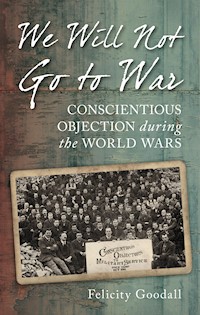
We Will not Go to War
We Will Not Go To War
CONSCIENTIOUS OBJECTION duringthe WORLD WARS
Felicity Goodall
To Alan, Thomas and Stephen
First published as A Question of Conscience in 1997
This edition published in 2010
The History Press
The Mill, Brimscombe Port
Stroud, Gloucestershire, GL5 2QG
www.thehistorypress.co.uk
This ebook edition first published in 2011
All rights reserved
© Felicity Goodall 1997, 2010, 2011
The right of Felicity Goodall, to be identified as the Author of this work has been asserted in accordance with the Copyrights, Designs and Patents Act 1988.
This ebook is copyright material and must not be copied, reproduced, transferred, distributed, leased, licensed or publicly performed or used in any way except as specifically permitted in writing by the publishers, as allowed under the terms and conditions under which it was purchased or as strictly permitted by applicable copyright law. Any unauthorised distribution or use of this text may be a direct infringement of the author’s and publisher’s rights, and those responsible may be liable in law accordingly.
EPUB ISBN 978 0 7524 7644 5
MOBI ISBN 978 0 7524 7643 8
Original typesetting by The History Press
Contents
Foreword by the Revd the Lord Soper
Preface
Introduction to the 2010 Edition
Acknowledgements
1 Individualists to the Core
2 Conscription
3 The ‘Frenchmen’
4 Prison
5 The Home Office Scheme
6 Those at Home
7 Friends Ambulance Unit
8 Aftermath
9 The Interwar Years
10 War Clouds
11 A New Generation
12 Women
13 Non-Combatant Corps
14 Bomb Disposal
15 On the Land
16 In the Hands of the Army
17 The Absolutists
18 Service in the Blitz
19 Friends
20 A Change of Heart
21 Hindsight
Further Reading
Foreword
It has been claimed that great causes inevitably need a literature, if not to initiate them, certainly to sustain them. As a Methodist I have long been convinced that Charles Wesley’s hymns played as important a part in the Methodist Revival as did his brother John’s sermons.
I am immediately convinced of the truth of this generalization when reading this collection of records of the stories of conscientious objectors in the First and Second World Wars.
As a pacifist I believe ever more urgently that the essential quality of the Christian Gospel is the imperative need for the recognition that conscientious objection to war lies at the heart of the spirit and teaching of Jesus. Indeed the story and example of such objectors, not all necessarily members of the Christian Church, are exponents of the living literature of the gospel of non-violence.
I welcome this publication not only as a testimony to the honesty and heroism which I witnessed when I spoke on behalf of many conscientious objectors in the Second World War. I welcome it because, in my experience, no commitment to pacifism is still so generally misunderstood if not totally derided. I welcome it even more, as over the years since the ending of the Second World War there has been a wishful longing for peace-making in many unexpected quarters. As far as my experience as an open-air preacher goes this is certainly true.
Evangelism against war and for peace today is useless unless it is rooted in the ‘Way of the Cross’ rather than the ‘Way of the Gun’. I hope that the story of conscientious objectors will become part of the literature of hope in the total repudiation of mass violence, and that our fragile humanity can believe in general disarmament which can become increasingly possible only when we say, whatever it may cost, we will go to war no more. I welcome this book as a valuable contribution to this end.
The Revd The Lord Soper, 1997
One of a series of humourous postcards produced by the No-Conscription Fellowship.
Preface
This book is a series of snapshots from people’s lives, told in their own words. It is not intended as a textbook, nor is it intended to be a history of conscientious objection in the two world wars. Instead I hope the reader will get a flavour of who these people were, and what it was like to question your conscience and decide not to participate in two world wars, wars which became the most momentous event in the lives of two generations.
Most of the information in this book has been gleaned from interviews with conscientious objectors, some has come from their unpublished memoirs, in a few cases I have quoted extracts from published letters or memoirs. The Imperial War Museum Sound Archive has been an invaluable source, especially as so many of these men and women are no longer alive. In all cases they told their stories with straightforwardness and honesty. I hope I have managed to retain this in the way I have woven their words together.
Introduction to the 2010 Edition
Since the 2003 invasion of Iraq, a handful of serving members of the armed forces have registered as conscientious objectors. Unlike the men and women in this book, these new ‘conchies’ are volunteers rather than conscripts, since military service was abolished in 1960.
Challenging military culture and standing up for a belief is as courageous in this century as it was in the last. But today the right to conscientious objection is recognised by the United Nations, and there is some public support – a million people marched to protest against the invasion of Iraq. In 1914 the picture was very different. War fever hit the streets as men queued to volunteer for the British army. Conscientious objection was seen as unpatriotic and cowardly, but many of those ‘conchies’ did serve as non-combatants in the trenches and were prepared to die. In accordance with their beliefs they were unarmed, and refused even to handle munitions. The penalty was to be shackled to the wheels of a gun carriage or ‘crucified’ against barbed wire. Those who went to prison, or who won exemption, were no less courageous in making a stand against the presiding culture of their day.
In 1939 a nation whose memory had been scarred by the Great War went to war with less enthusiasm, but the rise of the Third Reich threatened everything the British held dear. By the summer of 1940 Britain stood as the last bastion of western freedom, and every resource was pitched into the battle against the Nazi aggressor. Those who deviated from that overwhelming wartime spirit were regarded as highly suspect, unpatriotic, and even fifth columnists. Few could understand how men and women could deviate from the norm when Britain had its back to the wall. This new generation of conchies examined their consciences under a different light, some even put personal belief to one side. As Robert Kennedy said, ‘Moral courage is a rarer commodity than bravery in battle.’
This is what makes the stance of First and Second World War conscientious objectors truly remarkable. To stand against the tide of public opinion armed only with your beliefs; to be divided from friends, family and even spouses by those beliefs; to be isolated from the defining experience of your generation. Few people have the courage not to follow the common herd.
Acknowledgements
Many people have given willingly of their time and memories in the preparation of this book and I am indebted to all of them. I am extremely grateful to Margaret Brooks and Rosemary Tudge at the Imperial War Museum Sound Archives for their help and patience during my research in the archives. I also owe a great debt to Sue Fry, who transcribed many of the interviews for me. This book would not have been possible without the help of many conscientious objectors and their relatives with whom I have been in contact. I would particularly like to mention Dr Eric Dott, Harold Holttum, Aubrey Brocklehurst, the late Edward Blishen, Leonard Bird, Frank Chadwick, the late Bernard Hicken, Tom Carlile, James Hanmer, Ronald Rice, Dennis Waters, Walter Wright, David Spreckley, Cecil Davies, Len Richardson, Olive Shaw, Meredith Edwards, Ernest Lenderyou, Gwen and Joan Bagwell, David and Margaret Jones, Joyce Millington, Maidwen Daniel, Rosalind Rusbridge, Iris Cooze, Dick Lindup, Ralph Bateman, Leslie White, Tony White, Stanley Rickman, Alan Litherland, Ted Parrish, Bill Nightingale, Frank Hoare, Tim Miles and Cedric Smith. I would also like to thank May Lovejoy, who generously lent me so many of her father’s photographs and papers; Roy Blake, for giving me permission to quote from his father’s memoirs; Edward Stanton, for allowing me to quote from his father’s memoirs; Pleasaunce Holttum, for allowing me to quote from her father’s letters; Stephen Peet, who not only lent me his parents’ letters but much useful background material; Sidney Renow for giving me the pick of his enormous collection of photographs; Ken Shaw, for lending me his treasured photographs; Marjorie Wilson, for kindly lending me her husband’s letters and diaries; Mrs Eaton, for permission to quote from her father-in-law’s diary; and Derek Severs, who lent me his uncle’s papers. Thanks also go to Lord Soper, for his support and encouragement, Bill Hetherington at the Peace Pledge Union and to the library at Friends House. I would also like to thank Susan Roberts, my parents, and finally my husband and children who have put up with my repeated absences during the completion of this book.
Permission to quote from interviews with the following people was given by Margaret Brooks, keeper of the Imperial War Museum Sound Archives:
Dorothy Bing ref 555/9
Harold Bing ref 358/11
Fenner Brockway ref 476/4
Rachel Cadbury ref 10038/6
George Frederick Dutch ref 356/10
Alfred Evans ref 489/11
Howard Lloyd Fox ref 10173/4
Mark Hayler ref 357/28
Michael Rendel Harris ref 9325/12
John Marshall ref 10307/5
Howard Marten ref 383/6
While every effort has been made to trace all those whose stories appear in the book, if there are any omissions I can only apologize.
Many COs spent years alone in prison cells with only an ideal for company.
CHAPTER 1
Individualists to the Core
On 2 March 1916, eighteen months after the onset of the First World War, British men became subject to conscription for the first time. Sixteen thousand of them chose to register as conscientious objectors and the word ‘conchie’ became a term of abuse. Reviled and scorned by the public, many of them were also maltreated by the military, some were even sentenced to death.
I remember telling somebody that if I was the only person in the world I would take this attitude. That’s how I felt about it. It was a very personal thing.
Howard Marten
Transport yourself back to the summer of 1914, to a country largely without electricity and largely untouched by the omnipresent motor car. Every town and village is buzzing with the expectation of war and the anticipation of the glory to be won on the battlefield.
Harold Bing was a schoolboy in Croydon.
My attitude towards the war was of course critical from the start. This was very largely because I’d grown up in a pacifist home. My father as a young man had been very much influenced by his reading of Tolstoy, had become a pacifist, had opposed the Boer War and many of the friends whom he met and who came to our home were people who took that point of view. When I heard that a big anti-war demonstration was to be held in Trafalgar Square on Sunday the 2 August 1914 and Keir Hardie was to be one of the speakers, I walked from my home up to Trafalgar Square – about eleven miles – took part in that demonstration, listened to Keir Hardie and walked home again afterwards which might have shown a certain amount of boyish enthusiasm for the anti-war cause. It was quite a thrilling meeting with about ten thousand people there and certainly very definitely anti-war. Of course at that very same time while we were demonstrating in Trafalgar Square the Cabinet was sitting at Downing Street discussing the entry of England into the war and deciding on the ultimatum which brought England into the war two days later on 4 August.
Howard Marten was another man with a pacifist pedigree – his father was a Quaker and he was brought up in a nonconformist atmosphere, like many conscientious objectors. As a schoolboy he had attended pacifist meetings during the Boer War.
I was as a boy always inclined to pacifist views. I could never side with the idea of martial violence. It didn’t appeal to me at all; even as far back as the Boer War, I felt that that was inconsistent with our Christian beliefs. I was in school and enjoyed a certain amount of unpopularity even at that time, because of my pacifist views, and there was a good deal of violence in London towards what they called ‘pro-Boers’ – that was the epithet which was flung at pacifists. The Old Queen’s Hall, which was bombed in the last war, was the scene of many meetings. That I think was my first experience of being personally involved in peace work, although my grandfather was the secretary and treasurer of a Kentish peace society, so that there was an aura of pacifism rather hanging over our family, and he did a lot of active work towards peace.
Harry Stanton was the son of a Luton blacksmith.
One had a growing sense of isolation, that one was surrounded by people who thought in different terms, who spoke, as it were, a different language. It seemed useless to discuss the war with them; their standards of conduct were depreciated, though they would refuse to acknowledge it. Yet to me the very isolation gave a strange sense of joy – perhaps an expression of my combatant instinct! The facile taunts and innuendoes of the ‘man in the street’, provided daily by the leader writers of the popular press, had the effect of stiffening my resolution. And now and again as I met men and women whose convictions were leading them along the same unpopular course, came the feeling that here was something worth doing, that somehow we must hang on to this foundation of truth and sanity we had discovered, until the flood of passion and wrong thinking had subsided.
Fenner Brockway was an Independent Labour Party activist and editor of the Labour Leader, the organ of the ILP.
I remember the day war was declared how our heading – the banner heading – on the Labour Leader was ‘The German Workers Are Still Our Brothers’. And we were encouraged by the fact that in Germany there were socialists who were opposed to the war just as we were.
In 1915, with the prospect of conscription, the opposition to the war took a new form. It was my wife who suggested that those of us who would refuse military service should get together. I didn’t feel I could advocate this in the columns of the Labour Leader, although I was editor, because in a sense it was unconstitutional action and I didn’t want to commit the party to that as a party. So I got my wife to write a letter to the paper and she did. And as a result of that names poured in of young men who would refuse to fight in the war. The interesting thing was that it was not only young socialists. It was young religious people; mostly young Quakers but others as well, Methodists – Primitive Methodists.
Mark Hayler was one of the first fifty members of the No-Conscription Fellowship.
The first meeting of any size was held at the Friends Meeting House at Bishopsgate, and there was a riot and the soldiers and the rest stormed the gates of the meeting house. So the chairman said, who I think was Clifford Allen, ‘So as not to disturb the crowd outside’ (they could hear us clapping inside) ‘wave your handkerchiefs’. I’ve never seen that done before. This technique of crowd control reportedly worked!
So the No-Conscription Fellowship was formed with a membership of 8,000. It would become, as one conscientious objector termed it, ‘the most abused institution in England’. Fenner Brockway became its secretary.
I wouldn’t say that we had any common philosophy then. We hadn’t worked out all the implications of pacifism. But the statement of principles which those who joined the No-Conscription Fellowship were asked to sign spoke of the sanctity of human life and in its essence was pacifist. And we had the most remarkable unity between the young socialists and the young Quakers and the young religious people.
Howard Marten was one of those young Quakers. The Society of Friends had first adopted their peace testimony in the 1660s, laying the foundations for Quaker pacifism.
You found the ranks of the No-Conscription Fellowship were made up of men from every conceivable walk of life. You had all sorts of religious groups, from the Salvation Army to the Seventh Day Adventists; Church of England, Roman Catholics; there was no limit. It was a sort of cross section of every type. Then you had in addition to that the more politically minded: the Independent Labour Party, and different degrees of socialists, and the ordinary political parties. Then a very curious group of what I used to call artistically minded. There were a lot of men who were not in any way organized or attached, but I should call them the aesthetic group: artists, musicians, all that. They had a terrific repugnance at war which could only express itself individually. You see artists and people of that calibre are very personally minded. They’re not group minded. They’re individualists to the core, so that naturally they would, almost inevitably, take a very personal attitude to that sort of thing.
Harry Stanton found his views on pacifism hotly contested by many of his friends and formed the Luton branch of the NCF on his twenty-first birthday.
In the very first days of the war I was defending, or rather advocating, the Quaker position with regard to war among my friends, many of whom were on the point of enlisting; though they generally acknowledged war to be an evil, they believed that in this case England must prefer the expedient course to the right one. If, however our discussions served no other purpose, they made known my attitude towards war, and prepared the way for what was to follow.
As conscription became more and more inevitable, those of us who had adopted the pacifist attitude began to consider wither our opposition would lead us. For an individual to attempt to resist the power of the state would be a tremendous venture. The number of persons prepared to make such an attempt must be very small, but they would be infinitely stronger if they could form a common plan of action.
Harold Bing and his father both joined the Croydon branch of the NCF.
The general public was not prepared to listen to propaganda at that time and while a number of meetings were held they were often broken up and speakers were thrown into ponds and otherwise maltreated. I, for example, on one occasion, was distributing literature house to house – we did a good deal of that, anti-war literature house to house – and was pursued by an infuriated householder who saw the literature, quickly came out and chased me for a long distance until he lost me in the darkness carrying with him a very heavy stick.
Unlike her Continental neighbours, Britain had drawn her fighting men from vigorous recruitment campaigns, without using the tool of conscription. But conscriptionists had been actively promoting the case for conscription since 1901, and as the war failed to be ‘over by Christmas’, pressure for conscription mounted. The National Registration Act of 1915 had already registered all men between the ages of sixteen and forty; it was followed by the Derby Scheme of Attestation offering inducements to those who would register as volunteers to be called on should the need arise. Chemist Harold Blake was among the thousands who were canvassed.
One of the promises given was the undertaking that no married men would be called until the supply of single ones was exhausted; while another was the right of appeal for exemption from active service from specially created tribunals. The impression was created among the public – no doubt intentionally – that all who did not attest would be conscripted before any of the groups were called up, and that only by attestation could the right of appeal be gained. The obvious result, beside the recruiting of all who sincerely meant to serve in case of need, was that the cowards took fright and flocked to attest, thinking that only thus could they obtain permission to appeal and in that manner escape military service. I myself had a canvasser visit me, who distinctly told me that if I did not attest I should be fetched among the first, and without the right of appeal. After listening to all he had to say I plainly told him that under no circumstances would I volunteer for war service. My employer also applied pressure, telling me that only by attestation could I hope to escape. I replied that if I refused to become a soldier, no power on earth could make me into one, to which uncompromising statement he replied, ‘No! but they can send you to prison.’ I gave him to understand that I was prepared to risk that contingency.
Yorkshireman Horace Eaton was also canvassed.
I well remember the Saturday afternoon when a gentleman called at our house for this purpose, and I had a long talk and discussion with him. I stated my willingness to join the RAMC for Red Cross service, if he could guarantee my entry into that branch, and that I should not be transferred to any other section. He said he should be able to manage that all right, but could not give any guarantee and so there the matter ended.
I was the only one on the staff of the firm by which I was employed who did not attest, and of course many were the remarks passed, and a black picture painted of what I should have to endure under conscription. My employer kindly allowed me absolute freedom in this matter and only wished to know my intentions, in order to make his plans for carrying on the business.
Quaker Howard Marten recalled the prevailing attitude to conscientious objectors.
I think people got the impression that it was only that people wouldn’t fight. It was something more than that: it was an objection to having one’s life directed by an outside authority.
As the First World War developed, the shortage of manpower rather indicated that there would be, at some time or other, a measure of conscription, and though I never had two minds about my personal position in the event of conscription, we did have a meeting of a limited number of friends and contacts of mine who were of similar views and we had to face, even at that stage, how far our views were consistent with an extreme attitude: that is were we prepared to adopt a pacifist position even to the point of being shot. We little realized at the time that it was going to come to that.
Mark Hayler worked in a reform school in Cheshire and objected on many grounds.
I claimed that in England there was an old tradition that a man had a right to stand on his own feet. It was a political attitude I suppose and I maintained it all the way through, although in my statement I took an ethical line, that was merely to bump up my case.
Eric Dott grew up in a comfortable middle-class home in Edinburgh.
I’m not quite so sure now but I did very much think at the time that this was the only way to help to prevent future wars, to register my protest as a CO that war was wrong and that I would take no part in it and hoping that in the future that view would prevail and perhaps future wars would be prevented by a growing number of COs until they couldn’t get enough soldiers to fight.
Eric had taken on board the ideals of both his mother and father.
In the first place my mother was a very earnest Christian and my first idea as the war was going on was that this was wrong, that it was unChristian and it was utterly wrong to take life. My father was increasingly a socialist and I think the war which he hated, which he looked upon as just a scramble for territory and wealth and markets, he looked upon as just an utterly immoral thing from that international socialist point of view, and I became increasingly interested in that. So at the time I was called up I had a sort of dual feeling, I still thought war was wrong as a Christian and therefore refused to go, but I also thought the war was a wicked war from a socialist point of view.
Fenner Brockway and Clifford Allen were both on the board of the No-Conscription Fellowship. Clifford Allen lost three stone in prison and died six months before the Second World War, weakened by his years in prison. Despite his stand as a conscientious objector, Clifford Allen was honoured with a peerage in 1932 and Fenner Brockway took his seat in the House of Lords in 1964.
Both Clifford Allen and I were inclined at that time (1915) to take an absolute pacifist view and to take the view that we were not merely resisting a conscription act but that we were witnessing for peace. And that it was an action not only against the war of 1914–18, but an action against war altogether. I may remark that both of us changed our philosophy later on in our lives, but that was our view then. There was a group that took the view that this action was against the conscription act. Some of them were inclined to be philosophically anarchistic, like C.H. Norman who supported resistance to conscription because it was an authoritarian state intervention with the individual. I would say the number who took that view were small. It wasn’t a matter of great debate and I don’t think it was a serious division.
CHAPTER 2
Conscription
They never dreamed there would be men who would defy the British Army. That was unthinkable; you might defy some native army, but you’d never defy the British Army.
Mark Hayler
The Military Service Act introducing conscription took effect on 2 March 1916. Harry Stanton remembered the surrounding publicity, including public hoardings lavishly spread with recruiting posters:
WILL YOU MARCH TOO
OR WAIT UNTIL MARCH 2?
Conscientious objectors felt the repercussions even before they fell into the hands of the military. Harold Blake was employed by a chemist in Northampton who knew his views.
Towards the end of March 1916, my employer told me that he thought the military authorities would not allow two qualified chemists to remain in one business, and as I had not attested and he had, he would probably be called to the colours and in that event he would close down the business. He then asked me whether I would prefer to await that event or to seek another situation at once. Seeing that my presence was undesirable because he considered that it jeopardized his prospects of exemption, I intimated to him that I would move on at once.
With conscription in place Mark Hayler also thought about moving on.
I thought of going on a farm but it was only releasing another man. There were odd ideas that the COs should get together and disappear. We met, the few of us who were COs in Warrington, met at the gasworks in the boiler house. There might have been eight or ten of us. How dedicated they were I don’t know, if the military had come down on us some would have gone into the army, as they did. But we decided that we would go to Scotland and we would live in the woods up there, it seems crazy when you think of it now, but it seemed to be a way to meet the immediate situation, to evade the military, and we wanted to evade the military as long as ever we could. The place that was chosen was somewhere up in Scotland, on a river and it was rather deep and the idea was to put a chain across that river, which when it was put down you couldn’t see, and if the military turned up we would cross the river and pull ourselves across on the chain. It seems really crazy when you think of it now. But when you’d burnt your boats as we had done it didn’t matter. Of course it never materialized, I think it was seen to be not practical, it was a happy idea, we were all very young and there was a bit of adventure about it.
Under the Military Service Act tribunals were established, showing a modicum of recognition for conscientious objectors. Although the Market Bosworth tribunal gave the members of the Atherstone Hunt complete exemption on the grounds that their occupation was indispensable (as were all hunt members on orders from the War Office), only a dozen conscientious objectors were given exemption. The military was always represented on the bench and Howard Marten voices the opinion of many COs in his condemnation of them.
The local tribunal was pretty hostile. They were men of not very great depth of vision or understanding, and although I wouldn’t say that I was a complete absolutist, a do-nothing, I wasn’t prepared to do anything under military direction, or to be exempted in a very restricted way.
Harold Blake, the Northampton chemist, was told at his tribunal:
‘Well Mr Blake we are quite convinced that you have a genuine conscientious objection.’ Here I inclined my head and quietly remarked, ‘Thank you’. The clerk proceeded, ‘But we think you ought to do something and we have therefore given you exemption from combatant service on the understanding that you become a dispenser in the RAMC.’
Harold was astounded. In his view combatant and non-combatant service both constituted the same thing – military service.
Therefore if I had proved conscientious objection to one, I had at the same time proved objection to the other and to give me exemption from one while denying it from the other was, IN PRACTICE, no exemption at all. Yet, it was a handsome bait, which, however, I was not tempted to swallow. It meant immediate rank as sergeant with pay and separation allowance for my wife on a comparatively liberal scale; also it meant that I should not be exposed to the dangers associated with the front line, but I would be located at a station where the duties I should have to perform would be to see that the work of dispensing was done satisfactorily and efficiently by the rank and file. All this flashed through my mind, but I stayed to hear no more, but rising from the chair I exclaimed indignantly, ‘I can’t accept it’, and then left the room and the building in disgust.
Scotsman Eric Dott had a supportive family but was alone among his immediate circle of friends in his conscientious objection to military service. He found outside support when he went to his tribunal in 1917.
I was very young and inexperienced and I was not in the least afraid but I was awfully shy of not knowing what to say and what to do and I was much relieved to find that at that tribunal there was a lady that I didn’t know in the least but I was told was there from the Society of Friends, and was there to be a friend to me during the tribunal for which I thanked her very much without having met her or known her at all. I just had to sit down and face these three officers and somehow when I look back on it now I didn’t take it terribly seriously, my chief concern really was, would I know what to do and say, rather like you might if called up before a set of your teachers and you didn’t quite know how to behave. It didn’t strike me in the way it was meant to strike me, not frightening or intimidating, no truly it wasn’t. For one thing they didn’t try to frighten or intimidate you but they tried to question, which is what they were there for, to see if I really was a conscientious objector and wasn’t just trying to dodge, that was their chief function because they weren’t there to try me in any sense to see what my punishment would be, they were there to assess whether I was truly a CO.
Tribunal members had certain routine questions, as Eric Dott remembers.
A favourite one was, ‘What would you do if your sister was threatened with rape by some German soldier?’ I answered to the effect that it had nothing to do with my being a CO against the war. I think I said I didn’t know what I’d do but it didn’t matter in the present context in the least what I would do, the thing was this was a protest against the war because the war was wrong.
I think my main reason was my original Christian one that I thought war was morally wrong and that to take life was against the Christian ethic, I don’t think I brought in the socialist ethic on that occasion.
They were very civil and very routine and they knew the kind of things I would say and were always perfectly polite, but they impressed upon me that all sorts of atrocities would happen if people did this, but I stuck to it that the war was all wrong, and that I couldn’t take any part in it whatever.
They tried to make me feel guilty, they said that this was a very wrong attitude altogether. And I said it was the only true attitude a true Christian could adopt.
Alfred Evans was born into a highly political family and when war broke out was an apprentice in a piano factory.
My father was an active trade unionist, president of his branch of the United Kingdom Society of Coachmakers at a time when it was dangerous to be associated with this society, for if found out he would have been subject to instant dismissal and to be blacklisted throughout his trade. He once asked me how I regarded him as a father and I said ‘good’ and he replied (and it was about the time of the miners’ strike in Tonypandy; Winston Churchill sent the troops down to Tonypandy and they were in danger of being shot down), ‘Then if I strike for a reasonable living for you and for your father, if you become a soldier it will be your business to shoot me down.’ I never forgot it.
The war came and at first I was willing on humanitarian grounds to join the RAMC (Royal Army Medical Corps). Accordingly in the early part of 1916 I appeared before a local tribunal to state my case and I was granted a certificate of exemption on condition that I joined the RAMC.




