


13,99 €
Mehr erfahren.
- Herausgeber: John Wiley & Sons
- Kategorie: Fachliteratur
- Sprache: Englisch
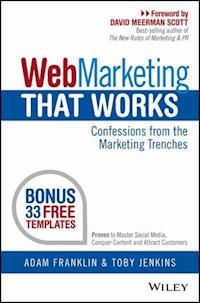
Practical tips on using the web to boost your business, no matter what business you're in Everyone in business knows they need to embrace the web, but not everyone knows how to do it or where to start. No matter what industry you're in, the web offers efficiencies and solutions for sales, marketing and customer service, and many other business functions. For businesspeople, small business owners, and marketers, Web Marketing That Works offers proven tactics, road-tested by the authors, and easy-to-use templates for boosting your Google search rankings, using social media to build relationships, developing an effective online marketing strategy, mastering the art of inbound marketing, and much more. * Features insider advice and proven tactics for small business owners and marketers who want to tap into the power of the web * Covers web strategy, execution, content marketing, and social media * Includes 33 free, downloadable templates * Written by the founders of Bluewire Media, one of Australia's top web marketing firms Every business, large or small, can benefit from the web. If you're not already using the web to boost your business, you're falling behind the competition. Web Marketing That Works shows you how to get ahead--starting right now.
Sie lesen das E-Book in den Legimi-Apps auf:
Seitenzahl: 323
Veröffentlichungsjahr: 2014
Ähnliche



















Contents
Cover
Series
Title Page
Copyright
Dedication
Foreword by David Meerman Scott
About the authors
Acknowledgements and thanks
First and foremost: our story and why you need this book
Bonus 33 free templates
Part I: How it all works
Chapter 1: Your web universe: content, web and inbound marketing
Building a web marketing asset
One block at a time
Your web universe from 20 000 feet
Elements of the web universe
Part II: Strategy
Chapter 2: Web strategy: defining your buyer personas
Setting your strategy
Building your buyer personas
Chapter 3: Flagship content: the cornerstone of your web marketing
Finding our flagship content: the birth of the template
Content so valuable people would pay for it
Conduct a content audit
Creating more: premium content
Chapter 4: Content marketing: know, like and trust
Relationships take time
What do you have to offer?
The art of repurposing
A final note on etiquette
Part III: Building home base
Chapter 5: Web marketing metrics and reporting ROI
The purpose of metrics
Web Marketing Health Check
Google Analytics
Chapter 6: Building your own website
Setting up our own website
Five pitfalls of website projects
Chapter 7: Landing pages: design, psychology and leads
Nurturing your leads
What is a landing page?
Two approaches to growing your community
Anatomy of a successful landing page
Get traffic direct to your landing page
Part IV: Content creation
Chapter 8: Email marketing: the ultimate tool for web marketers
Everyone uses email
Why email over social media?
Content people gravitate towards
Email type 1: regular email newsletters
Email type 2: lead-nurturing autoresponder emails
Email type 3: text only (your secret sales weapon)
Pruning your list
More email marketing experiments
Chapter 9: From blogging to content marketing: attracting leads, not just readers
Why were we missing the mark?
You need readers
Guest blogging
How to write great headlines
The anatomy of a good blog post
A blog post shared with 47 000 CEOs
Promotion
Are you a content marketer or a blogger?
Chapter 10: Video, audio and image publishing: YouTube, webinars, infographics and podcasts
YouTube — a no-brainer
Webinars
Infographics
Podcasting is here!
Chapter 11: Publishing content and finding your editorial rhythm
Build around your flagship content
Picture your buyer personas
Writing and creating content
How to generate content
Part V: Getting found
Chapter 12: Search and keywords: search engine optimisation
How Google works (for a non-techie marketer)
Determining what people are searching for
Optimising your site: basic on-page SEO
Getting good backlinks: basic off-page SEO
How to gauge domain authority
Link building is really relationship building
Chapter 13: PR on the web: influencer outreach
About PR
Getting PR in the social pages
Getting lucky
People end up in all sorts of interesting places
Reaching out
Grow with your media contacts
Owning the ink
Blogger Outreach Email Template
Chapter 14: The secret to online is offline: events and speaking
Inbound12: making the most of the opportunity
Attend events to meet people
Organising live events
Public speaking
Chapter 15: How to sell online while keeping your integrity
Charging a fee is often in your customer's best interest
Overcoming our fear of selling online
What to sell?
How to sell online without selling your soul
How to write a sales email
Anatomy of an effective sales page
Part VI: Social media
Chapter 16: Social media in action: strategy and guidelines
The pub and the dinner party of the internet
The final pillar in your web marketing strategy
The power of ‘trust' over ‘sell'
With so many options, where should you start?
Great. Next step — which platform is for me?
What is the ROI of social media?
Your social media strategy
Establishing a risk management plan
The green light
Getting active on social media
Social media guidelines
Chapter 17: LinkedIn: the essential social network for business
LinkedIn for beginners
LinkedIn for intermediates
LinkedIn for advanced users
LinkedIn for genuine influencers
Chapter 18: Facebook: a gold mine for marketers
Facebook business page
Getting more fans
Our best Facebook updates
Closing the gap on content promotion
Selling on Facebook
A note on privacy
Chapter 19: Twitter: a communication revolution
Digital immigration: learning from the natives
Twitter explained: for beginners
Intermediate Twitter
Advanced Twitter
Part VII: The future
Chapter 20: The road ahead
Index
Learn more with practical advice from our experts
Most books on online marketing are neither comprehensive nor practical. This is both. Two huge likeable thumbs up for this must-read!
∼ Dave Kerpen, New York Times best-selling author of Likeable Social Media and Likeable Business
A practical guide for CEOs looking to master marketing on the web. Adam and Toby have written a simple, no-fluff book as well as thrown in 33 templates to implement (and supercharge) your marketing today.
∼ Verne Harnish, author of Mastering The Rockefeller Habits and CEO of Gazelles
Adam Franklin and Toby Jenkins are the new power duo of digital marketing. Their how-to guide Web Marketing that Works is a powerful blueprint packed with concrete insights and practical tools that will multiply your team's success.
∼ Liz Wiseman, best-selling author of Multipliers
In Web Marketing that Works, you will learn everything you need to know to generate attention for your business. Just like my two friends Adam and Toby, the book is fun, approachable, slightly alternative, and it delivers great ideas about how to develop strategies and implement tactics for success.
∼ David Meerman Scott, best-selling author of The New Rules of Marketing & PR
Is there a ‘one-size fits all' strategy for brands to better understand the new myriad of ways that they can connect a message with a consumer? Adam and Toby think so. In Web Marketing that Works, you are given a real and practical how-to guide to get your business more digitally savvy. A lot of books on the market speak to the ‘why' this is so critical for business success today. This books speaks to the ‘how' … and it's something that every business needs to know and do.
∼ Mitch Joel, author of Six Pixels of Separation and CTRL ALT Delete and President of Twist Image
The problem with new marketing is that practitioners look for the easy route. They either copy other companies or leave it to their agencies to come up with ideas. Relationships between your business and your customers are just that … they're yours. Adam and Toby help you become the success story that others want to copy.
∼ Brian Solis, digital analyst and author of What's the Future of Business (WTF)
Adam and Toby deliver on the irresistible offer: a mother lode of ideas grounded in experience and insight, and focused templates to custom fit those ideas to your business.
∼ Liz Strauss, business strategist and author of The Secret to Writing a Successful and Outstanding Blog
With comprehensive coverage, exceptional detail, and dozens of free templates, this is the most useful book on digital marketing ever. It's years worth of knowledge and insights packed into a couple of hundred pages. Indispensable, and a must-read!
∼ Jay Baer, New York Times best-selling author of Youtility: Why Smart Marketing is About Help not Hype
Adam and Toby have put together a commendable and rare treat for those seeking to learn web marketing: a book that is both comprehensive AND easy to digest. By taking complex topics and boiling them down to their essence, the pair have made critical information on everything from SEO to blogging to social media and beyond accessible to everyone.
∼ Rand Fishkin, Moz founder and author of Inbound Marketing & SEO
No ‘pie-in-the-sky' theories with this book. Web Marketing that Works is 100 per cent actionable, includes dozens of easy-to-use templates and is built for marketers at the biggest brands to the one-person start up.
∼ Joe Pulizzi, author of Epic Content Marketing and founder of Content Marketing Institute
The web has changed marketing forever! Now buyers — not sellers — are in control. Adam and Toby's book gives you the marketing framework for business today so that you're using the web to empower buyers at their four decisive moments.
∼ Robert Bloom, author of The New Experts and The Inside Advantage and US Chairman/CEO of Publicis Worldwide
Adam and Toby have created an important resource for marketers, perfect for entrepreneurs and enterprise alike. This well-written volume provides coverage of a number of critical web marketing issues and an elegant journey from strategy to tactics not commonly covered in most introductory marketing books. If you want to drive leads, you owe it to yourself to read this book.
∼ Eric Keiles, co-author of Reality Marketing Revolution and Fire Your Sales TeamToday
The team at Bluewire Media has created a practical, actionable guide to help businesses launch, manage and measure their inbound marketing efforts, including insights from their experience, templates to keep efforts organized and efficient, and best practices to guide your lead generation efforts. You won't want to miss it.
∼ Brian Halligan, author of Inbound Marketing and CEO of Hubspot
If you want to be on the bleeding edge of marketing, this book is for you. Web Marketing that Works throws out yesterday's strategies and provides a roadmap for how to win in web marketing TODAY. EntrepreneurOnFire will be implementing these strategies, and I can't wait for the results!
∼ John Lee Dumas, host of Entrepreneur On Fire, the #1 iTunes business podcast
Adam and Toby ‘get it'. I have seen them in action and they understand how the social web works and how to make results happen. This book shows you how to succeed with your marketing online!
∼ Jeff Bullas, author of the Amazon bestseller, Blogging the Smart Way and Forbes Top 50 Social Media Power Influencer (#11)
Adam and Toby are the real deal. They are passionate about how web marketing can help business owners. This book is packed with practical advice and truly useful examples. A must-read for business owners. I devoured every page.
∼ Valerie Khoo, author ofPower Stories
If you are serious about moving your online marketing forward then Adam and Toby are the genuine article. Experts walking thriftily, delivering results for business owners!
~Brett Kelly, author of Business Owner Wisdom and CEO of Kelly+Partners
Wow! That's all I can say. I've seen my fair share of books claiming to share the secret sauce of web marketing, but none of them have even come close to this. Adam and Toby really know their onions, and this book is full of practical examples, how-tos, and step-by-step instructions. It's the perfect guide for anyone who's just setting up their own business. For that matter, I think most established businesses could learn a lot from it too. I know I did, and I've been in the game since 2001! Well done, boys.
∼ Glenn Murray, author of SEO Secrets and Practical SEO Copywriting
A great read for any small business owner, overwhelmed by theory, who simply wants to take action. We are who Google says we are. That's just how it is. Web Marketing that Works will ensure the reader (who actions these tested ideas) sees an ROI from their marketing efforts that they deserve. It's less a book, more a hardened battle plan.
∼ Tim Reid, host of The Small Business Big Marketing Show, Australia's #1 marketing podcast
Adam and Toby have combined some of the best marketing lessons and resources into a straightforward book that both makes the case for why and then gives step-by-step instructions on how to do it right. They humbly share their mistakes, then they give insights into their secrets for results. It's a great example of itself: content that drives relevance and results. I recommend this book for marketers in virtually any industry. You'll read it in a weekend and refer back to it (and the templates it contains) over and over again.
∼ Andy Crestodina, author of Content Chemistry
For most of us, web marketing is a big, scary puzzle. We avoid it because we're terrified of stuffing up, or we pay ‘experts' a fortune and don't even know if it's working. After reading this book full of practical advice and templates that are truly idiot-proof (trust me!) you will let out a huge sigh of relief and think: ‘I can do this. And I can start TODAY!'
∼ Marty Wilson, best-selling author of the What I Wish I Knew series
Adam and Toby have the runs on the board — this book is seriously jam-packed with stories, tips and practical ideas that will help your brand stand out in today's noisy marketplace.
∼ Trevor Young, author of microDOMINATION
It's time to put an end to lousy web marketing advice and that is exactly what Adam Franklin and Toby Jenkins have done in Web Marketing that Works. If you want real advice, street smart advice and practical advice, from two of the most experienced in the game, this is the book you really need to read.
∼ Andrew Griffiths, Australia's #1 small business author
If you want to get into the trenches and make a real impact with your online marketing, learn from Adam Franklin and Toby Jenkins. They have gained mastery through doing, and in Web Marketing that Works they share the nitty-gritty of precisely what you need to do to get the results you want.
∼ Ross Dawson, futurist and author of Living Networks
As a serial entrepreneur operating 8 businesses, 3 of those online and in different countries, I thought we knew a lot about web marketing. From this book I've picked up a stack of ideas and processes that will clearly work a treat for us. THANK YOU Adam and Toby. Clear, concise and logical. They cover the different aspects of web marketing, by story telling and with great process tips and templates. This book is going to become compulsory reading for all my senior management team and everyone near me involved in marketing. It's brilliant to get us all on the same page and to help us strategise a new marketing plan to suit us. Congratulations — in practical web and feeder marketing, you guys rock.
∼ Mike O'Hagan, serial entrepreneur and owner/founder of MiniMovers
I highly recommend Web Marketing that Works to marketing managers and those responsible for an organisation's digital strategy. After surveying the marketplace for a robust conceptual and practical framework for creating and managing a web and social media activity, nothing else comes close to this. I am delighted to see this model now in print. It will become the benchmark framework for ‘thinking marketers' to deliver superior client and business outcomes. It really is essential reading.
∼ Peter Bowman, author of Service 7
Adam and Toby have laid out a clear, easy-to-follow process that allows businesses to build genuine relationships with their customers. This is a great resource for entrepreneurs who are new to the online marketing world and are stuck between conflicting advice about online marketing.
∼ Danny Iny, author of Engagement from Scratch!
Most general marketing books are incomplete and lack practical application. This is a comprehensive primer that every business should read and apply. Now they can thanks to Adam and Toby's sharing of their own marketing laboratory. Take this book and go to market!
∼ Kevin Daum, best-selling author of ROAR! Get Heard in the Sales and Marketing Jungle and Video Marketing For Dummies
First published in 2014 by John Wiley & Sons Australia, Ltd 42 McDougall St, Milton Qld 4064
Office also in Melbourne
Typeset in 11/13.5 pt ITC Berkeley Oldstyle Std
© Adam Franklin & Toby Jenkins Partnership 2014
The moral rights of the authors have been asserted
National Library of Australia Cataloguing-in-Publication data:
Author:Franklin, Adam, author.Other Authors:Jenkins, Toby, author.Title:Web Marketing that Works: confessions from the marketing trenches / Adam Franklin and Toby Jenkins.ISBN:9780730309277 (pbk) 9780730309307 (ebook)Notes:Includes index.Subjects:Internet marketing. Electronic commerce. Internet advertising. Online social networks – Economic aspects. Success in business.Dewey Number:658.872All rights reserved. Except as permitted under the Australian Copyright Act 1968 (for example, a fair dealing for the purposes of study, research, criticism or review), no part of this book may be reproduced, stored in a retrieval system, communicated or transmitted in any form or by any means without prior written permission. All inquiries should be made to the publisher at the address above.
Cover design by Peter Reardon, www.pipelinedesign.com.au
Disclaimer
The material in this publication is of the nature of general comment only, and does not represent professional advice. It is not intended to provide specific guidance for particular circumstances and it should not be relied on as the basis for any decision to take action or not take action on any matter which it covers. Readers should obtain professional advice where appropriate, before making any such decision. To the maximum extent permitted by law, the authors and publisher disclaim all responsibility and liability to any person, arising directly or indirectly from any person taking or not taking action based on the information in this publication.
For our families and for Luce.
Foreword by David Meerman Scott
What we all really want is ATTENTION
Entrepreneurs, CEOs, and business owners want people to pay attention to their company. Marketers, PR pros, advertisers and salespeople are on the payroll for one reason: To generate attention.
In thinking about attention, there seem to be four main ways to generate it today.
You can buy attention. This is called advertising.
You buy access to people through expensive television commercials, magazine and newspaper ads, the Yellow Pages, billboards, tradeshow floor space, direct mail lists and the like.
Advertising agency staffers are really good at buying attention. The problem is that whenever you have an attention problem and consult an advertising agency, the solution always involves buying attention.
You can beg for attention. This is called public relations.
You beg for access via the editorial gatekeepers at radio and TV stations, magazines, newspapers, trade journals and, more and more these days, bloggers, podcasters and people with followings on other social networking sites.
I realise that the word ‘beg' is a little extreme, but in my former life as VP of corporate communications at several different global companies, I did feel a bit like a beggar. And these days I get hundreds of pitches a month from people (usually PR agency staffers) who want me to write about something on my blog or in my books or to pimp them on Twitter and frankly, many of these pitches have a whiff of desperation about them.
Public relations agency staffers are really good at begging for attention. The problem is that whenever you have an attention problem and consult a public relations agency, the solution always involves generating attention from third parties.
You can bug people one at a time to get attention. This is called sales.
You knock on doors, call people on the telephone, send personal emails, or wait for individuals to walk into your showroom.
Again, sorry about the extreme nature of the word ‘bug' but that's how I feel when confronted with pushy hardcore sales tactics.
Salespeople are really good at getting attention one person at a time. The problem is that whenever you have an attention problem and consult a sales professional, the solution always involves generating attention one person at a time.
You can earn attention online.
This idea is quite simple. You create something interesting and publish it online for free: A YouTube video, blog, research report, series of photos, Twitter or Instagram stream, e-book, Facebook page and the like.
And guess what? You can earn attention for your business yourself!
There's no doubt that earning attention works best. Why? Because today, buyers are in charge! Referencing blogs, social networks, review sites and other web-based tools, they often bypass the traditional marketing and selling model altogether — learning for themselves about your products and services, your competitors, and what your customers say about you (whether true or not!).
Don't struggle to adjust to this new environment — be agile and master it. The key is a real-time mindset and an arsenal of new communication tools. You win hearts and minds by creating low-cost (and no-cost!), measurable strategies and tactics that help buyers you don't yet know discover you. Publishing content online is free or nearly free. YouTube? Free. Twitter? Free. You don't have to pay to generate attention!
The best organisations have become content publishers and information brokers — communicating by delivering the precise information that buyers need at just the right time and in just the right way.
In fact, this idea of how to generate attention is so simple that it can be summed up like this: On the web, you are what you publish. If you're publishing great information on the web, you are great and people will find you and want to do business with you. If you're publishing nothing on the web, then you're nothing, nada, and nobody will find you when they search for a company like yours. And if you're publishing crap, well, then … you get the idea.
Organisations gain credibility and loyalty with buyers through content, and smart organisations think and act like publishers in order to create and deliver content targeted directly at their audience.
Don't push product. Teach people something. Share your expertise.
More than five years ago I met Adam and Toby, which is remarkable because I live in Boston and they are 10 000 miles away in Sydney. How did we meet? On the web of course! We shared many of the same philosophies about how to generate attention in today's hyper-connected world.
Soon after, we shared a meal in Sydney and cooked up a plan. They had been working on a strategy document for their clients and shared their draft with me. Our ideas were so similar that we collaborated on publishing what became our Web Strategy Planning Template that we would jointly brand and share with our followers (you'll learn about it in these pages). And boy, am I glad I did that because it's now been seen by more than a quarter of a million people! Imagine that? A simple PDF document that helps hundreds of thousands of people to become better at how they generate attention and it cost zero to publish.
In Web Marketing that Works, you will learn everything you need to know to generate attention for your business. Just like my two friends Adam and Toby, the book is fun, approachable, slightly alternative, and it delivers great ideas about how to develop strategies and implement tactics for success.
Good luck as you embark on generating attention for your business.
And remember, on the web, you are what you publish.
David Meerman Scott
Best-selling author of ten books including The New Rules of Marketing & PR, now in its fourth edition with more than 300 000 copies sold in English and available in over 25 languages, from Bulgarian to Vietnamese.
Boston, MA
January, 2014
About the authors
Adam Franklin and Toby Jenkins founded Bluewire Media in 2005 and help clients with their web marketing. They provide workshops, events, online courses, consulting, mentoring, keynote speaking and also form joint ventures.
Adam Franklin is an international social media speaker and marketing manager of Bluewire Media. Adam is a regular writer for StartupSmart and occasionally contributes to SmartCompany, Sydney Morning Herald and radio station 2UE.
Toby Jenkins is CEO of Bluewire Media, a business speaker and also competed at the Athens Olympics as part of the Australian water polo team.
Their Bluewire Media blog has been named in the Top 20 Australian Business Blogs every year since 2010, and their weekly Bluewire News email goes out to over 10 000 subscribers. They also host a podcast called Web Marketing That Works.
Adam and Toby co-created the Web Strategy Planning Template which has been seen by hundreds of thousands of people worldwide. They have featured on Smart Company's Hot 30 Under 30 and the Dynamic Business 2010 Young Guns lists of young entrepreneurs, as well as in David Meerman Scott's bestselling book The New Rules of Marketing & PR.
Adam and Toby have been mates since Grade One. They went to primary school, high school and university together, competed in water polo and swimming teams, travelled overseas and then decided to start a business together in 2005.
Bluewire Media
Blog: www.bluewiremedia.com.au/blog
Twitter: @Bluewire_Media Facebook: www.facebook.com/BluewireMedia
Adam Franklin
Twitter: @Franklin_Adam
LinkedIn: www.linkedin.com/in/adamfranklin
Personal blog: www.adamfranklin.com.au
Email: [email protected]
Toby Jenkins
Twitter @Toby_Jenkins
LinkedIn: www.linkedin.com/in/tobyjenkins
Personal blog: www.tobyjenkins.com.au
Email: [email protected]
Acknowledgements and thanks
We would like to thank the following people who have shaped our business, our marketing and this book. Many have guided us via their blogs, podcasts, speaking, books and videos, and a few we have the privilege of knowing and calling friends. Thank you.
Amy Porterfield Amanda Gonzalez Andrew Griffiths Andy Crestodina Ann Handley Anne Sorensen Ash Richardson Barry Feldman Ben Richardson Bernie Borges Bob Bloom Bob Ruffolo Brett Kelly Brian Clark Brian Halligan Brian Solis CC Chapman Charles Badenach Chris Brogan Chris Guillebeau Clay Collins Cliff Ravenscraft Corbett Barr Dan Norris Dan ZarrellaDaniel Pink Danny Iny Darren Rowse Dave Kerpen Dave Peck David Graham David Greiner David Heinemeier Hansson David Koch David Meerman Scott David Siteman Garland David Smerdon Dean Jackson Derek Halpern Dharmesh Shah Doug Kessler Eric Keiles Eric Reis Erik Qualman Erika Napoletano Evan Fortune Gary Bertwistle Gary Vaynerchuk Giam Swiegers Gina LofaroGini Dietrich Glenn Murray Georgina Dent Guy Kawasaki Iggy Pintado Jack Daly Jaime Tardy James Adonis James Shramko Jared Easley Jared Spool Jason Falls Jason Fried Jay Abraham Jay Baer Jeff Bullas Jen Bishop Jeremiah Owyang Jess Whittaker Jill Konrath Jim Collins Jim Stewart Joe Polish Joe Pulizzi Joel FlomJohn Fison John Jantsch John Lee Dumas Jon Morrow Jonathan Crossfield Julien Smith Karen Beattie Keith Ferrazzi Kevin Daum Kevin Ryan Kylie Bartlett Lance Schwab Larry Bloch Laura Fitton Laurel Papworth Lee Odden Leo Widrich Liz Strauss Liz Wiseman Llew Jury Malcolm Turnbull Malcolm Burrows Malcolm Gladwell Marc Lehmann Marcus Childs Marcus Sheridan Mari Smith Mark Parker Mark Schaefer Marshall Goldsmith Marty Wilson Mathew Myers Matthew Johnson Matt CrawfordMelissa Jun Rowley Mel Kettle Matt Crawford Melissa Jun Rowley Mel Kettle Mia Freedman Michael Hyatt Michael Stelzner Mike Cannon-Brookes Mike Lieberman Mike O'Hagan Mitch Joel Nancy Duarte Naomi Simson Nassim Nicholas Taleb Nick Bowditch Nick Kellet Nigel Heyn Oli Gardner Pat Flynn Patrick Lencioni Paul Wallbank Peter Blasina Peter Bowman Peter Diamandis Peter Williams Ramsay Taplin Ray Edwards Rand Fishkin Robert Cialdini Robert Rose Ron Baker Ross Dawson Ryan HolidaySally Hogshead Scott Belsky Scott Berkun Scott Dinsmore Scott Farquar Scott Ginsberg Scott Stratten Seth Godin Sharon Williams Shayne Tilley Simon Kalinowski Siimon Reynolds Simon Sinek Sonia Simone Steve Krug Susan Cain Tamar Weinberg Ted Rubin Tiffany Sauder Timothy Ferriss Tim Martin Timbo Reid Tom Poland Tony Hollingsworth Trent Dyrsmid Trevor Young Tristan White Valerie Khoo Vanessa Fox Verne Harnish Vivienne Storey Will Swayne Yaro StarakWe'd like to say a huge thank you:
To the Bluewire community for sharing in this nine-year journey with us so far.
To Valerie and Georgie, and Kristen, Alice, Elizabeth, Keira, Jem and the team at Wiley for making this book a reality.
To Greg, David, Mike, Toni, Tony, John and Ash for helping us navigate our business adventure.
To the Bluewire team for your friendship and your help in creating, implementing and refining so much of what we've shared in this book.
To our friends and families who have supported us since the beginning. Especially Frannie and Marg who helped us ‘bash these words into submission'.
And to Lucy, the love of Toby's life.
First and foremost: our story and why you need this book
A journey of a thousand miles begins with a single step.
Lao-tzu
January 7, 2005, was an auspicious day for us. We walked out of the business licensing office in Spring Hill, Brisbane, into a sweltering Australian summer day. We'd just registered our trading name, Bluewire Media. We were officially business owners. All that was missing was one small piece of the puzzle — clients.
And so began our marketing journey.
Here we were, non-technical business owners who'd never written a line of code, selling websites. Rather than learning how to program, our passion was in learning how to market, run and grow a business. We knew marketing was a key ingredient and we needed to learn how to get leads for our burgeoning business.
Door knocking was our opening move. Armed with notepads, matching business shirts and a polished script, we started canvassing the local businesses.
‘Hi. My name is Adam and this is Toby. We're from Bluewire Media, a web design company. We were wondering if you needed a website?'
‘No thanks, not at the moment.'
‘No problem. Thanks for your time.'
And so it went. We pounded the pavement for an entire two days, working our way through store after store, business after business, in the summer heat. The result? Nothing. Not a single solitary lead.
The breaking point came when it was Toby's turn to lead. He accidentally followed the script verbatim: ‘Hi, I'm Adam …'! We realised our gaffe, left the store and burst into laughter. It was either that or cry. We needed to look for a better way.
We graduated from door knocking to cold-calling. At least now we were in the shade. We had a brainwave and started to qualify businesses that were advertising in the Brisbane News magazine but didn't have a website. Clearly they had a marketing budget, so all we had to do was convince them to spend it with us.
There were three things hurting our credibility. Firstly, we were selling websites while our own was still under construction. Secondly, we had no website portfolio, since we had no clients. And thirdly, when we were making the calls, the birds in the trees beside Adam's parents' deck were chirping loudly in the background.
To make up for these chinks in our armour, we stepped up our sophistication and trialled our first offer: we'd mock up a website design for the business if they would agree to a meeting. While this was labour intensive, it won us the attention we were after and we started to book some appointments.
Interestingly, though, our first sale came through word-of-mouth, from an old water polo coach. His mate at the pub said he needed a website. Our coach passed on his details and we landed the gig. Receiving our first-ever cheque for a deposit of $247.10 is still one of our favourite business memories.
And we progressed. We learned two things from that first win: that our community was valuable and that we needed to deliver value. So we tapped into our existing networks, such as our university alumni and old boys' networks, and drummed up any PR we could off the back of Toby's recent performance at the Athens Olympics. All of our early press mentions featured water polo caps and laptops — anything to spread the Bluewire word!
We signed up to a free listing in the Yellow Pages and were seen at every networking function possible. We'd show up at the opening of an envelope if given half a chance.
We came to realise that the old adage that word-of-mouth is the best form of marketing was absolutely true. Since all of our business was coming through our networks and relationships, we decided that would be where we invested our time, money and resources. As a start-up, we had no money to invest in paid advertising so we focused on growing and nurturing our network by being generous and offering advice, and this led to sales.
Marketing on the web was fantastic for this because it scaled. Anybody on the web could potentially find us through our website, and with the click of a button we could send an email to our entire network. This was the birth of our Bluewire News emails. With these breakthroughs, our business, Bluewire Media, was off and racing.
We soon learned that the best use for the Yellow Pages was as a step for Adam to stand on so he was a bit taller in photos next to Toby. We loved the web and were hooked on this new business so threw ourselves into reading books, listening to CDs (it was pre iTunes!), attending conferences and learning from marketers online to discover all we could about web marketing that works.
We furiously implemented what we learned, experimenting and testing as we went. As non-technical first-time business owners, we were brimming with enthusiasm, and it's been like that for nearly a decade now. This book is the product and culmination of our firsthand experiences as we've tried to find the most effective ways to market our business on the web.
On the shoulders of giants
From the outset, our love of business, marketing and the web inevitably put us on a happy collision course with the work of David Meerman Scott, Seth Godin, Chris Brogan, Julien Smith, Gary Vaynerchuk, Brian Halligan and Dharmesh Shah.
Back in the mid to late 2000s these were the people who shaped our thinking about marketing a business in today's connected web world. Destiny for us was the ground-breaking ideas in their blogs and books about permission marketing, inbound marketing, the ‘new rules' and building trust.
Everything totally resonated and the timing was perfect. These people validated what we had been experiencing and, better yet, they provided a framework and language that went with it. The world was on the cusp of a genuine revolution. And as entrepreneurs in a web business, we were free to implement the ideas unhindered.
We had an ‘aha!' moment seeing David Meerman Scott's keynote presentation called ‘The New Rules of Marketing & PR' via satellite in Sydney. Wow! It stopped us in our tracks. You cannot beg, bug or buy attention, David argued. You must earn it by publishing great content on the web. He was speaking our language, even though he'd just opened our eyes and ears to it. What perfect timing to cross paths with David's ideas and have the luxury of being able to start implementing them straight away.
The old rules of marketing from the pre-web days dictated that you must beg (press releases), bug (salespeople) or buy (ads) people's attention. Today these approaches don't work as well as they used to. Now you must earn attention by publishing content on the web that solves your buyers' problems. In David Meerman Scott's words, ‘on the web you are what you publish!'
Around the same time, we read Seth Godin's Permission Marketing. His message — that you can't interrupt people with advertising messages and expect them to listen — also rang true. You can't beat people over the head, online or offline. You need their permission, and remarkable content is the ticket. Seth had even called out the offending style of marketing and given it a name — interruption marketing. This idea resonated with us, clearly delineating fundamentally different marketing styles. We knew interruption marketing wasn't for us.
Chris Brogan and Julien Smith's book Trust Agents and Gary Vaynerchuk's Crush It! provided a blueprint for taking action, based on the idea that being human, earning trust and developing relationships one at a time were the keys to success on the web. Very powerful and so simple.
Brian Halligan and Dharmesh Shah's book Inbound Marketing provided the final piece of the puzzle, a marketing philosophy to live by and a name for it too — inbound marketing. Attract visitors with great information, continue to nurture these people by helping and teaching them, and eventually they will become paying customers and delighted referrers.
Advertising no longer reigned supreme
In our early days, advertising agencies reigned supreme in the marketing world. As a small web firm, we partnered with many of them and worked with their clients, although we found from the very start that advertising principles simply didn't seem to perform the same when applied to the web. Banner ads, splash pages and flash intros were not things that we enjoyed personally, and it never seemed right to subject other people to them.
The stop-start campaign mentality didn't sit well with us either. Three to six months of frenzied activity followed by a complete halt seemed an unlikely formula for lasting success. Surely we were in this for the long run? Still, it was work, it paid the bills for our start-up, and it allowed us to cut our teeth in business and marketing.
A universe of connected humans
It turned out we weren't the only ones who didn't really like advertising and its unwelcome interruptions. The marketing world had changed to a place where we could all block out ads through do-not-call lists; TiVo; pop-up blockers; unsubscribe, un-follow and un-like buttons; and simply clicking out of a website. You could no longer effectively interrupt your way into people's lives. And if you did manage to intrude, you'd be more likely to annoy them than encourage them.
Instead you need to draw people in with inbound marketing. Use blogs, social media and content to be discovered, attract leads and win customers. Also, the stop-start campaign mentality doesn't apply — inbound marketing is an ongoing program. We need to stop creating interruptions to insert into other people's content, and start creating the content ourselves.
There is a supreme irony in the fact that the most modern technology is a vehicle for the development of a universe of real, connected human beings. The key to success now, more than ever, is to be human — to earn trust and develop relationships with other human beings.
The future is now
The permission-based world that Seth Godin describes in Permission Marketing has already arrived. What happens next is up to us.
We're living in an age when we can be connected to anyone on Earth with WiFi and a smartphone — a supercomputer in our pocket with more capability than was thought possible even 10 years ago.




