


296,99 €
Mehr erfahren.
- Herausgeber: John Wiley & Sons
- Kategorie: Fachliteratur
- Sprache: Englisch
Weeds affect everyone in the world by reducing crop yield and crop quality, delaying or interfering with harvesting, interfering with animal feeding (including poisoning), reducing animal health, preventing water flow, as plant parasites, etc. Weeds are common everywhere and cause many $ billions worth of crop losses annually, with the global cost of controlling weeds running into $ billions.
The anatomy of plants is generally well understood, but the examples used for explanations in most books are often restricted to non-weed species. Weeds have many features that make them more competitive, for example enabling them to more quickly recover after herbicide treatment. Some of these adaptations include rhizomes, adapted roots, tubers and other special structures. Until now,
no single book has concentrated on weeds’ anatomical features. A comprehensive understanding of these features is, however, often imperative to the successful implementation of many weed control measures.
Beautifully and comprehensively illustrated, in full colour throughout, Weed Anatomy provides a comprehensive insight into the anatomy of the globally-important weeds of commercial significance. Commencing with a general overview of anatomy, the major part of the book then includes sections covering monocotyledons, dicotyledons, brackens and horsetails, with special reference to their anatomy. Ecological and evolutionary aspects of weeds are also covered and a number of less common weeds such as Adonis vernalis, Caucalis platycarpos and Scandix pecten-veneris are also included.
The authors of this book, who have between them many years of experience studying weeds, have put together a true landmark publication, providing a huge wealth of commercially-important information. Weed scientists, plant anatomists and agricultural scientists, including personnel within the agrochemical and crop protection industry, will find a great deal of useful information within
the book’s covers. All libraries in universities and research establishments where agricultural and biological sciences are studied and taught should have copies of this exceptional book on their shelves.
Sie lesen das E-Book in den Legimi-Apps auf:
Seitenzahl: 349
Veröffentlichungsjahr: 2013
Ähnliche



















Table of Contents
Title page
Copyright page
SECTION I: Cells and Tissues
Introduction
Morphology, Anatomy, Physiology – Explanation of Terms
Chapter 1 Tissues
Chapter 2 Parenchyma
Chapter 3 Collenchyma
Chapter 4 Sclerenchyma, a Typical Contributor to Weediness
SECTION II: Meristematic, Secretory, Storage and Boundary Structures
Chapter 5 Meristems
Chapter 6 Secretory Structures
Chapter 7 External Secretory Structures
Chapter 8 Internal Secretory Structures
Chapter 9 Stored Compounds
Chapter 10 Epidermis
Chapter 11 Stomata
Chapter 12 Non-glandular Trichomes and Papillae
SECTION III: Vascular Elements and Pith
Chapter 13 Vascular Bundles
Chapter 14 Xylem
Chapter 15 Pits
Chapter 16 Phloem
Chapter 17 Pith
SECTION IV: Stem, Root and Growth
Chapter 18 Stem
Chapter 19 Dicot Stem – Cortex
Chapter 20 Dicot Stem – Patterns of Vascular Tissues
Chapter 21 Vascular Bundles and Leaf Traces in Dicots
Chapter 22 Monocot Stem
Chapter 23 Horsetail and Bracken Stem
Chapter 24 Root Morphology
Chapter 25 Root Histology
Chapter 26 Root Tip
Chapter 27 Xylem Patterns
Chapter 28 Endodermis and Pericycle
Chapter 29 Rhizodermis, Exodermis and Cortex
Chapter 30 Root Genetics
Chapter 31 Primary and Secondary Growth
Chapter 32 Anomalous Secondary Growth
SECTION V: Complex Tissues and Organs
Chapter 33 Leaf
Chapter 34 Flower
Chapter 35 Androecium
Chapter 36 Gynoecium
Chapter 37 Genetics of Flower Formation
Chapter 38 Fruit
Chapter 39 Carpels, Pericarp and Various Fruit Forms
Chapter 40 Genetics of Fruit Development
Chapter 41 Seed
Chapter 42 Genetics of Seed Development
Chapter 43 Secondary Reproduction Characteristics
Chapter 44 Flower Modifications in Weeds
Chapter 45 Seedling and Embryo
SECTION VI: Vegetative Propagation
Chapter 46 Vegetative Weed Reproduction
Chapter 47 Rhizomes
Chapter 48 Tubers and Corms
Chapter 49 Stolons and Runners
Chapter 50 Roots with Adventitious Buds
Chapter 51 Bulbs
SECTION VII: Weediness
Chapter 52 Indicators of Weediness
SECTION VIII: Short Monographs
Chapter 53 Introduction to Monographs
Chapter 54 Weed Anatomy Monographs
Weed Anatomy Monograph 1: Abutilon theophrasti Medicus
Weed Anatomy Monograph 2: Alopecurus myosuroides Huds. and Alopecurus japonicus Steudel
Weed Anatomy Monograph 3: Amaranthus retroflexus L. and Amarantus palmeri S. Wats.
Weed Anatomy Monograph 4: Ambrosia artemisiifolia L.
Weed Anatomy Monograph 5: Apera spica-venti (L.) P. Beauv.
Weed Anatomy Monograph 6: Avena fatua L. and Avena sterilis L.
Weed Anatomy Monograph 7: Bidens pilosa L. and Bidens tripartita L.
Weed Anatomy Monograph 8: Bromus secalinus L., Bromus sterilis L. and Bromus tectorum L.
Weed Anatomy Monograph 9: Calystegia sepium (L.) R. Br. and Convolvulus arvensis L.
Weed Anatomy Monograph 10: Chenopodium album L.
Weed Anatomy Monograph 11: Cirsium arvense (L.) Scop.
Weed Anatomy Monograph 12: Conyza canadensis (L.) Cronq. and Conyza bonariensis (L.) Cronq.
Weed Anatomy Monograph 13: Cynodon dactylon (L.) Pers.
Weed Anatomy Monograph 14: Cyperus esculentus L., Cyperus iria L., Cyperus rotundus L. and Cyperus serotinus Rottb.
Weed Anatomy Monograph 15: Digitaria sanguinalis L.
Weed Anatomy Monograph 16: Echinochloa colonum (L.) Link and Echinochloa crus-galli (L.) Beauv.
Weed Anatomy Monograph 17: Eleusine indica (L.) Link
Weed Anatomy Monograph 18: Elytrigia repens (L.) Nevski
Weed Anatomy Monograph 19: Fallopia convolvulus (L.) Löve, Fallopia japonica (Houtt.) Ronse Decraene, Fallopia sachalinensis (F. Schmidt) Ronse Decraene and Fallopia baldschuanica (Regel) Holub
Weed Anatomy Monograph 20: Galium aparine L.
Weed Anatomy Monograph 21: Impatiens glandulifera Royle
Weed Anatomy Monograph 22: Lolium multiflorum Lam., Lolium perenne L. and Lolium rigidum Gaudin
Weed Anatomy Monograph 23: Myosotis arvensis (L.) Hill and Myosotis palustris (L.) Nath.
Weed Anatomy Monograph 24: Paspalum dilatatum Poir.
Weed Anatomy Monograph 25: Phalaris minor Retz. and Phalaris paradoxa L.
Weed Anatomy Monograph 26: Poa annua L.
Weed Anatomy Monograph 27: Polygonum amphibium L., Polygonum aviculare L. and Polygonum lapathifolium L.
Weed Anatomy Monograph 28: Rottboellia cochinchinensis (Lour.) W. Clayton
Weed Anatomy Monograph 29: Setaria faberi Herrm., Setaria glauca (L.) Beauv. and Setaria viridis (L.) Beauv.
Weed Anatomy Monograph 30: Sorghum halepense (L.) Pers.
Weed Anatomy Monograph 31: Urochloa platyphylla (Munroe ex C. Wright) R. D. Webster
Weed Anatomy Monograph 32: Xanthium strumarium L. and Xanthium spinosum L.
SECTION IX: Methods for the Preparation of Sections
Chapter 55 Tissue Preparation and Staining Procedures
References
Index
This edition first published 2013 © 2013 by John Wiley & Sons, Ltd.
Wiley-Blackwell is an imprint of John Wiley & Sons, formed by the merger of Wiley’s global Scientific, Technical and Medical business with Blackwell Publishing.
Registered office: John Wiley & Sons, Ltd, The Atrium, Southern Gate, Chichester, West Sussex, PO19 8SQ, UK
Editorial offices: 9600 Garsington Road, Oxford, OX4 2DQ, UK
The Atrium, Southern Gate, Chichester, West Sussex, PO19 8SQ, UK
2121 State Avenue, Ames, Iowa 50014-8300, USA
For details of our global editorial offices, for customer services and for information about how to apply for permission to reuse the copyright material in this book please see our website at www.wiley.com/wiley-blackwell.
The right of the authors to be identified as the authors of this work has been asserted in accordance with the UK Copyright, Designs and Patents Act 1988.
All rights reserved. No part of this publication may be reproduced, stored in a retrieval system, or transmitted, in any form or by any means, electronic, mechanical, photocopying, recording or otherwise, except as permitted by the UK Copyright, Designs and Patents Act 1988, without the prior permission of the publisher.
Designations used by companies to distinguish their products are often claimed as trademarks. All brand names and product names used in this book are trade names, service marks, trademarks or registered trademarks of their respective owners. The publisher is not associated with any product or vendor mentioned in this book. This publication is designed to provide accurate and authoritative information in regard to the subject matter covered. It is sold on the understanding that the publisher is not engaged in rendering professional services. If professional advice or other expert assistance is required, the services of a competent professional should be sought.
Library of Congress Cataloging-in-Publication Data
Kraehmer, Hansjoerg, author.
Weed anatomy / Hansjoerg Kraehmer, Bayer Crop Science, Aktiengesellschaft, Frankfurt am Main, Germany, Peter Baur, Head of Competence Center Crop Protection, Global Application Development, Clariant Industrial & Consumer Specialities, Industriepark Höchst, Frankfurt am Main, Germany.
Includes bibliographical references and index.
ISBN 978-0-470-65986-1 (hardback) – ISBN 978-1-118-50334-8 (epub) – ISBN 978-1-118-50343-0 (epdf)
1. Weeds–Anatomy. I. Baur, Peter, 1965– author. II. Title.
SB611.K73 2013
632’.5–dc23
2012040912
A catalogue record for this book is available from the British Library.
Wiley also publishes its books in a variety of electronic formats. Some content that appears in print may not be available in electronic books.
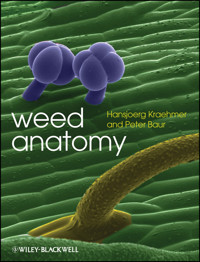
Cover image: Capitate glandular trichomes of Solanum nigrum L. (blue); SEM, computer-enhanced colours (see figure 7.1 for more details).
Cover design by Meaden Creative
SECTION ICells and Tissues
No function without structure
Introduction
Weeds are plants interfering with the interests of people. They are regarded as problems especially by farmers, by industrial vegetation managers, in ornamental production, in forestry or on sites where vegetation can cause safety risks, for example on railway tracks or along motorways. Some weeds impose a health risk for people by causing allergic reactions, such as Ambrosia artemisiifolia L. Others are toxic to animals, such as Senecio jacobaea L. which kills horses from time to time when eaten. As part of our ability to approach problems systematically, humans try to classify and to prioritise. A famous book cited by weed scientists is The World’s Worst Weeds (Holm et al. 1977). The title categorises weeds as bad. Weeds are, however, parts of ecosystems and are regarded as elements of biodiversity by many scientists today (Radosevich et al. 2007). For these reasons, we will not use value-driven categories in this book. We will also include rare weeds, that is weeds that are endangered and protected in some countries (e.g. according to the UK Biodiversity Action Plan). One might even ask if these plants can be called weeds as they don’t compete with crops and no longer negatively interfere with the interests of people. Proceedings of the Weed Science Society of America (WSSA) formerly classify weeds as either frequent or troublesome. Frequency can be quantified and measured; this is not so easy with troublesome. We will therefore try to concentrate on frequency and use tools described by plant population scientists (e.g. Braun-Blanquet 1964; Dierschke 1994). Anatomy and morphology are signs and the result of adaptation. In consequence, we try to link ecological characteristics with the form of adaptation. Weediness is the ability of unwanted plants to survive in an environment managed by humans. Modern weed control tools have reached a high degree of efficiency. Evolutionary principles, however, allow weeds to escape our efforts to control them. Resistance, physiological and morphological adaptation seem to happen much faster than we had previously realised. Within 6000 years of agriculture, a restricted number of weed species have been selected by humans. The flora has changed to some extent in history due to climate changes and to agricultural practice. A few species, however, have managed to survive over centuries. We will concentrate on these apparently best-adapted weeds and we will highlight their characteristics. The basis of our categories was defined by working groups of the European Weed Research Society.
Any plant can be a weed by definition (i.e. there are no typical structures or features within a plant that make it a weed). There are, however, characteristic features that allow some weed species to survive and proliferate in arable field situations: stolons, rhizomes, bulbs, tubers, buds on roots, seed morphology and reproductive organs. The uptake of herbicides and their distribution within a plant depend on leaf structures and barriers between parenchyma and vascular bundles. The morphological terms used in this book were derived from classical textbooks written, for example, by K. Esau (1969, 1977), A. Fahn (1990) or Bowes and Mauseth (2008), C.B. Beck (2010), E. Strasburger (1891). Thoughts about specific weed structures were inspired by W.C. Dickison’s book Integrative Plant Anatomy. Rich sources of details are A.R. Metcalfe’s series of Plant Anatomy (Metcalfe 1960, 1971; Metcalfe and Chalk 1965) and the Encyclopedia of Plant Anatomy.
In Section 9, below, you will find literature on staining techniques and microscopy.
Classical books on plant anatomy start with cells and tissues. They continue with characteristic plant tissues, for example parenchyma, collenchyma, sclerenchyma, epidermis, meristems, phloem, xylem and secretory structures. Organs and plant parts are described thereafter: stem, root, leaves and reproductive organs. We will try to follow this structure with examples from weeds in the first part of this book. For an introduction into cytology and the characteristics of protoplasts, we recommend to read the appropriate chapters in the latest issue of Esau’s Plant Anatomy (Evert 2006). Many textbooks have devoted separate chapters to primary and secondary growth. The most frequent weed species, however, are either annuals, biennials or non-woody perennials. For this reason, we will not refer to noxious trees nor bushes. Only higher plants are considered, that is algae or mosses are excluded. The second part of our book consists of short monographs of weeds with particular reference to anatomy.
We thank all our colleagues who have assisted us with the preparation of this book and have helped us in improving the layout. M. Hess, C. Rosinger, C. Ueno, M. Hills, J. Koehler and L. Lorentz discussed our approach with us regularly. B. Rueffer, M. Linder, P. Remmert and S. Engels assisted us with plant material. S. Teitscheid and Stephanie Giessler produced our illustrative SEM pictures and Philipp Baur contributed by processing SEM picture files. H. Reitzammer checked our manuscript from time to time. Our families encouraged us to go ahead with our book. They tolerated the collection of specimens during private excursions and, from time to time, quite a mess of plant material at home.
We are grateful to our employer, Bayer CropScience, for permission to use screening plant material and to publish SEM pictures produced for various purposes.
Nigel Balmforth and Carys Williams from Wiley-Blackwell accompanied us with help and assistance early on. The positive statements of a number of peers all over the world led our publisher to the final decision in favour of this worthwhile enterprise.
Morphology, Anatomy, Physiology – Explanation of Terms
The term morphology is derived from the Greek words ‘morphe’, meaning form or shape, and ‘logos’, which may be translated here as science. In essence, plant morphology is the science of form, shape, structure and outer appearance of plants. The definition of each of these descriptive terms is, however, not easy. Philosophical discussions about the form of plants concentrate today, more or less, on three different aspects: on the characterisation of organ types, on how plant parts were modified during evolution, what role they play and on the relative importance of these parts when describing the development of a plant (e.g. Classen-Bockhoff 2001). Anatomy is also derived from a Greek word, from anatomos, which means dissected. It deals with the ‘inner’ appearance of plants or plant parts. Anatomy describes tissues and organs as they can be seen when a plant is cut into pieces with a razor blade, a microtome knife or when a plant is analysed by means of electromagnetic waves. Physiology comes from ‘physis’, nature, and explains the function and development of plants or plant parts. You will find all these aspects in our book where appropriate. The major emphasis, however, is placed on the anatomical characteristics of weeds.
Chapter 1
Tissues
No structure without substructure
The reproductive development of higher plants starts with a fertilised egg cell. This cell and its descendants divide and form cell clusters. The growing embryo differentiates into a seedling and characteristic tissues or functional plant parts (Figure 1.1), which later on result in an organism consisting of stem, leaf and root. In between, a number of distinct tissues develop which can be classified according to their appearance and function. The following terms will be used in the next chapters.
Epidermis with interfacial cuticle: the plants’ outer protective layer of cells; it allows the exchange of water, some ions, CO
2
and O
2
with the environment; many agrochemicals can enter the plant via this layer.
Parenchyma: ground tissue of cells with thin walls; this kind of tissue often fills spaces between other tissues or between organs.
Collenchyma and sclerenchyma: tissues that stabilise the form of stem, leaf and root.
Vascular tissues called phloem and xylem: they transport water and assimilates from one plant part into another.
Meristem: these consist of embryonic cells which divide, form new tissues and are already apparent in seedlings, as shown in
Figure 1.2
.
Secretory tissues: many plants excrete all kinds of secondary products, for example oils, resins, gums, mucilages and others; these products are stored, transported or excreted by secretory tissues.
Figure 1.1 Germinating seed of Abutilon theophrasti Medik.
Figure 1.2 Embryo of Galium aparine L., longitudinal section.
Explanations of our figures often describe how tissues were dissected. Figure 1.3 depicts three major ways of generating sections as you may find them in most of our examples.
Figure 1.3 (A) longitudinal, radial; (B) longitudinal, tangential; (C) transverse. Staining and preparation techniques will be described in Section 9 of this book.
Chapter 2
Parenchyma
In animal histology, parenchyma is the tissue in which organs are embedded. In plants, parenchyma cells make up the bulk of the organs and are often found as a sort of filling material, for example in the pith. They are characterised as isodiametric in some textbooks. This is true for many cases but not for all. It is rather difficult to measure a diameter within the spongy mesophyll of leaves. One characteristic of parenchymatic cells is that their cell walls are usually thin (∼0.2 to 2 µm in diameter; this figure results from different published data, for example from Schopfer and Brennicke 2006 and Taiz and Zeiger 2007). Parenchyma is living tissue, it contains complete protoplasts. These cells keep their ability to divide and most look undifferentiated. Typically, they are surrounded by intercellular spaces or larger cavities for effective gas exchange (Figure 2.1).
Figure 2.1 Parenchymatic cells in the cortex of an Echinochloa crus-galli (L.) P. Beauv. root.
A special form of parenchymatic tissue is the chlorenchyma (Figures 2.2 and 2.3). It contains chloroplasts and is often located close to the surface of assimilating stems. The leaf mesophyll consists mainly of chlorenchyma cells. Intercellular cavities facilitate gas exchange. This is particularly pronounced in the aerenchyma of plants living in water where it consists of stellate cells, as shown in Figure 2.4.
Figure 2.2 Chlorenchyma cells in the stem of Galium aparine L. Intercellular cavities (arrow) facilitate gas exchange.
Figure 2.3 Chlorenchyma cells from the stem of G. aparine L. with chloroplasts.
Figure 2.4 Six-rayed stellate parenchyma cell in the pith of Juncus effusus L.
Chapter 3
Collenchyma
Cell walls of collenchyma cells are thicker than those of parenchyma cells. Thickening is often restricted to specific areas. Such a partial thickening results in angular collenchyma when corners are thicker or in lamellar collenchyma when longitudinal walls are thicker (Figure 3.1). Collenchyma is stabilising tissues with living cells. It stays, therefore, elastic when hydrated. Cell walls consist primarily of cellulose; they are never lignified. Collenchyma is often found directly under a stem surface, that is directly under the epidermis, such as in Figure 3.2.
Figure 3.1 Mixed form of angular and lamellar collenchyma (transverse) in Cirsium arvense (L.) Scop. Cellulose is stained blue.
Figure 3.2 Angular collenchyma of Kochia scoparia (L.) Roth. Cellulose is stained blue in a transverse stem section. The epidermis is covered by an orange-stained cuticle (arrow).
Epidermal cells, and especially their periclinal bases, are thickened from time to time (Figures 3.3 and 3.4).
Figure 3.3 Mixed form of angular and lamellar collenchyma (transverse) in Adonis annua L. Cellulose is stained purple. The epidermis (as shown in Figure 3.4) is linked to the collenchyma by thick, periclinal cell walls forming a layer made up by cellulose.
Figure 3.4 Lamellar thickening in transverse section of Consolida regalis Gray. Cellulose is stained blue.
Chapter 4
Sclerenchyma, a Typical Contributor to Weediness
Sclerenchyma cells have a support function just like collenchyma cells. Their walls are thick as well but more rigid as a result of lignification. This limits solute transport and inevitably causes cell death. The lumina of sclerenchyma cells disappear, often completely. Vascular bundles are protected by sclerenchyma tissue in most monocot and dicot species (Figure 4.1).
Figure 4.1 Fibres enclosing and stabilising (protecting) the phloem of Convolvulus arvensis L. Lignin is stained red in this transverse stem section.
In dicots, bundle caps consist mostly of sclerenchyma (Figures 4.2 and 4.3). In monocots, leaf bundles are often surrounded by a sheath, called the mesotome sheath. The cells of this layer are sclerified to a great extent. Phloem and xylem can both contain sclerenchymatic cells. There are two types of sclerenchyma cells: fibres and sclereids. Fibres are long cells usually occurring in strands. They are frequently associated with vascular bundles. They occur in bundle caps within phloem and in xylem. Sclereids can occur in many tissues: within the epidermis, within the pith, in leaves or in fruits as stone cells. They are variable in shape, that is they can be branched, isodiametric or can have lobes. Many types of sclereids are isolated from other cells. Sometimes they occur in clusters like in the pericarp of fruits (e.g. nutlike fruits contain sclereids). The stability of grass culms is based on fibres (Figure 4.4).
Figure 4.2 Fibres in stem of Conyza canadensis (L.) Cronquist, transverse section.
Figure 4.3 Fibres (greenish) in a bundle cap above orange phloem of C. canadensis (L.) Cronquist; transverse section.
Figure 4.4 Transverse section of Avena fatua L. Culm stability is caused by fibres (red). Vascular bundles are surrounded by sclerenchyma (red).
Stolons or rhizomes of some perennial weeds (e.g. Cynodon dactylon and Cyperus rotundus; Figures 4.5 and 4.6) contain sclerified tissue surrounding vascular bundles. These tissues protect the plant against mechanical damage and water loss. Some Amaranthus species can survive frost due to lignified parenchyma cells and fibres (Figure 4.7). They stay erect while others collapse completely in late autumn after the first frost because they are less lignified (Costea and DeMason 2001). Some species are characterised by perivascular fibre rings in the stem (e.g. Fallopia convolvulus and Plantago species; Figures 4.8 and 4.9).
Figure 4.5 Transverse section through a stolon of Cynodon dactylon (L.) Pers.
Figure 4.6 Transverse section through a wiry rhizome of Cyperus rotundus L. Sclereids are stained orange.
Figure 4.7 Longitudinal section through a strand of fibres in Amaranthus retroflexus L.
Figure 4.8 Perivascular fibre ring in Plantago lanceolata L., transverse section.
Figure 4.9 Perivascular fibre ring in stem of Fallopia convolvulus (L.) A. Löve, transverse section.
SECTION IIMeristematic, Secretory, Storage and Boundary Structures
Chapter 5
Meristems
No form without matter
Plants are open systems in contrast to animals, according to Troll (1973). The organs of an animal are usually developed during the embryonic stage. A plant, however, mostly adapts its growth and development to environmental conditions. The plant body can vary in size, number of leaves, roots or in many cases of flowers and shoots. Plants have tissues with the ability to stay undifferentiated and whose only task is to produce new cells. These tissues are called meristems. Apical meristems are found either in stem or root tips (Figures 5.1, 5.2 and 5.3); lateral meristems or cambia are found in peripheral circles of stems or roots (Figures 5.4 and 5.5).
Figure 5.1 Apical meristem of Bidens pilosa Gray.
Figure 5.2 Shoot apex of Cirsium arvense (L.) Scop.
Figure 5.3 Tip of Galium aparine L. radicle.
Figure 5.4 Lateral meristem of C. arvense (L.) Scop. (tangential section). Cambium cells are elongated and narrow.
Figure 5.5 Lateral meristem of Euphorbia heterophylla L.(tangential section); notice the steeply angled cross-walls.
Buds are derived from apical meristems (Figures 5.6 and 5.7). Some tissue-forming areas become active only later in plant development, and these are called secondary meristems. Secondary cambium within vascular bundles is called fascicular cambium, the meristem between bundles interfascicular cambium (Figures 5.8, 5.9). The vascular cambium becomes a cylinder visible as rings in transverse sections (Figures 5.10 and 5.11). Cork-producing cambia are also secondary; their actively dividing cell layer is called phellogen (Figure 5.12).
Figure 5.6 Longitudinal section through a shoot apex of C. arvense (L.) Scop. with buds.
Figure 5.7 Flower bud of Mercurialis annua L.
Figure 5.8 Beginning of interfascicular cambial activity (arrows) in C. arvense (L.) Scop.
Figure 5.9 Interfascicular cambium (arrow) in the shoot of Ambrosia artemisiifolia L.
Figure 5.10 Closed shoot cambium ring (arrow) of Abutilon theophrasti Medik. producing xylem towards the centre and phloem towards the periphery.
Figure 5.11 Closed cambium ring of Sesbania exaltata (Raf.) Rydb. ex A.W. Hill surrounding the central xylem cylinder of the shoot.
Figure 5.12 Cork cambium of Mimosa pudica L.
Chapter 6
Secretory Structures
Special structures for special substances
Vacuoles often store products that are no longer involved in primary metabolic events. They may serve as an inner reservoir for the excretion of such substances later on. Many plants have developed additional structures that allow them to store or transport secondary metabolites outside cells. The evolutionary advantage of the excretion of substances (e.g. gum, mucilage, resins, crystals) is not always obvious. Some phenols and terpenoids may have antifungal or bactericidal properties, others may repel animals. Several authors are tempted to define excreted or secreted substances as those no longer needed for primary purposes. This view is only valid as long as we do not recognise the function of excreted substances. Some substances are indeed lost, such as volatile terpenoids or such as ions which are often washed off from the plant surface by rain. Mauseth (1988) defines all plant cells as ‘secretory’ as, for example, cell walls are a special form of secretion. We go beyond this definition and describe in this chapter and in Chapters 7 and 8 only structures that do not occur in every plant.
Many specialised plant hairs have the function of glands. Salt glands allow Atriplex species growing on salt-containing soils to remove the salt from tissues. This property enables Atriplex sagittata Borkh. and Atriplex micrantha C.A. Meyer in Ledeb. to grow, for example, along motorways in Europe where salt is used to defrost the asphalt (Wittig 2008). Nectaries attract insects by producing sugars; they are close to the flower, and are called floral nectaries, or separated from flowers, and called extrafloral. Some plants have developed special secretory structures such as cavities or canals. Euphorbia species are known for their latex-containing laticifers (Figures 6.1 and 6.2). Many fruits of species in the family Apiaceae have typical secretory organs. Evert (2006) differentiates between external and internal secretory structures and we have followed this distinction in Chapters 7 and 8. Glandular trichomes play a major role in external secretion. The classification of trichomes is described in detail by several authors, for example Uphof and Hummel (1962) or Callow (2000). It could be that some weeds have gained a natural advantage through the storage of poisonous compounds that protect them from enemies.
Figure 6.1 Branched laticifer of Euphorbia heterophylla L., wild poinsettia, longitudinal section.
Figure 6.2 Old laticifer of E. heterophylla L., transverse section.
Chapter 7
External Secretory Structures
Plants have developed all kinds of surface structures for the secretion of compounds. One tool for targeted secretion are trichomes. End cells of glandular trichomes are usually filled with secondary metabolites. Many of these compounds have pharmacological activity. Today, several groups are trying to understand the genetic basis for the production of alkaloids, terpenoids and other drug precursors. In 2006, the Solanum Trichome Project was started. It is a collaborative functional genomics project funded by a National Science Foundation grant to Michigan State University, the University of Michigan and the University of Arizona (http://www.trichome.msu.edu/). One part of the project is the morphological characterisation of Solanum trichomes (Figures 7.1, 7.2, 7.3 and 7.4). Lamiaceae (=Labiatae) such as Lavandula, Mentha or Salvia have long been known as drug-producing plants. Glandular hairs of Lamium (Figures 7.5 and 7.6) were described by Metcalfe and Chalk (1965) in the last century. Bisio et al. (1999) published similar findings for Salvia blepharophylla Brandegee ex Epling. Cutter (1978) shows an electron microscope image of a Lamium trichome. According to the interpretation of this image, secretion from the head cells passes through the cell wall and accumulates under the cuticle.
Figure 7.1 Capitate glandular trichomes of Solanum nigrum L. (blue); SEM, computer-enhanced colours.
Figure 7.2 Capitate, uniseriate, glandular trichome of S. nigrum L.; SEM.
Figure 7.3 Capitate, uniseriate, glandular trichomes of S. nigrum L.; light microscopy.
Figure 7.4 Capitate, uniseriate, glandular trichome of S. nigrum L., light microscopy.
Figure 7.5 Glandular trichome of Lamium amplexicaule L.
Figure 7.6 Capitate glandular trichome of L. amplexicaule L. Casparian-like wall thickening.
Some hairs are constructed as stilettos or as stinging devices (Figure 7.7).
Figure 7.7 Stinging trichome of Pharbitis purpurea (L.) Voigt.
Nectaries are external secretary structures producing sugars to attract animals. Floral nectaries are associated with pollination. Extrafloral nectaries may have different functions. They often attract ants that prey on plant herbivores (Evert 2006). Typical floral nectaries can be found in the spurge family (Euphorbiaceae) (Figure 7.8).
Figure 7.8 Floral nectaries of Euphorbia heterophylla L., wild poinsettia.
Inflorescences of spurges are rather complicated. They are described in Chapter 43 (Secondary Reproduction Characteristics). Figure 7.9 shows the connection of anthers and inflorescence in a longitudinal section. Sugars are secreted by epithelial cells at the apex of nectaries (Figures 7.10, 7.11 and 7.12). Schnepf and Deichgräber (1984) have described the morphology and function of nectaries of several ‘non-weedy’ spurges with detailed electron microscope views.
Figure 7.9 Floral nectary of E. heterophylla L., wild poinsettia. The nectary is complete.
Figure 7.10 Section through a floral nectary of E. heterophylla L. showing the epithelium.
Figure 7.11 Epithelial cells in the floral nectary of E. heterophylla L., wild poinsettia.
Figure 7.12 Surface view of E. heterophylla L. nectary with a sugar-containing droplet.
Chapter 8
Internal Secretory Structures
Not everything stored is for consumption
Internal secretory elements can be unicellular. These are special forms of idioblasts and may be sacs or tubes. Cells with crystals are also often called idioblasts. Such cells are described in Chapter 9 (Stored Compounds). Other structures for the storage of secreted substances are extracellular cavities, for example resin ducts or ducts formed by special cells such as laticifers. Many species of the family Apiaceae have developed resin ducts in their fruit and stems. Some species of this family are used as culinary herbs, for example fennel or caraway. Young fruit of Caucalis (Figures 8.1 and 8.2) produce a very interesting scent when cut. Some representatives of the Apiaceae family are deadly poisonous, for example poison hemlock, Conium maculatum L., or Western water hemlock, Cicuta douglasii (DC.) Coult. & Rose. It appears that all secondary metabolites stored in internal secretory structures can contribute to the weediness of these plants. They are either protected against fungal attacks or avoided by animals, and benefit from a competitive advantage for this reason.
Figure 8.1 Resin duct in fruit of Caucalis platycarpos L. (longitudinal section).
Figure 8.2 Resin duct in fruit of C. platycarpos L.(transverse section).
Resin ducts are sometimes found in the pericarp of fruits as in Caucalis platycarpos L. (Figure 8.3), or in the cortex between collenchymatic tissues and vascular bundles. This is shown for Scandix pecten-veneris L. in Figure 8.4.
Figure 8.3 Resin duct in fruit of C. platycarpos L., transverse section.
Figure 8.4 Resin duct in stem of Scandix pecten-veneris L., transverse section.
In the Asteraceae family (=Compositae) similar structures can be found, for example in hairy beggarticks, Bidens pilosa L. (Figure 8.5).
Figure 8.5 Resin duct in stem of Bidens pilosa L., transverse section.
Another kind of secretory structures in Asteraceae are laticifers. These are either single cells or a series of connected cells containing latex. Plant latex is a stable dispersion or emulsion of polymer microparticles in water. Latex seems to be important for the closure of plant wounds. Some forms of latex can cause allergies, for example latex of spurge plants (Euphorbiaceae). Laticifers are typical of Sonchus species (Figures 8.6 and 8.7).
Figure 8.6 Laticifers of Sonchus oleraceus L. at the periphery of a vascular bundle, transverse section.
Figure 8.7 Laticifers of S. oleraceus L. at the periphery of a vascular bundle, longitudinal section.
Another representative of the Asteraceae family is dandelion, Taraxacum officinale agg. Weber. It shows articulated laticifers in all plant parts (Figure 8.8).
Figure 8.8 Articulated laticifers of Taraxacum officinale F.H. Wigg.
The production of plant latex in the form of natural rubber is of commercial interest. Recent molecular biology projects have analysed genes involved in the production of Taraxacum latex (Foucou 2006).
The spurge family (Euphorbiaceae) has evolved various secretory structures. One of these is non-articulated laticifers (Figures 8.9 and 8.10). These have been described by Mahlberg and Pleszczynska (1984) from a chemotaxonomical point of view. Older laticifers can be rather wide and have thick walls.
Figure 8.9 Laticifer of Euphorbia heterophylla L., wild poinsettia, transverse section.
Figure 8.10 Laticifer cell of E. heterophylla L., wild poinsettia, longitudinal section.
Chapter 9
Stored Compounds
Plants store carbohydrates, oils, proteins and secondary metabolites in different forms. Esau (1977) classifies these storage products as ergastic substances. Some herbicides (e.g. photosynthesis inhibitors or amino acid biosynthesis inhibitors) block pathways leading to the synthesis of such substances. The fact that plants can store them explains why they do not die immediately after the application of such herbicides. Starch is stored in large amounts in tubers and roots of various plants (Figure 9.1), allowing them to survive periods with reduced photosynthesis, dry or cold periods. Examples of storage organs are shown in Chapters 46 to 51.
Figure 9.1 Starch grains in roots of Convolvulus arvensis L. (longitudinal section).
Salts of organic or inorganic acids are often stored in the vacuole in high concentrations. Crystals of calcium oxalate are found in many plant tissues, for example in fruits, in the cortex or in the phloem of stems. These crystals may occur in various modifications, for example as prisms (Figures 9.2 and 9.3), amorphous (Figure 9.4), druses or as ‘crystal sand’ (see Figure 33.15).
Figure 9.2 Crystals in the pericarp of Adonis annua L. (transverse section).
Figure 9.3 Crystals in the most inner cortex layer of Mimosa pudica L. (longitudinal section).
Figure 9.4 Crystals in the outer phloem layer of Fallopia convolvulus (L.) A. Löve L. (longitudinal section).
Chapter 10
Epidermis
The epidermis is the outermost layer of the primary plant body (Mauseth 1988). Its surface towards the environment is covered by a cuticle that primarily consists of waxes and wax-like substances (Figures 10.1, 10.2 and 10.3). The epidermis consists of a single cell layer in the leaves and stems of most plants. A multiple epidermis is formed by several cell layers and is frequently found in fruits. Developmental studies can, however, only clarify which layers belong to a multiple epidermis (Esau 1977). The cuticle often extends deep into the anticlinal cell walls and may form spike-like structures. These anticlinal walls are recognised as ‘furrows’ when the turgescent epidermis is viewed in SEM pictures. Such furrows and ‘cuticular legs’ are regarded as areas of a preferred foliar uptake of chemical substances.
Figure 10.1 Epidermis of Adonis annua L. shoot, transverse.
Figure 10.2 Transverse section through a shoot of Consolida regalis Gray.
Figure 10.3 Leaf of Euphorbia heterophylla L., lower surface with wax platelets; SEM.
The epidermis regulates the exchange of substances with the environment through the surface and protects the plant against adverse conditions (drought, excessive radiation, pH changes, salinity, etc.) and against viral, bacterial, fungal and animal attacks. It is a barrier to agrochemicals and to enzymes produced by attacking organisms. It consists of a variety of cell types, as described in the following chapters. Rhizomes growing in soil are covered by an epidermis (Figure 10.4). The root epidermis is called rhizodermis (Figure 10.5). The subepidermal layer is sometimes suberised and is then called exodermis, according to von Guttenberg (1968).
Figure 10.4 Transverse section through a rhizome of Sorghum halepense (L.) Pers.
Figure 10.5 Transverse section through a root of Echinochloa crus-galli (L.) P. Beauv.
In the epidermis of most grasses two types of cells can be distinguished (Metcalfe 1960): short cells and long cells (Figure 10.6). Long cells are relatively narrow and elongated parallel to the long axis of the leaf. Short cells are either classified as silica cells or as cork cells. Silica cells are usually filled with silica bodies. Cork cells can be identified by staining methods for cork (suberin). In many cases, both cell types occur together as a pair (Figure 10.7) (Kaufman et al. 1970).
Figure 10.6 Longitudinal section through a shoot of Avena fatua (L.).
Figure 10.7 Longitudinal section through a shoot of Av. fatua (L.), magnified view of Figure 10.6.
Chapter 11
Stomata
A special type of epidermal cells are the stomata (Figures 11.1 and 11.2). This plural name is derived from the Greek singular ‘stoma’ which means entrance, mouth or aperture. Stomata, in fact, can open or close little holes in the epidermis (Figures 11.3 and 11.4). In this way, they regulate the exchange of CO2, O2 and water with the environment. Typically, stomata consist of guard cells and subsidiary cells (Figures 11.5 and 11.6). The guard cells maybe at the same level as other epidermis cells, sunken below or raised above them.
Figure 11.1 Open stoma in a leaf of Legousia speculum-veneris (L.) Chaix.
Figure 11.2 Open stoma on the lower leaf surface of Ambrosia artemisiifolia L.; SEM.
Figure 11.3 Open stoma in a leaf of Cirsium arvense (L.) Scop.
Figure 11.4 Closed stoma in a leaf of C. arvense (L.) Scop.
Figure 11.5 Section through a closed stoma in the lower leaf epidermis of A. artemisiifolia L.; SEM.
Figure 11.6 Closed stoma in a leaf of the grass species Urochloa platyphylla (Munroe ex C. Wright) R. D. Webster.
Chapter 12
Non-glandular Trichomes and Papillae
Trichomes are epidermal appendages (Figures 12.1, 12.2 and 12.3). They are initiated as protuberances from epidermal cells (Evert 2006). These protuberances can develop into hairs, scales, fibres or glands. Glandular trichomes are discussed in Chapter 7 (External secretory structures). It is not always easy to differentiate between glandular and non-glandular trichomes. Some trichomes remain alive, others die early and stay attached to the plant. Root hairs are special trichomes involved in water uptake. Trichomes have attracted the interest of the very early scientists working with microscopes. Hooke, Grew and Malpighi described plant hairs in the seventeenth century (Uphof and Hummel 1962).
Figure 12.1 Multicellular, uniseriate trichome of Veronica persica Poir.
Figure 12.2 Multicellular, uniseriate trichome of Ambrosia artemisiifolia L.
Figure 12.3 Multicellular hair of Lamium amplexicaule L.
Today, electron microscopy reveals details on the surface of trichomes that could not be seen by light microscopy (Figures 12.4 and 12.5). Papillae may be regarded as special forms of trichomes. Their detailed structures are visible in SEM images (Figure 12.6).
Figure 12.4 Multicellular, uniseriate trichome of A. artemisiifolia L.; SEM.
Figure 12.5 Trichomes of A. artemisiifolia L., SEM, computer-enhanced colours.
Figure 12.6 Papillae of Euphorbia heterophylla L. densely covered with wax crystals; SEM.
Some hairs on fruits are shaped as hooks so that the propagation unit easily sticks to animals for dispersal (Figure 12.7). Others look like long needles (Figure 12.8).
Figure 12.7 Hooked hairs of Galium aparine L.
Figure 12.8 Long, needle-like hair of Rottboellia exaltata L.f.
Hairs protect vegetation points in many plants such as dandelion (Figure 12.9). In the upper parts of shoots, hairs are often denser than in lower parts (Figures 12.10 and 12.11).
Figure 12.9 Shoot tip of Taraxacum officinale (G.H. Weber ex Wiggers).
Figure 12.10 Shoot tip of A. artemisiifolia L.
Figure 12.11 Shoot tip of A. artemisiifolia L.
Root hairs are elongations of root epidermis cells (Figure 12.12). Figure 12.13 shows that they arise near the root tip and that they are restricted to a short length of root. Usually, they are alive for a few days only. The rhizodermis walls becomes suberised and lignified after the death of the root hairs in most plants. The root hair zone is regarded as the actual water uptake area. Roots are often in close association with fungi, forming a so-called mycorrhiza. This symbiotic connection results in an enlarged water and mineral uptake capability.
Figure 12.12 Root hairs of Eleusine indica (L.) Gärtn.
Figure 12.13 Root hairs of Phalaris minor.
SECTION IIIVascular Elements and Pith
Up and down, in and out, life means motion
Chapter 13
Vascular Bundles
Up and down, in and out, life means motion
The long-distant transport of water and assimilates is organised in vascular bundles. Just like pipes in a house or like blood vessels in an animal, vascular tissue in plants transports solutes in different directions. Water and salts are transported within the xylem upwards from roots to leaves. In contrast, assimilates – for example sugars, amino acids – move within the phloem, either upwards from sources to sinks or downwards from leaves to roots or storage organs. Herbicides can be transported in both systems depending on their physicochemical properties. Weak acids, such as many hormone-type herbicides, sulphonylureas or glyphosate, are transported basipetally (i.e. downwards). Lipophilic compounds such as protoporphyrinogen-IX-oxidase (PPO) inhibitors or most photosynthesis inhibitors are transported acropetally or upwards. In herbaceous plants, primary phloem and xylem are combined in vascular bundles. Such bundles can be recognised macroscopically as the veins of leaves. Botanists differentiate bundles into open and closed types. Within open bundles, some meristematic tissue is left. In closed bundles, all elements are converted early into phloem, xylem, fibres and parenchyma. Vascular bundles in most dicots are arranged in a ring around the pith (Figure 13.1).
Figure 13.1 Transverse section through a shoot of Adonis annua L.: (A) xylem white, phloem green (cannot be differentiated from cortex); (B) xylem brown, phloem with bluish cell walls.
Four different bundle types are common: collateral, bicollateral, amphivasal and amphicribral bundles. They are defined on the basis of the physical arrangement of xylem and phloem. In collateral bundles, xylem is located innermost and phloem in outer parts.
Vascular bundles in grasses are in most cases equally distributed over the section; they are usually collateral (Figure 13.2).
Figure 13.2 Transverse section through a shoot of Elytrigia repens




