


117,99 €
Mehr erfahren.
- Herausgeber: John Wiley & Sons
- Kategorie: Fachliteratur
- Sprache: Englisch
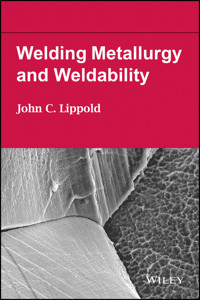
Describes the weldability aspects of structural materials used in a wide variety of engineering structures, including steels, stainless steels, Ni-base alloys, and Al-base alloys
Welding Metallurgy and Weldability describes weld failure mechanisms associated with either fabrication or service, and failure mechanisms related to microstructure of the weldment. Weldability issues are divided into fabrication and service related failures; early chapters address hot cracking, warm (solid-state) cracking, and cold cracking that occur during initial fabrication, or repair. Guidance on failure analysis is also provided, along with examples of SEM fractography that will aid in determining failure mechanisms. Welding Metallurgy and Weldability examines a number of weldability testing techniques that can be used to quantify susceptibility to various forms of weld cracking.
- Describes the mechanisms of weldability along with methods to improve weldability
- Includes an introduction to weldability testing and techniques, including strain-to-fracture and Varestraint tests
- Chapters are illustrated with practical examples based on 30 plus years of experience in the field
Illustrating the weldability aspects of structural materials used in a wide variety of engineering structures, Welding Metallurgy and Weldability provides engineers and students with the information needed to understand the basic concepts of welding metallurgy and to interpret the failures in welded components.
Sie lesen das E-Book in den Legimi-Apps auf:
Seitenzahl: 574
Veröffentlichungsjahr: 2014
Ähnliche


















CONTENTS
Cover
Title page
Copyright page
Dedication page
Preface
Author Biography
1 Introduction
1.1 Fabrication-Related Defects
1.2 Service-Related Defects
1.3 Defect Prevention and Control
References
2 Welding Metallurgy Principles
2.1 Introduction
2.2 Regions of a Fusion Weld
2.3 Fusion Zone
2.4 Unmixed Zone (UMZ)
2.5 Partially Melted Zone (PMZ)
2.6 Heat Affected Zone (HAZ)
2.7 Solid-State Welding
References
3 Hot Cracking
3.1 Introduction
3.2 Weld Solidification Cracking
3.3 Liquation Cracking
References
4 Solid-State Cracking
4.1 Introduction
4.2 Ductility-dip Cracking
4.3 Reheat Cracking
4.4 Strain-age Cracking
4.5 Lamellar Cracking
4.6 Copper Contamination Cracking
References
5 Hydrogen-Induced Cracking
5.1 Introduction
5.2 Hydrogen Embrittlement Theories
5.3 Factors That Influence HIC
5.4 Quantifying Susceptibility to HIC
5.5 Identifying HIC
5.6 Preventing HIC
References
6 Corrosion
6.1 Introduction
6.2 Forms of Corrosion
6.3 Corrosion Testing
References
7 Fracture and Fatigue
7.1 Introduction
7.2 Fracture
7.3 Quantifying Fracture Toughness
7.4 Fatigue
7.5 Quantifying Fatigue Behavior
7.6 Identifying Fatigue Cracking
7.7 Avoiding Fatigue Failures
References
8 Failure Analysis
8.1 Introduction
8.2 Fractography
8.3 An Engineer's Guide to Failure Analysis
References
9 Weldability Testing
9.1 Introduction
9.2 Types of Weldability Test Techniques
9.3 The Varestraint Test
9.4 The Cast Pin Tear Test
9.5 The Hot Ductility Test
9.6 The Strain-to-Fracture Test
9.7 Reheat Cracking Test
9.8 Implant Test for HAZ Hydrogen-induced cracking
9.9 Gapped Bead-on-Plate Test for Weld Metal HIC
9.10 Other Weldability Tests
References
Appendix A: Composition of selected steels
Appendix B: Nominal Composition of Stainless Steels
2.1 Filler metals for stainless steels
Appendix C: Composition of Nickel-Base Alloys
Appendix D: Etching Techniques
A4.1 Steels
A4.2 Stainless Steels
A4.3 Nickel-Base Alloys
A4.4 Fracture Surface Cleaning
References
Index
End User License Agreement
List of Tables
Chapter 01
Table 1.1 Fabrication-related defects
Table 1.2 Service-related defects
Chapter 02
Table 2.1 Systems reported to undergo constitutional liquation
Chapter 03
Table 3.1 Partition coefficient,
k
, and RPF and MPF for some Fe binary alloys
Table 3.2 Cracking susceptibility factor (CSF) relationships for steels
Table 3.3 SCTR data for stainless steels and Ni-base alloys
Table 3.4 Comparison of nonequilibrium solidification temperature range determined by Scheil–Gulliver and single sensor differential thermal analysis (SS DTA) with the SCTR measured by the Varestraint test
Table 3.5 Fraction eutectic present in aluminum binary alloy systems at the maximum of cracking shown in Figure 3.19
Chapter 04
Table 4.1 Ductility-dip cracking theories
Table 4.2 Steels susceptible to reheat cracking
Table 4.3 Empirical relationships for reheat cracking susceptibility based on composition
Table 4.4 Systems susceptible to liquid metal embrittlement
Table 4.5 Materials susceptible or resistant to copper-contamination cracking based on the spot Varestraint test
Chapter 05
Table 5.1 Relative ranking of HIC susceptibility according to microstructure
Table 5.2 Carbon equivalent formulae for steels
Table 5.3 Estimating the susceptibility index using the AWS method
Table 5.4 Determining minimum preheat and interpass temperature based on susceptibility index, restraint level, and plate thickness
Chapter 06
Table 6.1 General corrosion rates of metals and alloys
Table 6.2 Galvanic series for metals in seawater
Table 6.3 Effect of alloying and impurity elements on pitting corrosion of stainless steels
Table 6.4 Pitting resistance equivalent (PRE) values for stainless steels
Table 6.5 Materials and environments leading to stress corrosion cracking
Table 6.6 Immersion tests for evaluation of intergranular corrosion
Chapter 08
Table 8.1 Failure investigation checklist
Chapter 09
Table 9.1 Summary of weldability tests covered under ISO standards 17641 and 17642
Table 9.2 Solidification cracking temperature range (SCTR) values for several stainless steels and Ni-base alloys obtained using the Transvarestraint test
Table 9.3 Recommended variables and variable ranges for Transvarestraint testing of stainless steels and Ni-base alloys
Appendix D
Table A4.1 Chemical etchants for steels
Table A4.2 Chemical etchants for stainless steels
Table A4.3 Electrolytic etching techniques for stainless steels
Table A4.4 Staining techniques for stainless steels
Table A4.5 Macroetchants for Ni-base alloys
Table A4.6 Microetchants (swab or immerse) for Ni-base alloys
Table A4.7 Microetchants (electrolytic) for Ni-base alloys
List of Illustrations
Chapter 01
Figure 1.1 Henri Granjon, Institut de Soudure.
Figure 1.2 Trevor Gooch, The Welding Institute, 1992.
Figure 1.3 Warren F. “Doc” Savage, Rensselaer Polytechnic Institute, 1986.
Figure 1.4 Fukuhisa Matsuda, Osaka University, 1988 (W.A. “Bud” Baeslack III in the background).
Figure 1.5 Liberty ship failure.
Chapter 02
Figure 2.1 Block diagram for weld microstructure evolution and performance.
Figure 2.2 Early schematic of regions of a fusion weld
Figure 2.3 Regions of a fusion weld
Figure 2.4 Modern schematic showing regions of a fusion weld.
Figure 2.5 Schematic illustration of the determination of dilution in a heterogeneous weld.
Figure 2.6 Examples of different solidification paths in a simple eutectic system.
Figure 2.7 Various forms of heterogeneous nucleation associated with a molten weld pool
Figure 2.8 Schematic illustration of epitaxial nucleation.
Figure 2.9 Solidification modes that occur in metals.
Figure 2.10 Effect of temperature gradient in the liquid,
G
L
, and solidification growth rate,
R
, on solidification mode.
Figure 2.11 Effect of composition and solidification parameter on solidification mode
Figure 2.12 Constitutional supercooling theory according to Chalmers [7].
Figure 2.13 Simplified schematic of the constitutional supercooling theory for the case of
k
< 1.
Figure 2.14 Illustration of epitaxial nucleation and competitive growth
Figure 2.15 Examples of (a) epitaxial nucleation in austenitic stainless steel and (b) nonepitaxial nucleation of fcc weld metal (Monel) deposited on bcc base metal (Type 409 SS).
Figure 2.16 Illustration of the elliptical and teardrop-shaped weld pools
Figure 2.17 Surface tension-induced fluid flow
Figure 2.18 Effect of weld pool shape on the solidification parameters
G
L
and
R
and the macroscopic grain structure
Figure 2.19 Relationship between weld travel speed,
V
W
, and local solidification rate,
R
.
Figure 2.20 Change in solidification growth mode as a function of location in the weld
Figure 2.21 Examples of planar (a) and cellular dendritic (b) growth modes.
Figure 2.22 Equiaxed dendritic growth in the terminal crater of a weld in Alloy 690. (a) Metallographic cross section and (b) SEM micrograph
Figure 2.23 Schematic representation of the boundaries in single-phase weld metals.
Figure 2.24 Examples of boundaries in the fusion zone of a fully austenitic (fcc) stainless steel.
Figure 2.25 Solute profiles for macroscopic weld solidification showing the (a) initial transient, (b) steady state region, and (c) final transient.
Figure 2.26 Solute profiles during formation of a solidification grain boundary, assuming < 1.
Lesen Sie weiter in der vollständigen Ausgabe!
Lesen Sie weiter in der vollständigen Ausgabe!
Lesen Sie weiter in der vollständigen Ausgabe!
Lesen Sie weiter in der vollständigen Ausgabe!
Lesen Sie weiter in der vollständigen Ausgabe!
Lesen Sie weiter in der vollständigen Ausgabe!
Lesen Sie weiter in der vollständigen Ausgabe!
Lesen Sie weiter in der vollständigen Ausgabe!
Lesen Sie weiter in der vollständigen Ausgabe!
Lesen Sie weiter in der vollständigen Ausgabe!
Lesen Sie weiter in der vollständigen Ausgabe!
Lesen Sie weiter in der vollständigen Ausgabe!
Lesen Sie weiter in der vollständigen Ausgabe!
Lesen Sie weiter in der vollständigen Ausgabe!
Lesen Sie weiter in der vollständigen Ausgabe!
Lesen Sie weiter in der vollständigen Ausgabe!
Lesen Sie weiter in der vollständigen Ausgabe!
Lesen Sie weiter in der vollständigen Ausgabe!
Lesen Sie weiter in der vollständigen Ausgabe!
Lesen Sie weiter in der vollständigen Ausgabe!




