


16,99 €
Mehr erfahren.
- Herausgeber: John Wiley & Sons
- Kategorie: Geisteswissenschaft
- Serie: What is History series
- Sprache: Englisch
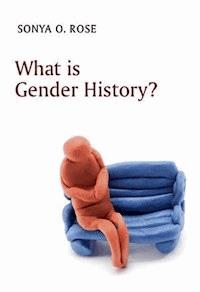
This book provides a short and accessible introduction to the field of gender history, one that has vastly expanded in scope and substance since the mid 1970s. Paying close attention to both classic texts in the field and the latest literature, the author examines the origins and development of the field and elucidates current debates and controversies. She highlights the significance of race, class and ethnicity for how gender affects society, culture and politics as well as delving into histories of masculinity. The author discusses in a clear and straightforward manner the various methods and approaches used by gender historians. Consideration is given to how the study of gender illuminates the histories of revolution, war and nationalism, industrialization and labor relations, politics and citizenship, colonialism and imperialism using as examples research dealing with the histories of a number of areas across the globe.
Written by one of the leading scholars in this vibrant field, What is Gender History? will be the ideal introduction for students of all levels.
Sie lesen das E-Book in den Legimi-Apps auf:
Seitenzahl: 259
Veröffentlichungsjahr: 2013
Ähnliche




















Table of Contents
Cover
What is History?
Title page
Copyright page
Preface and Acknowledgements
1 Why Gender History?
Conclusion
2 Bodies and Sexuality in Gender History
Conclusion
3 Gender and Other Relations of Difference
Conclusion
4 Men and Masculinity
Conclusion
5 Gender and Historical Knowledge
Conclusion
6 Assessing “Turns” and New Directions
Conclusion
Suggestions for Further Reading
Chapter 1 Why Gender History?
Chapter 2 Bodies and Sexuality in Gender History
Chapter 3 Gender and Other Relations of Difference
Chapter 4 Men and Masculinity
Chapter 5 Gender and Historical Knowledge
Chapter 6 Assessing “Turns” and New Directions
Index
What is History?
John H. Arnold, What is Medieval History?
Peter Burke, What is Cultural History?
John C. Burnham, What is Medical History?
Pamela Kyle Crossley, What is Global History?
Christiane Harzig and Dirk Hoerder, What is Migration History?
Andrew Hinde, What is Population History?
J. Donald Hughes, What is Environmental History?
Andrew Leach, What is Architectural History?
Stephen Morillo and Michael Pavkovic, What is Military History?
Sonya O. Rose, What is Gender History?
Copyright © Sonya O. Rose 2010
The right of Sonya O. Rose to be identified as Author of this Work has been asserted in accordance with the UK Copyright, Designs and Patents Act 1988.
First published in 2010 by Polity Press
Polity Press
65 Bridge Street
Cambridge CB2 1UR, UK
Polity Press
350 Main Street
Malden, MA 02148, USA
All rights reserved. Except for the quotation of short passages for the purpose of criticism and review, no part of this publication may be reproduced, stored in a retrieval system, or transmitted, in any form or by any means, electronic, mechanical, photocopying, recording or otherwise, without the prior permission of the publisher.
ISBN-13: 978-0-7456-4614-5
ISBN-13: 978-0-7456-4615-2(pb)
ISBN-13: 978-0-7456-5910-7(Single-user ebook)
ISBN-13: 978-0-7456-5909-1(Multi-user ebook)
A catalogue record for this book is available from the British Library.
The publisher has used its best endeavours to ensure that the URLs for external websites referred to in this book are correct and active at the time of going to press. However, the publisher has no responsibility for the websites and can make no guarantee that a site will remain live or that the content is or will remain appropriate.
Every effort has been made to trace all copyright holders, but if any have been inadvertently overlooked the publisher will be pleased to include any necessary credits in any subsequent reprint or edition.
For further information on Polity, visit our website: www.politybooks.com
Preface and Acknowledgements
This book is primarily about what gender historians do. It is not a history of gender, but rather it is about approaches to the field and their development, and considers some of the topics in history that have concerned gender historians. I have tried throughout to focus on gender or the meanings and expectations concerning what it means to be male or female. It is not a book about women’s history, although there is some discussion of the field and its contributions to gender history. The primary purpose of this volume is to provide an introduction to the subject both for students who have had some training in history but have not previously encountered gender history as a field, and for students who have studied women and gender in other disciplines but have not had the opportunity to learn about how historians approach these topics. The book takes up certain controversies that have developed among scholars of women’s and gender history, it provides an overview of some of the complexities in studying gender history, and it considers new directions in the field. This should make it useful to more advanced students and scholars who might find such an overview of value.
Chapter 1 provides basic definitions of the terms “gender,” “history,” and “feminist history.” It charts the development of gender history from women’s history and discusses its uneven influence on scholarship. Chapter 2 complicates the distinction between sex and gender and considers histories of the body and histories of sexuality. Chapter 3 takes up gender and its intersections with race and class using as examples among other topics, slavery, and colonialism. Chapter 4 introduces the reader to the study of men and masculinity, discussing different approaches to the topic and emphasizing the changing understandings of masculinity over time as well as the various ways that manhood is understood and practiced in a given historical period. Chapter 5 illustrates how historians of gender have contributed to questions that have been central to historians generally. It focuses especially on colonial conquest, revolution, nationalism, and war and covers examples from the seventeenth to the twentieth centuries. Chapter 6 examines some of the controversies over approaches to studying gender in history, and introduces the reader to some of the new directions being taken, including psychoanalytic and other approaches to subjectivity, and transnational or global histories. It serves, as well, as a review or reminder of some of the other issues and topics covered in the book.
The book is written as an engaged overview that attempts both to synthesize how scholars have approached the field and to give fairly detailed examples of historical scholarship on particular topics of concern to gender historians. It is impossible for such a book to cover everything in a domain of inquiry as diverse and rich as gender history, and thus I have attempted to provide the reader with a sense of the kinds of questions gender historians ask and how they have gone about answering them. While the text draws heavily from work on North America and Britain, I have also attempted to provide examples from across the world. As my own work specializes in modern history, especially the nineteenth and twentieth centuries, this is the focus of much of the book. However, I have also included some discussion of the exciting work done by scholars whose work is on periods ranging from the thirteenth through the eighteenth centuries. I wanted to give some idea of the histories of particular topics from a variety of regions and/or countries and time periods, and although such examples might seem to lack historical context – because their histories will simply be less familiar – it is my hope that the reader will nonetheless be able to learn from them some of what these gender historians have discovered in their research.
I am indebted to a host of feminist historians whose work has inspired me over the years. I cannot hope to list them all here, nor will they necessarily find their work specifically cited in the text. Many of them, however, will be included in the topically organized list of selected readings at the end of the book. Thanks also are especially due to Andrea Drugan at Polity, who has been a model of what an editor should be – supportive, encouraging, and quick to respond to various drafts and queries, and to Justin Dyer, for a heroic and truly helpful job of copy-editing. I would also like to thank the anonymous reviewers for Polity and my London friends, Catherine Hall, Keith McClelland, and Bill Schwarz, for listening to my concerns as I worked on this book. Special thanks go to Sue Juster for suggesting examples of particularly interesting scholarship on gender in Colonial North America. Most especially, I thank Guenter Rose for his patience and support and for putting up with the angst I experienced as I found writing this book to be a much more difficult and complex undertaking than I had anticipated.
1
Why Gender History?
In answering the question posed by the title of this book, “what is gender history?” I hope to convince the reader that gender both has a history and is historically significant. To begin, we must first consider what might seem self-evident but is, in fact, complex – how to think about history itself.
History is comprised of knowledge about the past. This means that history is the product of scholarship concerning the past. At this point the reader might wonder, isn’t history the past? Common sense would tell us that if someone is interested in history, that person is interested in what has happened before the present day. But it is important to be clear that the past is reconstructed through historical scholarship – the knowledge produced by historians. This suggests that the process of reconstruction is all-important in the knowledge that is produced. What we know about the past is dependent upon the questions historians have asked and how they have answered them. What has been the focus of their interest? What have they deemed to be important to study about the past? How have they gone about studying it? How have they interpreted the evidence they have unearthed? To complicate matters, the answers to these questions themselves have changed over time. Historians are not outside of history, but are shaped by it and by the political, cultural, social, and economic climates in which they live and work. Thus, history itself has a history. This is important background to keep in mind as we begin to explore the topics of gender and gender history.
Although historians have differed and continue to differ in their approaches to their subject, they would all share the following assumption: the conditions within which people live their lives and the societies which shape those conditions change over time. These changes are many and varied, and the rates at which transformations occur also are variable. But the presumption of change or transformation is fundamental to historical scholarship. Not all historical scholarship, however, charts and accounts for changes. While some historians are concerned to show how events and certain processes were instrumental in transforming a society or an aspect of society, others are interested in exploring the processes producing continuities over time, and still others are involved in projects that describe aspects of life in a particular period or set of years in the past. But although such historians may not focus on change , they assume that the characteristics of the lives they unearth and write about are products of social and cultural processes that take place through time.
Lesen Sie weiter in der vollständigen Ausgabe!
Lesen Sie weiter in der vollständigen Ausgabe!
Lesen Sie weiter in der vollständigen Ausgabe!
Lesen Sie weiter in der vollständigen Ausgabe!
Lesen Sie weiter in der vollständigen Ausgabe!
Lesen Sie weiter in der vollständigen Ausgabe!
Lesen Sie weiter in der vollständigen Ausgabe!




