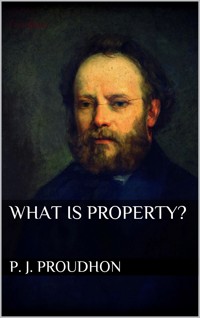
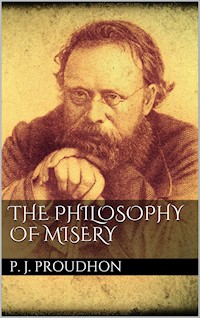
P. J. PROUDHON: HIS LIFE AND HIS WORKS.
PREFACE.
FIRST MEMOIR.
CHAPTER I. METHOD PURSUED IN THIS WORK.—THE IDEA OF A REVOLUTION.
CHAPTER II. PROPERTY CONSIDERED AS A NATURAL RIGHT
CHAPTER III. LABOR AS THE EFFICIENT CAUSE OF THE DOMAIN OF PROPERTY.
CHAPTER IV. THAT PROPERTY IS IMPOSSIBLE.
APPENDIX TO THE FIFTH PROPOSITION.
CHAPTER V. PSYCHOLOGICAL EXPOSITION OF THE IDEA OF JUSTICE
PART FIRST.
PART SECOND.
SECOND MEMOIR.
Conclusion.
P. J. PROUDHON: HIS LIFE AND HIS WORKS.
In
an important work, which his habitual readers certainly have not
forgotten, although death did not allow him to finish it, Sainte
Beuve thus judges the correspondence of the great
publicist:—"The
letters of Proudhon, even outside the circle of his particular
friends, will always be of value; we can always learn something
from
them, and here is the proper place to determine the general
character
of his correspondence."It
has always been large, especially since he became so celebrated;
and,
to tell the truth, I am persuaded that, in the future, the
correspondence of Proudhon will be his principal, vital work, and
that most of his books will be only accessory to and corroborative
of
this. At any rate, his books can be well understood only by the aid
of his letters and the continual explanations which he makes to
those
who consult him in their doubt, and request him to define more
clearly his position."There
are, among celebrated people, many methods of correspondence. There
are those to whom letter-writing is a bore, and who, assailed with
questions and compliments, reply in the greatest haste, solely that
the job may be over with, and who return politeness for politeness,
mingling it with more or less wit. This kind of correspondence,
though coming from celebrated people, is insignificant and unworthy
of collection and classification."After
those who write letters in performance of a disagreeable duty, and
almost side by side with them in point of insignificance, I should
put those who write in a manner wholly external, wholly
superficial,
devoted only to flattery, lavishing praise like gold, without
counting it; and those also who weigh every word, who reply
formally
and pompously, with a view to fine phrases and effects. They
exchange
words only, and choose them solely for their brilliancy and show.
You
think it is you, individually, to whom they speak; but they are
addressing themselves in your person to the four corners of Europe.
Such letters are empty, and teach as nothing but theatrical
execution
and the favorite pose of their writers."I
will not class among the latter the more prudent and sagacious
authors who, when writing to individuals, keep one eye on
posterity.
We know that many who pursue this method have written long,
finished,
charming, flattering, and tolerably natural letters. Beranger
furnishes us with the best example of this class."Proudhon,
however, is a man of entirely different nature and habits. In
writing, he thinks of nothing but his idea and the person whom he
addresses: ad rem et ad hominem. A man of conviction and doctrine,
to
write does not weary him; to be questioned does not annoy him. When
approached, he cares only to know that your motive is not one of
futile curiosity, but the love of truth; he assumes you to be
serious, he replies, he examines your objections, sometimes
verbally,
sometimes in writing; for, as he remarks, 'if there be some points
which correspondence can never settle, but which can be made clear
by
conversation in two minutes, at other times just the opposite is
the
case: an objection clearly stated in writing, a doubt well
expressed,
which elicits a direct and positive reply, helps things along more
than ten hours of oral intercourse!' In writing to you he does not
hesitate to treat the subject anew; he unfolds to you the
foundation
and superstructure of his thought: rarely does he confess himself
defeated—it is not his way; he holds to his position, but admits
the breaks, the variations, in short, the EVOLUTION of his mind.
The
history of his mind is in his letters; there it must be
sought."Proudhon,
whoever addresses him, is always ready; he quits the page of the
book
on which he is at work to answer you with the same pen, and that
without losing patience, without getting confused, without sparing
or
complaining of his ink; he is a public man, devoted to the
propagation of his idea by all methods, and the best method, with
him, is always the present one, the latest one. His very
handwriting,
bold, uniform, legible, even in the most tiresome passages, betrays
no haste, no hurry to finish. Each line is accurate: nothing is
left
to chance; the punctuation, very correct and a little emphatic and
decided, indicates with precision and delicate distinction all the
links in the chain of his argument. He is devoted entirely to you,
to
his business and yours, while writing to you, and never to anything
else. All the letters of his which I have seen are serious: not one
is commonplace."But
at the same time he is not at all artistic or affected; he does not
CONSTRUCT his letters, he does not revise them, he spends no time
in
reading them over; we have a first draught, excellent and clear, a
jet from the fountain-head, but that is all. The new arguments,
which
he discovers in support of his ideas and which opposition suggests
to
him, are an agreeable surprise, and shed a light which we should
vainly search for even in his works. His correspondence differs
essentially from his books, in that it gives you no uneasiness; it
places you in the very heart of the man, explains him to you, and
leaves you with an impression of moral esteem and almost of
intellectual security. We feel his sincerity. I know of no one to
whom he can be more fitly compared in this respect than George
Sand,
whose correspondence is large, and at the same time full of
sincerity. His role and his nature correspond. If he is writing to
a
young man who unbosoms himself to him in sceptical anxiety, to a
young woman who asks him to decide delicate questions of conduct
for
her, his letter takes the form of a short moral essay, of a
father-confessor's advice. Has he perchance attended the theatre (a
rare thing for him) to witness one of Ponsart's comedies, or a
drama
of Charles Edmond's, he feels bound to give an account of his
impressions to the friend to whom he is indebted for this pleasure,
and his letter becomes a literary and philosophical criticism, full
of sense, and like no other. His familiarity is suited to his
correspondent; he affects no rudeness. The terms of civility or
affection which he employs towards his correspondents are sober,
measured, appropriate to each, and honest in their simplicity and
cordiality. When he speaks of morals and the family, he seems at
times like the patriarchs of the Bible. His command of language is
complete, and he never fails to avail himself of it. Now and then a
coarse word, a few personalities, too bitter and quite unjust or
injurious, will have to be suppressed in printing; time, however,
as
it passes away, permits many things and renders them inoffensive.
Am
I right in saying that Proudhon's correspondence, always
substantial,
will one day be the most accessible and attractive portion of his
works?"Almost
the whole of Proudhon's real biography is included in his
correspondence. Up to 1837, the date of the first letter which we
have been able to collect, his life, narrated by Sainte Beuve, from
whom we make numerous extracts, may be summed up in a few
pages.Pierre
Joseph Proudhon was born on the 15th of January, 1809, in a suburb
of
Besancon, called Mouillere. His father and mother were employed in
the great brewery belonging to M. Renaud. His father, though a
cousin
of the jurist Proudhon, the celebrated professor in the faculty of
Dijon, was a journeyman brewer. His mother, a genuine peasant, was
a
common servant. She was an orderly person of great good sense; and,
as they who knew her say, a superior woman of HEROIC character,—to
use the expression of the venerable M. Weiss, the librarian at
Besancon. She it was especially that Proudhon resembled: she and
his
grandfather Tournesi, the soldier peasant of whom his mother told
him, and whose courageous deeds he has described in his work on
"Justice." Proudhon, who always felt a great veneration for
his mother Catharine, gave her name to the elder of his daughters.
In
1814, when Besancon was blockaded, Mouillere, which stood in front
of
the walls of the town, was destroyed in the defence of the place;
and
Proudhon's father established a cooper's shop in a suburb of
Battant,
called Vignerons. Very honest, but simple-minded and short-sighted,
this cooper, the father of five children, of whom Pierre Joseph was
the eldest, passed his life in poverty. At eight years of age,
Proudhon either made himself useful in the house, or tended the
cattle out of doors. No one should fail to read that beautiful and
precious page of his work on "Justice," in which he
describes the rural sports which he enjoyed when a neatherd. At the
age of twelve, he was a cellar-boy in an inn. This, however, did
not
prevent him from studying.His
mother was greatly aided by M. Renaud, the former owner of the
brewery, who had at that time retired from business, and was
engaged
in the education of his children.Proudhon
entered school as a day-scholar in the sixth class. He was
necessarily irregular in his attendance; domestic cares and
restraints sometimes kept him from his classes. He succeeded
nevertheless in his studies; he showed great perseverance. His
family
were so poor that they could not afford to furnish him with books;
he
was obliged to borrow them from his comrades, and copy the text of
his lessons. He has himself told us that he was obliged to leave
his
wooden shoes outside the door, that he might not disturb the
classes
with his noise; and that, having no hat, he went to school
bareheaded. One day, towards the close of his studies, on returning
from the distribution of the prizes, loaded with crowns, he found
nothing to eat in the house."In
his eagerness for labor and his thirst for knowledge, Proudhon,"
says Sainte Beuve, "was not content with the instruction of his
teachers. From his twelfth to his fourteenth year, he was a
constant
frequenter of the town library. One curiosity led to another, and
he
called for book after book, sometimes eight or ten at one sitting.
The learned librarian, the friend and almost the brother of Charles
Nodier, M. Weiss, approached him one day, and said, smiling, 'But,
my
little friend, what do you wish to do with all these books?' The
child raised his head, eyed his questioner, and replied: 'What's
that
to you?' And the good M. Weiss remembers it to this day."Forced
to earn his living, Proudhon could not continue his studies. He
entered a printing-office in Besancon as a proof-reader. Becoming,
soon after, a compositor, he made a tour of France in this
capacity.
At Toulon, where he found himself without money and without work,
he
had a scene with the mayor, which he describes in his work on
"Justice."Sainte
Beuve says that, after his tour of France, his service book being
filled with good certificates, Proudhon was promoted to the
position
of foreman. But he does not tell us, for the reason that he had no
knowledge of a letter written by Fallot, of which we never heard
until six months since, that the printer at that time contemplated
quitting his trade in order to become a teacher.Towards
1829, Fallot, who was a little older than Proudhon, and who, after
having obtained the Suard pension in 1832, died in his twenty-ninth
year, while filling the position of assistant librarian at the
Institute, was charged, Protestant though he was, with the revisal
of
a "Life of the Saints," which was published at Besancon.
The book was in Latin, and Fallot added some notes which also were
in
Latin."But,"
says Sainte Beuve, "it happened that some errors escaped his
attention, which Proudhon, then proof-reader in the printing
office,
did not fail to point out to him. Surprised at finding so good a
Latin scholar in a workshop, he desired to make his acquaintance;
and
soon there sprung up between them a most earnest and intimate
friendship: a friendship of the intellect and of the heart."Addressed
to a printer between twenty-two and twenty-three years of age, and
predicting in formal terms his future fame, Fallot's letter seems
to
us so interesting that we do not hesitate to reproduce it
entire."PARIS,
December 5, 1831."MY
DEAR PROUDHON,—YOU have a right to be surprised at, and even
dissatisfied with, my long delay in replying to your kind letter; I
will tell you the cause of it. It became necessary to forward an
account of your ideas to M. J. de Gray; to hear his objections, to
reply to them, and to await his definitive response, which reached
me
but a short time ago; for M. J. is a sort of financial king, who
takes no pains to be punctual in dealing with poor devils like
ourselves. I, too, am careless in matters of business; I sometimes
push my negligence even to disorder, and the metaphysical musings
which continually occupy my mind, added to the amusements of Paris,
render me the most incapable man in the world for conducting a
negotiation with despatch."I
have M. Jobard's decision; here it is: In his judgment, you are too
learned and clever for his children; he fears that you could not
accommodate your mind and character to the childish notions common
to
their age and station. In short, he is what the world calls a good
father; that is, he wants to spoil his children, and, in order to
do
this easily, he thinks fit to retain his present instructor, who is
not very learned, but who takes part in their games and joyous
sports
with wonderful facility, who points out the letters of the alphabet
to the little girl, who takes the little boys to mass, and who, no
less obliging than the worthy Abbe P. of our acquaintance, would
readily dance for Madame's amusement. Such a profession would not
suit you, you who have a free, proud, and manly soul: you are
refused; let us dismiss the matter from our minds. Perhaps another
time my solicitude will be less unfortunate. I can only ask your
pardon for having thought of thus disposing of you almost without
consulting you. I find my excuse in the motives which guided me; I
had in view your well-being and advancement in the ways of this
world."I
see in your letter, my comrade, through its brilliant witticisms
and
beneath the frank and artless gayety with which you have sprinkled
it, a tinge of sadness and despondency which pains me. You are
unhappy, my friend: your present situation does not suit you; you
cannot remain in it, it was not made for you, it is beneath you;
you
ought, by all means, to leave it, before its injurious influence
begins to affect your faculties, and before you become settled, as
they say, in the ways of your profession, were it possible that
such
a thing could ever happen, which I flatly deny. You are unhappy;
you
have not yet entered upon the path which Nature has marked out for
you. But, faint-hearted soul, is that a cause for despondency?
Ought
you to feel discouraged? Struggle, morbleu, struggle persistently,
and you will triumph. J. J. Rousseau groped about for forty years
before his genius was revealed to him. You are not J. J Rousseau;
but
listen: I know not whether I should have divined the author of
"Emile" when he was twenty years of age, supposing that I
had been his contemporary, and had enjoyed the honor of his
acquaintance. But I have known you, I have loved you, I have
divined
your future, if I may venture to say so; for the first time in my
life, I am going to risk a prophecy. Keep this letter, read it
again
fifteen or twenty years hence, perhaps twenty-five, and if at that
time the prediction which I am about to make has not been
fulfilled,
burn it as a piece of folly out of charity and respect for my
memory.
This is my prediction: you will be, Proudhon, in spite of yourself,
inevitably, by the fact of your destiny, a writer, an author; you
will be a philosopher; you will be one of the lights of the
century,
and your name will occupy a place in the annals of the nineteenth
century, like those of Gassendi, Descartes, Malebranche, and Bacon
in
the seventeenth, and those of Diderot, Montesquieu, Helvetius.
Locke,
Hume, and Holbach in the eighteenth. Such will be your lot! Do now
what you will, set type in a printing-office, bring up children,
bury
yourself in deep seclusion, seek obscure and lonely villages, it is
all one to me; you cannot escape your destiny; you cannot divest
yourself of your noblest feature, that active, strong, and
inquiring
mind, with which you are endowed; your place in the world has been
appointed, and it cannot remain empty. Go where you please, I
expect
you in Paris, talking philosophy and the doctrines of Plato; you
will
have to come, whether you want to or not. I, who say this to you,
must feel very sure of it in order to be willing to put it upon
paper, since, without reward for my prophetic skill,—to which, I
assure you, I make not the slightest claim,—I run the risk of
passing for a hare-brained fellow, in case I prove to be mistaken:
he
plays a bold game who risks his good sense upon his cards, in
return
for the very trifling and insignificant merit of having divined a
young man's future."When
I say that I expect you in Paris, I use only a proverbial phrase
which you must not allow to mislead you as to my projects and
plans.
To reside in Paris is disagreeable to me, very much so; and when
this
fine-art fever which possesses me has left me, I shall abandon the
place without regret to seek a more peaceful residence in a
provincial town, provided always the town shall afford me the means
of living, bread, a bed, books, rest, and solitude. How I miss, my
good Proudhon, that dark, obscure, smoky chamber in which I dwelt
in
Besancon, and where we spent so many pleasant hours in the
discussion
of philosophy! Do you remember it? But that is now far away. Will
that happy time ever return? Shall we one day meet again? Here my
life is restless, uncertain, precarious, and, what is worse,
indolent, illiterate, and vagrant. I do no work, I live in
idleness,
I ramble about; I do not read, I no longer study; my books are
forsaken; now and then I glance over a few metaphysical works, and
after a days walk through dirty, filthy, crowded streets. I lie
down
with empty head and tired body, to repeat the performance on the
following day. What is the object of these walks, you will ask. I
make visits, my friend; I hold interviews with stupid people. Then
a
fit of curiosity seizes me, the least inquisitive of beings: there
are museums, libraries, assemblies, churches, palaces, gardens, and
theatres to visit. I am fond of pictures, fond of music, fond of
sculpture; all these are beautiful and good, but they cannot
appease
hunger, nor take the place of my pleasant readings of Bailly, Hume,
and Tennemann, which I used to enjoy by my fireside when I was able
to read."But
enough of complaints. Do not allow this letter to affect you too
much, and do not think that I give way to dejection or despondency;
no, I am a fatalist, and I believe in my star. I do not know yet
what
my calling is, nor for what branch of polite literature I am best
fitted; I do not even know whether I am, or ever shall be, fitted
for
any: but what matters it? I suffer, I labor, I dream, I enjoy, I
think; and, in a word, when my last hour strikes, I shall have
lived."Proudhon,
I love you, I esteem you; and, believe me, these are not mere
phrases. What interest could I have in flattering and praising a
poor
printer? Are you rich, that you may pay for courtiers? Have you a
sumptuous table, a dashing wife, and gold to scatter, in order to
attract them to your suite? Have you the glory, honors, credit,
which
would render your acquaintance pleasing to their vanity and pride?
No; you are poor, obscure, abandoned; but, poor, obscure, and
abandoned, you have a friend, and a friend who knows all the
obligations which that word imposes upon honorable people, when
they
venture to assume it. That friend is myself: put me to the
test."GUSTAVE
FALLOT."It
appears from this letter that if, at this period, Proudhon had
already exhibited to the eyes of a clairvoyant friend his genius
for
research and investigation, it was in the direction of
philosophical,
rather than of economical and social, questions.Having
become foreman in the house of Gauthier & Co., who carried on a
large printing establishment at Besancon, he corrected the proofs
of
ecclesiastical writers, the Fathers of the Church. As they were
printing a Bible, a Vulgate, he was led to compare the Latin with
the
original Hebrew."In
this way," says Sainte Beuve, "he learned Hebrew by
himself, and, as everything was connected in his mind, he was led
to
the study of comparative philology. As the house of Gauthier
published many works on Church history and theology, he came also
to
acquire, through this desire of his to investigate everything, an
extensive knowledge of theology, which afterwards caused
misinformed
persons to think that he had been in an ecclesiastical
seminary."Towards
1836, Proudhon left the house of Gauthier, and, in company with an
associate, established a small printing-office in Besancon. His
contribution to the partnership consisted, not so much in capital,
as
in his knowledge of the trade. His partner committing suicide in
1838, Proudhon was obliged to wind up the business, an operation
which he did not accomplish as quickly and as easily as he hoped.
He
was then urged by his friends to enter the ranks of the competitors
for the Suard pension. This pension consisted of an income of
fifteen
hundred francs bequeathed to the Academy of Besancon by Madame
Suard,
the widow of the academician, to be given once in three years to
the
young man residing in the department of Doubs, a bachelor of
letters
or of science, and not possessing a fortune, whom the Academy of
Besancon SHOULD DEEM BEST FITTED FOR A LITERARY OR SCIENTIFIC
CAREER,
OR FOR THE STUDY OF LAW OR OF MEDICINE. The first to win the Suard
pension was Gustave Fallot. Mauvais, who was a distinguished
astronomer in the Academy of Sciences, was the second. Proudhon
aspired to be the third. To qualify himself, he had to be received
as
a bachelor of letters, and was obliged to write a letter to the
Academy of Besancon. In a phrase of this letter, the terms of which
he had to modify, though he absolutely refused to change its
spirit,
Proudhon expressed his firm resolve to labor for the amelioration
of
the condition of his brothers, the working-men.The
only thing which he had then published was an "Essay on General
Grammar," which appeared without the author's signature. While
reprinting, at Besancon, the "Primitive Elements of Languages,
Discovered by the Comparison of Hebrew roots with those of the
Latin
and French," by the Abbe Bergier, Proudhon had enlarged the
edition of his "Essay on General Grammar."The
date of the edition, 1837, proves that he did not at that time
think
of competing for the Suard pension. In this work, which continued
and
completed that of the Abbe Bergier, Proudhon adopted the same point
of view, that of Moses and of Biblical tradition. Two years later,
in
February, 1839, being already in possession of the Suard pension,
he
addressed to the Institute, as a competitor for the Volney prize, a
memoir entitled: "Studies in Grammatical Classification and the
Derivation of some French words." It was his first work, revised
and presented in another form. Four memoirs only were sent to the
Institute, none of which gained the prize. Two honorable mentions
were granted, one of them to memoir No. 4; that is, to P. J.
Proudhon, printer at Besancon. The judges were MM. Amedde Jaubert,
Reinaud, and Burnouf."The
committee," said the report presented at the annual meeting of
the five academies on Thursday, May 2, 1839, "has paid especial
attention to manuscripts No. 1 and No. 4. Still, it does not feel
able to grant the prize to either of these works, because they do
not
appear to be sufficiently elaborated. The committee, which finds in
No. 4 some ingenious analyses, particularly in regard to the
mechanism of the Hebrew language, regrets that the author has
resorted to hazardous conjectures, and has sometimes forgotten the
special recommendation of the committee to pursue the experimental
and comparative method."Proudhon
remembered this. He attended the lectures of Eugene Burnouf, and,
as
soon as he became acquainted with the labors and discoveries of
Bopp
and his successors, he definitively abandoned an hypothesis which
had
been condemned by the Academy of Inscriptions and Belles-lettres.
He
then sold, for the value of the paper, the remaining copies of the
"Essay" published by him in 1837. In 1850, they were still
lying in a grocer's back-shop.A
neighboring publisher then placed the edition on the market, with
the
attractive name of Proudhon upon it. A lawsuit ensued, in which the
author was beaten. His enemies, and at that time there were many of
them, would have been glad to have proved him a renegade and a
recanter. Proudhon, in his work on "Justice," gives some
interesting details of this lawsuit.In
possession of the Suard pension, Proudhon took part in the contest
proposed by the Academy of Besancon on the question of the utility
of
the celebration of Sunday. His memoir obtained honorable mention,
together with a medal which was awarded him, in open session, on
the
24th of August, 1839. The reporter of the committee, the Abbe
Doney,
since made Bishop of Montauban, called attention to the
unquestionable superiority of his talent."But,"
says Sainte Beuve, "he reproached him with having adopted
dangerous theories, and with having touched upon questions of
practical politics and social organization, where upright
intentions
and zeal for the public welfare cannot justify rash
solutions."Was
it policy, we mean prudence, which induced Proudhon to screen his
ideas of equality behind the Mosaic law? Sainte Beuve, like many
others, seems to think so. But we remember perfectly well that,
having asked Proudhon, in August, 1848, if he did not consider
himself indebted in some respects to his fellow-countryman, Charles
Fourier, we received from him the following reply: "I have
certainly read Fourier, and have spoken of him more than once in my
works; but, upon the whole, I do not think that I owe anything to
him. My real masters, those who have caused fertile ideas to spring
up in my mind, are three in number: first, the Bible; next, Adam
Smith; and last, Hegel."Freely
confessed in the "Celebration of Sunday," the influence of
the Bible on Proudhon is no less manifest in his first memoir on
property. Proudhon undoubtedly brought to this work many ideas of
his
own; but is not the very foundation of ancient Jewish law to be
found
in its condemnation of usurious interest and its denial of the
right
of personal appropriation of land?The
first memoir on property appeared in 1840, under the title, "What
is Property? or an Inquiry into the Principle of Right and of
Government." Proudhon dedicated it, in a letter which served as
the preface, to the Academy of Besancon. The latter, finding itself
brought to trial by its pensioner, took the affair to heart, and
evoked it, says Sainte Beuve, with all possible haste.The
pension narrowly escaped being immediately withdrawn from the bold
defender of the principle of equality of conditions. M. Vivien,
then
Minister of Justice, who was earnestly solicited to prosecute the
author, wished first to obtain the opinion of the economist,
Blanqui,
a member of the Academy of Moral and Political Sciences. Proudhon
having presented to this academy a copy of his book, M. Blanqui was
appointed to review it. This review, though it opposed Proudhon's
views, shielded him. Treated as a savant by M. Blanqui, the author
was not prosecuted. He was always grateful to MM. Blanqui and
Vivien
for their handsome conduct in the matter.M.
Blanqui's review, which was partially reproduced by "Le
Moniteur," on the 7th of September, 1840, naturally led Proudhon
to address to him, in the form of a letter, his second memoir on
property, which appeared in April, 1841. Proudhon had endeavored,
in
his first memoir, to demonstrate that the pursuit of equality of
conditions is the true principle of right and of government. In the
"Letter to M. Blanqui," he passes in review the numerous
and varied methods by which this principle gradually becomes
realized
in all societies, especially in modern society.In
1842, a third memoir appeared, entitled, "A Notice to
Proprietors, or a Letter to M. Victor Considerant, Editor of 'La
Phalange,' in Reply to a Defence of Property." Here the
influence of Adam Smith manifested itself, and was frankly
admitted.
Did not Adam Smith find, in the principle of equality, the first of
all the laws which govern wages? There are other laws, undoubtedly;
but Proudhon considers them all as springing from the principle of
property, as he defined it in his first memoir. Thus, in humanity,
there are two principles,—one which leads us to equality, another
which separates us from it. By the former, we treat each other as
associates; by the latter, as strangers, not to say enemies. This
distinction, which is constantly met with throughout the three
memoirs, contained already, in germ, the idea which gave birth to
the
"System of Economical Contradictions," which appeared in
1846, the idea of antinomy or contre-loi.The
"Notice to Proprietors" was seized by the magistrates of
Besancon; and Proudhon was summoned to appear before the assizes of
Doubs within a week. He read his written defence to the jurors in
person, and was acquitted. The jury, like M. Blanqui, viewed him
only
as a philosopher, an inquirer, a savant.In
1843, Proudhon published the "Creation of Order in Humanity,"
a large volume, which does not deal exclusively with questions of
social economy. Religion, philosophy, method, certainty, logic, and
dialectics are treated at considerable length.Released
from his printing-office on the 1st of March of the same year,
Proudhon had to look for a chance to earn his living. Messrs.
Gauthier Bros., carriers by water between Mulhouse and Lyons, the
eldest of whom was Proudhon's companion in childhood, conceived the
happy thought of employing him, of utilizing his ability in their
business, and in settling the numerous points of difficulty which
daily arose. Besides the large number of accounts which his new
duties required him to make out, and which retarded the publication
of the "System of Economical Contradictions," until
October, 1846, we ought to mention a work, which, before it
appeared
in pamphlet form, was published in the "Revue des
Economistes,"—"Competition between Railroads and
Navigable Ways.""Le
Miserere, or the Repentance of a King," which he published in
March, 1845, in the "Revue Independante," during that
Lenten season when Lacordaire was preaching in Lyons, proves that,
though devoting himself with ardor to the study of economical
problems, Proudhon had not lost his interest in questions of
religious history. Among his writings on these questions, which he
was unfortunately obliged to leave unfinished, we may mention a
nearly completed history of the early Christian heresies, and of
the
struggle of Christianity against Caesarism.We
have said that, in 1848, Proudhon recognized three masters. Having
no
knowledge of the German language, he could not have read the works
of
Hegel, which at that time had not been translated into French. It
was
Charles Grun, a German, who had come to France to study the various
philosophical and socialistic systems, who gave him the substance
of
the Hegelian ideas. During the winter of 1844-45, Charles Grun had
some long conversations with Proudhon, which determined, very
decisively, not the ideas, which belonged exclusively to the
bisontin
thinker, but the form of the important work on which he labored
after
1843, and which was published in 1846 by Guillaumin.Hegel's
great idea, which Proudhon appropriated, and which he demonstrates
with wonderful ability in the "System of Economical
Contradictions," is as follows: Antinomy, that is, the existence
of two laws or tendencies which are opposed to each other, is
possible, not only with two different things, but with one and the
same thing. Considered in their thesis, that is, in the law or
tendency which created them, all the economical categories are
rational,—competition, monopoly, the balance of trade, and
property, as well as the division of labor, machinery, taxation,
and
credit. But, like communism and population, all these categories
are
antinomical; all are opposed, not only to each other, but to
themselves. All is opposition, and disorder is born of this system
of
opposition. Hence, the sub-title of the work,—"Philosophy of
Misery." No category can be suppressed; the opposition,
antinomy, or contre-tendance, which exists in each of them, cannot
be
suppressed.Where,
then, lies the solution of the social problem? Influenced by the
Hegelian ideas, Proudhon began to look for it in a superior
synthesis, which should reconcile the thesis and antithesis.
Afterwards, while at work upon his book on "Justice," he
saw that the antinomical terms do not cancel each other, any more
than the opposite poles of an electric pile destroy each other;
that
they are the procreative cause of motion, life, and progress; that
the problem is to discover, not their fusion, which would be death,
but their equilibrium,—an equilibrium for ever unstable, varying
with the development of society.On
the cover of the "System of Economical Contradictions,"
Proudhon announced, as soon to appear, his "Solution of the
Social Problem." This work, upon which he was engaged when the
Revolution of 1848 broke out, had to be cut up into pamphlets and
newspaper articles. The two pamphlets, which he published in March,
1848, before he became editor of "Le Representant du Peuple,"
bear the same title,—"Solution of the Social Problem."
The first, which is mainly a criticism of the early acts of the
provisional government, is notable from the fact that in it
Proudhon,
in advance of all others, energetically opposed the establishment
of
national workshops. The second, "Organization of Credit and
Circulation," sums up in a few pages his idea of economical
progress: a gradual reduction of interest, profit, rent, taxes, and
wages. All progress hitherto has been made in this manner; in this
manner it must continue to be made. Those workingmen who favor a
nominal increase of wages are, unconsciously following a
back-track,
opposed to all their interests.After
having published in "Le Representant du Peuple," the
statutes of the Bank of Exchange,—a bank which was to make no
profits, since it was to have no stockholders, and which,
consequently, was to discount commercial paper with out interest,
charging only a commission sufficient to defray its running
expenses,—Proudhon endeavored, in a number of articles, to explain
its mechanism and necessity. These articles have been collected in
one volume, under the double title, "Resume of the Social
Question; Bank of Exchange." His other articles, those which up
to December, 1848, were inspired by the progress of events, have
been
collected in another volume,—"Revolutionary Ideas."Almost
unknown in March, 1848, and struck off in April from the list of
candidates for the Constituent Assembly by the delegation of
workingmen which sat at the Luxembourg, Proudhon had but a very
small
number of votes at the general elections of April. At the
complementary elections, which were held in the early days of June,
he was elected in Paris by seventy-seven thousand votes.After
the fatal days of June, he published an article on le terme, which
caused the first suspension of "Le Representant du Peuple."
It was at that time that he introduced a bill into the Assembly,
which, being referred to the Committee on the Finances, drew forth,
first, the report of M. Thiers, and then the speech which Proudhon
delivered, on the 31st of July, in reply to this report. "Le
Representant du Peuple," reappearing a few days later, he wrote,
a propos of the law requiring journals to give bonds, his famous
article on "The Malthusians" (August 10, 1848).Ten
days afterwards, "Le Representant du Peuple," again
suspended, definitively ceased to appear. "Le Peuple," of
which he was the editor-in-chief, and the first number of which was
issued in the early part of September, appeared weekly at first,
for
want of sufficient bonds; it afterwards appeared daily, with a
double
number once a week. Before "Le Peuple" had obtained its
first bond, Proudhon published a remarkable pamphlet on the "Right
to Labor,"—a right which he denied in the form in which it was
then affirmed. It was during the same period that he proposed, at
the
Poissonniere banquet, his Toast to the Revolution.Proudhon,
who had been asked to preside at the banquet, refused, and proposed
in his stead, first, Ledru-Rollin, and then, in view of the
reluctance of the organizers of the banquet, the illustrious
president of the party of the Mountain, Lamennais. It was evidently
his intention to induce the representatives of the Extreme Left to
proclaim at last with him the Democratic and Social Republic.
Lamennais being accepted by the organizers, the Mountain promised
to
be present at the banquet. The night before, all seemed right, when
General Cavaignac replaced Minister Senart by Minister
Dufaure-Vivien. The Mountain, questioning the government, proposed
a
vote of confidence in the old minister, and, tacitly, of want of
confidence in the new. Proudhon abstained from voting on this
proposition. The Mountain declared that it would not attend the
banquet, if Proudhon was to be present. Five Montagnards, Mathieu
of
Drome at their head, went to the temporary office of "Le Peuple"
to notify him of this. "Citizen Proudhon," said they to the
organizers in his presence, "in abstaining from voting to-day on
the proposition of the Mountain, has betrayed the Republican
cause."
Proudhon, vehemently questioned, began his defence by recalling, on
the one hand, the treatment which he had received from the
dismissed
minister; and, on the other, the impartial conduct displayed
towards
him in 1840 by M. Vivien, the new minister. He then attacked the
Mountain by telling its delegates that it sought only a pretext,
and
that really, in spite of its professions of Socialism in private
conversation, whether with him or with the organizers of the
banquet,
it had not the courage to publicly declare itself Socialist.On
the following day, in his Toast to the Revolution, a toast which
was
filled with allusions to the exciting scene of the night before,
Proudhon commenced his struggle against the Mountain. His duel with
Felix Pyat was one of the episodes of this struggle, which became
less bitter on Proudhon's side after the Mountain finally decided
to
publicly proclaim the Democratic and Social Republic. The campaign
for the election of a President of the Republic had just begun.
Proudhon made a very sharp attack on the candidacy of Louis
Bonaparte
in a pamphlet which is regarded as one of his literary
chefs-d'oeuvre: the "Pamphlet on the Presidency." An
opponent of this institution, against which he had voted in the
Constituent Assembly, he at first decided to take no part in the
campaign. But soon seeing that he was thus increasing the chances
of
Louis Bonaparte, and that if, as was not at all probable, the
latter
should not obtain an absolute majority of the votes, the Assembly
would not fail to elect General Cavaignac, he espoused, for the
sake
of form, the candidacy of Raspail, who was supported by his friends
in the Socialist Committee. Charles Delescluze, the editor-in-chief
of "La Revolution Democratique et Sociale," who could not
forgive him for having preferred Raspail to Ledru-Rollin, the
candidate of the Mountain, attacked him on the day after the
election
with a violence which overstepped all bounds. At first, Proudhon
had
the wisdom to refrain from answering him. At length, driven to an
extremity, he became aggressive himself, and Delescluze sent him
his
seconds. This time, Proudhon positively refused to fight; he would
not have fought with Felix Pyat, had not his courage been called in
question.On
the 25th of January, 1849, Proudhon, rising from a sick bed, saw
that
the existence of the Constituent Assembly was endangered by the
coalition of the monarchical parties with Louis Bonaparte, who was
already planning his coup d'Etat. He did not hesitate to openly
attack the man who had just received five millions of votes. He
wanted to break the idol; he succeeded only in getting prosecuted
and
condemned himself. The prosecution demanded against him was
authorized by a majority of the Constituent Assembly, in spite of
the
speech which he delivered on that occasion. Declared guilty by the
jury, he was sentenced, in March, 1849, to three years'
imprisonment
and the payment of a fine of ten thousand francs.Proudhon
had not abandoned for a single moment his project of a Bank of
Exchange, which was to operate without capital with a sufficient
number of merchants and manufacturers for adherents. This bank,
which
he then called the Bank of the People, and around which he wished
to
gather the numerous working-people's associations which had been
formed since the 24th of February, 1848, had already obtained a
certain number of subscribers and adherents, the latter to the
number
of thirty-seven thousand. It was about to commence operations, when
Proudhon's sentence forced him to choose between imprisonment and
exile. He did not hesitate to abandon his project and return the
money to the subscribers. He explained the motives which led him to
this decision in an article in "Le Peuple."Having
fled to Belgium, he remained there but a few days, going thence to
Paris, under an assumed name, to conceal himself in a house in the
Rue de Chabrol. From his hiding-place he sent articles almost every
day, signed and unsigned, to "Le Peuple." In the evening,
dressed in a blouse, he went to some secluded spot to take the air.
Soon, emboldened by habit, he risked an evening promenade upon the
Boulevards, and afterwards carried his imprudence so far as to take
a
stroll by daylight in the neighborhood of the Gare du Nord. It was
not long before he was recognized by the police, who arrested him
on
the 6th of June, 1849, in the Rue du Faubourg-Poissonniere.Taken
to the office of the prefect of police, then to Sainte-Pelagie, he
was in the Conciergerie on the day of the 13th of June, 1849, which
ended with the violent suppression of "Le Peuple." He then
began to write the "Confessions of a Revolutionist,"
published towards the end of the year. He had been again
transferred
to Sainte-Pelagie, when he married, in December, 1849, Mlle.
Euphrasie Piegard, a young working girl whose hand he had requested
in 1847. Madame Proudhon bore him four daughters, of whom but two,
Catherine and Stephanie, survived their father. Stephanie died in
1873.In
October, 1849, "Le Peuple" was replaced by a new journal,
"La Voix du Peuple," which Proudhon edited from his prison
cell. In it were published his discussions with Pierre Leroux and
Bastiat.The
political articles which he sent to "La Voix du Peuple" so
displeased the government finally, that it transferred him to
Doullens, where he was secretly confined for some time. Afterwards
taken back to Paris, to appear before the assizes of the Seine in
reference to an article in "La Voix du Peuple," he was
defended by M. Cremieux and acquitted. From the Conciergerie he
went
again to Sainte-Pelagie, where he ended his three years in prison
on
the 6th of June, 1852."La
Voix du Peuple," suppressed before the promulgation of the law
of the 31st of May, had been replaced by a weekly sheet, "Le
Peuple" of 1850. Established by the aid of the principal members
of the Mountain, this journal soon met with the fate of its
predecessors.In
1851, several months before the coup d'Etat, Proudhon published the
"General Idea of the Revolution of the Nineteenth Century,"
in which, after having shown the logical series of unitary
governments,—from monarchy, which is the first term, to the direct
government of the people, which is the last,—he opposes the ideal
of an-archy or self-government to the communistic or governmental
ideal.At
this period, the Socialist party, discouraged by the elections of
1849, which resulted in a greater conservative triumph than those
of
1848, and justly angry with the national representative body which
had just passed the law of the 31st of May, 1850, demanded direct
legislation and direct government. Proudhon, who did not want, at
any
price, the plebiscitary system which he had good reason to regard
as
destructive of liberty, did not hesitate to point out, to those of
his friends who expected every thing from direct legislation, one
of
the antinomies of universal suffrage. In so far as it is an
institution intended to achieve, for the benefit of the greatest
number, the social reforms to which landed suffrage is opposed,
universal suffrage is powerless; especially if it pretends to
legislate or govern directly. For, until the social reforms are
accomplished, the greatest number is of necessity the least
enlightened, and consequently the least capable of understanding
and
effecting reforms. In regard to the antinomy, pointed out by him,
of
liberty and government,—whether the latter be monarchic,
aristocratic, or democratic in form,—Proudhon, whose chief desire
was to preserve liberty, naturally sought the solution in the free
contract. But though the free contract may be a practical solution
of
purely economical questions, it cannot be made use of in politics.
Proudhon recognized this ten years later, when his beautiful study
on
"War and Peace" led him to find in the FEDERATIVE PRINCIPLE
the exact equilibrium of liberty and government."The
Social Revolution Demonstrated by the Coup d' Etat" appeared in
1852, a few months after his release from prison. At that time,
terror prevailed to such an extent that no one was willing to
publish
his book without express permission from the government. He
succeeded
in obtaining this permission by writing to Louis Bonaparte a letter
which he published at the same time with the work. The latter being
offered for sale, Proudhon was warned that he would not be allowed
to
publish any more books of the same character. At that time he
entertained the idea of writing a universal history entitled
"Chronos." This project was never fulfilled.Already
the father of two children, and about to be presented with a third,
Proudhon was obliged to devise some immediate means of gaining a
living; he resumed his labors, and published, at first anonymously,
the "Manual of a Speculator in the Stock-Exchange." Later,
in 1857, after having completed the work, he did not hesitate to
sign
it, acknowledging in the preface his indebtedness to his
collaborator, G. Duchene.Meantime,
he vainly sought permission to establish a journal, or review. This
permission was steadily refused him. The imperial government always
suspected him after the publication of the "Social Revolution
Demonstrated by the Coup d'Etat."Towards
the end of 1853, Proudhon issued in Belgium a pamphlet entitled
"The
Philosophy of Progress." Entirely inoffensive as it was, this
pamphlet, which he endeavored to send into France, was seized on
the
frontier. Proudhon's complaints were of no avail.The
empire gave grants after grants to large companies. A financial
society, having asked for the grant of a railroad in the east of
France, employed Proudhon to write several memoirs in support of
this
demand. The grant was given to another company. The author was
offered an indemnity as compensation, to be paid (as was customary
in
such cases) by the company which received the grant. It is needless
to say that Proudhon would accept nothing. Then, wishing to explain
to the public, as well as to the government, the end which he had
in
view, he published the work entitled "Reforms to be Effected in
the Management of Railroads."Towards
the end of 1854, Proudhon had already begun his book on "Justice,"
when he had a violent attack of cholera, from which he recovered
with
great difficulty. Ever afterwards his health was delicate.At
last, on the 22d of April, 1858, he published, in three large
volumes, the important work upon which he had labored since 1854.
This work had two titles: the first, "Justice in the Revolution
and in the Church;" the second, "New Principles of
Practical Philosophy, addressed to His Highness Monseigneur
Mathieu,
Cardinal-Archbishop of Besancon." On the 27th of April, when
there had scarcely been time to read the work, an order was issued
by
the magistrate for its seizure; on the 28th the seizure was
effected.
To this first act of the magistracy, the author of the incriminated
book replied on the 11th of May in a strongly-motived petition,
demanding a revision of the concordat of 1802; or, in other words,
a
new adjustment of the relations between Church and State. At
bottom,
this petition was but the logical consequence of the work itself.
An
edition of a thousand copies being published on the 17th of May,
the
"Petition to the Senate" was regarded by the public
prosecutor as an aggravation of the offence or offences discovered
in
the body of the work to which it was an appendix, and was seized in
its turn on the 23d. On the first of June, the author appealed to
the
Senate in a second "Petition," which was deposited with the
first in the office of the Secretary of the Assembly, the guardian
and guarantee, according to the constitution of 1852, of the
principles of '89. On the 2d of June, the two processes being
united,
Proudhon appeared at the bar with his publisher, the printer of the
book, and the printer of the petition, to receive the sentence of
the
police magistrate, which condemned him to three years'
imprisonment,
a fine of four thousand francs, and the suppression of his work. It
is needless to say that the publisher and printers were also
condemned by the sixth chamber.Proudhon
lodged an appeal; he wrote a memoir which the law of 1819, in the
absence of which he would have been liable to a new prosecution,
gave
him the power to publish previous to the hearing. Having decided to
make use of the means which the law permitted, he urged in vain the
printers who were prosecuted with him to lend him their aid. He
then
demanded of Attorney-General Chaix d'Est Ange a statement to the
effect that the twenty-third article of the law of the 17th of May,
1819, allows a written defence, and that a printer runs no risk in
printing it. The attorney-general flatly refused. Proudhon then
started for Belgium, where he printed his defence, which could not,
of course, cross the French frontier. This memoir is entitled to
rank
with the best of Beaumarchais's; it is entitled: "Justice
prosecuted by the Church; An Appeal from the Sentence passed upon
P.
J. Proudhon by the Police Magistrate of the Seine, on the 2d of
June,
1858." A very close discussion of the grounds of the judgment of
the sixth chamber, it was at the same time an excellent resume of
his
great work.Once
in Belgium, Proudhon did not fail to remain there. In 1859, after
the
general amnesty which followed the Italian war, he at first thought
himself included in it. But the imperial government, consulted by
his
friends, notified him that, in its opinion, and in spite of the
contrary advice of M. Faustin Helie, his condemnation was not of a
political character. Proudhon, thus classed by the government with
the authors of immoral works, thought it beneath his dignity to
protest, and waited patiently for the advent of 1863 to allow him
to
return to France.In
Belgium, where he was not slow in forming new friendships, he
published in 1859-60, in separate parts, a new edition of his great
work on "Justice." Each number contained, in addition to
the original text carefully reviewed and corrected, numerous
explanatory notes and some "Tidings of the Revolution." In
these tidings, which form a sort of review of the progress of ideas
in Europe, Proudhon sorrowfully asserts that, after having for a
long
time marched at the head of the progressive nations, France has
become, without appearing to suspect it, the most retrogressive of
nations; and he considers her more than once as seriously
threatened
with moral death.The
Italian war led him to write a new work, which he published in
1861,
entitled "War and Peace." This work, in which, running
counter to a multitude of ideas accepted until then without
examination, he pronounced for the first time against the
restoration
of an aristocratic and priestly Poland, and against the
establishment
of a unitary government in Italy, created for him a multitude of
enemies. Most of his friends, disconcerted by his categorical
affirmation of a right of force, notified him that they decidedly
disapproved of his new publication. "You see," triumphantly
cried those whom he had always combated, "this man is only a
sophist."Led
by his previous studies to test every thing by the question of
right,
Proudhon asks, in his "War and Peace," whether there is a
real right of which war is the vindication, and victory the
demonstration. This right, which he roughly calls the right of the
strongest or the right of force, and which is, after all, only the
right of the most worthy to the preference in certain definite
cases,
exists, says Proudhon, independently of war. It cannot be
legitimately vindicated except where necessity clearly demands the
subordination of one will to another, and within the limits in
which
it exists; that is, without ever involving the enslavement of one
by
the other. Among nations, the right of the majority, which is only
a
corollary of the right of force, is as unacceptable as universal
monarchy. Hence, until equilibrium is established and recognized
between States or national forces, there must be war. War, says
Proudhon, is not always necessary to determine which side is the
strongest; and he has no trouble in proving this by examples drawn
from the family, the workshop, and elsewhere. Passing then to the
study of war, he proves that it by no means corresponds in practice
to that which it ought to be according to his theory of the right
of
force. The systematic horrors of war naturally lead him to seek a
cause for it other than the vindication of this right; and then
only
does the economist take it upon himself to denounce this cause to
those who, like himself, want peace. The necessity of finding
abroad
a compensation for the misery resulting in every nation from the
absence of economical equilibrium, is, according to Proudhon, the
ever real, though ever concealed, cause of war. The pages devoted
to
this demonstration and to his theory of poverty, which he clearly
distinguishes from misery and pauperism, shed entirely new light
upon
the philosophy of history. As for the author's conclusion, it is a
very simple one. Since the treaty of Westphalia, and especially
since
the treaties of 1815, equilibrium has been the international law of
Europe. It remains now, not to destroy it, but, while maintaining
it,
to labor peacefully, in every nation protected by it, for the
equilibrium of economical forces. The last line of the book,
evidently written to check imperial ambition, is: "Humanity
wants no more war."In
1861, after Garibaldi's expedition and the battle of Castelfidardo,
Proudhon immediately saw that the establishment of Italian unity
would be a severe blow to European equilibrium. It was chiefly in
order to maintain this equilibrium that he pronounced so
energetically in favor of Italian federation, even though it should
be at first only a federation of monarchs. In vain was it objected
that, in being established by France, Italian unity would break
European equilibrium in our favor. Proudhon, appealing to history,
showed that every State which breaks the equilibrium in its own
favor
only causes the other States to combine against it, and thereby
diminishes its influence and power. He added that, nations being
essentially selfish, Italy would not fail, when opportunity
offered,
to place her interest above her gratitude.To
maintain European equilibrium by diminishing great States and
multiplying small ones; to unite the latter in organized
federations,
not for attack, but for defence; and with these federations, which,
if they were not republican already, would quickly become so, to
hold
in check the great military monarchies,—such, in the beginning of
1861, was the political programme of Proudhon.The
object of the federations, he said, will be to guarantee, as far as
possible, the beneficent reign of peace; and they will have the
further effect of securing in every nation the triumph of liberty
over despotism. Where the largest unitary State is, there liberty
is
in the greatest danger; further, if this State be democratic,
despotism without the counterpoise of majorities is to be feared.
With the federation, it is not so. The universal suffrage of the
federal State is checked by the universal suffrage of the federated
States; and the latter is offset in its turn by PROPERTY, the
stronghold of liberty, which it tends, not to destroy, but to
balance
with the institutions of MUTUALISM.All
these ideas, and many others which were only hinted at in his work
on
"War and Peace," were developed by Proudhon in his
subsequent publications, one of which has for its motto, "Reforms
always, Utopias never." The thinker had evidently finished his
evolution.The
Council of State of the canton of Vaud having offered prizes for
essays on the question of taxation, previously discussed at a
congress held at Lausanne, Proudhon entered the ranks and carried
off
the first prize. His memoir was published in 1861 under the title
of
"The Theory of Taxation."About
the same time, he wrote at Brussels, in "L'Office de Publicite,"
some remarkable articles on the question of literary property,
which
was discussed at a congress held in Belgium, These articles must
not
be confounded with "Literary Majorats," a more complete
work on the same subject, which was published in 1863, soon after
his
return to France.Arbitrarily
excepted from the amnesty in 1859, Proudhon was pardoned two years
later by a special act. He did not wish to take advantage of this
favor, and seemed resolved to remain in Belgium until the 2d of
June,
1863, the time when he was to acquire the privilege of
prescription,
when an absurd and ridiculous riot, excited in Brussels by an
article
published by him on federation and unity in Italy, induced him to
hasten his return to France. Stones were thrown against the house
in
which he lived, in the Faubourg d'Ixelles. After having placed his
wife and daughters in safety among his friends at Brussels, he
arrived in Paris in September, 1862, and published there,
"Federation
and Italian Unity," a pamphlet which naturally commences with
the article which served as a pretext for the rioters in
Brussels.Among
the works begun by Proudhon while in Belgium, which death did not
allow him to finish, we ought to mention a "History of Poland,"
which will be published later; and, "The Theory of Property,"
which appeared in 1865, before "The Gospels Annotated," and
after the volume entitled "The Principle of Art and its Social
Destiny."The
publications of Proudhon, in 1863, were: 1. "Literary Majorats:
An Examination of a Bill having for its object the Creation of a
Perpetual Monopoly for the Benefit of Authors, Inventors, and
Artists;" 2. "The Federative Principle and the Necessity of
Re-establishing the Revolutionary party;" 3. "The Sworn
Democrats and the Refractories;" 4. "Whether the Treaties
of 1815 have ceased to exist? Acts of the Future Congress."The
disease which was destined to kill him grew worse and worse; but
Proudhon labored constantly!... A series of articles, published in
1864 in "Le Messager de Paris," have been collected in a
pamphlet under the title of "New Observations on Italian Unity."
He hoped to publish during the same year his work on "The
Political Capacity of the Working Classes," but was unable to
write the last chapter.... He grew weaker continually. His doctor
prescribed rest. In the month of August he went to Franche-Comte,
where he spent a month. Having returned to Paris, he resumed his
labor with difficulty.... From the month of December onwards, the
heart disease made rapid progress; the oppression became
insupportable, his legs were swollen, and he could not
sleep....On
the 19th of January, 1865, he died, towards two o'clock in the
morning, in the arms of his wife, his sister-in-law, and the friend
who writes these lines....The
publication of his correspondence, to which his daughter Catherine
is
faithfully devoted, will tend, no doubt, to increase his reputation
as a thinker, as a writer, and as an honest man.J.
A. LANGLOIS.