


22,60 €
Mehr erfahren.
- Herausgeber: John Wiley & Sons
- Kategorie: Geisteswissenschaft
- Sprache: Englisch
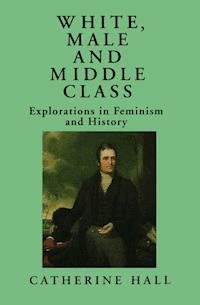
What are the relations between feminism and history, feminist politics and historical practice? What are the connections between gender and class? What part have racial identities and ethnic difference played in the construction of Englishness?
Through a series of provocative and richly detailed essays, Catherine Hall explores these questions. She argues that feminism has opened up vital new questions for history and transformed familiar historical narratives. Class can no longer be understood outside of gender, or gender outside of class.
But English identities have also been rooted in imperial power. White, Male and Middle Class explores the ways in which middle-class masculinities were rooted in conceptions of power over dependants - whether black or female.
Sie lesen das E-Book in den Legimi-Apps auf:
Seitenzahl: 622
Veröffentlichungsjahr: 2013
Ähnliche



















WHITE, MALE ANDMIDDLE CLASS
Explorations in Feminism and History
Catherine Hall
Polity Press
Copyright © Catherine Hall
The right of Catherine Hall to be identified as author of this work has been asserted in accordance with the Copyright, Designs and Patents Act 1988.
First published in 1992 by Polity Press in association with Blackwell Publishers Ltd
Reprinted 1995, 2003, 2005, 2007
Polity Press65 Bridge StreetCambridge CB2 1UR, UK
Polity Press350 Main StreetMalden, MA 02148, USA
All rights reserved. Except for the quotation of short passages for the purposes of criticism and review, no part of this publication may be reproduced, stored in a retrieval system, or transmitted, in any form or by any means, electronic, mechanical, photocopying, recording or otherwise, without the prior permission of the publisher.
Except in the United States of America, this book is sold subject to the condition that it shall not, by way of trade or otherwise, be lent, re-sold, hired out, or otherwise circulated without the publisher’s prior consent in any form of binding or cover other than that in which it is published and without a similar condition including this condition being imposed on the subsequent purchaser.
ISBN: 978-0-7456-6682-2 (Multi-user ebook)
British Library Cataloguing in Publication DataA CIP catalogue record for this book is available from the British Library
Typeset in 10½ on 12 pt Times by Times Graphics, SingaporePrinted and bound in Great Britain by Marston Book Services Limited, Oxford
This book is printed on acid-free paper.
For further information on Polity, visit our website: www.polity.co.uk
For Stuart, Becky and Jess
Contents
Acknowledgements
1 Feminism and Feminist History
Part I The Beginnings
2 The History of the Housewife
Part II Gender and Class
3 The Early Formation of Victorian Domestic Ideology
4 Gender Divisions and Class Formation in the Birmingham Middle Class, 1780–1850
5 The Butcher, the Baker, the Candlestick-maker: the shop and the family in the Industrial Revolution
6 The Tale of Samuel and Jemima: gender and working-class culture in early-nineteenth-century England
7 Private Persons versus Public Someones: class, gender and politics in England, 1780–1850
8 Strains in the ‘Firm of Wife, Children and Friends’: middle-class women and employment in early-nineteenth-century England
Part III Race, Ethnicity and Difference
9 Missionary Stories: gender and ethnicity in England in the 1830s and 1840s
10 Competing Masculinities: Thomas Carlyle, John Stuart Mill and the case of Governor Eyre
Index
Acknowledgements
‘The History of the Housewife’ first appeared in The Politics of Housework edited by Ellen Malos, London, 1980, and is published by kind permission of Allison & Busby. ‘The Early Formation of Victorian Domestic Ideology’ first appeared in Fit Work for Women edited by Sandra Burman, London, 1979, and is published by kind permission of Croom Helm. ‘Gender Divisions and Class Formation in the Birmingham Middle Class, 1780–1850’ first appeared in People’s History and Socialist Theory edited by Raphael Samuel and is published by kind permission of Routledge & Kegan Paul. ‘The Butcher, the Baker, the Candlestick-maker: the shop and the family in the Industrial Revolution’ first appeared in The Changing Experience of Women edited by Elizabeth Whitelegg, Madeleine Arnot, Else Bartels, Veronica Beechey, Lynda Birke, Susan Himmelweit, Diana Leonard, Sonja Ruehl and Mary Anne Speakman, Oxford, 1982, and is published by kind permission of Martin Robertson. A version of ‘The Tale of Samuel and Jemima: gender and working-class culture in early-nineteenth-century England’ first appeared in Popular Culture and Social Relations edited by Tony Bennett, Colin Mercer and Janet Woollacott, Milton Keynes, 1986, and is published by kind permission of Open University Press. ‘Private Persons versus Public Someones: class, gender and politics in England, 1780–1850’ first appeared in Language, Gender and Childhood edited by Carolyn Steedman, Cathy Urwin and Valerie Walker-dine, London, 1985, and is published by kind permission of Routledge & Kegan Paul. ‘Strains on the “Firm of Wife, Children and Friends”: middle-class women and employment in early-nineteenth-century England’ first appeared in Women’s Work and the Family Economy in Historical Perspective edited by Pat Hudson and W. R. Lee, Manchester, 1990, and is published by kind permission of Manchester University Press. ‘Missionary Stories: gender and ethnicity in England in the 1830s and 1840s’ was first published in Cultural Studies edited by Lawrence Grossberg, Cary Nelson and Paula Treichler, New York and London, 1992, and is reprinted by kind permission of Routledge, Chapman & Hall. A version of ‘Competing Masculinities’ first appeared as The Economy of Intellectual Prestige: Thomas Carlyle, John Stuart Mill and the case of Governor Eyre’ in Cultural Critique, no. 12, Spring 1989.
I am grateful to David Held at Polity Press for proposing this collection. The Economic and Social Research Council supported the joint research project of Leonore Davidoff and myself, between 1978 and 1982 and are now (1990–92) supporting my research on ‘Race, Ethnicity and the English Middle Class 1832–68’. I am deeply grateful for that support.
Many people have helped me over the years with this work – in classes, workshops, seminars and conferences, libraries and archives – I thank them all. The discussions I have had with the women’s history classes at the Birmingham Midland Institute in the 1970s, the students and staff of the Cultural Studies Department at the Polytechnic of East London since 1983, the collectives of Feminist Review and Gender and History, and varied feminist reading groups, have all helped me to shape the questions addressed in these essays. I could not have survived without the collectivity of feminist historians in Britain. David Albury, Michèle Barrett, Veronica Beechey, Moira Ferguson, Cora Kaplan, Keith McClelland, Jokhim Meikle and Bill Schwarz have all listened to me, discussed with me and kept me going. Lata Mani gave me helpful comments on chapter 10. Sally Alexander and Leonore Davidoff have both been critical and supportive in ways that have been vital to me, as has the love and encouragement of my sister, Margaret Rustin, and my mother, Gladys Barrett: these essays would not have been written without them. Stuart, Becky and Jess have lived with this work over the years and I dedicate this book to them.
1 Feminism and Feminist History
As a feminist historian writing in the 1990s I cannot be naïve either about memory, which feminist historians and theorists have done so much to explore, or about telling stories, which post-structuralism has helped us to think about when reading or writing history. My narrative, which concerns the ways in which I have engaged with feminism and history over the last twenty years, and the ways in which the essays in this book reflect the historical specificity of certain moments in that process, is necessarily partial, full of absences and silences, marked by its attempt to tell a coherent story, to make sense of tensions and contradictions which cannot in life be so neatly resolved. This, with all its particularities, is my story.
Historians construct stories, stories which necessarily have a narrative shape but in which the tensions between the teller, the tropes of the discourse (the beginning, the middle, the end), and what are understood to have been the events, are consciously worked on. But history, for me, is not just another fiction. Historical research is always premissed on a relation between past and present, is always about investigating the past through the concerns of the present, and always to do with interpretation. Historians attempt to interpret past realities and the meanings which they were given through language (for there is never only one real meaning, or one set of meanings), realities which can only be reached through forms of representation, which can only be read textually (in the widest sense of the term), which can never be grasped in an unmediated way. The stories which they construct, from laborious archival work ordered by conceptual frameworks, are grounded through an attempted comprehensiveness in relation to evidence, a commitment to look at countervailing accounts, an effort to test interpretations against others, the practices of good scholarship.
Some of this I learned as a student, some of it through feminism, some through working in cultural studies. The meaning of being an historian over the last twenty years, of trying to do certain kinds of historical work, has significantly changed. Feminism has made an important contribution to these changes. This introduction and the essays which follow are part of the story of that dynamic relation between feminism and history.
I have always loved history. I loved, as a child, being taken to places on family outings, whether castles, abbeys, battlefields, or royal palaces, walking round the walls of York, climbing on Hadrian’s Wall, going down the shaft in Leeds City Museum’s reconstructed coal-mine, having days out – outings that are intimately connected in my memory with those rare occasions when we were allowed to have fish and chips. Such trips were much encouraged by my mother, a first-generation grammar school girl who made it to Oxford to read history and had her budding historical career cut short by marrying a minister and becoming a minister’s wife.
I loved reading historical novels too – especially by Rosemary Sutcliff – imaginatively living in another world. In my adolescence, I turned to those which combined exciting hints of sexual adventure with their historical drama: the many volumes of Jean Plaidy collected weekly from the local library, and Katharine, about the mistress of John of Gaunt, which we owned and I must have read at least a dozen times. I can still remember reading the exciting bits of Gone With the Wind (impervious to its racism), tucked behind the sofa in the house of family friends in Lancashire. Those memories of Gone With the Wind are mixed up with the sherry trifle which was a feature of those visits, a forbidden treat since alcohol was unknown in our temperance household, and over which there was a conspiracy of silence, combined with suppressed giggles when my father commented on how good the trifle was!
History lessons at my school, Leeds Girls’ High School, were the only classes which I really enjoyed and which inspired me to try and find out things for myself. What a disappointment, having promised the class a radical reinterpretation of Sulamein the Magnificent, which would prove that he was not nearly as bad as had always been made out, that I could find no evidence in our school library to support this claim and had to rely entirely on vigorous assertion in defence of my claim! My favourite history teacher, Miss Braddy as she was then, is fixed in my memory as she was when we were doing A-levels, the Tudors and Stuarts, and she introduced us to Christopher Hill’s The Century of Revolution, just published, as our set text. An unlikely choice in a very conventional girls’ grammar school but one that set me off on a long love-affair with the British Marxist historians.
It wasn’t surprising, then, that I too ended up reading history at university. History always seemed the only choice, and that seemed to lead straight on to research, although on an unlikely topic – the English medieval aristocracy. That was because of Rodney Hilton’s teaching at Birmingham, which opened up to me a whole new and exciting world, a different and imagined feudal world, in which men made their own history and it was therefore vital for historians to grasp ‘the political and social consciousness of the various classes’.1 Hilton had been a member of the Communist Party Historians’ Group, that group which had decided to challenge British historiography and construct a new body of Marxist history that would both connect with popular politics and engage with the academic establishment. Rodney Hilton, Christopher Hill, Edward Thompson and Eric Hobsbawm, together with the other members of the group, called for a major reassessment of English cultural and political history and a communism which would combine elements of Marxism with popular radical English traditions.2
By the early 1960s, when I went to university, a substantial body of that work had already appeared and the Cold War freeze-out which had marginalized much of what had been done in the 1940s and 1950s was beginning to melt. The medieval England to which Hilton introduced me was theorized in ways that made sense to me – class struggle, popular resistance, a whole social formation; these were concepts at the heart of his writing and teaching. For a young woman bred on radical nonconformity and the New Statesman, growing up in Leeds as a Young Socialist and an activist in YCND, connected to the tail-end of the New Left as it entered popular politics through the peace movement in the early 1960s, this was a heady brew. My marriage in 1964 to a Jamaican intellectual active in New Left politics, whom I had first encountered on an Aldermaston march, strengthened this nexus of political and personal connections and gave me confidence to pursue my own project.
Hilton’s radical political agenda, twinned with his deep love for the activity of historical research, was an inspiring combination and one which led me to think that I could overcome the practical difficulties associated with my bad Latin – and even worse palaeographic skills – and become a medieval historian. Being a research student, however, turned out to be an alienating and disappointing life. The excitement of intensive teaching was over, now I was expected to get on with it alone and sustain my own project; weeks in the Public Record Office with undecipherable manuscripts, visits to dusty episcopal archives – what was this to do with class struggle and popular resistance? The model of the lone researcher seemed to be the only available paradigm, despite the collective discussions of the Communist Party historians.
Then came 1968 – which signified for me not only the months of student activism, the demands for a new curriculum, the insistence that the history syllabus should include discussion of theory and historiography (totally neglected in the majority of courses), but also the familiar discomfort, not yet recognized for what it was, of being a woman active in left politics. This was much intensified by the fact that I was by now many months pregnant with my first child and while other students revelled in the excitement of occupying the Great Hall at Birmingham University I found it too uncomfortable to sleep on the floor and had to go home – hardly a properly revolutionary experience! In December 1968 my baby was born and I soon found that the life of a mother did not fit well with that of a researcher. The printed Pipe Rolls were difficult to focus on in the few hours that Becky slept; questions which had seemed fascinating, such as the construction of aristocratic hegemony in the West Midlands, lost their edge for me in the midst of a totally new life dominated by the unfamiliar demands of a baby – by milk, nappies and a twenty-four-hour day. Gradually it became clear that finding a new way to survive was the most pressing issue – and a women’s group seemed to provide the answer.
The first Women’s Liberation Group met in Birmingham in February 1970. Many of us were young mothers with children who had started talking informally about the things that felt wrong with our lives, especially our isolation. We set up what became a consciousness-raising group, though I don’t think we thought of it as such at the time, and began to talk about what it meant to be a woman. Most of us had some kind of history in left politics, and a university education. Some of us attended the first women’s movement conference at the end of February 1970. We read Juliet Mitchell’s The Longest Revolution and Sheila Rowbotham’s ‘Women’s Liberation and the New Politics’, thought about why we wanted to exclude men from our group, and began to wonder about organizing campaigns on women’s issues in Birmingham. Being active in a women’s group, which rapidly evolved into other groups, and starting to organize collective childcare, seemed much more satisfying and immediate than doing historical research. In 1971 my second child was born and motherhood seemed to combine more comfortably with political activism than the Public Record Office.
I can distinctly remember one of my first encounters with feminist history, though some of the details may be wrong as I can no longer find the evidence. It was through reading an article by three American feminists who offered a reinterpretation of Victorian womanhood. The article was an eye-opener and I remember presenting a version of it to a women’s study group I was in. When our children were a little older and we had organized a more effective system of childcare, I began to think again about doing historical work, but this time focused on women. My fascination with what it had meant for me to become a housewife and mother, and the ways in which I and my sisters had developed a politics from that perspective, informed my first experiments in this new area of historical research. The politics of housework which we had begun to elaborate questioned the division of labour in the home, challenged the ways in which hidden reproductive work was being done by women, and demanded a different future for them. ‘The History of the Housewife’ – chapter 2 of this book – first given as a paper to a Ruskin History Workshop in London and later published in a shortened version in Spare Rib, reflected the combination of those new concerns with the older agenda inherited from the Marxist historians.
Feminist history as first conceptualized in the early 1970s was about the recovery of women’s history. We needed to fill out the enormous gaps in our historical knowledge which were a direct result of the male domination of historical work. How had women lived in the past, what had they experienced, what kinds of work had they done, in what patterns of family life had they been involved, what records had they made? How could we find out? Thus, in that first crucial text for British feminist history Hidden from History (1973), Sheila Rowbotham wrote in her preface that, while working on her book, she kept asking herself:
In what conditions have women produced and reproduced their lives, both through their labour and through procreation; how has the free expression of this activity been distorted and blocked by the circumstances of society?3
A year earlier Anna Davin had written in her essay ‘Women and History’ that feminists had to reject what had passed for history and begin anew. ‘In a class society,’ she argued, ‘history has meant the history of the rulers, and in a male dominated society the history of men.’4 The socialist and utopian rhetoric of such writing was characteristic of this first generation of feminist historians. Our socialism was heavily infused with humanism, redolent with the conviction that we too could make history, albeit not in conditions of our own making. We were convinced of the possibility of a socialist feminist politics and a socialist feminist history. We might not have wanted a marriage between Marxism and feminism, given the elaboration of our critique of marriage, but we certainly wanted a working partnership.
‘The History of the Housewife’, the first version of which was written in 1973, has the hallmarks of this early attempt to link the new language of feminism with a reworked Marxism. It was concerned to recover a lost history and give value and meaning to the activities of women which had not been legitimated in traditional historical writing. Implicitly it challenged the grand narratives of Marxism (long before post-modernism emerged on the scene), which told the story of the transition from feudalism to capitalism and from manufacture to modern industry without any reference to women. That challenge could in part be met by recovering older traditions of feminist history-writing – such as Alice Clark’s investigation of the impact of the transition from feudalism to capitalism on women’s work (an aspect of the transition never mentioned in the many discussions about it amongst men that I had heard over the years), and Ivy Pinchbeck’s study of women’s work and the Industrial Revolution.5
The working concepts I made use of included the sexual division of labour (a reworking of the Marxist emphasis on the social division of labour); the insistence on the family as a site for the provision of the social relations of production (connected to the Althusserian concept of ideological state apparatuses, or ISAs); the stress on housework as the invisible support for the generation of surplus value (the beginnings of the debate over whether housework was, or was not, productive which eventually ground to a halt as the inadequacy of an attempted application of Marxism to a different set of problems became apparent); and the notion of a ‘dominant ideology’ which oppressed women. Other concerns of this essay are the separation of home from work and the break that this represented for women, and the family as a unit of consumption. The Althusserian concept of ‘relative autonomy’ – the relative autonomy of the family, for example, from forms of social determination – is also in play as a way of theorizing uneven developments and explaining the different temporalities of production and reproduction.
This first phase of feminist history-writing in the 1970s was also marked by an ambition, a conviction that it was possible to aim for a broad historical sweep, to rethink historical epochs, to construct new temporalities. In the early days of the women’s movement it seemed appropriate to generalize, to use secondary sources, to deal with long historical periods. Those heady days have now been replaced by more cautious approaches and more careful investigations. We soon began to feel the need for more detailed work, a more nuanced and dense grasp of particular historical moments. This shift in emphasis was connected with the gradual move away from thinking primarily about feminist history as part of a political movement towards thinking about it as an academic subject. The professionalization of feminist history (however limited it has been in Britain) has both advantages and disadvantages, for it was our political certainties which gave us the strength to make the assertions that we did. It would be a pity if the loss of those certainties, and the ever more complex understanding of the ways in which gender difference interacts with other axes of power, were to prevent us in the future from moving from the particular to the more general.
During the 1970s women’s history gradually became a subject in its own right. Adult education provided a facilitating framework for the development of new kinds of courses and new areas of study and had an excellent radical pedigree. Both Raymond Williams’s Culture and Society and E. P. Thompson’s The Making of the English Working Class were written while their authors were working in adult education.6 Cora Kaplan has evoked the excitement of teaching women’s writing in these arenas in the 1970s, for adult education classes provided an ideal opportunity to feed ideas into collective practice and be sure of a critical response with a political inflection.7 We met in those classes because of a movement, we collectively developed our new objects of study and new forms of analysis, and our manifesto that ‘Women’s history – and therefore people’s history – has yet to be written, and to write it is part of our present struggle’.8 All this was a far cry from the individualist mode of historical research.
In Birmingham the Extra-Mural Department was happy to cooperate with the establishment of a regular yearly slot in its programme. This started off as ‘Women in Society’ in 1974, boasting one section on history; became, in 1975, ‘Women in History’ (aiming to cover the medieval, early modern and modern); and in succeeding years increasingly narrowed its focus as articles and books slowly became available and the research which made new teaching possible was set in motion. In the late 1970s a feminist history research group was set up, also under the aegis of the Extra-Mural Department, which developed a collective research project, gave collective papers and published an article.9 Similar courses and groups were being established around the country, utilizing the WEA and extra-mural facilities when appropriate or relying on independent networks. These varied groups were all concerned with the work of historical reconstruction, the recovery of a past, which was so vital if we were to believe in a future for ourselves. That work focused on putting women back into the historical picture, recognizing and celebrating women’s achievements which had been lost through the male domination of historical writing.10
While feminist critics reread the canon with the objective of finding a female self and a speaking voice for women, feminist historians set about discovering what women had done in the workplace, in the home, as mothers, daughters, wives and lovers, what political movements they had been involved with, what forms of struggle they had engaged in, what battles they had won and what they had lost, how men had managed to maintain their power over women for so long. At that time woman/women was not a contested category. Rather it seemed clear to us that women, ‘our sex’, were those who were oppressed by men, those who must demand power and agency for themselves and make history. Such a formulation inevitably masked a multitude of problems for, as Ann Snitow points out, the tension ‘between needing to act as women and needing an identity not overdetermined by our gender … is at the core of what feminism is’.11
By 1975 I had decided that I had no future as a medievalist and that I should turn to the nineteenth century. I went to Essex University to do an MA, the only university in the country where it was possible to study women’s history as part of a postgraduate course. While there I pursued my interest in domestic ideology (conceptualized as a coherent ideology) particularly in relation to the early-nineteenth-century middle class. Chapter 3, ‘The Early Formation of Victorian Domestic Ideology’, was originally written as my MA dissertation. In that work I began to explore the ways in which women had themselves been implicated in the construction of a new bourgeois culture in the late eighteenth and early nineteenth centuries. Far from a ‘dominant ideology’ having been imposed on women by men, women ideologues, particularly the redoubtable Hannah More, had played a vital part in defining and articulating the boundaries of a new domesticated morality. Here was a woman indeed making history, but not in the conditions of her own making. Hannah More was a great anti-Jacobin propagandist, but consideration of the tensions between her forms of political conservatism and the radicalism of her claims for women’s sphere (albeit a radicalism very different from that of her despised antagonist Mary Wollstonecraft) was to be highly relevant in what were to become the Thatcher years. Furthermore, an appraisal of More and Wollstonecraft highlighted the tensions between issues of equality and difference, a central and necessarily unresolved conflict for feminism.12
‘The Early Formation’ was written in the shadow of E. P. Thompson’s The Making of the English Working Class, a text on which many feminist historians cut their teeth. For, slicing across our preoccupation with women was a constant preoccupation with class questions. British feminism and British feminist history developed in dialogue with the Labour movement and class politics. Political identities and political discourses in Britain have been vitally associated with class identities and the language of class has, since the early nineteenth century, provided a dominant discourse of politics, closely intertwined with the language of radicalism and socialism. The language of class was the language which was used to articulate what was different about capitalism and modernity and thus has occupied a key position in nineteenth-and twentieth-century society. Feminism in Britain in the late 1960s and early 1970s was rooted in an engagement and dialogue with those languages of class, of radicalism and of socialism, and indeed with the political movements associated with them. By the mid-1970s a distinctive radical feminist voice had emerged, with its own historical agenda, challenging and fertilizing socialist feminism and transforming the feminist agenda with its insistence, particularly, on questions about the control of women’s sexuality and male violence.13 In the first years of the new women’s movement, however, the dialogue with socialism was pre-eminent.
Feminist history in Britain developed in a quite specific relation to this engagement with socialism and with class politics. The first national conference of the women’s liberation movement was held at Ruskin College, Oxford, the trade union college where Raphael Samuel, one of the founder members of the New Left, of the History Workshop movement and History Workshop Journal, teaches history. It was the result of a demand from a group of women. It began as a history workshop and grew into a national conference. At the same time the early history workshops took up questions about women’s history and became a place where budding feminist historians could meet, where our double marginality – from the historical establishment and from the heartlands of labour history – acted as a stimulus rather than silencing us. History Workshop Journal was from its inception both a space and a site of struggle for feminist historians. Sally Alexander and Anna Davin’s feminist editorial in the first issue of the journal summed up the preoccupations of the mid-1970s:
By bringing women into the foreground of historical enquiry our knowledge of production, of working class politics and culture, of class struggle, of the welfare state, will be transformed. Men and women do inhabit different worlds, with boundaries which have been defined (and from time to time re-arranged) for them by the capitalist mode of production as it has made use of and strengthened the sexual division of labour and patriarchal authority. It is relationships like that between the two worlds, between the sexual division of labour and class struggle, home and work, or the private sector and the public, the social relations between men and women which form the substance of feminist history, and will enrich all socialist history.14
Here class struggle, the capitalist mode of production, the sexual division of labour, patriarchy and public and private provided the conceptual framework for a distinctively socialist feminist approach. That approach was the result of long and hard work, of many collective discussions, of unsuccessful as well as successful attempts to rework concepts. What now appears a seamless development was an uneven and difficult process, with tiny theoretical gains being won at great, if sometimes exciting, cost.
British feminist history was fed and watered by the tradition of British Marxist historiography – many of us were taught by those historians, inspired by their example and their influence, their commitment to the possibility of a political project in the rewriting of histories, their attempts to recover the heroic stories of peasants, or humble seventeenth-century Puritans, or the working class, their determination to hold together the use of empirical evidence and a powerful theoretical framework, their success in terms of their readership and their capacity to make a difference. We learned from them how to construct historical narratives in terms of class struggle. But the engagement with that historiography, the challenge that it presented in terms of the things that were not said and were not explored, the refusal to consider seriously the woman question, the conviction that class was gender blind – only slowly and tentatively articulated by us – also moved us to reject our fathers and to attempt to do a different kind of work, write different histories, inspired by a different set of political imperatives.15
The exploration of class, particularly as a cultural formation, has remained, however, at the heart of my work and the essays in Part II of this book represent the effort to understand the complex interplay of gender and class. Many of them were written while I was working with Leonore Davidoff, for in 1978 we began a joint research project on the place of gender in the formation of the English middle class, published in 1987 as Family Fortunes: Men and Women of the English Middle Class, 1780–1850.16 The preoccupations with gender and class reflected both the feminist politics of the mid-1970s and the historiographical concerns of that period. The early optimism of the women’s movement of the late 1960s and early 1970s, the euphoric sensation that our new understanding of the sexual division of labour, the organization of the family and the power relations between men and women meant that society could be transformed, that the world could be turned upside down by our new view of it and by willing it, organizing it to be so, was giving way to a more sober conviction that the kinds of social change which we sought were going to be very difficult to achieve, not least because of the changes involved for ourselves and in ourselves. The utopian moment was over – the long haul had begun.
One response to this was the turn to psychoanalysis, heralded by Juliet Mitchell’s Psychoanalysis and Feminism, and the recognition that feminine subjectivity presents serious problems for feminists, that out wants and desires might be more contradictory than we had realized, that our psyches might be more resistant to change than our social selves.17 Another response was linked to the socialist-feminist dialogue with radical feminism, for the socialist perspective kept the question of a different future for women and men on the agenda. This inspired the attempt to come to terms with the extent to which women’s oppression could only be understood as part of a whole social process in which men are implicated quite as much as women. Thus the move away from an exclusive focus on women and the beginnings of a feminist interest in men and the construction of masculinities. Significantly, Michèle Barrett’s chapter on sexuality and subjectivity in her influential book Women’s Oppression Today (1980) was ‘Femininity, Masculinity and Sexual Practice’, an indicator of a new emphasis but one which has been strongly criticized and regarded as possibly dangerous by some feminists, in its return to that ever central object of study, men.18
From its inception, the project on which Leonore Davidoff and I worked together, and which resulted in both Family Fortunes and the essays on gender and class published here, was concerned with women and men. We wanted not just to put the women back into a history from which they had been left out, but to rewrite that history so that proper recognition would be given to the ways in which gender, as a key axis of power in society, provides a crucial understanding of how any society is structured and organized.19 What was the specific relation of women to class structures and how should women’s class position be defined? How was class gendered, to use the word which began to be increasingly utilized by feminists as a way of thinking about the social relations between the sexes and the ways in which men’s power over women provides a fundamental form of social, economic and political power?20 How was it different to be a man or a woman belonging to a particular social class? Do men and women have different class identities? Are their forms of class consciousness and class solidarity the same? Since in classical Marxism class is defined as a relation to the means of production, what were the implications of this for women? Was women’s labour in the home unproductive? Were women engaged in class struggles in the same ways as men? Did women have an identity as women which cut across forms of class belonging? These were the kinds of questions which raged amongst feminists in the 1970s, which provoked some fascinating and important debates (as well as some dead ends), and which made us determined to explore the meaning of class for both men and women, in the conviction that a class formation could not possibly be understood by looking at only men or only women, that masculinities and femininities are always defined in relation to each other and that they only make full sense when placed in a whole social, economic and cultural world.
Our central preoccupations were, then, class and gender. The concept of gender emerged from years of consciousness-raising. Work had to be done to discover a new analytic term, a concept which was strong enough to counter class without being reducible to sex. Gender was understood relationally: manliness, to use the nineteenth-century term, is what is not feminine, femininity the opposite of manliness, ‘the rugged lofty pine and graceful slender vine’ of the anonymous poem in a commonplace book, or in the words of the popular poet Ann Taylor Gilbert, writing on the differences between men and women in 1807:
Man’s proudest glory is his head,
A Woman’s is her heart.21
We only establish the differences between men and women by discursively constructing ‘the other’, as we might now put it. Furthermore, those definitions are not fixed in essence but are constantly changing as they are contested and reworked. Masculinities and femininities are thus historically specific and we can trace the changes over time in the definitions which have been in play and in power. What it means to be a man or a woman is not given at birth, but constructed in culture and constructed through difference.
Other developments in feminist theory and history were also crucial to the definition of our project and, in particular, there were important influences from the United States. The debates over class had never had the pertinence there that they had had in Britain, since class is a highly contested category in the USA and socialist politics have occupied a much less central position there. In the United States the dominant paradigm was set by the emphasis on individual rights, on equality and on sisterhood. One of the first and most evocative slogans to come from the American women’s movement was that impassioned cry, ‘Sisterhood is powerful’. Women together, organized and with a collective identity and collective demands, could be politically effective. The refusal of the status of victim – people who have things done to them, who cannot be agents in their own liberation – was empowering in terms of both public campaigns and private struggles. American feminist historians began to explore the myriad sources of modern feminism and the specificity of women’s culture.
The recognition, within the women’s movement, of women’s potential for power and agency in the world was reflected in the writing on ‘women’s culture’. Nancy Cott, for example, in The Bonds of Womanhood (1977), looked at the ways in which middle-class American women in the early nineteenth century increasingly occupied a separate sphere from men, in which they began to spend more time together and to recognize mutual interests. Women gradually began to combine, both in the family and outside it through friendship, to protect those mutual interests, moving from gossip over teacups to semi-formal organizations such as maternal associations and missionary ventures, often using the church as a base.22 Mary Ryan, in her Cradle of the Middle Class, developed this argument in the context of a community study of the middle class, and looked at the ways in which women’s organizations were able to challenge the boundaries between public and private.23 Other writers began to explore the ways in which these mutual interests provided, on the one hand, a basis for a heightened awareness of the particularity of women’s identity and needs and, on the other, could bring them into more direct conflict with men through moral reform attacks on the ‘double standard’ and temperance. In some instances this opened the way for explicitly feminist concerns. Carroll Smith Rosenberg’s article, ‘The female world of love and ritual’, was undoubtedly the most influential piece of historical writing on women’s culture, with its celebration of women’s agency, its demonstration of the strength of their homosocial relationships, and the pleasure women had in their ‘alternative world’. It mirrored the pleasure feminists had in the world which they were creating and stressed a commonality of culture which was symptomatic of this first phase of feminism but neglected the differences and power relations between women, rooted both in class and ethnicity, which dominated feminist politics in the 1980s.24
‘Sisterhood is powerful’ recognized the power which collectivities of women could have, whether in friendship groups and through gossip (who is excluded, who is included) or in informal or formal organizations. The perception of the extent of women’s power and influence was in part based on the recognition of the multiplicity of sites of power, which was certainly understood by feminists in the 1970s as they challenged male power and asserted themselves in the home, in the kitchen and bedroom, against their men, with their children, in workplaces and political organizations. Feminism placed the issue of power on the political agenda, just as the black power movement did in the United States. Foucault’s knowledge/power couplet, his theorization of the multiplicity of power relations, his challenge to orthodox Marxist conceptions of power as residing in ‘the ruling class’ or ‘the state’, may now be to the fore in the minds of students schooled in post-structuralist thought, but the political preconditions for the take-up of such ideas in Britain were in part to do with feminism.
The recognition of the multiplicity of sites of power between men and women was linked to the concept that ‘the personal is political’ – one of the key breakthroughs of the early women’s movement – the understanding that sexual politics, the politics of power relations between men and women, is part of everyday personal life. Thus, the question of who does the washing-up, who changes the nappies, who sweeps the floor, who does the shopping, who feels it is their fault when things go wrong in a family or household, is not just to do with individual difficulties between couples but is part of a social organization of power. Men’s power over women is not only at play in the public arenas of education or employment, but in the most private recesses of our experience, in our feelings about ourselves as daughters, mothers, wives and lovers. Such a perception, which now seems entirely common sense, emerged from the consciousness-raising groups of women in the United States and Britain. No theorist can be said to have discovered it, it was a genuinely collective naming of a problem which in the 1950s had had ‘no name’. As such, it posed a fundamental challenge to the seemingly ‘natural’ relations between the sexes.
Feminist politics in the 1970s was inevitably very preoccupied with the place of the family, attempting to understand the extent to which women’s oppression, to use the language of the 1970s, was rooted in the family.25 The recognition of the myth of the happy nuclear family, often starting with women’s experience of motherhood and childcare, the beginnings of work on representations of the family, the gradual discovery of the extent of violence within the family, the understanding that ‘there is nothing wrong with thinking that there’s a great deal wrong with the family’, the realization of the particularities of the Western nuclear family and the discovery of possible alternatives, the attempt to create and live with such alternatives – all this was part of the feminist politics of the family in the 1970s.26 It was clear that the family was one of the keys to it all – the place where boys first learned to be boys and girls to be girls, the place where sexuality was tied to reproduction, where women were trapped in the dual burdens of motherhood and low-paid work, where men could be patriarchs, monarchs of all they surveyed, even if their territory was very modest and their subjects few. The family was central to social organization and central to the power relations between the sexes. As such, the neglect by historians of the institution of the family and its place in the social and political world was quite extraordinary.
Feminist historians in the 1970s drew on this common body of feminist theory and practice; the desire to understand the connections between sexual politics and class politics, the recognition of women’s agency, ‘sisterhood is powerful’, the conviction that power relations between the sexes were at the heart of the social and psychic order, ‘the personal is political’, and the knowledge that the institution of the family was not only central to women’s subordination but also to economic, political and social life. The women’s movement can also be said to have inspired the work on the middle class which Leonore Davidoff and I launched into. Whereas much of the early British feminist history investigated the lives of working-class women, inspired by the example of socialist history, the recovery of ‘history from below’, and the absence from that of any adequate work on women, we drew on the feminist injunction that you should always start with yourself and what you know and experience. For most feminists in the 1970s, ‘experience’ was still a central category, and so we began to investigate the institution into which we were both born, and which we had in our turn reproduced, the middle-class family. Ten years ago there was a striking absence of historical work on the middle class, let alone the middle-class family. In deciding to work on the middle class we were undoubtedly driven in part to discover what seemed to be the moment of formation of that particular family form which has remained hegemonic into the late twentieth century.27
Our preoccupations were still, however, in part centred on male theory (not only Marx but Gramsci for his work on civil society and the construction of hegemony, and Weber for his rich and suggestive analysis of the relations between particular religious forms and the development of capitalism), on male historiography, on male power, and indeed on the relational aspects of the historical specificities of masculinities and femininities. From this rich brew, nineteenth-century middle-class men emerged as a central object of study; fascinating in their conviction of their own power, their sense of themselves as making history, their future. At the end of 1978 I spent three months in the Birmingham Reference Library reading Aris’s Birmingham Gazette between the 1780s and 1840s. I became increasingly desperate about the virtual absence of women from any page of these papers until I finally realized – one of those realizations that is so obvious once you have made it – that the newspaper was contributing to the construction of a new middle-class male public sphere by the very items that were chosen to be reported, whether philanthropic meetings, civic processions or significant funerals. Men moved to the centre of the story – not to displace women, but in order to be able to make sense of the particular articulations of masculinity or femininity within the middle class. To be a middle-class man was to be a somebody, a public person, while the essence of middle-class femininity was being constructed as private and domestic. Such oppositions acquired their meanings ideologically, but that ideology had material effects of the most immediate and concrete kind.
The essays in Part II are all concerned with the complex interplay between gender and class. What were the distinctive patterns of domesticity associated with the English nineteenth-century middle class? What was the relation between prescribed ideologies and lived practices? What were the particular masculine and feminine identities constructed within the middle class? What tensions were there between class and gender identities, and how might these contradictions have contributed to the development of feminism? What kind of impact had middle-class notions of proper relations between men and women had on working-class people? What access could historical specificity give us to the particularities of the gender/class dynamic?
While many nineteenth-century middle-class men may have tried to speak for their wives, as James Luckcock, the Birmingham jeweller, did so memorably in the poem he wrote about himself on his wife’s behalf, entitled ‘My Husband’ (quoted chapter 4), a careful use of a variety of sources made it possible to rethink the ways in which middle-class men had selectively thought about and recorded their world, many of those categories being preserved in the writings of middle-class male historians. In our study, both male and middle class were subjected to the feminist lens – whiteness, for me however, was a more resistant category.
While white feminist theorists, critics and historians were struggling over the meanings of gender, black feminists were issuing a different challenge. This happened first in the United States where black women questioned the white and ethnocentric concerns of American feminism as it had emerged in the late 1960s and 1970s. The concept of sisterhood came under fire as black women insisted on the importance of recognizing difference and diversity and argued that the white feminist version of sisterhood was exclusive to white women, who only accepted sisters on their own terms.28 These issues became vital to feminist politics in Britain as black women challenged white feminists in campaigns, at meetings and at conferences. The formation of autonomous black women’s groups in the late 1970s, particularly the Organization of Women of African and Asian descent, which attempted to bring together black women from a number of different backgrounds and perspectives, was a critical moment for feminism.29 Black feminists argued that a white, Eurocentric, Western feminism had attempted to establish itself as the only legitimate feminism, that this feminism did not speak to the experiences of black women, and that there was little recognition of the ways in which the gains of white women were made at the expense of black women.
In 1982 Hazel Carby, in her critique of white feminist theory in Britain, was also scathing about the new forms of history. When white feminists, she argued, ‘write their herstory and call it the story of women but ignore our lives and deny their relation to us, that is the moment in which they are acting within the relations of racism and writing hisstory’.30 Valerie Amos and Pratibha Parmar took up this emphasis on the ‘herstory’ which had developed in Britain and the amnesia on questions of race from which it suffered:
The ‘herstory’ which white women use to trace the roots of women’s oppression or to justify some form of political practice is an imperial history rooted in the prejudices of colonial and neo-colonial periods, a ‘herstory’ which suffers the same form of historical amnesia of white male historians, by ignoring the fundamental ways in which white women have benefitted from the oppression of Black people.31
Feminist theory and practice, these black feminists were insisting, must entail an understanding of imperialism and a critical engagement with, and challenge to, racism.
In the United States black women started to write their own story, both fictionally and in more conventional historical forms.32 Black feminist historians were faced with the double problem that African-American history was well developed but failed to address questions of gender, while women’s history failed to address questions of race.33 The ‘double consciousness’ of the black American man had been written about by Dubois most eloquently in the early twentieth century: ‘One ever feels his twoness – an American, a Negro; two souls, two thoughts, two unreconciled strivings; two warring ideals in one dark body, whose dogged strength alone keeps it from being torn asunder.’34 This ‘double consciousness’ had to be extended to include the dynamic of gender. In Britain the problems in constructing a black feminist history have been different from those in the USA since there is a much less well developed black historiography as a base for building and critique. The black and Asian population in Britain occupies a very different position from the black population in the United States, since it was only in the 1950s that large numbers of Afro-Caribbean and Asian peoples came into Britain. Not until the 1960s and 1970s did a black identity haltingly emerge, articulating the particular dreams and desires of ‘immigrants’, constructing solidarities and allegiances between different ethnic communities. The identity of the ‘black Briton’ remains uncertain and contested, the dream of ‘going home’ still a living reality for many.35
As Delia Jarrett Macaulay has recently described, her writing of black women’s history was connected with the emergence of a black feminist identity, which has its own history in relation to the black power movement. That moment was associated with the late 1970s, the space which the Greater London Council (GLC) opened up in London for women and ethnic minorities, the move to establish a black caucus in the Labour Party, and the ways in which these political events intersected with the powerful impact of black women’s writing. The International Conference on the History of Blacks in Britain which Macaulay attended in London in 1981 was hardly affected by the contemporary black presence; the only paper presented which related to women was about the Hottentot Venus.36 Peter Fryer’s vital book Staying Power was published in 1984 but its history of blacks in Britain had almost nothing to say about women.37 The absence of a black women’s history became a problem with a name.
The conditions for the development of such a history were, however, hardly propitious. In the 1980s the entry of black and Asian women into the higher education system was extremely limited, coinciding with the period when history departments were drastically cut back, funding for historical research decimated, adult education threatened. What work has been done by black feminist historians has once again come from the margins – teachers, librarians, activists, who have been determined to begin to write their own histories.38
But black women, as we have seen, presented a challenge to white women as well as developing their own historical project. White women must find out for themselves how different racisms, each with their contingent historical conditions, arising from the colonial and imperial ventures of the last five centuries, have been and continue to be central to British history and an understanding of British society. It was not the task of black women to teach white women this, any more than it was the task of women of teach men; oppressors should learn about their own forms of oppression. The understanding of difference is a task for all of us. As Audre Lorde wrote:
Women of today are still being called upon to stretch across the gap of male ignorance, and to educate men as to our existence and our needs. This is an old and primary tool of all oppressors to keep the oppressed occupied with the master’s concerns. Now we hear that it is the task of black and third world women to educate white women, in the face of tremendous resistance, as to our existence, our differences, our relative roles in our joint survival. This is a diversion of energies and a tragic repetition of racist patriarchal thought.39
Racism, imperialism, colonialism – these are issues for white women in Britain because they have shaped our histories, structured our stories, formed our identities. The ‘Empire’ is not just out there, it is inside us too. As Barbara Smith wrote in 1982:
White women don’t work on racism to do a favour for someone else, solely to benefit Third World women. You have to comprehend how racism distorts and lessens your own lives as white women – that racism affects your chances for survival, too, and that it is very definitely your issue. Until you understand this no fundamental change will come about.40
Yet as Vron Ware pointed out in 1990, ‘a history of British women and “race” has been largely unexplored’ and we have a ‘whitewashed’ feminist history, one that has largely failed to explore the ways in which racism and the experience of black women are relevant to the history of white women, one which denies women’s involvement in the Empire, and the crucial role which gender has played in ‘organizing ideas of “race” and “civilization” throughout history’.41 For white men and women experience their gender, their class, their sexual identities through the lens of race just as black men and women do. The difference is that while black has been a signifier of subjection, white has been a signifer of dominance, and the dominant rarely reflect on their dominance in the ways that the subjected reflect on their subjection.42
The obtuseness of British feminist historians on questions of race (including myself, despite my Jamaican husband and mixed-race children) only makes sense in the context of the political agenda which we constructed and the ways in which it was built on British amnesia.43 The ‘we’ at that point becomes pertinent in an inescapable way. The collectivity of sisterhood in the 1970s and early 1980s was always subject to challenge – from working-class women, from lesbians in opposition to the heterosexism of the women’s movement, from older women feeling their different experiences marginalized. The most powerful voice dominating the collectivity was the voice of middle-class, white women in their twenties and thirties. It took the angry black voice demanding, ‘What exactly do you mean when you say WE?’ – which must have been heard at countless tense meetings and encounters, insisting that white women must recognize the specificities and limitations of their own experience and the existence of difference – to disrupt that collectivity.44
The political imperatives of the first phase of the women’s movement were the imperatives of gender. The political identities we constructed, and which constructed us, were defined primarily in relation to the axes of gender and class. In the process of constructing identities, that is, ‘the process of representing symbolically the sense of belonging which draws people together into an “imagined community” and at the same time defines who does not belong or is excluded from it’, we effectively excluded not only black women but those parts of ourselves which were identified in racial or ethnic terms.45 Our ‘Englishness’, our ‘whiteness’, seemed irrelevant to our political project. It was only when this collective forgetting was challenged that parts of the self which had been repressed were articulated into more prominent forms of consciousness; another version of what happened when ‘black’ became a powerful political identity for people who had not previously conceptualized themselves in that way. Thus Michèle Barrett and Mary Mcintosh, in their highly contested but nevertheless vital contribution to the white feminist ‘critique from within’, insisted that white women must pay serious attention to their own practices and ideas if we were to be able to unpick the ways in which the processes of domination had continued to be invisible.46 It was this disaggregation of the unquestioned ‘we’, this gradual break-up of any universalizing category ‘woman’, that created the political conditions for the rethinking of that category and an attempt to redefine the feminist project so that the acceptance of difference was at its heart.
Developments in feminist theory had prepared the way for such a rethinking. The turn to psychoanalysis, and more specifically the feminist rereading of Freud through Lacan as a way of explaining the constitution of female subjectivity in and through language, had raised productive, if difficult, questions for feminist history.47 In 1984 Sally Alexander took the bull by the horns and wrote a piece in History Workshop Journal, previously the bastion of socialist and socialist-feminist emphasis on class as the primary form of political identification, problematizing ‘the absence of the sexually differentiated subject in marxism’. She argued that in order to place subjectivity and sexual difference at the heart of her historical work she had turned to ‘the psychoanalytic account of the unconscious and sexuality’ and that subjectivity was best understood through a process of differentiation, division and splitting in the individual, which is never finished or complete.48 That notion of the formation of subjectivity as an ever-unfinished process, one that inevitably involves psychic conflict and antagonism, and one that is fundamentally unstable, but always has historical conditions of existence, has been particularly helpful in thinking about the specificity of subjectivities. For if, as Cora Kaplan argues,
social life is ordered through psychic structures that to some extent organize its meanings, that psychic life in turn is only ever lived through specific social histories and political and economic possibilities.49
So Alex Owen, for example, has explored how in the nineteenth-century spiritualist movement in England, women were able to challenge the norms of femininity. For mediumship provided an expression of the instability of gendered identity, moments when the hidden and repressed components of the psyche could be brought to light, the seemingly unified and coherent self disrupted.50 From a different kind of engagement with psychoanalysis Carolyn Steedman used memories, stories, fragments and dreams to reconstitute female working-class subjectivity, to insist on its psychic components, and think about how ‘class and gender, and their articulations, are the bits and pieces from which psychological selfhood is made’ and decisively add another nail to the coffin of an unreflecting masculinist narrative of the working class.51




