


Erhalten Sie Zugang zu diesem und mehr als 300000 Büchern ab EUR 5,99 monatlich.
- Herausgeber: The History Press
- Kategorie: Geisteswissenschaft
- Sprache: Englisch
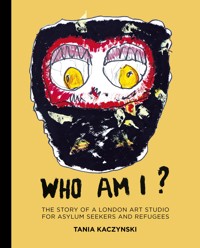
When everything is lost, imagination is the only place of true freedom. The New Art Studio, co-founded in 2014 by art psychotherapist Tania Kaczynksi, is a unique space in London set up as a lifeline for refugees and asylum seekers so they can experience art therapy in a relaxed, informal atmosphere. Who Am I? is a poignant look at the state of the dispossessed, and at how creating art can provide a last bastion of hope for those who have lost everything. Alongside the unique and touching artwork of the studio's members are their true stories of bravery, loss and redemption.
Sie lesen das E-Book in den Legimi-Apps auf:
Seitenzahl: 84
Veröffentlichungsjahr: 2020
Das E-Book (TTS) können Sie hören im Abo „Legimi Premium” in Legimi-Apps auf:
Ähnliche




















This book is dedicated to my dear parents,Marian and William Kaczynski,who both passed away while I was writing it.I know you can see from afar.Who Am I? is for you both and for all refugees, past, present and future.
Front Cover: Who Am I? by Paul
Back Cover: The Journey Continues by Wallid (p.78)
Frontispiece: Puppet King by Paul
First published 2020
The History Press
97 St George’s Place, Cheltenham,
Gloucestershire, GL50 3QB
www.thehistorypress.co.uk
© Tania Kaczynski, 2020
The right of Tania Kaczynski to be identified as the Author of this work has been asserted in accordance with the Copyright, Designs and Patents Act 1988.
All rights reserved. No part of this book may be reprinted or reproduced or utilised in any form or by any electronic, mechanical or other means, now known or hereafter invented, including photocopying and recording, or in any information storage or retrieval system, without the permission in writing from the Publishers.
British Library Cataloguing in Publication Data.
A catalogue record for this book is available from the British Library.
ISBN 978 0 7509 9552 8
Design by Katie Beard
Printed in Turkey by IMAK
eBook converted by Geethik Technologies
CONTENTS
Introduction: Making Art with the Displaced
Part One: An Idea
1 Welcome to the New Art Studio
2 Park Life
3 ‘New Studio Coming?’
4 Politics and Paints
Part Two: Studio Stories
5 Siri the Saviour
6 The Body Remembers
7 The Banality of Bureaucracy
8 ‘Wallid, You’re Next’
9 The Coat
10 Come Back
11 Same Paints, Different Picture
Part Three: No Way Out But Through
12 Life Outside London
13 It’s Never Over
14 Once Upon A Time
15 And Now …
Afterword
Contributors
Acknowledgements
Further Reading
Crowned Creature by Paul
INTRODUCTION
MAKING ART WITH THE DISPLACED
Here is a book like no other.
It tells real stories about real people, people who happen to be asylum seekers and refugees. Though we are bombarded with words about immigration, we seldom hear from the human beings at the heart of it, or see how the experience appears through their individual eyes.
Where there is war there will always be people seeking asylum. And there is always war. We are in the midst of the most urgent humanitarian crisis since the Second World War; there are currently over 70 million displaced people in the world, which means there are 70 million people without citizenship of anywhere.
These displaced people are people just like us.
One day, we might be asylum seekers too.
Who Am I? tells the story of a tiny art project that survived against the odds. It describes the creation of the New Art Studio and how two art therapists, Jon Martyn and I, joined forces with an international crew of the dispossessed to form an art collective unlike any other.
London Scene by Benjamin Croft
The lives of asylum seekers and refugees remain insecure even after they have lived in the UK for many years. In order to protect the individuals I describe in this book, all names and countries of origin have been changed or omitted.
I can, however, tell you that the studio is multicultural, and that we have members from Iran, Pakistan, Afghanistan, Russia, Ukraine and many more. Although our artists have their own distinctive style, each individual image exists thanks to the existence of the whole. The energy and spirit of the studio gives birth to the paintings. It is a very collective unconscious. In the same way it takes a village to raise a child, so it takes a studio to raise an artist.
Free at Last by Reyhana
Still Beating by Shaka
1
WELCOME TO THE NEW ART STUDIO
Making art with the dispossessed
Strong bonds form when people make art together. Intimacy grows swiftly and without effort. And when the people making art are asylum seekers the effect intensifies, as astonishing, unfinished stories unfold on canvas and paper like tales from One Thousand and One Nights.
We use the phrase ‘asylum seekers’ lightly. It rolls off the tongue without thought. We hear it so often that we become immune to the reality of being an asylum seeker unless we are lucky, like me, and get to make art and develop friendships with those who have experienced it. Each of them is an individual with stories to shame the media headlines – the kind we assume happen only in movies and Boys’ Own adventures full of escape, near-starvation, unjust imprisonment and tyrannical rulers who act with impunity. Stories that make civilian life in the free world seem childlike and unchallenged.
Going Away by Paul
Snowy Mountains by Akram
In the beginning, the lives of asylum seekers were just like ours. Before civil war broke out, before despots took control, their lives were full of comfy normality: school, work, marriages, emotional fall-outs and reconciliations … before they began to run. Caught in the crossfire, they fled for their lives and are now adrift, globally homeless in an indifferent world.
Buried in the Escher-like labyrinth of the Islington Arts Factory (an arts community centre reminiscent of the heydays of the 1970s) with no natural light, a leaking roof, cold in winter and hot in summer, existing on donated materials, the New Art Studio is a lifeline for people who have nothing: no family, no money, no connections.
Where do we go when we make art? To our unconscious, to our underworld, to places that frighten and compel us. To our dreams and to our nightmares. At the New Art Studio we travel that journey together.
I’d like to introduce you to the people behind the headlines and the statistics. To a group of artists, a group of friends. Let me show you around.
Universal Exile by Paul
Determined by Reyhana
2
PARK LIFE
The New Art Studio as a refugee
Before the New Art Studio I ran a similar project for six years as part of a large charity. It was here that I met Jon Martyn, a fellow art therapist. It was a thriving project. The clients and I bonded way beyond the boundaries of formal psychotherapy – we bonded as artists and we bonded as people. It was there that Jon and I began thinking and planning what was to become the New Art Studio.
That feeling of connection and camaraderie is vital for refugees and asylum seekers who have had to leave their sense of belonging behind. The studio had an atmosphere of community akin to extended family and it became as important to me as it was for the members who attended. So having to explain that it was closing for reasons beyond my control was devastating. I felt the air being sucked from the room when I shared the news, and watched as everyone readjusted to the new normal as they had so many times before.
The easy thing would have been to find another job, and say goodbye and good luck to the group. But I didn’t – I realised I loved that studio and all who sailed in her.
I loved the people who arrived shaken and frail and came back to life in the slow, silent aura that blanketed the studio with love and hope. I loved the use of mixed-up English to describe the paintings, art materials and feelings that accompanied the images. And I loved that all this happened inside the warm glow of art-making.
I had made art with many different ‘clients’ in the past, but this group held my attention in an otherworldly way. I transcended something with them, crossed borders from their countries to here. So when we were made homeless, refugeed in a cruel mirroring of their own stories, I heard myself promising that, in some form or other, we would continue.
And then we hatched a crazy plan. Until we could find a new space, we would meet once a week in the park. We would recreate the studio we had shared, simply without the walls and ceiling. In a way, this shaky ground was familiar territory. The studio members were – and still are – used to living in hope and in limbo, from one day to the next. Now our little studio was thrown into the same rolling sea. We lived on our wits and wings and prayers.
And art, always the art.
Slowly but surely, rough-and-ready Finsbury Park itself became a facilitator. We would lay out our art material and our food on a blanket, and settle down to our usual Thursday. The group would sit and chat, drawing trees and skies, birds and bicycles. One of the members told stories of sleeping here for two weeks when she had first arrived in the United Kingdom ten years earlier. Lela, one of the longest-standing members of the group, explained which berries you could eat from the trees, trees I had walked past a thousand times before and now saw in a completely new light. Lela’s knowledge of foraging came from her years as a freedom fighter, when she became skilled at survival techniques.
The fact that the group was willing to take a chance on me – and each other – without the physical and emotional security of an institution was the beginning of a series of small miracles. Trust issues are a major part of the asylum psyche, so for these people to meet in the park without a receptionist, caretaker, key worker or any other visible trappings of an established charity was in itself a celebration of our vision.
The talk would always return to the future of the studio. ‘New studio coming?’ I would reassure everyone that ‘Yes, there is a new studio coming …’
Shelter by Lela
Edmonton by Anon.




