


Erhalten Sie Zugang zu diesem und mehr als 300000 Büchern ab EUR 5,99 monatlich.
- Herausgeber: IVP Academic
- Kategorie: Religion und Spiritualität
- Sprache: Englisch
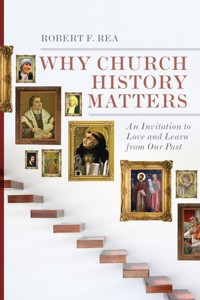
Does it matter how Christians in other times and places thought?If the Bible alone is God?s revelation, why spend time studying church history?Aren?t history and tradition more of a problem than a solution?For many Christians who believe the Bible is the ultimate authority for faith and life, questions about the role and value of the church's traditions can be difficult to tackle. But let's be honest: even those of us who admit that church history is important are often too intimidated or busy to delve into it deeply. And for students, it is sometimes difficult to see how church history matters in practical ways for future vocations inside and outside the contemporary church.In this wide-ranging book, veteran teacher Bob Rea tackles these barriers to understanding and embracing the significance of the faith and practice of our spiritual forefathers. In three parts he covers how Christians understand church tradition, why it is beneficial to broaden our horizons of community and how tradition helps us understand ministry. Rea not only skillfully explains why church history matters—he shows why it should matter to us.
Sie lesen das E-Book in den Legimi-Apps auf:
Seitenzahl: 391
Veröffentlichungsjahr: 2014
Das E-Book (TTS) können Sie hören im Abo „Legimi Premium” in Legimi-Apps auf:
Ähnliche












www.ivpress.com/academic
InterVarsity Press P.O. Box 1400, Downers Grove, IL 60515-1426 World Wide Web:www.ivpress.com Email:[email protected]
©2014 by Robert F. Rea
All rights reserved. No part of this book may be reproduced in any form without written permission from InterVarsity Press.
InterVarsity Press® is the book-publishing division of InterVarsity Christian Fellowship/USA®, a movement of students and faculty active on campus at hundreds of universities, colleges and schools of nursing in the United States of America, and a member movement of the International Fellowship of Evangelical Students. For information about local and regional activities, write Public Relations Dept., InterVarsity Christian Fellowship/USA, 6400 Schroeder Rd., P.O. Box 7895, Madison, WI 53707-7895, or visit the IVCF website atwww.intervarsity.org.
Scripture quotations, unless otherwise noted, are from the New Revised Standard Version of the Bible, copyright 1989 by the Division of Christian Education of the National Council of the Churches of Christ in the USA. Used by permission. All rights reserved.
While all stories in this book are true, some names and identifying information in this book have been changed to protect the privacy of the individuals involved.
Cover design: David Fassett
Images: Wooden staircase: Tom Merton/Getty Images
Three Cappadocian Fathers: St Gregory of Nazianzus, St John Chrysostom and St Basil the Great, by an anonymous artist from the Byzantine school, De Agostini Picture Library. G. Dagli Orti. The Bridgeman Art Library
Karl Barth: Horst Tappe Foundation / The Granger Collection, NYC. All rights reserved. Cathedral Saints: © suesmith2/iStockphoto Adam Clarke: © pictore/iStockphoto John Wesley: © Linda Steward/iStockphoto St. Teresa of Avila: © duncan1890/iStockphoto Gold frames: © winterling/iStockphoto; © wambi/iStockphoto; © JoKMedia/iStockphoto Wooden frame: © 1MoreCreative/iStockphoto
ISBN 978-0-8308-6482-9 (digital) ISBN 978-0-8308-2819-7 (print)
Contents
Foreword
Abbreviations
Introduction
Part One: How We Understand the Tradition
1. What Is the Tradition?
2. How Have We Understood Tradition Historically?
3. How Do We Understand the Tradition Today?
Part Two: Expanding Circles of Inquiry
Introduction
4. Who Am I? Christian History and Christian Identity
5. A Great Cloud of Witnesses
6. Accountability Partners
7. Mentors and Friends
Part Three: Tradition Serving the Church
Introduction
8. Rightly Dividing the Word of Truth
9. Tradition and Ministry
Celebrate the Body of Christ
Recommended Resources for Ministry
Notes
Name and Subject Index
Scripture Index
Praise for Why Church History Matters
About the Author
More Titles from InterVarsity Press
Foreword
When I began teaching many years ago, I needed a textbook to help inspire inquiring students to study the Christian tradition. I began gathering materials for such a book. Thanks to much experience, and to IVP, that book is now a reality.
At times readers will come to other conclusions about some of the illustrations or about the theologians chosen as mentors and friends. I encourage you to consider each possibility and to reject any perspectives when they appear to run counter to Scripture especially, but also to the core values of tradition. But please do not dismiss the point being illustrated simply because the illustration itself does not meet your approval. The very fact that readers might disagree demonstrates the necessity and benefit of studying Christian history, for knowing the tradition empowers students to disagree reasonably.
I also invite readers to supplement my illustrations with others—that is a primary reason for the book. When our growing sensitivity to connect our identity, community and accountability with the past augments our unique collage of personal experiences, we discover illustrations that otherwise we would not see. Please extend the work in your own life, ministry and classroom.
Endnotes, in addition to giving reasons for points made in the text, are meant to provide resources for further study. I have cited resources that are more academic than popular, and wherever possible I favor resources written or translated into English, making them accessible to students. This should help students make a life plan for studying Christian history by preparing a list of resources to include as part of their regular reading.
Special appreciation to my professors, colleagues and students, for our study together helped to form in me what is reflected in this work. Thanks to all who evaluated the ideas and eventually the manuscript, and to IVP for believing in the project and encouraging its completion. I deeply appreciate the constant support of my wife, Mary Ann, who has been my partner for nearly three decades. Tremendous thanks to the sacrificial servants of God across the centuries, who many times have transformed my own thinking and challenged me to deeper spirituality. Finally, praise and glory be to God, whose presence and power, authority and word, grace and mercy—the redemptive plan, from eternity to eternity—are the reason why I want to face each new day.
Abbreviations
ACCS
Ancient Christian Commentary on Scripture (the series in general)
ACCSNT
Ancient Christian Commentary on Scripture: New Testament
ACCSOT
Ancient Christian Commentary on Scripture: Old Testament
ACR
Australasian Catholic Record
ACW
Ancient Christian Writers
ANF
Ante-Nicene Fathers
ASV
American Standard Version (1901)
AugStud
Augustinian Studies
BT
Bible Translator
CBQ
Catholic Biblical Quarterly
ChrCent
Christian Century
ChrTo
Christianity Today
CTHPT
Cambridge Texts in the History of Political Thought
CTJ
Calvin Theological Journal
CWS
Classics of Western Spirituality
EDNT
Exegetical Dictionary of the New Testament, ed. H. Balz and G. Schneider (3 vols.; Grand Rapids: Eerdmans, 1990–1993)
ERT
Evangelical Review of Theology
ESV
English Standard Version
FC
Fathers of the Church
HTR
Harvard Theological Review
HE
Eusebius, Ecclesiastical History (Historia ecclesiastica)
HeyJ
Heythrop Journal
JBL
Journal of Biblical Literature
JECS
Journal of Early Christian Studies
JETS
Journal of the Evangelical Theological Society
JTS
Journal of Theological Studies
KJV
King James Version
LCC
Library of Christian Classics
LCL
Loeb Classical Library
LF
Library of the Fathers
LXX
Septuagint
MSS
manuscripts
NASB
New American Standard Bible (1971)
NIDNTT
New International Dictionary of New Testament Theology, ed. C. Brown (4 vols.; Grand Rapids: Zondervan, 1975–1985)
NIV
New International Version
NovTSup
Supplements to Novum Testamentum
NPNF1
Nicene and Post-Nicene Fathers, series 1
NPNF2
Nicene and Post-Nicene Fathers, series 2
NRSV
New Revised Standard Version
NT
New Testament
NTS
New Testament Studies
OCA
Orientalia christiana analecta
OECT
Oxford Early Christian Texts
OSWC
Oxford Studies in World Christianity
OT
Old Testament
OTM
Oxford Theological Monographs
PP
Popular Patristics
PSTJ
Perkins (School of Theology) Journal
RBS
Resources for Biblical Study
RSV
Revised Standard Version (1952)
SBLGNT
Society of Biblical Literature Greek New Testament
SCES
Sixteenth Century Essays and Studies
SHCTh
Studies in the History of Christian Thought
SHCTr
Studies in the History of Christian Traditions
SMT
Studii Montis Regii
SVTQ
St. Vladimir’s Theological Quarterly
TDNT
Theological Dictionary of the New Testament, ed. G. Kittel and G. Friedrich, trans. G. W. Bromiley (10 vols.; Grand Rapids: Eerdmans, 1964–1976)
TGl
Theologie und Glaube
ThTo
Theology Today
TLNT
Theological Lexicon of the New Testament, by C. Spicq, trans. and ed. J. D. Ernest (Peabody, MA: Hendrickson, 1994)
VE
Vox evangelica
WA
Weimar edition of Luther’s Works (in German)
WTJ
Westminster Theological Journal
Introduction
“Why Are You Here?”
The next two hours would change the rest of my life. I had passed twelve hours of written exams. In just moments five scholars would determine my academic future. As a conservative Protestant from a free-church, Bible-only tradition, my horizons broadened considerably while studying historical theology at a Roman Catholic university in the Jesuit tradition. Now my Roman Catholic examiners would give their verdict. Four would question me on predetermined subjects. A fifth would ask about anything he chose.
The numerous and varied questions from the first three examiners proceeded quite well. My fourth examiner was to ask about Martin Luther. He first said, “Bob, we know you know about Martin Luther, so I want to ask some other questions.” He then asked, “What is theology?” I swallowed hard. This was a shift from the agenda, and I wondered why. Were they coming after me? I answered, “Theology is the study of God, God’s revelation, God’s actions and God’s people, including important documents, events, personalities, movements and doctrinal developments. I believe that theology should be Bible-based.”
The examiner then asked some follow-up questions that seemed equally nebulous, and I struggled to answer. Finally I said, “I’m not sure how to answer your questions because I’m not sure what you’re asking.” My adviser, who chaired the exam, said that it was time for the next examiner, whose first question felt like an arrow into the dark. I remember feeling sick and saying, “I would love to answer, but I still don’t know what you are asking.” He then clarified, “Okay. If theology only comes from the Bible, and if we can get everything we need from the Bible, why are you here?” Aha! Finally I could see the purpose of their questions. They wanted to know why someone who simply needed to read the Bible to understand Christian theology would invest thousands of hours and even more dollars to study historical theology.
As I formulated my answers to those questions, little did I know that I was beginning to formulate an apologetic for the subject that I so deeply love and for a career as a seminary professor of church history/historical theology. Since that day, many Christians, from various backgrounds, have asked me the same question—Why are you here?—in one way or another. College students majoring in Bible ask why they should spend their time studying church history when they could spend that time studying the Scriptures. I suspect that some of my seminary students, savvy enough to realize such a question is presumptuous, silently wonder the same. Many seminarians have shared that they love the study of church history, but they fail to see how advanced study in historical theology is practical. Yet others say, “If I had known that there was so much theology and so much practical application from church history, I would have taken more classes, and I would have taken them early in my program.”
This book, appearing some three decades after my appearance before the examiners, addresses these and similar questions. If the Bible is God’s revelation, why spend time studying the history of the church’s teaching and practice? Why should I care what Christians in other times and other places believed and how they acted? Aren’t history and tradition more problems than solutions?
Why Do We Need This Book?
We live in an era when church administration, counseling and technology dominate a pastor’s time. Topics such as theology and tradition dwell near the bottom of the priority list at best, or are viewed with suspicion at worst. Church leaders, driven by perceived needs, and genuinely hoping to deepen their congregants’ experience of the Christian life, have nonetheless inadvertently tended to steer church attention and activities away from the doctrines and teachings that are foundational to Christian experience through the centuries. This can leave us feeling shallow and unfulfilled. The problem is this: when we ignore centuries of God-loving Christians and the rich well of resources that they have passed on to us, sometimes ignoring even Scripture itself in the process, our perceived needs are often little more than mirrors of our fallen culture.
When we ignore centuries of God-loving Christians and the rich well of resources that they have passed on to us, our perceived needs often become little more than mirrors of our fallen culture.
We need these earlier Christians. We need our brothers and sisters in Christ. Their wisdom and experience are foundational resources for Christian life and ministry. We can learn from their insights (and blind spots). We can grow by allowing them to instruct us. This book is a call to Christians who love the Bible to study historic Christians and their wisdom and experiences throughout the ages—to understand the Bible and theology better and to experience a fuller Christian life. I want contemporary Christians to embrace the entire Christian community by including not only Christians of the contemporary cultures in our current conversations but also Christians from previous cultures. This renewed relationship with our extended Christian family will help provide accountability for our faith and practices by allowing us to expand, nuance, confirm or correct our own convictions and assumptions. I hope to stimulate the study of church history among those who love God, love the Bible, love the church, love the truth and seek to know the truth and its application for life. I intend to help contemporaries discover the greater Christian community through their writings and the testimonies of their lives, while enjoying the fellowship of both those now living and those who have gone before us. When we invite into our contemporary fellowship the spiritual masters, scholars, pastors, preachers, educators and other Christian leaders who have gone before—often many centuries before—the study of our history greatly expands the number and variety of the church’s teachers and mentors, research partners, ministerial fellowships, sermon preparation groups and academic cohorts.
Today we see among Christians an increasing desire to go back to this deep well. More and more believers look to the spiritual masters to deepen their faith. These believers sense something missing in their own spiritual lives, and they have discovered that learning from great Christians throughout the centuries quenches a thirst and inspires them to serve others more effectively. This should come as no surprise, since Christianity is essentially historical. Christianity’s background, emergence and development are deeply grounded in God’s work in and through real people across real time and real space.
Israel remembered the mighty acts of God throughout their history. God, through leaders, prophets and the Scriptures, directed them to recall their historic moments with specific acts of remembrance, such as the Passover celebration. Hebrews recited to one another the stories of God’s great acts, remembered their birth lineage, and recalled the prayers of their ancestors so that their faith would be true and grounded in the God who is not an idea or a wish but living and active.
Then, “in the fullness of time,” God sent the only begotten of the Father to become a human being. The eternal creator of time became existence in time. The Word became flesh. The Son of God became Jesus, entering into the history that holds together in him. His miracles, healing and teaching were repeated again and again and then written down by the Gospel writers for posterity. His passion, death, resurrection and ascension were recorded for all to celebrate, to know that we find our identity and new life through participation in them with him. Christians remember these events through special dates in the Christian calendar and in weekly events, such as reading Scripture, preaching sermons and celebrating the Lord’s Supper.
The character and the mission of the church likewise are fully historical, first referred to in the New Testament Epistles and recorded in the book of Acts (a crucial book for any Christian faith group to be able to understand their roots). Since the end of the writing of the Scriptures, but more extensively starting in the fourth century, Christian historians have intentionally endeavored to record the history of the church so that Christians can remember who they are, where they came from, and why they exist.
Because Christianity is essentially historical—grounded in the events of God leading up to the Messiah, in the life and redemption brought by the Messiah, in the founding of the church through apostolic leadership, and in the ongoing commitment to the faith and to its advance throughout the centuries—every Christian knows something of the history of Christianity. As we will see, one cannot “do” Christianity apart from the history of the church.
So, to ignore Christian history is always a huge loss to the church. It chokes Christian community by restricting our interaction with believers of our own time, who are already very much like us. The result is that we unknowingly overlook otherwise obvious blind spots in our view of the Christian landscape. We limit the breadth of our community, and we surrender opportunities for historical accountability. We also miss important opportunities in exegesis, spirituality, personal relationships, interchurch relationships and methods of practical ministry.
Who Should Read This Book?
The “ideal reader” of this book is a student who, throughout this book, is described as a “Bible-focused” Christian. Bible-focused students are simply those who hold the Bible dear and study it in order to know God and God’s truth. This includes not only evangelicals, but also many mainstream Protestant believers and a growing number of Roman Catholics and Eastern Orthodox. I use this term because many alternative terms for Christians who focus their theology on the Bible as God’s authoritative written revelation for the church’s identity and mission carry connotations or limitations that exclude some who will benefit from the book. “Evangelical” is difficult to define and today sometimes includes those who themselves avoid the term. “Fundamentalist,” while perhaps a good term at its onset, carries connotations of anti-intellectualism or legalism. “Protestant” is used in diverse ways as well. “Bible-focused,” on the other hand, embraces those who are happy with one or more of the preceding terms, but it also includes believers who would never describe themselves in those ways but are Bible-focused nonetheless. If you, as a reader, do not feel that “Bible-focused” describes you well, I believe that this book will still be of great benefit in your Christian journey, and perhaps you will even change your mind somewhere along the way.
Why have Bible-focused Christians neglected the Christian tradition? In the sixteenth century Reformers such as Luther, Calvin, Zwingli and others raised serious questions about the church’s departure from Scripture. This led to significant conflict. At the Council of Trent (1545–1563), the Roman Catholic Church responded by affirming both Scripture and tradition as authoritative. Since the Council of Trent, most Protestants and Roman Catholics have assumed a fairly strict dichotomy between Scripture and tradition. Many Protestants came to equate emphasis on tradition with rejection of the authority of Scripture, or at least pollution of the authority of Scripture. Protestant leaders, especially those from more Bible-focused groups, often have spoken of tradition as the antithesis of Scripture, even though frequent recourse to individual denominational creeds rather than Scripture seems inconsistent with such a position.
This prejudice against tradition has other consequences. First, it fosters the tendency among Bible-focused groups to de-emphasize or ignore the history of the church. This is true, as I have noted, at the congregational and denominational levels, sometimes reinforced by the fact that unfortunate educational experiences have left many with the distinct impression that the only thing more boring than history is church history.
But this neglect is evident also in theological education. Most Bible-focused educators give the nod to the importance of Christian history, but few of them articulate convincing reasons as to why. Many college-level ministerial training programs no longer require the traditional courses in Christian history. Those who do so generally require only one course, which sweeps through two thousand years in the blink of an eye, hitting the highlights and often missing the magic in the process. Most evangelical seminaries give heavy emphasis to biblical and practical courses with more abbreviated emphasis on historical and theological investigation.1
One way to address the problem is to offer more courses in Christian history and to help students integrate their discoveries into their current lives and future ministries. Another way is to make sure that Christian history becomes one of the key theological lenses through which every subject is examined—exegesis, systematic theology, ethics, Bible translation, apologetics, preaching, teaching, counseling, worship, church growth, missions, and so on. What if historical theological considerations became an integral aspect of every subject in Christian ministerial and vocational training, especially in colleges and seminaries that consider themselves Bible-focused?
A second consequence of the prejudice against tradition, it seems to me, is that Protestant scholars tend to differentiate between church history as one area of study and historical theology as another. This suggests that since absorbing names and dates and documents is difficult and often consumes the lion’s share of our time and energy, we can bypass “history” and go straight to what matters, “theology.” In other words, we study the past in order to understand the thinking of a few key people. This assumes that if we concentrate on their thoughts apart from the causes and contexts of their thoughts, we can get to the kernels of historical investigation without some of the difficulties of historical investigation.
For Roman Catholics and Eastern Orthodox, of course, such a differentiation makes no sense. I contend that they are correct. I have often been described as “not a church historian, but a historical theologian.” Although I appreciate what I hope is intended as a compliment—“He doesn’t just repeat the facts, but teaches theology that students can use”—such a separation for most students (and most believers) is artificial and can be misleading. How can we understand the development of Christian thought and practice apart from the contexts in which each developed? Rather than separating these perspectives, this book treats them as two names for the same thing, as “Martin” and “Luther” are two names for the same person. So for our purposes, “church history,” “historical theology,” “Christian history” and “Christian tradition” are synonymous phrases referring to a single discipline.
How Is This Book Laid Out?
Bible-focused students of Christian history find addressed in one volume three major outcomes, reflected in the three parts of the book. Part 1 introduces history, Christian history and tradition by defining terms, by surveying the history of how tradition has been viewed and by explaining how major Christian faith groups view the tradition today. Part 2 provides rationale and motivation for the study of Christian history by explaining why Christian history is foundational for forming personal and corporate identity, for experiencing broad Christian community, for providing contemporary accountability, and for bringing theological balance by expanding horizons and filling theological gaps. Part 3 identifies specific ways church history can help in practical ministry in the study of Scripture (textual work, translation, exegesis) and in other areas (preaching, teaching, systematic theology, ethics, worship, spirituality, pastoral care, cultural transformation, ecumenical endeavors). The intent is to balance the scholarly and the practical, modeling scholarship in the service of the church. Students will also see how their current and future vocations can be enhanced by broadening their study to include great Christians, teachings, and developments from across the centuries.
Part One
How We Understand the Tradition
1
What Is the Tradition?
What Are History and Christian History?
History is the study of the past in order to understand the present and to improve the future. Historians examine significant physical remains, such as coins, artifacts and architecture, in order to reconstruct the framework of the past. They also looks at persons, events, documents, movements, developments and teachings to help individuals understand where they came from, how their cultures developed, why they hold to key values, and what assumptions and presuppositions from the past formulate their understanding of reality in the present. Historians also examine this data to help contemporary communities understand the various factors that contribute to each group’s identity, purpose and values. In the process, history helps us understand and evaluate our worldview—the collection of basic values that drives one’s foundational outlook about everything in the world.
History is the study of the past in order to understand the present and to improve the future.
History is not merely the collection of data. We do not simply stockpile information and then call the collected data “history.” Not every person, event, document, movement, development or teaching is historic. Instead, history is the endeavor to provide accountability to the present in light of the past—to search out people, events, movements, artifacts and so on that have particular significance for the present and the future. Not all people and events carry the same relevance for history. For example, nearly every student of world history knows what happened on December 7, 1941, whereas few people know what happened on December 5, 1941. Yet both days had twenty-four hours and innumerable pieces of data. We remember December 7, 1941, however, because the attack on Pearl Harbor changed the world then and in many ways determined movements, relationships and identities for today and the future.
Christian history, or historical theology, is the study specifically of the church’s past in order to understand the church’s present and to improve the church’s future. Church historians examine artifacts that shed light on times and places. Church historians also look at significant persons, events, documents, movements, developments and teachings in the history of the church to help individual Christians and groups of Christians understand where they came from, where other Christian groups came from, why they hold particular commitments, and what assumptions and presuppositions from the past formulate their Christian worldview in the present. One major difference between history and Christian history, at least among Christian historians, is that believers also look for the presence, actions, will and heart of God in past events in order to try to discern God’s will for the present and the future.
Some have said that history never changes. This is simply untrue. The data of history—the actual artifacts, persons, events, documents, movements, developments and teachings from the past—do not change, except that new discoveries add more information or correct misinformation of the past. But how those persons and developments are understood—the identified significance of past developments—does change.
In other words, the personal or community identity and values that we bring to the data help determine what we interpret as significant. No one comes to the study of history with complete objectivity. For example, I am an Anglo, middle-class American male who grew up as a lower-class boy in a declining urban neighborhood. I will never be a tribal African woman who grew up in a small village. I will never be a disenfranchised Latino man who grew up on the outskirts of Mexico City. If the three of us were to discuss the significance of historical events, we would bring three very diverse perspectives to the historical data. Each of us would see particulars within those events that the others would not see. Occasionally, our understandings of events may conflict, but in most cases we would understand events in much the same way, emphasizing different aspects of the events.
In other cases changing times and changing cultural perspectives alter or augment the previous understanding of historical persons, events and developments. Here I offer an example from more recent world history. During World War II many American men joined the armed forces, leaving their production jobs vacant. Thousands of American women sacrificially left their homes to work in jobs previously thought to be exclusively for men. The women demonstrated competence in those positions, but when the war was over, nearly all of them, with little regret, returned to the places in life that they considered to be for women. But they told their daughters that they could grow up to be anything they wanted to be. Those daughters grew up to tell their daughters the same. Today women do not assume that their gender precludes them from becoming doctors, lawyers, plumbers, construction workers, soldiers or corporate executives. In the years immediately following World War II no historian would have considered the war a liberator of women in the realm of occupation. The significance of World War II was about political boundaries and the exchange of world power. But today we must recognize that one of the most significant developments in World War II for contemporary American life and culture was the sacrifice of those women who changed their world. The data of what happened did not change, but the interpretation of the data—the significance for today and tomorrow understood from that data—has changed. In other words, history has changed.
We could add to this a number of examples of how newly emphasized values can alter the perceived importance of characters and movements in the history of the church. Historical evaluations of fourth-century Roman emperor Constantine have moved from almost universal laud as the great Christian emperor to a variety of critical positions that take issue with his claim to Christian faith. Western Christians are currently reassessing the grace theology of fifth-century church father John Cassian—long considered a saint by Eastern Orthodox—who advocated that both God and the human individual work in every act of salvation and sanctification.
This is why it is so difficult to make lasting historical judgments until years after an event or movement. What contemporaries and those immediately after an experience think of the event’s significance may differ greatly from how their children and grandchildren see the event. Sometimes the most unpopular political leaders are later highly esteemed.
This is not to say that there is no absolutely objective understanding of history and historical theology. God, who knows all things, has all the actual and potential perspectives of every person and event of history, including church history. But only God has that objectivity, because God is infinite. Father, Son and Holy Spirit know everything and can therefore see objectively. God knows absolute truth absolutely.
We humans, on the other hand, are finite and therefore always subject to the limitations of finitude—we have limited perspective, limited experience, limited intelligence, limited understanding of reality. We have degrees of objectivity, but not absolute objectivity. We can have enough objectivity to make a fair evaluation of the evidence. We can be objective enough to understand past persons, events and developments so that we see who they are, where they came from, why events occurred, and how current groups and emphases came to be.
Actually, “objective enough” is the functional standard in nearly every field of endeavor. Human blood, for example, already has all of the elements of human blood, many of which we probably have yet to discover. Early “objective” tests of human blood determined blood type. Then we added Rh factor. Today a standard blood test can measure scores of factors that we know to relate to various aspects of health. Particular blood tests target particular pathologies or profiles. The point is that long ago, when we knew precious little about human blood, we could be objective enough to determine what we sought—blood type. Then we were objective enough to determine Rh factor. Today we are objective enough to determine blood sugar levels, lipid profiles, liver enzymes, red and white blood cell levels, blood gases, DNA and more. In the future we will discover that there is much more diagnostic information available in human blood, and we will learn to test in a way which is objective enough to make reliable decisions.
In the same way, finite human beings can never be fully objective. But individuals and groups can be objective enough to make determinations in areas of investigation. In history, as in medicine, broadly universal agreement will give us functional objectivity. But fully aware of our finite limitations, we must always approach history with humility, for we must always recognize that our perspectives are limited.
In summary, we must recognize that real artifacts, persons, events, documents, movements, developments and teachings have actually occurred. The real facts change only in that we discover more information or correct previous inaccurate reports. Real events occurred, and real people lived in real situations. Only God, who is infinite, has a fully objective knowledge of these real events and real people. God is objective. We humans are finite, and thus we are never absolutely objective. But we can be objective enough to understand the past so that it can inform the present and improve the future. Our finitude, however, requires that we learn in community, and in regard to church history this community must include contemporary Christians and historic Christians.
The way we understand the significance of the past for today and for the future does change. I must insert a word of caution here, however. In recent years some historians have proposed that the data itself is insignificant, except insofar as it can be construed or misconstrued to establish or advance what the historian wants to promote. In other words, what really happened matters most when it supports the historian’s agenda. These historians contend that since data is always subject to interpretation, and since cultural presuppositions determine the data’s meaning, we should admit our intentions from the beginning and either reconstruct the historical data to make it support our case or even invent connections that never existed to support our case.1
This intentional reconstruction of historical data should not be the intent of Bible-focused Christians at any level. We endeavor to understand what actually happened and to understand the significance of what happened for our time and for our future, though we recognize that our own ideas and culture may focus our attention on certain perspectives of history or limit our ability to see important aspects of history. We recognize that we come to these events with a finite set of values, methods and assumptions.
This leads to one of the key reasons for this book. When we consult resources to help us understand history and theology, we must be careful not to limit our resources to authors who share our cultural perspectives and intellectual commitments. We need the points of view offered by contemporaries of various perspectives and various cultures. But also, we cannot hope to approach “objective enough” unless we also consider the points of view offered by historical figures who lived godly Christian lives and who endeavored to understand the truth with open hearts in times and cultures very different from our own. Only then can we expand our own limited understandings to approach a fuller and fairer analysis of the past in order to understand the present and improve the future.
“Tradition,” “tradition,” “traditions” and “traditioning”
The words tradition, Tradition and traditions are classic terms to describe perspectives or approaches to understanding developments in the Church’s history. The word tradition is used in a number of ways. In less technical contexts it is the general category or milieu for everything that has developed in Christian history. This includes major persons, events, documents, doctrines, controversies, councils, conflicts, movements, and much more.
In a more technical sense, when church leaders use the word Tradition (note the capital T), most often they are referring to the Roman Catholic and Eastern Orthodox view. In this view, God’s revelation through prophets and apostles is preserved in Scripture, so Scripture receives double honor, so to speak; but the Holy Spirit is believed to reveal the repository of truth further and develop scriptural revelation further through the faith and practices of the church. The collection of revealed truth, the revealed authority, in Scripture and the post-Scripture faith and practice of the church, is called “Tradition.” Roman Catholics and Eastern Orthodox sometimes differ on teachings that they include in the Tradition.
Some Protestants also use the term Tradition (with a capital T) when they affirm the teachings, doctrines and practices upon which believers throughout the world and over the centuries agree—a uniformity of belief and practice in the church that affirms teachings and practices in nearly every place and age. Of course, these Protestants do not include in the Tradition all of the same teachings that either Roman Catholics or Eastern Orthodox include. But there is much overlap, particularly in the major doctrines of Christianity, such as the doctrines of God (Trinity) and Christ (Christology). Other Protestants avoid using “Tradition” (capital T) and instead use “tradition” (lowercase t) to mean pretty much the same thing. For Protestants, this tradition, though not revelational and not nonnegotiable, has an authoritative aspect because committed believers have affirmed it across temporal, cultural and ecclesiastical lines. This common belief by the larger community of believers—the consensus fidelium—lends it credibility for all believers. To avoid confusion, from here on Tradition (capital T) will be used only for Roman Catholics and Eastern Orthodox and only when referring to the whole body of tradition taken together, which they consider to be revealed by God.
When church leaders use the word traditions, they refer to developing teachings, doctrines, events, churches and so forth within specific centuries, specific cultures and specific church groups. These are practices that the church as a whole or specific church groups have chosen to meet specific needs or desires in specific times or places. These traditions are understood to be dependent upon one culture or one set of philosophical presuppositions and to fade when new situations arise. They often depend upon or result in denominational distinctives. Hence, they are seen as helpful but not universally authoritative.
More recently an alternative use of the word tradition was included in the 1963 Faith and Order Commission Report, presented at Montreal. This use of “tradition” refers to the activity of tradition, or the dynamic of traditioning—the means by which some specific item of faith is transmitted.2 Knowing how tradition emerges and is transmitted is important for understanding the value of tradition for contemporary Bible-focused Christians as well. For the sake of clarifying between “tradition” above and this use, I describe this fourth use as “traditioning.”
In this book “tradition” is most often used in the general sense as a synonym for Christian history, church history or historical theology and includes all of the above: (1) “Tradition” or “tradition,” (2) “traditions” and (3) “traditioning.” Some sections will lend themselves naturally to including the first more than the others, but all are valuable for contemporary Bible-focused Christians.
Some tend to limit the period in which tradition has a normative nature. D. H. Williams, for example, has said, “The apostolic and patristic tradition is foundational to the Christian faith in normative ways that no other period for the church’s history can claim. A theologian or pastor may agree or disagree with the patristic legacy, but it is functioning nonetheless as a rule by which such agreement or disagreement occurs.”3 Williams limits the primary period of tradition to the patristic period. I am tempted to affirm this position, since most issues of extreme importance were discussed in this period. But this position suffers the same critique as those that limit the tradition of significant value to the first century. Many important developments occur after the patristic period as well.
Still others, whether intentionally or accidentally, tend to limit tradition’s value to the period that produced their own faith group. They may not say it directly, but they act and teach as though their favorite period or favorite movement is normative. Protestants, for example, often have paid particular attention to the fifteenth, sixteenth and seventeenth centuries, since the great Reformers who produced Protestantism lived and taught in that period. Many other examples could be given.
The Necessity and Dangers of Tradition
Tradition is inevitable. Every sociological group develops standard practices and approaches that become, whether intentionally or accidentally, the normal or even the “right” way to live out their theory and practice. At the same time, each group must continue to weigh those traditions carefully to be sure that the traditions that either emerged or were designed to improve their lives and to implement their mission do not come to impede their mission. This is true with the church as a whole and with each faith group that is part of the church.
Christianity is a world religion dependent upon and explicitly concerned with tradition, because the entirety of Christian identity depends upon real events in history. God really acted in creation, in Abraham, Isaac and Jacob, in delivering Israel from slavery, and in preparing Israel for the Christ. The Son of God really became incarnate in a virgin woman, was born in Bethlehem, lived an exemplary life, died, was buried, was resurrected, and ascended. Apostles and others really spread the gospel throughout the world, with various practices being prescribed and others simply emerging. Yet in a variety of practices Christians served one God and one Christ through one Spirit. This continues today.
So in Christianity, not only do we stand on the tradition, but also in many ways we are the tradition. This means that you are the tradition. You have had Christianity passed on to you, in a particular form, at a particular time; you did not come up with the idea. Tradition informs you, your priorities, your points of view, your worldview. Tradition also guides the emphases, practices and commitments of your faith group, your congregation and even your circle of congregational friends. This is what the Bible teaches us. The Bible itself is part of Christian tradition, and at the same time it is foundational for Christianity.
Already in Galatians 1:8 the apostle Paul warns, “But even if we or an angel from heaven should proclaim to you a gospel contrary to what we proclaimed to you, let that one be accursed!” (NRSV). It mattered then and matters now what “gospel” is preached, for there can be a false gospel. Paul’s readers were to believe only the proper tradition that had been preached to them by the apostles. George Tavard says it well: “Thus understood, tradition is the art of passing on the Gospel. It is not distinct from the Good News of Christ. Rather it is the power of the Gospel itself which inspires the devotion and loyalty of the men and Churches responsible for its transmission.”4
When sincere Christians try to live the truth faithfully as their Christian community understands it, they develop normative strategies and practices to live, love, worship and serve together—they develop traditions. Intended to be grounded in Scripture, these traditions sometimes encompass core Christian practices, but often they are simply this or that particular Christian community choosing the best of several available options for their own setting. Each of these helpful choices of method, practice or preference, while not essential to the core of Christian faith, is necessary to carry out the core of Christian faith. For example, nearly every faith group has developed its own set of traditions for how to celebrate the Lord’s Supper. The celebration itself, commanded by Jesus, is at the core of Christian faith; how the celebration is conducted is not. While each Christian community’s traditions are meaningful, each can also learn from the rich practices of others.
This means that although Protestants often have declared their distaste for tradition, they have nonetheless developed traditions that are necessary to their ability to implement Christian faith and practice. Tradition helps them preach the gospel. Harold Brown observes, “From the Protestant perspective it is necessary to tone down the polemic against tradition as though it were necessarily a falsification of simple Christian truth. To do this we must recognize and acknowledge the role that tradition plays in our own worship and life. This should help us gain a tolerance for the importance of tradition in other communities.”5
At the same time, we must recognize the dangers of tradition. Past Christians have had good reason to suspect the tradition, as we will see. Blind following of tradition has led to many travesties among Christians, as all Christian groups would admit. Jesus decried traditions that impede obedience to the very commands of God. He was clear that loyalty to traditions rather than loyalty to what is written in Scripture is not only counterproductive but also an affront to God.
Tradition can proliferate and come to hide the vital truths of the gospel. Tradition can lead us to trust our own practices and perspectives rather than Jesus Christ. Tradition can dull our sensitivity to insights that God may be helping us to discover. Traditions can incline us toward legalistic attitudes and actions in issues that are not at the core of the gospel. Extrabiblical traditions among various geographic locations or faith groups can lead us to consider our own group’s or our own location’s experience as normative for all times and places or even as essential to salvation. Loyalty to these parochial traditions can cause us to reject or devalue other Christians and their parochial traditions. Often traditions help faith groups identify their own members, but this can happen in such a way that the traditions rather than the gospel itself become their standard and consequently a cause of division among Christians.
Worst of all, the body of traditions can become so important to us that we neglect the real heart of the gospel, even granting assurance to some that they are Christians when indeed they are not. This was Martin Luther’s fear—Roman Catholic traditions would lead people to believe they were saved when they did not have what Luther understood to be saving faith. This is the fear of nearly every major reformer—people following their traditions are not really on the path of salvation. Of course, each reformer ends up beginning another group—a group that recovers rich Christian emphases but at the same time begins to develop new traditions.
So on the one hand, tradition is not only inevitable but also beneficial. Tradition helps us connect with God and identify with one another in authentic faith. Tradition helps us experience God and Christian fellowship. Tradition helps us live the Christian life. In that sense, we are the tradition, the living gospel, and we believe that the true preaching of Jesus Christ, the proper tradition, is necessary for others to find saving faith. No substitute will do. On the other hand, tradition can be dangerous. When we elevate extrabiblical teachings and practices to the level of essential Christian faith, we are drawn from the gospel to something that we substitute for the gospel. When this happens, the results can be scandalous.
Tradition—Good or Bad?
God created human beings in time and in order to grow, making the records of human development and growth in the church part of God’s plan. The Holy Spirit has worked in and through believers of all centuries. Much tradition has been very helpful to the church. At the grander levels, we owe much to those who clarified doctrines such as the canon of Scripture, the Trinity, Christology and many others. So we need the truth of Christ and historical theology as we evaluate our own Christian lives and practices.
But not every act or every movement of previous believers can be adopted as appropriate. Heresies and false teachings have been present in all centuries. Some tradition has been harmful, distracting the church from what is most important in the church’s life and mission. Human motives are often questionable, and poor motives can lead to poor actions that turn the church in wrong directions.




