


38,99 €
Mehr erfahren.
- Herausgeber: John Wiley & Sons
- Kategorie: Fachliteratur
- Sprache: Englisch
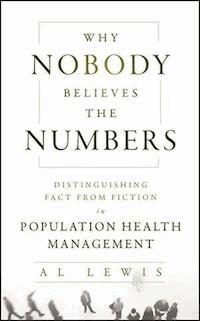
Why Nobody Believes the Numbers introduces a unique viewpoint to population health outcomes measurement: Results/ROIs should be presented as they are, not as we wish they would be. This viewpoint contrasts sharply with vendor/promoter/consultant claims along two very important dimensions: (1) Why Nobody Believes presents outcomes/ROIs achievable right here on this very planet... (2) ...calculated using actual data rather than controlled substances. Indeed, nowhere in healthcare is it possible to find such sharply contrasting worldviews, methodologies, and grips on reality. Why Nobody Believes the Numbers includes 12 case studies of vendors, carriers, and consultants who were apparently playing hooky the day their teacher covered fifth-grade math, as told by an author whose argument style can be so persuasive that he was once able to convince a resort to sell him a timeshare. The book's lesson: no need to believe what your vendor tells you -- instead you can estimate your own savings using "ingredients you already have in your kitchen." Don't be intimidated just because you lack a PhD in biostatistics, or even a Masters, Bachelor's, high-school equivalency diploma or up-to-date inspection sticker. Why Nobody Believes the Numbers explains how to determine if the ROIs are real...and why they usually aren't. You'll learn how to: * Figure out whether you are "moving the needle" or just crediting a program with changes that would have happened anyway * Judge whether the ROIs your vendors report are plausible or even arithmetically possible * Synthesize all these insights into RFPs and contracts that truly hold vendors accountable for results
Sie lesen das E-Book in den Legimi-Apps auf:
Seitenzahl: 288
Veröffentlichungsjahr: 2012
Ähnliche



















Table of Contents
Praise for Why Nobody Believes the Numbers
Title Page
Copyright
Dedication
Introduction
Chapter 1: Actuaries Behaving Badly
Some Background: We're Shocked, Shocked, to Find That Invalidity Is Going On in Here
The Proof: Doing the Pre-Post Math for Grown-Ups
Epidemiology
Math
Fixing the Problem…at Least in Theory
Approximating the Valid Methodology in Practice: The Dummy Year Adjustment
Chapter 2: Plausibility Testing: How to Measure Outcomes Using Ingredients You Already Have in Your Kitchen
Plausibility Testing: The Event Rate Test Explained
How to Actually Do a Plausibility Test
Chapter 3: Case Studies That Flunk Every Plausibility Test Known to Mankind
The Seven Rules of Plausibility
Chapter 4: Case Studies That Flunk Every Plausibility Test Known to Mankind and Then Some
Case Study #1: Achieving Dramatic Reductions in Risk Factors and Medical Spending by Implementing Off-the-Shelf Wellness Programs (Not)
Case Study #2: Raleigh, We Have a Problem
Case Study #3: Are Health Plan H's Doctors Killing Their Patients?
Case Study #4: Vendor A Cures Health Plan I's CHF Patients
Chapter 5: Case Studies of Where, When, and How Wellness Programs Have Actually Worked
Case Study #1: Encouraging Health Prevention—at a Cost
Case Study #2: Do You Really Want to Create a Culture of Wellness? Are You Sure?
Chapter 6: Yes, Virginia, There Is a Savings Clause
Chapter 7: Disease Management Programs That Actually Work (Pinch Me)
Combined DM/Wellness/Incentives/Benefits Redesign: How Doing All Four in Coordination Creates Synergy
Chapter 8: Contracting/RFP Checklist of Do's and Don'ts (Mostly Don'ts)
Category 1: Clauses Designed Specifically for Validity
Category 2: Clauses That Are Not Specifically Related to Metrics Validity but That Unfortunately Fit the Oscar Wilde Observation, “Experience Is the Name You Give to Your Mistakes.”
Appendix: The Keys to the Numerical Kingdom
Author's Note on Sources
Notes
Chapter 1: Actuaries Behaving Badly
Chapter 3: Case Studies That Flunk Every Plausibility Test Known to Mankind
Chapter 4: Case Studies That Flunk Every Plausibility Test Known to Mankind and Then Some
Chapter 7: Disease Management Programs That Actually Work (Pinch Me)
Glossary
About the Author
Bibliography and Further Reading
Acknowledgments
Praise for Why Nobody Believes the Numbers
“Using equal parts wit and basic arithmetic, Lewis does for invalid outcomes analysis what Upton Sinclair did for meatpacking.”
—Stuart Altman Sol C. Chaikin Professor of National Health Policy The Heller School for Social Policy and Management, Brandeis University; Chair, Health Industry Forum
“Why Nobody Believes the Numbers marries recreational reading with serious population-based data. Like most serious population-based data, this information reveals that what people thought they knew is simply not the case, with serious implications for private-sector resource allocation and public-sector policy. And like most good recreational reading, you won't want to put it down.”
—Michael Barry, MD President, Informed Medical Decisions Foundation; Clinical Professor of Medicine, Harvard Medical School
“Al Lewis has accomplished the near impossible: written a smart, funny, and readable book about outcomes. A proof-based indictment of a faith-based culture, Why Nobody Believes the Numbers should lift the debate on outcomes validity to a much higher plane, and reward those whose population health programs deliver actual, if modest, results rather than specious, breathless, and often hilariously impossible short-term return on investment (ROI) claims. This is a must read for anyone involved in developing policy or making buying decisions on programs that try to improve health and save money.”
—Robert Galvin, MD Chief Executive Officer, Equity Healthcare (Blackstone Group); Co-founder, Leapfrog Group; founder, Bridges to Excellence
“The principal lessons of this hilarious book are: (1) you know more than you think you do, and (2) the so-called experts know less. Why Nobody Believes the Numbers shows how a little fifth-grade arithmetic can invalidate much of what passes for outcomes.”
—Regina Herzlinger Nancy R. McPherson Professor of Business Administration, Harvard Business School
“Why Nobody Believes the Numbers exposes the poor design and invalid statistics of disease-management programs in a credible, user-friendly fashion. The case studies and mathematical proofs show readers how to identify and address outcome measurement malpractice. Its entertaining style can keep readers' interest long after they might otherwise have closed the book on the statistical fallacies of study design.”
—Nancy Kane Professor of Management and Associate Dean for Educational Programs, Harvard School of Public Health
“Why Nobody Believes the Numbers is an amusing but incisive look at vendor outcomes numbers that don't even come close to adding up and yet are widely accepted. I'd recommend this book to all CFOs and HR executives who want to improve the health of their members but do it cost-effectively.”
—Dean Karlan Professor of Economics, Yale University; Founder, StickK.com
“Only someone like Al Lewis, who has mastered a complex field like outcomes measurement for disease management programs, could write a book that is so funny and so much fun, while being so enlightening.”
—James Prochaska Founder of Pro-Change Behavior Systems, Inc.
“Al Lewis is not only the ‘inventor of disease management.’ He is also smarter than a fifth grader, who in turn is apparently smarter than most consultants and vendors in this field. Much of outcomes measurement is like Las Vegas: you know you are getting taken, but you visit anyway. Why Nobody Believes the Numbers explains how you are being bamboozled by the croupiers of the population health management industry. Caveat emptor no more!”
—Dave Rearick, DO Vice President of Medical Management, Marsh & McLennan
“Lewis sugarcoats the bitter medicine of math with a generous amount of humor, making this the most painless lesson in outcomes analysis ever published. The lesson: trust your own judgment. If you are smarter than a fifth grader, you can determine whether your programs save money.”
—Tom Scully Administrator, Centers for Medicare and Medicaid Services (2001–2003); Senior Counsel, Alston & Bird; Partner, Welsh Carson, Anderson & Stowe
“I don't recall fifth-grade math being this funny. But apparently a lot of vendors and consultants don't recall it at all.”
—William H. Tobey Senior Fellow, Belfer Center, Harvard University
“Lewis has singlehandedly created what industry committees have failed to create: a how-to guide for valid outcomes analysis to support vendors, employers, consultants, and carriers. It could even be a textbook for Master's in Health Administration programs, except it is too much fun to read.”
—Warren Todd President and Executive Director, Care Continuum Alliance (2001–2006)
“Why Nobody Believes the Numbers explores hilarious case studies of vendors and health plans whose THC-induced ROI calculations violate every rule of arithmetic, rules that the author notes must be strictly enforced. The book then offers some practical advice on contracting and measurement that if followed would enhance the field's credibility and long-range growth prospects.”
—Tom Underwood CEO, Sandata Technologies; CEO, Alere Health (2010–2012)
Copyright © 2012 by Al Lewis. All rights reserved.
Published by John Wiley & Sons, Inc., Hoboken, New Jersey.
Published simultaneously in Canada.
No part of this publication may be reproduced, stored in a retrieval system, or transmitted in any form or by any means, electronic, mechanical, photocopying, recording, scanning, or otherwise, except as permitted under Section 107 or 108 of the 1976 United States Copyright Act, without either the prior written permission of the Publisher, or authorization through payment of the appropriate per-copy fee to the Copyright Clearance Center, Inc., 222 Rosewood Drive, Danvers, MA 01923, (978) 750-8400, fax (978) 646-8600, or on the Web at www.copyright.com. Requests to the Publisher for permission should be addressed to the Permissions Department, John Wiley & Sons, Inc., 111 River Street, Hoboken, NJ 07030, (201) 748-6011, fax (201) 748-6008, or online at http://www.wiley.com/go/permissions.
Limit of Liability/Disclaimer of Warranty: While the publisher and author have used their best efforts in preparing this book, they make no representations or warranties with respect to the accuracy or completeness of the contents of this book and specifically disclaim any implied warranties of merchantability or fitness for a particular purpose. No warranty may be created or extended by sales representatives or written sales materials. The advice and strategies contained herein may not be suitable for your situation. You should consult with a professional where appropriate. Neither the publisher nor author shall be liable for any loss of profit or any other commercial damages, including but not limited to special, incidental, consequential, or other damages.
For general information on our other products and services or for technical support, please contact our Customer Care Department within the United States at (800) 762-2974, outside the United States at (317) 572-3993 or fax (317) 572-4002.
Wiley publishes in a variety of print and electronic formats and by print-on-demand. Some material included with standard print versions of this book may not be included in e-books or in print-on-demand. If this book refers to media such as a CD or DVD that is not included in the version you purchased, you may download this material at http://booksupport.wiley.com. For more information about Wiley products, visit www.wiley.com.
Library of Congress Cataloging-in-Publication Data:
Lewis, Al
Why nobody believes the numbers : distinguishing fact from fiction in population health management / Al Lewis.
p. cm.
ISBN 978-1-118-31318-3 (hardback); ISBN 978-1-118-33536-9 (ebk); ISBN 978-1-118-33420-1 (ebk); ISBN 978-1-118-33206-1 (ebk)
1. Health maintenance organizations–Evaluation–United States. 2. Managed care plans (Medical care)–Standards–United States. I. Title.
RA413.5.U5L49 2012
362.1′042584–dc23
2012003575
Introduction
This book contains arithmetic. DON'T HIT ME. However, I promise that the arithmetic will be quite accessible, even to people who say they “can't do math.” Oh, and you think you can't do math? You'll see examples of vendors and consultants whose math skills couldn't land them a job as the “before” picture on Sesame Street.
This promise is possible partly because Why Nobody Believes the Numbers largely avoids things that make other books about numbers real turn-offs, such as, for example, numbers. But mostly it's possible because I am a great writer. Don't take my word for it—just look at the evidence:
I am blessed with such effective persuasive powers that I was once able, against all odds, to convince a resort to sell me a timeshare.
My first book got eight five-star reviews on Amazon, including four from people I don't even recall having slept with.
The bottom line: The math is presented clearly enough that readers who understand it can probably continue to live independently for at least a few more years.
Now that we've settled that issue, let's review what you probably already know if you've bought this book, or borrowed it from a friend temporarily until your own copy(ies) arrive in the mail: Vendorsa routinely show you outcomes reports for your Population Health Improvementb programs whose savings claims are much closer to fiction than fact.
Lesen Sie weiter in der vollständigen Ausgabe!
Lesen Sie weiter in der vollständigen Ausgabe!
Lesen Sie weiter in der vollständigen Ausgabe!
Lesen Sie weiter in der vollständigen Ausgabe!
Lesen Sie weiter in der vollständigen Ausgabe!
Lesen Sie weiter in der vollständigen Ausgabe!
Lesen Sie weiter in der vollständigen Ausgabe!
Lesen Sie weiter in der vollständigen Ausgabe!
Lesen Sie weiter in der vollständigen Ausgabe!
Lesen Sie weiter in der vollständigen Ausgabe!
Lesen Sie weiter in der vollständigen Ausgabe!
Lesen Sie weiter in der vollständigen Ausgabe!
Lesen Sie weiter in der vollständigen Ausgabe!
Lesen Sie weiter in der vollständigen Ausgabe!
Lesen Sie weiter in der vollständigen Ausgabe!




