


11,49 €
Mehr erfahren.
- Herausgeber: Atlantic Books
- Kategorie: Geisteswissenschaft
- Sprache: Englisch
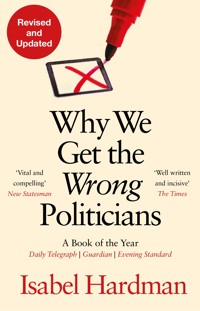
REVISED AND UPDATED TO INCLUDE THE EXPLOSIVE EVENTS OF 2021 and 2022 Winner at the Parliamentary Book Awards Shortlisted for the Waterstones Book of the Year Longlisted for the Orwell Prize ____________ Daily Telegraph's Best Books of the Year Guardian's Best Books of the Year Evening Standard's Best Books of the Year Daily Mail's Best Books of the Year BBC's Biggest Books Prospect's Best Books of the Year Politicians are consistently voted the least trusted professional group by the UK public. They've recently become embroiled in scandals relating to everything from expenses to sexual harassment to illicit parties. Every year, they introduce new legislation that doesn't do what it sets out to achieve - often with terrible financial and human costs. But, with some notable exceptions, they are decent, hard-working people, doing a hugely difficult and demanding job. In this searching examination of our political class, award-winning journalist Isabel Hardman tries to square this circle. She lifts the lid on the strange world of Westminster and asks why we end up with representatives with whom we are so unhappy. Filled with forensic analysis and revealing reportage, this landmark and accessible book is a must read for anyone who wants to see a future with better government. 'This book has the power to fundamentally change how we do things in this country.' Emily Maitlis 'An entertaining read that addresses hard questions... invaluable for those who think they know what's wrong with Westminster but have no idea how to put it right.' John Humphrys
Das E-Book können Sie in Legimi-Apps oder einer beliebigen App lesen, die das folgende Format unterstützen:
Veröffentlichungsjahr: 2018
Ähnliche



















‘A really good book . . . Well-structuredand well-written.’
Observer
‘A vital and compelling read.’
New Statesman
‘Riveting.’
Daily Telegraph
‘A brilliantly lucid explanation of the systemic problems in our electoral system that make policy-making and government such a mess.’
Evening Standard
‘Excellent.’
Prospect
‘A fast-paced, intelligent dissection of modernpolitics, packed full of juicy anecdotesand insider knowledge.’
Helen Lewis
‘Compelling and entertaining.’
Robert Peston
Isabel Hardman is a journalist and broadcaster. She is Assistant Editor of The Spectator and presents Week in Westminster on BBC Radio 4. In 2015, she was named ‘Journalist of the Year’ at the Political Studies Association’s annual awards. She lives in London.
First published in hardback in Great Britain in 2018 by Atlantic Books, an imprint of Atlantic Books Ltd.
This revised and updated edition published in 2022
Copyright © Isabel Hardman, 2018, 2022
The moral right of Isabel Hardman to be identified as the author of this work has been asserted by her in accordance with the Copyright, Designs and Patents Act of 1988.
All rights reserved. No part of this publication may be reproduced, stored in a retrieval system, or transmitted in any form or by any means, electronic, mechanical, photocopying, recording, or otherwise, without the prior permission of both the copyright owner and the above publisher of this book.
Every effort has been made to trace or contact all copyright holders. The publishers will be pleased to make good any omissions or rectify any mistakes brought to their attention at the earliest opportunity.
10 9 8 7 6 5 4 3 2 1
A CIP catalogue record for this book is available from the British Library.
Paperback ISBN: 978 1 83895 847 3
E-book ISBN: 978 1 78239 974 2
Printed in Great Britain
Atlantic Books
An imprint of Atlantic Books Ltd
Ormond House
26–27 Boswell Street
London
WC1N 3JZ
www.atlantic-books.co.uk
______
CONTENTS
Author’s Note
Preface to the New Edition
Preface to the Paperback Edition (2019)
Introduction: A Mistrusted Class
Part I: How We Get the Wrong Politicians
Chapter 1: Getting In
Chapter 2: Starting Out
Chapter 3: Getting Out There
Chapter 4: Getting Things Done
Chapter 5: Getting On
Chapter 6: Getting Caught
Chapter 7: Getting Ill
Chapter 8: Getting Out
Part II: Why We Get the Wrong Policies
Chapter 9: They Just Don’t Get It
Chapter 10: All Things to All Men
Chapter 11: Yes-Men
Chapter 12: Trapped!
Conclusion: Can We Get the Right Politicians?
Notes
Acknowledgements
Index
______
AUTHOR’S NOTE
By necessity, a great deal of the research for this book has taken place in off-the-record interviews with politicians and members of their staff or families. Any quotes that are either unattributed or lacking a reference in the endnotes are from interviews with the author.
______
PREFACE TO THE NEW EDITION
How could a prime minister have got it so wrong that he ended up being ambushed by his own laws? On 12 April 2022, Boris Johnson was fined by the Metropolitan Police for celebrating his birthday with colleagues during a lockdown that he himself had imposed, using laws written by his ministers. The excuses from his allies were many, including, memorably, that he had been ‘in a sense, ambushed with a cake’. Johnson himself produced a perhaps more ludicrous defence, which was that he had thought it was within the rules to be eating a birthday cake for nine minutes when social mixing for anything other than work purposes was banned. Ludicrous because this was the man who had signed off on what was in the rules and what wasn’t. Three months later, in the wake of another scandal, Johnson announced his resignation.
The coronavirus pandemic has brought politicians into our everyday lives in a previously unimaginable way. They have been responsible for laws dictating who we can have sex with, when we can leave our homes, and whether our children can go to school. They have, of course, also been responsible for the highs and lows of Britain’s response to that virus. So many of the flaws of our Westminster system were already evident – chronicled painfully within the pages of this book – before the pandemic. My worry, as I have written this updated edition of Why We Get the Wrong Politicians, is that even as we put away our masks and get used to the new normal after COVID, we will find that British politics is very much in the old normal.
Since this book was first published in 2018, we have had an election, a new prime minister, a new relationship (complicated) with the European Union, a new war on the borders of Europe, and the promise of another new prime minister. For a while, we also had a new way of legislating, with Parliament sitting in a ‘hybrid’ form during parts of the pandemic. Some of the measures taken during lockdown were sensible. Others resulted in bizarre spectacles such as a ‘conga’ of MPs waiting in a socially distanced line to vote because ministers were refusing to make that particular act one that could be done from home. Others still are cause for real concern about the balance of power between the government and MPs.
We have also lost another MP to a brutal act of terror and seen a number more in fear of their lives after credible threats and plots. Sir David Amess was a well-loved member of the Commons, and dedicated himself to constituency work in a moving and often endearing way: his campaign to have Southend given city status was only realised posthumously, as a tribute to his habit of shoehorning this bid into any question in the Chamber, even if totally irrelevant. He was murdered by an Islamist extremist, five years after Jo Cox was murdered by a right-wing extremist. Both were killed in the line of duty as they served their constituents.
There had been some arguments during the Brexit process that getting the thing done would drain politics of the poison seeping through it. While it is true that I no longer cycle into Westminster through crowds of Remainers and Leavers waving their respective flags on College Green, I’m not sure that the poison has gone at all: MPs are still mobbed and intimidated as they try to go to work – it’s just that the people doing this tend to be carrying anti-vaccination banners. There still needs to be a debate about how we treat our MPs, and how we protect them. The current legislation on online harms is an attempt to crack down on some of this abuse, but I fear that in a future update of this book, that bill will join those in the Something Must Be Done section of laws that sounded nice but ended up with vast unintended consequences.
Perhaps there are upsides to the parliamentary debacle over Brexit and the way all of us have become so much more aware of politicians over the past few years as they’ve been beamed into our sitting rooms from the latest Downing Street coronavirus update. It has at least shown us quite how badly our political system needs to change. The striking thing is that most MPs I know who have read this book agree with me, and so if you reach the end of it feeling angry and frustrated about how much our politicians are managing to get wrong, I hope that you will try to encourage changes in our system, whether it be by pressuring your local political parties about the way they select and support candidates, or talking to your local MP, or writing to ministers. As we will see in this book, change doesn’t happen in politics unless the status quo suddenly becomes inconvenient. It is inconvenient to those of us affected by the bad laws written and scrutinised by politicians who don’t understand their consequences. The trick now is to make those consequences even more inconvenient to the politicians in power than a fine for being ambushed by cake.
Isabel Hardman, July 2022
______
PREFACE TO THEPAPERBACK EDITION (2019)
Not long after the publication of this book, British politics reached such a low point that I wondered whether readers might prefer something called How We Can Do Without Politicians.
It wasn’t just the way in which the political class has handled Brexit – the sort of ‘handling’ you might see from a person who trips over while carrying a tray full of mugs – but also the political climate more generally. MPs have faced yet more threats to their safety from the far right, to the extent that some have become afraid to leave the Parliamentary Estate. A few commentators suggested that the mobs outside the Palace of Westminster were merely an inevitable expression of the anger felt by both sides about the way politicians were messing up Brexit. But this shows quite how low our political debate has sunk. Even fools don’t deserve to be threatened and harassed, yet certain writers believe that politicians are fair game.
Should our politicians be fair game? It’s pretty difficult to feel proud of the way the political system is functioning at the moment, and I’m not at all delighted that events since this book was first published have only served to underline many of the conclusions I reach. But as I hope readers will see, I also reach a conclusion about politicians individually that some may find disappointing: they are not selfish, venal, lazy caricatures. What is far worse than the few fools and failures that every parliament seems to contain is the fact that the House of Commons is – both structurally and culturally – not working, and that will remain the case no matter how many snap elections we have over the next few years.
The current political climate isn’t going to improve matters. Why on earth would anyone with a vaguely decent perspective on life and a few hobbies want to go anywhere near Parliament? Politicians have long been held in low esteem, but what we have seen emerge over the past few years has been a special type of hatred, in which the daily abuse of MPs has become so normal that I fear we are all being brutalised by it. It is now not just those typing below the line on comments threads, or people who think it a good use of their time to set up anonymous accounts. It is also politicians and other members of the Westminster Bubble, including journalists and staffers. Accusing others of low political motives, of plots and even of being ‘traitors’ is now par for the course among people who know each other and who formerly looked up to each other too. Politics has become uglier, and the long-term effect of that will be that people who don’t want to waste their time around those who behave abhorrently will just stay away altogether.
The response from some quarters to predictions like this is that politicians should be thick-skinned, given how hard the job is. We certainly don’t want people who can’t deal with difficult ideas, opposition and long hours. But thick-skinned isn’t the same as being comfortable in one’s skin, and ugly politics rarely attracts those valuable people who have the latter quality. Politicians need to be at ease with themselves so that they can learn and then show the rest of us what it is to disagree well, and how we can live together better as a nation. The splits in our society go far beyond politics and Brexit, but those two matters often show most sharply how many of us are forgetting to disagree well. Our politics is going wrong, and that is harming our wider social fabric.
Perhaps, though, the debacle surrounding Brexit has at least shown us quite how badly our political system needs to change. We cannot carry on with a political class that has grown used to dodging important decisions on social care, infrastructure and, yes, Brexit. Brexit has been the reckoning for those who have grown used to procrastinating in the hope that the next minister or indeed the next government might end up having to take the awkward decision instead. Few policy areas have the legal deadline that leaving the European Union had as soon as Theresa May had triggered Article 50 – and yet she did so without a clear idea of the kind of decision she wanted to make, let alone the kind that Parliament would allow her to make.
In the meantime, important issues including social care have languished on the back burner, and the crises within those sectors have only grown. It’s not just that Westminster culture tolerates indecision, but also that those who have made it into Parliament are rarely the ones who know what it is to be on the sharp end of a crisis. Yes, MPs see many more people who are vulnerable and desperate for help than most of the rest of us do, but in order to enter Parliament, you need money, and a lot of it at that. As this book shows, this excludes vast swathes of the population who could be excellent, compassionate parliamentarians but who just cannot afford the job interview. We therefore end up with a political class that cannot instinctively see the impact of bad policies – or of failing to implement any policies – on the most vulnerable.
I had expected that writing a book with this title and containing these conclusions might make me unpopular with MPs. This would be rather inconvenient, given that my day job is to work with them on stories. But while a couple of the MPs I single out have taken to avoiding me in the corridors of power, most parliamentarians have been not only grateful that someone has explained the maddening nature of their job, but also largely in agreement with my assessment of the problems with the current political system. If even the people in the political bubble agree that something needs to change, then surely we have an opportunity to do something?
There has also been more talk of Parliament ‘taking back control’ of law-making, something I explore further in the updated section on Brexit in Chapter 12. Having failed to take advantage of the mechanisms for scrutiny that are already available to them, MPs then decided that they’d like to start rewriting laws, specifically the ones enabling Britain to leave the European Union. Speaker John Bercow was accused of being part of a plot against the government – and against Brexit – when he changed House of Commons procedure to allow an amendment that would speed up the government’s response to a defeat on the Brexit ‘meaningful vote’. Brexiteers were furious and Remainers delighted at what they saw as MPs being given more power over the process.
I have avoided offering my own opinions on the politics of Brexit and other big issues in this book, but one thing I am confident of is that Parliament is not en route to becoming more powerful as a result of Britain leaving the European Union. The changes attempted by rebel, largely pro-Remain MPs have been too piecemeal to really improve the scrutiny of legislation, while Brexiteer ministers have behaved in a cavalier fashion largely because they know they will get away with it.
But at least there is now an appetite among MPs to make Parliament more powerful. At least we have a debate about whether the legislature should be able to write real, meaningful laws. At least we have ended up in a situation where the executive realises that delaying decisions isn’t without political cost.
For us to get the best possible politicians, we need to capitalise on that hunger while we can. MPs now have a taste for holding up legislation until it works, and maybe even for writing laws themselves, if only they had the resources and training to do so. The political parties are talking a good game on social mobility, knowing that it resonates with swing voters. But until the parties open up Parliament to people who would be good MPs, rather than merely to those who can afford to be MPs, they are only talking, not changing.
I wonder, then, if those who read this book and are moved by it one way or the other might ask their MP or local political party what they could do about its conclusions. Is your MP really content that Parliament is working the way it should? Do they really think the Commons is approving legislation that is well drafted and that has the consequences the government claimed it would? Wouldn’t your MP like more power? Perhaps your local MP is Theresa May, in which case the answer would almost certainly be ‘yes’, given the (largely self-inflicted) predicament she ended up in as prime minister. But whether you are in a constituency represented by an MP from the governing party or one from an opposition group, you’ll most likely find that your local politician isn’t happy with the current system.
The current system doesn’t need a revolution before it changes. Most of the reforms proposed in this book could be implemented in the mid-term of a parliament, and without much fanfare. Some would cost more money, because they would involve giving parliamentarians the proper resources to ensure that policy really is going to work. But the money saved by avoiding dropping more people into crisis would make these reforms worthwhile. And to get those reforms, we need MPs to feel that it is politically expedient to campaign for them, to take every opportunity to try to get the government of the day to agree.
This matters to those on the left and the right of politics, as well as those of us whose political convictions wobble around like a blancmange. Presumably, when you vote for a party, you do so hoping that at least a handful of its policies end up being implemented. If you’re a diehard political activist, you may yearn for your party to build the new Jerusalem by implementing every single one of its policies. Either way, you are being ill-served by the current system, under which governments are able to implement their policies in the scrappiest and most thoughtless way possible. This not only embarrasses the party in power, but also damages people’s lives. No one, whether card-carrying loyalist or swing voter, really wants that.
You might not get to the end of this book feeling that Parliament is for you. But my hope for every reader is that you go away feeling that Parliament must and can change. You don’t need to stand for election yourself to play your part in ensuring that we get a much better political system than the one we are lumbered with now.
Isabel Hardman, January 2019
INTRODUCTION
______
A MISTRUSTED CLASS
‘What have you done? Oh my God. What the fuck have you done?’ Anne Milton’s best friend wasn’t taking the news of her election as an MP very well at all. The new member for Guildford had previously worked as a nurse, but was now heading into Parliament to do a job that would be more bewildering than anything she had encountered on a hospital ward.
Soon, it would be voters who would be asking her – and all her colleagues who had just been elected – what the fuck they had done: with their money, their health service, and all the promises they were led to believe would be fulfilled if enough people backed their party.
Milton was about to enter the Westminster Bubble, a place popular folklore would have us believe seethes with venal, selfish characters who love nothing more than to ruin everyone else’s lives, in between having affairs with their secretaries.
The Westminster Bubble first cropped up in the late 1990s as a description of the tight community of politicians, researchers, think tanks and journalists around Parliament. It has gained increasingly negative connotations as an insular community in which insignificant things seem enormous and the things that matter to everyone else are ignored. Bubble members are out of touch with the rest of the world, and their lack of understanding of the people they purport to represent leads them to make serious mistakes on a regular basis.
Voters largely agree with this characterisation. MPs are the least trusted professional group – below estate agents, bankers and journalists – with just 21 per cent of Britons saying they’d trust an MP to tell the truth. The public don’t like politics as a line of work generally, but they also tell pollsters that the quality of the politicians is the feature they dislike the most.1 Voters are angry with politicians, ignoring their instructions, for instance, during the EU referendum of 2016, and then again in the snap election of 2017 in which Theresa May instructed the country to give her a bigger mandate.
What are voters most angry with? Often it’s the sex-and-sleaze scandals that make their way into the press. But perhaps even these wouldn’t matter so much if the public had confidence that the people they were electing knew what they were doing and weren’t going to make ordinary people’s lives worse. When the government makes a mistake, it means people lose their home, or their ability to buy food, or their chance to have life-saving surgery. If the government making such mistakes is full of people who appear to be enjoying themselves rather too much, then that stings all the more.
But this book will not be a grand tour of thieving philanderers. In fact, it’s worth warning you now that while there are some venal politicians, there are many more who are decent human beings. And while the examples of wrongdoing over the years are spectacular, doesn’t every walk of life have its villains? Teachers are rightly respected by society for doing an incredibly difficult job. But in 2016/17, the National Council for Teaching and Leadership banned 42 teachers for sexual misconduct.2 In 2020/21, the Teaching Regulation Agency barred 39 teachers from teaching for reasons that included sexual misconduct and threatening behaviour.
Analysis by the General Medical Council of its decisions to suspend or erase doctors from the medical register in 2015 found that 24 of the people into whose hands we put our lives had been ‘struck off’ for inappropriate relations with colleagues (5) or patients (19), and 9 had lost their place on the register due to ‘sexual issues’. Those ‘issues’ ranged from voyeurism to sexual assault, and one offence included a minor under 13 years old.3
Listing these decisions by other professional bodies regulating public servants isn’t an act of whataboutery, where someone tries to defend their actions by pointing to the actions of someone else. Just because there are teachers and doctors who act inappropriately does not make it acceptable that there are politicians who do so too. The question is whether politicians as a group are more likely proportionately to be evil, venal people or whether just as we accept that there will always be some bent coppers, we have to accept that not all the people we elect will turn out to be good eggs.
Unfortunately for those who’d like a polemic about how very wrong so many of our politicians are, I don’t think this is actually the most serious problem afflicting Westminster. I joined the lobby – the group of journalists who work in and cover the day-to-day goings-on of Parliament – in 2011, and while I have met my share of politicians who are either too selfish or too stupid to deserve the honour of representing their constituents, I have largely become more disillusioned by the way the vast majority of decent, well-meaning types are ill-used by Parliament itself.
So the next important question is whether Parliament turns good eggs into bad. Just take this exchange on the BBC’s Question Timein 2014 involving the left-wing populist comedian Russell Brand. A member of the audience confronted the comedian, telling him to ‘stand for Parliament. If you’re gonna campaign, then stand, OK? You have the media profile for it.’
Brand replied: ‘My problem would be, mate, I’d stand for Parliament but I’d be scared that I’d become one of them.’4
Brand seems to think that going into politics would force him to change in some way to become like other politicians. It’s clearly not a resemblance he aspires to. He obviously thinks that being like all the other politicians in Westminster would represent some kind of erosion of his good character.
Perhaps he fears he might trudge willingly into a cash-for-access scandal. Or that the Westminster Bubble might turn him into a sex pest, or an anti-Semite. Does Parliament turn MPs into sleazebags, or were some of them always like this? And if the latter is true, then how did they become MPs in the first place?
The expenses scandal gave many people a clear grievance against all politicians. That was unforgivable in itself, but what was worse was that a culture of unacceptable behaviour had sprung up. And that is what this book is about. It is about how we get the wrong political cultures, which lead to us having an unrepresentative, often unprepared and frequently unhappy bunch of politicians who end up passing bad laws causing personal disasters on small or catastrophic scales to people who then flood their constituency surgeries in crisis. Cultures are more dangerous than individuals: they continue with each changing of the guard of bad guys, and are so pernicious that even those employed to scrutinise them can sometimes miss what’s going on or fail to recognise how bad their effects are.
Who are these people anyway?
The rogues’ gallery of MPs who got things very wrong indeed is horrifying enough. But that’s not the full extent of the definition of ‘wrong politicians’. Parliament doesn’t look like the rest of us. It might be that a fully representative Parliament wouldn’t necessarily be best for the country, as it is rather handy, after all, for a fair number of your lawmakers to have an understanding of the law from their previous occupation. But this book will show that there just isn’t an opportunity for the best to get into the corridors of power anyway.
In the 2019 Parliament, 29 per cent of UK-educated MPs went to private schools. While this is a record low for the years that the Sutton Trust, which campaigns for better social mobility in this country, holds data, it is still disproportionate compared to the general population, which is around 7 per cent privately educated.5 In addition, of the 173 MPs who did go to independent schools, 11 went to one school: Eton College, the alma mater of 20 prime ministers. Eton places a high value on the importance of public service, but it is staggering that just one school has produced so many MPs when there are entire towns in this country that have never been represented by someone who was born and schooled locally.
It’s not just educational background. Despite women making up just over half the population, by 2022 only 35 per cent of MPs were female. It was only in the 2015 Parliament that the number of female MPs who’ve ever been elected to the House of Commons passed the number of men who were sitting on the green benches at that very moment. The 2019 election saw the percentage of MPs from ethnic minority backgrounds rise from 7.8 per cent to 10 per cent, even though roughly 14 per cent of the population is black or minority ethnic. And while 18 per cent of the population has either a long-term health condition or a disability, just under 1 per cent – five MPs – in the 2019 Parliament say they are disabled. This has an impact on the perceptions of those looking at the ladder from afar, whether as schoolchildren or adults aspiring to be politicians.
We have a Parliament weirdly full of career politicians and strangely lacking in experience from sectors such as science and technology, retail and manual work. The 2015 Parliament contained 107 people who had been ‘politicians/political organisers’ in their previous life, but just 16 former schoolteachers. Even those who had previously worked as either solicitors or barristers were fewer in number (89) than the career politicians. And perhaps the ‘business’ category in the House of Commons Library research that lists MPs’ former occupations includes amongst its 192 members those who have worked in corner shops or Asda – but perhaps not.
A question that is asked less frequently but is perhaps more important than how representative our politicians are is how good they are. Surely we want to attract people to Parliament who are the brightest and the best in order to ensure the smooth running of the country so that the rest of us can get on with our lives? But how can we tell how good someone is at being an MP? As we shall see in this book, the only ‘appraisal’ an MP ever gets is the next general election, and there is no set job description to assess them against anyway. And though you may have been supremely bright in your previous life as a mechanical engineer, you still might not have the right skill set for Parliament. Perhaps the best way to work out whether MPs are much cop is to see what they produce in Parliament. Yet this book will argue that all too often Parliament approves bad laws and doesn’t even notice it’s doing it. It’s not just MPs’ friends who find themselves asking ‘What the fuck have you done?’ It’s the general public – and often even the MPs themselves.
Are they normal?
‘Do I think my colleagues are normal?’ asked David Cameron when we sat down for coffee in his constituency. ‘Er, mostly. But I think politics attracts people who are more disposed towards getting totally absorbed in it.’
So what lies behind the predisposition to getting sucked into the Westminster Bubble? Perhaps the starkest contrast between politicians and others working in high-pressure jobs became obvious to me when I was attending a series of events for army officers and their families in 2016. A handful of MPs were also present. They were of similar ‘rank’, but you could tell the difference between politician and soldier instantly. It wasn’t just their physical deportment, but something more inherent. The military men and women were not arrogant. But neither were they brittle. They seemed quietly comfortable in their skins. This is not something you encounter very often in Parliament, and it jarred. Politicians might have to appear gregarious and confident, able to persuade people to elect them in the first place. But these two attributes can exist without someone having much contentment about themselves.
Military life is hard. It involves months away from family and years of moving around the country to different bases. But it does involve meritocracy and, in a career sense at least, a sense of stability. Even though soldiers endure and risk immeasurably more than MPs can even imagine, they seem more grounded. Perhaps what makes MPs brittle is the fact that they become more and more dependent on the whims of the voters, and more and more disillusioned about what they can achieve. Or perhaps it is the case that brittle people are more likely to go into politics.
What is striking about politicians is how many of them have had dysfunctional upbringings, even if their social backgrounds were ostensibly comfortable. Many MPs and candidates describe difficult relationships with their parents, and particularly their fathers. One candidate told me: ‘My dad left my mother when I was very little and was barely involved, and so I have always had this endless desire to prove to him that I’m actually worth knowing, that I’ve made something of myself. But because he’s not around, I’ll never satisfy that desire. So I just keep going.’
Of the 2015 intake MPs who have spoken about their upbringing, 39 grew up without fathers, including 15 Tories and 21 Labour. Michael Gove was adopted at four months old. Eight MPs were raised by a single-parent dad. Of course, single-parent households are far happier and healthier places to grow up than toxic ‘nuclear’ families in which a marriage has died long ago and the air is thick with tension and resentment. Even parents who enjoy a healthy marriage can be abusive, controlling, or emotionally detached from their children. And so whether or not an MP had a difficult upbringing is far harder to assess than merely looking at figures for fatherlessness.
One of the MPs who has spoken very movingly about her difficult upbringing is Caroline Flint, who was first elected Labour MP for Don Valley in 1997. She kept her background quiet for many years, worrying about being judged for it. Her mother was 17 when she gave birth, and Flint never knew her father. She was then adopted by her mother’s new husband, Peter Flint, when she was two and a half years old, but only discovered her adoption certificate as a ten-year-old. Initially, the presence of both her mother and her adoptive father’s names confused her, and ‘I thought I must be some changeling child that had been left or something like that,’ she says.
A happy childhood changed a couple of years after this, when her mother and Peter Flint broke up, and he cut off all ties with his adoptive daughter, but stayed in touch with her two half-siblings. ‘The end of his relationship with me, that was hard, because I suddenly lost half my family,’ says Flint. ‘Emotionally that was tough because suddenly it dawned on me that he hadn’t really wanted me.’ Her mother’s troubled relationship with alcohol worsened, and at sixteen Flint also lost the grandparents who had supported her mother. She barely spoke about her home life to schoolmates. ‘You did feel embarrassed about it and it’s also that whole thing about not wanting to bring people home because you’re not quite sure what you’re going to come home to.’
She lived away from home twice during her teens. The first time she lodged with a family friend to finish her O levels when her mother, brother and sister went to live with her grandparents in Fleetwood. The second time, the whole family were back in London, but because her mother’s alcoholism and its impact on their relationship was so bad, Flint was given a charity grant to live elsewhere while studying for her A levels. She then went to university having concluded that ‘if I could just get to university, I could have a better choice over what I could do in life’.
Flint didn’t go to her own graduation because she was worried that her mother might turn up drunk, despite not admitting this to anyone else at the time. Her mother had died of cirrhosis when she won her seat in 1997, and though she had been in the Commons for more than a decade by the time we spoke about her history for this book, Flint admitted that her early life experiences still drive her at work. ‘I still feel I’m having to prove myself even today,’ she says. ‘But I have also come to realise that I have a lot to be proud of and I shouldn’t be so hard on myself.’
Her Labour colleague Liam Byrne feels the same motivation as a result of his father’s battle with alcoholism, which eventually killed him. ‘You are constantly driving for perfectionism all the time because what you learn as a child, or what you try and do as a child, is you try and make everything all right, so you develop a kind of subconscious idea that if only you can make everything OK then your parent will stop drinking, and harmony will be restored. And also because there is a degree of shame that is involved, you develop pretty impenetrable armour plating and you have to wear that in public so no one can see into your private problems.
‘So that kind of combination of developing armour plating and, you know, driving for perfection in everything, those are two things that are very common in children of alcoholics, and they are two things that you need in public life.’ He admits that this made him a ‘very tough bastard to work for’, but his perfectionism also landed him some of the most difficult jobs in government, such as immigration and deficit reduction.
Politics itself is addictive. Many who leave find it difficult to go cold turkey. One former political adviser told me, in a slightly jittery manner, that he had been forced to take up long-distance running as a means of replicating the regular adrenalin hit that he’d grown used to from his parliamentary work. Another spent weeks in the mental equivalent of Renton’s bedroom in Trainspotting, trying to shake his dependency on the drug called Westminster. A former Number 10 press secretary said he noticed that ‘people actually stand up straighter when I tell them my job title’. Those regular hits of adrenalin and power have a profound effect.
In his book The Winner Effect, neuroscientist Ian Robertson describes how the brains of people in power change as they experience more of it. Power – and sex – causes a surge in testosterone, he writes, adding that ‘high testosterone levels further increase the appetite for power and sex, in a politico-erotic vicious circle’. Testosterone boosts dopamine levels, and dopamine is a ‘key element in motivation – in getting clear in our minds what we want, and setting out to get it. Winning changes how we feel and think by racking up testosterone and the dopamine-sensitive brain systems responsible for an action-oriented approach.’ This can be addictive, ‘particularly in people with a high need for power’.6 Robertson is writing about political leaders rather than lowly backbenchers, but every politician has to win, not just the candidate selection and their seat, but also the game of rising up the greasy pole in Parliament, an addiction that can be very difficult indeed to feed, given the unpredictability of the political career ladder.
The addiction extends to those who work in politics but aren’t in office. In his account of his time as General Secretary of the Labour Party, Inside Out, Peter Watt speaks repeatedly of politics as a drug. It was one that took him further and further away from his family as he became embroiled deeper and deeper in party scandals. That’s what addictions do: they take people away from even those they love the most. David Cameron was unusual in that he seemed to be able to seal different parts of his life in Tupperware, switching off, or ‘chillaxing’, as he called it, from government to spend time with his wife and family in a way that many colleagues in Parliament couldn’t understand. They didn’t seem to like the idea of someone who wasn’t an addict like them, but rather the political equivalent of a social smoker, able to dip in and out when they fancied.
Few politicians would admit to being addicted to power. They do, however, readily admit to being addicted to Westminster. When Tony Blair – who Robertson profiles as someone with a need for power that eclipsed his good judgement – returned to Parliament in 2012 to speak to lobby journalists, he was asked by one curious hack why on earth he had agreed to come back into the lions’ den. His face lit up. ‘I just wanted to remember what it was like,’ he said.7 Perhaps for the former prime minister, it was like a visit to his old school, remembering the smells and atmosphere that never really go away. Or perhaps he still wanted just one more hit before he went clean.
It is wrong to say that someone who is addicted to politics isn’t also driven by the thought of how confusing and often unjust the benefits system is, or by a desire to get a better deal for women fleeing domestic violence. But given the life that MPs live, whatever it is that does drive them must be very strong and compelling. Otherwise they wouldn’t bother.
Angry Young Things
For some, the addiction strikes early. Student politics can be as off-putting to people as it can be a feeder for Westminster. But with 86 per cent of the MPs elected in 2017 having at least one university degree,8 university political societies will have been where many of them cut their teeth before entering Westminster, even if they spent a couple of decades doing something completely different between graduating and being elected. And most researchers who work for MPs have just graduated from university too, which further shrinks the net for people who are drawn into politics and who consider Parliament to be the sort of place where they belong.
During and after university, aspiring politicians can become members of the youth wings of their parties. These are as earnest as you might expect of a group of people who consider politics important when only a small proportion of their peers are actually even voting. But they can also be menacing places.
Strange personality cults can develop around those who are seen to have influence on whether someone becomes an MP, even if they are as far from power as the young people who flock to them.
One cult that went badly wrong was in the youth wing of the Conservative Party. Like most cults, it looked so attractive on the surface. But bubbling beneath that were tensions, plots – and bullying. When a young Tory activist, Elliott Johnson, committed suicide in September 2015, what most had dismissed as young people playing at politics was revealed to be something far darker. It turned out that Johnson, who had struggled with mental health problems for a long while before he died, had ended up in the middle of an internecine war between different factions of the party’s youth wing.
Suicides always raise questions. Johnson’s parents squarely blamed the Conservative Party and an activist called Mark Clarke, who they claimed had bullied him. Clarke had been chucked off the candidates’ list and then rehabilitated when he set up ‘Road Trip’, which transported young activists around the country to campaign in key seats. Road Trip turned out to be less of a godsend to a party with an ageing membership than CCHQ had initially thought: it wasn’t just a dating agency for young Tories, but a hotbed of furious infighting between activists who wanted to gain ultimate power over an organisation that few had heard of. Clarke, for his part, has denied allegations that he bullied Johnson (along with 13 other activists who were named in an inquiry by law firm Clifford Chance).
But one question that goes far beyond the complexity of a suicide is how did Clarke end up getting so much power – and how on earth was a man like him ever a candidate? A great deal of the answer to this has to do with the people who choose our MPs. They’re not the general electorate, who decide between candidates, but a selectorate within a party. And those selectorates are often rather small and quite unrepresentative of the voting public.
The membership bubble
Clarke was chosen by a selectorate in Tooting. He managed to appeal to those party members, but the wider Tooting public had other ideas about his suitability for Parliament. He then tapped into an insecurity that the Conservative Party had about its activist base, which came about as a result of declining party membership.
The Conservative Party only tends to publish figures on how many members it has when it can report an increase. When things are going badly, CCHQ claims that it is difficult to collate the data as it is held by local associations rather than centrally. When things are going well, CCHQ manages to get around these impossible barriers with rather more ease. It last released figures in July 2019, when there were 180,000 members. Though other political parties have gained significant numbers of supporters since then, it is fair to surmise that the absence of any new data since 2013 means that the Tories have not conformed to this trend. In the 1950s, when party members pushed their politicians to go further on policies such as house building, they had 2.8 million members. Now Conservative Party conferences are far more about corporate visitors than they are about members voting on policy. Indeed, they often feature stands from upmarket department stores such as Harvey Nichols.
The Labour Party saw a massive surge in membership as a result of its 2015 leadership contest to become a ‘mass movement’ of some 590,000 members. That number then dropped during rows about anti-Semitism in the party, and following the departure of Jeremy Corbyn. The party has stopped making so much noise about its membership figure in more recent years, perhaps because insiders suggest it may now be between 100,000 and 200,000.
Similarly, the Scottish National Party gained so many members following the 2014 independence referendum that by December 2018 it had 125,534 members: impressive for a party that only stands candidates in one country of the United Kingdom (Scotland has a population of over five million people).
Meanwhile Liberal Democrat membership has fluctuated according to whether it is in government or not, with so many resignations following the party’s U-turn on its tuition fee policy in 2010 that it took the organisation several years to process all the returned membership cards. As of August 2019, it had 115,000 members. The Greens had 48,500 members in July 2019 and UKIP had 29,000.9
Even parties with energetic new memberships like Labour have a way to go before they can really claim they are replicating the million-strong mass movements of the 1950s. Besides, ‘mass movement’ is not synonymous with ‘representative movement’. The party members project funded by the Economic and Social Research Council and run out of Queen Mary University of London and Sussex University found in 2017 that 51 per cent of political party members are university graduates, 80 per cent are in the top three social classes known as ABC1, and 61 per cent are male.
Does it matter that party members aren’t exactly representative of the wider population? Surely they can fight over who is in charge of various local political fiefdoms and leave the rest of us to get on with more rewarding hobbies? But party members have a particularly powerful fiefdom. They get to choose who will become their local constituency candidate, and in safe seats, this means they get to choose their MP. The stakes are even higher: the MPs they choose then make up the selectorate that chooses their party leader, and therefore the prime minister.
Council of despair
If joining a political party is a first and very small step on the ladder leading to Parliament, then working in local government represents the next step for many would-be MPs. Representing a ward on the town, district or county council entails many of the same activities: speaking in the council chamber, attending scrutiny committees, holding surgeries for people to bring their problems to. Of course, fewer people know who you are, and you don’t get paid nearly as much as an MP (you receive an allowance, rather than a salary, which ranges from a few thousand pounds to as much as £20,000). And the job isn’t always full-time, unless you become a cabinet member in your administration. But the MPs who have served as councillors say it gave them a realistic perspective about spending decisions, how to communicate with the public, and the intricacies of government.
The thing is, if you’re an MP and you’ve served as a councillor, you’re likely to be from the background that already dominates Westminster: white men of advancing age. The Local Government Association’s Census of Local Authority Councillors in 2018 found that 63 per cent of councillors were male (down from 67.3 per cent in 2013), and a staggering 96 per cent were of white ethnic origin (in 2001 it was 97.3 per cent). The average age of a councillor was 59, while 45 per cent were retired and only 26 per cent in full or part-time employment.10 Council work is part-time but takes place in normal working hours, which makes it more difficult to juggle a full-time or even many part-time jobs. Additionally, meetings in large local authority areas are often held at times that make it impossible for parents of young children to attend. Though the start time may be a reasonable 9 a.m., the meeting might take place at the other end of the county to the ward that parent represents, which entails a childcare nightmare for someone who is not being paid a great deal in recompense.
So while local government might be a good tributary of politicians who have a better chance of understanding the mechanics of budgets, benefits and roads, the stream of parliamentarians it sends to Westminster isn’t particularly diverse. Not for nothing are councillors often called pale, stale and male.
Asking the question
But what if someone who might make a decent MP has never really thought of going near politics? Gloria de Piero, who grew up in poverty, found that when she started applying for jobs in the Labour Party, ‘I didn’t recognise many people that sounded like me. I didn’t go to Oxbridge and I thought you had to.’ She struggled to get a job in politics, so moved into journalism before eventually being elected MP for Ashfield in 2010. But instead of basking in the affirmation of being elected, in 2012 she launched a tour called ‘Why Do People Hate Me?’, which asked ordinary people why they didn’t like politicians.
She visited aerobics classes, bingo halls and pubs to find voters who wouldn’t normally pitch up at her surgeries. A YouGov poll she commissioned asked those who wouldn’t even consider standing for Parliament what put them off. Unsurprisingly, 41 per cent of them said, ‘I don’t like politicians and the way politics works’, and 16 per cent said, ‘none of the main political parties reflects my views’. But many identified with statements about themselves, saying ‘being an MP isn’t for people like me’ (21 per cent), ‘I wouldn’t want the press crawling over my private life and my past’ (31 per cent) and ‘I couldn’t afford to give up my job to campaign for election’ (31 per cent).
De Piero also found a sizeable group of voters who, far from hating her, were actually quite interested in whether they could do her job. The YouGov poll revealed that 24 per cent of voters would consider standing as an MP if someone suggested it. But her conversations in supermarket cafés and elsewhere taught her something else: no one was making that suggestion. ‘How do we do it, where’s the job advert?’ was the question people often asked her after she’d pointed out that if they cared so much about the problems in their community, they too should get involved.
How do people end up being asked to get involved in politics? Generally, they’re already in a network socially or professionally that makes this more likely. The saying ‘it’s who you know’ applies largely to old boys’ networks, which are still alive and well in politics, but there are many other types of politically friendly networks, such as jobs with established links to politics, including the law. When the Equality and Human Rights Commission examined representation in Westminster with its Pathways to Politics report, it suggested that those from disadvantaged backgrounds were less likely to have been ‘socialised’ in politics; that is, that their family backgrounds and education meant they just hadn’t come into contact with politics as a line of work, let alone politicians themselves. Worse, they weren’t being ‘sought out, encouraged, or “pulled in” by political parties or political institutions’.11
If it isn’t suggested to you, then you’re less likely to consider it. Even those who’ve dreamed of being a politician since a tender age will have been asked in one way or another – perhaps someone in their immediate circle made it clear that it was a possibility for them. This isn’t just the fault of those in politics, though. Schoolchildren in deprived areas often grow up believing or even being told that certain jobs aren’t for them. Some bloody-minded types ignore that. Many end up agreeing.
Can it really be the case that the best men and women for the job aren’t even hearing about the chance to stand for it? This is no elegy in a country churchyard for those who were never asked to be MPs: this book will suggest they may have had a lucky escape. But it is an elegy for Parliament, which deserves to be fed by networks from across society, not just those connected to privilege.
Part I
______
HOW WE GET THEWRONG POLITICIANS
CHAPTER 1
______
GETTING IN
Brian Shaw is a three-time winner of the World’s Strongest Man competition. At six feet eight and 415 pounds, Colorado-born Shaw must eat between 8,000 and 10,000 calories a day while training for the contests, which involve carrying fridges and heaving huge concrete balls known as Atlas Stones onto high platforms. He leads a disciplined life.




