


Erhalten Sie Zugang zu diesem und mehr als 300000 Büchern ab EUR 5,99 monatlich.
- Herausgeber: The History Press
- Kategorie: Geisteswissenschaft
- Sprache: Englisch
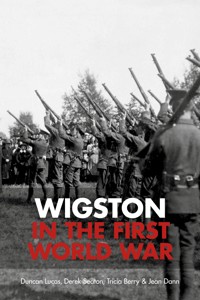
Wigston, in the heart of tranquil Leicestershire, was transformed from a peaceful existence in August 1914 as war clouds swept across the skies of Europe. This village, the home of farming folk and framework knitters, suddenly witnessed its young men leaving, in vast numbers, to answer the call of King and Country. Greater demands were placed upon those who remained as the factories and farms responded to the needs of a wartime nation. A unique presence was the Glen Parva Barracks, the Regimental Depot of The Leicestershire Regiment, where tens of thousands of recruits and conscripted men received their basic training to prepare them for war. This is the story of Wigston in the First World War, the men who fought on the front line – one of whom was awarded the Victoria Cross – and those who served on the home front during 'the war to end all wars'.
Sie lesen das E-Book in den Legimi-Apps auf:
Seitenzahl: 162
Veröffentlichungsjahr: 2014
Das E-Book (TTS) können Sie hören im Abo „Legimi Premium” in Legimi-Apps auf:
Ähnliche




















This book is dedicated to all service personnel who went from Wigston to answer their country’s call in the First World War and never returned. We acknowledge their sacrifice with gratitude and remember their loved ones left behind.
CONTENTS
Title
Dedication
Introduction
Acknowledgements
1 Glen Parva Barracks
2 Recollections
3 Home Front: 1914–1918
4 Belgian Refugees
5 William Ewart Boulter VC and His Band of Brothers
6 The War Effort
7 1914 Wartime
8 The First World War
9 The Poppy and the Shamrock
10 Home to Rest
11 The Aftermath
Bibliography
Copyright
The Fountain, on the Bank, Wigston Magna. (Duncan Lucas)
INTRODUCTION
Wigston Magna and South Wigston, in the heart of tranquil Leicestershire, were transformed from their peaceful semi-rural existence in August 1914 as war swept across Europe. These adjoining villages, the homes of farming folk and framework knitters, suddenly witnessed their young men leaving in vast numbers to answer the call of King and Country.
Greater demands were placed upon those who remained, as the factories and farms responded to the needs of a wartime nation. Occupying a unique presence, within the boundaries of the Wigston Magna Urban District Council, was the Glen Parva Barracks, the Regimental Depot of The Leicestershire Regiment, where tens of thousands of recruits and conscripted men received their basic training to prepare them for war.
This is the story of the Wigstons, their fighting men, one of whom was awarded the Victoria Cross, and those who served on the home front. Each chapter seeks to portray a different aspect of what happened to one close-knit community during ‘The war to end all wars’.
Derek Seaton, 2014
ACKNOWLEDGEMENTS
Our sincere thanks are extended to a number of people and organisations who so kindly contributed their time and knowledge, without which it would not have been possible to publish Wigston in the First World War.
We are extremely grateful to Richard Bettsworth, editor of TheLeicester Mercury, for permission to use the photograph of Sergeant William Ewart Boulter VC and his parents (1916), and Adam Goodwin, archivist at the Record Office for Leicestershire, Leicester and Rutland for his interest in the project and his invaluable assistance. Also to other members of staff at the Record Office who dealt so efficiently with our many enquiries and our requests to have documents made available; permission to feature a number of photographs relating to Glen Parva Barracks and Wigston during the wartime years is also greatly appreciated.
We should also like to express our thanks to the following for their important contributions: Gerry Broughton, Janice Broughton, Peter Cousins, Mark Gamble, Colin Gore, Mick Rawle, Joan Rowbottom and Sue Shore.
We are extremely grateful to Daniel Tanner for his specialised assistance in assembling all of the illustrations, from various sources, in readiness for the publisher. His contribution was invaluable.
A special word of thanks must go to Matilda Richards of The History Press for her guidance, expertise and encouragement at all times.
Finally, we owe a huge debt of gratitude to Diane Batson for her work in word processing eight of the chapters, plus the framework of the book and for bringing the entire manuscript together as required by the publisher.
Duncan Lucas, Derek Seaton
Tricia Berry and Jean Dann
1
GLEN PARVA BARRACKS
BY DEREK SEATON
The building of Leicester Barracks (later to become known as Glen Parva Barracks) took place between 1876 and 1880. This was a direct result of Parliament passing the Military Forces Localisation Act 1872, which was part of a series of reforms to expand and modernise the British Army.
Initially, in 1874, the Government purchased 20 acres of the Grange estate in the tiny hamlet of Glen Parva, from Captain Philip Goodchild, for the building of the infantry barracks. Importantly, the southern boundary of the site adjoined the London & North Western Railway close to the area which shortly afterwards was developed into the village of South Wigston. The price paid for the land was £3,791. In 1875, the tender to erect the barracks for the sum of £66,500 (excluding extras) was submitted by Messrs Henry Everett & Son, building contractors of Colchester in Essex, and was accepted.
The barracks, which were designed to accommodate upwards of 500 troops, were ready for occupation in the spring of 1880 and were designated as the 27th Brigade Depot in the first instance.
In 1881 the old numbered Regiments of Foot were replaced by regiments with county titles, thus the 17th became The Leicestershire Regiment. The barracks were soon to become known as the Regimental Depot of The Leicestershire Regiment, the home of the county regiment.
Throughout the next thirty years, thousands of recruits passed through Glen Parva Barracks as The Leicestershire Regiment, affectionately known as ‘The Tigers’, served throughout the world. The 1st Battalion had fought with distinction in the Boer War, and by 1910 there were large numbers of veterans of the Siege of Ladysmith adding their individual and collective experience of war to the training of new recruits and soldiers coming through the ranks.
For some years the rival European powers had been competing over trade and the extension of their colonies. Military might and threatening alliances were growing and war clouds were on the horizon.
On Sunday, 2 April 1911, the last national census was taken before the world was plunged into war.
The census returns for Glen Parva Barracks are recorded as follows:
Officers
5
NCOs
47
Men
123
Total
175
Persons other than soldiers:
Wives
30
Children
64
Civilians
4
Visitors;
4
Total
102
The number of people, both military and civilian, located at the depot by 1914 was comparatively low. Both the two regular battalions of The Leicestershire Regiment were stationed overseas. The 1st Battalion was in Fermoy, County Cork, Ireland, whereas the 2nd Battalion was undertaking a tour of duty in India and was stationed in Ranikhet. Thus the depot was then mainly occupied by permanent staff, instructors and recruits in small numbers. This was soon to change!
On 4 August 1914, Britain declared war on Germany as the major European countries aligned themselves into two main camps for the commencement of a titanic struggle that would forever be known as the First World War.
Within a week of the outbreak of the war some 1,100 reservists had been recalled, equipped and sent off from the depot, they marched away to the strains of Mr Charles Moore’s Wigston Temperance Silver Prize Band.
Horses as well as men were urgently required and The Leicester Mail, reporting on Glen Parva Barracks on 10 August, stated: ‘Fifty horses have been commandeered and were paraded on the Fairfield Green.’ The intention was to use local horses for transport duties but this in turn put an enormous strain upon local tradespeople and deliveries. One local firm of bakers, Messrs Black’s Bread Co. Ltd, at No. 32 Charles Street, Leicester, was clearly irritated by the loss of its horses and inserted the following notice in the local press:
HORSES COMMANDEERED BLACK’S BREAD CO. LIMITED beg to inform their customers that the Army having commandeered 10 of their best horses they will have great difficulty in delivering bread. They guarantee to call upon all their customers daily but must ask to be excused if they should be a little later than usual.
A week after the declaration of war, Field Marshall Earl Kitchener, the newly appointed Secretary of State for War, launched a massive recruitment campaign on 11 August. He called for 100,000 volunteers between the ages of 19 and 30 years and within three weeks his target had been well exceeded. This initial intake formed the First New Army (K1).
The command of the Regimental Depot, following the outbreak of war, was an all-important assignment. In this regard, The Leicestershire Regiment was fortunate in being able to call upon the services of a very experienced soldier and administrator in Lieutenant-Colonel John Edward Mosse, a retired Tiger. He had been commissioned into the regiment in 1879 and served for twenty-four years. Although on the retired list, he willingly offered his services and was duly appointed the commanding officer of Glen Parva Barracks in succession to Colonel George Burne.
Entrance to Glen Parva Barracks. (Duncan Lucas)
Lieutenant-Colonel John Mosse with his wife Catherine and their daughter Miss Sheila Mosse, together with two orderlies and the family dogs, outside of the Commandant’s residence at the Regimental Depot. (Record Office for Leicestershire, Leicester and Rutland)
Locally, the response to Earl Kitchener’s call to arms was almost overwhelming. The sheer scale of new recruits put an enormous strain upon the administrative and training elements of the Regimental Depot as men enlisted in unprecedented numbers. Extra clerical staff had to be requisitioned for the recruiting at the barracks in order to cope with the additional workload, as upwards of 100 men a day were joining Kitchener’s Army in the Leicester area.
The scene was vividly described in the Leicester Advertiser (4 September 1914): ‘The number of recruits presenting themselves for all sections of the Army is increasing and as soon as they have been passed by the doctor and been sworn in they are drilled. The barracks square at Glen Parva has resounded to the incessant instructions of the drill sergeants.’
As a direct result of Earl Kitchener’s call, four new battalions of Tigers were formed; they became the 6th, 7th, 8th and 9th (Service) Battalions of The Leicestershire Regiment, later to become the 110th Leicestershire Brigade.
Many men from the local factories, such as Messrs Two Steeples Ltd, hosiery manufacturers of Wigston Magna, joined up together to form the Pals’ Battalions as they became known. The Managing Director, Mr Edward Lee, held a patriotic recruiting campaign at the factory and twenty-two men from the workforce answered the call of their boss. The lads were given a great send off by their fellow workers, many of whom accompanied them to Glen Parva Barracks as they joined the ranks of the 8th and 9th Battalions in September 1914.
Recruits for Kitchener’s Army at Glen Parva Barracks in September 1914. (Duncan Lucas)
Fellow workers from Two Steeples Ltd pictured outside of Glen Parva Barracks on 3 September 1914, who gathered to wave off ‘their boys’. (Duncan Lucas)
Despite all the best endeavours of the recruiting staff and instructors, the sheer volume of new recruits turning up at the depot was beyond their capabilities. Large numbers of men, at one stage up to 1,000 recruits, had to be billeted with local residents in the streets of South Wigston. An allowance of 2s a day was paid for each man in respect of food and lodgings. South Wigston became a village ‘invaded’ by Kitchener’s men.
As the newly formed Service Battalions of The Leicestershire Regiment were prepared for war, the two regular battalions had arrived in France. The 1st Battalion took part in the retreat from Mons in September 1914 and was then involved in the first battle of Ypres, which was concluded in November 1914. Meanwhile, the 2nd Battalion reached the Western Front at the end of the year, having arrived from India with the Garhwal Brigade of the Meerut Division of the Indian Army Corps and also initially saw action at Ypres. Heavy casualties were taken and replacements became a matter of urgency, putting a greater demand upon the resources of Glen Parva Barracks to respond.
By the spring of 1915 recruitment had fallen dramatically, added to which the 4th and 5th Territorial Battalions of the Regiment had arrived in France. With four battalions now involved in or preparing for action on the Western Front urgent replacements were required as the casualty lists mounted.
An important visitor to Glen Parva Barracks in April 1915 was Private William Henry Buckingham VC, 2nd Battalion, The Leicestershire Regiment. He had been awarded the Victoria Cross ‘for conspicuous acts of bravery and devotion to duty in rescuing and rendering first aid to the wounded whilst exposed to heavy fire at Neuve Chapelle on 10 and 12 March 1915’. Following medical treatment at South Manchester Hospital he returned to the depot where he spent the next nine months as a member of the Regimental Recruiting Team. Under the command of Colour-Sergeant B. Payne, the small team was effective in recruiting men into the regiment. Meanwhile, the 110th Leicestershire Brigade was preparing to leave for France.
Two courageous members of the Recruiting Team based at the depot. Seated is Lance-Corporal Thomas Newcombe DCM and holder of the Russian Cross of St George. Standing is Private William H. Buckingham VC. (Record Office for Leicestershire, Leicester and Rutland)
Private Buckingham eventually returned to France to join the 1st Battalion on the Western Front.
As the months went by and the casualties increased, Glen Parva Barracks’ small hospital (two wards with fifteen beds in each) provided additional medical and recuperative care for a small number of soldiers. Often they would be taken, along with other wounded comrades, recovering in local hospitals, for tea and entertainment as guests of local organisations.
The Military Service Bill was presented before the House of Commons on 5 January 1916. The proposed legislation to introduce conscription was keenly debated and duly passed by Parliament with a huge majority. Conscription under the new Military Service Act commenced on 2 March, and was made general for unmarried men and widowers between the ages of 18 and 41 years. The Act was extended to include married men from 25 May onwards.
In the wake of the new legislation some men claimed exemption on a variety of grounds. They included a small number of conscientious objectors who refused to don a military uniform whereas others were prepared to serve with non-combatant units, for example as stretcher-bearers with the Royal Army Medical Corps.
Local Military Service Tribunals were established throughout the country, including Leicester, to consider applications for exemption. A large number of conscientious objectors were given non-combatant service and ordered to report to Glen Parva Barracks.
On 24 May 1916, twelve men appeared before the Police Court at the Town Hall in Leicester for ‘failing to appear at the time and place at which they were required to do so’ under the Act. With one exception they pleaded guilty and refused, on conscientious grounds, to serve either as combatants or non-combatants. Each of the accused was fined £2 and ordered to be handed over to the Military Authorities. Later in the day they were marched to Glen Parva Barracks under a military escort.
On 17 June 1916, whilst on duty at the barracks, Lieutenant-Colonel John Mosse, the Commandant of the Glen Parva Depot, collapsed in the orderly room and died the same day. His sudden and unexpected death from a stroke, at the age of 56, caused great distress throughout the depot where he was held in high regard by his fellow officers and was very popular with the NCOs and men.
The funeral of Lieutenant-Colonel John Mosse took place on Thursday 22 June. Large crowds of local residents lined the short route from the barracks to the Church of St Thomas the Apostle (the church was built in 1893 for the newly created Parish of Glen Parva with South Wigston and it became the Garrison Church for the depot). The colonel’s coffin, draped by the Union Jack, was conveyed on a horse-drawn gun-carriage. The bearer party consisted of two sergeant-majors, two colour-sergeants and two quartermaster-sergeants from the barracks, with a firing party in attendance, detachments of troops and the depot band.
The funeral service was conducted by the vicar the Revd Trevor Spedding who also served as chaplain to the Regimental Depot. Following the service, the funeral procession proceeded to Welford Road Cemetery, Leicester, where Lieutenant-Colonel John Mosse was laid to rest.
Many tributes were paid to the late colonel in the local press, including one from the Mayor of Leicester, Alderman Jonathan North, who said of him: ‘Lieutenant-Colonel John Mosse was a typical British soldier who held high ideals of duty and set an example which won him the confidence and esteem of the officers and men among whom he served.’
Further distress was felt at the depot when news was received of the death of Private William Henry Buckingham VC, who had been killed in action at the Battle of the Somme on 15 September 1916. He was, at the time, serving as personal orderly to Captain John Wilford Eric Mosse, Company Commander, ‘A’ Company of the 1st Battalion of The Leicestershire Regiment, and the son of the late Lieutenant-Colonel John Mosse.
The firing party prepare to fire three volleys as the coffin was lowered into the grave. (Record Office for Leicestershire, Leicester and Rutland)
The hectic hive of activity at Glen Parva Barracks showed no signs of lessening as the war progressed and, in February 1917, it was reported in the local press that District Courts Martial were held regularly at the depot. Often the senior officers served as President of the Court and other officers would be required to make up the court.
On 21 June 1917, the Bishop of Peterborough, the Right Revd Frank Theodore Woods, granted a licence for the erection of a brass plate in the Parish Church of St Thomas to honour the memory of the late Lieutenant-Colonel John Mosse. The plate, bearing the badge of The Leicestershire Regiment, read as follows:
In memory of Lieutenant-Colonel John Edward Mosse, who died suddenly in the performance of his duty while in command of the Depot, The Leicestershire Regiment on the 17th June 1916 in his 56th Year. Erected as a tribute of affection and respect by the Officers, Warrant Officers, Non-Commissioned Officers and Men who served under him from the 4th August 1914.
The cost of the plate was met by contributions from all ranks who served with Lieutenant-Colonel John Mosse.
Sport always featured prominently in regimental depots and Glen Parva Barracks was no exception, as sporting activities continued throughout the wartime years. Soldiers and civilian recruiting staff held a Depot Sports Day on 1 September 1917. Activities were not confined entirely to sport as, in addition to the extremely competitive racing, it was reported in the Leicester Advertiser (8 August 1917): ‘The general knowledge paper and the recruiting arithmetic competition caused much amusement and interest.’ During the afternoon, selections were played by the Depot Band under the direction of Mr Dambman (Bandmaster). The prizes were presented by Mrs Drew, the wife of the Commanding Officer Lieutenant-Colonel Tom Maxwell Drew, who had taken over as Commandant. He had served with the 1st Battalion, The Leicestershire Regiment, was a veteran of the Boer War and had taken part in the Siege of Ladysmith.
The depot had a first-class football team and, during February 1918, they won every match in which they competed. Two significant results achieved were as follows: Depot v. Belper Road, Leicester, won 8–3, and Depot v. Leicester Balmoral, which they won 9–1.
The outstanding player was Lance-Corporal Henry Sarson, a centre forward who had scored almost 50 goals while playing for the depot team. On 9 February 1918 he was selected to play for Leicester Fosse in the club’s away game against Sheffield United. (Leicester Fosse Football Club became Leicester City Football Club in 1919.) The Football League and Football Association Cup programmes had been suspended during the wartime years and the Fosse competed in the Midlands Section of the Football League. During the next five weeks, Lance-Corporal Sarson played for Leicester Fosse on three more occasions.
St Thomas the Apostle, South Wigston, the Garrison Church for Glen Parva Barracks. (Derek Seaton)
Entertainment for wounded soldiers at the depot continued to be a high priority. A report in the Leicester Advertiser, dated 4 May 1918, described a typical event:




