


12,99 €
Mehr erfahren.
- Herausgeber: John Wiley & Sons
- Kategorie: Geisteswissenschaft
- Serie: Global Futures
- Sprache: Englisch
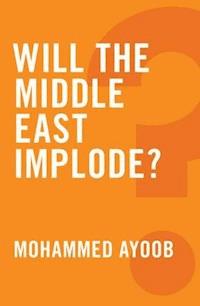
The Middle East has long been fraught with tension and volatility. However, the recent Arab uprisings have intensified instability, turning this 'hot-spot' into a veritable tinderbox whose potential for implosion has far-reaching regional and global consequences.
In this short book, leading Middle East scholar Mohammed Ayoob argues that the Arab Spring has both changed and charged some of the region’s thorniest problems - from the rise of political Islam to Iran’s nuclear ambitions, the Israel-Palestine conflict to rivalries between key regional powers. Exploring the sources of conflict in the Middle East and their various linkages, Ayoob offers a thoughtful and balanced assessment of whether the region is indeed destined for implosion or whether political sagacity and diplomatic creativity can bring it back from the brink.
Sie lesen das E-Book in den Legimi-Apps auf:
Seitenzahl: 191
Veröffentlichungsjahr: 2014
Ähnliche




















‘Mohammed Ayoob’s short book is a brilliant analysis of Middle East politics. It makes for sobering, yet essential, reading.’
Patrick Seale, author of The Struggle for Arab Independence: Riad el-Solh and the Makers of the Modern Middle East
‘Mohammed Ayoob is our most informed, judicious, perceptive, and insightful commentator on recent developments in the Middle East. He has now written an indispensable book that surveys the region as a whole while providing penetrating accounts of what is unfolding in each country, and how the play of forces from within and without is generating a crisis of potentially global proportions.’
Professor Richard Falk, Milbank Professor of International Law Emeritus, Princeton University, and UN Special Rapporteur on Occupied Palestine
Will the Middle East Implode?
Global Futures Series
Christopher Coker, Can War be Eliminated? Jonathan Fenby, Will China Dominate the 21st Century?
Mohammed Ayoob
WILL THE MIDDLE EAST IMPLODE?
polity
Copyright © Mohammed Ayoob 2014
The right of Mohammed Ayoob to be identified as Author of this Work has been asserted in accordance with the UK Copyright, Designs and Patents Act 1988.
First published in 2014 by Polity Press
Polity Press 65 Bridge Street Cambridge CB2 1UR, UK
Polity Press 350 Main Street Malden, MA 02148, USA
All rights reserved. Except for the quotation of short passages for the purpose of criticism and review, no part of this publication may be reproduced, stored in a retrieval system, or transmitted, in any form or by any means, electronic, mechanical, photocopying, recording or otherwise, without the prior permission of the publisher.
ISBN-13: 978-0-7456-8030-9
A catalogue record for this book is available from the British Library.
The publisher has used its best endeavours to ensure that the URLs for external websites referred to in this book are correct and active at the time of going to press. However, the publisher has no responsibility for the websites and can make no guarantee that a site will remain live or that the content is or will remain appropriate.
Every effort has been made to trace all copyright holders, but if any have been inadvertently overlooked the publisher will be pleased to include any necessary credits in any subsequent reprint or edition.
For further information on Polity, visit our website: www.politybooks.com
This book is dedicated to the scholars and staff of the Institute for Social Policy and Understanding (ISPU) in appreciation of their contribution to the objective study of Muslim Americans and America’s relations with the Muslim world
Contents
Acknowledgements
1 After the Arab Spring
2 The Islamist Challenge
3 Deadlock over Palestine
4 Regional and Global Rivalries
5 Iran and “the Bomb”
6 Will the Middle East Implode?
Afterword
Further Reading
Notes
Acknowledgements
The idea for this book came from Louise Knight, Senior Acquisitions Editor at Polity, who suggested to me that I should seriously consider the proposal and simultaneously offered me a contract to write it. Had it not been for her the book would never have been written. Justin Dyer did a fantastic job of editing the manuscript in record time. He went above and beyond the call of duty by constantly bringing to my attention unfolding events in the Middle East that could have a major bearing on the subjects that I have addressed in the book. I am grateful to Louise for the faith she reposed in me and to Justin for his superb handling of the manuscript. I am also grateful to the two anonymous reviewers of the initial draft who made very valuable comments that forced me to think harder about several themes covered in the book and to refine my arguments and sharpen my conclusions. The scholars who have endorsed the book so generously also deserve my gratitude.
The Institute for Social Policy and Understanding (ISPU), to whose scholars and staff this book is dedicated, is an independent, nonpartisan think tank that operates out of Washington, DC, and Michigan. It is a unique research organization that has become a trusted source of information and analysis for the policy-making community, the media, and academia about Muslim Americans, Muslim societies around the world, and America’s relations with key Muslim countries, especially in the Middle East and South Asia. I am grateful to ISPU for having enriched my intellectual life during the past decade that I have been associated with it as an adjunct scholar.
Mohammed Ayoob
1
After the Arab Spring
As the civil war in Syria continues to spill out of control, the security situation in Libya deteriorates further, the threat of secession in Yemen escalates, and the elected government in Egypt is overthrown by a military coup, it is hardly surprising that the legacy of the Arab Spring is hotly debated. But was the Arab Spring simply a mirage that will ultimately lead to disillusionment? Or were these uprisings really a harbinger of better times? So far the evidence would seem to give credence to the first interpretation, although enough of the spark of the original movements survives to make some analysts optimistic about the long-term future of the Arab world. What these discussions miss, however, is the real significance of the Arab uprisings: namely, the introduction of a huge amount of uncertainty in Middle Eastern politics that has upset the calculations of most regional and external actors and led to a highly fluid and potentially combustible state of affairs in this already volatile region.
Lesen Sie weiter in der vollständigen Ausgabe!
Lesen Sie weiter in der vollständigen Ausgabe!
Lesen Sie weiter in der vollständigen Ausgabe!
Lesen Sie weiter in der vollständigen Ausgabe!
Lesen Sie weiter in der vollständigen Ausgabe!
Lesen Sie weiter in der vollständigen Ausgabe!
Lesen Sie weiter in der vollständigen Ausgabe!
Lesen Sie weiter in der vollständigen Ausgabe!




