


Erhalten Sie Zugang zu diesem und mehr als 300000 Büchern ab EUR 5,99 monatlich.
- Herausgeber: The Crowood Press
- Kategorie: Fachliteratur
- Sprache: Englisch
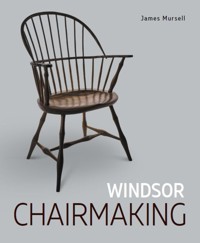
Windsor chairs are a beautiful and traditional feature in any home. Some three hundred years of tradition lie behind chairs made today. While sound joints are essential, it is the sensitive shaping of each component that leads to a fine chair. This lavish book celebrates their history and explains their heritage. It compares and contrasts the distinct Windsor designs from England and America. Tools, techniques and the selection of materials are extensively covered. Detailed plans and measurements for four chairs [two English, two American] are provided and allow makers on one side of the Atlantic to attempt a chair from the other side. A unique study of a magnificent 18th century armchair brings to life the 260 year old story told by the tool marks and other clues left by the maker. Guidance and techniques explain how to design your own chair from scratch, taking into account the anthropomorphic nature of these chairs and the messages they can send out.
Sie lesen das E-Book in den Legimi-Apps auf:
Seitenzahl: 320
Veröffentlichungsjahr: 2023
Das E-Book (TTS) können Sie hören im Abo „Legimi Premium” in Legimi-Apps auf:
Ähnliche



















First published in 2009 byThe Crowood Press LtdRamsbury, MarlboroughWiltshire SN8 2HR
www.crowood.com
This impression 2015
This e-book first published in 2024
© James Mursell 2009
All rights reserved. This e-book is copyright material and must not be copied, reproduced, transferred, distributed, leased, licensed or publicly performed or used in any way except as specifically permitted in writing by the publishers, as allowed under the terms and conditions under which it was purchased or as strictly permitted by applicable copyright law. Any unauthorised distribution or use of this text may be a direct infringement of the author’s and publisher’s rights, and those responsible may be liable in law accordingly.
British Library Cataloguing-in-Publication Data
A catalogue record for this book is available from the British Library.
ISBN 978 0 7198 4362 4
Dedication
To Louise
CONTENTS
Introduction
1 HISTORY
2 MATERIALS, EQUIPMENT AND TOOLS
3 PROCESSES AND TECHNIQUES
4 TWO ENGLISH CHAIRS
5 TWO AMERICAN CHAIRS
6 LESSONS FROM THE PAST
7 THE BODY LANGUAGE OF CHAIRS, SHAPE AND DESIGN
8 WINDSOR FURNITURE OTHER THAN CHAIRS
Further Reading
Glossary
Suppliers
Acknowledgements
Index
INTRODUCTION
The golden period for Windsor chairs was between 1720 and 1800, just eighty years, or one lifetime. It is tempting for contemporary Windsor enthusiasts to wish to have been born during this exciting period, but we are probably much luckier to be alive today. We are able to see examples of the whole spectrum of chairs that were produced in this period from the distance of over two centuries, in spite of the loss and destruction of the vast majority of old chairs.
Most makers in the mid-eighteenth century would have been exposed to only a limited range of furniture, and most of that would have been made locally and exhibited only minor variation. Development was mainly incremental, but every now and again a step change would have been made by enterprising and imaginative makers who had been exposed to a much greater variety of influences, perhaps in London.
We must thank those early innovators who took the simple concept of a Windsor chair and developed it into a worldwide phenomenon, starting with individual makers and leading into the industrial production in the nineteenth century that epitomized the Victorian Industrial Revolution.
English double-bow in yew fruitwood and elm.(Courtesy Michael Harding-Hill)
Today, with relatively inexpensive travel and the internet, we can study furniture from all over the world, and in particular Windsors from England and America. We are also fortunate that dedicated scholars have researched so thoroughly the developments of Windsor chairmaking on both sides of the Atlantic, in particular Nancy Goyne Evans who has produced the seminal works on the origins of Windsors and the development of American Windsor chairs, and Dr Bernard ‘Bill’ Cotton who has studied nineteenth-century English chairs so thoroughly.
Although interest in Windsor chairs almost died out in England and America at the beginning of the twentieth century, there has been a major revival in the past thirty years. Michael Harding-Hill and Charles Santore have championed the merits of eighteenth-century Windsors in England and America respectively, while Mike Dunbar and Jack Hill have introduced thousands of people to the delights of the chairs through their teaching.
A modern industrially made double-bow chair by Ercol.(Courtesy Ercol)
Windsor chairs are still made today using industrial techniques. The best known manufacturer in Britain is probably Ercol, and many people who bought chairs from that company in the sixties are still proud owners, and keenly aware of the link to the past that these chairs represent. Windsors seem to be firmly embedded, even today, as a significant element in the histories of both England and America. Sadly many modern Windsors are not of such high quality as Ercol chairs. English pubs are full of modern manufactured Windsors, which aesthetically are quite depressing to anyone with an appreciation for the originals; and in America also, industrially produced Windsors can be seen everywhere. Unexciting as their designs may be, at least Windsors are still being made and used in good numbers.
This book will concentrate on chairs from that ‘golden’ period prior to 1800, and will pay little attention to chairs and designs made after that time. This reflects the author’s interests and inclinations, and should not discourage further study of these later chairs.
Checking the cut end of a felled oak tree for shakes – no problems were found.
Windsor chairs, even though they may have started life in the cities of London and Philadelphia, are nowadays considered ‘country’ furniture, and occupy a place in the woodworking pantheon with ladderback chairs. Both can be made with just the simplest of hand tools, and do not require the mastery of specialist techniques such as the cutting of dovetail joints before the first Windsor or ladderback is made. Thus the world of country chairs is far more accessible to woodworkers and prospective woodworkers than most forms of furniture. This is somewhat paradoxical as cabinet makers often consider chairs to be amongst the most difficult items to make. This relatively simple form of construction allowed artisans from other fields, such as wheelwrights, to make Windsors as part of their output as far back as the 1750s, and it is a good reason, for anybody who is interested, to make a chair today. It is hoped that this book will encourage the process.
Gimson ladderback chair with rush seat 1892 – 1904.(© Victoria and Albert Museum, London)
The fact that green wood can be used for the chair’s construction is another feature that makes them attractive to people in the modern world. John Alexander in America and Mike Abbott in the UK have done more than most to publicize and promote green woodworking. Their enthusiasm for this type of material coincided with our increasing awareness of the environment and the importance of a sustainable lifestyle, both globally and individually. The use of the same word ‘green’ to describe both fresh, wet wood and also ‘consideration for the environment’ only enhances the interest that exists today for Windsor chairs, whether making new chairs or collecting/studying old chairs.
It is probably worth another word about ladderback chairs. Although they have a longer history than Windsors, they have never achieved quite the same prominence. Probably the best known examples were made by the highly commercial Shakers in America, who in the nineteenth century developed and promoted their chairs to make money for their communities. In England more recently the chairs of Gimpson and others have had a great following. Nobody can deny these chairs’ undoubted elegance, but it is perhaps possible to question their comfort in some cases. The reason for this is that ladder-backs tend to make fewer concessions to the human frame than Windsors – backs tend to be more vertical, and seats are not moulded to fit the posterior of sitters. However, some current makers, such as Brian Boggs, have combined form and function so successfully that comfort ceases to be an issue.
Ladderback chair by Brian Boggs.(Courtesy Brian Boggs)
It may already be obvious that ‘country’ chairmakers tend to fall into either the ‘ladderback’ or ‘Windsor’ camp, but not both. It is a little like the love of cats and dogs, where most people love one or the other, but seldom both, though there are exceptions. Dave Sawyer, who makes the finest Windsors that I am aware of, in the woods of northern Vermont, began by making ladderbacks, but progressed to Windsors. He describes the Windsor as the Stradivarius of chairs, and I agree wholeheartedly with this sentiment!
Balloon-back Windsor chair by Dave Sawyer.(Courtesy Dave Sawyer)
There is little doubt that Windsor chairs can become an addiction. You need only look at the number of people who have devoted significant parts of their lives to their study and making. No doubt each person is attracted to different aspects of these chairs, but I will try to explain what caused the addiction in me.
When I was very young my parents had Windsor chairs around our dining-room table, but soon acquired a set of Chippendale-style chairs from my grandmother. These were elegant chairs, but had embroidered seats stuffed with horse hair, which was none too comfortable on the legs to a young lad in short trousers. One up to Windsors!
At this same young age my father taught me to appreciate the pleasures of making things of wood, and this, combined with the love of these simple chairs, lodged in the back of my mind and lay dormant for almost thirty years. In the meantime I followed an academic rather than a practical education, culminating in a degree in botany. An MBA led to a number of years working in industry, both in England and America, and although I didn’t appreciate it at the time, this period of living in America would be a major influence in my chairmaking career.
In the mid-eighties I took over part of the family fruit-growing business, and after several years began, in the winter evenings, to make simple furniture based on lessons learned from my father and at school. Nearly thirty years had passed since I had sat on those Windsor chairs of my youth, but taking a chairmaking course to develop hand skills rekindled this interest and ignited a passion that has never left.
It was the simplicity of construction, and the ease with which one could create a thing of beauty and utility, that grabbed my attention. This combination perfectly matched the way that I work and think, and has informed my chairmaking ever since.
To bring my story up to date, chairmaking began to dominate my leisure time. I began to make chairs as a hobby, and within two years had taken a second course, this time in America. This introduced me to green woodworking, and finally gave me the means to begin creating the chairs that I could picture in my head. Sadly, fruit growing was becoming unviable and I closed down my farm in 2001. The upside of this difficult decision, and one that I have never regretted, is that it allowed me to devote all my time to Windsor chairs.
Ten days of formal instruction and fifteen years of selfapprenticeship have brought me to where I am now – and I’m still learning!
Windsor chairs are far more sculptural and organic in form than most cabinet work, and this is due to the lack of flat surfaces, parallel lines or right-angles. In addition, when sympathetically made, they combine the very best of form and function. The scope for experiment and development is also almost infinite. What more could one ask for as a woodworker?
Comparing cabinet making to Windsor chairmaking is like comparing apples and oranges. If cabinet making is 90 per cent about making joints and 10 per cent about shaping wood, then Windsor chairmaking is the opposite – 90 per cent shaping and 10 per cent joints.
Chairs can be made by an individual, or they can be produced by machines in factories with minimal human intervention, and with every combination of man and machine in between.
It is interesting to consider at what point the ‘quality’ of a machine-made chair will be surpassed by a hand-made chair. However, ‘quality’ when applied to chairs is a characteristic that is hard to pin down, but it includes such things as structural soundness of joints, success of the shape of individual components and the whole, and the finish. The first priority of a chair is that it will perform its function of supporting a body without breaking, and do so over many years. Once that has been achieved, and this depends on the quality of the joints, then the chair can be judged on the aesthetic features of shape and finish. If you agree that Windsor chairmaking is ’10 per cent joints and 90 per cent shaping’, then this points the way to success for an individual maker.
When one starts making Windsor chairs for the first time, the challenge is to complete the chair with as few mistakes as possible. There are so many steps in the process that mistakes are almost inevitable, but eventually the process will become instinctive. Until these mistakes are eliminated in the handmade chairs, the good quality machine-made chair may be considered superior.
The quality of the machine-made chair will depend on the original design, the tolerances of production and, to a small extent, the skill of the person assembling the final chair. It is inevitable that it will be the product of economic compromises which will lead to a chair that is shaped to the economic rather than the aesthetic optimum. The individual maker has the time and opportunity to aim for aesthetic perfection. In fact he must strive for it, as this is all that sets his work apart from the mass or batch produced competition!
This book will cover most aspects of Windsor chairmaking, but with the overriding ambition of encouraging the making of chairs that are both structurally sound and elegant.
The Structure of this Book
I have written this book with readers of widely different experience in mind, and am sure that it will be used in many different ways. It is a distillation of all that is important to me about Windsor chairs, covering far more that just ‘how to make a chair’. With this in mind, I offer a brief description of each chapter so that you can pick out those that are of most immediate interest – though I do not wish to put anyone off from the traditional approach of reading from start to finish!
Chapter 1
Starting with a definition, this chapter gives a brief description of how Windsor chairs have evolved historically and in design, both in England and America.
Chapter 2
The ingredients needed to make a Windsor chair. Traditional and non-traditional materials are considered. The ideal tools and equipment are detailed, along with a list giving the minimum requirements.
Chapter 3
How to make chairs. This covers techniques for each stage of chair making. Pick and choose depending on the project in hand. There is a great emphasis on the use of hand tools.
Chapter 4
Plans and specifications for two English Windsor chairs.
Chapter 5
Plans and specifications for two American Windsor chairs.
Chapter 6
Looks in detail at a magnificent English armchair made in the mid-1700s. Lessons are drawn from the extensive tool marks that the maker left on the chair. Finally the philosophy of the maker is discussed with implications for current makers.
Chapter 7
How do the relative angles and shapes of a chair’s components affect how we see it? The body language of chairs is discussed, and guidance is given towards designing your own original chair.
Chapter 8
Moving beyond side and armchairs, much more can be made using the same techniques described in the rest of the book.
CHAPTER 1
HISTORY
What is a Windsor Chair?
A Windsor chair has a solid wooden seat into which pieces are socketed from below and above, to create legs and backs respectively. There is no connection between the elements above and below the seat other than through the seat itself. This somewhat formal definition describes a form of construction rather than a style, and many people are disappointed that their mental picture of what a Windsor chair should look like is but one example, rather than definitive. The presence of spindles (or sticks) in the back, a steam-bent bow or a pierced splat does not make a Windsor chair, though they may well form part of one.
A Windsor chair has a solid wooden seat. The other components are socketed into the seat from above and below, but with no direct connnection between them.
Once you absorb the definition, it becomes liberating, and the possibilities of this form of construction become clearer. Chairs are not the only items that can be made in this way, although they are by far and away the most common. In Chapter 8 I briefly explore a few other types of furniture that can be made using the same techniques. The use of this form of construction is restricted only by imagination, and by the number of people familiar with its use and who are prepared to solve woodworking problems in this way, rather than using a more ‘conventional’ approach.
Early Windsor Chairs and Stools
The ancient Egyptians made stools using the Windsor method around 3,000 years ago, so it is hardly new! Once boring tools had been developed, people must have inserted sticks into planks. Three sticks of equal length and equally spaced inserted into a plank make a ‘milking’ stool, which is stable on all surfaces. The Egyptian stools varied in height: sometimes the legs were straight, and at other times curved; also the seats varied in thickness, and in some cases were dished to make them more comfortable. Even with these few variables the style of stool that is possible is enormous. The Egyptians had also learned to turn wood, so they possessed all the technology needed to make Windsor chairs – though as far as we know they did not convert their stools into chairs!
The first picture of a chair that we would recognize today as a Windsor was painted in Botticelli’s studio in 1483 in Florence. This chair has a thick ‘D’-shaped seat supported by three tapered (square-section) legs, with two in the front and one at the back. The superstructure features a ‘U’-shaped arm (following the shape of the back of the seat) mounted on eight turned spindles. This is the one of the first pictures known to show socketing of elements into the top surface of the seat. This idea obviously did not catch on in Italy at the time, and it had to wait more than 200 years before it became popular in England.
Most early ‘Windsor’ chairs and stools did not have stretchers, and the individual legs were held in place solely by the mortice and tenon joint in the seat. This necessitated a thick seat and substantial tenons to give a sufficiently strong joint. The first record of stretchers in ‘Windsor’ furniture is a Dutch painting from 1661, which shows a round stool with three well splayed legs joined together with three stretchers. It is surprising that this practice did not evolve earlier, as purely turned furniture depended absolutely on horizontal members holding the vertical pieces together.
Restoration chair, 1685–1693. Carved and turned walnut, with caned panels. (© Victoria and Albert Museum, London)
The restoration of the monarchy in England in 1660 marked the transition from joined, mainly oak seating to the turned and carved styles that Charles II brought back with him from the Continent. In the broadest sense it seems that joiners tended towards cabinet making, while seating became the province of the turner/chairmakers. After the Restoration, heavily carved, caned chairs became the height of fashion, and it was only when these began to fall from favour in the early 1700s that turner/chairmakers began to make Windsor chairs instead.
The first reference to a Windsor seat was in 1718, describing seating found in the garden of Dyrham Park near Bath. However, it appears that this was not of the form that we know today as Windsor, but referred to seats made of planks that could be rotated in order to shelter from the wind and sun. Nevertheless, the association with formal gardens was crucial to the development of the early Windsors as we know them, because these may have been a forerunner to the ‘modern’ Windsor in the form of Forest chairs, which began to appear around 1710. These were made of branch wood with the bark retained, and it was a small step to them being made of turned wood, giving rise to our understanding of Windsor chairs.
It is suggested by Goyne Evans that the link with ‘Windsor’ came from such chairs being seen in the grounds of Windsor Castle. Nobody knows for sure how the name came about, but there is no evidence that they were made in the town itself; it may even be true that the earliest chairs were made in London, where most of the recorded turners worked. This is supported in part by the earliest known advertisement for Windsor chairs in a newspaper dated 1730. John Brown advertised ‘All sorts of Windsor garden chairs, of all sizes, painted green or in the wood’. His workshop was in St Paul’s Churchyard, London.
Whatever the truth about the origins of the name ‘Windsor’ as applied to chairs, there are other examples of where a product has acquired its name from a location where it was never made. Stilton cheese is named after a town in Cambridgeshire, England, where it was first sold at a pub that lay on the Great North Road. The cheese originated near Melton Mowbray, Leicestershire, and was never made in Stilton itself, but acquired its name though the marketing of the product. A second example is the Panama hat: these hats are all made in Ecuador, but acquired their current name when the Panama Canal was being built. Many of the workers wore this type of hat, and the name was subsequently adopted. Again, the product was never made in the place that it was named after.
Early Use and Styles
Once the chairs acquired the comb-back form that we are now familiar with, they became essential furniture for the aristocracy’s formal gardens. They were almost all painted green to blend into the garden setting and presumably to protect them from the elements. The chairs did not remain solely in the garden for long; on his death in 1736, Lord Byron’s house (Newstead Abbey, Nottinghamshire) contained the following Windsor furniture indoors:
RED GALLERY
4 double Windsors
GREAT GALLERY
4 trebles and 6 singles
LITTLE GALLERY
4 Windsors
BLUE GALLERY
1 treble and 1 single
It was their adoption and endorsement by the aristocracy that set Windsor chairs off on such a dizzying trajectory over the next 150 years. The patronage of rich and powerful owners made the chairs desirable to those that sought to emulate their ‘betters’, but the secret of the Windsor chair’s success lay in the way that it was made. The sensitive shaping of the chairs leads one to the conclusion that in the early days each chair was made by one craftsman, perhaps with the assistance of apprentices. But it was the ability to make each part of the chair in large numbers, and then to assemble chairs from a stock of parts, that generated economies of scale and the possibility of a significant reduction in the price. This process did not happen all at once, but chair factories – the embodiment of economies of scale – were in existence by the 1790s.
In the early eighteenth century the price of Windsors was on a scale between rush-seated chairs and cabinet makers’ chairs, being roughly double the cost of the former and half the price of the latter. This pricing position, along with the comfort of a sculpted seat, and their initial unique position as outdoor chairs, meant that they filled a niche in the market. Were these chairs deliberately created by entrepreneurs to fill this niche, rather than evolving by chance? It is unlikely that we will ever know, given how thin the historical record is. All that can be said is that most of the evolution took place in the first eighty years of their existence, after which the basic chair patterns were recycled and modified.
Manufacturing Evolution
The study of the evolution of Windsor chairs from the historical record is fraught with the same challenges as the study of biological evolution from the fossil record. In both cases many gaps exist, and transitional forms are very rare. Another common feature is that a period of explosive evolution was followed by relative stability and lack of innovation.
Tree of Life: the evoluton of Windsor chairs can be compared with the evolution of organisms.
The price of Windsors was first brought down by a division of labour to create the components. Relatively low-skilled individuals became specialists in creating different parts for the chairs, and so each part was made with the greatest possible efficiency. With this specialization the parts became virtually commodity items, with the associated loss of value. In America the Philadelphia chairmaker Trumble advertised for 40,000 hand-shaved hickory spindles in 1775. Anyone who has shaved their own spindles can appreciate the amount of work involved. Assuming five minutes per spindle, including time for splitting the blanks, this translates to 3,333 hours, or eighty-three weeks of forty hours doing nothing else, for one man! Bodgers working in the woods above High Wycombe in the nineteenth century were not paid highly for their production, and the relationship between them and the factories must have been similar to today’s suppliers to supermarkets.
As the Industrial Revolution progressed, machinery played an increasingly important role, gradually replacing the human inputs and reducing costs still further. As these developments progressed, the decline in the aesthetic qualities of the chairs can be seen: in England they tended to became heavier, while in America the simpler designs relied increasingly on paint and decoration to make them attractive.
It is very difficult to create the same quality of chair when it is made by many people from stock parts, compared with a chair made by an individual; but the unfortunate reality for today’s makers is that these less expensive chairs perform the task of supporting a human body almost as well as the handmade version. So although comfort and aesthetic quality may be compromised, they may nevertheless be quite sufficient for most of the market.
The first Windsors, as we now know them, were developed in England. They had ‘D’-shaped seats, steam-bent arms, and long spindles topped with a crest to form the back. In front of these long spindles the arm was supported by short spindles. Many of the earliest chairs did not have stretchers between the legs.
Very early English Windsor comb-back, 1700–1750. Elm seat, sticks and arm-bow of ash, oak legs, all painted green.(© Victoria and Albert Museum, London)
Windsor Chairs in America
These chairs were not confined to England for long. They had crossed the Atlantic to Philadelphia before 1736, when the will of Patrick Gordon (Governor of Pennsylvania) included mention of Windsor chairs. It is thought that production of domestic chairs did not begin in Philadelphia until around 1740, but the first chairs bore a striking resemblance to their English cousins. The most obvious characteristics that distinguished them from their forebears were the adoption of different turning patterns, and an increased splay to the legs. The latter characteristic continued to distinguish American from English chairs throughout their histories (seeChapter 7). Shortly after the production of these high-back chairs began, low-back versions were also developed. The seat, arm-posts and undercarriage remained virtually unchanged, but the steam-bent bow was replaced with a three-piece ‘sawn’ arm, supported along its length by short spindles.
Philadelphia high-back.(Courtesy Charles Santore)
Around 1750 in England, cabriole legs and baluster splats were incorporated into Windsor chairs. These embellishments were taken from earlier cabinet makers’ chairs and would have increased the cost of production considerably. By now the chairs were undoubtedly used mainly indoors, but the market had broadened from the aristocracy to the professional and merchant classes. While the market developed in a similar way in America, these new features were not adopted. The splat became almost de rigueur in English chairs from that time onwards, though the use of cabriole legs declined. These expensive legs were not consistent with the constant push to reduce prices and expand the market.
The ‘Pitt’ chair. (© Christie’s Images Limited)
It was in this period that John Pitt (1714–1759) from Slough, near Windsor, made the chair that is considered to be the oldest provenanced Windsor chair. The distinctively carved cabriole legs set his chairs apart from others of the same period, but have allowed several other chairs to be attributed to him over the past ten years.
English armchair in elm yew and fruitwood. The four cabriole legs, crinoline stretcher, ribbon slats and fretted splat make this an impressive chair. (Courtesy Michael Harding-Hill)
The next development in England at a similar time was that of the double-bow chair. The crest was substituted for a second steam-bent bow that was tenoned into the arm, and into which the tops of the spindles were fitted. It was common in these c. 1750 English chairs for the crests to be supported on spindles and a ribbon slat at either end. These rectangular cross-sectioned pieces were also incorporated in the first double bows, but this practice was quickly dropped – presumably because it was unnecessary, and added to the complication and cost.
American double-bow chair. (Courtesy Charles Santore)
The double bow was adopted in Philadelphia in the 1760s, but by now the styles on each side of the Atlantic were quite distinct, the American chairs having become generally lighter in appearance than the English. Although it is dangerous to generalize, it is my opinion that it is the spaces between components that dominate in American chairs, while in English chairs it is the components themselves that catch the eye. In England there was a brief fashion for gothic-style chairs, distinguished by their pointed backs, though occasionally produced with round backs, and with all spindles replaced by pierced splats.
Continuous-arm chair from New York.(Courtesy Winterthur Museum)
As we move towards the end of the eighteenth century almost all splats in English chairs became pierced, and makers incorporated many contemporary patterns in them. The most commonly known pattern that uses the pierced wheel as its dominant motif became popular at the end of the century, and has been used continuously up to the present day. Ask most people today in Britain to picture a Windsor chair, and they would probably describe a ‘wheelback’ chair.
In America Windsor chairmaking spread from Philadelphia to New York, Boston and Rhode Island, and to country areas around these centres. The most dramatic development, which was entirely American, was the creation of the continuous armchair in New York City in around 1790. The single piece, steam-bent bow tied all the spindles together to create the flowing shape of the Bergère chair that may have been the inspiration.
English fan-back side chair. (Courtesy Michael Harding-Hill)
The first side chairs, as opposed to armchairs, in England and Philadelphia were fanbacks, following the same pattern of development as the armchairs, and were made in the 1750s. The backs of these English chairs were usually made up of a splat, spindles and two outer ribbon slats, all joined together with a horizontal crest. Frequently the back would have been braced with two extra spindles inserted into a projection behind the seat. The legs of the earlier chairs may have been in the cabriole style, but they became uniformly turned as time went on.
Development of seat shape – England.
In Philadelphia elegant fanbacks were made by Henzey and Trumble in the 1770s, developing their designs from the earlier prototypes. These later chairs had turned back-posts and spindles that supported a fine crest. Bow-back chairs developed around 1770 in both countries, though they gained prominence in America prior to England.
Development of seat shape – America (‘D’ shape to Oval to Shield).
The shape of seats changed over time in both countries. In England the ‘D’-shaped seat quickly became more rectangular and developed a swell around the front legs, while in America the initial ‘D’-shaped seat evolved first into the oval and then the shield shape. Both oval and shield patterns have been used continuously to the present day.
Given the simplicity of their form of construction, and the huge success that they enjoyed in Britain and America both in their domestic markets and as exports, it is very strange that they only appear to have been successful in English-speaking countries. Goyne Evans identifies the Sgabello chairs that developed in northern Italy prior to the earliest Windsors. Although they comply with the definition of a Windsor chair, their flat plank seats and backs bear little resemblance to the chairs that we would describe as Windsor.
Production of Windsors Today
The last chairmaking factories in High Wycombe closed down in the twentieth century, but it is remarkable how frequently I still meet people who can remember going into the woods above the town and seeing the bodgers at work. There is little doubt that these bodgers would have been the last of their kind, but they are still remembered with interest, and as part of our cultural history. This collective memory may well be due to great publicity generated by chairmaking businesses, but must also be due to research and recording by organizations such as the Shell Film Unit that produced a number of excellent black and white films, recording the life of the bodgers.
American fan-back side chair. (Courtesy Nancy Goyne-Evans)
Their life must have been very hard, having to work in all weathers with little protection. This lifestyle has been re-enacted by pole-lathers all around the UK, and proves to be very popular, particularly during the summer months.
Today the private ownership of Windsor chairs is treated differently in Britain and America. In Britain the market for quality hand-made Windsors is small, and is limited to those who appreciate and can afford fine furniture. However, a number of businesses continue to survive making good quality reproductions produced in a semi-industrial way. In America, by contrast, Windsor chairs can be described as aspirational furniture. You need only watch Hollywood blockbusters carefully and you will see one or more Windsor chairs in most films. By contrast British films virtually never include them, except in period dramas; there was just one in the whole series of the Harry Potter films, and that was in deep shade!
The value ascribed to Windsor chairs on either side of the Atlantic is another measure of their popularity. The largest ever bid at auction in Britain is around £20,000, while in America chairs have been known occasionally to change hands for $500,000.
Painted Windsor chair. (Courtesy Winterthur Museum)
The ongoing tradition of painting Windsors in America is something that finds little resonance in Britain. All Windsors were painted in the early 1700s, but this ceased in England as the chairs were brought indoors. Many theories exist about why the practice continues in America, but not in England. Perhaps American homes tended to have more exposed wood in the living rooms, and the colour of painted chairs livened up the overall appearance. Another explanation is that the chairs are always made of several different woods, and American seat wood (pine or tulip) is not particularly attractive, so painting the whole chair unifies the whole piece, and adds colour to its surroundings. By contrast English chairs always used elm for the seats, and some of the other woods, particularly yew, are very attractive in their own right – hence no need to paint over them.
Whatever the reasons, painting is just one feature that distinguishes American chairs from English, along with a lightness of construction and a rake and splay of components that seem exaggerated to British eyes.
Each person must decide on which tradition to follow. It is difficult to work in both styles at the same time as there are so many nuances that differ and which, if not observed, will jar the eye of anyone knowledgeable. My hope is that this book will encourage new people to begin making Windsors, and that existing makers may pick up some tips, and perhaps also try their hand at making chairs from the opposite side of the Atlantic.
CHAPTER 2
MATERIALS, EQUIPMENT AND TOOLS
Wood
The definition of Windsor furniture involves a form of construction limited to one material – wood. It is possible to imagine metal or plastic Windsor chairs, but the nature of these materials means that there are much better ways of joining parts together than the mortice and tenon joints that are ubiquitous in Windsor furniture. Metal is more likely to be welded, while plastic is usually glued or welded, or moulded into a single piece. One cannot say that metal is never used, but the occasional situations in which it was used in old chairs almost always involved attaching the arm to a back-post or arm-post.
Although Windsor chairs have solid wooden seats by definition, some were designed to be upholstered, with fabric added on top of the seat. In this situation the makers made little effort to shape the seat, relying on the padding to provide comfort, rather than the careful shaping of the solid seat. Fortunately limiting yourself to wood as the sole material is not too restricting. Each species has its own distinct combination of hardness, colour, grain pattern, strength, density and so on; and with hundreds of species to choose from, you will be spoilt for choice. The down side of this variation is that there is never a single wood that will be ideal for each role. A metal or plastic chair can be made using the same material throughout, but you are unlikely ever to find an old Windsor chair made of a single species of wood.
The woods that were chosen for chairmaking 200 years ago were inevitably grown locally. We have become so used to wood being imported from all around the world that the link between furniture and locally grown species has largely been lost. This is a trend that is beginning to reverse, however, with the greater awareness of the true costs of transport. Also, it must be said, there is something attractive about making a product with local origins. Sadly it is not easy, though not impossible, to produce a Windsor chair made entirely of locally grown wood. It is a worthy ambition to minimize the use of wood imported from outside one’s local area, and it can make a key selling-point when marketing your work.
England: Traditional Woods
WOODS FOR SEATS




