


21,99 €
Mehr erfahren.
- Herausgeber: John Wiley & Sons
- Kategorie: Fachliteratur
- Sprache: Englisch
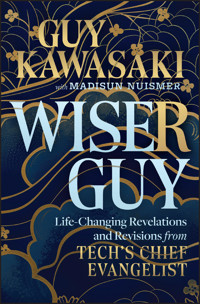
A collection of honest, humorous, and heartfelt stories from a Silicon Valley icon
Wiser Guy is Guy Kawasaki’s dynamic update of Wise Guy, delivering a fresh collection of stories that combine humor, humility, and the wisdom gained from five more years of life—and 250 episodes of the Remarkable People podcast.
This new edition reflects Guy’s continued evolution, enriched by deep conversations with luminaries such as Jane Goodall, Steve Wozniak, Stephen Wolfram, Angela Duckworth, and Julia Cameron.
These interviews have broadened his perspective and deepened the relevance of his advice—transforming Wiser Guy into more than just a memoir; it’s a collaborative, cross-generational conversation about purpose, resilience, and leadership.
Whether you’re launching your career, building a company, navigating uncertainty, or simply striving to grow, Wiser Guy is a practical and inspiring guide. It offers candid reflections and actionable insights from Guy and the remarkable minds who have influenced him—creating a roadmap for living a more meaningful, impactful life.
Sie lesen das E-Book in den Legimi-Apps auf:
Seitenzahl: 250
Veröffentlichungsjahr: 2025
Ähnliche

















Table of Contents
Cover
Table of Contents
Title Page
Copyright
Dedication
Preface
Mahalo
1 Foundation
My Draft‐Dodging Humble Heritage
Thank God for My Sixth‐Grade Teacher
The World Isn't Black and White
A Little Fear Is Good
The Toughest Teachers Are the Best
Father Knows Best (and Pays the Tuition)
The Promised Land
My First Two Career Decisions
Tony the Public Health Tiger
2 Motivation
Forget the World, Change the Car
Woz Explains What Motivated Steve Jobs
Crime Can Pay
“Are You Jackie Chan?”
$250,000 in Checking
No One Complained About Me?
Shut Down Your Nigel
Off‐the‐Books Learning
From Twelfth to Gold
3 Inspiration
The Original Two Guys in a Garage
The Book That Changed My Life
Jane Goodall, Secretary
“I Have ALS. Why Don't I Complete Fifty Marathons?”
From Prisoner to Painter
From Illegal to Inspiration
Make Yourself Indispensable
The Story of Canva
The Lesson of My Missing Shrimp Tacos
Pick Up the Turtle
Fail Like Apple
4 Realization
Look Beyond Money
You Can Teach an Old Dog New Tricks
The Knight Who Shined My Shoes
You Can't Go Wrong Starting in Sales
Fake It Until You Litigate It
Look for Commonality
Face It Until You Make It
You Never Know
So Much for Selling Pez Dispensers
There's Always a Way
The Truth Helps You Keep Your Job
Send the Right Signals
What Makes People Happy
5 Exhortation
Put Skills First
Ask What's Missing
Just Say Yes
Remove Friction
What People Regret
Relish the Shit Sandwich
Simple Questions Yield Big Answers
Be Nice to Your Interns
Make Your Decisions Right
Blowing the Whistle
The Time I Almost Quit Apple
The Time I Did Quit Apple
Only Losers Punch Down
“I Am Sorry”
Change Is Good
6 Observation
How I Became Friends with Jane Goodall
The Second Believer Is Key
The Miami LGBTQ+ Canvassers
The Gorilla Is Invisible
Keep Your Mouth Shut
Would Elon Do This?
Finding a Contact Lense in a Pool and a Shark in the Sea
Do the Math
What I Learned by Almost Drowning
Small Changes Make a Big Difference
Showing Weakness Is a Sign of Strength
How I Got My Job at Apple
How I Passed Up the Most Lucrative Job of My Career
How I Got My Job at Canva
The Beauty of the Performative
Michelle Obama's Hair
Ignoring Is Bliss
Unveil Your Passions
7 Innovation
You Are the Customer
Go and Be
What Does the Cow See?
Work Backwards
Reebok's White Space
Establish a Subcategory
What Do “Experts” Know?
Prove Your Concept
Make a Bigger Pie
Be a Mission‐Driven Asshole
The Law of Big Numbers
Letting Flowers Bloom
8 Salvation
The Memorial Mindset
Money from Out of the Blue
Nordstrom's Tires
Extras Special
How to Keep Score
Guy the Yard Man
The Honorable Steve Case
Dyslexia for Dummies
It Could Be Worse
A Dinner in Berlin
Dealing with Dickheads
9 Joculation
Is Your Background Black?
The Coolest People Use Apple Stuff
The Electric Kool‐Aid Acid Attire Test
The Worst College Interview Question Ever
Jolly Ranchers Trump Baseballs
How to Tell If Google Might Hire You
What's $745,000 Between Friends?
Life Regresses to the Mean
Mutual Distrust
WTF
10 Validation
Nic Kawasaki, Son
Peg Fitzpatrick, Co‐author
Noah Kawasaki, Son
Madisun Nuismer, Co‐author and Producer
Shawn Welch, Co‐author
But Wait, Shawn Has More
Nate Kawasaki, Son
Scott Knaster, Macintosh Developer Support
Rebecca Hoover, Educational Therapist
Nohemi Kawaski, Daughter
Summation
The Power of Perspective
You Never Know
Hard Work and High Standards
Comfort Zones Are for Wimps
Importance of Gratitude
Final Thoughts
About the Authors
Index
End User License Agreement
Guide
Cover
Table of Contents
Title Page
Copyright
Dedication
Preface
Mahalo
Begin Reading
Summation
About the Authors
Index
End User License Agreement
Pages
iii
iv
v
vii
xi
xii
xiii
xiv
xv
1
3
4
5
6
7
8
9
10
11
12
13
14
15
17
19
20
21
22
23
24
25
26
27
29
31
32
33
34
35
36
37
38
39
40
41
42
43
44
45
47
48
49
50
51
52
53
54
55
56
57
58
59
60
61
62
63
65
66
67
68
69
70
71
72
73
74
75
76
77
78
79
80
81
82
83
84
85
86
87
89
90
91
92
93
94
95
96
97
98
99
100
101
102
103
104
105
106
107
108
109
110
111
112
113
115
117
118
119
120
121
122
123
124
125
126
127
128
129
130
131
133
135
136
137
138
139
140
141
142
143
144
145
146
147
148
149
150
151
153
155
156
157
158
159
160
161
162
163
165
167
168
169
170
171
172
173
174
175
176
177
178
179
180
181
182
183
184
185
186
187
188
189
190
191
193
194
195
196
197
198
199
200
201
202
203
204
205
206
207
208
GUY KAWASAKI with MADISUN NUISMER
WISER GUY
Life‐Changing Revelations and Revisions from TECH’S CHIEF EVANGELIST
Copyright © 2025 by John Wiley & Sons, Inc. All rights reserved, including rights for text and data mining and training of artificial technologies or similar technologies.
Published by John Wiley & Sons, Inc., Hoboken, New Jersey.Published simultaneously in Canada.
No part of this publication may be reproduced, stored in a retrieval system, or transmitted in any form or by any means, electronic, mechanical, photocopying, recording, scanning, or otherwise, except as permitted under Section 107 or 108 of the 1976 United States Copyright Act, without either the prior written permission of the Publisher, or authorization through payment of the appropriate per‐copy fee to the Copyright Clearance Center, Inc., 222 Rosewood Drive, Danvers, MA 01923, (978) 750‐8400, fax (978) 750‐4470, or on the web at www.copyright.com. Requests to the Publisher for permission should be addressed to the Permissions Department, John Wiley & Sons, Inc., 111 River Street, Hoboken, NJ 07030, (201) 748‐6011, fax (201) 748‐6008, or online at http://www.wiley.com/go/permission.
The manufacturer's authorized representative according to the EU General Product Safety Regulation is Wiley‐VCH GmbH, Boschstr. 12, 69469 Weinheim, Germany, e‐mail: [email protected].
Trademarks: Wiley and the Wiley logo are trademarks or registered trademarks of John Wiley & Sons, Inc. and/or its affiliates in the United States and other countries and may not be used without written permission. All other trademarks are the property of their respective owners. John Wiley & Sons, Inc. is not associated with any product or vendor mentioned in this book.
Limit of Liability/Disclaimer of Warranty: While the publisher and author have used their best efforts in preparing this book, they make no representations or warranties with respect to the accuracy or completeness of the contents of this book and specifically disclaim any implied warranties of merchantability or fitness for a particular purpose. No warranty may be created or extended by sales representatives or written sales materials. The advice and strategies contained herein may not be suitable for your situation. You should consult with a professional where appropriate. Further, readers should be aware that websites listed in this work may have changed or disappeared between when this work was written and when it is read. Neither the publisher nor authors shall be liable for any loss of profit or any other commercial damages, including but not limited to special, incidental, consequential, or other damages.
For general information on our other products and services or for technical support, please contact our Customer Care Department within the United States at (800) 762‐2974, outside the United States at (317) 572‐3993 or fax (317) 572‐4002.
Wiley also publishes its books in a variety of electronic formats. Some content that appears in print may not be available in electronic formats. For more information about Wiley products, visit our web site at www.wiley.com.
Library of Congress Cataloging‐in‐Publication Data is Available:
ISBN: 9781394324828 (Cloth)ISBN: 9781394324835 (ePub)ISBN: 9781394324842 (ePDF)
Cover Design: WileyCover Image: © Nina/stock.adobe.com. Generated with AIAuthor Photos: Guy Kawasaki @ Liz DePuydt, Madisun Nuismer @ Danny Witty
To Beth, Nic, Sakura, Duke, Noah, Lauren, Nohemi, Anthony, and Nate.
Wisdom is the power to put our time and our knowledge to the proper use.
—Thomas J. Watson Jr.
Preface
The only true wisdom is in knowing you know nothing.
—Socrates
Before you ask or wonder, this is not my autobiography or memoir. It is a compilation of the most enlightening stories of my life—mostly ones I've lived but some that I've heard. Think personal lessons, not personal history.
This book started as a simple project: Get back the rights of Wise Guy from Penguin, make a few edits, get a new cover, and push it out. That's not what happened. Think complete restoration as opposed to simple detailing.
It's how I roll—or, as Madisun says, “You always need a project, Guy.”
My stories do not depict epic, tragic, or heroic occurrences because this wasn't the trajectory of my life. They do not depict a rapid, tech‐bro rise, either. One decision. One failure. Hard work. One success. My goal is to educate, not awe you.
There are, however, stories that depict epic, tragic, and heroic occurrences. I was blessed to learn these because of my podcast, Remarkable People. Without a doubt, these stories made me a wiser Guy.
I hope our book will help you live a joyous, productive, and remarkable life. If Wiser Guy succeeds at this, that's the best story of all.
—Guy Kawasaki
Santa Cruz, California, 2025
Mahalo
Feeling gratitude and not expressing it is like wrapping a present and not giving it.
—William Arthur Ward
Mahalo is the Hawaiian word for “thank you,” but its emotional impact is greater than a quick‐and‐dirty “thanks.” When coming from a person with ties to Hawaii, it's a term to express deep, heartfelt appreciation.
So this is my chance to thank the people who've shaped my journey, supported my work, and made this book possible. Writing about the stories that made me wise was a deeply personal endeavor, and I couldn't have done it without them.
First, my family. My wife, Beth, is my rock, my editor, and my reality check. She's been my partner, and her love and patience have been the foundation of my life. To my kids, Nic, Noah, Nohemi, and Nate—you've taught me more about life, love, and resilience than any job or deal ever could. And Will Mayall, whom I consider the brother I never had. You are my greatest teachers.
Second, the Remarkable People podcast team—Madisun Nuismer, Jeff Sieh, Tessa Nuismer, and Shannon Hernandez—and incredible guests, such as Jane Goodall, Stephen Wolfram, Bob Cialdini, Halim Flowers, Katy Milkman, Maryléne Delbourg‐Delphis, Carol Dweck, and Angela Duckworth. They shared their wisdom and trusted me with their stories.
Third, the Yakookza cabal of catty surf buddies. (“Yakookza” is my made‐up word combining yakuza and kook—you can figure this out.) Their names are Mark Nishimura, Cynthea Williford, John Conway, Joanna Mana, and Troy Obrero. FIIG!
Fourth, my editors, past and present: Rick Kot and Leah Zarra plus the teams behind them at Penguin and Wiley. Thank you for your patience, vision, and ability to turn my ramblings into something coherent. You've been a true partner in this process.
Fifth, my colleagues from Apple, especially Mike Boich, Joanna Hoffman, Alain Rossmann, Mike Murray, Steve Jobs, Carol Ballard, and Holly Lory. You taught me the art of thinking differently. The lessons I learned during those years have shaped my career and my approach to life.
Sixth, my readers and listeners. Your support means the world to me, and I write and podcast for you. You've allowed me to share my ideas, my failures, and my successes, and for that I'm eternally grateful.
Seventh, to the people who've doubted me, robbed me, or gave me a ride in a Porsche or Ferrari. You've been some of my greatest motivators. Every “no can do” has pushed me to find a better way, and every setback has made me wiser. And every car ride motivated me with envy.
Finally, Madisun Nuismer. Yes, she was mentioned before, but she is what's known as a “force multiplier,” not to mention producer and co‐author, so she deserves two mahalo mentions. You would be surprised to learn how much of my compassion, efficiency, and effectiveness is because of her.
Wiser Guy is the culmination of a lifetime of lessons, and it's dedicated to everyone who's been part of my journey. Thank you for making me wiser. I hope this book does the same for you.
1Foundation
You don't have to be great to start, but you have to start to be great.
—Zig Ziglar
Foundation: the basis or groundwork of anything.
My Draft‐Dodging Humble Heritage
My family emigrated to Hawaii from Japan between 1890 and 1900. At the time Japan was fighting in two major conflicts: the First Sino‐Japanese War and the Russo‐Japanese War.
Young Japanese men were required to serve in the military, so my family immigrated to Hawaii and worked as sugar cane laborers. It is safer, after all, to harvest sugar in Hawaii for $1/day than to invade China or Russia. Also, my great‐grandfather was on the FBI watch list because he traveled to Japan under two different names.
My father started working at age fourteen to support the family. He graduated from high school but did not get a college degree. He became a stevedore, then a fireman, and finally a real estate agent. His deep sense of civic duty led him into politics, and he was a state senator for approximately twenty years.
Like my father, my mother did not attend college. Her family, however, was well off, so she went to Yokohama, Japan, in 1939 for schooling. Fortunately, she returned to Hawaii on one of the last two ships before the Japanese attack on Pearl Harbor in 1941. My mother dedicated her life to our family.
Wisdom
As the saying goes, you have to wait a long time by the side of a river before a roast duck will fly into your mouth. So take charge and be proactive because to win in life, you can't be passive.
The move to Hawaii changed the arc of my family's life, steering us clear of the draft, conventional life in Japan, and the perils of Hiroshima during WWII.
I'm a fortunate and appreciative product of my family's courageous decisions and relentless pursuit of a better future. My family and I owe everything to America.
Thank God for My Sixth‐Grade Teacher
I grew up in Kalihi Valley, a low‐income part of Honolulu. If you've driven from Honolulu International Airport to Kaneohe via the Wilson Tunnel, you passed right by my boyhood home. At the time, the area was populated by working‐class Hawaiians, Filipinos, Samoans, Japanese, and Chinese.
There were few Caucasians, whom locals derogatorily referred to as “haoles.” Our neighbors worked as clerks, janitors, and laborers—if they worked at all. Our home was near a public housing project. I didn't venture into it because the majority of the residents were Hawaiians and Samoans, and you only went there if you had to.
I attended a public school called Kalihi Elementary which is housed in the pink buildings on the Ewa (west) side of Likelike Highway. My educational route would have led me from Kalihi Elementary to Kalakaua Middle School, Farrington High School, and the University of Hawaii. After college, I would have worked in a retail, tourism, or agricultural job.
However, it was not my destiny because my sixth‐grade schoolteacher, Trudy Akau, advised my parents to take me out of the public school system and get me into a private, college‐prep school—specifically, Punahou or Iolani.
Akau's advice changed the course of my life. If she had not persuaded my parents to send me to Iolani and if my parents hadn't made the necessary sacrifices to pay Iolani's tuition, I would not have gone to Stanford. If I had not gone to Stanford, I would not have met the guy who piqued my interest in computers and hired me at Apple.
Wisdom
First, become a Trudy Akau. Take interest in others, help them, get beyond your comfort zone, and offer guidance to them and their families. One caring person altered the trajectory of my life. You could do the same.
Second, follow the advice of people like Trudy Akau. Teachers, coaches, counselors, and ministers are motivated by a desire to help others. They typically have your best interests at heart. Pay attention to what they say.
Third, before it's too late, express gratitude to the Trudy Akaus in your life. Not thanking her is one of my biggest regrets.
If you are a teacher, coach, pastor, priest, or rabbi, or hold a position that influences people, understand that you are, in the words of Steve Jobs, “denting the universe.” You may affect only one person at a time and a few over your lifetime, but every dent counts.
Make no mistake: You are doing God's work.
The World Isn't Black and White
As far back as I can remember, my parents instilled a sense of honesty and honor in me. I learned that it was disgraceful to lie, cheat, or steal. One day, when I was a teenager, my uncle challenged this belief system by taking me shopping at the now‐defunct Wigwam department store to purchase some screws for his house repair.
He opened a plastic container in the store, took a few screws, and then we left. My uncle was a shoplifter, and I was his accomplice! He justified his actions by saying he only needed a few screws. Even today, at seventy, I still struggle to make sense of why he stole those screws.
Wisdom
First, people aren't simply good or bad. Good people can do bad things, and bad people can do good things. This includes yourself—you will do bad things that you will regret.
Second, remember that you are influencing people who are watching you. The transgression that you consider inconsequential could shape the values and morals of others without you ever knowing it—but so could your kindness and generosity.
I am sure that if my uncle was aware of the impact this small act would have on me, he would have purchased the full container of screws.
A Little Fear Is Good
Three other youthful experiences taught me to respect grownups and not screw around. The first occurred on a Kalihi Elementary field trip to the Nike (nothing to do with the shoe company) missile site in Kahuku, Hawaii.
Following the tour, the Army served us lunch, and I dropped a clump of rice on the floor. I picked it up and was about to throw it back on the floor when an Army officer, speaking in an frightening, authoritative, drill sergeant tone, said, “Don't throw anything on the floor. Pick it up and bus your tray.” He scared the crap out of me, and ever since then I've respected those in uniform and accepted the responsibility to keep things clean.
The second formative experience occurred when my father took me to his workplace, the alarm bureau of the Honolulu Fire Department. This facility dispatched fire trucks when people reported a fire.
While waiting for him one day after school, I set off an alarm box to see what would happen. I wasn't aware that the box was there for demonstration purposes. My father convinced me that I had caused firemen to jump down the pole into a firetruck and rush to the scene.
He also informed me that it was a crime to make a false alarm. Therefore, the police might come after me. He and his buddies had a good laugh, but the experience turned me into a scaredy‐cat who didn't break the law. This lesson probably kept me out of much teenage‐boy, reptilian‐brain trouble.
The third experience occurred at Iolani. The only time that I got into trouble in high school was when I recruited a buddy to skip art class with me. Stupidly, we chose the same day when a few other students did the same thing.
We received a detention, and in my case the punishment was sweeping the basketball gym floor for a week. This experience didn't scare me, but it taught me an valuable lesson because it was embarrassing. And I hate being embarrassed.
My parents also gave me hell for doing this. After all, they were making a big investment in my education. Back then, there weren't many doting helicopter parents (the ones that “hover” over their kids to protect them).
Teachers were always right, and you did what they said. End of discussion. This sounds antiquated now, but the “teacher as all‐powerful” approach worked for me.
Wisdom
There are two ways to learn from these experiences. First, teach others to respect authority. Contrary to the popular belief that one must always be supportive, nurturing, and protective, scaring people can be a good thing too. Sometimes you should just listen and obey, rather than question and debate.
Second, learn from people in authority. You cannot do anything you want to and always get away with it. And not getting away with some things is an exceptionally good lesson in how the world works.
The Toughest Teachers Are the Best
Think about the best teachers you had in your life—regardless of when or where. Go to that place in your mind, and you'll get the full impact of what I'm about to tell you.
At the age of fourteen, I started the seventh grade at Iolani. This was a private, Episcopalian, college‐prep school that offered instruction from kindergarten to twelfth grade. When I attended, it was an all‐boys school with a graduating class of 150 pupils.
Iolani was an excellent experience. Among the Iolani teachers and staff, Harold Keables had the most influence on me. He was my Advanced Placement English teacher—and the toughest teacher I've ever had at any level of school.
He taught me how to hold myself to high standards and the value of hard work. For example, here's how he taught writing:
He highlighted the errors that you made.
You copied the sentence as you originally wrote it.
You cited and quoted the rule that you violated from Good Writing: An Informal Manual of Style by Alan Vrooman.
You rewrote the sentence correctly.
You submitted this as homework and hoped you got it right the second time.
This was the 1970s—long before personal computers and word processing—so we wrote everything out in cursive with a pen. When each error required three steps to rectify, you learned the rules of grammar and spelling after a few papers. Keables is the reason I disdain the passive voice and adore the serial comma.
I eventually read The Chicago Manual of Style from cover to cover because Keables inspired such meticulous attention to detail. I hope that you are taught by a Harold Keables at least once in your life.
Wisdom
First, seek out and embrace people who will challenge you. You will learn more from them than from those who hold you to lower standards. Years later, you'll realize that the toughest teachers and bosses were the ones who taught you the most. Iron sharpens iron.
Second, be a hardass if you are a teacher, manager, coach, or someone who has the ability to influence others. Lowering standards and expectations in an effort to be kind, gentle, or popular benefits no one. However, you can do both, which is excellent. The future cost of low standards can be great.
Third, have patience. I wasn't one of Keable's best students, so he's probably now in Heaven, shocked that I'm the one who has written seventeen books. As a teacher, you never know which student will take what you taught and run with it.
Finally, as I advised regarding Trudy Akau, thank those who helped you achieve your goals before they are gone. You'll regret not doing so if the opportunity passes.
Father Knows Best (and Pays the Tuition)
Dan Feldhaus, the college counselor at Iolani, persuaded me to apply to Stanford. My grade point average was 3.4, and my SAT scores were 610 for math and 680 for English. Back then these were good scores, but not great.
No tutors helped me raise my grade point average, and no consultants helped me polish my essays. I did not visit any institutions to get on the radar of the admissions office (even the University of Hawaii, which is a mile from Iolani).
To my surprise, I was accepted. The only explanation is that in the early 1970s, Asian Americans were considered an oppressed minority, therefore my race helped me to get admitted. This was so long ago that discrimination hadn't been reversed for Asians yet!
The University of Hawaii, Occidental, and Stanford all admitted me. (I applied to additional colleges, but I can't recall which ones!) I loved playing football and could have played at Occidental, so my first choice was the school that Barack Obama made famous. (Factoid: He supposedly got a B in the politics class of Professor Robert Boesche.)
But my father made the decision for me: “If I'm going to pay all this money, you're going to Stanford. Or you can go to UH (University of Hawaii) for free. I'm not paying for a school so you can play football.”
So much for fostering independent thinking in your children. I went to Stanford, and the rest is history.
Wisdom
First, don't allow others to make mistakes. At least play the devil's advocate and explain why they might be making one. Caring is scaring.
My father was right to coerce me into attending Stanford. There were solid reasons for attending Occidental but playing football was not one of them.
Second, acknowledge that others (even your parents!) may be correct even when you are certain they are wrong. You never know … and only time can tell.
The Promised Land
Iolani was the first educational institution that transformed my life. Stanford ranks second. That experience began in the fall of 1972, when I stepped off a Western Airlines flight from Honolulu, jumped into a van for incoming freshmen, and rode to the Stanford campus for the first time.
I had no idea what to expect when the van stopped, but I learned fast. California was the Promised Land: exotic cars, blonde beauties, and high‐paying tech companies. The skies parted, and the angels sang. This was where God had wanted me to be.
Stanford broadened my horizons and elevated my aspirations beyond Hawaii's expectations of a job in retailing, tourism, or agriculture. If I hadn't left Hawaii, my life would have turned out quite differently, and I would not have accomplished all that I have.
Mike Boich, the first software evangelist of Apple's Macintosh Division, and I met at Stanford. We were then both sophomores at the time, and we hit it off immediately because of a shared love of cars.
Ten years later, Boich hired me at Apple, and that's how my technology career kicked into high gear.
Wisdom
First, see the world. Get out of your hometown. Embrace the unknown and resist the known. Going to college across the Pacific Ocean—2,336 miles away—was a horizon‐expanding, exciting, and fun experience that taught me many important lessons.
Second, even if you excelled at Podunk High, there is always someone who is smarter, bigger, or faster than you. Be ready for this realization to occur, so you aren't destroyed by it.
Third, if you eliminate the outliers who are smarter, bigger, and faster than you, that doesn't mean you can't be better than they are. Maybe you'll just be in the right place at the right time. Or you can outhustle and outwork them because you had to compensate for your shortcomings.
My First Two Career Decisions
If you were an Asian American (or Jewish) kid in the 1970s, your parents hoped you would become a dentist, doctor, or lawyer. There are many ways that your path becomes clear. Let me explain mine.
I went on rounds at the Stanford Medical Center because I had delusions of becoming a doctor. I fainted on the first day, and I interpreted this as a sign that I wasn't meant to be a doctor. I doubt I would have passed organic chemistry anyway.




