


Erhalten Sie Zugang zu diesem und mehr als 300000 Büchern ab EUR 5,99 monatlich.
- Herausgeber: Titan Books
- Kategorie: Fantasy und Science-Fiction
- Serie: Onyx Court
- Sprache: Englisch
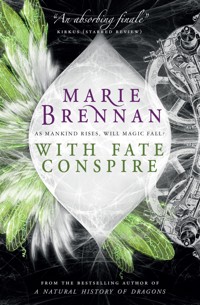
It is 1884, and Eliza searches for her childhood sweetheart, who vanished from the streets of Whitechapel. No one believed her when she said that he was stolen away by the fairies. Beneath London, the fae in the Onyx Court are under siege, the iron of the underground railway destroying their home of three centuries. Many flee to the countryside. Those who stay have one goal: to find safety in a city that does not welcome them. But what price will the mortals of London pay for that safety?
Sie lesen das E-Book in den Legimi-Apps auf:
Seitenzahl: 795
Veröffentlichungsjahr: 2017
Das E-Book (TTS) können Sie hören im Abo „Legimi Premium” in Legimi-Apps auf:
Ähnliche












Contents
Cover
Also by Marie Brennan
Title Page
Copyright
Map
Dramatis Personae
Epigraph
Prologue
Part One
Part Two
Part Three
Epilogue
Acknowledgments
About the Author
Also Available from Titan Books
Also by Marie Brennan and available from Titan Books
THE MEMOIRS OF LADY TRENT
A Natural History of Dragons
The Tropic of Serpents
Voyage of the Basilisk
In the Labyrinth of Drakes
Within the Sanctuary of Wings (April 2017)
ONYX COURT
Midnight Never Come
In Ashes Lie
A Star Shall Fall
With Fate ConspirePrint edition ISBN: 9781785650796E-book edition ISBN: 9781785650802
Published by Titan BooksA division of Titan Publishing Group Ltd144 Southwark Street, London SE1 0UP
First edition: January 20172 4 6 8 10 9 7 5 3 1
This is a work of fiction. Names, characters, places, and incidents either are the product of the author’s imagination or are used fictitiously, and any resemblance to actual persons, living or dead, business establishments, events, or locales is entirely coincidental. The publisher does not have any control over and does not assume any responsibility for author or third-party websites or their content.
Copyright © 2011, 2017 by Marie Brennan. All rights reserved.
Map by Rhys Davies.
No part of this publication may be reproduced, stored in a retrieval system, or transmitted, in any form or by any means without the prior written permission of the publisher, nor be otherwise circulated in any form of binding or cover other than that in which it is published and without a similar condition being imposed on the subsequent purchaser.
A CIP catalogue record for this title is available from the British Library.
DRAMATIS PERSONAE
Mortals
Those marked with an asterisk are attested in history.
Whitechapel Irish
Elizabeth O’Malley—a young woman
James O’Malley—her father, a prisoner in Newgate
Owen Darragh—a boy, missing seven years
Maggie Darragh—his sister
Mrs. Darragh—his mother, an invalid
Fergus Boyle—a troublemaker
Father Tooley—a priest
Dónall Whelan—a fairy doctor
No. 35 Cromwell Road
Louisa Kittering—a rebellious young woman
Mrs. Kittering—her mother
Mrs. Fowler—housekeeper to the Kitterings
Ned Sayers—footman to the Kitterings
Ann Wick
}
Sarah
}
maids to the Kitterings
Mary Banning
}
Society for Psychical Research
*Frederic William Henry Myers—a spiritualist investigator
*Henry Sidgwick—his friend, likewise an investigator
*Eleanor Sidgwick—wife of Henry, likewise an investigator
*Annie Marshall—wife of Myers’s cousin, now deceased
Iris Wexford—a medium
Scotland Yard
*Adolphus Williamson—Chief Inspector of the Special Irish Branch
*Patrick Quinn—Police Sergeant of the Special Irish Branch
*Augusta Ada King—mathematician and Countess of Lovelace, now deceased
*Charles Babbage—an inventor, now deceased
*Eliza Carter—a girl from West Ham
Mrs. Chase—a widow from Islington
Eveleen Myers—wife of Frederic Myers, and a photographer
Delphia St. Clair—wife of Galen St. Clair, now deceased
Francis Merriman—a mortal seer and founder of the Onyx Hall, now deceased
Princes of the Stone, in chronological order
Sir Michael Deven
Sir Antony Ware
Dr. John Ellin
Lord Joseph Winslow
Sir Alan Fitzwarren
Dr. Hamilton Birch
Galen St. Clair
Matthew Abingdon
Colonel Robert Shaw
Geoffrey Franklin
Henry Brandon
Alexander Messina
Benjamin Hodge—the current Prince
Faeries
The Court of London
Lune—Queen of the Onyx Court
Sir Peregrin Thorne—Captain of the Onyx Guard
Sir Cerenel—Lieutenant of the Onyx Guard
Dame Segraine—a lady knight of the Onyx Guard
Dame Irrith—a sprite, and lady knight of the Vale of the White Horse
Amadea—Lady Chamberlain of the Onyx Court
Tom Toggin—a hob; valet to the Prince of the Stone
Bonecruncher—a follower of the Prince
Invidiana—a previous Queen, now deceased
The Goblin Market
Nadrett—a criminal boss
Dead Rick—his dog; a skriker
Cyma—a former lady, in debt to Nadrett
Gresh
}
Nithen
}
followers of Nadrett
Old Gadling
}
Chrennois—a French sprite, and follower of Nadrett
Valentin Aspell
}
Hardface
}
Goblin Market bosses
Lacca
}
Orlegg—a thrumpin in service to Valentin Aspell Greymalkin—likewise in service to Valentin Aspell
Po—a Chinese faerie, ally of Lacca, and keeper of an opium den
Hafdean—keeper of the Crow’s Head
Blacktooth Meg—hag of the River Fleet
Charcoal Eddie—a less-than-bright Puck
The Galenic Academy
Abd ar-Rashid—a genie of Istanbul, and Scholarch of the Academy
Wrain
}
Wilhas von das Ticken
}
Niklas von das Ticken
}
Academy Masters
Lady Feidelm
}
Ch’ien Mu
}
Yvoir—a French faerie, and scholar of photography
Kutuhal—a vanara from India
Fjothar—a svártalfar from Scandinavia
Rosamund Goodemeade—a helpful brownie
Gertrude Goodemeade—likewise a helpful brownie, and Rosamund’s sister
Eidhnin
}
Irish fae, of a nationalist bent
Scéineach
}
Suspiria—founder of the Onyx Hall, now deceased
Father Thames—spirit of the River Thames
Home is a name, a word, it is a strong one; stronger than magician ever spoke, or spirit ever answered to, in the strongest conjuration.
—Charles Dickens, Martin Chuzzlewit
PROLOGUE
THE ONYX HALL, LONDON
29 January 1707
The lights hovered in midair, like a cloud of unearthly fireflies. The corners of the room lay in shadow; all illumination had drawn inward, to this spot before the empty hearth, and the woman who stood there in silence.
Her right hand moved with absent surety, coaxing the lights into position. The left hung stiff at her side, a rigid claw insufficiently masked by its glove. Without compass or ruler, guided only by bone-deep instinct, she formed the lights into a map. Here, the Tower of London. To the west, the cathedral of St. Paul’s. The long line of the Thames below them, and the Walbrook running down from the north to meet it, passing the London Stone on its way; and around the whole, touching the river on both sides, the bent and uneven arc of the city wall.
For a moment it floated before her, brilliant and perfect.
Then her fingertip reached up to a northeastern point on the wall, and flicked a few of the lights away.
As if that had been a summons, the door opened. Only one person in all this place had the right to interrupt her unannounced, and so she stayed where she was, regarding the newly flawed map. Once the door was closed, she spoke, her voice carrying perfectly in the stillness of the room. “You were unable to stop them.”
“I’m sorry, Lune.” Joseph Winslow came forward, to the edge of the cool light. It gave his ordinary features a peculiar cast; what would have seemed like youth in the brightness of day—more youth than he should claim—turned into strange agelessness under such illumination. “It is too much in the way. An impediment to carts, riders, carriages, people on foot … it serves no purpose anymore. None that I can tell them, at least.”
The silver of her eyes reflected blue as she traced the line of the wall. The old Roman and medieval fortification, much patched and altered over the centuries, but still, in its essence, the boundary of old London.
And of her realm, lying hidden below.
She should have seen this coming. Once it became impossible to crowd more people within the confines of London, they began to spill outside the wall. Up the river to Westminster, in great houses along the bank and pestilential tenements behind. Down the river to the shipbuilding yards, where sailors drank away their pay among the warehouses of goods from foreign lands. Across the river in Southwark, and north of the wall in suburbs—but at the heart of it, always, the City of London. And as the years went by, the seven great gates became ever more clogged, until they could not admit the endless rivers of humanity that flowed in and out.
In the hushed tone of a man asking a doctor for what he fears will be bad news, Winslow said, “What will this do to the Onyx Hall?”
Lune closed her eyes. She did not need them to look at her domain, the faerie palace that stretched beneath the square mile enclosed by the walls. Those black stones might have been her own bones, for a faerie queen ruled by virtue of the bond with her realm. “I do not know,” she admitted. “Fifty years ago, when Parliament commanded General Monck to tear the gates from their hinges, I feared it might harm the Hall. Nothing came of it. Forty years ago, when the Great Fire burned the entrances to this place, and even St. Paul’s Cathedral, I feared we might not recover. Those have been rebuilt. But now …”
Now, the mortals of London proposed to tear down part of the wall—tear it down, and not replace it. With the gates disabled, the City could no longer protect itself in war; in reality, it had no need to do so. Which made the wall itself little more than a historical curiosity, and an obstruction to London’s growth.
Perhaps the Hall would yet stand, like a table with one of its legs broken away.
Perhaps it would not.
“I’m sorry,” Winslow said again, hating the inadequacy of the words. He was her mortal consort, the Prince of the Stone; it was his privilege and duty to oversee the points at which faerie and mortal London came together. Lune had asked him to prevent the destruction of the wall, and he had failed.
Lune’s posture was rarely less than perfect, but somehow she pulled herself even more upright, her shoulders going back to form a line he’d come to recognise. “It was an impossible task. And perhaps an unnecessary one; the Hall has survived difficulties before. But if some trouble comes of this, then we will surmount it, as we always have.”
She presented her arm to him, and he took it, guiding her with formal courtesy from the room. Back to their court, a world of faeries both kind and cruel, and the few mortals who knew of their presence beneath London.
Behind them, alone in the empty room, the lights drifted free once more, the map dissolving into meaningless chaos.
PART ONE
February–May 1884
I behold London; a Human awful wonder of God!
WILLIAM BLAKE,
JERUSALEM: THE EMANATION OF THE GIANT ALBION
Oh City! Oh latest Throne! where I was rais’dTo be a mystery of lovelinessUnto all eyes, the time is well nigh comeWhen I must render up this glorious homeTo keen Discovery: soon yon brilliant towersShall darken with the waving of her wand;Darken, and shrink and shiver into huts,Black specks amid a waste of dreary sand,Low-built, mud-walled, Barbarian settlement,How chang’d from this fair City!
ALFRED, LORD TENNYSON,
“TIMBUCTOO”
A great town is like a forest—that is not the whole of it that you see above ground.
MR. LOWE, MP,
ADDRESS AT THE OPENING OF THE METROPOLITAN RAILWAY, REPORTED IN THE TIMES, 10 JANUARY 1863
Given enough time, anything can become familiar enough to be ignored.
Even pain.
The searing nails driven through her flesh ache as they always have, but those aches are known, enumerated, incorporated into her world. If her body is stretched upon a rack, muscles and sinews torn and ragged from the strain, at least no one has stretched it further of late. This is familiar. She can disregard it.
But the unfamiliar, the unpredictable, disrupts that disregard. This new pain is irregular and intense, not the steady torment of before. It is a knife driven into her shoulder, a sudden agony stabbing through her again. And again. And again.
Creeping ever closer to her heart.
Each new thrust awakens all the other pains, every bleeding nerve she had learned to accept. Nothing can be ignored, then. All she can do is endure. And this she does because she has no choice; she has bound herself to this agony, with chains that cannot be broken by any force short of death.
Or, perhaps, salvation.
Like a patient cast down by disease, she waits, and in her lucid moments she prays for a cure. No physician exists who can treat this sickness, but perhaps—if she endures long enough—someone will teach himself that science, and save her from this terrible death by degrees.
So she hopes, and has hoped for longer than she can recall. But each thrust brings the knife that much closer to her heart.
One way or another, she will not have to endure much more.
The monster city seethed with life. Its streets, like arteries both great and small, pulsed with the flow of traffic: hackneys and private carriages, omnibuses bursting with riders inside and out, horse trams rattling past on their iron rails. People on foot, on horseback, on the improbable wheels of bicycles. On the river, ships: forests of masts and steam funnels, skiffs hauling cargo to and fro, ferries spilling passengers onto piers that thrust out from the stinking foreshore. Trains thundered in from the suburbs and back out again, the population rising and falling, as if the city breathed.
The air that filled its lungs was humanity, of countless different kinds. The high and the low, glittering with diamonds or the tears of despair, speaking dozens of languages in hundreds of accents, living cheek by jowl, above and below and beside one another, but occupying entirely different worlds. The city encompassed them all: living and dying, they formed part of the great organism, which daily threatened to strangle on its simultaneous growth and rot.
This was London, in all its filth and glory. Nostalgic for the past, while yearning to cast off the chains of bygone ages and step forward into the bright utopia of the future. Proud of its achievements, yet despising its own flaws. A monster in both size and nature, that would consume the unwary and spit them out again, in forms unrecognizable and undreamt.
London, the monster city.
THE CITY OF LONDON
26 February 1884
“Hot buns! A farthing apiece, warm you on a cold morning! Will you buy a bun, sir?”
The cry rose into the air and was lost among others, like one bird in a flock. A burst of steam from the open cut alongside Farringdon Road heralded the arrival of a subterranean train; a minute later, the station above disgorged a mass of men, joining those carried into the City by the power of their own feet. They shuffled along Snow Hill and up onto Holborn Viaduct, yawning and sleepy, their numbers sufficient to stop carriages and omnibuses when they flooded across the street crossings.
A costerwoman’s voice had to be strong, to make itself heard above the voices and footsteps and the church bells ringing seven o’clock. Filling her lungs, Eliza bellowed again, “Hot buns! Hot from the oven! Only a farthing apiece!”
One fellow paused, dug in his pocket, handed over a penny. The four buns Eliza gave in exchange had been hot when she collected her load an hour ago; only the close-packed mass of their fellows had preserved any heat since then. But these were the clerks, the ink-stained men who slaved away in the City’s halls of business for long hours and little pay; they wouldn’t quibble over the truth of her advertising. By the time their wealthier betters came in to work, three hours or so from now, she would have sold her stock and filled her barrow with something else.
If all went well. Good days were the ones where she traced the streets again and again, with new wares every round: laces for boots and stays, lucifers, even larks one time. Bad days saw her peddling cold, stale buns at sundown, with no comfort save the surety that at least she would have something to eat that night. And sometimes a doss-house keeper could be persuaded to take a few as payment, in exchange for a spot on his bench.
Today was beginning well; even a bun of only moderate warmth was a pleasant touch on a cold morning like this one. But chill weather made men sullen in the afternoon and evening, turning up their collars and shoving their hands into pockets, thinking only of the train or omnibus or long walk that would take them home. Eliza knew better than to assume her luck would hold.
By the time she reached Cheapside, following the crowds of men on their way to the countinghouses, the press in the streets was thinning; those still out were hurrying, for fear their pay would be docked for lateness. Eliza counted her coins, stuck an experimental finger among the remaining buns, and decided they were cold enough that she could spare one for herself. And Tom Granger was always willing to let her sit a while with him.
She retraced her steps to the corner of Ivy Lane, where Tom was halfheartedly waving copies of The Times at passersby. “You’ll never sell them with that lazy hand,” Eliza said, stopping her barrow alongside.
His grin was as crooked as his front teeeth. “Wait ’til tomorrow. Bill says we’ll ’ave exciting news then.”
“Oh?” Eliza offered him a bun, which he accepted. “Scandal, is it?”
“Better. There’s been another bombing.”
She had just taken a large bite; it caught in her throat, and for a moment she feared she would choke. Then it slid down, and she hoped that if Tom saw her distress, he’d chalk it up to that. “Where?”
Tom had already crammed half the bun in his own mouth. His answer was completely unintelligible; she had to wait while he chewed enough to swallow. “Victoria Station,” he said, once he could speak more clearly. “Right early this morning. Blew the booking office and all ’alfway to the moon. Nobody ’urt, though—pity. We sells more papers when there’s dead people.”
“Who did it?”
He shrugged, then turned away to sell a paper to a man in a carpenter’s flannel coat. That done, he said, “Harry thinks it was a gas pipe what blew, but I reckon it’s the Fenians again.” He spat onto the cobblestones. “Fucking micks. They sells papers, I’ll give ’em that, but ’em and their bleeding bombs, eh?”
“Them and their bleeding bombs,” Eliza echoed, staring at the remnants of her bun as if it needed her attention. She had lost all appetite, but forced herself to finish anyway. I missed it. While I slept tied to a bench, he was here, and I missed my chance.
Tom rattled on about the Irish, allowing as how they were devilish strong buggers and good at hard labour, but one paddy had come up the other day, bold as you please, and tried to get papers to sell. “Me and Bill ran ’im off right quick,” Tom said.
Eliza didn’t share his satisfaction in the slightest. While Tom spoke, her gaze raked the street, as if frantic effort now could make up for her failure. Too late, and you know it. What would you have done anyway, if you’d been here last night? Followed him again? Much good that did last time. But you missed your chance to do better. It took her by surprise when Tom left off his tirade and said, “Three months, it’s been, and I still don’t get you.”
She hoped her stare was not as obviously startled as it felt. “What do you mean?”
Tom gestured at her, seeming to indicate both the ragged clothing and the young woman who wore it. “You. Who you are, and what you’re doing ’ere.”
She was suddenly far colder than could be explained by the morning air. “Trying to sell buns. But I think I’m about done in for these; I should go for fried fish soon, or something else.”
“Which you’ll bring right back ’ere. Maybe you’ll go stand around the ’ospital, or the prison, but you’ll stick near Newgate as long as you can, so long as you’ve got a few pennies to buy supper and a place to sleep. Them fine gents like to talk about lazy folks as don’t care enough to earn a better wage—but you’re the only one I’ve ever met where it’s true.” Tom scratched his neck, studying her in a way that made her want to run. “You don’t drop your aitches, you ain’t from a proper coster family—I know they runs you off sometimes, when you steps on their territory—in short, you’s a mystery, and ever since you started coming ’ere I’ve been trying to work you out. What’s around Newgate for you, Elizabeth Marsh, that you’ll spend three months waiting for it to show up?”
Her fingers felt like ice. Eliza fumbled with the ends of her shawl, then stopped, because it only drew attention to how her hands were shaking. What was there to fear? No crime in hanging about, not so long as she was engaged in honest work. Tom knew nothing. So far as he was aware, she was simply Elizabeth Marsh, and Elizabeth Marsh was nobody.
But she hadn’t thought up a lie for him, because she hadn’t expected him to ask. Before her mind could settle down enough to find a good one, his expression softened to sympathy. “Got someone in Newgate, ’ave you?”
He jerked his chin westward as he said it. Newgate in the specific sense, the prison that stood nearby. Which was close enough to a truth—if not the real truth—that Eliza seized upon it with relief. “My father.”
“Thought it might be an ’usband,” Tom said. “You wouldn’t be the first mot walking around without a ring. Waiting for ’im to get out, or ’oping ’e won’t?”
Eliza thought about the last time she’d seen her father. Four months ago, and the words between them weren’t pretty—they never were—but she’d clean forgotten about that after she walked out of the prison and saw that familiar, hated face.
She shrugged uncomfortably, hoping Tom would let the issue drop. The more questions she answered, the more likely it was that he’d catch a whiff of something odd. Better to leave it at a nameless father with an unnamed crime. Tom didn’t press, but he did pick up one of his newspapers and begin searching through a back page. “’Ere, take a look at this.”
The piece above his ragged fingernail was brief, just two short paragraphs under the header MR. CALHOUN’S NEW FACTORY. “Factory work ain’t bad,” Tom said. “Better than service, anyway—no missus always on you, and some factories pay more—and it would get you out of ’ere. Waiting around won’t do you no good, Lizzie, and you keeps this up, sooner or later your luck’ll go bad. Work-house bad.”
“Ah, you’re just trying to get rid of me,” Eliza said. It came out higher than usual, because of the tightness in her throat. Tom was just useful; his corner was the best one to watch from. She never intended more than that—never friendship—and his kindness made her feel all the more guilty about her lies.
But he was right, as far as it went. She’d been in service before, to an Italian family that sold secondhand clothes in Spitalfields. Being a maid-of-all-work, regardless of the family, was little better than being a slave. Lots of girls said factory work was preferable, if you could get it. But abandoning Newgate …
She couldn’t. Her disobedient eyes drifted back to the advertisement anyway. And then she saw what lay below, that Tom’s hand had covered before.
LONDON FAIRY SOCIETY—A new association has formed in Islington, for the understanding of Britain’s fast-vanishing fairy inhabitants. Meetings the second Friday of every month at 9 White Lion St., 7 P.M.
Eliza only barely kept from snatching the paper out of Tom’s hands, to stare at the words and see if they vanished. “May I?” she asked.
She meant only to read it again, but Tom handed her the paper and flapped his hands in its wake. “Keep it.”
The cold had gone; Eliza felt warm from head to toe. She could not look away from the words. Coincidence—or providence? It might be nothing: folk with money babbling on about little “flower fairies,” rather than faeries, the kind Eliza knew all too well. This new society might not know anything that could help her.
But her alternative was waiting around here, with the fading hope that it would do her any good. Just because there’d been another bombing didn’t mean any of the people involved had been here; it could have been pure chance last October, spotting him in Newgate. She’d spent nearly every day here since then, and not caught so much as another glimpse. They were tricksy creatures, faeries were, and not easily caught. But perhaps this London Fairy Society could help her.
“Thank you,” Eliza told Tom, folding the newspaper and stuffing it into the sagging pocket of her shawl.
He shrugged, looking away in embarrassment. “Ah, it’s nothing. You feeds me buns enough; I owes you a newspaper’s worth, at least.”
She wasn’t thanking him for the paper, but saying so would only make him more awkward. “I’d best be moving,” Eliza said. “These buns won’t sell themselves. But I’ll think about the factory, Tom; I will.” She meant it, too. It would be glorious to go back to something like normal life. No more of this hand-to-mouth existence, gambling everything on the hope of a second stroke of luck. After these three months, she’d even go back into service with the DiGiuseppes, just to know each night that she’d have a roof over her head.
If a normal life was even possible anymore, after everything she’d been through. But that was a question for the future. First, she had to catch herself a faerie.
Tom wished her well, and she gripped the handles of her barrow again, wheeling it down Newgate toward a fellow in Holborn who would sell her fried fish, if she could dispose of the rest of her current load. Her eyes did their habitual dance over the crowds as she cried her wares, but saw nothing unusual.
Second Friday. That’ll be the fourteenth, then. A bit more than a fortnight away. She’d keep on here until then, on the off chance that her luck would turn even better. But Islington, she hoped, held the answers.
THE GOBLIN MARKET, ONYX HALL
2 March 1884
With a clicking of toenails upon cracked black stone, the dog trotted into the room of cages. A half dozen lined the narrow chamber, three on a side, mostly full with sleeping humans. In the nearest, a young girl lay alone on a floor of filthy straw, curled in upon herself. The dog drew nearer, sniffing. His nose brushed her hair, close by the cage’s wooden bars, and she jerked awake with a cry of fear.
The dog sat down on his haunches and studied her, tongue lolling just a little. It was as close to an appealing look as a scruffy thing like him could come; his black fur was untidy and matted, and a chunk had been torn from his left ear. But when he made no threatening move—merely sat and watched—the girl moved hesitantly from the corner where she’d retreated. Holding one hand out, she inched closer, until her hand was near enough to the bars for the dog to extend his nose and sniff politely. He even licked her dirty fingers, a brief, warm caress.
At that touch of kindness, the girl burst into tears.
“Oi there!”
The dog rose in a swift turn. A squat, ugly figure stood in the doorway, scratching the wiry hairs of his beard. “Get off it,” the goblin said, scowling at him. “’E wants to see you, and not on four feet.”
In the cage, the girl had retreated once more. The dog cast a brief glance over his shoulder at her, then sighed, a peculiarly human sound. Bending his head, he concentrated, and his body began to shift.
He heard a faint whimper from behind him as the transformation finished. However little reassurance his dog form had offered, as a man he was worse; Dead Rick knew that all too well. Ragged trousers stopped short of his bare feet, whose toenails curved thick and filthy to the floor. On his body he wore only a torn waistcoat, scavenged off a dead mortal; he hated the confining feel of sleeves on his arms. His hair was as dirty and matted as it had been when it was fur, and as for his face … he didn’t turn around. He might not be a barguest, with a devil’s flaming eyes, but he’d seen himself in a mirror; the hard slash of his mouth wouldn’t reassure anyone.
He could have changed elsewhere, out of sight of the girl. But she was better off learning this now, that even the friendliest creature down here couldn’t be trusted.
Gresh’s toothy smile would never be mistaken for friendly. “She’s a fine bit, ain’t she?” he asked as Dead Rick came toward him. “Bit old to be stealing out of a cradle, but ’er mother kept ’er there anyway, as they didn’t ’ave nowhere else to put ’er. Living sixteen to a room they was; now it’s just fifteen, and she gets this whole cage to ’erself. Better for everyone!”
Dead Rick doubted the girl would agree, or her mother. Then again, what did he know? Perhaps her mother was a gin-soaked whore, and would be glad enough for one less mouth to feed. The girl might be bought by some kind faerie, who wanted a human child to play with like a doll.
Or angels might fly out of your arse, whelp. But she wouldn’t age here, and disease would never touch her, which was more than anyone could say for life in the streets above.
“Come on,” he said, pushing by Gresh. “You said ’e wants to see me.”
“You don’t need me to guide you,” the goblin said.
Dead Rick paused in the corridor and glanced back. Gresh was standing in the doorway still, shoulders hunched with eagerness. “Don’t,” Dead Rick warned him. “You spoil ’er, and it’ll be your ’ide.”
The goblin glared back. “I don’t need no dog telling me what to do.”
He said dog like it was an insult—like Dead Rick should be ashamed of being a skriker. A habit he picked up from their mutual master. But there were advantages to being a dog; Dead Rick growled low in his throat, holding Gresh’s eyes, and sure enough the goblin backed down first. With grumbling complaints, but he came with Dead Rick, and left the girl to what peace she could find.
Laughter echoed off the stone around them as they went along, its source impossible to determine. The warren of the Goblin Market was packed full, fae and the human creatures they kept for entertainment or use; they crowded almost as close as the East End poor that that girl came from. For every faerie that flitted, going in search of a passage beyond the mortal world, another came here to London. To the Onyx Hall, twisted reflection of the City above, the palace that had once been the glory of faerie England—and now was their crumbling refuge against the progress of humankind.
Traces of that glory were still visible, in the sculpted columns and corner posts, the arches spanning high-ceilinged chambers, the occasional mosaic laid into the black stone of a wall. It had all seen hard use these centuries past, though. Much was cracked, or stained, or half-hidden behind the clutter of the refugees. Curtains strung on cord divided larger rooms into smaller, giving the illusion of privacy; fae defended treasured belongings or mortal pets against the greedy hands of their neighbours. But anything could be sold, if the price was good enough: a human child bargained for mortal bread, an enchanted mirror traded for drugs that could make even a faerie forget his troubles.
Gresh was right; Dead Rick didn’t need the goblin to tell him where to go. He knew his way through the warren blindfolded. The room he headed for had a broken floor, scuffed stone giving way to bare earth, into which someone had dug a pit; down at the bottom, a red-eared faerie hound, his muzzle stained with blood, seized a rat and shook the rodent until its back broke. The observers—mostly fae, a few mortals—roared him on. Dead Rick shoved through the crowd, making his way toward the short staircase that curved at the far end. By the time he reached it, Gresh had disappeared, into the wagering mass.
The staircase still showed a touch of refinement, though the balustrade’s carving had taken some beating over the ages. The room it led to showed a bit more than a touch, largely because the rat-fighting rabble weren’t allowed in. If its chairs were mismatched, some were at least carved of exotic wood, and the carpet on the floor was still vibrant with colour. Silks draped along the walls helped cover the cracks behind, the signs of inevitable decay.
And there were only two people inside, one faerie and one mortal. The latter was dressed in a ridiculous parody of a footman’s livery, styles that would have been old-fashioned fifty years before, but that hardly mattered; the more important thing was that he was there, uselessly, feeding the self-importance of his master.
Who scowled at Dead Rick. Nadrett waited for the door to close, then said, “I expects you ’ere when I needs you. Not to ’ave to send my goblins searching for you all over the warren.”
He made an elegant figure, by Goblin Market standards. Not clad in patches and rags, nor parading around in a gaudy assortment of gypsy silks; his waistcoat might be red as children’s blood, but it was restrained in its tailoring. One had to look closely to notice the buttons of bone, the cuff links of knotted hair. He wore no coat, but did affect a gentleman’s silk top hat, adorned with a large pin of crystalline starlight.
None of which hid the fact that Nadrett had clawed his way to the top of the Goblin Market heap by a combination of cunning and brutality. Dead Rick was forced to lower his gaze. “Sorry. I was looking in on the cages—”
“You better not ’ave been touching my property.”
Dead Rick was no good at lying. His hesitation told enough, and Nadrett spat a curse. “That one ain’t ’ere to tithe bread. Got a buyer, wants a girl as stinks of mortality. You go licking ’er, she starts to smell of faerie instead, and then I don’t get as good a price.”
He should keep his mouth shut, but the words came out anyway. “I ain’t ’ere to help your coves in their perversions.”
Quick as a striking snake, Nadrett was there, inches from his face. “Yes, you are,” the faerie spat. “Because you serve me. Those perversions are where I makes my profit, see, and if I don’t profit, then I takes the difference out of your mangy hide. So it’s in your best interests to make sure my customers ain’t unhappy.”
Dead Rick opened his mouth to answer—stupid whelp; you never learn—and Nadrett’s hand closed on his throat. He might weigh a stone less than the skriker, but his grip was iron. “Cross me,” Nadrett whispered, “and I will destroy you. Everything you used to be. You’ll be like this forever, broken, crawling, serving whatever master whips you worst.”
Shame and fear twisted in his gut, like a worm, eating away at his pride. He felt a whine build, trapped under Nadrett’s hand, and rolled his eyes in desperation. When Nadrett let go, Dead Rick turned his head to the side, casting his gaze down. “I won’t cross you.”
His master laughed. “’Course not. You’ll do exactly what I says. And you’re in luck: I’ve got use for you today. Follow me.”
Hating himself for it, Dead Rick obeyed.
Their path was a long one, weaving through the shabby clamour of the Goblin Market. The constant, encroaching decay made it almost impossible to go anywhere directly; too many chambers and connecting passages had vanished. Whole sections were almost completely cut off, their only access being through patches too unsafe to traverse. A faerie who set foot there was liable to come out somewhere else entirely—or not come out at all.
London’s foundation is rotting out from underneath it, Dead Rick thought. People still told tales of the glories of the Onyx Hall, but that was all that remained: tales, and these decaying fragments. And the Goblin Market’s the most rotten of all.
The place Nadrett led him wasn’t quite Market territory, and wasn’t quite not. The night garden didn’t belong to anyone, except the refugees who slept on blankets beneath the overgrown trees. It lay in what had once been the heart of the Onyx Hall, and in past ages had been the favoured haunt of courtiers. But now the Walbrook ran foul through its heart, and the flowers grew among choking weeds.
A trio of goblins lounged on a chipped bench, and rose when Nadrett came through the entrance arch. Scots, and not familiar to Dead Rick; he would have wagered human bread, if he’d had any, that they were newcomers. Temporary residents of the night garden, who’d sold their services to the Goblin Market—to Nadrett—in exchange for a leg up. “We’ve cleared it,” the leader said. “Got two fellows watching each of the other doors.”
Nadrett clapped him on the shoulder and turned to Dead Rick. “You knows your job. Get to it.”
He stared past his master, into the abandoned wilderness of the garden. “Who is it?”
“What does that matter? Some mortal. She’s none of your concern.”
Female, then. But not the little girl in the cage. Dead Rick swallowed, tasting bile. Not the little girl; just some other human who likely never did anything to bring this fate on herself.
The mere drawing of Nadrett’s breath was enough to prompt him. Grinding his teeth, Dead Rick shifted back to dog form, and ran out into the night garden.
A welter of smells filled his nose. The refugees might be gone for the moment, but their scents remained: hobs and goblins and pucks, courtly elves and nature-loving sprites, some so new they carried echoes of their homes with them. Cool soil, and the thick mat of vegetation that grew over it; once the garden had been planted with aromatic, night-blooming flowers—evening primrose, jasmine—and some of the hardier ones still survived. Up ahead lay the stinking Walbrook. The crumbling enchantments had mixed the buried river’s reflection with its polluted reality, poisoning the earth around it.
Dead Rick paused near one of the stream’s surviving footbridges, thinking he saw movement ahead. It proved to be just a faerie light, drifting aimlessly through the air. Most of them had abandoned the ceiling, where people said they used to form shifting constellations, but in the distance Dead Rick thought he saw a more solid glow.
He padded toward it, keeping to the underbrush. Yes, there was light ahead, behind that cluster of sickly apple trees. He sank to his belly and crawled forward one paw at a time until he could see.
The mortal was scarcely more than a girl, fifteen years old at most. She sat with her back to a stone plinth, knees pulled tight to her chest. Dead Rick wondered if she knew she was sitting on a grave. Her dress was reasonably fine; she ought to be able to read—but vines had grown over the inscription, making it easy to miss if she didn’t look for it. And her attention was elsewhere, scouring the surrounding area for signs of a threat.
Signs of him.
Faerie lights floated about the small clearing, as if trying to comfort her. They had just enough awareness to respond to others’ wishes; her fear might have drawn them. Or had she called them to her? Don’t ask questions, Dead Rick growled to himself. Don’t think of ’er as a person—just do your job.
The growl escaped his muzzle, without him intending it. The mortal gasped, rising to a wary crouch.
She shouldn’t ’ave been sitting in the light. She’ll be ’alf-blind once she runs.
So much the better for him.
Dead Rick growled again, this time with purpose. There was a gap in the hawthorn bushes; he snaked through it, making no sound, and snarled more sharply. Then circled further: another growl. To a frightened mind, it would sound like she was surrounded.
In every direction except one: the overgrown path that led away from the grave. And sure enough, she bolted.
He was running almost before she moved. She was human, and wearing a dress; he was a dog, and knew his way about the garden. A fallen tree had blocked the left-hand path years ago, so that even if she went that way—and he heard her try—in the end, she had to go right. And Dead Rick was there, waiting to harry her onward.
Nadrett had sent him to do this so often that it was almost routine. But the girl surprised him; she plunged through an overgrown holly bush, hissing as it raked her, to take a less obvious path. Dead Rick cursed inwardly. Two fellows watching each of the other doors—but were they watching all of them? Or only the ones that led anywhere anymore? The arch ahead opened on a corridor that went about fifty feet before fading into a bad patch of the Onyx Hall.
It had been fifty feet the last time he looked. It might be less now.
Dead Rick put on a burst of speed. A dry fountain near the wall gave him an advantage; he leapt up the enormous grotesque at the center, toenails scrabbling on the twisted stone, and launched himself through the air toward the arch. He landed with an almighty crash, but that served him well enough: he heard the girl stumble and fall, then claw to her feet and run in the other direction, away from whatever huge monster was lurking by the arch.
Huge, no. Monster, yes. That’s what I’ve become.
Dead Rick shook himself, as if his gloom could be shaken off like water. If he failed at this, Nadrett would see to it he was more than just gloomy.
He trotted rapidly along the girl’s trail, following her scent. His pause had given her time to get ahead, and in the absence of his snarls she’d gone quiet. The trail led him over the footbridge; he caught a whiff on the railing, as if she’d paused there, eyeing the filthy water. But for a girl in skirts, who likely couldn’t swim, it would just be unpleasant suicide; in the end she’d gone on.
Across an expanse of shaggy grass, almost as tall as he was. Dead Rick leapt over a fallen urn, hoping to cut her off. The gamble worked: she was coming down the path toward him. Renewed snarling sent her the other way, and now he knew how this would end. Normally he trapped them against the wall, but with a bit of herding …
She was nearing the end of her strength. Dead Rick quickened his own pace, baying like a wolf, and burst into the open almost at her heels. The girl flung herself across the torn ground, up the steps of a ruined pavilion, and fell sprawling across the boards of its floor. Dead Rick leapt—
Her scream tore through the air, and then stopped.
Dead Rick’s paws slammed down on her chest, and his jaws snapped shut just shy of her nose. The girl was rigid with terror beneath him, and her mouth gaped open, heaving again and again as if she were screaming still, but no sound came out.
For a moment, the desire was there. To sink his teeth into that vulnerable throat, to tear the flesh and lap up the hot blood as it fountained out. Death was part of a skriker’s nature. It would be easy, so long as he didn’t see her as a person—just meat and fear and a voice to be stolen.
But that was Nadrett’s way, and the Goblin Market’s. Clenching his muzzle until it hurt, Dead Rick backed off, slowly, stepping with care so his rough toenails wouldn’t scratch the girl through her dress.
Nadrett was leaning against one of the pavilion’s posts, tossing a small jar from hand to hand. “That’s a good one,” he said with a satisfied leer. “Prime stuff. That’ll fetch a good price, it will. Maybe I’ll even let you ’ave a bit of the profit, eh?”
If he had any pride left, Dead Rick would refuse it. Since he didn’t, he jumped down to the grass, passing Nadrett without so much as a snarl.
His master laughed as he went. “Good dog.”
Coming from Nadrett’s mouth, the word made Dead Rick ashamed.
WHITECHAPEL, LONDON
4 March 1884
The shift was vivid, as the street’s name changed from Fenchurch to Aldgate High Street to Whitechapel Road. In less than a mile, Eliza passed from one London to another, from the grand counting houses and respectable shops of the City to the plain brick buildings and narrow back courts that, until a few months ago, she had called home.
She’d argued with herself all yesterday about coming back. A run of good days had given her money for last night’s doss and tonight’s, with enough left over to buy new wares to sell, but a day spent not working was one day closer to starvation. Selling as she went would have gotten her run off by the costers who worked this area, though, and besides, she didn’t want anything linking her to the woman who sold hot buns and other oddments around the City. So her barrow was in the keeping of a woman in St. Giles who could hopefully be trusted not to sell it the moment Eliza’s back was turned, and Eliza herself had taken a day’s holiday. A risk, yes—but no more so than returning to Whitechapel in the first place.
“You’ve got a nerve on you, Eliza O’Malley, showing your face openly around here.”
The call came from the doorway of a rag-and-bone shop at the corner of George Yard. Eliza had gone on three more steps before she realised she could stop: it was no longer necessary, or useful, to pretend she was Elizabeth Marsh, good English costerwoman. Those who would give her trouble here already knew who she was.
So she stopped, turning, and saw Fergus Boyle leaning in the doorway, arms crossed over his chest and one foot on the box he’d apparently been carrying. He grinned when she faced him. “Gave you a fright, did I?”
Her skin was still tingling from the sudden jolt of hearing her name, after months of playacting as someone else. The accustomed accents, though, rose to her lips with no difficulty at all. “Get you gone, Fergus Boyle; haven’t you anything better to do with yourself than bedevil me?”
“With you vanishing the way you did? I don’t.” With his foot he shoved the box to the wall, out of harm’s way. Eliza stood her ground as he came closer. “You should hear the stories. Some think you’ve been slung in gaol, like your aul da. The ones who think you’re cautious say you went to America, never mind how you’d pay for the journey. I put my money on you hiding with the Fenians. Did you and your friends have anything to do with that dynamite at Victoria Station the other day?”
“I’m no Fenian,” Eliza said, casting a wary glance across the people on the street. The bobbies hardly cared enough to keep order in Whitechapel, but since last year the new Special Irish Branch kept a lively ear out for any whisper of sedition.
“Sure,” Boyle said, grinning in a way she didn’t like. “You had nothing to do with Charing Cross last fall. You just happened to see the bomb in time to throw it out the back of the train. Pure chance, that was.”
Not chance at all—but what could she tell him? That the Charing Cross and Praed Street bombings hadn’t been Fenian jobs, not completely? That they’d had help from faeries? Boyle was descended from good County Roscommon stock, the son of a farmer’s daughter and a fellow from the next farm over; they’d brought their stories with them when they came to London during the Great Hunger. He believed in fairies, right enough. But they were creatures you left milk for on the back step, to keep them from witching your cows or tangling your children’s hair in the night. Not city-dwelling goblins who bombed railways.
As for telling him why she’d followed a faerie onto the Underground … she’d tried that before, near on seven years ago. Not Fergus Boyle, but other people. And none of them had listened.
“I can’t stay long,” she said, knowing he’d take her changing the subject as proof that he was right. “What is it you want? Just to tell me I’ve got a nerve on me?”
“Not staying long, is it? And what have you to hurry back to?” Boyle stepped even closer, so that he loomed over her. “Or is it that you’re afraid the Special Branch boyos will catch you?”
Eliza shoved him, hard, at the point on his shoulder that would spin him back a step. “Sure I have better things to do with my time than spend it talking with the likes of yourself.”
Fergus’s mocking grin faded a hair. “Ach, you’re not going to trouble Mrs. Darragh, are you?”
“I’m not.”
She’d always been a good liar, but Boyle still looked at her suspiciously. “Good. Maggie’s been glad to see the back of you—says her aul ma got upset when you were around.”
Now it was Eliza’s turn to look suspicious. “When did you and Maggie Darragh get on such close terms, that you’d be knowing what she’s thinking?”
He grinned more broadly, and Eliza sighed. She knew perfectly well that Maggie didn’t want her around, and was prepared for that; if she had to dodge Fergus Boyle, though, then this would be even more difficult. But she refused to abandon Mrs. Darragh—not when she was the only hope the woman had left.
Best to distract him with a believable lie. “Unlike some people,” Eliza told him, “I have a care for my soul. I’m off to confession—that’s a thing we do in church, that is, as I’m sure you’ve never heard of it.” And lying about that is the least of the things I’m going to Hell for.
Boyle looked dubious. Fortunately, Eliza saw a stick-thin girl crouching over the crate behind him. “You might want to be watching that, you might,” Eliza said mildly, with a nod of her head; then she slipped away while Boyle was busy clouting the girl over the ear.
Her heart beat too fast as she hurried down Whitechapel Road, weaving through the carts and the filthy fog. Four months and more since she’d been here, and it wasn’t long enough. Boyle was right: What if some fellow from the Special Irish Branch remembered her face? She hadn’t been stupid enough to tell them she was the one who threw the bomb from the Charing Cross train; they’d never believe she did it to save the people in the third-class carriage. More than seventy people were hurt that same night, when the other bomb exploded on a train leaving Praed Street. But Eliza was Irish; just being there was almost enough to hang her, and touching the bomb would be more than enough.
That was why she’d done her best to vanish, hiding behind the gift for mimicry and playacting that had always amused Owen so much. With the bloody Irish Republican Brotherhood and their friends in America constantly making trouble, it wasn’t safe to be Irish in London right now. And even less safe to be Eliza O’Malley.
Boyle was right: the cautious thing to do would be to scrape together enough money, somehow, to go elsewhere. America, or Ireland, or at least another city. Liverpool, perhaps. But even if she could give up her search, Eliza was London-born; she’d never known another home. God help her, she even missed the dirty, cramped slums of Whitechapel, so much more familiar than the stuffy businesses of the City.
Not that she had any romantic illusions about the area. It was a sink of vice and crime, filled with the cast-off poor of every race, with tails doing customers in back alleys for tuppence a fuck and gangs taking by threat or violence what little money other folk had managed to earn. But as she passed the narrow alleys and courts Eliza heard familiar accents, and sometimes even the Irish language itself, in raucous and friendly exchange. She pulled her shawl closer about her face and hurried onward, head down, to avoid being seen by anyone else she knew—or seeing them herself. That would just make it all the harder to leave again.
Mrs. Darragh and her daughter lived in a single room in a court off Old Montague Street, with a piece of canvas tacked over the window where the glass had been broken out. At least, they had when Eliza was last here; what if they’d moved on? Boyle wouldn’t have told her. If he and Maggie had some kind of understanding, he might have even helped them into better lodgings.
She knocked at the door, leaning close to listen. No footsteps sounded in response, which at least told her Maggie wasn’t there. She knocked again. “Mrs. Darragh? ’Tis Eliza O’Malley.”
No answer, but the door was unlatched when she tried the handle. “I’m coming in,” Eliza said, and opened it enough to peer through.
With fog and the grimy canvas window, the interior was gloomy as a tomb. Slowly Eliza’s eyes adjusted, and then she made out the figure sitting in the room’s one chair, near the smoldering hearth on the far wall. Right where I left her, four months ago. “Mrs. Darragh, ’tis Eliza,” she repeated, and came in.
The woman stared dully at the floor, hands loose in her lap as if she could not be troubled to do anything with them. The dim light was kind to her face, smoothing away some of the lines that had carved themselves there, but her hopeless expression made Eliza’s heart ache. The loss of Owen had broken his mother, and she’d never mended since.
Eliza left the door open a crack, for the light, and came to crouch at Mrs. Darragh’s feet. All the chatter she’d planned faded in the woman’s presence: it just wasn’t possible to say Oh, how well you look today, or anything else so false and cheerful. What good would it do? Nothing would raise her spirits, save one.
“Mrs. Darragh,” she murmured, taking the older woman’s slack hands in her own, “I’ve come to tell you good news, I have. I’ve almost caught him. The faerie.”
No reply. Eliza pressed her lips together, then went on. “I told you I saw him, last October? Followed him to Mansion House Station, and saw the others there, getting on the train to Charing Cross. He came from near Newgate, though, and that’s where I’ve been—waiting there, hoping to see him again, or another one. But I’m after finding something better. There’s a society in Islington; I’ll be going there in a few days to see if they know anything. Once I catch a faerie—any faerie—I’ll make it talk. I’ll make it tell me how to find Owen. And then I’ll go after the bastards who took him, and I’ll make them give him up, and I’ll bring your son back to you.”
The hands trembled in her grasp. Mrs. Darragh’s lower lip quivered, too, and she had the despairing expression of a woman who could not even summon the energy to cry.
“I will,” Eliza insisted, tightening her grip. Not too hard; the bones felt birdlike in her hands, as if they’d snap. “I haven’t abandoned him. Or you. I—”
The brightening of the room was her warning, and the cold air that swept in with it. “Haven’t abandoned her?” a sharp voice said from behind. “Odd way you have of showing it, Eliza O’Malley, vanishing without so much as a word.”
She didn’t rise from her crouch, or let go of Mrs. Darragh’s hands, but only turned her head. Maggie Darragh stood in the entrance, a heel of bread gripped in one fist, other palm flat against the door. Her battered bonnet shadowed her face, but Eliza didn’t need to see it to imagine her expression.
“You made it clear you didn’t want me around,” Eliza said.
Maggie made a disgusted sound and shoved the door away, so that it rebounded off the wall and swung a little back. “Not clear enough, I suppose, for here you are again, whispering your poison in her ears.”
The hands pulled free of Eliza’s, Mrs. Darragh tucking them in beneath her elbows, hugging her body. In the greater light, the pitiful ragged state of her dress was revealed. “Poison?” Eliza said. “It’s hope I bring, which is more than anyone else can be troubled to give her.”
Maggie’s laughter sounded like the cawing of a crow. “Hope, you call it, that makes Ma cry, and never an Owen to show for it. He’s dead, you stupid fool, dead or run off. Or are you still too much in love with him to admit it?”
Contempt weighted down the word love. They’d barely been grown, Eliza and Owen; just fourteen years of age. Too young for Father Tooley to marry them, though everybody knew that was where it would end. But it wasn’t love that made Eliza say, “He didn’t run off. I know who took him. And I’m going to bring him back.”
“You’ve had seven years,” Maggie said cruelly. “What are you waiting for?”
Eliza flinched. In a whisper, she said, “Not quite seven.” Not until October. Sometimes she felt like there was a clock ticking where her heart should be, marking off the hours and days and years. Running out of time. When the seven years were up, would Owen come back to them? Or would he be lost for good, beyond any hope of rescue?
Not the latter. She would never let it happen. She’d only let the years slip by because she had no clues, no lead to follow; it had been so easy to wonder if she imagined it all, as Maggie thought. But she didn’t wonder anymore. She knew they were real, and she had their scent. She would keep hunting until she caught one, and forced it to tell her what she wanted to know.
“Get out,” Maggie said, and Eliza could hear the angry tears in her voice. “We’ve troubles enough without you bringing more around. Leave Ma to mourn her son as she should.”
Eliza rose, wincing as her knees protested. “I don’t want to bring ye two any trouble, Maggie; you must believe me. Whatever Fergus has been saying about me, I’m no Fenian. I love Ireland as much as the next woman, and God knows it would be grand to get the English boot off our necks—but it isn’t my home; London is. I would never do anything to this city, not for a country I’ve never even seen, and not if it means blowing up innocent people, you may be sure. I didn’t leave Whitechapel because I was guilty. I did it because I thought I might be able to find Owen.”
Maggie stood silent for a moment, digging her fingers into the heel of bread. When she spoke again, her voice was softer, if not friendly. “Get out, Eliza. We can’t live in the past, and there’s no future worth speaking of. Stop dancing it in front of us, like it’ll do me or Ma any good. Just leave us be.”
And that hurt worse than any of it—the hopelessness, the defeated line of Maggie’s shoulders. They’d had such bright dreams, when Owen and Eliza were young, and now they’d been reduced to this ash. That, as much as Owen himself, was what the faeries had stolen from them.
Eliza fumbled blindly in her pocket, grabbed everything there. A little over a shilling in small coins: everything she’d saved, except what she needed to fill her barrow tomorrow, and her doss money for tonight. Those, she always kept in her shoe. She spilled it out onto the bedside table, next to the unlit stub of a candle. “God keep ye safe, Maggie, Mrs. Darragh,” Eliza said, and slipped out before pride could overcome need enough for her friend to protest.
RIVERSIDE, LONDON
10 March 1884




